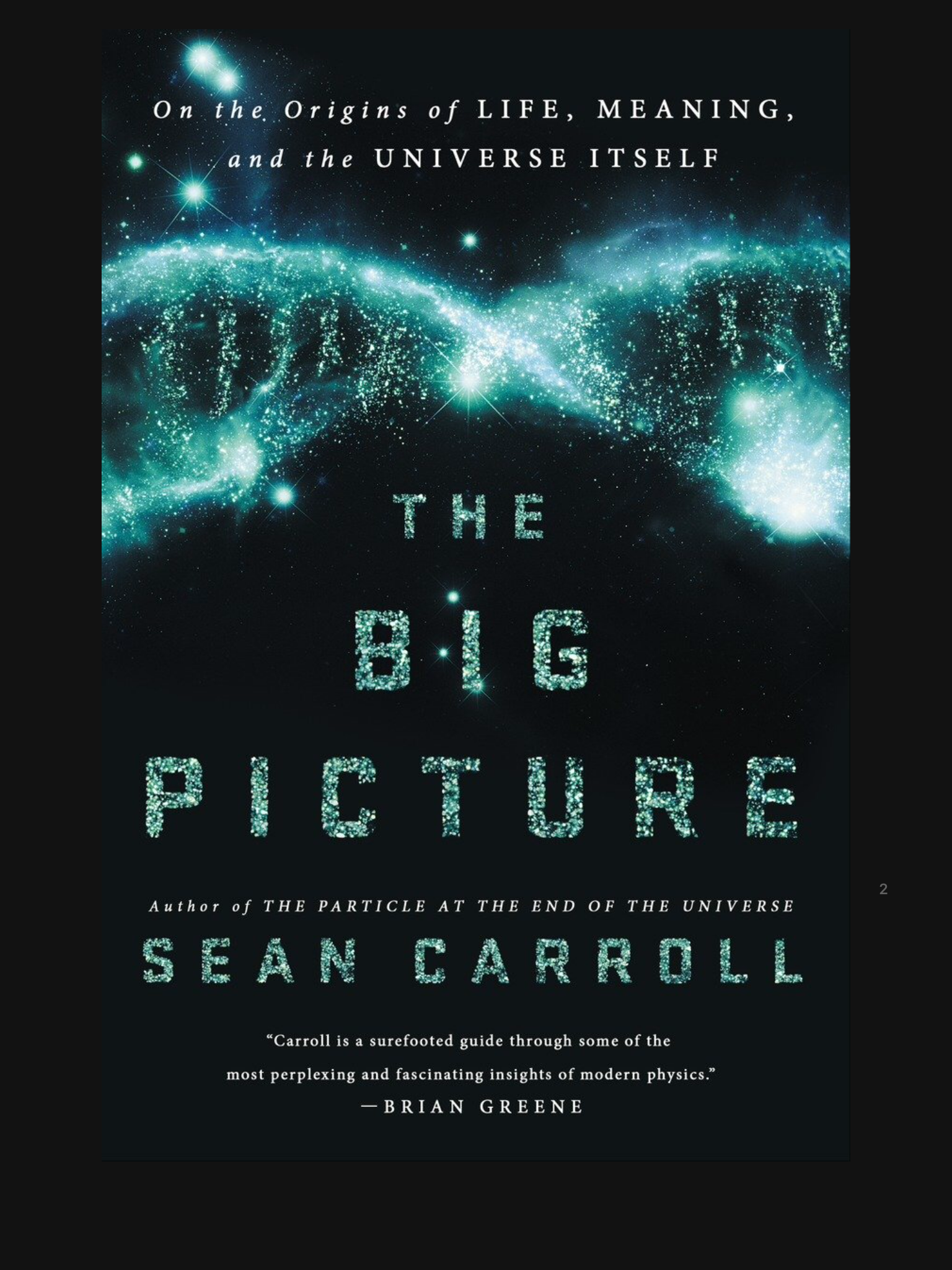
The physicist Sean Carroll’s new book was published today, and it’s right in my wheelhouse of fascination with the really big picture and the impulse to make sense of our place in it all.
Downloaded.
The physicist Sean Carroll’s new book was published today, and it’s right in my wheelhouse of fascination with the really big picture and the impulse to make sense of our place in it all.
Downloaded.
“Normality is a paved road: It’s comfortable to walk, but no flowers grow.” –Vincent Van Gogh
No one is truly normal. We often adopt an air of normalcy as a means of self preservation. At least that’s what we think.
But concealing our glorious oddness actually puts our true, weird self in jeopardy.
There is no one quite like you anywhere.
Don’t be deterred by the discomfort that comes with being the outlier you actually are.
Come to the weird side. That’s where the flowers grow.
Meditations 11.15:
“The despicable phoniness of people who say, “Listen, I’m going to level with you here.” What does that mean? It shouldn’t even need to be said. It should be obvious—written in block letters on your forehead. It should be audible in your voice, visible in your eyes, like a lover who looks into your face and takes in the whole story at a glance. A straightforward, honest person should be like someone who stinks: when you’re in the same room with him, you know it. But false straightforwardness is like a knife in the back. False friendship is the worst. Avoid it at all costs. If you’re honest and straightforward and mean well, it should show in your eyes. It should be unmistakable.”
This is the emperor of Rome talking. He doesn’t have time for superficial niceties and flat-out phoniness. And neither should we.
I can’t get over how direct and raw and real Marcus’s language is. This little book is such a treasure.
And to his point above, don’t you love people who shine with integrity and authenticity? It takes courage to not play the games that most people expect, to speak clearly and honestly and to do right no matter the consequences.
“You cannot protect yourself from sadness without protecting yourself from happiness.” –Jonathan Safran Foer
One defines the other. The duality is essential for either to exist.
Hot defines cold. Light needs dark.
Don’t resist what you find bubbling up in your emotions.
Let it be. Observe, acknowledge, be fascinated.
Everything is temporary. Change is the constant.

I’ve been an iPad guy since the first version was announced in 2010. I loved it immediately and used it mostly for reading, but also for writing.
It was just supplemental, though, to my iPhone and the two iMacs I had—one at the office and the other at home.
The home iMac is old now and sits unused. I use my iPad mini for most of my computer tasks away from the office. It’s a great device for reading, and it’s so good as my presentation device. I use the iOS Keynote app and a VGA adapter to connect the iPad to a projector, and I use my iPhone as the remote. It’s a lightweight, minimal, and rock solid presentation setup.
The iPad mini is also the device that I do a lot of writing on. But that’s where the mini falls short for me. The screen is just too small. I pair the iPad with an external Bluetooth keyboard, but the canvas I’m writing on seems too constricting. The screen is too small for me to write comfortably. Inserting a cursor in the right location and highlighting text can be frustrating. I find myself writing less away from my office iMac just because it’s not as enjoyable to write on the tiny iPad mini screen.
I was intrigued when Apple introduced the new, very lightweight Macbook last year. The form factor is gorgeous. The screen looks impressive, and I was eager to try the new keyboard design. But the computer seemed a bit underpowered. However, I imagined its second iteration might be my dream writing machine.
When Apple introduced the 12.9 inch iPad Pro last fall, it seemed almost comically large to me. “Who is going to want that?” I wondered.
Now, I want that.
I keep hearing about people who have replaced their laptop (or even their desktop) with this new iPad. Federico Vittici, Jason Snell, CGP Grey and Myke Hurley, Serenity Caldwell… All are iPad-Pro-as-laptop-replacement evangelists.
And now, even Steven Sinofsky, Microsoft’s former head of its Windows division, has written that the iPad Pro has become his primary computer.
I appreciate the simple elegance of iOS versus OS X. There’s less to fiddle and fuss with. There’s less distraction and a more focused environment. It’s a truly modern and mature operating system.
And now, with the most powerful computing power ever in an iOS device and a screen bigger than the entry level Mac laptops, the iPad Pro may be my ultimate computing device so far. It’s at the top of my wish list.
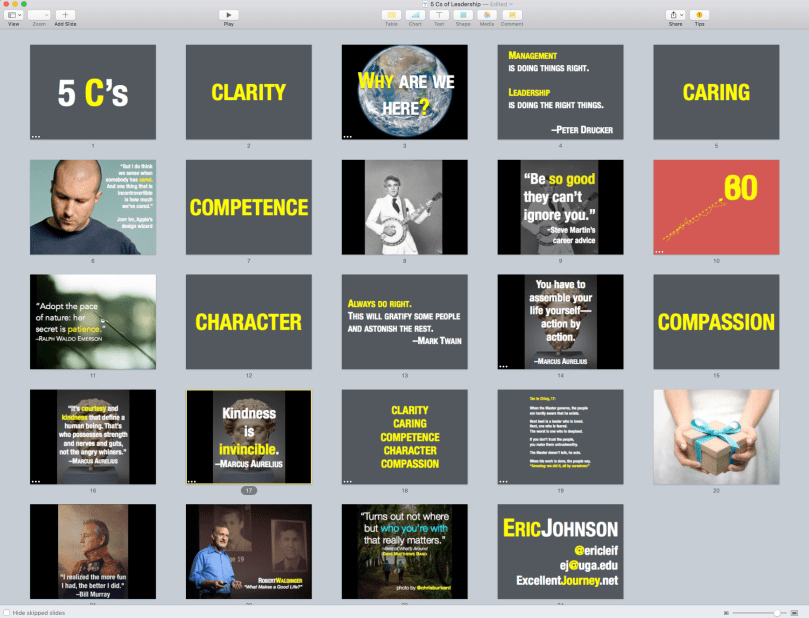
I was asked recently to guest lecture in a leadership class at my university.
My original plan was to do a very informal talk without slides. I was going to base it on my Five C’s of Leadership post.
The morning of the class, though, one of the students who works for me and is also in the class told me I should do slides because he wanted his classmates to see my approach to using visuals in a presentation.
So, I whipped up some slides pretty quickly.
Now, I’ve been asked by another student who was in that lecture to offer the same talk to an organization he’s in. I tweaked the slides today, and I’ll speak to his student leadership society tonight.
A good presentation is about the connection between the speaker and the audience. It’s not about the quality or content of the slides. If your slides can stand alone, then what was the point of showing up to speak? Just email your slide deck to the audience.
But I find real value in connecting strong images and key words on screen with the message I’m sharing. Visuals done right can make the ideas resonate and stick with an audience in a way that just hearing the talk can’t.
Plateaus happen. Regularly.
Years ago, in the midst of what was at that point an unremarkable career in stand-up comedy, Louis CK was frustrated with the creative rut he found himself in.
And then he learned the Carlin strategy, and everything changed.
It turns out that George Carlin would record a comedy special every year and then, the next day, throw out that material and start over from scratch.
Louis was stunned by that approach. He had worked long and hard to come up with the material for his show, and he had never imagined throwing it out and starting over.
But he was discontent with his work and the arc of his career, so he gave the Carlin strategy a try.
It was hard. Awful and hard at first.
But that void summoned better work eventually. And he kept doing it every year—scrapping his tried and true material and forcing himself to begin with a blank page once again.
And, in the process, Louis CK became Louis CK.
I do a version of the Carlin strategy with the presentations I give every year. I start over with new themes and slide designs and new ideas and stories.
It’s frustrating and a bit unsettling at first. I love the security of doing what I’m confident will work.
You have to sit with the awful for a while. Trick yourself if you have to by saying “I’m going to start by intentionally making this as awful as I can.”
Any action, even atrociously bad work, will at least propel you forward. You likely will surprise yourself, though, if you persist, and find that your awful starts getting better.
New ideas will appear that you would have never imagined if you had stuck to your old material.
Some of my best work came only after letting go of the good stuff I had been clinging to.
If you need a jolt in your creative life, consider the Carlin strategy. What if you started from scratch and created something completely new?
HT: Cal Newport — How Louis C.K. Became Funny and Why It Matters
Meditations 10.17-18:
“17. Continual awareness of all time and space, of the size and life span of the things around us. A grape seed in infinite space. A half twist of a corkscrew against eternity.
18. Bear in mind that everything that exists is already fraying at the edges, and in transition, subject to fragmentation and to rot.
Or that everything was born to die.”
“I wander about in unending perplexity.” –Socrates
Me, too.
I’ve spoken to several audiences of college students recently, and I’ve been telling them not to be distressed if they don’t have things figured out. No one has things figured out.
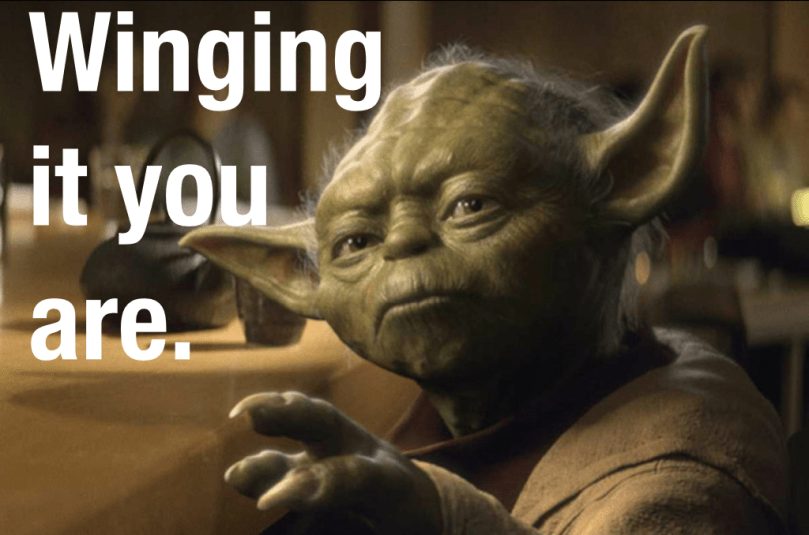
Everyone is totally winging it.
And the people who seem most certain that they have things figured out are the ones you should run away from as fast as you can.
This message is supposed to be comforting, but I’m afraid I’m just alarming some of these students who, as I’m sure I did when I was their age, are counting on more life experience bringing with it greater security and certainty.
The more you realize how much you don’t know, though, the more you know you’re headed in the right direction as a thinking human being.
I listened to an episode of The Art of Manliness podcast today and heard a psychiatrist discuss the way people frequently confuse wishes with goals.
Imagine having a goal for the weather to be spectacular tomorrow.
Ridiculous, right?
We have zero control over the weather. It just happens. You adjust to it; it doesn’t adjust to you.
So much of our thought and energy, though, goes into pointless worry and futile attempts to control what is uncontrollable.
The weather, rush hour traffic, circumstances and accidents and quirks of fate. You can only play the hand you’ve been dealt.
What other people think or do is beyond your control.
You can do nothing except choose your own actions.
The universe does not revolve around you. You’re not entitled to anything.
Put your focus on what is in your power to control, and let go of trying to grasp the wind and bend fate to your whims.
You can’t stop the rain. But you can wear a raincoat.
Meditations 10.11:
He “has dedicated himself to serving justice in all he does, and nature in all that happens. What people say or think about him, or how they treat him, isn’t something he worries about. Only these two questions: Is what he’s doing now the right thing to be doing? Does he accept and welcome what he’s been assigned?”
Marcus, keeping it simple. Only two concerns matter.
Do the right thing right now.
And embrace what fate has assigned to you. Work with what is. There’s no use in resisting whatever got you to where you are now.
But you can use anything—any obstacle or seemingly undesirable circumstance—to prompt you to do the right thing right now and propel yourself forward.

We are at peak Hamilton.
The broadway musical is all the rage. Tickets are impossible for the foreseeable future.
The cast just graced the White House for a mini performance.
And the show’s creator, Lin-Manuel Miranda, has a compelling story of his own along with charisma galore.
I’ve had the soundtrack on repeat on my Mac at work. It’s excellent music whether or not you’ve seen the show or even know the basics of the story.
I’ve been reading Ron Chernow’s biography of Hamilton, and it’s clear why Miranda found inspiration in the life of one of our (previously) more obscure founding fathers. Hamilton was an intense, charismatic personality with a knack for putting himself in the center of the most important events.
And he was a baller whose titanic work ethic and oversized ambition rocketed his talent to inevitable greatness.
Hamilton was a poor kid whose father abandoned him and whose mother died and left him in poverty on a hellish island in the Caribbean. Objectively, he should have been just another anonymous kid whose life was derailed by misfortunes beyond his control.
But Hamilton was too talented and too determined to be ignored. Largely self-taught, he was a prodigy with a quill and ink. The kid wrote his way off that island and into American history. (Go read the book or somehow see the show. It’s a killer story.)
What’s striking to me as I read about Hamilton is how his talent and effort and sheer audacity created the opportunities that made him and ended up helping to make our nation.
Whatever task he was given, he gave it his all. As a junior officer when the American revolution began, his competence and attention to discipline and detail in the midst of what was generally a ragtag band of half-hearted soldiers caught the eye of George Washington. His effort and resulting insights and instincts made him indispensable as General Washington’s young assistant.
Hamilton had a prodigious ability to just do work. As the architect of some of the nation’s primary government institutions and philosophies, he would write late into the night and get back at it early the next morning. He was young, but he was no overnight sensation. He worked hard and earned his seat at the table.
I regularly refer to the comedian Steve Martin’s admonition: “Be so good they can’t ignore you.” This worked for Steve Martin in stand-up comedy in the 1970s and for Alexander Hamilton in nation-building in the 1770s.
The surest way to success is focused, smart, persevering, old-fashioned effort.
You can’t control what others do or what opportunities are offered to you, but you can control what you do with what you’ve been given.
Pursue mastery. Settle in for the long haul of gradual, continuous improvement. Be awesome, and be ready to take your shot if it comes.
It’s easy simply to go through the motions and do your work without giving much thought to the difference you can make.
But what’s the point? Why do something that won’t make an impact, that won’t change anything?
Even a commonplace task you do regularly can be filled with meaning, though, if you fill it with the awareness of possibility and potential transformation or simply authentic, in-the-moment presence.
When I’m on autopilot, which is too often my default state, what I make seems hollow and my interactions with others feel superficial.
But when I actively connect what I’m doing to the potential to make a difference, no matter how small, in someone or something—when I consider my work a gift that has meaning and my interactions opportunities for genuine connection—then I find energy and purpose that otherwise would be missing.
I want to do work that matters. I want to connect with fellow humans in meaningful ways.
Approaching each opportunity for creation and connection as though I’m offering a gift changes everything.
Our minds regularly cycle through the desires of the moment. “What do I want next?”
But, imagine asking instead: “What can I give next?”
“What can I contribute?”
“How can I offer something meaningful?”
This shift—asking what can I give rather than what can I get—upends our programming.
What do you have to give? What can you contribute that would make a difference?
Who are you not to share your gifts with the world?
Don’t worry about how your generosity will be received. Just be bolder and kinder than seems reasonable.
Keep giving and connecting and creating possibilities that didn’t exist until you took action.

A couple of squares of this rich dark chocolate make for a reasonable, but moderately indulgent post-dinner treat.
A little taste of this satisfies my sweet tooth and makes me less inclined to indulge in high-sugar treats after dinner.
This chocolate is so dark that the sugar content is minimal. (And, of course, sugar is poison. Tasty, tasty poison.)
Chocolate this dark is a bit of an acquired taste. It demands mindfulness as you taste it.
You don’t chew this chocolate. You let it melt in your mouth.
Respect the chocolate.
Enjoy better chocolate.
Choose high quality over high quantity.
I love seeing how creators create.
I appreciate a master pulling the curtain back and letting us see at least a bit of the behind-the-scenes process. The chaos and messes and wayward first drafts that lie behind the art are just as instructive as, if not more than, the inspiration and perspiration.
I preordered on iTunes the digital download of the new Star Wars film, The Force Awakens, so it was waiting on me when I woke up last Friday. My family enjoyed a movie night together as we watched the film again for the first time since we saw it in the theater on Christmas day.
And it was entertaining the second time through. But the next morning I got even more enjoyment out of watching the documentary that was packaged with the extra features, Secrets of The Force Awakens: A Cinematic Journey.
It’s an hour-long documentary about the making of the film, and it was better than most “making-of” films I’ve seen.
The documentary spotlighted a visceral enthusiasm among the film’s makers. They all seem like kids let loose in the toy factory, from the young lead actors to the veteran director and producers and writers.
There’s a great scene in the documentary of the key cast members reading through the entire script together before the shooting began.
I was most intrigued, though, by the way designers and artists were let loose to create compelling images, of potential characters and sets and scenes, even before a script was in place.
The director and writer were inspired by these images which often ended up informing the story.
A light saber duel in the snow? How cool would that be? How can the story take us there?
And, indeed, that was my favorite scene in the film, and the turning point in the plot.
When I’m creating a presentation, I’m often inspired by disparate, seemingly unrelated ideas and images. Even honing the typography of a slide or stumbling on a compelling image I find online can propel my narrative in a different direction than I originally imagined.
In the discovery phase of your work, feel free to ramble and collect and follow what delights you. Consume voraciously. Make note of every little thing that sparks your curiosity.
The small details can support the big picture, but it’s possible for those details, even seeming tangents, to give life to a big picture you haven’t yet imagined.
Don Robertson, in Stoicism and the Art of Happiness, quotes the philosopher Friedrich Nietzsche:
“My formula for what is great in mankind is amor fati: not to wish for anything other than that which is; whether behind, ahead, or for all eternity. Not just to put up with the inevitable – much less to hide it from oneself, for all idealism is lying to oneself in the face of the necessary – but to love it. (Nietzsche, Ecce Homo, 10)”
Love what is, even if what is is the opposite of your desire and seemingly in violation of your dearest values?
I get that what is already is. Resistance is futile.
Nietzsche is going a big step further than mere acceptance, though.
Love what fate has brought you no matter what it is?
This is hard stuff and requires some sort of mental jujitsu.
Embrace whatever comes as though it were a gift, an opportunity to continue propelling yourself toward the best human you can be.
Be grateful for everything.
Love your fate.
Elon Musk is taking us tantalizingly closer to a world of electric cars. He revealed Tesla’s mass market Model 3 last night.*
The Model 3 is Tesla’s attempt to put a long-range fully electric car within reach of the average consumer. The starting price is set at $35,000, and this model has a driving range of at least 215 miles beteween charges. It will be the safest car in its class. It also happens to accelerate from 0-60 miles per hour in six seconds. (Musk smiled as he said: “At Tesla, we don’t make slow cars.”)
In the near future we will look back on the age when combustion engines powered our vehicles as a quaintly primitive phase in our progress, an age when spewing toxic gases to propel us somehow seemed perfectly reasonable.
Late 2017 is when the Model 3 is set to begin shipping. I’m already imagining having one plugged in in my garage. (And I may need that much time to clean my garage.)
The future can’t get here fast enough. Hurray for the audaciously impatient Elon Musk and the Tesla team for expediting it.
*I watched the presentation video and appreciated the brisk format, but it was a bit unpolished. Musk is not a master presenter just yet. However it’s always good to see a transformational leader speak for himself and make the public case directly. (Steve Jobs set unrealistically high expectations for the CEO genius/compelling speaker combination.)


“If you only read the books that everyone else is reading, you can only think what everyone else is thinking.” –Haruki Murakami
Groupthink narrows possibilities.
Go your own way. Follow where your curiosity leads you, even if—especially if—it’s not the safe, well-worn path that everyone else seems to be on.
The comfort of the crowd is shallow.
The less travelled path may be riskier and lonelier, but that’s the way to possibilities and opportunities the crowd can’t even imagine.
Think different. And think differently.
“To dare is to lose one’s footing momentarily. Not to dare is to lose oneself.” –Soren Kierkegaard
via @SchoolOfLife
Most people, most of the time, are more afraid of the momentary risk of insecurity and social anxiety than they are of plodding into the abyss of the cautious and unexamined, unlived life.
 Excellent Journey