Show your work: The Force Awakens edition

I love seeing how creators create.

I appreciate a master pulling the curtain back and letting us see at least a bit of the behind-the-scenes process. The chaos and messes and wayward first drafts that lie behind the art are just as instructive as, if not more than, the inspiration and perspiration.

I preordered on iTunes the digital download of the new Star Wars film, The Force Awakens, so it was waiting on me when I woke up last Friday. My family enjoyed a movie night together as we watched the film again for the first time since we saw it in the theater on Christmas day.

And it was entertaining the second time through. But the next morning I got even more enjoyment out of watching the documentary that was packaged with the extra features, Secrets of The Force Awakens: A Cinematic Journey.

It’s an hour-long documentary about the making of the film, and it was better than most “making-of” films I’ve seen.

The documentary spotlighted a visceral enthusiasm among the film’s makers. They all seem like kids let loose in the toy factory, from the young lead actors to the veteran director and producers and writers.

There’s a great scene in the documentary of the key cast members reading through the entire script together before the shooting began.

I was most intrigued, though, by the way designers and artists were let loose to create compelling images, of potential characters and sets and scenes, even before a script was in place.

The director and writer were inspired by these images which often ended up informing the story.

A light saber duel in the snow? How cool would that be? How can the story take us there?

And, indeed, that was my favorite scene in the film, and the turning point in the plot.

When I’m creating a presentation, I’m often inspired by disparate, seemingly unrelated ideas and images. Even honing the typography of a slide or stumbling on a compelling image I find online can propel my narrative in a different direction than I originally imagined.

In the discovery phase of your work, feel free to ramble and collect and follow what delights you. Consume voraciously. Make note of every little thing that sparks your curiosity.

The small details can support the big picture, but it’s possible for those details, even seeming tangents, to give life to a big picture you haven’t yet imagined.




Sunday night Stoic: Amor fati

Don Robertson, in Stoicism and the Art of Happiness, quotes the philosopher Friedrich Nietzsche:

“My formula for what is great in mankind is amor fati: not to wish for anything other than that which is; whether behind, ahead, or for all eternity. Not just to put up with the inevitable – much less to hide it from oneself, for all idealism is lying to oneself in the face of the necessary – but to love it. (Nietzsche, Ecce Homo, 10)” 

Love what is, even if what is is the opposite of your desire and seemingly in violation of your dearest values?

I get that what is already is. Resistance is futile.

Nietzsche is going a big step further than mere acceptance, though. 

Love what fate has brought you no matter what it is?

This is hard stuff and requires some sort of mental jujitsu. 

Embrace whatever comes as though it were a gift, an opportunity to continue propelling yourself toward the best human you can be.

Be grateful for everything. 

Love your fate.

Tesla Model 3 unveiled

Elon Musk is taking us tantalizingly closer to a world of electric cars. He revealed Tesla’s mass market Model 3 last night.*

The Model 3 is Tesla’s attempt to put a long-range fully electric car within reach of the average consumer. The starting price is set at $35,000, and this model has a driving range of at least 215 miles beteween charges. It will be the safest car in its class. It also happens to accelerate from 0-60 miles per hour in six seconds. (Musk smiled as he said: “At Tesla, we don’t make slow cars.”)

In the near future we will look back on the age when combustion engines powered our vehicles as a quaintly primitive phase in our progress, an age when spewing toxic gases to propel us somehow seemed perfectly reasonable.

Late 2017 is when the Model 3 is set to begin shipping. I’m already imagining having one plugged in in my garage. (And I may need that much time to clean my garage.)

The future can’t get here fast enough. Hurray for the audaciously impatient Elon Musk and the Tesla team for expediting it.

*I watched the presentation video and appreciated the brisk format, but it was a bit unpolished. Musk is not a master presenter just yet. However it’s always good to see a transformational leader speak for himself and make the public case directly. (Steve Jobs set unrealistically high expectations for the CEO genius/compelling speaker combination.)

gallery-3la-fi-tesla-model-3-pic-20160331

Go your own way

“If you only read the books that everyone else is reading, you can only think what everyone else is thinking.” –Haruki Murakami

Groupthink narrows possibilities. 

Go your own way. Follow where  your curiosity leads you, even if—especially if—it’s not the safe, well-worn path that everyone else seems to be on.

The comfort of the crowd is shallow. 

The less travelled path may be riskier and lonelier, but that’s the way to possibilities and opportunities the crowd can’t even imagine. 

Think different. And think differently. 

To dare

“To dare is to lose one’s footing momentarily. Not to dare is to lose oneself.” –Soren Kierkegaard

via @SchoolOfLife

Most people, most of the time, are more afraid of the momentary risk of insecurity and social anxiety than they are of plodding into the abyss of the cautious and unexamined, unlived life.

The most beautiful people

Farnam Street shared this Elisabeth Kübler-Ross quote today:

“The most beautiful people we have known are those who have known defeat, known suffering, known struggle, known loss and have found their way out of the depths. These persons have an appreciation, a sensitivity and an understanding of life that fills them with compassion, gentleness and deep loving concern. Beautiful people do not just happen.”

The thrill of fresh work from Dan Carlin

HH57-slider

I scanned through my podcast queue in Overcast yesterday and got a little thrill to see a new Hardcore History episode.

If ever there were an artisanal, hand-crafted podcast it’s Dan Carlin’s Hardcore History.

Who knows how much time he puts into crafting the multi-hour series that covers expansive topics such as all of World War I?

Each episode plays as a single seamless, intricately detailed narrative with Carlin holding forth in his uniquely captivating style.

Three-and-a-half hours fly by. I seek out reasons to drive so I can listen some more.

When it’s over, I’m left waiting weeks until the next installment, waiting patiently until my comfortably familiar podcast queue is interrupted with that little thrill once more.

Carlin is, in essence, performing a sort of extemporaneous yet exhaustively plotted audio book with each series. And his work is remarkably compelling. He shines a light on the tragic foibles of our species.

Seeing terrible headlines today seems less shocking when you consider the even more awful things humans have been doing to each other since history has been recorded.

Carlin is a craftsman who clearly cares deeply about what he makes. He goes deep and creates work that adds real value to my life. 

Care deeply. Go deep. Make something worth talking about, something that might cause even a little thrill for someone, somewhere. 

(If you want to get started with Carlin’s work, my favorite series are his World War I deep dive, Blueprint for Armageddon, and his take on the fall of the Roman Republic, Death Throes of the Republic.)


What I’m reading: Ron Chernow’s Hamilton 

 
I’ve been missing a compelling read in my life. 

I’m starting Ron Chernow’s acclaimed and hefty biography of Alexander Hamilton. There’s a lot of hype right now around the new Broadway show that was inspired by this book. And I enjoyed Chernow’s similarly epic biography of Rockefeller. 

Some of my favorite books have been biographies. A masterful author, like Edmund Morris or David McCullough, matched with a fascinating character, like Theodore Roosevelt or Harry Truman, can produce works that rival the best page-turning fiction. 

Good evening, Mr. Hamilton (and Mr. Chernow). Let’s get started. 

Aurelius 2016!

“PDA”—public display of anger—seems to be all the rage at the moment.  

But don’t rage against the rage. 

Be curious. Be calm. Be courageous. 

And most importantly, be kind. 


The Roosevelts, another Ken Burns masterpiece

I’ve been watching the Ken Burns documentary, The Roosevelts: An Intimate History, on Netflix.

Burns first fully captured the attention of the nation with his epic and innovative multipart documentary series, The Civil War, which was originally broadcast in 1990. It remains the most watched program ever to air on PBS and was a breakthrough in putting documentary filmmaking into the mainstream of popular culture.

I remember coming home from work to my little one bedroom apartment on Capitol Hill eager to settle in and watch each episode unfold. It brought to life the greatest event in the nation’s history and merged history and entertainment as never before. It provided the water-cooler conversation for the nation as we all discussed the people and politics of mid-19th century America. This was reality TV in its most noble and artistic form.

This new series (first airing in 2014) on Theodore, Eleanor, and Franklin Roosevelt is just as compelling. These icons of American history come across as profoundly gifted yet flawed people who embraced action and made a difference that still resonates to this day.

Burns is a master storyteller and mixes photos and film footage with music and voice-over along with interviews to spin a riveting narrative and evoke deep emotion. Meryl Streep voices Eleanor, with Paul Giamatti as T.R. and Edward Hermann as F.D.R.

I’ve been drawn to biography since my childhood. Studying how others lived their lives informs me on the possibilities for living my own life.

If you want something to watch that will be intellectually challenging and emotionally moving while possibly inspiring you to make your own life more excellent, give this series a go.

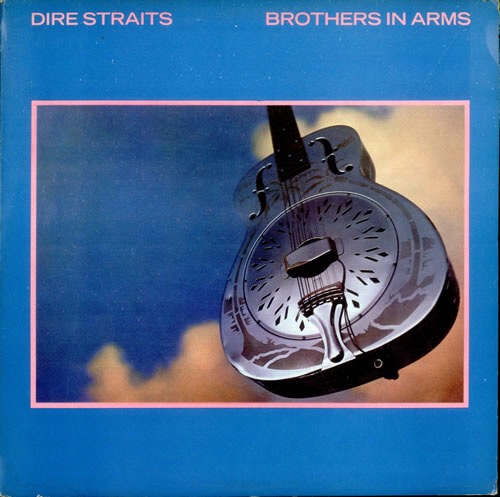
Brothers In Arms

  
During my senior year in college I was one of the first guys in my dorm to get a CD player. 

This album by Dire Straits was THE CD to get to show how crispy good this new digital format was. Guys would come by my room just to listen to a track or two and marvel at the clarity compared to vinyl. 

And this album still holds up and remains one of my favorites. It’s especially suited for a quiet night and for headphones. 

The limits of self-improvement

“If we are unduly absorbed in improving our lives we may forget altogether to live them.” –Alan Watts

ht Scott Berkun

We are always getting ready.

We hope for a better future.

“What’s next?” is the question that occupies our thoughts almost constantly.

There is a lot I could improve about my life to make it better in the future.

But my life is here and now.

The future keeps receding into infinity. We are only ever living right now.

The only way to improve this very moment is to fully inhabit it.

Marcus Aurelius explains your options

A timely reminder from Marcus Aurelius:

“Everywhere, at each moment, you have the option:

to accept this event with humility

to treat this person as he should be treated

to approach this thought with care, so that nothing irrational creeps in.”

Another translation of that first line reads:

“Always and everywhere, it depends on you piously to be satisfied with the present conjunction of events.”

But what if “the present conjunction of events” sucks?

What is, already is. Resisting reality is futile and frustrating.

What if you simply observed even the most upsetting events and responded with fascination and curiosity?

Accept what has happened, bad and good, as though it is a gift to you to be used to expedite your own growth and propel you further and faster toward perfecting your character.

Michael Pollan and Netflix aim to inspire you to cook more often

Netflix recently released their newest documentary, Cooked. It’s a gorgeously filmed exploration of the impact cooking had on making us human and the perils of abandoning cooking and relying mostly on the packaged food-like substance industry.

The documentary is based on Pollan’s book of the same name.

The film is a delight to the eyes. Gorgeous scenery from around the world provides the backdrop for a clear and compelling case to get back to our primal connection with the food we eat.

As the primary cook for my family I’m in the kitchen almost every day. And it’s a pleasure. It’s one of the few tasks I do every day that is tangible and satisfying in the most visceral way. I make something real that I can smell and taste. And this daily act fuels, and hopefully delights, the people I love most.

I recommend that as often as you can, you should cook your own food.

Watching this new film will inspire you to appreciate your relationship with food and how you prepare it.

“Cooking is probably the most important thing you can do to improve your diet. What matters most is not any particular nutrient, or even any particular food: it’s the act of cooking itself. People who cook eat a healthier diet without giving it a thought. It’s the collapse of home cooking that led directly to the obesity epidemic.” –Michael Pollan

COOKED_VERTICAL_KEYART_US.0

Sunday morning Stoic: Be more generous than seems reasonable

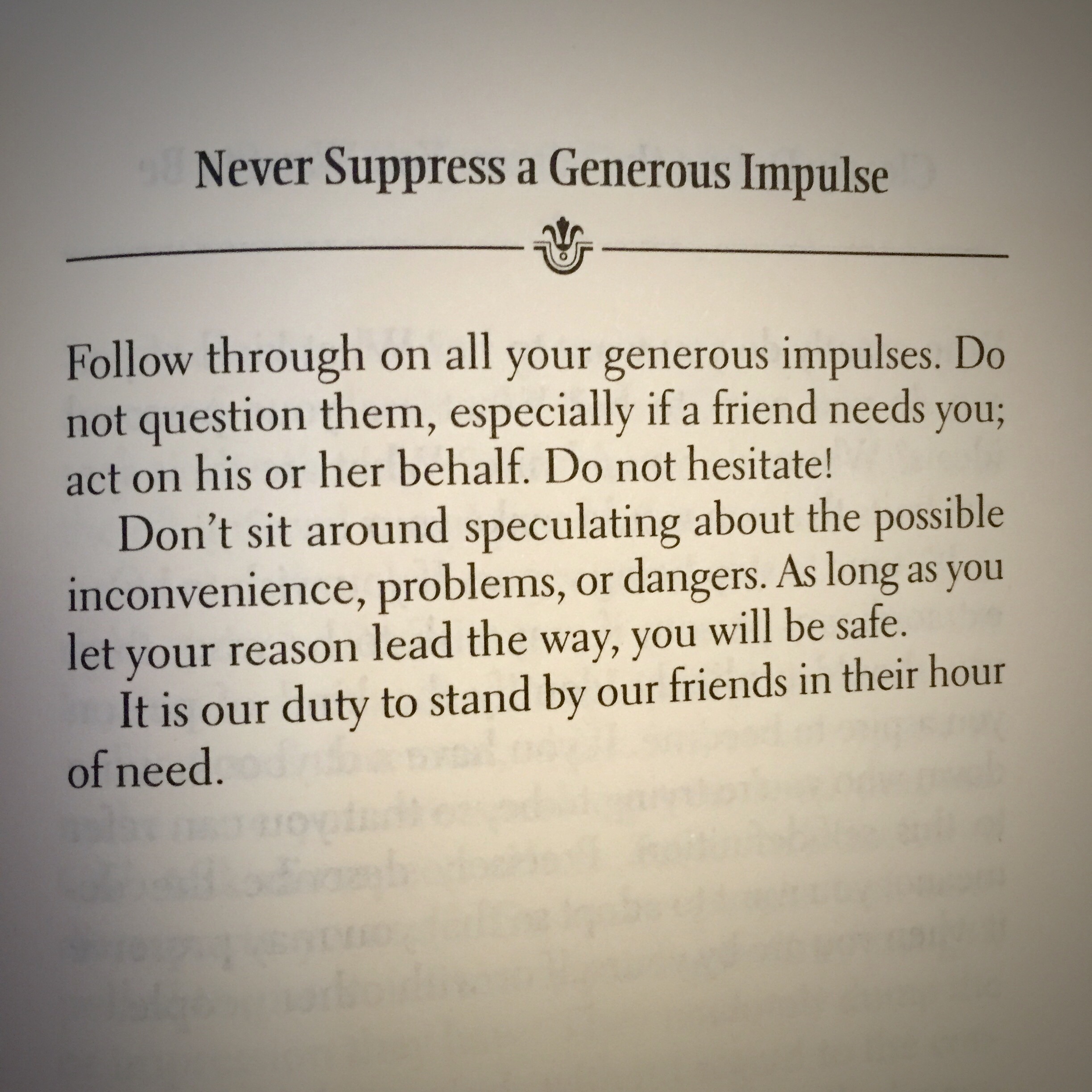
From Epictetus, via Sharon Lebell’s The Art of Living:


I can’t outgive my wife. 

Often, we’ll see a need or be asked for a contribution to some cause we care about. When she asks me how much we should give, I’ll come up with an amount I think is a little bold, but not unreasonable. But before telling her, I’ll ask what she has in mind, and it’s always bigger and bolder.

I too often try to be reasonable with our generosity. But most of us can give more and do more than we think is reasonable. 

Push your generosity comfort zone out to the edge where it’s slightly-uncomfortable-but-kind-of-thrilling. Push pass the resistance that guides you to caution, and follow your impulse to give more boldly. 

Sunday morning Stoic: Your defining characteristic

Meditations 8.12:

“When you have trouble getting out of bed in the morning, remember that your defining characteristic—what defines a human being—is to work with others.”

Homo sapiens are wired to be tribal. That’s how we survived and flourished.

As much as I lean introvert and value alone time, it’s in community and connection and contribution where I thrive and feel most alive.

It’s all about relationships. 

Why Seinfeld keeps touring

My wife and I are going to see Jerry Seinfeld perform here in our hometown tonight.

He’s set for life financially, and his reputation as one of the comedy greats is already a lock.

But he keeps touring because he loves the work.

I wrote about this previously, but I love his craftsman approach. From a 2012 New York Times profile:

For Seinfeld, whose worth Forbes estimated in 2010 to be $800 million, his touring regimen is a function not of financial necessity but rather of borderline monomania — a creative itch he can’t scratch. “I like money,” he says, “but it’s never been about the money.” Seinfeld will nurse a single joke for years, amending, abridging and reworking it incrementally, to get the thing just so. “It’s similar to calligraphy or samurai,” he says. “I want to make cricket cages. You know those Japanese cricket cages? Tiny, with the doors? That’s it for me: solitude and precision, refining a tiny thing for the sake of it.”

When he can’t tinker, he grows anxious. “If I don’t do a set in two weeks, I feel it,” he said. “I read an article a few years ago that said when you practice a sport a lot, you literally become a broadband: the nerve pathway in your brain contains a lot more information. As soon as you stop practicing, the pathway begins shrinking back down. Reading that changed my life. I used to wonder, Why am I doing these sets, getting on a stage? Don’t I know how to do this already? The answer is no. You must keep doing it. The broadband starts to narrow the moment you stop.”


More music, more happy

My family recently upgraded our primary television and added a Sonos Playbar as well. It was an expensive addition to an already costly purchase, but it’s proving to be well worth it. (Remember: “The things you use every day should be the best-designed things you can get.”)

We use TV almost exclusively for streaming Netflix, Hulu, and iTunes, and it’s our kids who use it the most. But this new soundbar has us listening to a lot more music.

I’m no audiophile, but the quality of the sound from this Sonos soundbar is remarkable for just a single device, at least compared to what we had before.

And having great audio in our living room and the new Apple TV prompted me to give Apple’s streaming music service another try.

So, we are listening to music more often now, and it’s been a delight. We click on a playlist or album while having dinner or doing chores or winding down for bed, and it’s added a wonderful extra bit of joy to our home.

It turns out that Sonos has been doing research about this and is actively marketing results that show that listening to music out loud in your home has measurable benefits for the whole family.

Their study shows that households that play music out loud laugh more and have less tension. There’s a long list of other benefits highlighted by their research.

I know that turning on music makes us less inclined to retreat into our devices. Cooking and dining together are just more fun with music in the background. We find ourselves often singing along out loud together as we go about our evening routines.

You don’t need a fancy sound system or a sophisticated taste in music to reap these benefits. Just put on some music and tune in with those you share your life with.