“Incredibly different incredible people”

“The best way to increase the odds that your team will see things you don’t is to assemble incredibly different incredible people.” –Scott Belsky

This is a great post by Scott Belsky

The team members that have pushed me further and helped transform our work are usually the ones that ask the most questions and express their discontent most effusively. 

Groupthink is comfortable, but it’s deadly to innovation and meaningful improvement. 

Gather contrarians and outliers and annoyingly curious people into your team. 

Embrace the hard questions and the counterpoints to make sure you don’t coast into complacency. 

Find the thing you do for the joy of the thing itself

There was a common theme in two things I read today. 

First, I read this Jon Westenberg post on Medium that included a striking insight about work:

“Have you ever watched one of those reality TV singing competitions? You’ve probably seen a hundred young people, eyes shining, clutching microphones and talking about their dreams. They’ll explain that ever since they were kids, they wanted to be singers.

They hardly ever say they wanted to sing. When it comes down to it, half the time it’s because actually singing isn’t the end goal. They want the trappings and lifestyle and the breaks of being a singer.

If the act of singing was really their end goal, they wouldn’t be on a reality TV show. They’d be out there every night singing anywhere they could, writing songs, starting bands, recording music.

The same is true for anything you could make. Do you want to make X, or do you want to be the person who made X? Because if you don’t care about the act of making something, and if you don’t want to get out there every day and try to make something, you might as well quit.

You want people to care?

They should care about your work. Not you.”

And then I read this today at lunch after finally getting started on Anne Lamott’s highly regarded book on writing, Bird By Bird:

“Writing has so much to give, so much to teach, so many surprises. That thing you had to force yourself to do—the actual act of writing—turns out to be the best part. It’s like discovering that while you thought you needed the tea ceremony for the caffeine, what you really needed was the tea ceremony. The act of writing turns out to be its own reward.”

Find the thing you do for the joy of the thing itself, not for any extrinsic reward attached to the thing. Go in the direction of the things that give you intrinsic rewards

I keep coming back to this profound, potentially life changing passage from Anthony De Mello’s The Way to Love:

“You must cultivate activities that you love. You must discover work that you do, not for its utility, but for itself. Think of something that you love to do for itself, whether it succeeds or not, whether you are praised for it or not, whether you are loved and rewarded for it or not, whether people know about it and are grateful to you for it or not. How many activities can you count in your life that you engage in simply because they delight you and grip your soul? Find them out, cultivate them, for they are your passport to freedom and to love.”

This advice might not lead you to any paying gigs or a dream career. But you still should find those things that make you come alive without any attachment to external rewards. Even if it’s only a hobby or a side hustle, get busy making something or doing something that is simply a delight to you, where the process is an end in itself—where the journey is the reward.

Meticulous attention to detail

My friend Emily is a young professional not too far removed from college. She’s living a dream working in New York City.

She was featured in an interview online and had this very thoughtful response, profound even, when asked for her most important advice:

“My biggest piece of advice is to fiercely and tirelessly pay meticulous attention to detail, and specifically the details that no one else thought to or cared to remember. Be that person with the mindset that “no job is too small.” What I have discovered time and time again, is that people trust other people that really care; not just about the beautiful clothes and the red carpets, but the less glamorous details that people steer clear from. Don’t steer clear of those things. Embrace them, run with them, and when that trust is built into a foundation that cannot be torn down by one mistake, those big things suddenly become yours. And these big things you create are so beautifully done because of how much you cared about the little things. And those are going to be your true moments of pride.”

I can’t add to that. So well said. And so true. 

Care more than seems reasonable. 

Just keep swinging

“My motto was always to keep swinging. Whether I was in a slump or feeling badly, the only thing to do was keep swinging.” —Hank Aaron

ht @garretkramer

Have a bias for action.

Do something rather than nothing.

Even a step in the wrong direction is better than standing still.

You don’t have to feel right to act. Just do what you think is best.

Don’t wait on inspiration. Inspiration is for amateurs.

If you’re in a slump, don’t stand at the plate with your bat on your shoulder, hoping for ball four.

Swing.

And keep swinging.

Going for it on fourth down, every time

I’ve posted about maverick Arkansas high school football coach Kevin Kelley before, and now Andy Staples of SI writes about seeing his team, the Pulaski Academy Bruins, in person where they ended the opponent’s 84-game home winning streak.

Kelley’s team is famous for going for it on almost every 4th-down, opting for onsides kicks on every kickoff, and now building laterals into many of their passing plays. Here’s Staples’s take on why this is so successful:

The Bruins don’t win because they don’t punt or because they attempt onside kicks every time or because their receivers routinely lateral on plays that aren’t the last one of the game. They win because of the attitude Kelley’s approach instills on Pulaski Academy’s sideline and the mindset it instills on the other sideline. The Bruins always play as if they’re down 10 with 90 seconds to go. Think about all the points you’ve seen scored in that type of situation. The offense plays as if it has nothing to lose. The defense tightens, playing to protect the lead rather than to advance the cause. That’s every minute of every Pulaski Academy game.

Wouldn’t you love to play on a team with that kind of bold philosophy? Wouldn’t you love to work on a team with a disregard for convention, with an attitude of curiosity and boldness that defies the caution that restrains most organizations?

The safe thing is to do what everyone else does: Build a resume that looks like everyone else’s. Produce work like everyone else does. Avoid artistic risks and leaps of faith. Accept the conventional wisdom and common assumptions because they’re conventional and common and safe.

But caution is the devil.

What if you had the courage to go for it on fourth down regularly, to try the uncommon path, to follow your reason and your creativity in a different direction altogether?

There is a lot of elbow room out on the edges. Not many have the chutzpah to go there. The competition for average levels of success is way stiffer than it is for extraordinary success because so few aim that high. It seems counterintuitive, but it might be easier for you to achieve a crazy, scary dream than to achieve the safe, sanitized middle class American dream.

Even if you regularly fall short when you defy convention, you’ll have a lot more fun than if you had just followed along with the crowd. And you’ll be strengthening your courage muscles and making yourself even more willing to be bold.

Don’t punt. Go for it.

Wonderful life: Rebooting my college talk again

I get asked to speak on campus to student groups several times each academic year. I’m honored to be invited, and it’s a chance for me to be intentional about thinking through and sharing something that might awaken possibility in college students. 

Tonight was my first gig of the semester. Instead of dusting off a talk I did the previous year, I like to start over and rethink and reboot. 

I will often include stories and quotations and points I’ve used before but mix them with new ideas and stories and a fresh narrative structure and theme.

There’s a lot of value in regularly starting over, even with—especially with—the tried and true. 

Your best work may be buried under the good work you’ve been too content with. Dig it up and and shake it out and get busy making something new. 

Screen Shot 2015-09-09 at 4.13.53 PM

The formula for greatness

I found this 2006 article, What it takes to be great, in Fortune.com’s archives.

It covers much of the same ground as Daniel Coyle’s book, The Talent Code.

In short, the key to greatness is… wait for it… practice—diligent, consistent, focused, challenging practice.

From the article:

The best people in any field are those who devote the most hours to what the researchers call “deliberate practice.” It’s activity that’s explicitly intended to improve performance, that reaches for objectives just beyond one’s level of competence, provides feedback on results and involves high levels of repetition.

Most of us just go through the motions and simply repeat what we are good at already. It’s easy and feels good. But that kind of practice does nothing to propel you forward.

Masters, however, repeatedly push themselves to failure and focus on steady, incremental improvements.

Simply hitting a bucket of balls is not deliberate practice, which is why most golfers don’t get better. Hitting an eight-iron 300 times with a goal of leaving the ball within 20 feet of the pin 80 percent of the time, continually observing results and making appropriate adjustments, and doing that for hours every day – that’s deliberate practice.

Consistency is crucial. As Ericsson notes, “Elite performers in many diverse domains have been found to practice, on the average, roughly the same amount every day, including weekends.”

Evidence crosses a remarkable range of fields. In a study of 20-year-old violinists by Ericsson and colleagues, the best group (judged by conservatory teachers) averaged 10,000 hours of deliberate practice over their lives; the next-best averaged 7,500 hours; and the next, 5,000. It’s the same story in surgery, insurance sales, and virtually every sport. More deliberate practice equals better performance. Tons of it equals great performance.

What’s encouraging about all this is that greatness isn’t the domain of those born with extraordinary gifts. They may have an advantage, but ultimately it comes down to factors you can control—the quality and quantity of your effort, your willingness to build effective habits and put in the kind of practice that leads to steady but sure improvement.

Determine what you want to be great at, come up with a plan to get there, and then do the work.

The guardian

Solid insight from @garrytan:

Steve Jobs was that guardian for Apple. He was ruthlessly protective of the experience Apple products provided for their customers. 

Walt Disney was all about “plussing” and relentlessly improving the Disney experience. 

This article about Stephen Colbert shows he’s personally overseeing even very small details about his reinvention of The Late Show. 

My friend Kevin was telling me today that Taylor Swift is like that with her concerts. 

Committees and bureaucracy are more likely to offer safe but unexceptional products and services. 

A singular and determined voice is usually generating and guiding the very best work. 

The transformative power of deep practice

Daniel Coyle’s book, The Talent Code, is one of the best books I’ve read in the last couple of years. He explores “talent hotbeds”, places that produce a disproportionate amount of talented people in various fields—sports, the arts, and academics. And he comes up with key factors that separate the best from all others.

His follow-up book, The Little Book of Talent, condenses the lessons he learned about talent into very direct, transferable and applicable insights.

And this is the key insight:

“If I had to sum up the difference between people in the talent hotbeds and people everywhere else in one sentence, it would be this:

People in the hotbeds have a different
relationship with practicing.

Many of us view practice as necessary drudgery, the equivalent of being forced to eat your vegetables, far less important or interesting than the big game or the big performance. But in the talent hotbeds I visited, practice was the big game, the center of their world, the main focus of their daily lives. This approach succeeds because over time, practice is transformative, if it’s the right kind of practice. Deep practice.

The key to deep practice is to reach. This means to stretch yourself slightly beyond your current ability, spending time in the zone of difficulty called the sweet spot. It means embracing the power of repetition, so the action becomes fast and automatic. It means creating a practice space that enables you to reach and repeat, stay engaged, and improve your skills over time.”

Everything changes when you see practice as not just a means to an end, but a worthy end in itself.

This applies to all of life, actually. Every moment is a chance to practice intention and focus and mindfulness.

Practice, then, is not merely preparation for something else, but is rather the act of honoring the only place your life ever is—here and now.

Work alone

From Susan Cain’s book, Quiet: The Power of Introverts in a World That Can’t Stop Talking, there’s this excerpt from the memoir of Steve Wozniak, the quieter and lesser known of the two Steves who founded Apple:

“Most inventors and engineers I’ve met are like me—they’re shy and they live in their heads. They’re almost like artists. In fact, the very best of them are artists. And artists work best alone where they can control an invention’s design without a lot of other people designing it for marketing or some other committee. I don’t believe anything really revolutionary has been invented by committee. If you’re that rare engineer who’s an inventor and also an artist, I’m going to give you some advice that might be hard to take. That advice is: Work alone. You’re going to be best able to design revolutionary products and features if you’re working on your own. Not on a committee. Not on a team.”

I do think that group work is overrated. Group brainstorming, even, has been shown to actually come up with fewer ideas than when individuals work on idea generation alone.

A team possibly can improve your ideas and offer feedback and new possibilities and enact plans to execute ideas, but the fundamental work is likely done on your own, in your zone.

The ambivert advantage

I’m currently reading Quiet: The Power of Introverts in a World That Can’t Stop TalkingIt’s making me realize my personality is a fairly even split of introversion and extroversion; I suppose that makes me an “ambivert”, and I’m sure most people are more split than they assume.

Most people who know me wouldn’t hesitate to label me an extrovert. I’m sure I come across publicly as gregarious and not at all spotlight-averse.

But I prefer alone time over group time. A great lunch for me is lunch by myself with something good to read. I tend to choose staying in over going out and one-on-one conversation rather than a dinner party with a crowd. But if I’m at a dinner party, I can, if I choose, be engaging and even entertaining. (I’m hilarious, right friends?) I don’t enjoy small talk, but I can hold my own

My two primary peak experiences when I work, though, are seemingly at opposite ends of the personality spectrum.

I fall into a sort of creative bliss when working alone and getting into a flow state where I lose track of time and ideas appear and possibilities bubble up.

But I get a different kind of high that’s just as satisfying when I stand on a stage and connect with an audience, often about the ideas that came about in that isolated flow state. That peak on-stage experience is also a flow state. 

I’m most creative alone after having some time to get into a zone. I’m most alive when I’m in front of an audience sharing what I crafted in that alone time. 

I had a colleague in my first career when I was a staff member on Capitol Hill who regularly wanted to pull up a chair next to me so we could write together. That did not work. And I finally told him just to send me his ideas, and I would synthesize them on my own.

I’ve learned to structure my time around what works best for me. I don’t seek out lunch appointments or group work. I make sure to get plenty of down time before and after presentations. I value long stretches of quiet time.

Know yourself. Look back on your peak moments, your most productive environments, and your most satisfying states. Determine how best to bolster your strengths and hack your personality to more completely fulfill your nature.

Bertrand Russell on the good life

Kottke posted a link to University of Utah professor Matt Might’s thoughtful career and life advice.

There is so much worth pondering in that post. But the career applications especially stand out. 

Might’s academic career floundered when he saw his work as a means to an end. But his work flourished when he did work for its inherent value and for its meaning to him. 

Focus on being awesome, not on being successful. 

And he shared a portion of this quote: 

“The good life is one inspired by love and guided by knowledge. Knowledge and love are both indefinitely extensible; therefore, however good a life may be, a better life can be imagined. Neither love without knowledge, nor knowledge without love can produce a good life.” –Bertrand Russell

So good. 

Love and knowledge. Beauty and truth. 

Indefinitely extensible. 

Inexhaustible. 

Enough to fill a life. 

A good life. 

Show your work: Star Wars

Seeing inside the process of a craftsman or artist makes me appreciate their work more. Knowing how the magic is made doesn’t diminish the magic; it enhances it. 

And that kind of transparency inspires me to push through the messy misfires and tedious small steps on the way to making my own art. 

Even the world’s greatest masterpieces didn’t emerge instantly pristine. Imagine how many discarded drafts and crumpled sketches and trashed recipes came before the lauded final product. Trial and error and daily effort and persistence don’t grab headlines, but the art wouldn’t be art without the work. 

Want to make something great? Do the work. 

Inspired by Austin Kleon’s “Show Your Work”, I regularly share behind-the-scenes glimpses of projects I’m working on. Let’s demystify the creative process and encourage others to dive in and make something remarkable, too.  

All of us can make art. If it’s something you care about and making it would be meaningful to others, it’s art. Your work, your hobby, your passion. 

I love this video that was just released showing the work being done now on the upcoming film, Star Wars: The Force Awakens:

This is the kind of thing you would usually see only after a film has been released. But the creators are “showing their work” in progress, and it gives a sense of just how much they care about what they’re making. Now I have a new hope (see what I did there?) for the future of this grand story. 

The right things

Or as Peter Drucker put it:

“Management is doing things right. Leadership is doing the right things.”

Efficiency is meaningless, or even harmful, without effectiveness. What’s the point in going in the wrong direction faster?

Focus on the essentials first. Keep checking your direction. Then drill down to efficiency and methods. 

Why before how. 

Creativity has to start somewhere

Suck is a default starting point for almost all truly great work.

From Ed Catmull’s great book, Creativity, Inc.:

“And yet, candor could not be more crucial to our creative process. Why? Because early on, all of our movies suck. That’s a blunt assessment, I know, but I make a point of repeating it often, and I choose that phrasing because saying it in a softer way fails to convey how bad the first versions of our films really are. I’m not trying to be modest or self-effacing by saying this. Pixar films are not good at first, and our job is to make them so—to go, as I say, “from suck to not-suck.” This idea—that all the movies we now think of as brilliant were, at one time, terrible—is a hard concept for many to grasp. But think about how easy it would be for a movie about talking toys to feel derivative, sappy, or overtly merchandise-driven. Think about how off-putting a movie about rats preparing food could be, or how risky it must’ve seemed to start WALL-E with 39 dialogue-free minutes. We dare to attempt these stories, but we don’t get them right on the first pass. And this is as it should be. Creativity has to start somewhere, and we are true believers in the power of bracing, candid feedback and the iterative process—reworking, reworking, and reworking again, until a flawed story finds its throughline or a hollow character finds its soul.”

You don’t need to be a kid or have a kid to go see Pixar’s latest sensational film, Inside Out. It’s so good and has a depth that has you pondering its message long after you leave the theater.

But it started out sucking at first, too. The Pixar team kept at it, though, and ended up making remarkable art.

Start somewhere. Awful is a good place to begin. In fact, try to be as dreadful as you can, as laughably bad as you can imagine, just to take the pressure off.

Then see how you can make it just a little better.

Then keep going.

ht Parislemon

Showing my work: Analog color

IMG_7015

I’m leading an educational session at a conference this week. It’s a first for this topic for me, and I don’t feel I’ve found my framework yet. It just hasn’t clicked.

I’ve floundered around with digital tools — Keynote, Mindnode, text editors — but the flow hasn’t come yet.

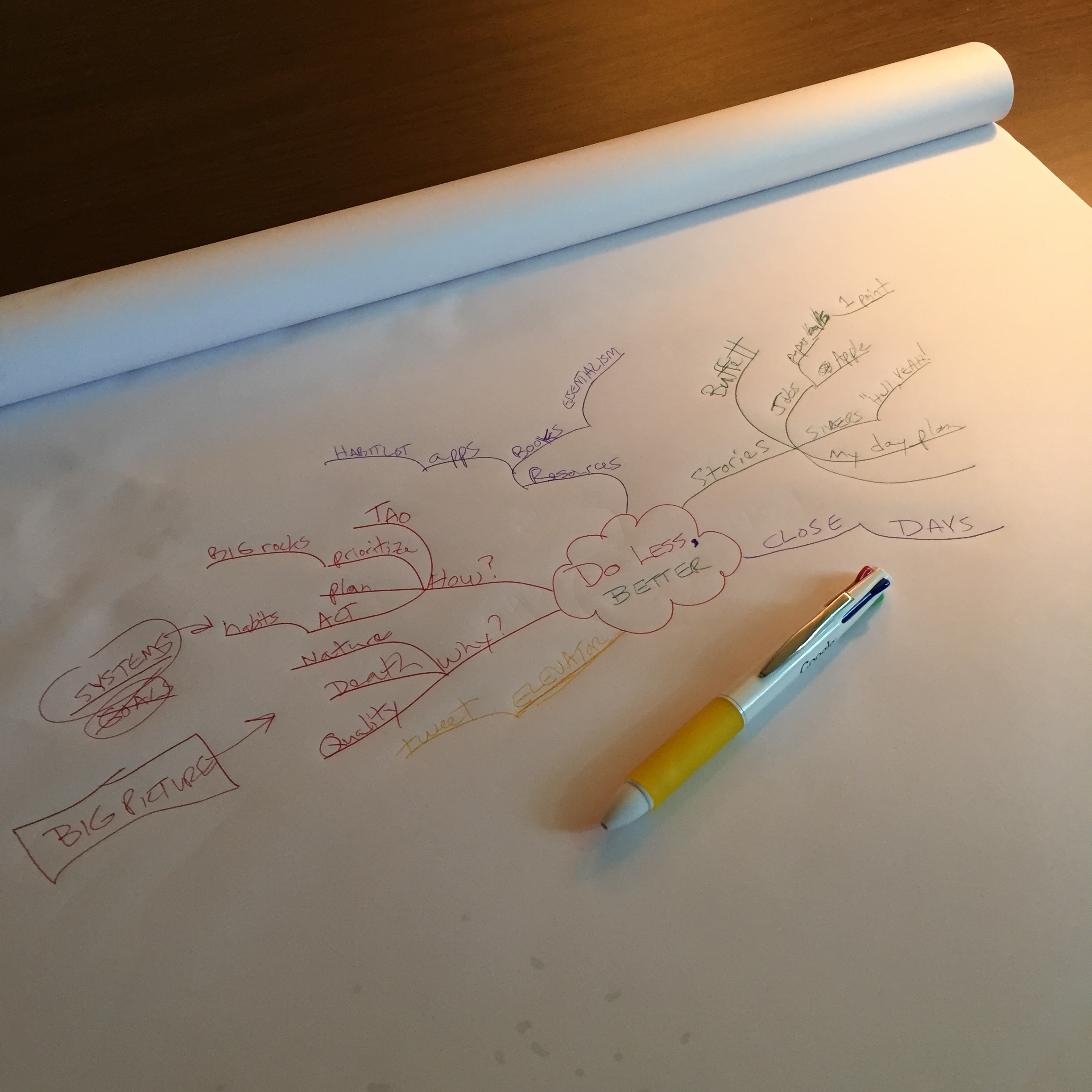
So, today I turned around to my desk, away from my Mac, and took my multi-colored pen to actual paper and mind-mapped my ideas. And they flowed better than at any time in my thinking on this topic.

Analog before digital. Why can’t I stick to that?

It’s still not there yet. I’m imagining people sitting in my session wondering why they chose it and what the heck I was trying to accomplish. But I’ve done this enough times to know that something at least partially intelligible and maybe even meaningful will come out of me.

Priming my creativity with a pen in hand, some color, and a big sheet of paper is a reliable way to force some flow. 

Now, I’ve got to gather up those thoughts and string them together in a way that sparks some kind of transformation in my audience. What’s the point otherwise?

“The only reason to give a speech is to change the world.” –John F. Kennedy

More better

You are going to die.

I am, too.

(Warm, happy way to kick off a conversation. I’m fun at parties.)

The universe is staggeringly massive.

For every grain of sand* on Earth, there are at least 10,000 stars in the visible universe.

Amazing, right?!
*And yes, there’s an algorithm for determining the number of grains of sand on Earth. Also amazing.

We are infinitesimally small.

Our time is limited.

(The average human lifespan fills just .000001 percent of the entire history of the planet.)

In the big scheme of things — the REALLY big scheme — who we are and what we do doesn’t seem to, in the words of Humphrey Bogart in Casablanca, “amount to a hill of beans in this crazy world”.

Yet we all are so busy and in a hurry and stressed out.

Our to-do lists tug at us and unsettle both our conscious minds and our subconscious and even sneak into our dreams at night.

Our calendars are filled with meetings and appointments and projects and task-forces and so many things that won’t be worth remembering or talking about.

How much of what we do makes a real difference and is truly meaningful?

How often do you get to the end of a day and lay your head on your pillow and feel genuine, wholehearted satisfaction about the way you spent a precious day in your short life?

Maybe it’s unspoken existential angst or cultural brainwashing from childhood or tyrannical bosses that fling us into the futile effort to do MORE, check MORE off our lists, accomplish MORE…

…in the effort to have more and be more and somehow win at life.

MORE. MORE. MORE.

But what if…?

What if you apply “MORE” to quality rather than quantity?

What if you did LESS, but did it BETTER?

Do LESS, but do it MORE BETTER.
(Grammar police, look away.)

Here is almost the entire product line of the biggest, richest company in the world:

Screen Shot 2015-05-01 at 5.03.55 PM

All of Apple’s products could fit on a conference room table.

Steve Jobs attributed much of his success to saying “No” to make room for a better “Yes”.

Steve Jobs:

“Innovation is saying no to 1,000 things.”

Albert Einstein, too:

“I soon learned to scent out what was able to lead to fundamentals and to turn aside from everything else, from the multitude of things that clutter up the mind.”

Warren Buffett:

“The difference between successful people and unsuccessful people is that really successful people say no to almost everything.”

Jazz great Thelonius Monk:

“What you don’t play can be more important that what you do play.”

Steve Jobs, Albert Einstein, Warren Buffett, Thelonius Monk — all champions of doing less, but doing it better.

Imagine honing your focus and investing more of your limited time and attention in things that matter most.

Imagine the rewards of deep work and quality time on fewer projects.

Imagine more quiet moments and eye contact and actually taking time to listen intently.

What would intense focus on fewer things do for your work life, your relationships, your peace of mind?

But, to have that kind of focus, you have to be ruthless at saying “No” to even really good and noble things as well as to time-wasters and trivial distraction.

And you have to say “No” to nice people and to “good” opportunities.

Derek Sivers says when he’s confronted with a new opportunity, if his response is not a “Hell, YEAH!”, then it’s simply a “no” for him.

“Hell, YEAH!”

Or

“no”

That may be extreme, but exceptional, more better lives tend to defy convention.

Consider the things in your life, professional and personal, that are most important.

Make a list. Prioritize it.

What if you cut that list down to just a few key priorities, the things that would have the biggest impact and matter the most?

And what if you structured your time around giving those few key priorities more of your attention?

Peter Drucker, paraphrased:

Management is doing things right. Leadership is doing the right things.

What if you built habits around the few priorities that have the biggest impact in your work and your life?

Consider whittling your daily to-do list down to one or two key tasks, tasks that would benefit from close attention and deep focus.

Consider overhauling your schedule by cutting out most meetings.

Turn off notifications on your devices.

There are people who only check email at designated intervals — first thing in the morning, around noon, and in the afternoon.

Crazy, right? Who does this?

I’m guessing Warren Buffett doesn’t live out of his email in-box.

Einstein didn’t surf the internet. 😉

(We’ll give Steve Jobs a pass on this one.)

What can you: streamline, unclutter, simplify, clarify?

Instead of a buffet, a smorgasbord even, of services and options, what if you offered just a few truly great choices?

Is your purpose, your mission — for your team, your family, your work, your life — clear?

Crystal clear?

How much stuff do you possess that you don’t really need, that’s not either useful or beautiful?

Less stuff, but better stuff.

Fewer pursuits, but more rewarding pursuits.

Picture the end of your life.

What kind of life do you want to look back on?

It will be quality, not quantity, that will matter most at that point.

And that should matter most now.

Do less…

… better.

*This is the thought stream for a presentation I will be leading at a conference next month. I posted a PDF of this from a Keynote document for use by the audience prior to the presentation. It can stand alone but is intended to be a warm up for what I hope will be a lively conversation.
Be obsessed

Justine Musk (Elon Musk’s wife) had this as part of her response to a question on Quora about how to be as successful as Bill Gates, Steve Jobs, Elon Musk, and Richard Branson:

Be obsessed.

Be obsessed.

Be obsessed.

If you’re not obsessed, then stop what you’re doing and find whatever does obsess you. […] Don’t pursue something because you “want to be great”. Pursue something because it fascinates you, because the pursuit itself engages and compels you. Extreme people combine brilliance and talent with an insane work ethic, so if the work itself doesn’t drive you, you will burn out or fall by the wayside or your extreme competitors will crush you and make you cry.

Intrinsic rewards over extrinsic rewards.

Warren Buffett and the “avoid at all cost list”

Cal Newport shared this Warren Buffett story, which was passed on by someone else and may be only apocryphal. But the point of the story certainly seems in line with what we know of Buffett’s philosophy:

Buffett wanted to help his employee get ahead in his working life, so he suggested that the employee list the twenty-five most important things he wanted to accomplish in the next few years. He then had the employee circle the top five and told him to prioritize this smaller list.

All seemed well until the wise billionaire asked one more question: “What are you going to do with the other twenty things?”

The employee answered: “Well the top five are my primary focus but the other twenty come in at a close second. They are still important so I’ll work on those intermittently as I see fit as I’m getting through my top five. They are not as urgent but I still plan to give them dedicated effort.”

Buffett surprised him with his response: “No. You’ve got it wrong…Everything you didn’t circle just became your ‘avoid at all cost list.’”

Focus. Do less, better.

“The difference between successful people and unsuccessful people is that really successful people say no to almost everything.” –Warren Buffett