It’s called “giving” a speech

I saw this tweet today from Chris Anderson, who is the TED Talks guy and knows a bit about what makes for an effective speech. (He has a new book out on that very topic.)

Instead of approaching a speaking opportunity with the focus on you, the speaker, focus instead on the audience and what you hope to give them.

It’s not about what you want or what you can accomplish or your agenda or the applause or laughs or approval you hope to receive.

What’s your gift to the audience? How can you share something that meets their needs, that just might awaken a new possibility in them?

This, of course, applies well beyond just speech-making.

Whatever your art or your craft or even just your pay-the-bills kind of job, consider the gift you can offer with it, how you could create something meaningful for someone else. See if that perspective doesn’t transform your work and maybe your own sense of purpose.

Streaks App

Earlier today I downloaded Streaks, an app to track habits you want to keep.

My habit-keeping habit has been abysmal this year, and I needed a fresh approach.

I have used Habit List to good effect in the past, but I’m thinking a shiny new tool might rejuvenate my commitment to routines that make my life better. 

John Gruber of Daring Fireball recommended Streaks recently. I took a look, and it looks ideal for what I want to do—track my follow through on just a few key daily habits. It has a gorgeous and simple design and looks like a fun app to use. 

Not an hour after I purchased Streaks, I saw on Twitter that the app just won a design award from Apple today as one of the best apps of the year. 

I’ll give Streaks a go and try to revitalize some habits and revitalize my commitment to living a more excellent life. 

Don’t find yourself. Create yourself.

IMG_1260

A conversation I heard yesterday reminded me that so many of us think there is some inner kernel inside that is the “true” version of ourselves. If only we keep digging and searching we will eventually, hopefully, uncover what or who we are somehow meant to be.

It’s my experience, though, that the search to find yourself is futile.

There’s no need to wait and ponder and hope that your ideal calling will be revealed to you somehow.

Instead, get busy doing something. Take action. Take a shot, even if you’re not completely sure it’s the best action to take. You only know by doing.

Pick a path you don’t hate, and give it a go. Follow what intrigues you until it doesn’t.

Craft the life you want. Become who you want to be.


Don’t wobble

Sit, sit. Walk, walk. Don’t wobble. –Zen proverb

Kevin Kelly shared this wisdom in his most recent interview on Tim Ferriss’s podcast.

When you sit, fully sit.

When you walk, make walking the thing.

When you’re in conversation with another human being, let all else fall away except for that conversation.

Don’t wobble. Don’t drift from the thing you’re doing to give your attention to something else.

I’m not going to pull this off with any kind of consistency. I wobble. A lot.

But keeping aware of the intention to be present with where I am and what I’m doing is a start.

Lin-Manuel Miranda on leaving college with “stuff” already created

Lin-Manuel Miranda is the man of the moment with Hamilton’s incredible success.

This Rolling Stone feature sheds some light on his drive.

He has written his way to the top. Like the character he portrays on stage, Alexander Hamilton, Miranda is a prolific writer.

Here’s Miranda in the Rolling Stone interview talking about his creative output while he was a college student:

I finished college with a ton of stuff written. I was painfully aware of the financial sacrifices my parents were making so that I could go to college, so I was not going to just leave with a B.A. in something. I was going to leave with stuff. I wrote a show every year of college. Not for credit, but because I needed to be leaving with more than just a B.A. So in that way, I’m very Hamilton-esque, in that I’m aware of both time and of the incredible opportunity that I’m lucky to have, and not wanting to squander either.

“I needed to be leaving with more than just a B.A….” Incredible.

He didn’t wait on a degree or permission or a paying gig to start doing what he wanted to do.

He acted as if, as if he already was who he wanted to be.

What if we just started doing what we think we want to be doing without waiting to be picked or to qualify somehow.

Miranda didn’t wait. He’s a smashing success not because he paid his dues or bought into the system or followed a path others laid out. 

He made it big because he got busy doing the work that was calling to him as soon as it called.

He picked himself. 


Writing that moves: Posnanski makes like Maddux

My morning in this lovely AirBnB cottage near Venice Beach has been made reading a couple of Joe Posnanski’s pieces. (This west coast time zone had me up early, watching my kids sleep as we continue on our California vacation.)

Posnanski is a sportswriter, but it’s his stuff about fatherhood and family that gets to me. 

He wrote most recently about taking his teenage daughter to see the musical Hamilton. (Go read that piece now. It’s so, so good.)

I’ve never been a big fan of Broadway musicals. I had been underwhelmed years ago by Cats (hated it) and Phantom (meh). But we took our young daughters to see Wicked earlier this year, and I was wowed and truly moved. 

Then I heard some early hoopla about Hamilton and was intrigued enough to listen to the soundtrack. I’ve since listened to that soundtrack repeatedly and can quote key lyrics. And I’ve begun reading the Ron Chernow biography that inspired Lin-Manuel Miranda to create a hip-hop infused stage production telling the story of an under appreciated founding father. And I know who Lin-Manuel Miranda is and have watched YouTubes of his commencement speeches and his beatboxing with Emma Watson. And I know I will regret not having seen the original cast perform Hamilton live. 

And Posnanski’s endearing story of taking his daughter to see this show resonated with me as an admirer of all things Hamilton right now and as a dad of daughters. I got all the feels and could imagine sitting in that theater with my older daughter and making a memory that endures.

I then read an older piece of his about taking his daughter to Harry Potter world in Florida. Also a delight and evocative of my experiences with my daughters. 

Posnanski’s writing sneaks up on the reader. He’s just casually unspooling the threads of a story. It’s conversational and earnest. And then—Pow!—without warning you feel something. You’re moved. It’s clear he’s been moved, and he takes you with him. 

The great Braves pitcher, Greg Maddux, my favorite baseball player, pitched kind of like that. He didn’t have jaw-dropping stuff. His fastball was average. He wasn’t imposing. But he was an artist on the mound. He was subtle and cerebral and his pitches moved in surprising, yet strategic ways. It wasn’t power or speed, it was movement and careful, precise placement that was thought through before the batter ever approached the plate. The pitch counts and the innings would unspool innocuously with lots of balls in play and runners scattered here and there. And then, all of a sudden, you had a complete-game shutout. 

Maddux was more of a craftsman than an artist. But the parallel to mastery of a hard skill seems apt to me. 

Movement. Artful placement. Beautiful stuff.  

The key in writing, I think, is to feel something that truly moves you and find a way to express it in such a way that your reader feels that same thing. 

Seems simple, but so few pull it off well. 

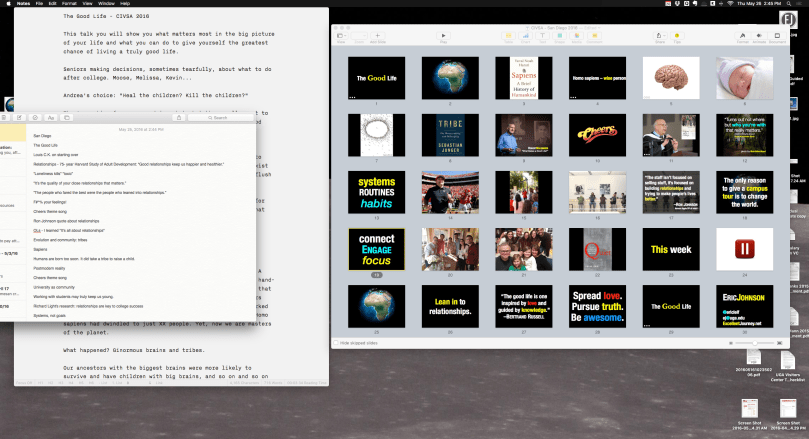
Showing my work: The Good Life, San Diego

Screen Shot 2016-05-26 at 2.44.56 PM

I’m giving the opening talk at my professional association’s annual conference in San Diego next Tuesday.

I’m not ready. Yet.

I’ve had a theme in my mind for a few months now, but the ideas are just now coming together.

When I’ve been asked to do these kinds of conference talks, I’ve been fortunate to be given the freedom to talk about what I choose, whatever I think would be of interest to this audience.

I do begin with the audience in mind. If I were in their seats, what would I want to hear? How would I want to feel? What ought to be said at this event, at this time?

But I’m also channeling whatever key idea has been churning in my brain recently, and having an audience is an opportunity to explore that idea in a structured way.

My aim is to awaken possibility and to send my audience out better than they were before they walked in.

I don’t know how effective I’ve been at transforming audiences, but I know that making the attempt to convey something meaningful to others certainly transforms me.

If you’re given a chance to express yourself, to speak or write or connect with others in any way, take it. It might make a difference for someone else, and it will make a difference for you.

*The screenshot of my desktop today shows my work in progress on this talk, and includes the apps Keynote, iA Writer, and Notes. I collected ideas in Notes on my phone, then began connecting them together with a narrative written in iA Writer. Lastly, I create slides in Keynote.


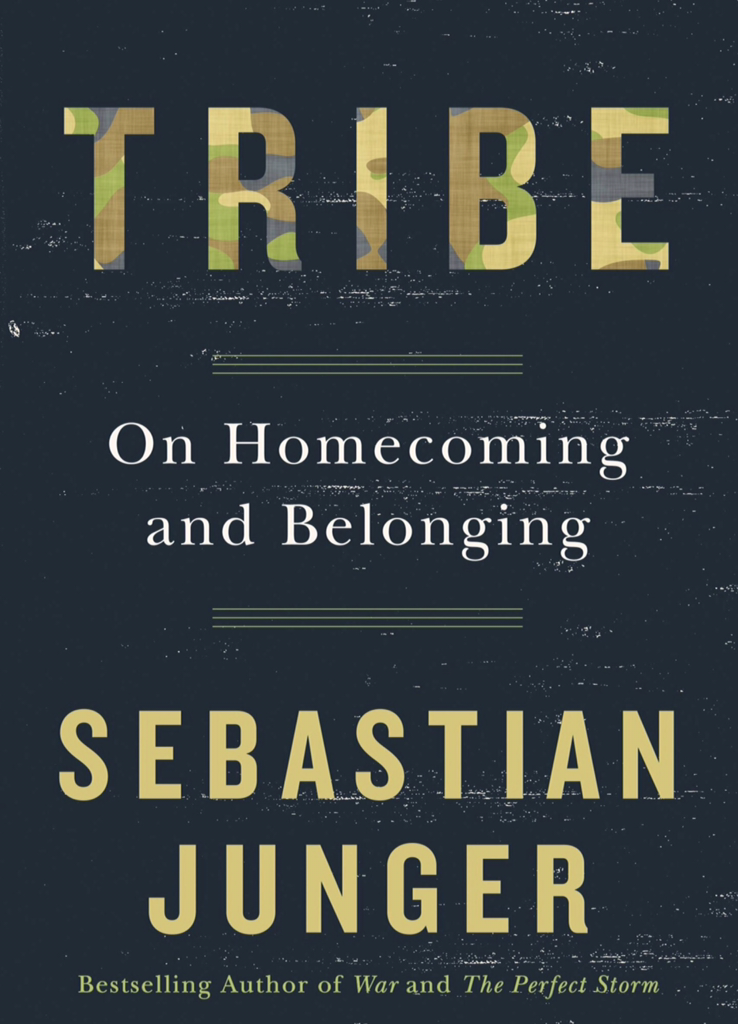
Tribe: Sebastian Junger’s book on what’s missing from modern society


When something is sparking your curiosity or rolling about in your subconscious, you start seeing it appear in your everyday life as though the universe is in sync with you. 

For example, when you buy a new car, or have your eye on one, all of sudden you start seeing that particular car everywhere. Your brain is simply more attuned to what you’ve chosen to focus on. 

Lately I’ve been exploring the significance of community and connection and meaningful relationships as keys to a good life. And stories and articles and books that propel that theme even further keep popping up on my radar. 

I just came across (and downloaded) Sebastian Junger’s new book, Tribe. His TED Talk on the topic is compelling, and his interview on Tim Ferriss’s podcast is fantastic. 

The premise is that millions of years of evolution shaped humans into social animals, and tribal creatures particularly. Our modern society is deficient in some of the basic tribal dynamics that are necessary for us to be fully functional and to more healthfully deal with the traumas of life. 

It is all about relationships

The most valuable commodity

The pursuit of truth and understanding, the neverending stretching of our boundaries of knowledge is THE human pursuit.

Sebastian Junger’s TED Talk: The consequences of a more disconnected society

This theme, that it’s all about relationships, keeps appearing in what I’m reading and watching. 

I watched this sobering TED Talk today by the author and war correspondent Sebastian Junger. It is a pointed indictment of a culture that is more disconnected and less tribal than ever. 

The rise in PSTD among returning soldiers, he asserts, may be more about the culture they’re coming home to than it is about their combat experiences. 

We are wired for community, for connection, to be a part of something beyond ourselves. If our culture is trending away from genuine, face-to-face human relationships, it’s on us to cultivate that connection. Our health and well-being are dependent on it. 

The quality of your relationships will determine the quality of your life. 

What I’m reading: Tom Holland’s Dynasty

I can’t get enough Roman history. I’m currently reading Tom Holland’s Dynasty: The Rise and Fall of the House of Caesar. Holland previously had written Rubicon: The Last Years of the Roman Republic, which, paired with Dynasty, tells a comprehensive and compelling and, frankly, disturbing tale of how the dominant empire of the ancient world came to be.

The stories in this latest book are chilling. The rulers of Rome were ruthless in their quest for power and their desperation to hold onto it.

And, wow, does Holland make this into a heck of a page-turner. I stayed up late last night just to find out how Caligula met his end. (Glad to be rid of him.)

One of my favorite novels is Robert Graves’s I, Claudius, a fictionalized account of much of the same history Holland covers in Dynasty. Apparently, the truth in this case is just as compelling as the fiction

Rome supposedly brought “civilization” to the western world. But the makers of Rome were astonishingly, perversely uncivil.*

Public discourse in our country right now may be disconcerting, but it’s harmlessly enlightened compared to first century Rome.

*My favorite of the Caesars, the philosopher-emperor Marcus Aurelius who ruled a little more than a century after these villainous emperors, shines even more brightly considering the dastardly legacy of so many of his predecessors. 

Coach Smart has a process for building relationships. You should, too.

Kirby Smart is the new head football coach at my alma mater. It’s Coach Smart’s alma mater, too.

This recent column highlights some of the methods the new coaching staff is implementing, and this part stood out to me:

Smart said the most important charge he has given his staff is to build trust with the players. To do that, he has directed Georgia’s assistants to meet with at least one player every day, and they’re to talk about anything but football. He also has the coaches ride the team buses to the temporary practice fields at the Club Sports Complex and never with their own position group.

“It’s about developing relationships with players,” he said. “If they don’t trust you, they will not give you everything (they) have.”

The cynic could see this as leveraging relationship-building merely to get better results on the field. Are these relationship efforts simply a means to an end, a savvy tactic to make the team more successful?

However, my own career experience has demonstrated repeatedly that it is indeed all about relationships. The culture of an organization or any kind of team is shaped primarily by the quality and authenticity of the relationships within the group.

It’s common for the leaders of an organization to be generally in favor of strong relationships and yet have not much to show for that sentiment.

What’s remarkable about Coach Smart’s approach is he’s building a system to take action on something most people passively hope will head in the right direction just because of good intentions.

Putting a system in place to support, realize, and build accountability for your good intentions is crucial.

I have learned this in my job recently, and it was my employees who showed the way. The student tour guides who lead the campus tours at our university have always been directed generally to make the tour experience conversational, to get to know the prospective students on their tour. But the tour guides systematized this directive themselves by setting an expectation that by the end of each tour they would have had an individual conversation with every prospective student on the tour and know each one by name.

That focus and that specificity has made our campus tour well known for its surprisingly personal nature and its emphasis on relationships. Visitors routinely remark on how delightfully surprised they were by the genuine connection our tour guides made with them.

It’s the clear, measurable expectation, though, that elevated the experience we offer into a consistently remarkable success.

What if we built systems and habits and routines, a process even, to make sure we take action on our professed priorities, especially about something as important as the quality of our relationships?

Schedule a standing date night with your spouse for every month and have the babysitter pre-booked.

Schedule a weekly time to call your parents or siblings or children.

Put time on your calendar to invest in conversations with your coworkers. I appreciate that Coach Smart forbid the assistant coaches to talk football in the daily meetings with individual players. Your relationship with your team members should be a relationship with a fellow human being, not just a coworker.

For family, friends, work, and community, be intentional about building and strengthening the quality of your relationships.

Make a plan. Put it on a calendar. And get busy investing your time in what matters most.


Sunday morning Stoic: Civic goals and your gift

Meditations 11.21:

“If you don’t have a consistent goal in life, you can’t live it in a consistent way.” Unhelpful, unless you specify a goal.

There is no common benchmark for all the things that people think are good—except for a few, the ones that affect us all. So the goal should be a common one—a civic one. If you direct all your energies toward that, your actions will be consistent. And so will you.

I keep being reminded of the emptiness of the pursuit of self-centered goals.

“What do I want to be, do, have, accomplish…?”

It’s natural to think this way and can be useful in propelling you forward. But in the long run, this mindset ends up feeling petty and superficial and ultimately uninspiring.

“I want a car, a house, a spouse…” Then what? A bigger car? A bigger house? A bigger spouse?

If you turn your focus outward instead, you will come up with more compelling goals, goals that are civic and ripple into the common good, not just your own good.

Ask, “What can I give?” rather than “What do I want?”

What can you contribute that will benefit others? How can you make a difference that elevates your community or solve a problem that pushes us forward?

What is your gift?

Meathead’s new BBQ book

I have been a big fan of Meathead Goldwyn’s web site, AmazingRibs.com. It is my go-to source for grilling technique and recipes. 

Meathead is actually something of a science egghead. He meticulously probes cooking methods and recipes to debunk myths and come up with the best possible results.

Now, he’s published a book filled with what he’s learned about grilling and smoking. I ordered it this week to give as a birthday gift, and I’ve spent the morning looking through it.

It’s a beautiful book with a hard cover and strong design elements throughout. A web site can be infinitely resourceful, but some information benefits from being in the form of an actual book. This is one worth putting your hands on. 

The book is filled with Meathead’s BBQ fundamentals, techniques, and equipment recommendations along with a solid assortment of recipes. He begins at the basics and takes you through the key information in a thoughtful, logical way. 

If you’re a novice, this book is the best starting point possible. If you’re an experienced grill master, you still will learn and be inspired.

Highly recommend. 

Kurzgesagt: The universe is crazy big

This video* is chock full of insights that clarify complicated concepts about the size of the universe.

And it’s a sobering reminder of just how small we are. The video points out that the local group of galaxies—that includes our Milky Way and the neighboring galaxies that are close enough to ever possibly consider exploring in some way—make up .00000000001 percent of the observable universe. The rest of the universe—basically all of it—will forever be beyond our reach.

In the very distant future, though, most galaxies will be so far from us that their light will never reach Earth. If humans are still here, or if intelligent life exists elsewhere, those future generations won’t see any signs of this vast universe that we know we inhabit.

How nice to be alive in a time of peak, supersize existential angst.

Kurzgesagt (which apparently means “in a nutshell” in German) is a brilliant YouTube channel that uses impeccably crafted, beautiful animated videos to explain science “in a nutshell”, as they say.

*via Kottke

Being normal is boring

“Normality is a paved road: It’s comfortable to walk, but no flowers grow.” –Vincent Van Gogh

via James Rhodes

No one is truly normal. We often adopt an air of normalcy as a means of self preservation. At least that’s what we think. 

But concealing our glorious oddness actually puts our true, weird self in jeopardy. 

There is no one quite like you anywhere. 

Don’t be deterred by the discomfort that comes with being the outlier you actually are. 

Come to the weird side. That’s where the flowers grow.