Balancing stock and flow

I just stumbled on this remarkable insight from the writer Robin Sloan who explains the economic terms “stock and flow” and relates them to the kinds of content we produce in this information age:

“Flow is the feed. It’s the posts and the tweets. It’s the stream of daily and sub-daily updates that remind people that you exist.

Stock is the durable stuff. It’s the content you produce that’s as interesting in two months (or two years) as it is today. It’s what people discover via search. It’s what spreads slowly but surely, building fans over time.

I feel like flow is ascendant these days, for obvious reasons—but we neglect stock at our own peril. I mean that both in terms of the health of an audience and, like, the health of a soul. Flow is a treadmill, and you can’t spend all of your time running on the treadmill. Well, you can. But then one day you’ll get off and look around and go: Oh man. I’ve got nothing here.”

So much of what I create is flow, fine for the moment but not particularly sticky, not worth talking about over time. Occasionally I make something reasonably solid that I know will still be meaningful, at least to me, months or years from now. But I mostly just stumble on those stock, substantive creations by simply showing up every day and attempting to do something small.

For better balance, more impact, and deeper satisfaction, I should be intentional about the kind of work that has staying power and makes a difference for more than just a day.

Posting on this site daily has been worthwhile and has rewired my attention each day in consistently surprising, constructive ways. But the daily updates don’t typically lead to the kind of substance that sticks.

What can I invest time in that will endure? What projects and pursuits could even have the potential to outlive me? Why not be bold and imagine doing work that just might resonate even a century from now?

I find real merit in the daily flow and the energy that it pulses through the rhythm of my routines. Now, balance that with the intention to dig deeper on work, on stock, that will last and structure habits and routines around that intention.

Aim high and dig deep. And keep showing up every day.
Quiet life, happy life

“A happy life must be to a great extent a quiet life, for it is only in an atmosphere of quiet that true joy can live.” –Bertrand Russell

Even when I’ve got the chance for quiet moments, I often fill them with noise and distraction.

Can I just be still?

Why not let the quiet steep? Let me sit past the restlessness to find the beauty and joy in the quiet.

“All of humanity’s problems stem from man’s inability to sit quietly in a room alone.” –Blaise Pascal

Unconventional wisdom

“Whenever you find yourself on the side of the majority, it is time to pause and reflect.” –Mark Twain

Running with the crowd may feel safe, but it shouldn’t make you feel comfortable.

The bold ideas, the original and courageous convictions, are most often at odds with popular opinion and conventional wisdom.

“When 99 percent of people doubt your ideas, you’re either completely wrong or about to make history.” –Scott Belsky

I’m an artist. You are, too.

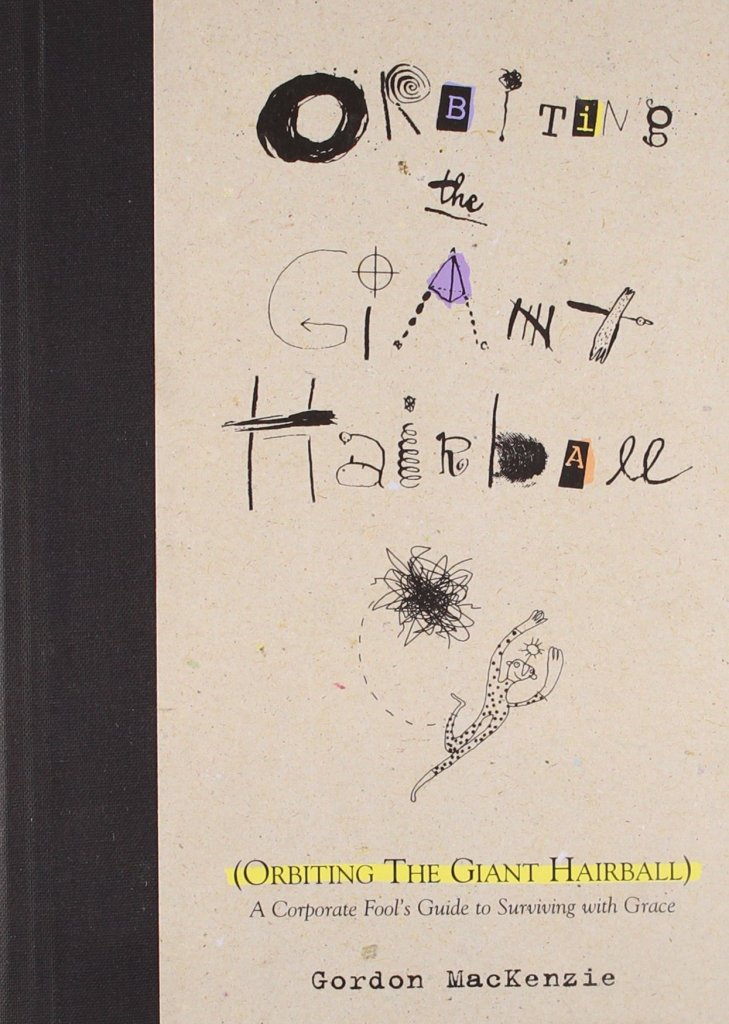
Orbiting the Giant Hairball is the kind of book that stays with you. I read it many years ago and still think of lessons from it. The author, Gordon McKenzie, worked at Hallmark, and the book explores his efforts to retain his independence and nurture his creativity within an often stifling bureaucratic organization.

In the most memorable story in the book McKenzie tells of his annual visit to an elementary school to share his art. He would start by presenting to the Kindergarten class and work his way up, talking to each grade level, all the way to the fifth-graders to finish the day. At each grade level he asked the students, “How many of you are artists?” Every Kindergarten student would quickly put a hand up. At the next class, though, a few first-graders did not raise a hand. A few more second-graders didn’t. Progressively, as he moved up in grade levels, fewer students raised a hand when he asked who were artists.

By fifth grade, no hands went up at his question. He then told the fifth-graders that every Kindergarten student had claimed to be an artist. “What is happening?” he asked them. “Are all the artists transferring out of this school?”

Of course, the point is something is happening to convince kids they are not artists. Parents or peers or teachers or culture or the system or some combination is turning off the default setting for creativity.

It’s on us to keep drilling back into the settings, our own settings and those of people we can impact, and turning back on the “I’m an artist” setting.

You don’t have to make a living off your art to be an artist. Just make something that only you can make – an experience, a photo, a meal, a poem or post, a song or video, a note to a friend. Express yourself. Make art. Go back to the Kindergarten default that you are an artist.

81OO-vQSZbL

Andromeda rising

This merits full screen. It’s a great video highlighting the most recent wonder from the Hubble Space Telescope, a stunning view into the galaxy nearest ours.

The density of stars in this image of just a portion of just one galaxy is incredible. And watch till the end of the video to appreciate the context. And remember that galaxy is headed straight for us.

If you need a regular dose of perspective, bookmark this video. When you feel the weight of the world on you, just pause and look into the sky and unburden yourself.

You are so, so small. But it’s glorious to be so small and yet able to ponder just how grand it all is.

A daily app: Pedometer++

IMG_6244


We have daily carry items. Everyday I put my keys, phone, and wallet in my pockets before leaving home. Now, most of us have daily apps, phone apps we use every day. These are the apps that stay on your home screen or not too far from it.

I’ve recently begun using Pedometer++ to track the number of steps I take each day. It only works with iPhone 5s, 6, and 6 Plus. The app design is simple and bright, and its function is basic: it just tracks how many steps you take in a day and the number of floors you may have climbed.

You can set the app to list your current steps on the little red badge on the app icon making it unnecessary to even open the app if you just want to check the number.

It makes me want to walk more. I love seeing the steps number go up. I’ll even make an extra effort to put my phone in my pocket at home, even in my pajamas, to make sure steps don’t go uncounted.

It’s a free app, but ads appear at the bottom of the display. With an in-app “tip”, you can support the developers and get rid of the ads. Yes, for me, to both.

This is a tiny little tool that is tweaking my routine and my consciousness in a healthy way and merits its use as one of my daily apps.

Advanced search for life’s big decisions

From Greg Mckeown’s excellent book, Essentialism:

“Applying tougher criteria to life’s big decisions allows us to better tap into our brain’s sophisticated search engine. Think of it as the difference between conducting a Google search for “good restaurant in New York City” and “best slice of pizza in downtown Brooklyn.” If we search for “a good career opportunity,” our brain will serve up scores of pages to explore and work through. Instead, why not conduct an advanced search and ask three questions: “What am I deeply passionate about?” and “What taps my talent?” and “What meets a significant need in the world?” Naturally there won’t be as many pages to view, but that is the point of the exercise. We aren’t looking for a plethora of good things to do. We are looking for the one where we can make our absolutely highest point of contribution.”

I need to remember to continually eliminate the good to hone in more clearly on the better. And then keep going, editing and discarding even those better options until I get to the best.

Be precise with your questions. Get specific, as detailed as possible, to find the best possible answer.

Sunday morning Stoic: Invisible man

Meditations 7.67:

“Nature did not blend things so inextricably that you can’t draw your own boundaries—place your own well-being in your own hands. It’s quite possible to be a good man without anyone realizing it. Remember that.”

It’s quite possible to be a good man without anyone realizing it.

What if your character was so strong, your virtue so impeccable, your goodness so subtle that you flew completely under the radar?

What if you were practically invisible, with no awards or glory or killer job offers or huge number of Twitter followers?

Be good, be honorable and virtuous and strong, not for any external reward or acclaim, but just for the virtue of the action itself. Don’t do this for that. Do this for this.

And don’t be discouraged or distracted from your focus on excellence if no one acknowledges you. This thought from Marcus is mirrored in this passage (chapter 17) from the Tao Te Ching:

“When the Master governs, the people are hardly aware that he exists. Next best is a leader who is loved. Next, one who is feared. The worst is one who is despised. If you don’t trust the people, you make them untrustworthy. The Master doesn’t talk, he acts. When his work is done, the people say, ‘Amazing: we did it, all by ourselves!'”

The Master doesn’t talk, he acts. When his work is done, the people say, “Amazing: we did it, all by ourselves!”

A clue to finding your work

Paul Graham:

“If something that seems like work to other people doesn’t seem like work to you, that’s something you’re well suited for.”

What do you not mind doing, or even enjoy, that others think is a chore or tedious?

I often ask this interview question (crafted by a former student –Thanks, Sarah!): What is something you love doing that most others find trite or tedious or boring at best?

The answer may not hold the key to career nirvana, but this line of questioning can uncover clues to lead you there.

More from Graham’s essay:

“The stranger your tastes seem to other people, the stronger evidence they probably are of what you should do. When I was in college I used to write papers for my friends. It was quite interesting to write a paper for a class I wasn’t taking. Plus they were always so relieved.

It seemed curious that the same task could be painful to one person and pleasant to another, but I didn’t realize at the time what this imbalance implied, because I wasn’t looking for it. I didn’t realize how hard it can be to decide what you should work on, and that you sometimes have to figure it out from subtle clues, like a detective solving a case in a mystery novel. So I bet it would help a lot of people to ask themselves about this explicitly. What seems like work to other people that doesn’t seem like work to you?”

David Foster Wallace: “This is water”

Merlin Mann pointed out that this great video, which had been taken down for copyright issues previously, is back on YouTube.

It’s from the late, great David Foster Wallace’s memorable Kenyon College commencement speech. And it’s as brutally honest and surprisingly insightful as any commencement speech ever dares to be.

Instead of offering lofty platitudes and exhortations for success, Wallace shines a light on the reality of “day in, day out” life. And life happens just one moment at a time.

I’ve gone back to this talk regularly for its sharp reminders about real life and real freedom.


Quiet desperation

IMG_1258

 
There are thoughts we think, but dare not speak. Questions without answers, or with hard answers we would rather not consider.

In the still, quiet moments right before you drift off to sleep – that’s when it’s quiet enough, when the distractions recede just long enough to hear your life calling to you.

Listen. And act. Go confidently. Or just go, even haltingly.

Live the life you have imagined.


Live immediately

Seneca, possibly the most eloquent of the Stoic sages, from the work most consider his masterpiece, On the Shortness of Life (via BrainPickings):

“Putting things off is the biggest waste of life: it snatches away each day as it comes, and denies us the present by promising the future. The greatest obstacle to living is expectancy, which hangs upon tomorrow and loses today. You are arranging what lies in Fortune’s control, and abandoning what lies in yours. What are you looking at? To what goal are you straining? The whole future lies in uncertainty: live immediately.”

Just start.

Hardcore History: Blueprint for Armageddon V

2015/01/img_6234.jpg


I was delighted when I opened my podcast app (Overcast) and found a new episode of Dan Carlin’s Hardcore History. I’ve raved before about how great Carlin’s work is, but new episodes don’t appear very often. And when you listen you understand why. I can’t imagine the hours that go into creating each episode. The research alone for a single episode must take weeks or months. And a four-hour episode flows seamlessly, meaning the preparation and editing involved in laying out the narrative so smoothly has to take a lot of time.

This latest episode is the fifth in his series on World War I. The complexities of that conflict are overwhelming, and I would not, even after hours of listening to this series, be able to recall the names of the constantly changing cast of generals and political figures. But what I get from this podcast, from the accretion of details and small stories and heartbreaking anecdotes, is an overarching sense of the insanity of our history. It’s fascinating and compelling to follow the flow of events and lives that collide in often tragic circumstances.

I listen while driving alone or while walking. My drive to work is only around fifteen minutes, but I look forward to Dan Carlin regaling me in those short bursts of time with true stories of humanity’s biggest events and told with Carlin’s characteristic enthusiasm and drama.

Here’s a good interview with Dan Carlin that explores how this podcast came to be and how he works.

If you haven’t discovered podcasts yet, Hardcore History is an excellent one to start with. It’s not light or quick. But it’s as rewarding a show to listen to as any I’ve discovered.

The invincible human being

I had previously filed away this article, “Why Stoicism is one of the best mind-hacks ever“, and just dug it up out of Instapaper. It’s a good summary of some basics of Stoic philosophy. And, at the center is this, beautifully explained by the author:

What the whole thing comes down to, distilled to its briefest essence, is making the choice that choice is really all we have, and that all else is not worth considering. ‘Who […] is the invincible human being?’ Epictetus once asked, before answering the question himself: ‘One who can be disconcerted by nothing that lies outside the sphere of choice.’

Any misfortune ‘that lies outside the sphere of choice’ should be considered an opportunity to strengthen our resolve, not an excuse to weaken it. This is one of the truly great mind-hacks ever devised, this willingness to convert adversity to opportunity, and it’s part of what Seneca was extolling when he wrote what he would say to one whose spirit has never been tempered or tested by hardship: ‘You are unfortunate in my judgment, for you have never been unfortunate. You have passed through life with no antagonist to face you; no one will know what you were capable of, not even you yourself.’ We do ourselves an immense favour when we consider adversity an opportunity to make this discovery – and, in the discovery, to enhance what we find there.

“Choice is really all we have.”

You can choose your response, your attitude, no matter the circumstances.  Some “bad” event can be redefined as “good” if you use it to learn, to grow, to become a stronger person. Imagine embracing all that occurs as though it was part of a master plan to refine you into an invincible human being.

Sunday evening Stoic: Wash off the mud

Meditations 7.47:
2015/01/img_1283.png

Of course, you do revolve with the stars. And, our view of the stars and the perspective they provide has magnified profoundly since the second century when the emperor wrote those words.

The image in the slide above is the latest bit of wonder from the Hubble space telescope. It’s an incredible new photo of Andromeda, the galaxy nearest to our Milky Way. You can see so many far, far away stars, and in just one little speck of the nearby universe. (Consider this image for a good sense of how massive Andromeda is, but also for an appreciation of what a small speck we are in relation to the wonders of the universe.)

The world too much with you? Weighing you down? Stuck in the mud of life and not seeing the light? Look up. Look within. Let the big picture cascade over you and wash away the mud.

We are living in wonder land.

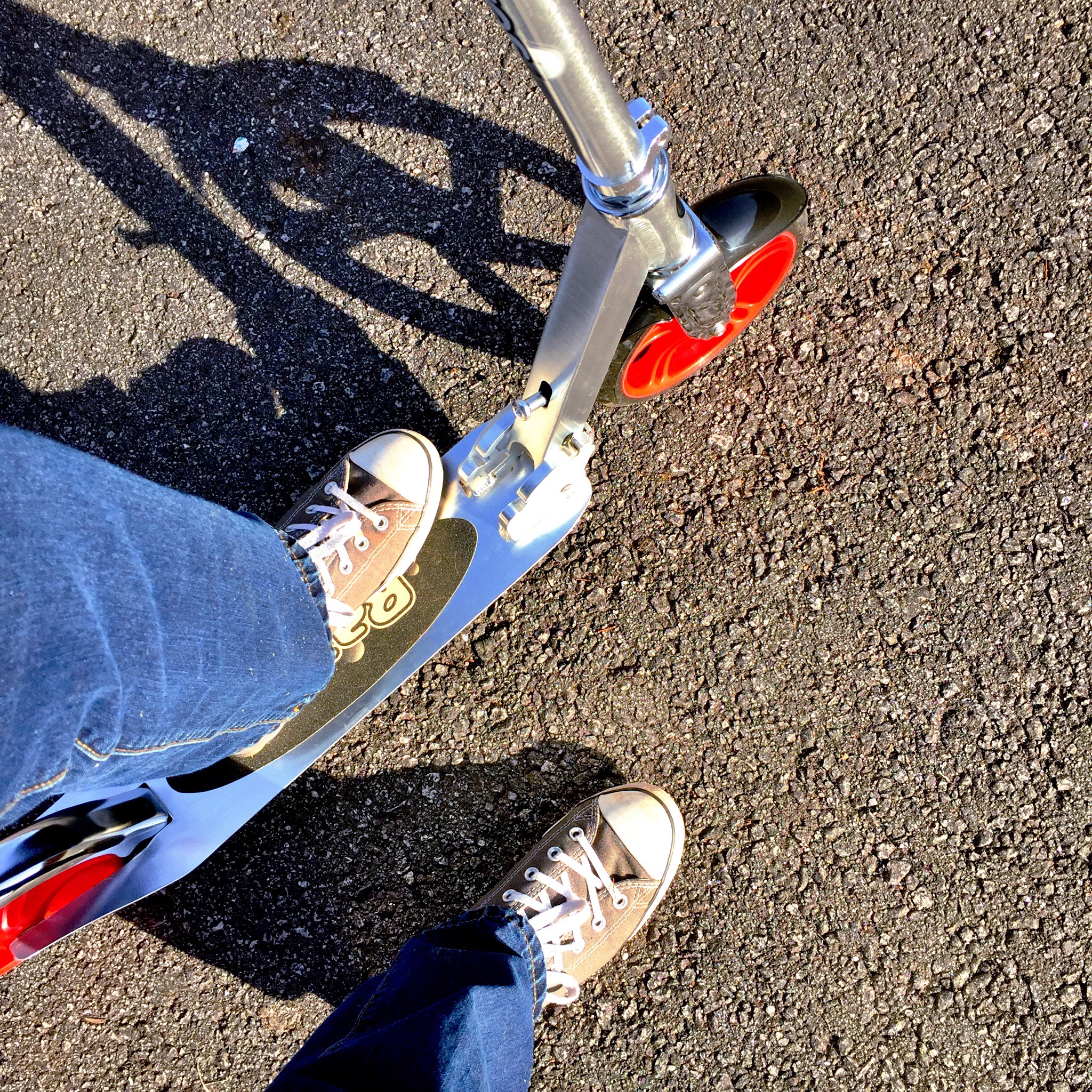
Razor A5 scooter: No age limit on fun

2015/01/img_6222.jpg

This Razor A5 scooter is a blast to ride. Yes, I’m 50 years old, but I’m not too old to enjoy the thrill of coasting downhill on a kick scooter.

Today was a family fun day with my kids. My 7-year-old learned to ride a bicycle last week, and she’s been eager to get outside and try her new skills.

The scooter we got her last year is just sitting there now that she has this new love for her bike. What’s a dad to do?

“Out of my way, kid on a bike! Dad on a scooter coming around.”

This thing is a delight to ride. The large wheels give it a smooth ride, able to handle bumps and uneven pavement. The handle adjusts to fit kids or adults (who are just big kids). And it’s a solid little machine, clearly well designed and well made.

Thumbs up for the A5 from kid and dad.

Bill Murray: More fun, more better

2015/01/img_6210.jpg

Image credit replaceface via Scott Schiller

Here’s a bucket list item: randomly encounter Bill Murray and engage in spontaneous wackiness. Stories abound about Bill Murray sightings and the delightfully funny escapades that often ensue.

This Rolling Stone article highlights some great moments in random fun with Bill Murray.

On the job fun:

Murray’s St. Vincent co-star Melissa McCarthy confides, “Bill literally throws banana peels in front of people.” I assume she’s using “literally” to mean “metaphorically,” as many people do, but it turns out to be true: Once during a break in filming when the lights were getting reset, Murray tossed banana peels in the paths of passing crew members. “Not to make them slip,” McCarthy clarifies, “but for the look on their face when they’re like, ‘Is that really a banana peel in front of me?'”

Fun with kids:

Murray transforms even the most mundane interactions into opportunities for improvisational comedy. Peter Chatzky, a financial-software developer from Briarcliff Manor, New York, remembers being on vacation at a hotel in Naples, Florida, when his grade-school kids spotted Murray having a drink poolside and asked him for autographs. Murray gruffly offered to inscribe their forearms but ended up writing on a couple of napkins instead. Jake, a skinny kid, got “Maybe lose a little weight, bud,” signed “Jim Belushi.” Julia got “Looking good, princess. Call me,” signed “Rob Lowe.”

Murray has realized that it’s when he’s having fun that he is most truly himself and able to offer his best:

Like all of Murray’s best film work, it originates in his stress-free mentality. “Someone told me some secrets early on about living,” Murray tells a crowd of Canadian film fans celebrating “Bill Murray Day” that same weekend. “You can do the very best you can when you’re very, very relaxed.” He says that’s why he got into acting: “I realized the more fun I had, the better I did.”

I need to be reminded regularly to not take life so seriously. A guy like Murray is probably constantly asking himself, “What’s funny about this situation?” or “How can I have fun with this?”

My primary work is about providing experiences, and fun has to be a big part of it. Not scripted or programmed fun, but the kind that flows naturally out of the moment. I’ve got to keep reminding myself to actively model spontaneous fun and allow my team to relax and make some moments worth talking about for the people we serve. Break the pattern. Do the unexpected. But don’t try too hard.

My best presentations stand out in my memory for the fun I had connecting with the audience. When I deviate from the plan and say or do something unexpected or get the audience to laugh, usually at me. Walking into a moment with the attitude, “Let’s have some fun here” can make everything better, whether it’s a job interview or a first date or a presentation or even a Monday morning in your cubicle in a soulless, downtrodden workplace.

And reading this about Bill Murray is a good reminder to have more fun with my family, to be silly and spontaneous more often with my wife and kids. Now that we are back in a daily school and work routine, it’s easy to sleepwalk my way through each morning and evening, checking off the tasks. But it only takes a few moments of being truly awake to add real juice to your days and make them more meaningful and more fun.

And waking up, when sleeping is the norm, seems to be Murray’s ultimate aim, for himself and for those he encounters:

Another essential Murray principle: Wear your wisdom lightly, so insights arrive as punch lines. When pressed about his interactions with the public, he admits that the encounters are, to a certain extent, “selfish.” Murray shifts his weight on the couch and explains, “My hope, always, is that it’s going to wake me up. I’m only connected for seconds, minutes a day, sometimes. And suddenly, you go, ‘Holy cow, I’ve been asleep for two days. I’ve been doing things, but I’m just out.’ If I see someone who’s out cold on their feet, I’m going to try to wake that person up. It’s what I’d want someone to do for me. Wake me the hell up and come back to the planet.”

Only 51 weeks left in 2015

december-31st

I know, I know… Give it a rest, right?

But December 31, 2015 is now exactly 51 weeks away. One whole week of 2015 is gone.

I hope it was a good week and a lovely start to your year. Each of the next 51 weeks will disappear just as suddenly.

I tend to overestimate what can be accomplished in a week or two, thinking I can completely revolutionize my life in a fortnight. (Yes, I just used the word fortnight for the first time in my life. The joy of this landmark moment that you are sharing with me right now, it’s inexpressible. This glow of vocabulary achievement will linger for at least, what, fourteen nights, maybe.)

I, however, tend to underestimate the impact of incremental, consistent, even if slow, improvement. Just keep being awesome in small ways, and do it over and over even if you don’t notice any big change. You can usually only see the big change looking back on it over a long period of time. It sneaks up on you. You can’t see it while it’s happening.

But you won’t get there by trying to check off your list of awesome in one fell swoop. Just start. Do what you can with what you’ve got where you are. And then keep at it and improve just a little. And 51 weeks later you might truly surprise and delight yourself.


Just start

Screen Shot 2015-01-07 at 4.14.45 PM

“JUST DO IT” is a compellingly catchy slogan, but it’s a bit overwhelming and slightly frightening for some of us.

“Really? I don’t think I can do it. So, I just won’t even try.”

But, just starting, that’s not so risky or intimidating.

Just attempt one push-up. Just take a short, easy walk. Just start writing something, even just a sentence, that you don’t have to share with anyone if you don’t want to. Just say “Hello” to that person. Just try that new habit for a week or two and see what happens. Just begin that hard thing you don’t feel confident about or eager to do.

Don’t even think about the entirety of the project or the goal. Most goals are arbitrary anyway. And imagining the steps down the road can take your focus off the one step right in front of you now. And that step is not so hard.

Thinking about starting is not the same as starting. Don’t worry about being perfect or getting it just right. The audacity of beginning something that could end up being awesome might give you enough oomph to get over the hump of meh.

Meh is a good place to begin, actually. You can trick yourself by saying, “Let me start with this awful, unimpressive, tentative first step or first draft.” Intend to be mediocre if you have to to take the pressure off. And then you can’t help but get better if you keep going.

But you can’t keep going if you don’t get going.

Just start.