Six weeks left in 2014: 4th-graders showing the way

december-31st

I’ve been invited to speak to my daughter’s 4th-grade-class this morning. One of her teachers reads this site and was inspired by my countdown of the remaining weeks in the year. She’s been talking with her students about finishing strong this year and having them come up with some goals and habits for themselves.

Fourth-graders are not my typical audience, except for my daughter who hears me way too much. (I think she still thinks I’m pretty cool for now, though. Don’t know how much longer that will last.) Maybe there’s not too much difference between college students and 4th-graders. Both groups seem to have an eager, appealing, puppy-like quality about them that gets hidden by some of them in the early teen years. And both 10-year-olds and 20-year-olds seem open to new possibilities in a way that people my age rarely are.

I’ll be curious to hear what goals these 9- and 10-year-olds have come up with for the last few weeks of the year. I’ve not got any prepared presentation or slides to show. I plan to hear what’s on their minds and talk through the process of creating routines and building habits to craft their lives into becoming who they want to be.

And I’m drafting this in order to help me think through what exactly I want to say. I’ve been stuck trying to think of how to approach these kids, and the best way I know of getting unstuck is to just write, to get moving in some direction even if it’s a wrong one.

I want to leave their classroom today with these kids having a clearer understanding of their own power to shape their lives and some strategies to take action right away. And I hope we have some fun talking about possibilities and new ideas and how to be more awesome.

I’ll report back on how it goes and what these kids are dreaming of to finish the year strong. Counting today there are only 43 days left in 2014. Let’s make these last six weeks the best weeks of the year.

Thoughts on job interviews and college students

It’s interview season at my work. Last week we interviewed almost 300 college students who applied to work as campus tour guides. We conducted group interviews with six applicants at a time being interviewed by a four-person committee. I was in every interview and wouldn’t have it any other way.

This week I’m interviewing the 39 finalists we selected from last week’s group interviews. These are individual, half-hour interviews.

It’s the two most important weeks of the year for my work. It takes a lot of time to go through these interviews, but there’s nothing more crucial to our culture and our mission. The students we select to serve on our staff almost completely determine our organization’s culture as well as the quality of the work we do. Our logistics and process and web site cannot make up for a mediocre interaction with our people. The experience is our product.

Hire for attitude, and train for skill. I would rather have a team member with no experience and a thin resume than one short on kindness and sincerity and charisma. And charisma is a thing. There’s an intangible likeability quality that jumps out with some interviews. It’s confidence, but not too much. It’s charm, but not forced. It’s interestingness, but not so much or so different that it’s distracting or seeming to be contrived.

Years ago I interviewed Craig to be a student orientation leader. Before his interview I reviewed his application, and the only activity on it was intramural basketball. This guy didn’t have the usual list of college accomplishments and organizations, so I wasn’t expecting much. But he shined in his interview. He was confident and kind and funny and showed that he had the kind of charisma that would make him a great fit. We hired him, and he was terrific in his job.

I admire all the students who have the courage to apply and give it a go and show up for an interview. For many it’s the first interview experience of their lives. We are doing a service by giving them the opportunity to have this experience, and I’m happy to spend two weeks listening.

Occasionally, an applicant will ask, “What are you looking for in a candidate?” And it’s not a particular resume item or demographic check box. We are looking for people who have genuine enthusiasm and a commitment to our calling and kindness and the eagerness to connect with prospective students and to possibly infect them with the same feelings they now have for higher education and its potential to transform their lives.

Charisma is caring deeply and having the courage to wholeheartedly express what it is you care about.

Charisma is caring deeply and having the courage to wholeheartedly express what it is you care about. I don’t think it’s a matter of having it or not having it. Everyone has it, somewhere within. And we let it out with varying degrees of frequency and intensity.

The best interviewees are the ones who walk in with the intent to connect without too much regard for the outcome, without being attached to the stakes. If you can go into an interview with the sole goal of having a great conversation with your fellow humans, where you listen and understand and express what’s most meaningful to you, you will be a success whether you’re hired or not. If you walk in too caught up in getting the thing, you will be less than your best self. The attachment will restrict and confine you.

You can’t control what other people do, whether they like you or want to hire you. Get those thoughts out of your head. Focus only on what you can control: your attitude, your body language, your enthusiasm for you what you care about.

Don’t be afraid to shine. Why not unleash your charisma?

As I am sitting through this final week of interviews, I am delighting in great conversations with young people who are interesting and passionate and kind. I get to watch as some of them come alive as they may never have before. I get to learn from watching 19- and 20-year-olds in the spotlight. It’s a good gig.

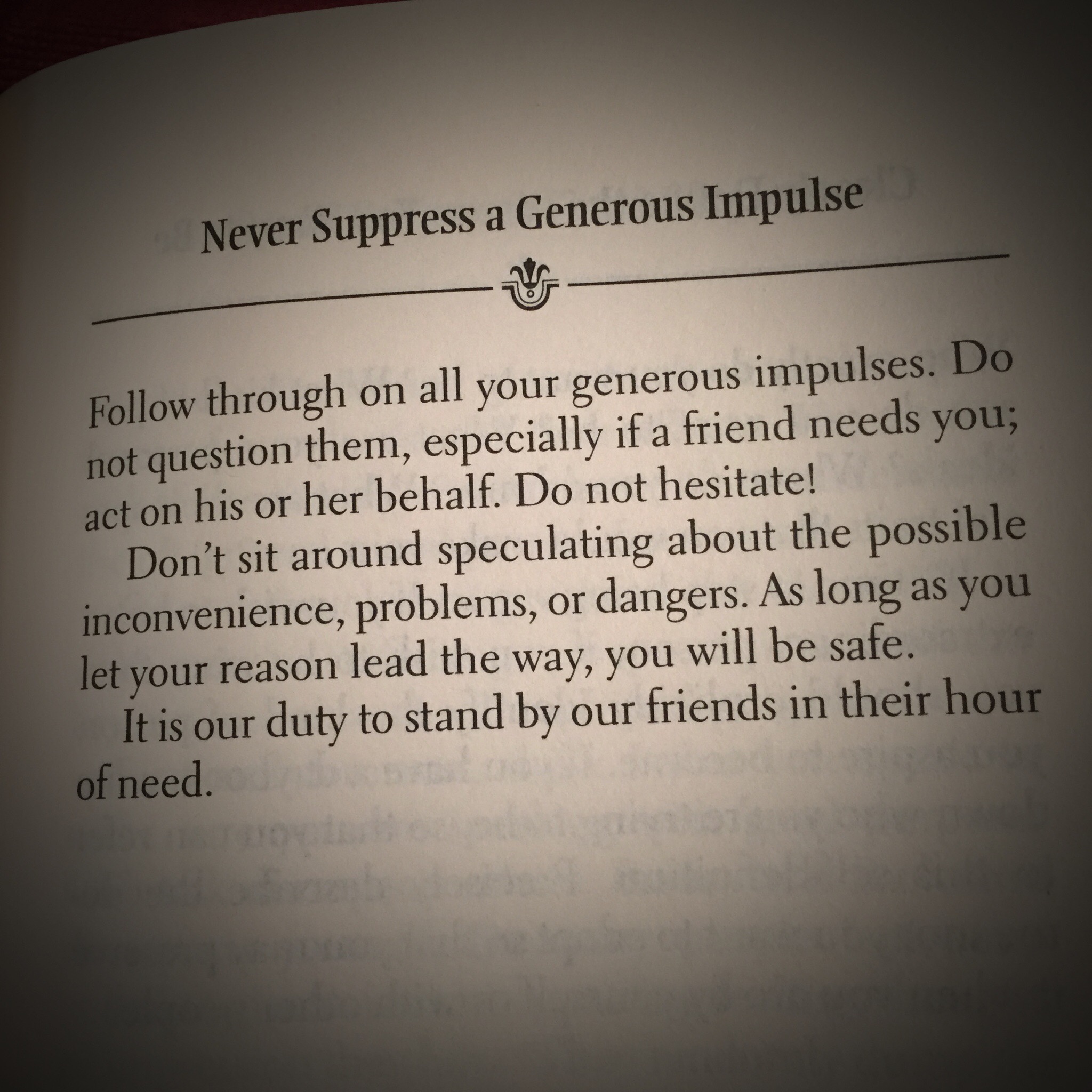
You won’t regret being generous

Epictetus in The Art of Living:
IMG_5866.JPG

My 10-year-old will still occasionally remind me of the time a few years ago when she saw me decline a stranger’s request for a couple of dollars. I was in a hurry and didn’t want to be bothered to fish around in my wallet for a guy on the street I would never see again.

My daughter was surprised, and clearly disappointed, I didn’t help the man. I regret the message that sent to her. I regret my failure to model generosity in front of her.

I have never regretted being too generous, though. When you consider an impulse to give, in money or service, see how it feels to up the ante, to offer even more than you think reasonable.

My wife is good like that. I will suggest a reasonable, safe gift, and she will trump it with an offer to do even more. And then I think, “Of course! Why not do better and give more if we can?”

Honor your impulses to do good, to give, and to be kind.

Sunday morning Stoic: Perspective

Meditations 9.32:

“You can discard most of the junk that clutters your mind—things that exist only there—and clear out space for yourself:
… by comprehending the scale of the world
… by contemplating infinite time
… by thinking of the speed with which things change—each part of every thing; the narrow space between our birth and death; the infinite time before; the equally unbounded time that follows.”

I remember even years ago walking into work, feeling burdened and stressed by whatever seemed pressing at the time, and visualizing a view from above. Like in a dramatic scene in a movie, the picture in my mind would zoom out from wherever I was and let me see just how small I was until I was the size of an ant scurrying across this grand landscape. And then I couldn’t help but smile at the foolishness of my little worries.

When you fly and look out the plane window you can get the same sense of the smallness and insignificance of whatever petty concerns are tugging at you.

Seeing the really big picture – from the vast scale of the universe to the fleeting nature of our experience of it – can restore perspective and shine a light on the insanity of our daily worries.

If it freaks you out a bit to be reminded how small we are, how brief our time here is, welcome to reality. But it’s important, also, to appreciate how special it is that we can even think at all and ponder and marvel at our place in this perplexing, magnificent universe.

Excellent day

IMG_5844.JPG
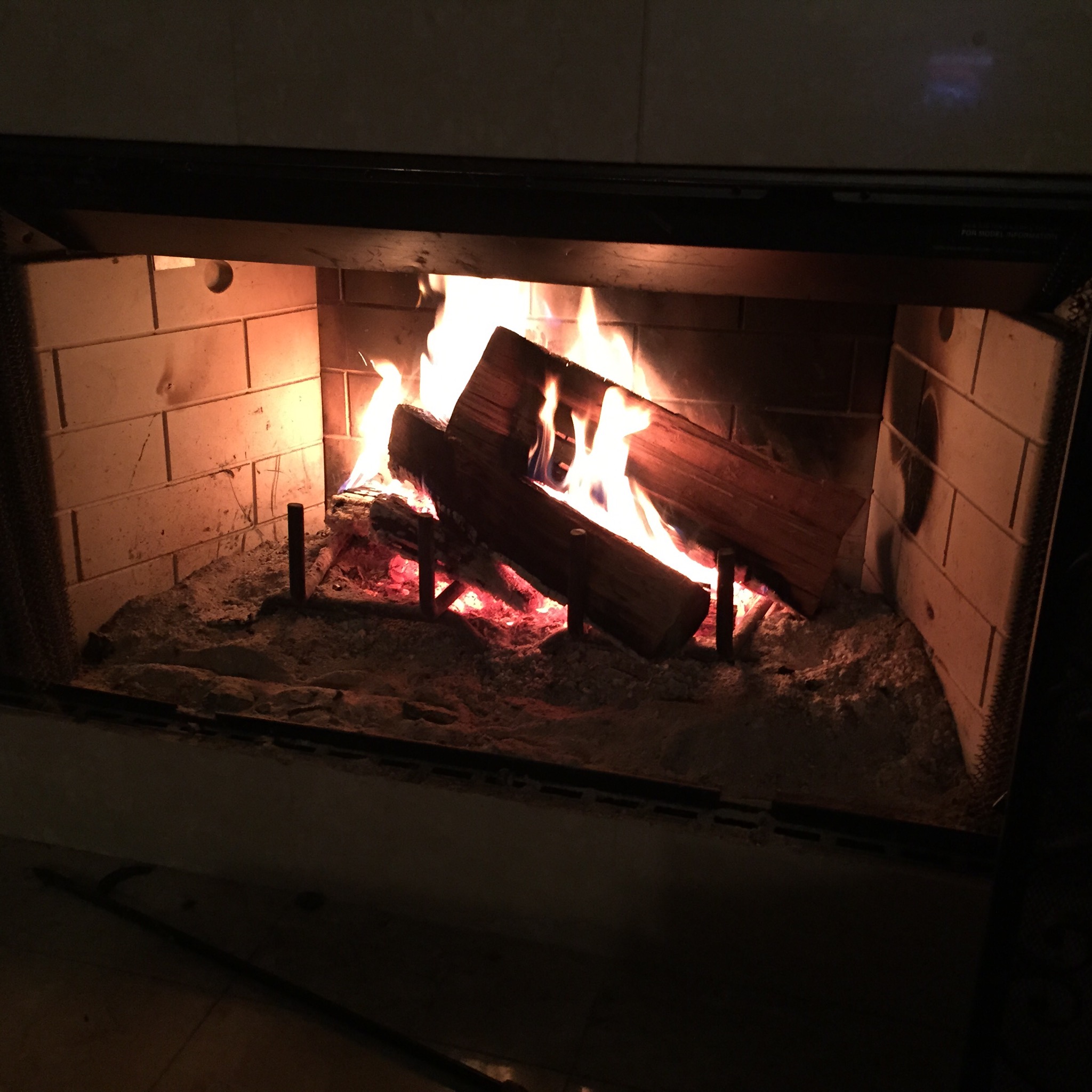
We had tickets to the big game tonight. But it’s been a full, happy day. And the kids are away at a slumber party, and it’s an unusually cold night. And when do we get a night at home alone to sit by a fire and watch the big game from our couch?

I regularly ask this question in job interviews: “What would an ideal day look like for you?”

When I ask that interview question, I’m more often than not disappointed at the responses. So many stumble and search and seem perplexed trying to imagine their ideal day. It’s clear most people have not given much thought to what would make for an excellent day.

Imagine, in detail, the components of your ideal day. An excellent life ultimately is just a collection of excellent days. What if you were intentional about crafting your days and building them around what was most important, around what added the most value to your life, and around what truly delights you?

For me, today has been an especially excellent day.

Imagining a better future


IMG_1264

I just started reading Zero to One, the new book by entrepreneur Peter Thiel. He opens the book with this contrarian question he asks in job interviews: “What important truth do very few people agree with you on?”

He’s usually disappointed by the answers. He says a good answer takes this form: “Most people believe in x, but the truth is the opposite of x.” He goes on to say that good answers to the question can point us to the future:

“But what makes the future distinctive and important isn’t that it hasn’t happened yet, but rather that it will be a time when the world looks different from today. In this sense, if nothing about our society changes for the next 100 years, then the future is over 100 years away. If things change radically in the next decade, then the future is nearly at hand. No one can predict the future exactly, but we know two things: it’s going to be different, and it must be rooted in today’s world. Most answers to the contrarian question are different ways of seeing the present; good answers are as close as we can come to looking into the future.”

I was 5-years-old when Apollo 11 landed on the moon. I assumed we would all have flying cars and be living in a completely peaceful and prosperous Jetsons-like world by the time I was 50.

But progress in our time has been mostly iterative, fine-tuning of previous breakthroughs, not revolutionary. Cars are a little safer and more comfortable and a bit more energy efficient than when I was a kid, for example. Communication technology has been the exception.

I’m inspired by the possibility of what could be if we put our intellectual horsepower to work on asking better questions about the future.

What do we take for granted that needs challenging? What basic assumptions are just wrong? What could the world look like 50 years from now if we stretched our collective imagination for the best possible options for humanity and all life on this planet?

What is an important truth that most of us are just wrong about?

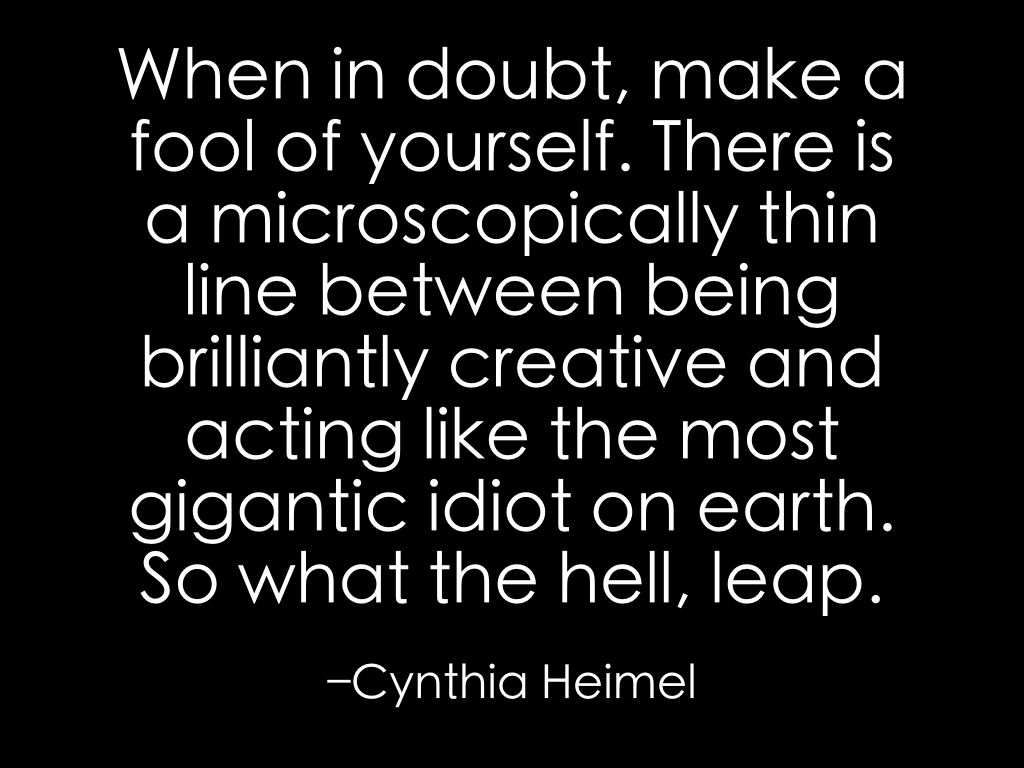
Make a fool of yourself

“Compulsive avoidance of embarrassment is a form of suicide.” –Colin Miller

Austin Kleon shared this quote in his excellent, short book, Show Your Work!

To risk being vulnerable takes courage, and there’s no guarantee of success to reward your courage. In fact, failure and disappointment are more likely than success when you attempt hard things and open yourself to disapproval and even ridicule.

But not much good will come from the safety and caution of avoiding embarrassment. Keep flinching and you risk dousing the creative fire inside you.

I’m too proud of how cool I am, or appear to be. Throw off your coolness. Make a fool of yourself if you have to to bring out your best self and your best work.

And cheer for and stand up for those with the guts to risk embarrassment in their attempt to be or do something excellent.

IMG_1263.PNG

Seven weeks left in 2014: Habit List app

december-31st

I’ve been counting down the weeks left in the year, and we are at the seven week mark today.

I’ve been diligent with most of my finish-the-year-strong habits – getting in my mile walk every day, sticking with the hundred push-ups plan, and posting to this site daily. (Not so solid with my reading habit, though. Commit to a book, man!)

I remembered a habit tracking app I used last year, Habit List, and re-downloaded it. I was delighted to find a new and better design than when I last used it. I’ve tried the very popular Lift app, but I’m not interested in the social component, and the app is just not focused enough for what I want in a habit tracker.

Jerry Seinfeld apparently kept a big calendar on his office wall and crossed off each day on the calendar when he wrote, a daily habit that was a high priority for his work. And he was obsessive enough to not want to break the streak, so the calendar with the red “X”s compelled him to write every day if only to keep the streak alive.

Habit List is that calendar, but on your phone, in your pocket. You load in the habits you want to keep consistently and how often you want to do them. Then you can easily track how you’re doing. I get a small but satisfying boost whenever I tap that I’ve completed that habit for the day and keep the streak going.

And I feel a little tug of uneasiness as long as a habit remains unchecked for the day. I came in from a trip late Sunday night and was tired. But I didn’t want to break my “mile walk” streak, so I put on a jacket and grabbed the leash and took Mosley on a brisk walk through the neighborhood, going just far enough to check off the mile habit for the day.

Remember, systems are better than goals. Do what it takes to consistently put your priorities in front of you, to shame yourself if you have to, in order to act like and become the person you want to be.

Screen Shot 2014-11-11 at 8.53.44 AM
Habit List app

Steve Martin and innovation

2013-04-17

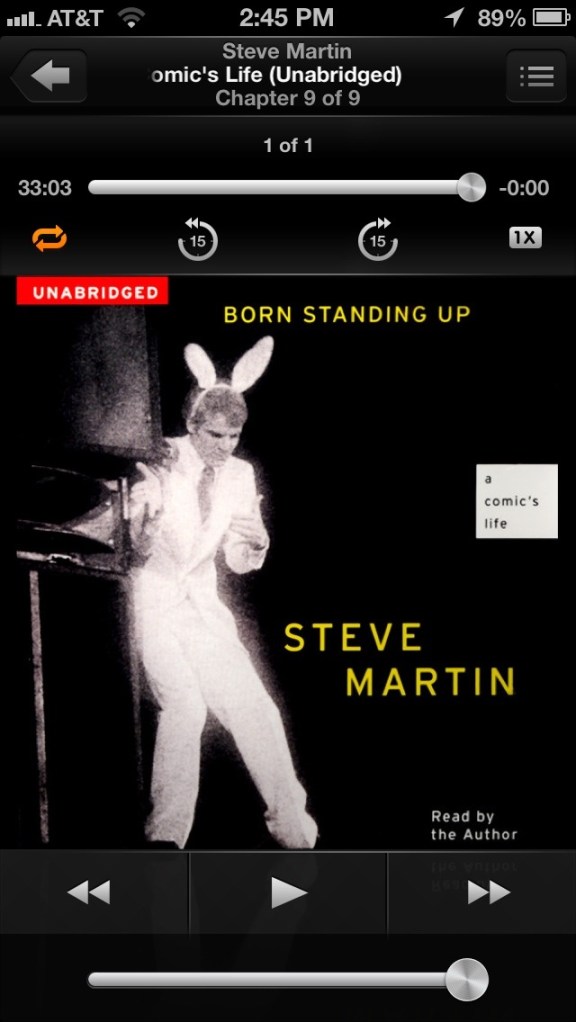
I’ve shared before that my favorite audiobook is Steve Martin’s Born Standing Up. He narrates his own story, which is immensely entertaining as well as instructive about what it takes to stand out in your field.

Cal Newport, author of So Good They Can’t Ignore You, linked to one of his older posts about Martin’s influence on his career philosophy. Here’s Newport explaining a key element of Martin’s success – innovating, not just polishing:

Paying your dues is overrated. Simply putting in the time is not enough. Martin’s story is one of a constant urge to innovate. He was trying to figure out the essence of “funny.” He then yielded these insights to move beyond the static structure of the punchline that dominated performance comedy at the time. This restless urge to understand then innovate led him to be outstanding. Without it, he would have just become another good comedian. Like hundreds of others.

You need to do the same. Understand what the best exemplars in your field do well. Figure out why. Then ask how you can mix, match, and reconstruct these elements into something new and even better.

It’s not just about working hard. You’ve got to think hard, too, and determine how you can go where no one has gone.

I just downloaded a sample of Peter Thiel’s new book, Zero to One, which is about this concept. Greatness is more than iteration and improvement. It is creating something remarkable where before there was nothing at all. If you want to shine, you’ve got make the leap from merely good at more of the same to remarkably great in a way never done before.

The magical math of marriage

IMG_1261.JPG

I was intrigued by this book on marriage and ordered it last week. It just arrived, and I haven’t started it yet. I have not read many books on marriage. But I’m looking forward to thinking more clearly about how my wife and I can make our marriage even better.

I want to be more intentional about nurturing the most important relationship in my life. It’s easy to let the crush of busyness and routine, especially with two genuine, full-speed kids ruling our schedules, keep us from making space for our marriage.

I heard Joseph Campbell say that the key for a successful relationship is to put the marriage ahead of any individual interests. The marriage is a separate, unique entity. You don’t make sacrifices for the other person; you do it for the marriage, something bigger than even the two of you separately. And what we have together is more dynamic and has more creative potential than what either of us can realize on our own.

That’s some magical math. It’s synergy, where the whole is greater than the sum of the parts. 1+1 is somehow more than two.

Strong relationships are possibility machines.

Strong relationships are possibility machines, in families and business and in friendships. It’s worth making the effort to examine and nurture the most important relationship of all. Honoring my marriage will pay dividends to my kids. Loving my wife well is as much a gift to my kids as anything I could do for them directly.

What will matter most, what will mark the true success of our lives, is the quality of our most significant relationships.

The truth about art

We all know that art is not truth. Art is a lie that makes us realize truth. –Pablo Picasso

Jason Silva keeps making good stuff. I appreciate his effusive expressiveness. He’s got charisma, and I love how he’s using video to convey in short bursts his passion for ideas and feelings that awaken possibility and shine a light on what could be.

This Paradox of Art video is a good reminder of the value of art and the power of effective art to communicate truth beyond its own form.

I remember as a teenager being frustrated reading poetry in high school English class.

“What does it mean?” “I don’t get it.” “What’s the point?”

I was trying to read poetry as if it were prose. I grew to understand that art could point to something far from its explicit expression. As I grew in my own depth, the beauty of art began to reveal itself to me.

I don’t have to get stuck to the words in a poem. Those words should send me to an understanding or insight or emotion that I otherwise wouldn’t experience were it handed to me directly.

And when I try to express myself, I need to remember to embrace the freedom offered by metaphor and mystery. I don’t have to serve it up straight and cold and direct. In fact, allowing and encouraging the audience to ponder and search and discover is preferable. As Kubrick said, giving your audience “the thrill of discovery” will allow your art to connect even more deeply than if your truth was just handed over.

Of course, art is infection, as Tolstoy explained. So, don’t make your work so impenetrable that it has no effect.

And all of us are artists, we all can create and offer something of value. Get busy creating and trying to express your truths as artfully as you can.

Eight weeks left in 2014: Walk on

december-31st

I’ve been counting down the weeks left in the year, and we are at the eight week mark today.

I’ve been consistent with the hundred pushups challenge, but not so much with my reading habits. Get on that, man. Wake up earlier. Stop getting lost in internet mazes. What if I read eight more books before New Year’s Day? Compiling my list tonight.

I’m adding a new habit this week: walk a mile every day. It’s an easy, quick distance to cover. The dog needs the exercise and the attention, and I need to get moving more often.

Walking is a simple, primal activity that is good for body and mind. Mark Sisson published a post recently detailing the prolific walking habits of some great thinkers – Aristotle, Thoreau, Wordsworth, Dickens, and Beethoven among others.

Sisson quotes this from Soren Kierkegaard:

Above all, do not lose your desire to walk. Everyday, I walk myself into a state of well-being & walk away from every illness. I have walked myself into my best thoughts, and I know of no thought so burdensome that one cannot walk away from it. But by sitting still, & the more one sits still, the closer one comes to feeling ill. Thus if one just keeps on walking, everything will be all right.

The author of my favorite book, Brenda Ueland, wrote about the therapeutic benefits of leisurely, meandering walks. She went on a solitary, five to six mile walk every day to tend to her creative spirit. Harry Truman was famous for his daily, brisk walks and lived a long and interesting life.

Few things refresh and recharge like a walk. And sitting for a living as most of us do necessitates some intentional movement for a healthier life. Setting a goal of just one mile each day, which takes twenty minutes or less, makes this so doable. I could do this at lunch or early in the morning or include the whole family in the evening. I’m using the Runkeeper app to track my distance traveled.

I want to be stronger and healthier and building my day around healthy routines and productive habits will make a bigger impact than setting random goals.

Wake up knowing you’ve got to get your mile in each day. Walk on.

Shine for someone

I found this anecdote a while back:

“Maya Angelou was once asked what was her secret to being such a good writer and poet. Her response was, ‘Because when I was a little girl, every time I walked into a room my daddy’s eyes lit up.’”

I can’t trace it to an interview with Maya Angelou or verify it’s her story, but it rings true for me and seems to fit what I know of her. Every person is unique and has the gift of their never-to-be-duplicated presence to offer. But that sense of worth needs nurturing, and the potential for a truly radiant spirit and creative gift can be quashed without regular doses of encouragement and eye-shining love.

Whose eyes have shined for you? Who has given you the courage to be your best, to dare to be more than even you have imagined?

My parents, my grandmother, my sister. They all made me feel like I was special. My wife has the most amazing eyes of anyone I’ve ever seen, and I was smitten on our first date when she shined those gorgeous blue eyes on me with as much delight and focused attention as I’d ever known, as if I were, at that moment, the most interesting man in the world.

And when I’m giving a presentation, I live for those in the audience who smile back at me, who nod and engage from where they are. Who laugh at my humor, or fake it just to be kind. And I want to be that kind of person for someone else when I’m in an audience.

I’ve been fortunate to have a lot of people offer me encouragement throughout my life. Who do you need to appreciate for the encouragement you’ve received? Who have been your biggest fans?

And who gets the gift of your shining eyes? Who do you light up for? Whose fire can you warm yourself at?

I want to regularly light up for my wife and daughters and for the people I work with and for strangers who cross my path. It’s easy to take for granted the people we see often. But those closest to us deserve to be reminded that we are grateful for their presence.

It takes courage to express enthusiasm when “meh” is the prevailing sentiment.

Most human interactions are self-absorbed and monotonously sterile. Genuine enthusiasm and delight and focused attention seem shocking by comparison, and it takes courage to express enthusiasm when “meh” is the prevailing sentiment. But don’t you grow a little bigger inside when someone lights up at your presence?

Have the courage to be encouraging, to embolden those you encounter. Give your complete attention to the person in front of you. Genuinely connect with the random people you see and may never see again as well as with the people in your life every day. Be known for the energizing effect you have just for the delight you take in acknowledging the presence of others.

Get excited and allow your eyes to light up when others walk in the room. Shine for someone.

Peaking at 80

Screen Shot 2014-11-04 at 8.27.12 AM

I’ve been telling students recently they should make decisions with the intent to peak at 60. The long game will reward you.

I chose 60 because it seemed distant enough for a college student to imagine the long arc of a career. As a 50-year-old myself, though, 60 is shockingly close now and not much of a long game for me.

Then I came across a post from Kottke who linked to this excellent New York Times feature on masters in their field who are still doing great work into their 80s and beyond.

Here’s Tony Bennett:

“Here I am at 88, and I still feel like I have an awful lot to learn, today and tomorrow and the next day and the next day. About my craft. About how to become a better artist. About coming up with creative ideas.”

There are profiles of people from a variety of professions, and the recurring theme is a discontent that propels constant growth and a relentless commitment to learning and improving.

Don’t ever arrive. Keep striving.

“The tree of knowledge and the fountain of youth are one and the same.” –Lewis Lapham

Sunday night Stoic: Calm, purposeful, authentic

IMG_1256.PNG
A new week to practice the traits you want to characterize your life.

Keep calm and rise above the frenzy. Breathe and observe. Choose to respond with poise.

Be intentional in your actions. Don’t worry about appearing to be busy, but know that purposeful action is powerful. Don’t wait and waste what little time you’ve been afforded. Just begin.

And be real, be authentic. Don’t try to be. Just be. Don’t overthink how you are perceived. Speak and act and think as best you know how right now.

Bonfire

IMG_5803.JPG

Many a man has a bonfire in his heart, and no one comes to warm himself at it. –Vincent Van Gogh

Sitting by a warm fire on this cold night in Tennessee reminded me of this great line in a letter Van Gogh sent to his brother, Theo.

Everyone has a fire within, with the potential for it to be stoked into something great with a little attention and care. It is a noble calling to be one who helps others come alive just by listening and encouraging and being present.

Just keep going

IMG_1255.PNG
ht Jason Silva

Times are tough for you? Patience. This will pass.

All is well? Life seems good? This, too, shall pass.

Anxiety, elation, frustration, satisfaction, boredom… No feeling is permanent.

It doesn’t matter how you feel. Just keep going. It’s what you do and how you respond that matters most.

Can you simply observe your emotions and your thoughts without getting lost in them? Me, neither.

But those who are masters of mindfulness have described a state where you can watch your thoughts and feelings flow by as if you were in that empty space behind a waterfall. Sign me up for a comfortable chair in that blissful spot.

Observe and inhabit all you think and feel knowing it’s all impermanent. Don’t get down on yourself for being unable to control the torrent. Learn to observe and be curious. And just keep going.

Data, data everywhere…

B1BjcvhIIAANOI7-1.jpg-large

*From a Jeremy Waite tweet

And there are a lot of stars in the sky.

We are traveling in uncharted territory. The information age we are creating has us swamped with more to read and see and hear than humans have ever encountered. We are constantly consuming words and images and ideas. I find it a challenge to just sit or do anything not requiring complete attention without reaching for a device to beam some more info my way.

I am grateful to be living in the future. I live to learn and grow. But I’ve got to build in some quiet, some space carved out from the noise of the nonstop flow of information. Maybe meditation is the way to go. Or a daily walk sans earbuds.

What’s the balance between consuming and creating and just being? What systems and habits do I need to build into my daily life to better navigate through the sea of data we’re all swimming in while still living an authentic, present, fully human existence?