Back to awesome

I’ve been slacking. (Not slack-lining. That would be cool.)

This is not cool. I put my good habits aside for a minute, which is perfectly okay in moderation. But that minute turned into weeks.

I’ve not been diligent with what I eat and how I move. Too much sitting. Way too many food-like substances. (Curse you, Ben… and Jerry.)

Not focused enough when I work. Not present enough with my family.

Just not aiming for awesome often enough.

No one seems to have noticed. But I have. And I want to rededicate myself to habits and systems that lead to excellence, for the sake of those I love and those who expect the best from me and for my own self-respect.

“Get it together, man.” Indeed.

Awesome doesn’t happen in an instant. But deciding to be more awesome does.

Mark Twain On Being Unafraid Of Dying

The fear of death follows from the fear of life. A man who lives fully is prepared to die at any time.

And this:

I do not fear death. I had been dead for billions and billions of years before I was born, and had not suffered the slightest inconvenience from it.

Doing summons feeling

From R.J.Baughan’s The Joy of Doing:

“Men do not really live for honors or for pay; their gladness is not in the taking and holding, but in the doing, the striving, the building, the living. It is a higher joy to teach than to be taught. It is good to get justice, but better to do it; fun to have things, but more to make them. The happy man is he who lives the life of love, not for the honors it may bring, but for the life itself.”

via Art of Manliness

There’s magic in action. Just start. Do the thing you want to do for the simple joy of doing the thing.

And even when — especially when — you don’t feel like doing the thing, do it anyway. Doing usually summons feeling.

Stoic Zen: The glass is already broken

Kottke shared this paragraph from Mark Epstein’s book Thoughts Without a Thinker: Psychotherapy From a Buddhist Perspective:

“You see this goblet?” asks Achaan Chaa, the Thai meditation master. “For me this glass is already broken. I enjoy it; I drink out of it. It holds my water admirably, sometimes even reflecting the sun in beautiful patterns. If I should tap it, it has a lovely ring to it. But when I put this glass on the shelf and the wind knocks it over or my elbow brushes it off the table and it falls to the ground and shatters, I say, ‘Of course.’ When I understand that the glass is already broken, every moment with it is precious.”

This is Zen. But also very Stoic.

Negative visualization is a Stoic practice. Imagining and accepting the worst case can help me better appreciate what is while preparing me for what could be.

Sunday morning Stoic: Only the present

A crisp, bright, quiet spring Sunday morning.

A cup of tea (coconut) and Marcus Aurelius’s Meditations.

A Sunday morning ritual for me.

It’s hard to open this book without reading a passage that delights or challenges and refreshes my mind with its clarity and straightforward insight.

This passage today, 8.35:

“Don’t let your imagination be crushed by life as a whole. Don’t try to picture everything bad that could possibly happen. Stick with the situation at hand, and ask, “Why is this so unbearable? Why can’t I endure it?” You’ll be embarrassed to answer.

Then remind yourself that past and future have no power over you. Only the present—and even that can be minimized. Just mark off its limits. And if your mind tries to claim that it can’t hold out against that … well, then, heap shame upon it.”

Only the present.

More better

You are going to die.

I am, too.

(Warm, happy way to kick off a conversation. I’m fun at parties.)

The universe is staggeringly massive.

For every grain of sand* on Earth, there are at least 10,000 stars in the visible universe.

Amazing, right?!
*And yes, there’s an algorithm for determining the number of grains of sand on Earth. Also amazing.

We are infinitesimally small.

Our time is limited.

(The average human lifespan fills just .000001 percent of the entire history of the planet.)

In the big scheme of things — the REALLY big scheme — who we are and what we do doesn’t seem to, in the words of Humphrey Bogart in Casablanca, “amount to a hill of beans in this crazy world”.

Yet we all are so busy and in a hurry and stressed out.

Our to-do lists tug at us and unsettle both our conscious minds and our subconscious and even sneak into our dreams at night.

Our calendars are filled with meetings and appointments and projects and task-forces and so many things that won’t be worth remembering or talking about.

How much of what we do makes a real difference and is truly meaningful?

How often do you get to the end of a day and lay your head on your pillow and feel genuine, wholehearted satisfaction about the way you spent a precious day in your short life?

Maybe it’s unspoken existential angst or cultural brainwashing from childhood or tyrannical bosses that fling us into the futile effort to do MORE, check MORE off our lists, accomplish MORE…

…in the effort to have more and be more and somehow win at life.

MORE. MORE. MORE.

But what if…?

What if you apply “MORE” to quality rather than quantity?

What if you did LESS, but did it BETTER?

Do LESS, but do it MORE BETTER.
(Grammar police, look away.)

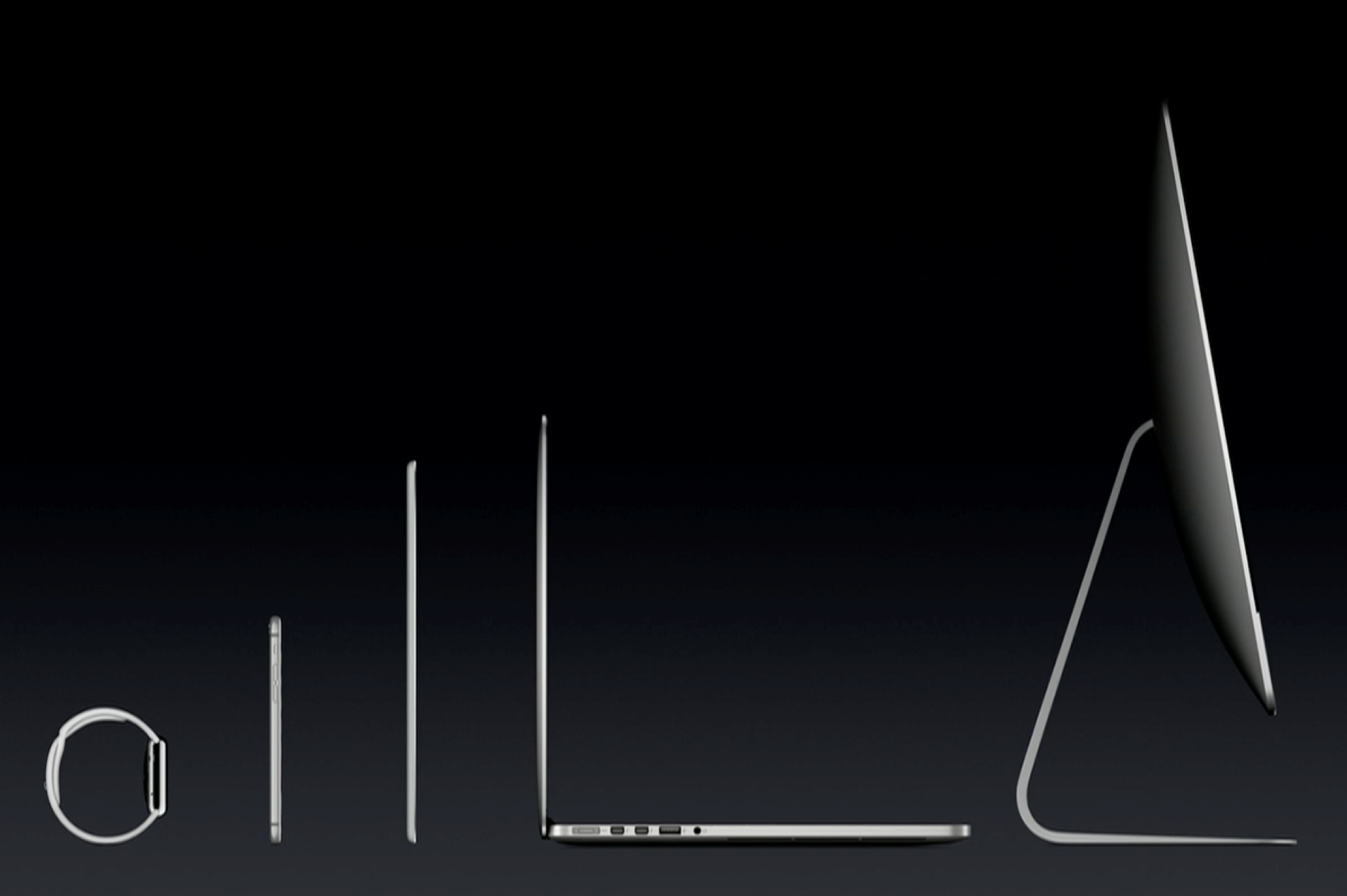
Here is almost the entire product line of the biggest, richest company in the world:

Screen Shot 2015-05-01 at 5.03.55 PM

All of Apple’s products could fit on a conference room table.

Steve Jobs attributed much of his success to saying “No” to make room for a better “Yes”.

Steve Jobs:

“Innovation is saying no to 1,000 things.”

Albert Einstein, too:

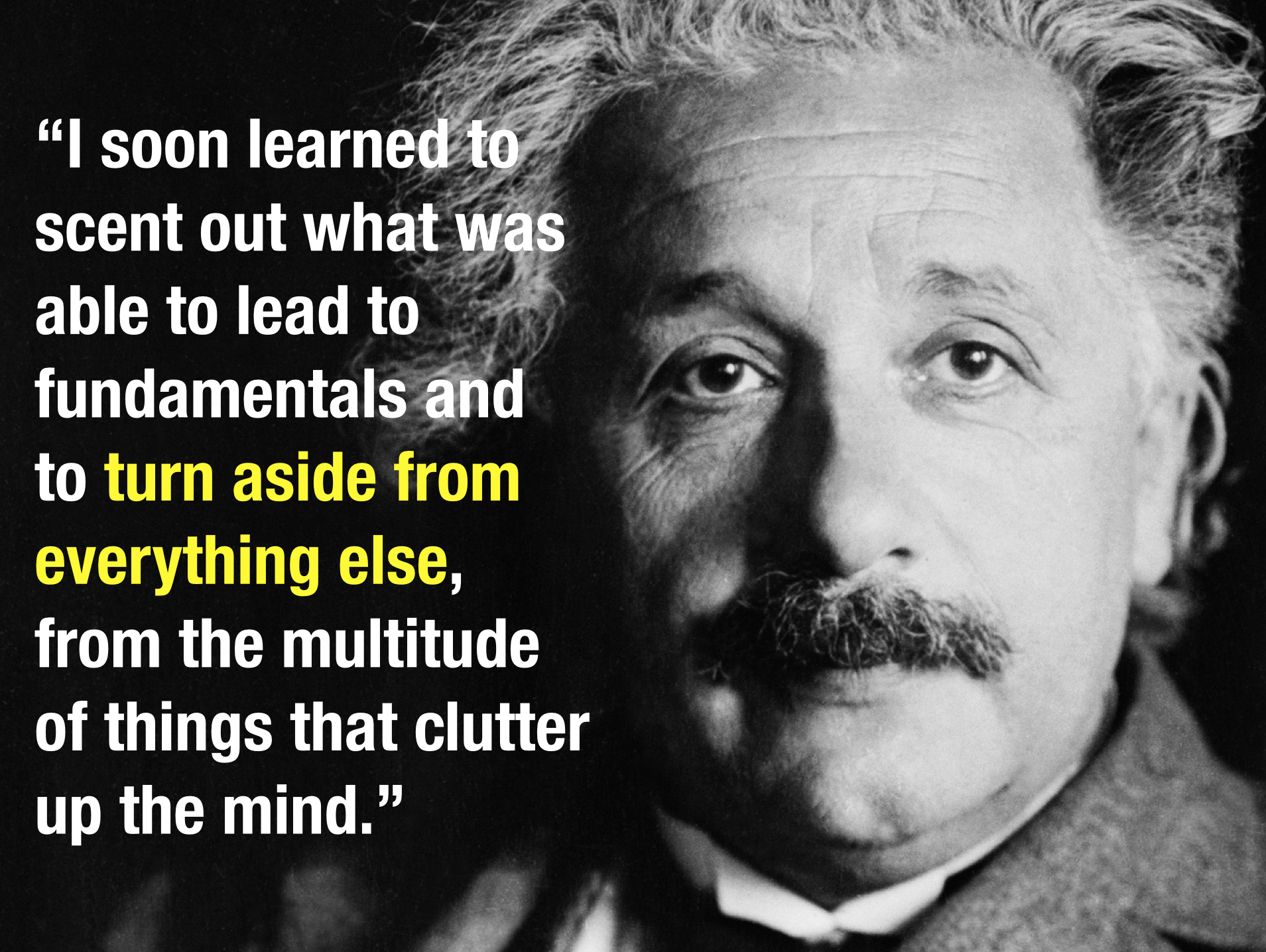
“I soon learned to scent out what was able to lead to fundamentals and to turn aside from everything else, from the multitude of things that clutter up the mind.”

Warren Buffett:

“The difference between successful people and unsuccessful people is that really successful people say no to almost everything.”

Jazz great Thelonius Monk:

“What you don’t play can be more important that what you do play.”

Steve Jobs, Albert Einstein, Warren Buffett, Thelonius Monk — all champions of doing less, but doing it better.

Imagine honing your focus and investing more of your limited time and attention in things that matter most.

Imagine the rewards of deep work and quality time on fewer projects.

Imagine more quiet moments and eye contact and actually taking time to listen intently.

What would intense focus on fewer things do for your work life, your relationships, your peace of mind?

But, to have that kind of focus, you have to be ruthless at saying “No” to even really good and noble things as well as to time-wasters and trivial distraction.

And you have to say “No” to nice people and to “good” opportunities.

Derek Sivers says when he’s confronted with a new opportunity, if his response is not a “Hell, YEAH!”, then it’s simply a “no” for him.

“Hell, YEAH!”

Or

“no”

That may be extreme, but exceptional, more better lives tend to defy convention.

Consider the things in your life, professional and personal, that are most important.

Make a list. Prioritize it.

What if you cut that list down to just a few key priorities, the things that would have the biggest impact and matter the most?

And what if you structured your time around giving those few key priorities more of your attention?

Peter Drucker, paraphrased:

Management is doing things right. Leadership is doing the right things.

What if you built habits around the few priorities that have the biggest impact in your work and your life?

Consider whittling your daily to-do list down to one or two key tasks, tasks that would benefit from close attention and deep focus.

Consider overhauling your schedule by cutting out most meetings.

Turn off notifications on your devices.

There are people who only check email at designated intervals — first thing in the morning, around noon, and in the afternoon.

Crazy, right? Who does this?

I’m guessing Warren Buffett doesn’t live out of his email in-box.

Einstein didn’t surf the internet. 😉

(We’ll give Steve Jobs a pass on this one.)

What can you: streamline, unclutter, simplify, clarify?

Instead of a buffet, a smorgasbord even, of services and options, what if you offered just a few truly great choices?

Is your purpose, your mission — for your team, your family, your work, your life — clear?

Crystal clear?

How much stuff do you possess that you don’t really need, that’s not either useful or beautiful?

Less stuff, but better stuff.

Fewer pursuits, but more rewarding pursuits.

Picture the end of your life.

What kind of life do you want to look back on?

It will be quality, not quantity, that will matter most at that point.

And that should matter most now.

Do less…

… better.

*This is the thought stream for a presentation I will be leading at a conference next month. I posted a PDF of this from a Keynote document for use by the audience prior to the presentation. It can stand alone but is intended to be a warm up for what I hope will be a lively conversation.

Be obsessed

Justine Musk (Elon Musk’s wife) had this as part of her response to a question on Quora about how to be as successful as Bill Gates, Steve Jobs, Elon Musk, and Richard Branson:

Be obsessed.

Be obsessed.

Be obsessed.

If you’re not obsessed, then stop what you’re doing and find whatever does obsess you. […] Don’t pursue something because you “want to be great”. Pursue something because it fascinates you, because the pursuit itself engages and compels you. Extreme people combine brilliance and talent with an insane work ethic, so if the work itself doesn’t drive you, you will burn out or fall by the wayside or your extreme competitors will crush you and make you cry.

Intrinsic rewards over extrinsic rewards.

Be the audience

Filmmaker Christopher Nolan (Inception, the Batman trilogy, Interstellar) had this response recently when asked how he thinks of the audience when creating films:

“Every stage in the process, I try to be the audience,” he answered. “I don’t think of the audience as someone else. We’re all a part of the audience.”

I’m in the process of putting together a presentation for an upcoming conference, and I’m stuck. Well, not really stuck. I just haven’t started.

I’ve been futzing around in my mind with what I want to say and coming up with little that excites me.

But who cares what I want to say? Instead, I should focus on the audience. What could I offer that would awaken possibility in them and send them out better and happier for our time together? If I were in the audience, what would delight and fascinate and challenge me?

Make the audience the hero of the story. It’s not about you. You’re not the focus, even though it’s you standing on stage. The point is the potential transformation and the heroic potential of those in the room that you’re serving.

Put yourself in the audience. Be the audience. And see if that unsticks you.

A poverty of attention

Nobel Prize winner Herbert Simon:

“In an information-rich world, the wealth of information means a dearth of something else: a scarcity of whatever it is that information consumes. What information consumes is rather obvious: it consumes the attention of its recipients. Hence a wealth of information creates a poverty of attention and a need to allocate that attention efficiently among the overabundance of information sources that might consume it.”

And he said this in the 1970s, long before the internet.

There is more information available now than ever before in human history. This is uncharted territory.

Is our attention strained and scattered more than ever before? Mine is. My hunger for information seems insatiable. But my ability to focus on one thing, or one person, for a meaningful amount of time has gotten more fragile.

Paying attention — deep, focused attention — has become a kind of superpower. That’s the muscle I need to be trying to strengthen.

Screen Shot 2015-04-28 at 5.03.50 PM

Hiatus

My wife and I are headed out for a week-long adventure and a much needed getaway for just the two of us.

As excited as we are for a vacation together, we are truly sad to leave our kids for a week. We’ve never been apart from them for more than a few days. This little week will fly by for all of us, I’m sure, and bring us back together refreshed and with renewed appreciation for each other. (Or lifelong bitterness from our kids that they were stuck in school while mom and dad were frolicking in the sun on a tropical getaway.)

For this week, though, I also will be taking a hiatus from posting here daily.

I challenge myself to post daily. And I find it to be a worthwhile practice. I begin each day with the expectation that I need to find something worthwhile to share. This intent adds a juicy tension to my days. My antennae are up. Knowing I need to find something to write even a few words about before the day is done, my mind is on a constant search for ideas and insights. I’m a hunter-gatherer of possibilities. Most days don’t deliver any profound poetic breakthroughs. But occasionally I’ll stumble across something that resonates and reshapes my imagination in even a tiny, but meaningful, way.

And then the practice of trying to craft the words to express myself, as hard as it continues to be, brings this painfully earned satisfaction. Writing never feels easy. But it’s a worthwhile struggle.

When doing a guided meditation the instructor may at some point tell you to intentionally let your mind wander away from your breath for a moment. Then, after that pause, you’re guided to bring your attention back to your body and to your breath.

That hiatus and then coming back is a reassuring reminder that you have control. Falling off the path for a moment does not mean you’re lost. It’s the getting back on, and knowing you will get back on the path, that matters.

I just might still post while I’m away this week, but I’m not sticking to my daily discipline. I’ll start a new string of daily writing after this brief hiatus.

Aloha!


Michener’s Hawaii: Pairing reading and travel


My wife’s company is sending us to Hawaii for a week as a reward for her great sales performance in the past year. 

I’ve never been to Hawaii, but it’s a place that’s always been near the top of my dream destinations list. 

To get myself in an island state of mind I started reading James Michener’s epic novel, Hawaii

So good. 

Michener reaches way back as he begins with the geological history of the place and the story of the volcanic eruptions that eventually launched the islands from deep within the Pacific.  From there he gradually builds a narrative of the first people to find the islands, and it’s an incredible story of risk and courage and skill. I’m locked in to this great book and eager to immerse myself in all things Hawaii as we plan for our trip. 

When I visited Italy years ago I re-read I, Claudius, the masterful novel set in first century Rome. Like pairing wine with a meal, it’s a delight to pair fiction with an upcoming journey. You see the place you’re visiting with an enhanced imagination, primed to absorb the experience more vividly. 

I’m intent to savor this trip to Hawaii. This novel is helping me dial in the tone of the place ahead of my visit and will hopefully help me better appreciate what may be a once in a lifetime experience. 

Thich Nhat Hanh: Understanding is love’s other name

“Understanding someone’s suffering is the best gift you can give another person. Understanding is love’s other name. If you don’t understand, you can’t love.” –Thich Nhat Hanh

Via BrainPickings.com

If you truly understand someone, you can’t help but love them. 

Consider making the attempt to understand the perspective of anyone you feel you don’t, or can’t, love. 

Even if you could never approve of his actions, understanding—seeing the world even for a moment the way he does—will give you compassion for him. 

No pointless actions

Meditations 8.17:

“If it’s in your control, why do you do it? If it’s in someone else’s, then who are you blaming? Atoms? The gods? Stupid either way.

Blame no one. Set people straight, if you can. If not, just repair the damage. And suppose you can’t do that either. Then where does blaming people get you?

No pointless actions.”

Warren Buffett and the “avoid at all cost list”

Cal Newport shared this Warren Buffett story, which was passed on by someone else and may be only apocryphal. But the point of the story certainly seems in line with what we know of Buffett’s philosophy:

Buffett wanted to help his employee get ahead in his working life, so he suggested that the employee list the twenty-five most important things he wanted to accomplish in the next few years. He then had the employee circle the top five and told him to prioritize this smaller list.

All seemed well until the wise billionaire asked one more question: “What are you going to do with the other twenty things?”

The employee answered: “Well the top five are my primary focus but the other twenty come in at a close second. They are still important so I’ll work on those intermittently as I see fit as I’m getting through my top five. They are not as urgent but I still plan to give them dedicated effort.”

Buffett surprised him with his response: “No. You’ve got it wrong…Everything you didn’t circle just became your ‘avoid at all cost list.’”

Focus. Do less, better.

“The difference between successful people and unsuccessful people is that really successful people say no to almost everything.” –Warren Buffett

Ordinary laziness

From the @AlanWattsDaily Twitter stream:

I’m torn between the desire to get big things done and make a dent in the universe and the inclination to chill out a lot more often, to just play and ponder.

Balance, right? The down times, the lazing about, can give fresh energy to the dent-making endeavors.

Most of us, though, lean hard away from, or at least try to appear to lean away from, the “pleasant mellowness” of ordinary laziness. Got to look busy, you know.

Movement and play and real life

Today I took my daughters to the swimming pool for the first time this year. It was a warm, sunny afternoon, and they were so eager to swim after such a long time away from the water.

And it was a delight. That first plunge into a cool pool is such a sensory pleasure. Time stands still. You feel your body, momentarily weightless. Your skin tingles. Your inner compass spins. Your physical presence comes alive after a long hiatus of being bound to just the ground.

We played silly games in the pool and stretched our limbs and soaked in just a bit of sunshine.

And we smiled. My kids were smiling and laughing and actually enjoying each other with a freedom I haven’t seen in a while. Disconnected from screens, with nothing but water and their bodies, they played and wearied themselves the old-fashioned way. With movement.

Our bodies are too often just the vehicle for our minds. We are so busy thinking, mostly about things not truly worth thinking about, that we rarely feel even the weight of our bodies, much less the subtle interactions of our senses.

But jump into the water and you will rediscover that you are more than just a worry-fillled mind.

I need more movement, more mindful movement at least. To feel the ground under my bare feet, to actually taste and smell the food I eat, to float and splash and play.

Physical play, I think, is our default state. Being a dad has returned me to real play, and I need more of it. Swimming and freeze tag and tickle fights. Movement. Touch. Laughter. This is real life. Not passive staring at screens and sitting. So much sitting.

Take off your shoes and jump into real life this spring.