Ordinary laziness

From the @AlanWattsDaily Twitter stream:

I’m torn between the desire to get big things done and make a dent in the universe and the inclination to chill out a lot more often, to just play and ponder.

Balance, right? The down times, the lazing about, can give fresh energy to the dent-making endeavors.

Most of us, though, lean hard away from, or at least try to appear to lean away from, the “pleasant mellowness” of ordinary laziness. Got to look busy, you know.

Notes to myself

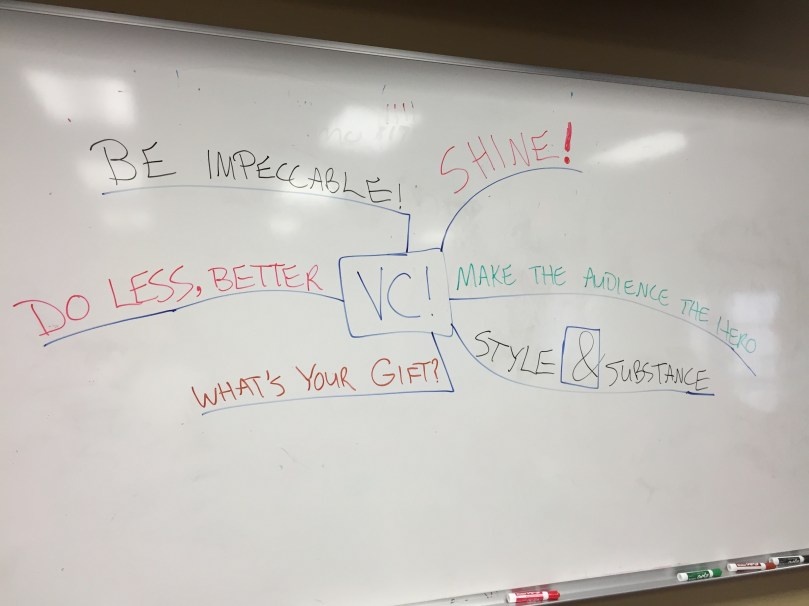
These are the notes I wrote on the board for our student staff meeting today.

I was reminding them of what I think are some key principles when connecting with all the visitors we encounter every day.

  • Make the audience the hero – It’s not about you. Put yourself in the mindset of those you’re speaking to. How can they come out of this encounter better and happier?
  • Style & substance – Offer more than charm and wit. Your style needs to support meaningful content, not just entertain superficially.
  • What’s your gift? – Don’t stand before an audience wondering what you can get from them – laughs, applause, approval.  Instead, focus on what you can give to your audience. What value can you add to those you encounter?
  • Do less, better – Focus on the essentials. Cut the excess, even good stuff, to shine a brighter light on what’s most important.
  • Be impeccable – Aim for perfection. Be careful with even small details. Get it right. Keep pushing yourself to constantly improve.
  • Shine! – Don’t be afraid to be awesome. Be bold and confident.

These are notes to my staff, but they’re just as much notes to myself. I need to be reminded regularly to not be content with good enough. Why not be extraordinary?

Elle Luna: The crossroads of should and must

This epic essay by Elle Luna was posted almost a year ago. I discovered it only today when Seth Godin linked to her new book that came from that essay.

The book looks beautiful. Purchased.

In this essay (and now in her book) Elle tells her story of finding her calling by resisting the path of Should and instead embracing the path of Must. Most of us are guided by what we think we should do while ignoring the call of our deepest desires and what we must do to be fully alive.

“What if who we are and what we do become one and the same? What if our work is so thoroughly autobiographical that we can’t parse the product from the person? What if our jobs are our careers and our callings?” –Elle Luna

I have struggled, though, with the notion that we have some innate passion we have to find and follow. Maybe it’s just semantics. What an authentic life needs is to be true to what you genuinely love and to make an art of it, to do it as well as you can.

Pick a path the excites you, that seems like fun, but that also will challenge you and will compel you to mastery. Course correct regularly. Change your mind. Try and fail, but stick with something long enough to know.

Elle Luna closes her essay with a strong call to choose Must over Should, to have the courage to live the life that is calling to you:

“If you believe that you have something special inside of you, and you feel it’s about time you gave it a shot, honor that calling in some small way — today.

If you feel a knot in your stomach because you can see the enormous distance between your dreams and your daily reality, do one thing to tighten your grip on what you want — today.

If you’ve been peering out over the edge of the cliff but can’t quite make the leap, dig a little deeper and find out what’s stopping you — today.

Because there is a recurring choice in life, and it occurs at the intersection of two roads. We arrive at this place again and again. And today, you get to choose.”

Walt Disney and the long, long game

Screen Shot 2015-03-23 at 5.14.41 PM

I’ve referred to the long game previously, the perspective of considering the long arc of your story and a patient pursuit of an awesome life.

In the two Walt Disney biographies I’ve been reading, I keep coming across an even longer perspective. Disney was driven by a vision of a future he knew he would never personally reach.

Imagine that your work will outlive you by 50-plus years or so. Even if the memory of you fades, what can you contribute that will endure? How can what you do and what you make now reverberate into future generations?

“Make a fifty-year master plan. A fifty-year master plan will change how you look at opportunities in the present.” –Walt Disney

It’s not about ego. You’re going to be gone in just a few years. But thinking through the long, long game can add possibilities to your work that a shorter perspective just can’t.


Walt Disney, Steve Jobs, and plussing your life

I’ve been immersed in Walt Disney recently. I’m reading a biography which is giving me a better appreciation of the impact one dynamic person can have on an organization and ultimately on society.

And then today I found this article linked from ToolsAndToys.net. It’s a piece by Rolly Crump, a former Disney Imagineer who worked on Disneyland projects like the original concepts for It’s A Small World and The Enchanted Tiki Room. He shares some great insights about what it was like to work with Walt. (Disney refused to let employees, or anyone, call him “Mr. Disney.” He insisted on being addressed by just his first name.)

In all the stories I’m reading about Walt, he comes across to me as a kinder, gentler Steve Jobs. Both men had charismatic personalities that could bring out the best work in others. No one could out-dream them. Their ideas were bigger and bolder than anyone else’s.

Walt was not actually an artist. (He didn’t even draw the original Mickey Mouse. He just came up with the concept and the personality and the voice and got Ub Iwerks to do the drawing.) And Steve was not a computer engineer or a designer. (It was Woz who made the original Apple computers. Steve just figured out how to sell them.) But both men saw possibilities others didn’t. They asked for more, for better, for the seemingly impossible. And they got it more often than not. With their ideas and their drive and their communication skills, they sold their dreams and impressed their high standards on those who worked with them.

Here’s Crump talking about the way Walt would generate and improve ideas:

In designing for Disneyland you definitely worked more as a conduit for Walt’s ideas. He directed what you were doing, and his direction was far superior to your own personal ideas. His ideas were way ahead of yours—you had to play catch-up on that, and then you had to kind of read subconsciously what it was that he wanted and the direction to take. Walt would come up with an idea, and that idea would explode inside of him. It would get better and better. So when you showed him something, he would take what you did to another level. And when you gave it back, he’d take it to yet another level.

So many Steve Jobs anecdotes sound like that. His ideas were a few steps ahead. Go bigger. Get it done sooner than anyone thinks possible. Give it more “wow”, more “cool”.

Walt called it “plussing”. He would take an idea and “plus it”, make it a little better. And it was constant for him. He was relentless in plussing everything, from a scene in a movie to the way a cast member interacted with a guest at Disneyland. (Here you can listen to a recording of Walt talking about plussing and why he loved Disneyland more than his movies.)

Jobs and Disney must have had a sharply tuned sense of discontent. What most of us would accept as okay, they would ask for better. And the results are what make Apple and Disney the icons they have become in our culture.

Maybe most of us are too timid, too content with good enough. What if you asked for better from yourself and from those you work with. What if you plussed your life as relentlessly as Walt and Steve plussed their creations?

Art & Fear: The ceramics class and quantity before quality

This story from the book Art & Fear by David Bayles and Ted Orland popped up in a favorite technology blog yesterday:

The ceramics teacher announced on opening day that he was dividing the class into two groups. All those on the left side of the studio, he said, would be graded solely on the quantity of work they produced, all those on the right solely on its quality.

His procedure was simple: on the final day of class he would bring in his bathroom scales and weigh the work of the “quantity” group: fifty pound of pots rated an “A”, forty pounds a “B”, and so on. Those being graded on “quality”, however, needed to produce only one pot – albeit a perfect one – to get an “A”.

Well, came grading time and a curious fact emerged: the works of highest quality were all produced by the group being graded for quantity. It seems that while the “quantity” group was busily churning out piles of work – and learning from their mistakes – the “quality” group had sat theorizing about perfection, and in the end had little more to show for their efforts than grandiose theories and a pile of dead clay.

Brilliant. And I’ve been having this lesson delivered to me repeatedly over the past year. Quantity leads to quality. I don’t know if I’m learning it. I still get stuck overthinking, delaying, waiting for inspiration. When what I need to do is just show up. Do work. And keep showing up.

Attempt mediocrity, even. Dare to write one really awful sentence if you have to. It takes the pressure off. And mediocre might just lead to good, which every now and then might get me to awesome. But if I start by expecting to begin with awesome, I might just sit there instead, waiting for lightning to strike. Or, more likely, start scrolling Twitter and RSS feeds.

Quantity. Hammer away at the thing you want to get good at. Not to the point of grooving an easy path or just mailing it in. You need to challenge yourself routinely with hard things, by stretching your skills. But the more you do, the better you’ll be.

Don’t wait for the muse to show up. Your showing up is more likely to summon the muse than the other way around.

The ceramics class story, by the way, has been linked in several places (Cool Tools, Herbert Lui, and Coding Horror are three I found), and then I saw that book recommended today in a Chase Jarvis post, 6 Books Guaranteed to Make You More Creative. I have five of his recommended six books. The one I’m lacking: Art & Fear. The internet, great and powerful, clearly, is telling me to get that book.

Walt Disney’s vision and defying his father

I’m reading a biography of Walt Disney. Interestingly, Walt’s father did not exactly encourage his dreams. The author describes a conversation between father and son when Walt was in his late teens and just getting started on his career:

“That evening after dinner, Walt’s father called him into the living room for a serious discussion. “Walter,” Elias said, “I have a job for you at the jelly factory. It pays twenty-five dollars a week.”
“Dad,” Walt replied, “I don’t want to work at the jelly factory. I want to be an artist.”
“You can’t make a living drawing pictures,” Elias said. “You need a real job.”

And that was just one small moment of a theme in their relationship, a pattern of Elias Disney trying to impose his version of reality on his son regardless of Walt’s interests and inclinations. Walt Disney’s father was stern, harsh even, with all of his children. His personality seems in many ways the opposite of the personality of Walt. Those who knew Walt universally acclaimed his personality as optimistic and kind and fun-loving, and it’s certainly possible that he crafted his persona, consciously or not, in opposition to his father’s.

But Disney, obviously, defied his father’s expectations for his career more than even he could possibly have imagined. Maybe his father’s opposition helped fuel Walt’s ambition. Maybe Walt was that much more persistent and committed because of the resistance he knew he would face from his father.

I don’t want to be that kind of father, though. I would like to think I will encourage the dreams of my children when they begin to wade through the dilemmas of building a career. My kids should get their obstacles elsewhere. Not from me.

Maybe, though, my fears will turn me into a wet-blanket of an old man who pushes my kids to the safe option rather than the one with the chance for awesome. We want security for our children. I know that is what motivates so much parental meddling and micromanagement of their adult children’s lives. Working with college students I see this frequently and posted this previously:

I heard a commencement speaker last year say that your parents do not want what is best for you. They want what is good for you. They want you to be safe, secure, successful, and have all your needs met. But what’s best for you might be risk and struggle and failure, key components on any path to mastery and awesomeness. Respect your parents, but lead your own life. And know that one day you might be that parent wanting what is just good for your child. And that’s okay. Parents are wired by evolution to protect their babies. Of course, the way you live your life will inform your children more than anything you say to them.

If, like Walt Disney, you face opposition to your path within your own family, you can be like Walt, and move yourself to action in spite of the resistance. Walt was not directly disrespectful to his father. He was just determined to go it alone if he had to, and he did. Turn your obstacles into fuel.

The value of sharing your thinking

From Seth Godin today:

There’s a lot to admire about the common-sense advice, “If you don’t have anything worth saying, don’t say anything.”

On the other hand, one reason we often find ourselves with nothing much to say is that we’ve already decided that it’s safer and easier to say nothing.

If you’ve fallen into that trap, then committing to having a point of view and scheduling a time and place to say something is almost certainly going to improve your thinking, your attitude and your trajectory.

Posting on this site every day is a challenge, and most days don’t give birth to art. But expecting myself to come up with at least a small thing to share adds a bit of juice to my days. My brain wakes up each morning scanning for ideas, more eager to learn something new knowing I need to find something to express before the day is over.

And showing up every day with an attempt to express myself moves me to better understand what I do think. “How do I know what I think until I see what I say?”, right?

I recommend this daily discipline. Whether it’s a journal or a blog or a YouTube channel or an Instagram account, find a place to make something worth sharing on a regular schedule. It will frustrate and discourage you regularly, in the best way, as you grapple with the challenge of crafting something worthwhile. But it will enliven your mind and stoke your creativity and mark your days with mystery and with meaning.

The sacred status of design at Apple

The New Yorker profile on Jony Ive I posted about yesterday is rich with detail about the primacy of design at the world’s most valuable company. It’s such a long feature it took reading it over two days for me to finish it.

I’m struck by the near sacred status of design at Apple. The design studio seems to be the axis of action for the entire company. Instead of analyzing markets and matching products to the greatest profit potential, Apple enables the design team to dream up products that delight them and allows the time to let those ideas mature and to refine them meticulously.

There’s art AND science involved. Jony Ive clearly is THE taste maker. His eye and his raw, unfiltered intuition–his gut–are determining the way our world will end up looking and working.

Yet this story also highlights the precision Ive and his team apply to every iteration of every possible idea they explore. From pencil sketches of random ideas to intricate measurements of the angle of corners on app icons, these designers explore the possibilities with detail and depth and care that set their final products far apart from the rest of the industry.

A former Apple designer was quoted in the article on the reverence for design within the company:

when a designer joined a meeting at Apple it was “like being in church when the priest walks in.”

Apple has made design its driving force and built its culture accordingly. Every organization has a pecking order of its values, whether that order is intentional or not, spoken or simply implicit in the way the leadership focuses attention and resources.

It’s worth revisiting regularly what you and your team (or family) should value. What is most important and will make the biggest difference in your work? Is that getting the attention and respect and resources it deserves?

The hardest thing

“The hardest thing is spending the most time on the most important things.” –Matt Mullenweg

Mullenweg is the very young founder of WordPress (the home of this web site and many more). He said this in the most recent episode of The Tim Ferriss Show podcast when talking about his work and his company’s focus. (Ferriss’s podcast has been killing it recently with quality guests.)

Knowing what’s most important is one thing. Relentlessly devoting most of your time, at the expense of good things that just are not most important, is another thing. But these two things are everything.

Choose what to focus on, what will have the biggest impact over the long term, and keep checking that your time and attention are pointed there. This means eliminating good stuff, but the most important stuff likely won’t get done otherwise.

Daily apps: Useful and delightful

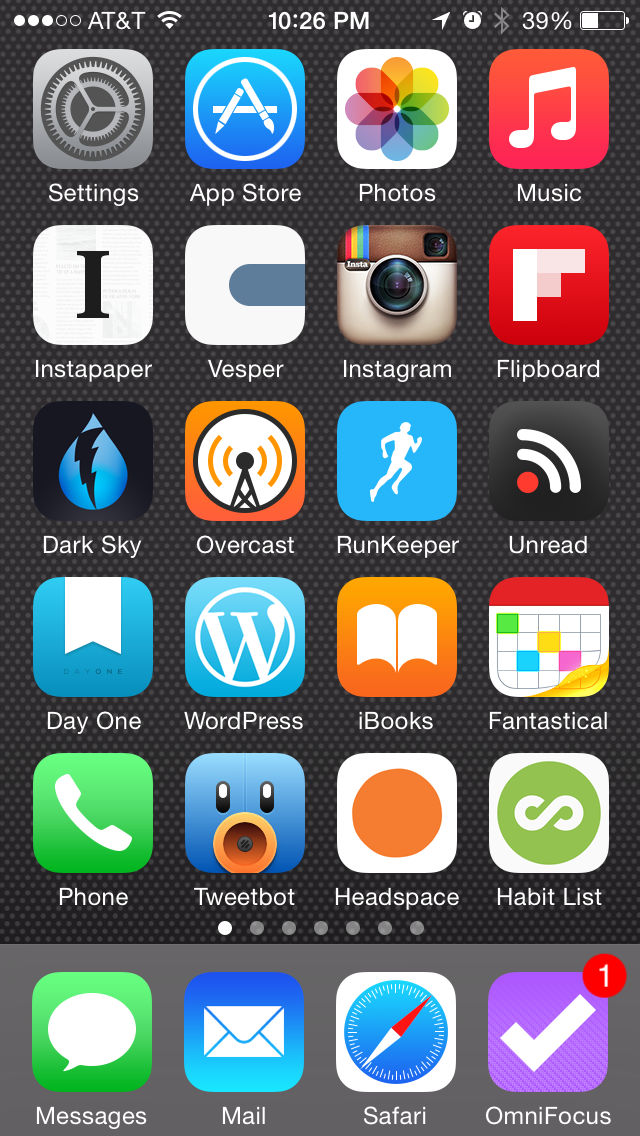
IMG_6304
My current iPhone home screen.

These are my most frequently used apps at the moment. I have six other screens of apps that mostly don’t get much use.

Those apps that merit inclusion on my home screen are ones that serve a regular useful purpose and are a delight to use. They do their jobs well.

Useful and delightful. A solid couple of traits to value and aspire to in more than just the apps on your devices.

Band camp and intrinsic rewards

I was in the marching band in high school. Trumpet and French horn. I was no great musician, but I especially enjoyed the camaraderie. During the summer we all had to participate in band camp, where we learned the music and the show we would perform at football games and in competitions. (There was no actual camping, by the way. Not sure why it was called a camp.)

It was tedious and hot. Georgia-in-August hot. Putting the show in during the first days of camp took a lot of do-overs as everyone was learning where to go and when. After the band director would stop the show to correct something, we were then exhorted to hurry back to the sideline of the field to start over.

Well, it was hot. And tedious. And most teenagers in August who were waking up early maybe for the first time all summer are inclined to move slowly as they do this hard thing. And the director and the band officers would implore everyone to hurry, to run to get back to the starting point. It was mostly a futile effort getting a hundred high school students to run in the August heat across a dusty field.

I, however, was that kid who made a game out of it. I put a smile on my face and raced back across the field to the line every time, cheering and acting silly as I passed by many of my fellow band members. If I was going to have be out in the heat of an August day in Georgia doing this band practice, I might as well try to have fun.

If I’ve got a choice (and I do), I’m going to choose to be happy. And sprinting across the field at band camp while joking with friends made the tedium less tedious and added a dash of fun. I hoped to make someone else smile along the way as well. There were always a few of us who chose to make it fun.

Not many of my classmates, though, chose a similar response. Most dragged their feet and complained the whole way back to the line. Getting the band back in place to start over was a chore every time.

One day the director gathered the band up as practice was starting and offered a challenge. He would give fast food gift cards to those band members who showed the most spirit and energy running back to the line that day.

Well, every time we stopped and had to start over that day, the whole band went crazy, running back to the line with hyped up glee, yelling and cheering. One of my friends, who could have been the poster boy for the feet-dragging whiners previously, was all of a sudden Mr. Spirit, whooping and running each time we had a do-over.

Almost everyone seemed to be responding to this new motivational tactic. Except, it seemed to have the opposite effect on me. I hurried back, but not with my usual enthusiasm. Now, with a prize at stake, my motivation was gone. I didn’t want to be seen as faking it just to get some free food. And I did not win a spirit award that day. My friend, Mr. Spirit, did.

I remember feeling perplexed by my response. Why had I been bothered by the reward? Why was that enough to tone down my enthusiasm?

The reward for me previously had been an intrinsic one. It was the fun I had doing the thing. But when the reward was a free hamburger and being acknowledged in front of my peers, I put the brakes on. I didn’t understand the psychology then, but I now know that the extrinsic inducement sabotaged my motivation that day.

The next day at band camp there were no more gift cards to be awarded. And everyone went back to business as usual, with just the usual few choosing to delight in running back to the line just for the sake of it, not for any prizes. Those rewards had a very limited impact.

I know there is research now showing that extrinsic rewards turn out to have limited success and work primarily for tasks requiring a low level of mental and emotional investment. Bonuses and prizes and other external payoffs just don’t have the impact and staying power that everyone assumes.

Intrinsic rewards, though, are where the real juice is, especially for higher level work and organizational excellence. Finding how to tap those for yourself and those you lead can open possibilities for deep satisfaction and exceptional performance.

Check out Dan Pink’s TED Talk explaining what he discovered about the power of intrinsic motivation.


Balancing stock and flow

I just stumbled on this remarkable insight from the writer Robin Sloan who explains the economic terms “stock and flow” and relates them to the kinds of content we produce in this information age:

“Flow is the feed. It’s the posts and the tweets. It’s the stream of daily and sub-daily updates that remind people that you exist.

Stock is the durable stuff. It’s the content you produce that’s as interesting in two months (or two years) as it is today. It’s what people discover via search. It’s what spreads slowly but surely, building fans over time.

I feel like flow is ascendant these days, for obvious reasons—but we neglect stock at our own peril. I mean that both in terms of the health of an audience and, like, the health of a soul. Flow is a treadmill, and you can’t spend all of your time running on the treadmill. Well, you can. But then one day you’ll get off and look around and go: Oh man. I’ve got nothing here.”

So much of what I create is flow, fine for the moment but not particularly sticky, not worth talking about over time. Occasionally I make something reasonably solid that I know will still be meaningful, at least to me, months or years from now. But I mostly just stumble on those stock, substantive creations by simply showing up every day and attempting to do something small.

For better balance, more impact, and deeper satisfaction, I should be intentional about the kind of work that has staying power and makes a difference for more than just a day.

Posting on this site daily has been worthwhile and has rewired my attention each day in consistently surprising, constructive ways. But the daily updates don’t typically lead to the kind of substance that sticks.

What can I invest time in that will endure? What projects and pursuits could even have the potential to outlive me? Why not be bold and imagine doing work that just might resonate even a century from now?

I find real merit in the daily flow and the energy that it pulses through the rhythm of my routines. Now, balance that with the intention to dig deeper on work, on stock, that will last and structure habits and routines around that intention.

Aim high and dig deep. And keep showing up every day.

Unconventional wisdom

“Whenever you find yourself on the side of the majority, it is time to pause and reflect.” –Mark Twain

Running with the crowd may feel safe, but it shouldn’t make you feel comfortable.

The bold ideas, the original and courageous convictions, are most often at odds with popular opinion and conventional wisdom.

“When 99 percent of people doubt your ideas, you’re either completely wrong or about to make history.” –Scott Belsky

Advanced search for life’s big decisions

From Greg Mckeown’s excellent book, Essentialism:

“Applying tougher criteria to life’s big decisions allows us to better tap into our brain’s sophisticated search engine. Think of it as the difference between conducting a Google search for “good restaurant in New York City” and “best slice of pizza in downtown Brooklyn.” If we search for “a good career opportunity,” our brain will serve up scores of pages to explore and work through. Instead, why not conduct an advanced search and ask three questions: “What am I deeply passionate about?” and “What taps my talent?” and “What meets a significant need in the world?” Naturally there won’t be as many pages to view, but that is the point of the exercise. We aren’t looking for a plethora of good things to do. We are looking for the one where we can make our absolutely highest point of contribution.”

I need to remember to continually eliminate the good to hone in more clearly on the better. And then keep going, editing and discarding even those better options until I get to the best.

Be precise with your questions. Get specific, as detailed as possible, to find the best possible answer.

A clue to finding your work

Paul Graham:

“If something that seems like work to other people doesn’t seem like work to you, that’s something you’re well suited for.”

What do you not mind doing, or even enjoy, that others think is a chore or tedious?

I often ask this interview question (crafted by a former student –Thanks, Sarah!): What is something you love doing that most others find trite or tedious or boring at best?

The answer may not hold the key to career nirvana, but this line of questioning can uncover clues to lead you there.

More from Graham’s essay:

“The stranger your tastes seem to other people, the stronger evidence they probably are of what you should do. When I was in college I used to write papers for my friends. It was quite interesting to write a paper for a class I wasn’t taking. Plus they were always so relieved.

It seemed curious that the same task could be painful to one person and pleasant to another, but I didn’t realize at the time what this imbalance implied, because I wasn’t looking for it. I didn’t realize how hard it can be to decide what you should work on, and that you sometimes have to figure it out from subtle clues, like a detective solving a case in a mystery novel. So I bet it would help a lot of people to ask themselves about this explicitly. What seems like work to other people that doesn’t seem like work to you?”

Bill Murray: More fun, more better

2015/01/img_6210.jpg

Image credit replaceface via Scott Schiller

Here’s a bucket list item: randomly encounter Bill Murray and engage in spontaneous wackiness. Stories abound about Bill Murray sightings and the delightfully funny escapades that often ensue.

This Rolling Stone article highlights some great moments in random fun with Bill Murray.

On the job fun:

Murray’s St. Vincent co-star Melissa McCarthy confides, “Bill literally throws banana peels in front of people.” I assume she’s using “literally” to mean “metaphorically,” as many people do, but it turns out to be true: Once during a break in filming when the lights were getting reset, Murray tossed banana peels in the paths of passing crew members. “Not to make them slip,” McCarthy clarifies, “but for the look on their face when they’re like, ‘Is that really a banana peel in front of me?'”

Fun with kids:

Murray transforms even the most mundane interactions into opportunities for improvisational comedy. Peter Chatzky, a financial-software developer from Briarcliff Manor, New York, remembers being on vacation at a hotel in Naples, Florida, when his grade-school kids spotted Murray having a drink poolside and asked him for autographs. Murray gruffly offered to inscribe their forearms but ended up writing on a couple of napkins instead. Jake, a skinny kid, got “Maybe lose a little weight, bud,” signed “Jim Belushi.” Julia got “Looking good, princess. Call me,” signed “Rob Lowe.”

Murray has realized that it’s when he’s having fun that he is most truly himself and able to offer his best:

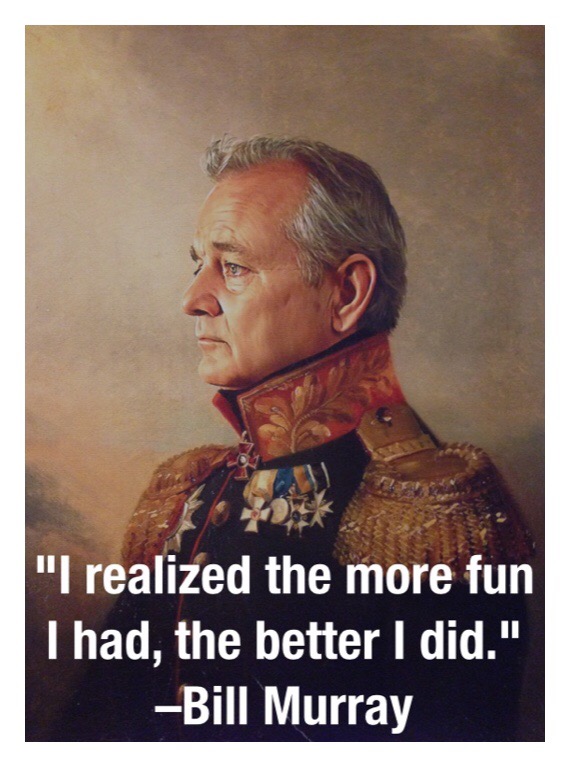
Like all of Murray’s best film work, it originates in his stress-free mentality. “Someone told me some secrets early on about living,” Murray tells a crowd of Canadian film fans celebrating “Bill Murray Day” that same weekend. “You can do the very best you can when you’re very, very relaxed.” He says that’s why he got into acting: “I realized the more fun I had, the better I did.”

I need to be reminded regularly to not take life so seriously. A guy like Murray is probably constantly asking himself, “What’s funny about this situation?” or “How can I have fun with this?”

My primary work is about providing experiences, and fun has to be a big part of it. Not scripted or programmed fun, but the kind that flows naturally out of the moment. I’ve got to keep reminding myself to actively model spontaneous fun and allow my team to relax and make some moments worth talking about for the people we serve. Break the pattern. Do the unexpected. But don’t try too hard.

My best presentations stand out in my memory for the fun I had connecting with the audience. When I deviate from the plan and say or do something unexpected or get the audience to laugh, usually at me. Walking into a moment with the attitude, “Let’s have some fun here” can make everything better, whether it’s a job interview or a first date or a presentation or even a Monday morning in your cubicle in a soulless, downtrodden workplace.

And reading this about Bill Murray is a good reminder to have more fun with my family, to be silly and spontaneous more often with my wife and kids. Now that we are back in a daily school and work routine, it’s easy to sleepwalk my way through each morning and evening, checking off the tasks. But it only takes a few moments of being truly awake to add real juice to your days and make them more meaningful and more fun.

And waking up, when sleeping is the norm, seems to be Murray’s ultimate aim, for himself and for those he encounters:

Another essential Murray principle: Wear your wisdom lightly, so insights arrive as punch lines. When pressed about his interactions with the public, he admits that the encounters are, to a certain extent, “selfish.” Murray shifts his weight on the couch and explains, “My hope, always, is that it’s going to wake me up. I’m only connected for seconds, minutes a day, sometimes. And suddenly, you go, ‘Holy cow, I’ve been asleep for two days. I’ve been doing things, but I’m just out.’ If I see someone who’s out cold on their feet, I’m going to try to wake that person up. It’s what I’d want someone to do for me. Wake me the hell up and come back to the planet.”
Just start

Screen Shot 2015-01-07 at 4.14.45 PM

“JUST DO IT” is a compellingly catchy slogan, but it’s a bit overwhelming and slightly frightening for some of us.

“Really? I don’t think I can do it. So, I just won’t even try.”

But, just starting, that’s not so risky or intimidating.

Just attempt one push-up. Just take a short, easy walk. Just start writing something, even just a sentence, that you don’t have to share with anyone if you don’t want to. Just say “Hello” to that person. Just try that new habit for a week or two and see what happens. Just begin that hard thing you don’t feel confident about or eager to do.

Don’t even think about the entirety of the project or the goal. Most goals are arbitrary anyway. And imagining the steps down the road can take your focus off the one step right in front of you now. And that step is not so hard.

Thinking about starting is not the same as starting. Don’t worry about being perfect or getting it just right. The audacity of beginning something that could end up being awesome might give you enough oomph to get over the hump of meh.

Meh is a good place to begin, actually. You can trick yourself by saying, “Let me start with this awful, unimpressive, tentative first step or first draft.” Intend to be mediocre if you have to to take the pressure off. And then you can’t help but get better if you keep going.

But you can’t keep going if you don’t get going.

Just start.


Taming the easily distracted brain: Focus, then wander

M.G. Siegler linked to this Daniel Levitin NYT article from last summer about the way the brain works.

The article explains that our brains have two basic operating modes: a focus mode that gets things done and a wandering or daydreaming mode that allows for neural resets and fosters creative breakthroughs. Both modes are necessary, and both are being challenged as never before with the information overload most of us experience every day.

The author recommends dedicating chunks of time, 30 minutes to an hour, say, to focus on a project without distraction. And build in breaks between focused time to allow the mind to wander, to daydream. Here is Levitin’s advice:

“If you want to be more productive and creative, and to have more energy, the science dictates that you should partition your day into project periods. Your social networking should be done during a designated time, not as constant interruptions to your day.

Email, too, should be done at designated times. An email that you know is sitting there, unread, may sap attentional resources as your brain keeps thinking about it, distracting you from what you’re doing. What might be in it? Who’s it from? Is it good news or bad news? It’s better to leave your email program off than to hear that constant ping and know that you’re ignoring messages.

Increasing creativity will happen naturally as we tame the multitasking and immerse ourselves in a single task for sustained periods of, say, 30 to 50 minutes. Several studies have shown that a walk in nature or listening to music can trigger the mind-wandering mode. This acts as a neural reset button, and provides much needed perspective on what you’re doing.”

Turn off any unnecessary pings on your devices. I’ve known people whose phones audibly alert them every time an email arrives. Insane. This article has prompted me to turn off email notifications on my phone’s lock screen and even to disable the badge noting the number of unread emails on the app icon.

Twitter and email and messaging apps should serve my needs. They don’t need to control me and make me jump at every new input. What if I responded to email just once each day? What if the only apps open on my Mac were the ones I was actively using?

This is hard to do. It’s so tempting to keep checking to see if anything new has appeared in any of my many internet collection buckets. But even blocking off 30 minutes to work with focus, without distraction, on something important can lead not only to a more productive work life, but to a saner, calmer life as well. Close the door if you can. Put on headphones. Shield yourself from pings and alerts.

And go take a walk. Get outside. Wander the halls. Change your perspective regularly for a reset before going back into focus mode. Experiment for yourself and see what works best for you.

Find a rhythm that nature, and your neural wiring, expects and seems most conducive for productivity and creativity and peace of mind. Focus. Wander. Focus. Wander.

Got it? Okay. Going on a walk. Right. Now.