Bertrand Russell on the good life

Kottke posted a link to University of Utah professor Matt Might’s thoughtful career and life advice.

There is so much worth pondering in that post. But the career applications especially stand out. 

Might’s academic career floundered when he saw his work as a means to an end. But his work flourished when he did work for its inherent value and for its meaning to him. 

Focus on being awesome, not on being successful. 

And he shared a portion of this quote: 

“The good life is one inspired by love and guided by knowledge. Knowledge and love are both indefinitely extensible; therefore, however good a life may be, a better life can be imagined. Neither love without knowledge, nor knowledge without love can produce a good life.” –Bertrand Russell

So good. 

Love and knowledge. Beauty and truth. 

Indefinitely extensible. 

Inexhaustible. 

Enough to fill a life. 

A good life. 

Stephen Colbert on radical acceptance and steering toward fear

Stephen Colbert will be taking over David Letterman’s old slot on The Late Show soon. This GQ profile of Colbert by Joel Lovell is so good.

The writer goes much deeper than Colbert’s take on comedy and television. Colbert’s father and two of his brothers were killed in a plane crash when he was a 10-year-old. He ended up channeling that pain in a profound way.

From the article:

He said he trained himself, not just onstage but every day in life, even in his dream states, to steer toward fear rather than away from it. “I like to do things that are publicly embarrassing,” he said, “to feel the embarrassment touch me and sink into me and then be gone. I like getting on elevators and singing too loudly in that small space. The feeling you feel is almost like a vapor. The discomfort and the wishing that it would end that comes around you. I would do things like that and just breathe it in.” He stopped and took in a deep yogic breath, then slowly shook his head. “Nope, can’t kill me. This thing can’t kill me.”… And then he said, “Obviously there’s something defensive about it. What you’re doing is sipping little bits of arsenic so that you can’t be poisoned by the rest of your discomfort. You’re Rasputin-ing your way through the rest of your life.”

This is classic Stoicism. Face the pain. Embrace the obstacle.

He had an improv teacher who challenged students to “love the bomb”, to relish failure and use it as fuel to make you better.

And Colbert took that lesson well beyond the mere embarrassment of screwing up on stage:

 “ ‘You gotta learn to love the bomb,’ ” he said. “Boy, did I have a bomb when I was 10. That was quite an explosion. And I learned to love it. So that’s why. Maybe, I don’t know. That might be why you don’t see me as someone angry and working out my demons onstage. It’s that I love the thing that I most wish had not happened.”

“I love the thing that I most wish had not happened.” –Stephen Colbert

Why resist what has happened? Time travel is not an option. Radical acceptance is.

It’s been ten years since my mother died. I can’t say so clearly, as Colbert does, that “I love the thing that I most wish had not happened.” But I can be grateful for what I had in my 41 years with my mom and what I still hold on to, not only from memories of her but also from how her loss has challenged me and hopefully given me gifts and graces and perspective that I otherwise would not have.

The article concludes powerfully:

“ ‘What punishments of God are not gifts?’ ” he said again. His eyes were filled with tears. “So it would be ungrateful not to take everything with gratitude. It doesn’t mean you want it. I can hold both of those ideas in my head.”

The next thing he said I wrote on a slip of paper in his office and have carried it around with me since. It’s our choice, whether to hate something in our lives or to love every moment of them, even the parts that bring us pain. “At every moment, we are volunteers.”

Sunday night Stoic: Think on these things

I’ve been listening to the audiobook version of the late Christopher Hitchens’s autobiography, Hitch-22: A Memoir. Hitchens was notable for his eloquence and strongly stated opinions on controversial topics.

He was no man of faith, but tells in his memoir that he chose the scripture reading for his father’s funeral. It was Phillipians 4:8:

“Finally, brethren, whatsoever things are true, whatsoever things are honest, whatsoever things are just, whatsoever things are pure, whatsoever things are lovely, whatsoever things are of good report; if there be any virtue, and if there be any praise, think on these things.”

I was reminded of what an excellent verse it is. And it could just as easily look like a line pulled straight from Marcus Aurelius’s Meditations. It has a clear Stoic shine to it.

This line from Paul’s letter would be a fine bit of scripture for anyone’s memorial service.

When I was a young man, I wrote a personal mission statement that began with this line:

“Pursue truth no matter the cost.”

I regularly have fallen short of that audacious aim. Often the cost of such a pursuit is more than I’m willing to pay. But that pursuit challenges me even more now.

I’m no scientist or activist. I’m not on any heroic, risk-filled quest to right wrongs. But I still care deeply about being true and honoring honest inquiry and letting go of comfortable fictions that only obscure reality.

I want to retain the curiosity that compels discontent with mere conventional wisdom and popular opinion.

I want to fill my mind with what is true and honest and just and pure and lovely.

These are the things most worthy of our attention.

David Cain’s advice to teenagers: “Waste no energy earning respect in high school”

David Cain writes great stuff and is well worth adding to your must-reads.

This is from his post, “An Open Letter to My 15-Year-Old Self Just Before the Start of High School”:

“None of the respect you earn in high school will buy you anything after you leave high school. It’s like working at Canadian Tire for a summer and getting paid only in Canadian Tire money. Waste no energy earning respect in high school. Spend it instead wandering every sidestreet of geekdom and subculture you pass by. Instead of finding scraps of approval from uncool people, you will end up finding something real and lasting in Brian Eno or Nietzsche or Margaret Atwood or Public Radio. Find those grooves of meaning that you can follow into adulthood. When people give you a hard time for liking what you like, that’s a sign you’re on the right track. You are uncovering veins of precious metals; they are scrounging for nearly-expired coupons.”

True.

And this, too:

“Get over any desire to be normal. The desire to be normal is its own perversion. Some people do achieve the appearance of normalness, which means they have successfully hidden or beaten down everything about them that is interesting or memorable in the hopes that they become impervious to criticism. Go the other way. The great joke here is that nobody has ever been normal.”

The whole post is solid. There is probably a teenager in your life who ought to read it. But most of us are still challenged by some of the same tensions we faced in high school. 

Two arrows: Pain and suffering

Screen Shot 2015-07-29 at 4.23.55 PM

Tim Ferriss has an interview with Jane McGonigal* on his podcast that’s worth listening to. She’s an expert in the value of playing games, and hearing her made me go load Tetris on my phone.

(*Also see her TED Talks: Gaming can make a better world and The game that can give you 10 extra years of life.)

In their conversation, though, this quote was discussed:

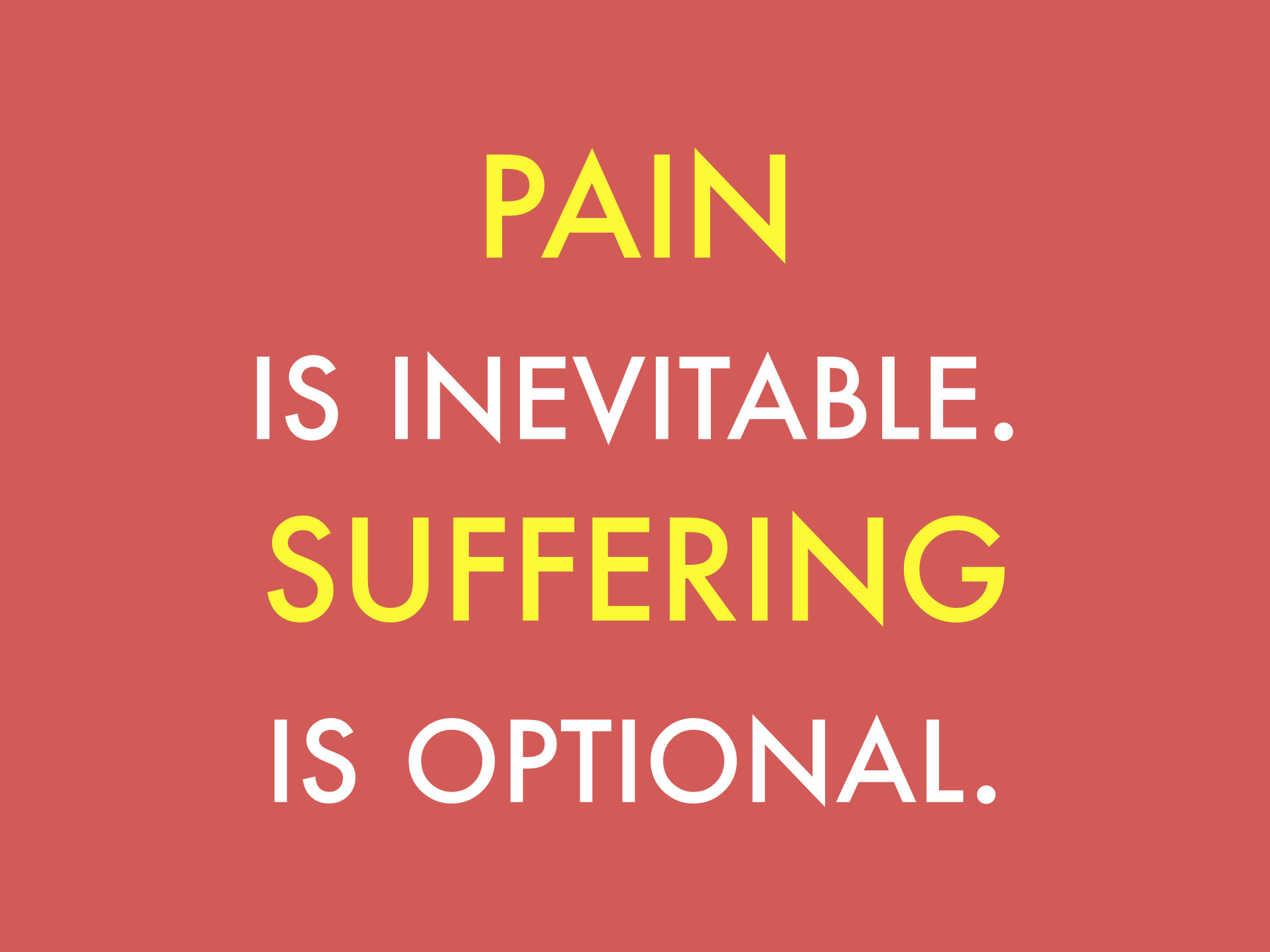
“Pain is inevitable. Suffering is optional.”

It’s not from the Buddha, and I couldn’t find a definitive source to credit. But it is very Buddhist. And Stoic.

From the Buddhist teaching in the Sallata Sutha:

“When touched with a feeling of pain, the uninstructed run-of-the-mill person sorrows, grieves, & laments, beats his breast, becomes distraught. So he feels two pains, physical & mental. Just as if they were to shoot a man with an arrow and, right afterward, were to shoot him with another one, so that he would feel the pains of two arrows.”

From Marcus Aurelius’s Meditations (4.49):

“So remember this principle when something threatens to cause you pain: the thing itself was no misfortune at all; to endure it and prevail is great good fortune.” 

Between stimulus and response there is a gap. In that gap you get to choose your response. The stimulus may cause pain, but you can choose to respond in a way that doesn’t add suffering on top of the pain.

We cannot control what happens. We can control our response to what happens.

Easier said than done, I know. But this is worth remembering whenever you’re confronted with pain of any sort.

Every poet in your pocket: Our obsession with glowing glass rectangles

This has been in my favorite tweets list since last year:Screen Shot 2013-10-02 at 11.19.39 AM

It’s easy to castigate the obsession most people have with their phones. 

It’s rare to see anyone alone in a waiting mode—standing in line or waiting on an appointment, for example—who isn’t staring at a phone. If they were reading a book or newspaper, it would seem just fine, even a worthwhile use of their time.

John Adams advised his son, John Quincy, to carry a book with him wherever he went so he would always have a “poet in his pocket” to make good use of any down time.

All of the information the world has collected is right there, in your pocket. Every poet in your pocket! Holy smoke, why not avail yourself of this modern marvel?

And social connections are no less real because the messages from friends and family are digital.

But what about when you’re with others? When is it okay to take your attention away from those physically present and instead focus on your phone?

If it’s clear that you’re prioritizing whoever or whatever is on your device over someone who is right in front of you, you’re probably coming across as rude, and you’re missing a chance for connection in the here and now.

You need to know your own boundaries and draw a line where your devices are distracting versus adding value. If it’s keeping you from being present, from seeing what’s right in front of you, from making connections in real time, put it in your pocket.

My kids won’t know a world without the internet. Their generation won’t have to struggle with making sense of this like mine is.

Imagine what will be the challenge for them, though. What’s after glowing glass rectangles?

The tools we now have to improve our lives certainly can have detrimental consequences along with their incredible opportunities. But the tools are ours. We get to decide how our devices will be used.

As awesome as it is to have so much information and communication power at our fingertips, it’s also awesome to fully inhabit the here and now, to master the present moment and the people who share it with us. 

Where you are

When you get there you will only be right here, right now

How I can live now and not defer my living to some future now?

See for yourself

“Place no head above your own.” –The Buddha

Don’t believe something because someone says to believe.  

Use your own head. 

See for yourself. 

Follow reason. 

Discard what doesn’t hold up to honest inquiry. 

Pursue truth, no matter the cost. 

Choose kind 

My 7-year-old daughter came by my office after school on Tuesday. It’s the last week of school, and she was lively and lighthearted and spent some time, as usual, writing on the whiteboard in my office. When I left work I noticed she had written this on the board: 

“When given a choice to be right or kind, choose kind.”

I paused and wondered where a 7-year-old came up with such a thoughtful bit of wisdom, but I forgot to ask her about it.

The next day my wife and I attended the end-of-year party for her second-grade class. Her teacher, Ms. McCranie, is a superhero of a teacher, and she’s retiring this year after a long and remarkable career. As Ms. McCranie was giving out the academic awards she came to the Citizenship Award and explained that it was awarded primarily for kindness. She said she tells her students that, “when given a choice to be right or kind, choose kind.”

“Aha”, I thought. That’s where my Annie got that wisdom. And I was so impressed that this thought had been impressed in my daughter’s consciousness so distinctly.

And then Ms. McCranie announced that the Citizenship Award for her class was being awarded to Annie.

Her mom and sister and I are entitled to smirk at this slightly, knowing what it’s like to live with her occasionally feisty and fiery moods. But if in public and at school, at least, she’s demonstrating enough kindness to win a class award and she can quote verbatim such solid wisdom, I’ll take it.

I need to have that wisdom impressed on me regularly as well.


Doing summons feeling

From R.J.Baughan’s The Joy of Doing:

“Men do not really live for honors or for pay; their gladness is not in the taking and holding, but in the doing, the striving, the building, the living. It is a higher joy to teach than to be taught. It is good to get justice, but better to do it; fun to have things, but more to make them. The happy man is he who lives the life of love, not for the honors it may bring, but for the life itself.”

via Art of Manliness

There’s magic in action. Just start. Do the thing you want to do for the simple joy of doing the thing.

And even when — especially when — you don’t feel like doing the thing, do it anyway. Doing usually summons feeling.

Stoic Zen: The glass is already broken

Kottke shared this paragraph from Mark Epstein’s book Thoughts Without a Thinker: Psychotherapy From a Buddhist Perspective:

“You see this goblet?” asks Achaan Chaa, the Thai meditation master. “For me this glass is already broken. I enjoy it; I drink out of it. It holds my water admirably, sometimes even reflecting the sun in beautiful patterns. If I should tap it, it has a lovely ring to it. But when I put this glass on the shelf and the wind knocks it over or my elbow brushes it off the table and it falls to the ground and shatters, I say, ‘Of course.’ When I understand that the glass is already broken, every moment with it is precious.”

This is Zen. But also very Stoic.

Negative visualization is a Stoic practice. Imagining and accepting the worst case can help me better appreciate what is while preparing me for what could be.

More better

You are going to die.

I am, too.

(Warm, happy way to kick off a conversation. I’m fun at parties.)

The universe is staggeringly massive.

For every grain of sand* on Earth, there are at least 10,000 stars in the visible universe.

Amazing, right?!
*And yes, there’s an algorithm for determining the number of grains of sand on Earth. Also amazing.

We are infinitesimally small.

Our time is limited.

(The average human lifespan fills just .000001 percent of the entire history of the planet.)

In the big scheme of things — the REALLY big scheme — who we are and what we do doesn’t seem to, in the words of Humphrey Bogart in Casablanca, “amount to a hill of beans in this crazy world”.

Yet we all are so busy and in a hurry and stressed out.

Our to-do lists tug at us and unsettle both our conscious minds and our subconscious and even sneak into our dreams at night.

Our calendars are filled with meetings and appointments and projects and task-forces and so many things that won’t be worth remembering or talking about.

How much of what we do makes a real difference and is truly meaningful?

How often do you get to the end of a day and lay your head on your pillow and feel genuine, wholehearted satisfaction about the way you spent a precious day in your short life?

Maybe it’s unspoken existential angst or cultural brainwashing from childhood or tyrannical bosses that fling us into the futile effort to do MORE, check MORE off our lists, accomplish MORE…

…in the effort to have more and be more and somehow win at life.

MORE. MORE. MORE.

But what if…?

What if you apply “MORE” to quality rather than quantity?

What if you did LESS, but did it BETTER?

Do LESS, but do it MORE BETTER.
(Grammar police, look away.)

Here is almost the entire product line of the biggest, richest company in the world:

Screen Shot 2015-05-01 at 5.03.55 PM

All of Apple’s products could fit on a conference room table.

Steve Jobs attributed much of his success to saying “No” to make room for a better “Yes”.

Steve Jobs:

“Innovation is saying no to 1,000 things.”

Albert Einstein, too:

“I soon learned to scent out what was able to lead to fundamentals and to turn aside from everything else, from the multitude of things that clutter up the mind.”

Warren Buffett:

“The difference between successful people and unsuccessful people is that really successful people say no to almost everything.”

Jazz great Thelonius Monk:

“What you don’t play can be more important that what you do play.”

Steve Jobs, Albert Einstein, Warren Buffett, Thelonius Monk — all champions of doing less, but doing it better.

Imagine honing your focus and investing more of your limited time and attention in things that matter most.

Imagine the rewards of deep work and quality time on fewer projects.

Imagine more quiet moments and eye contact and actually taking time to listen intently.

What would intense focus on fewer things do for your work life, your relationships, your peace of mind?

But, to have that kind of focus, you have to be ruthless at saying “No” to even really good and noble things as well as to time-wasters and trivial distraction.

And you have to say “No” to nice people and to “good” opportunities.

Derek Sivers says when he’s confronted with a new opportunity, if his response is not a “Hell, YEAH!”, then it’s simply a “no” for him.

“Hell, YEAH!”

Or

“no”

That may be extreme, but exceptional, more better lives tend to defy convention.

Consider the things in your life, professional and personal, that are most important.

Make a list. Prioritize it.

What if you cut that list down to just a few key priorities, the things that would have the biggest impact and matter the most?

And what if you structured your time around giving those few key priorities more of your attention?

Peter Drucker, paraphrased:

Management is doing things right. Leadership is doing the right things.

What if you built habits around the few priorities that have the biggest impact in your work and your life?

Consider whittling your daily to-do list down to one or two key tasks, tasks that would benefit from close attention and deep focus.

Consider overhauling your schedule by cutting out most meetings.

Turn off notifications on your devices.

There are people who only check email at designated intervals — first thing in the morning, around noon, and in the afternoon.

Crazy, right? Who does this?

I’m guessing Warren Buffett doesn’t live out of his email in-box.

Einstein didn’t surf the internet. 😉

(We’ll give Steve Jobs a pass on this one.)

What can you: streamline, unclutter, simplify, clarify?

Instead of a buffet, a smorgasbord even, of services and options, what if you offered just a few truly great choices?

Is your purpose, your mission — for your team, your family, your work, your life — clear?

Crystal clear?

How much stuff do you possess that you don’t really need, that’s not either useful or beautiful?

Less stuff, but better stuff.

Fewer pursuits, but more rewarding pursuits.

Picture the end of your life.

What kind of life do you want to look back on?

It will be quality, not quantity, that will matter most at that point.

And that should matter most now.

Do less…

… better.

*This is the thought stream for a presentation I will be leading at a conference next month. I posted a PDF of this from a Keynote document for use by the audience prior to the presentation. It can stand alone but is intended to be a warm up for what I hope will be a lively conversation.
Thich Nhat Hanh: Understanding is love’s other name

“Understanding someone’s suffering is the best gift you can give another person. Understanding is love’s other name. If you don’t understand, you can’t love.” –Thich Nhat Hanh

Via BrainPickings.com

If you truly understand someone, you can’t help but love them. 

Consider making the attempt to understand the perspective of anyone you feel you don’t, or can’t, love. 

Even if you could never approve of his actions, understanding—seeing the world even for a moment the way he does—will give you compassion for him. 

Warren Buffett and the “avoid at all cost list”

Cal Newport shared this Warren Buffett story, which was passed on by someone else and may be only apocryphal. But the point of the story certainly seems in line with what we know of Buffett’s philosophy:

Buffett wanted to help his employee get ahead in his working life, so he suggested that the employee list the twenty-five most important things he wanted to accomplish in the next few years. He then had the employee circle the top five and told him to prioritize this smaller list.

All seemed well until the wise billionaire asked one more question: “What are you going to do with the other twenty things?”

The employee answered: “Well the top five are my primary focus but the other twenty come in at a close second. They are still important so I’ll work on those intermittently as I see fit as I’m getting through my top five. They are not as urgent but I still plan to give them dedicated effort.”

Buffett surprised him with his response: “No. You’ve got it wrong…Everything you didn’t circle just became your ‘avoid at all cost list.’”

Focus. Do less, better.

“The difference between successful people and unsuccessful people is that really successful people say no to almost everything.” –Warren Buffett

Ordinary laziness

From the @AlanWattsDaily Twitter stream:

I’m torn between the desire to get big things done and make a dent in the universe and the inclination to chill out a lot more often, to just play and ponder.

Balance, right? The down times, the lazing about, can give fresh energy to the dent-making endeavors.

Most of us, though, lean hard away from, or at least try to appear to lean away from, the “pleasant mellowness” of ordinary laziness. Got to look busy, you know.

Tim Kreider’s manifesto on the merits of idleness

Tim Ferriss is featuring an audiobook version of Tim Kreider’s book, We Learn Nothing, on his podcast. He posted a sample of the audiobook with a free chapter, Lazy: A Manifesto.

The sample chapter is a terrific essay on the crazy obsession our culture has with being “busy”. When you ask someone how they’re doing, “Busy” is a common and depressingly acceptable, even admirable, response.

Go listen to that free chapter. It’s so good. And Kreider will have you questioning your own addiction to at least appearing to be busy.

From the book:

“Yes, I know we’re all very busy, but what, exactly, is getting done? Are all those people running late for meetings and yelling on their cellphones stopping the spread of malaria or developing feasible alternatives to fossil fuels or making anything beautiful?

This busyness serves as a kind of existential reassurance, a hedge against emptiness: obviously your life cannot possibly be silly or trivial or meaningless if you are *so busy*, completely booked, in demand every hour of the day. All this noise and rush and stress seem contrived to drown out or cover up some fear at the center of our lives.”

And this:

“Idleness is not just a vacation, an indulgence, or a vice: it is as indispensable to the brain as vitamin D is to the body, and deprived of it we suffer a mental affliction as disfiguring as rickets. The space and quiet that idleness provides is a necessary condition for standing back from life and seeing it whole, for making unexpected connections and waiting for the wild summer lightning strikes of inspiration—it is, paradoxically, necessary to getting any work done.”

There is not enough idleness in my life. And most of my busyness is probably not accomplishing much in the big scheme of a 13-billion-year-old universe.

“I can’t help but wonder whether all this histrionic exhaustion isn’t a way of covering up the fact that most of what we do doesn’t matter.” –Tim Kreider

Do less, better. That should be my mantra. What does matter? What will count for something worthwhile when I look back on it? What makes for a really good day? Focus on the quality of those things that will send me to bed each night with the satisfaction, not of having been busy, but of having spent my time wisely and joyfully.

SLOMO: “Do what you want to!”

This short film is well worth fifteen minutes of your attention:

ht Charlie Hoehn

This former doctor has found bliss roller-blading* by the beach. He chucked his living-by-the-rules-and-society’s-defaults kind of life and just started doing what he wanted to do.

He was inspired by a chance encounter years before with a 93-year-old whose life advice was: “Do what you want to!”

That story reminded me of Joseph Campbell recounting this story in his 1980s television series with Bill Moyers:

Campbell: Remember the last line [of Babbitt]? “I have never done the thing that I wanted to in all my life.” That is a man who never followed his bliss. Well, I actually heard that line when I was teaching at Sarah Lawrence. Before I was married, I used to eat out in the restaurants of town for my lunch and dinners. Thursday night was the maid’s night off in Bronxville, so that many of the families were out in restaurants. One fine evening, I was in my favorite restaurant there, and at the next table there was a father, a mother, and a scrawny boy about twelve years old. The father said to the boy, “Drink your tomato juice.”

And the boy said, “I don’t want to.”

Then the father, with a louder voice, said, “Drink your tomato juice.”

And the mother said, “Don’t make him do what he doesn’t want to do.”

The father looked at her and said, “He can’t go through life doing what he wants to do. If he only does what he wants to do, he’ll be dead. Look at me. I’ve never done a thing I wanted to in all my life.”

And I thought, “There’s Babbitt incarnate.”

That’s the man who never followed his bliss. You may have a success in life, but then just think of it—what kind of life was it? What good was it—you’ve never done the thing you wanted to do in all your life. I always tell my students, go where your body and soul want to go. When you have the feeling, then stay with it, and don’t let anyone throw you off.

 “Follow your bliss” is not a call to a shallow, selfish life. It’s the call to listen and to act. To not just follow the expectations of others. To not just get locked into a groove that someone else made. Live your life.

***

*As an aside, I was intrigued by Slomo’s neurological explanation in the documentary of the science of the joy of accelerating. Because, the inner ear and gravity and the center of the earth…

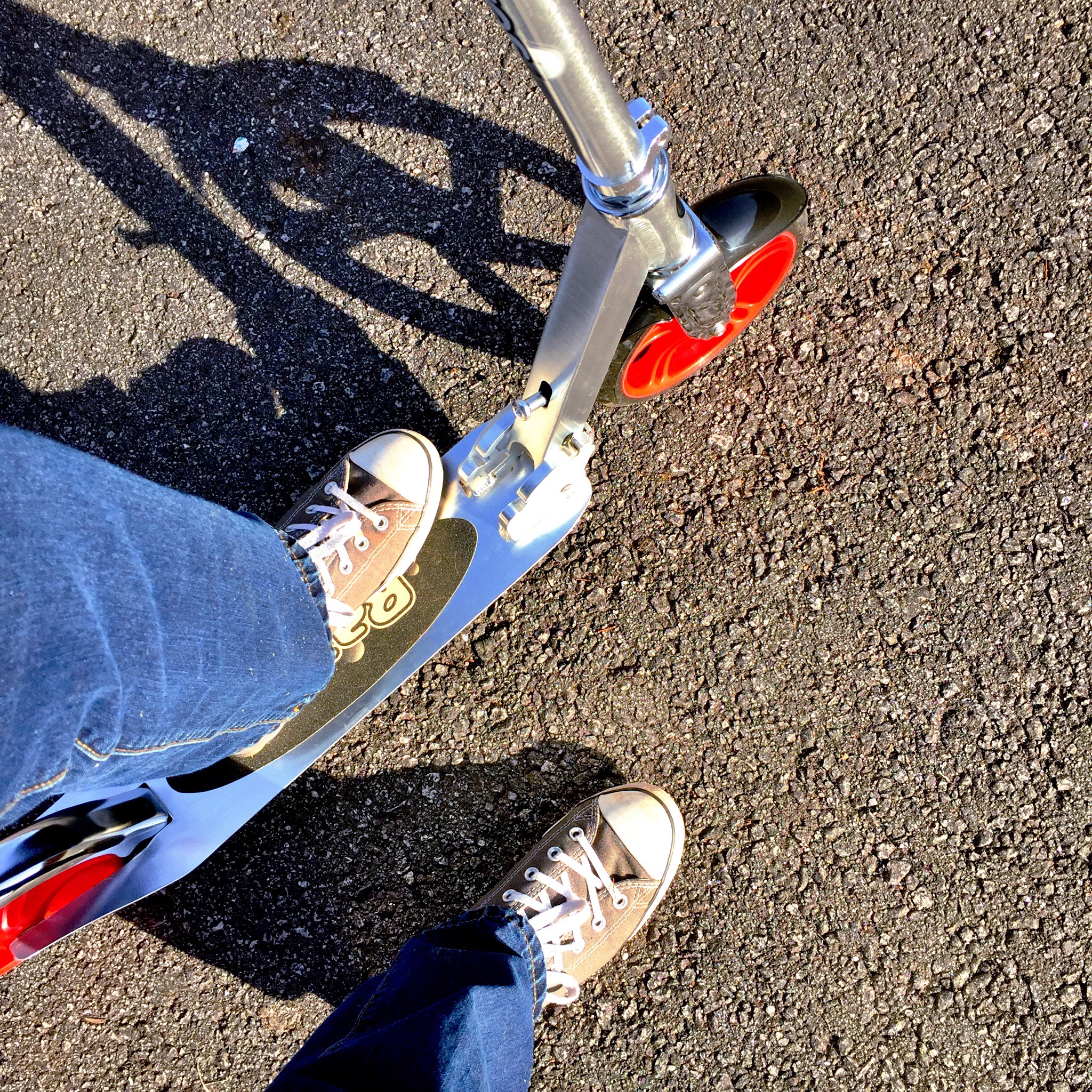
Recently, I’ve been borrowing my seven-year-old daughter’s scooter at every chance.

Me, to my kids: “Hey, girls! Do you want to go ride your bikes…?!”

Me, to myself: *…so I have an excuse to ride the scooter*

I delight in zooming down our steep driveway and onto the road. And when we go around the block, I live for the smooth, even descent where I can just glide downhill back to our house, the wind in my gray hair. It puts a smile on my face and creates this simple little pleasure that most fifty-year-old men rarely experience.

Slomo, I get it. Skate on.

IMG_6222


Thoreau and the most encouraging fact

Henry David Thoreau (via Brain Pickings):

The millions are awake enough for physical labor; but only one in a million is awake enough for effective intellectual exertion, only one in a hundred millions to a poetic or divine life. To be awake is to be alive. I have never yet met a man who was quite awake. How could I have looked him in the face?

We must learn to reawaken and keep ourselves awake, not by mechanical aids, but by an infinite expectation of the dawn, which does not forsake us in our soundest sleep. I know of no more encouraging fact than the unquestionable ability of man to elevate his life by conscious endeavor.