Sunday night Stoic: On being real

Meditations 11.15:

“The despicable phoniness of people who say, “Listen, I’m going to level with you here.” What does that mean? It shouldn’t even need to be said. It should be obvious—written in block letters on your forehead. It should be audible in your voice, visible in your eyes, like a lover who looks into your face and takes in the whole story at a glance. A straightforward, honest person should be like someone who stinks: when you’re in the same room with him, you know it. But false straightforwardness is like a knife in the back. False friendship is the worst. Avoid it at all costs. If you’re honest and straightforward and mean well, it should show in your eyes. It should be unmistakable.”

This is the emperor of Rome talking. He doesn’t have time for superficial niceties and flat-out phoniness. And neither should we.

I can’t get over how direct and raw and real Marcus’s language is. This little book is such a treasure.

And to his point above, don’t you love people who shine with integrity and authenticity? It takes courage to not play the games that most people expect, to speak clearly and honestly and to do right no matter the consequences.

Sunday morning Stoic: A grape seed in infinite space

Meditations 10.17-18:

“17. Continual awareness of all time and space, of the size and life span of the things around us. A grape seed in infinite space. A half twist of a corkscrew against eternity.

18. Bear in mind that everything that exists is already fraying at the edges, and in transition, subject to fragmentation and to rot.

Or that everything was born to die.”

On confusing wishes with goals

I listened to an episode of The Art of Manliness podcast today and heard a psychiatrist discuss the way people frequently confuse wishes with goals.

Imagine having a goal for the weather to be spectacular tomorrow.

Ridiculous, right?

We have zero control over the weather. It just happens. You adjust to it; it doesn’t adjust to you.

So much of our thought and energy, though, goes into pointless worry and futile attempts to control what is uncontrollable. 

The weather, rush hour traffic, circumstances and accidents and quirks of fate. You can only play the hand you’ve been dealt. 

What other people think or do is beyond your control. 

You can do nothing except choose your own actions. 

The universe does not revolve around you. You’re not entitled to anything. 

Put your focus on what is in your power to control, and let go of trying to grasp the wind and bend fate to your whims. 

You can’t stop the rain. But you can wear a raincoat. 

Sunday morning Stoic: Only these two questions

Meditations 10.11:

He “has dedicated himself to serving justice in all he does, and nature in all that happens. What people say or think about him, or how they treat him, isn’t something he worries about. Only these two questions: Is what he’s doing now the right thing to be doing? Does he accept and welcome what he’s been assigned?”

Marcus, keeping it simple. Only two concerns matter.

Do the right thing right now.

And embrace what fate has assigned to you. Work with what is. There’s no use in resisting whatever got you to where you are now.

But you can use anything—any obstacle or seemingly undesirable circumstance—to prompt you to do the right thing right now and propel yourself forward.

Sunday night Stoic: Amor fati

Don Robertson, in Stoicism and the Art of Happiness, quotes the philosopher Friedrich Nietzsche:

“My formula for what is great in mankind is amor fati: not to wish for anything other than that which is; whether behind, ahead, or for all eternity. Not just to put up with the inevitable – much less to hide it from oneself, for all idealism is lying to oneself in the face of the necessary – but to love it. (Nietzsche, Ecce Homo, 10)” 

Love what is, even if what is is the opposite of your desire and seemingly in violation of your dearest values?

I get that what is already is. Resistance is futile.

Nietzsche is going a big step further than mere acceptance, though. 

Love what fate has brought you no matter what it is?

This is hard stuff and requires some sort of mental jujitsu. 

Embrace whatever comes as though it were a gift, an opportunity to continue propelling yourself toward the best human you can be.

Be grateful for everything. 

Love your fate.

Aurelius 2016!

“PDA”—public display of anger—seems to be all the rage at the moment.  

But don’t rage against the rage. 

Be curious. Be calm. Be courageous. 

And most importantly, be kind. 


Marcus Aurelius explains your options

A timely reminder from Marcus Aurelius:

“Everywhere, at each moment, you have the option:

to accept this event with humility

to treat this person as he should be treated

to approach this thought with care, so that nothing irrational creeps in.”

Another translation of that first line reads:

“Always and everywhere, it depends on you piously to be satisfied with the present conjunction of events.”

But what if “the present conjunction of events” sucks?

What is, already is. Resisting reality is futile and frustrating.

What if you simply observed even the most upsetting events and responded with fascination and curiosity?

Accept what has happened, bad and good, as though it is a gift to you to be used to expedite your own growth and propel you further and faster toward perfecting your character.

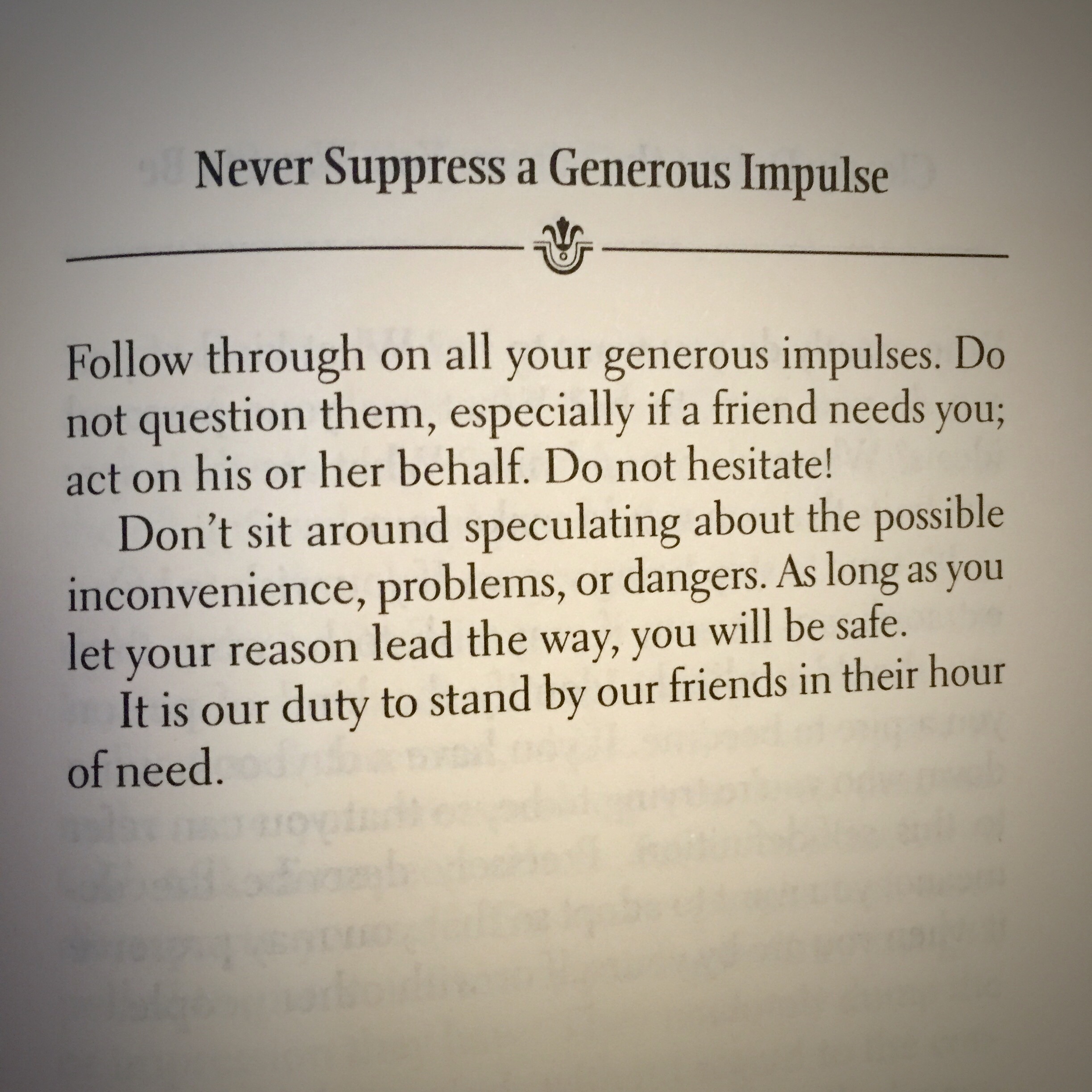
Sunday morning Stoic: Be more generous than seems reasonable

From Epictetus, via Sharon Lebell’s The Art of Living:


I can’t outgive my wife. 

Often, we’ll see a need or be asked for a contribution to some cause we care about. When she asks me how much we should give, I’ll come up with an amount I think is a little bold, but not unreasonable. But before telling her, I’ll ask what she has in mind, and it’s always bigger and bolder.

I too often try to be reasonable with our generosity. But most of us can give more and do more than we think is reasonable. 

Push your generosity comfort zone out to the edge where it’s slightly-uncomfortable-but-kind-of-thrilling. Push pass the resistance that guides you to caution, and follow your impulse to give more boldly. 

Sunday morning Stoic: Your defining characteristic

Meditations 8.12:

“When you have trouble getting out of bed in the morning, remember that your defining characteristic—what defines a human being—is to work with others.”

Homo sapiens are wired to be tribal. That’s how we survived and flourished.

As much as I lean introvert and value alone time, it’s in community and connection and contribution where I thrive and feel most alive.

It’s all about relationships. 

Sunday morning Stoic: Assemble your life yourself

Meditations 8.32:

“You have to assemble your life yourself—action by action. And be satisfied if each one achieves its goal, as far as it can. No one can keep that from happening.

—But there are external obstacles.…

Not to behaving with justice, self-control, and good sense.

—Well, but perhaps to some more concrete action.

But if you accept the obstacle and work with what you’re given, an alternative will present itself—another piece of what you’re trying to assemble. Action by action.”

It’s on me to put my own life together, to craft myself into the person I aim to be, to create opportunities worthy of my time here.

Don’t wait on others or on the right conditions or on a feeling you hope will propel you forward.

Just take action, whether you feel like it or not. And then keep acting.

Of course, it won’t go as planned. But act like the obstacles and setbacks you encounter are actually a part of your plan.

Don’t resist what is. Use everything, even unwanted obstacles, as building blocks in the creation of the life you are assembling for yourself.

Sunday night Stoic: Forward progress

Meditations 8.7:

“Nature of any kind thrives on forward progress. And progress for a rational mind means not accepting falsehood or uncertainty in its perceptions, making unselfish actions its only aim, seeking and shunning only the things it has control over, embracing what nature demands of it—the nature in which it participates, as the leaf’s nature does in the tree’s.”

Even just bringing order to my workspace or cleaning my house feels like moving forward, like I’m making room for new possibilities.

Instead of asking “What do I need?” or “What can I get?”, what if I asked “What do I have to offer?” or “What can I contribute to lift others?”

Here’s to a week of forward progress, of making and doing and listening and of looking for opportunities to give and to contribute something worthwhile.

Sunday night Stoic: Step one and step two

Meditations 8.5:

“The first step: Don’t be anxious. Nature controls it all. And before long you’ll be no one, nowhere—like Hadrian, like Augustus.

The second step: Concentrate on what you have to do. Fix your eyes on it. Remind yourself that your task is to be a good human being; remind yourself what nature demands of people. Then do it, without hesitation, and speak the truth as you see it. But with kindness. With humility. Without hypocrisy.”

Easy. Just two steps to become an awesome human. 

Two simple, overwhelmingly challenging steps

This is a good week to step anew into the life you want to live.

Sunday night Stoic: On dealing with annoying people this week

Meditations 2.1:

“When you wake up in the morning, tell yourself: The people I deal with today will be meddling, ungrateful, arrogant, dishonest, jealous, and surly. They are like this because they can’t tell good from evil. But I have seen the beauty of good, and the ugliness of evil, and have recognized that the wrongdoer has a nature related to my own—not of the same blood or birth, but the same mind, and possessing a share of the divine. And so none of them can hurt me. No one can implicate me in ugliness. Nor can I feel angry at my relative, or hate him. We were born to work together like feet, hands, and eyes, like the two rows of teeth, upper and lower. To obstruct each other is unnatural. To feel anger at someone, to turn your back on him: these are obstructions.”

Humbug? No. Reality check

Use the potential stress and annoyances of this week as opportunities to grow in patience and understanding and self control.

That trying relative, the rude store clerk, the reckless driver… they’re giving you a chance to get a little better as a human as you choose your response to whatever may come this week.

This is not the gift you would ask for, but accept every little thing that happens as a gift that moves you further along toward the person you aim to be.

Happy holidays!

How fragile we are

  All life is sorrowful, or ultimately unsatisfactory.

Heartbreak is coming your way, no matter how good life may seem at the moment.

The deeper you get into life and the more you experience, the more you realize—whether you allow yourself to acknowledge it consciously or not—pain is inevitable.

You will lose those you love dearly.

You will hurt and be hurt.

That bright, shiny dream will either elude you, or possibly worse, will be realized yet end up falling short of truly satisfying you.

Discontent.

Disillusion.

Disappointment.

But if you’re heartbroken right now, hang on a bit. Keep moving forward.

Joy is on the horizon.

So is sorrow.

You can’t have one without the other. They define each other.

We break most easily when we expect only joy.

Cynical as it seems, the secret to happiness is low expectations. Or seeing reality as it is.

Expect heartbreak. Anticipate cruelty and pain and disappointment. Steel yourself for the impersonal rhythm of reality.

But don’t give in to despair and cynicism. 

Life sucks sometimes, but not all the time—not even most of the time. It’s filled with wonders and light and hope.

We are fragile creatures. 

Be kind to everyone. Everyone is breakable, no matter how strong they may seem. 

Be kind to everyone, even those who seem undeserving. Who knows what they’ve gone through, what burden they may be bearing?

Be strong for others. You will eventually need someone to be strong for you.


Sunday night Stoic: There is a limit to the time assigned you

Meditations 2.4:

“Remember how long you’ve been putting this off, how many extensions the gods gave you, and you didn’t use them. At some point you have to recognize what world it is that you belong to; what power rules it and from what source you spring; that there is a limit to the time assigned you, and if you don’t use it to free yourself it will be gone and will never return.”

It is final exams week for college students, and I still remember procrastinating like it was my job when I was a student facing a tough upcoming test.

My dorm room was never cleaner than when I had a deadline looming.

It was fear. The fear of doing hard things, the fear of failing, the fear of being exposed as the fallible mortal I am.

Procrastination is giving in to the resistance.

Most of us spend our lives putting off the big questions and the excrutiatingly hard tasks of making sense of our existence and doing something meaningful with our time on the planet.

So, tomorrow morning is going to be a “big rocks” morning for me. (If you don’t put the big rocks—the most significant priorities of your life—in the jar first, they’ll never get in. The trivial inessentials—the sand and gravel—will fill up your life and leave no room for what matters most.)

I’m going to use a jumbo sized blank page (or maybe even the jumbo whiteboard in my office) and some markers and start mapping what’s important and what needs to be done.

What is most important? Who is most important? What really matters that I have been putting off?

Damn the resistance, just start.

You don’t know when your time will be up.

On coconut pie and numbering your remaining days

This Wait But Why post is enlightening and sobering. Tim Urban charts his life expectancy and the frequency with which he is likely to experience various things if he lives to 90.

Seeing all the weeks or days you have left laid out in a grid makes for a unique perspective.

I’m 51. If I’m lucky enough to live to 90, I’ve got fewer than 40 Christamases left to experience. Same for the seasons. Less than 40 summers remain.

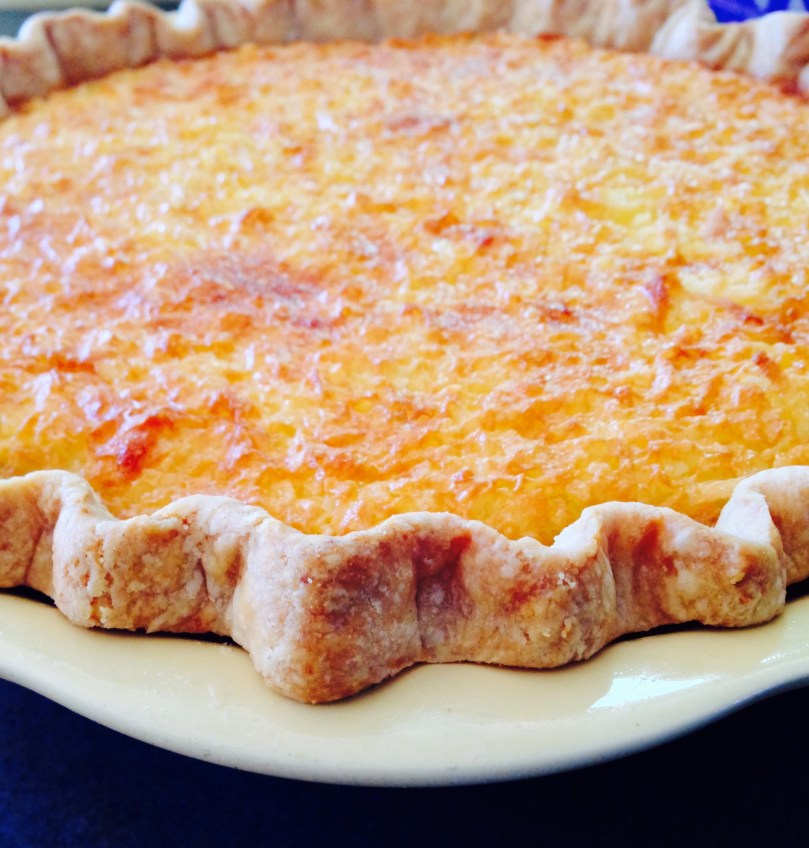
And if I eat coconut pie only three times each year, I’m down to just 120 or so moments of coconut pie bliss. (Note to self and to my lovely wife who bakes the world’s best coconut pies: Create more coconut pie eating opportunities.)

The relationship insights of seeing your remaining life laid out like this are more striking. Urban shares this observation about his time with his family:

It turns out that when I graduated from high school, I had already used up 93% of my in-person parent time. I’m now enjoying the last 5% of that time. We’re in the tail end.

It’s a similar story with my two sisters. After living in a house with them for 10 and 13 years respectively, I now live across the country from both of them and spend maybe 15 days with each of them a year. Hopefully, that leaves us with about 15% of our total hangout time left.

This is painfully true and a bit disheartening to contemplate. My parents and my sister were my world until I moved out for college. Once we lived in different towns, contact with them plummeted to just a few face-to-face encounters each year.

It’s going to happen with my kids, too. They are at the center of my life right now, and my wife and I are everything to them. But in a few years, their mom and I will just be peripheral characters in their ongoing stories.

The awareness of the finite nature of everything we do and experience can make those things shine with meaning more than our usual obliviousness allows.

Especially in this holiday season it’s helpful to remember to savor the fleeting moments you have with the people you love most.

Regularly focusing on the brevity of life will compel you to add more meaningful moments to the days remaining on your grid.

And you might just eat coconut pie a little more often.

ht ToolsAndToys.net 

IMG_4400

Sunday night Stoic: Seize the day

Meditations 6.32:

“I am composed of a body and a soul. Things that happen to the body are meaningless. It cannot discriminate among them.

Nothing has meaning to my mind except its own actions. Which are within its own control. And it’s only the immediate ones that matter. Its past and future actions too are meaningless.”

This is hard stuff. This is graduate-level “sticks and stones may break my bones, but words will never hurt me.”

You control your mind and how it responds to whatever happens.

Between stimulus and response there is a gap. In that gap is your ability to choose your response. It’s not easy to mind the gap, so to speak, but we get to try again and again all day long every day.

But only the present moment matters. Only the present moment is real. Past and future are phantoms.

This moment is where life is.

Your mind is the portal and the instrument for living.

Right here. Right now.

Live now in the full power of your ability to choose—to choose your attitude, your actions, your thoughts.

You have little control over how long your body will keep your mind in the game. (Eat well. Do your pushups. Don’t sit too much. Don’t drink and drive or text and drive. Avoid doing stupid things.)

Live while you can. And live wisely, in sync with your nature.

Seize the day.

Sunday night Stoic: Reality

Seneca:

“We suffer more often in imagination than in reality.”

The world is too much with us. Our own lives are enough to live. But now we’ve got the worries of the whole world to ponder every day streaming through our devices and pinging our brains with a ceaseless flow of bad news and heartbreaking stories.

I don’t think the world is particularly more woeful now or humans more horrid. In fact, compared to every other generation of our species, we probably are living in the safest, most peaceful time ever.

Steven Pinker makes just that case in his book, The Better Angels of Our Nature. Humans living today are less likely to suffer violent deaths or experience any kind of physical violence than in any century in human history.

One of my favorite podcasts is Dan Carlin’s Hardcore History. A consistent theme throughout every historical era he describes is how brutally violent people have been to each other. Atrocities we see in the news today wouldn’t seem shocking or out of place to people a millennia or two ago. They saw worse and lived with much more reason to be afraid.

People behaving badly has been the rule rather than the exception. Humans are the worst, right?

But we’re getting better. And we are more troubled than we ought to be.

I don’t watch television news. I scan the headlines each morning, and I can’t help noticing the latest trending topics in social media.

But I don’t spend much time exploring the details of current events. Why should I? Why fuel irrational fears about things that are unlikely to ever happen to me.

Our perception of reality is in most cases more fearful than is warranted. What we imagine is way worse than what we are likely to experience.

If you’re feeling like the world’s got you down, take a mental vacation. Tune out the constant blast of news that feeds your fear. 

Focus your attention on what matters most to you. Use your imagination instead to make the best of whatever is in your control. 


Sunday night Stoic: Be prepared

I used to think my thoughts were somewhat magical, that if I thought only good things, only good things would happen.

It’s a powerful, but flawed, mindset.

There is power in intentionally choosing the bright side, of seeing the best in circumstances and in others. But willful disregard of undesired outcomes will leave you vulnerable to the whims of fate and the blunt trauma of real life.

The Boy Scout motto is “Be prepared.” This should be a wise person’s motto as well.

Be prepared for your plans to fail, for bad news to arrive, for heartbreak and for disappointment.

Before beginning a new venture, consider what could go wrong. It’s a lot more fun to imagine smooth sailing, but the calm waters you see now could be roiling tomorrow. Be prepared.

Stoics practice negative visualization regularly. They imagine the worst that could happen—the loss of all they hold dear. And they hold that thought for a moment and feel the pain of their worst fears realized. Even doing this for a few seconds will sober you and then revitalize your appreciation that those fears have not actually happened. Yet.

When my grandmother was gravely ill and years later when my mother was as well, I refused both times to acknowledge they might not make it through their illnesses. I wanted to think and speak only as though they would recover, especially in their presence.

I was not prepared when they died. My illusion of perpetual happy endings was shattered.

And I regret, now, that I didn’t get over my avoidance of discouraging thoughts and words enough to have a final, meaningful conversation with each of them, letting them know how much I loved and appreciated them and thanking them for giving me such a good life.

Fortunately, I had close relationships with both, and I know they knew I loved them. It would have been so nice, though, to have had a moment of closure before they were gone.

Love your family and friends while you can, and let them know how much they mean to you.

Imagine, regularly, what it would be like to not have your health and your wealth and your relationships. Doing so will make you more grateful and will lead you to a more authentic and meaningful life and will move you to act rather than passively and naively defer and delay.

Steel yourself for the worst that could happen. Prepare for things to not go as planned. And prepare to use whatever comes as fuel to propel you further and higher.