Doing vs. trying

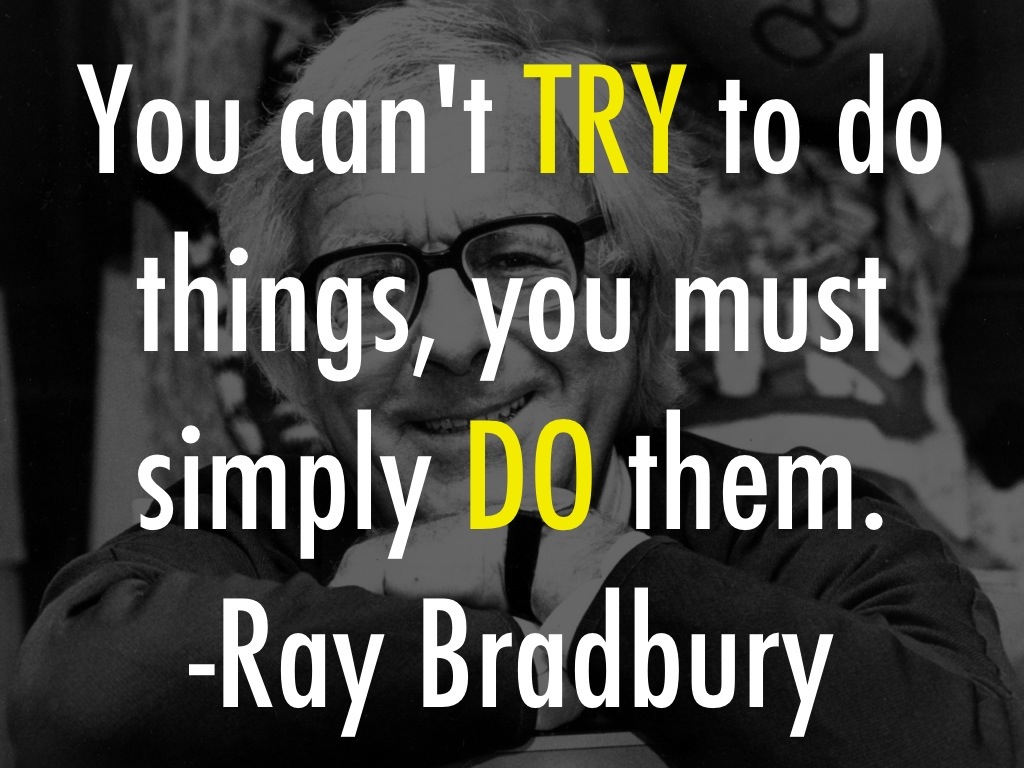
I can try to eat better, or I can eat better. I can try to write something every day, or I can write every day. I can try to get started on that big project at work that’s scary exciting, or I can just start. I can try to be a better listener and try to be a more attentive, present parent. Or I can just do it.

I find myself couching my commitments in the safety of “try”, giving myself room to not actually follow through. Dropping the “try”, though, takes away the net and calls my bluff. Will I do it or not? No points for just trying.

Where do you need to drop “try” and just do it?

20130617-140335.jpg

20130617-140350.jpg

Fathers, be good to their mothers, too

Years ago I was sitting with a group of student leaders going through a training session about university services. The head of the counseling department was explaining all the programs his office offered, and he mentioned they even provide relationship counseling. He asked our group, “How many of you want a relationship like your parents have?” I raised my hand immediately and then found everyone staring at me. There were no other raised hands in the room. The counseling director was trying to make the point that no one wants a relationship like their parents, and he was mostly right.

I, however, didn’t even have to ponder the question. My parents had a beautiful relationship that had always been my standard of what a marriage should be. Maybe that’s why I was a bachelor late into my thirties. I was not willing to settle for a typical relationship when my parents had shown me all my life how awesome a marriage could be.

The way my dad loved my mom was even more instructive than the way he loved me and my sister. And he was, and is, an amazing, inspiring, kind-hearted father and grandfather. But I’ve never known anyone who loved another as much as my dad loves my mom. I never heard him utter a sharp word to her. He put her first in everything. His highest aim was to delight her.

My parents modeled love in a powerful way, and dad doesn’t hesitate to let me know he expects the best from me, too. Shortly after I got married, my wife and I visited my parents’ home. They stood on the porch as we got in the car to drive away. Minutes later I got a phone call from my dad. “Son, I saw that you didn’t open the car door for Shanna as you left. Even though you’re married now, especially now that you’re married, you need to keep treating her like you did when you were dating.”

Thanks, dad, for continuing to remind me in word and deed to love my wife and kids with no ordinary love, and to show my own kids what they need to expect and create in their relationships.

On Father’s Day we are supposed to acknowledge the role that dad’s play in the lives of their children. It’s not enough to just be there for your kids, though, dads. Be awesome for the moms, too. The John Mayer song implores “fathers be good to your daughters”, yes, but being good to the mother of your daughters and sons is just as important.

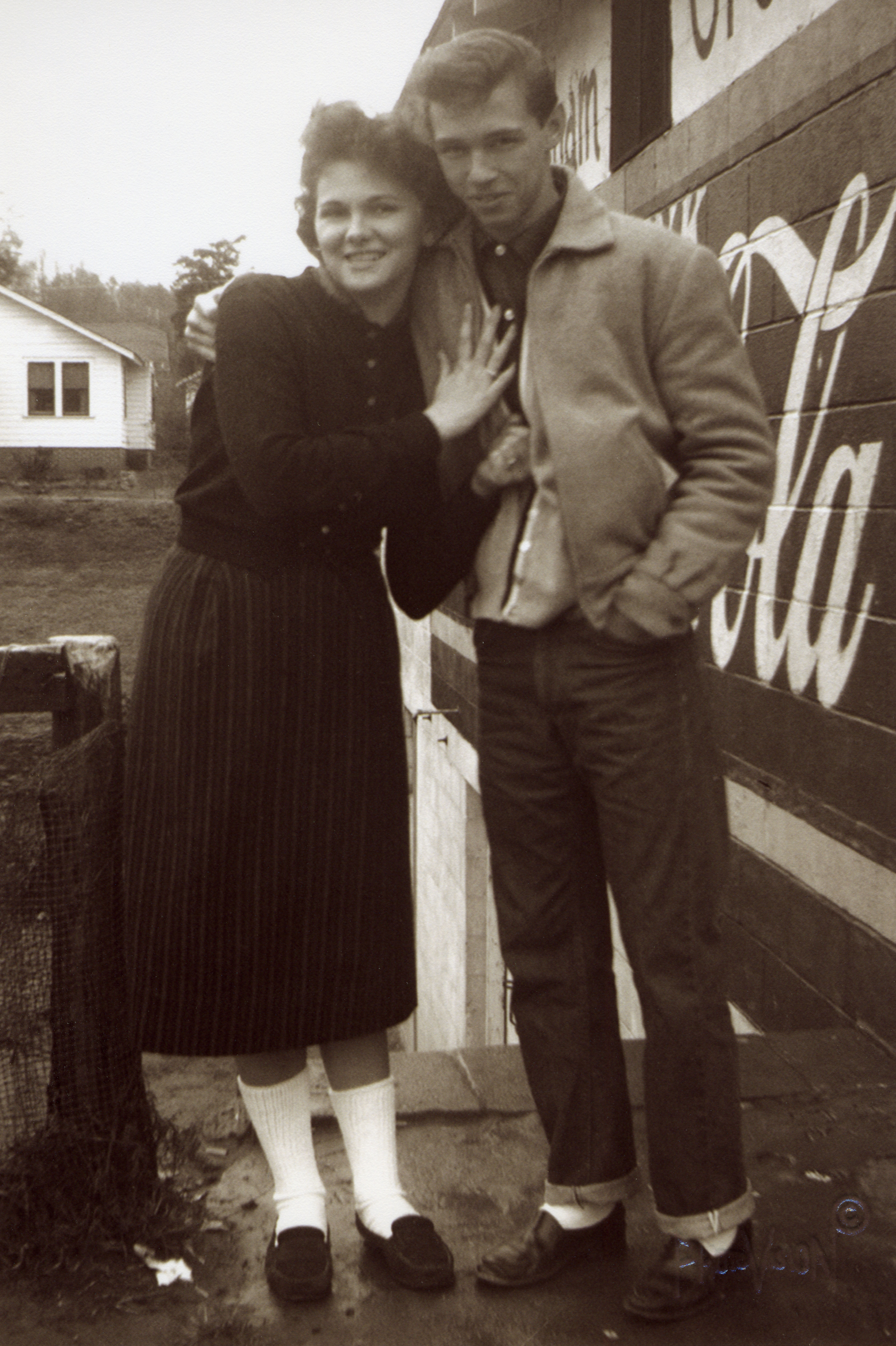
Mom & Dad, 1958
Mom & Dad, 1958


Primal summer

I’m an older dad. My first child was born when I was forty. Being a dad is the most important role in my life. I need to live a long time and stay healthy for my daughters and my much-younger-than-me wife. I want to be at full speed for races in the yard and tag and piggyback rides. I need to be able to pick my kids up and carry them for a few more years. And I want to be around to my see girls grow into women and be fully there for them for as long as possible.

Four-and-a-half years ago, I weighed thirty pounds more than I do now. I was just under 200 pounds. For a 5’9″ guy, that’s not good. In January of 2009, probably having made yet another New Year’s resolution to get healthy, I stumbled across a web site that changed my life: Mark’s Daily Apple.

This very fit looking Californian with impressive surfer-dude hair laid out a compelling case for a whole new way (a very old way, actually) to eat and live. The human species has been around for possibly two million years, but we’ve only been eating processed foods and copious amounts of added sugar for a mere century. And agriculture is only about 10,000-12,000 years old, so even grains were not a regular part of the human diet for the vast, vast majority of our existence.

The original humans were hunter-gatherers. And if we eat more like hunter-gatherers instead of the zoo humans we have become we are more likely to have optimal health.

This immediately made sense as I read it. After years of trying to eat better with nothing to show for it, just this shift in perspective about how we are wired as humans changed everything for me. I immediately dropped pasta and bread and soft drinks and sweet tea from my diet. It was easier than I expected. Within a couple of months, and without even exercising, I had lost twenty pounds. My weight continued to drop effortlessly and leveled off in the 160’s and stayed there while I was only about 75 percent strict with this primal way of eating.

Recently, though, that 75 percent commitment has drifted down to closer to 50 percent. And my pants have gotten a little tighter. Not awesome. So, this summer I am going primal. 100 percent. (Well, I’m going to allow some deviations for Sunday lunches when my kids like to go out for fun food. If I’m 100 percent awesome six days a week, I won’t feel bad about a weekly Sunday lunch splurge.)

This means my meals will consist of real foods – meat, vegetables, fruits, nuts and good fats like olive oil and coconut oil. Hunter-gatherer food. I will avoid grains and vegetable oils (they’re bad) and added sugar* and processed, packaged food in general.

I’ve scheduled my annual physical with my doctor for August 15, two months from now. There’s nothing quite like a publicly announced deadline to focus my attention.

Interestingly, I was worried after my first year of primal eating that my doctor would not approve of my new lifestyle, even with the weight loss, if my cholesterol was crazy. I was eating eggs for breakfast every morning and plenty of meat and butter each week. Conventional wisdom says that stuff will kill you. However, at the first physical after my primal transformation my good cholesterol was better than it had ever been. My doctor let me know that total cholesterol is not a helpful number. The HDL/LDL ratio is what’s important, and my new way of eating had now put me into the lowest risk category for heart disease. Saturated fat for the win!

Good health is everything if you don’t have it. Your health is easy to take for granted, especially when you’re young and bulletproof. All else in life – relationships, work, play – are diminished, though, when your health is diminished.

I have control over what I put in my mouth. I get to decide to be healthy, to act and think like a vigorous, strong, healthy human, just like our ancestors. I’m going to use my primal summer to reestablish good eating habits, get moving and get outside more often, and be a more fully authentic, better version of myself by the time the season begins to wane.

*Sugar is poison. Tasty, tasty poison.

How to find work you love

Some of my students and former students may have read my “Follow your passion” is not helpful advice post, and they’re saying to the screen: “But EJ [they call me EJ], what about Howard Thurman?”

I have shared this Howard Thurman quotation with thousands of college students over the past fifteen years:

“Don’t ask yourself what the world needs. Ask yourself what makes you come alive and then go do that. Because what the world needs is people who have come alive.”

I stand by this quote as great advice for a college student and anyone trying to pick a career path. Sounds a lot like the misguided follow your passion advice, I know. “Follow your passion” is just not helpful as a stand-alone, magic bullet for a happy career. While skills trump passion in your quest for satisfying work, you still need to choose a path that offers delight and interest, that makes you come alive. What kind of work would be a good enough fit for you to spend years getting good at it? That’s a much less overwhelming, paralyzing question than asking you to figure out your lifetime passion.

If you’re trying to just “follow your passion”, you’re likely to get stuck searching for that one elusive match. If, instead, you explore all the things that make you come alive, you will focus on a direction rather than a destination, on a set of skills that you can begin refining. Be intentional about asking what it is that you love to do, not for the extrinsic rewards, but for the joy of the thing itself.

“You must cultivate activities that you love. You must discover work that you do, not for its utility, but for itself. Think of something that you love to do for itself, whether it succeeds or not, whether you are praised for it or not, whether you are loved and rewarded for it or not, whether people know about it and are grateful to you for it or not. How many activities can you count in your life that you engage in simply because they delight you and grip your soul? Find them out. Cultivate them, for they are your passport to freedom and to love.” -Anthony DeMello

I challenge university students to leverage their time here to ask these kinds of questions. If they don’t ask the “what makes you come alive” question while they’re in college, when will they in the rest of their busy adult lives? In answering that question, look for patterns – skills that keep recurring, interests that intrigue more than most, problems that you enjoy solving.

Gretchen was a student orientation leader with wisdom beyond her years. When confronted with incoming freshmen in angst over choosing an academic major, she told them how she picked a major. She was undecided when she arrived as a freshman, so she read every course description in the college catalog. Each time she read a course description that seemed remotely appealing, that looked like a class that was interesting or fun, she circled the class. When she finished reading every course description and circling only those that grabbed her attention, she went back and counted which major had the most courses circled. And that became her major.

Brilliant, no? And so simple. She was figuring out what made her come alive. But then she got on that path and worked hard at getting good. She was good enough to go on to an Ivy League graduate program and great success in her career and family life.

The “don’t ask yourself what the world needs” quote is especially crucial for new students to hear. Many arrive on campus with their parents’ expectations setting their own. We get a lot of “pre-wealth” majors at freshman orientation. I had a student whose father required her to be pre-med. She didn’t like science so much, and when, after a rough freshman year in the classroom, she pleaded with him to let her change her major, he relented only if she would then choose business instead.

I heard a commencement speaker last year say that your parents do not want what is best for you. They want what is good for you. They want you to be safe, secure, successful, and have all your needs met. But what’s best for you might be risk and struggle and failure, key components on any path to mastery and awesomeness. Respect your parents, but lead your own life. And know that one day you might be that parent wanting what is just good for your child. And that’s okay. Parents are wired by evolution to protect their babies. Of course, the way you live your life will inform your children more than anything you say to them.

If you’re struggling with finding a career, use the “come alive” question to help you find a general direction, a path to follow. You don’t have to know the one thing you need to be doing, your life calling. You just need to know enough to start moving in a direction that works for you. You need a place or a profession that you don’t dislike and where you can start building skills and getting good enough to truly love what you do and come alive in the process.
“Follow your passion” is not helpful advice

When I was in school my dream job was not to one day run a university visitors center and be a campus tour guru. It’s not exactly an obvious dream career. My first career dream when I was a kid was to be an astronaut. (I came of age when NASA was the coolest thing in the world, and we were sending men to the moon.) Then later I imagined I would be a politician or a TV news guy.

I stumbled into a job in higher education a few years after graduating from college after a stint working on Capitol Hill. I thought I would stick around in my university job just until I figured out what I really wanted to do. Twenty-one years later, I’m still here. And I’m passionate about my work. It’s not because I lucked into work that is a perfect “fit” for my passions. I do care about education, and I really like being on a campus and working with college students every day. But I wouldn’t be here if the twenty-something version of myself had insisted on discovering some innate passion that I was born to follow.

So many people struggle to answer that question: “What is my passion?” We’ve all been told to do “what you love” and “follow your passion”, but how do we figure out what that is? The pursuit of this perfect career-passion match ends up paralyzing and frustrating more than it results in blissful job nirvana.

Earlier this year I read Cal Newport’s book, So Good They Can’t Ignore You. Newport makes a compelling case that “follow your passion” is not particularly helpful advice. After looking closely at those who had found genuine career satisfaction, he realized that it wasn’t because they followed some inborn passion. Instead, career passion seems to come from getting really good at something and sticking with it. Passion follows excellence.

In a recent post on his blog, Newport offers this advice on choosing a career:

Pick something that you wouldn’t mind investing years in mastering. If you already have some skills, then it might make sense (though is by no means necessary) to start there, as you already have a head start on mastery, but you should still expect years of deliberate improvement before deep passion can blossom for your work.

The key thing, in other words, is to direct expectations away from match theory — which says passion depends primarily on making the right job choice — and toward career capital theory — which says passion will grow along with your skill.

This has been true for me. I chose work that seemed like fun, then I invested years in getting good at it. Passion for it bloomed naturally as I kept getting better and more knowledgable and more valuable to my employer. My continuing pursuit of excellence and the increased autonomy that comes with it have created genuine job satisfaction.

It’s not so much what you do as how well you do it. Certainly, pick a path that seems interesting or fun or meaningful, a career where you could see yourself spending a decade or so. Then throw yourself into mastering your work. Don’t wait till you find your passion. Just focus on being awesome at whatever path you choose, and passion and joy will find you.

So Good They Can't Ignore You

The honest waiter

My wife and I were at a favorite local restaurant for a rare date night. We were scanning the familiar menu, and she found an item she’d never tried. She mentioned it to the waiter, and he said, “Have you ever had that here?” When she said she hadn’t, the waiter crouched down, got close, and said quietly, “It’s not good.” He then went on to recommend several items on the menu he felt were outstanding.

We trusted that waiter for the rest of the night. We deferred to his recommendations on appetizers and dessert as well. And we had a delightful, memorable evening and left a generous tip.

He easily could have just smiled and nodded and let us order whatever. But he was honest, at some peril of being seen as disloyal to his employer. His tactful frankness (he wasn’t snarky or disrespectful toward the chef) endeared him to us and gave him credibility. This waiter cared about our experience and was willing to take a bit of a risk in the effort to delight us. He wanted us to have the best of what the restaurant offered.

We often feel we have to tow a party line in our work. Our public face has to look perfect, and our eagerness to simply meet a customer’s expectation can preclude exceeding those expectations. There’s great value in honesty and authenticity, even when, especially when, it pulls back the curtain a bit to reveal some flaws.

You can earn credibility and trust by letting your guard down and giving your guests or your customers the inside scoop, the real deal on how to make the most of what you have to offer. We’re still talking about that honest waiter and enthusiastically recommending that restaurant. Be honest. Be real. Be remarkable.

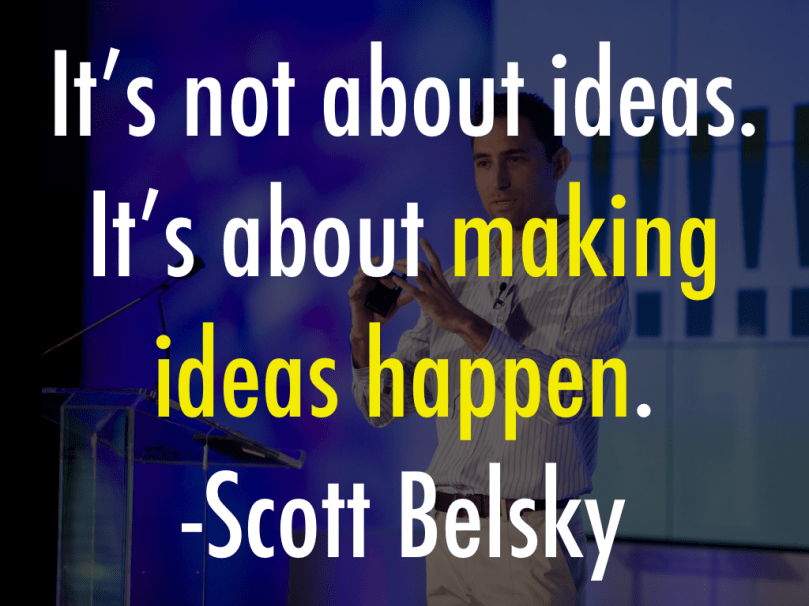
Making ideas happen

I was talking with my dad this week about the conference I just went to, and he reminisced about attending photography conferences. He said that he, too, would leave conferences with lots of new ideas and enthusiasm. But if he didn’t take action immediately when he returned, those big ideas were never realized.

making ideas happen

In the spirit of showing my work and forcing myself to take action, here’s my plan for making some of these new ideas I’ve collected happen. My office has a “fall kick off” staff retreat set for August 24. That is my ship deadline. I plan to have something remarkable ready to show our team by that date. Some are small projects that we’ve discussed for years but just never got around to doing. Others are big and can’t be completed in two months. However, it’s worthwhile to show them the progress we’ve made on longer term goals and begin to include the whole team in the next steps on bigger projects.

Watching Apple’s keynote yesterday, I was inspired by the way Apple announces new products and reminds its customers and its own employees of their mission. Apple keeps coming back to why they do what they do, and that makes the how and the what more meaningful. I’m envisioning allocating at least a portion of our staff retreat for an Apple-like keynote where we will unveil all the cool new stuff we’ve been working on while reinforcing the why’s of our work.

Having a fixed deadline will focus our efforts this summer. We can’t get away with just talking about these projects. If you’re ever frustrated about never getting around to that project that’s important but not necessarily urgent, give yourself a deadline. Make it public if you can. Magic happens when you’re working against the clock.

“To achieve great things, two things are needed; a plan, and not quite enough time.” -Leonard Bernstein

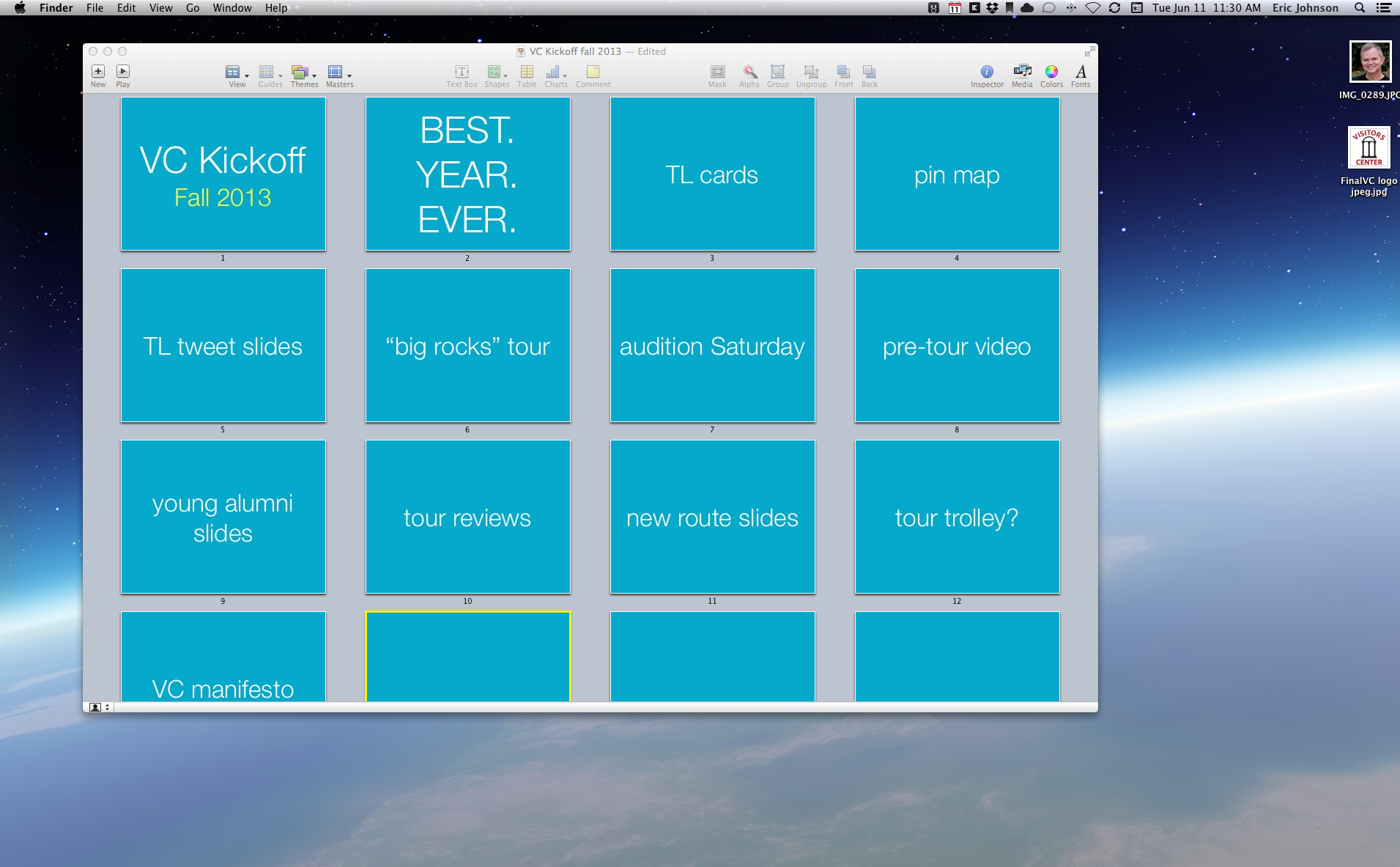
I’ve created a Keynote document that may or may not be the starting point for an actual presentation at the August 24 retreat. But I’m beginning with the end in mind and imagining now what would be ideal to present on that day. And then we will begin taking action to make these ideas happen. Keynote’s “Light Table” view (in Powerpoint it’s “Slide Sorter” view, I think) is a great place to brainstorm a project. I treat each slide like an index card with one separate thought or possibility per slide. They’re easy to see at a glance and simple to sort and rearrange (or delete) as the ideas evolve.

Real artists ship. If our work is our art, we need to make like a real artist and get busy making our ideas happen.

Screen Shot 2013-06-11 at 11.29.57 AM   Tuesday, June 11

It’s the feel of a thing, not the think of it

I spent my lunch break watching Apple’s WWDC keynote presentation which highlighted their newest products, including a dramatic rethinking of iOS. I can sit mesmerized for two hours by an Apple keynote. Not only do they make “insanely great” products, they know how to put on a good show. Steve Jobs is at the top of his presentation game, for example, in this historic 2007 introduction of the first iPhone.

Clearly, I’m an Apple fan. I got my first Mac, the Pixar-lamp-like white iMac, ten years ago, and I bought the 3rd-generation iPod that same year. I’ve been hooked ever since. Apple creates beautifully designed, brilliantly engineered products that make work and play more of a pleasure. They don’t hit everything out of the park, but no company has a higher batting average over the past decade than Apple.

Apple’s focus is clear. They want to make the best products in the world, if not necessarily the best-selling. (Though iPod and iPad dominate their markets, and iPhone is the most profitable in its category. And the Mac is still growing significantly compared to all other PC makers.) Unlike so many of the technology giants, Apple’s business plan does not revolve around getting their customers to click on ads. They want to make devices that make their customers’ lives better. This is their approach from the CEO down to the retail employees in Apple Stores.

20130610-200450.jpg

My computers and phone are just tools, but I appreciate that the quality of my tools has had an impact on the way I work and play. I’m all in on Apple. If the quality I’ve grown accustomed to with their products starts fading, I’ll reassess. (I was “all in” on Palm once, and now they don’t exist.) Today’s keynote shows Apple is still going strong, still innovating and polishing and polarizing critics and fans.

The key to Apple’s success is their commitment to the experience customers have with their products. Apple products often will lose a features checklist or specs comparison with competing products. But they win, often by a rout, on the feel of their products, on the delight of using them. Apple makes the hardware and the software and controls the entire user experience.

They revealed this brilliant campaign today that tells their values in a compelling way. Making consumer products and designing experiences can be poetic and artful. We are emotional creatures, moved to action less by logic and more by feeling.

What if your company, your organization, your family was as committed to excellence and the quality of experiences, the feel of things, as much as Apple is?

20130610-183811.jpg

Think different

This classic, much heralded ad campaign helped redefine Apple when the company was on the ropes in the 90s, fighting to be relevant again with Steve Jobs back in charge after his long exile. The version of this commercial that aired was narrated by the actor Richard Dreyfus. After Jobs died, this version, with Jobs narrating was released. It’s nice to hear this – his mantra, his vision – in his voice.

Here’s to the crazy ones.

http://vimeo.com/30169342

Here’s to the crazy ones, the misfits, the rebels, the troublemakers, the round pegs in the square holes… the ones who see things differently — they’re not fond of rules… You can quote them, disagree with them, glorify or vilify them, but the only thing you can’t do is ignore them because they change things… they push the human race forward, and while some may see them as the crazy ones, we see genius, because the ones who are crazy enough to think that they can change the world, are the ones who do.
–Apple’s “Think Different” ad

Be like a “dog chasing a tennis ball”

This commencement address by Dropbox founder and CEO Drew Houston is terrific. He’s speaking at his alma mater, M.I.T., and he’s only been out of college since 2005. He tells the story of how he got started as an entrepreneur, and he offers some great wisdom about choosing work that challenges and delights you like a “dog chasing a tennis ball”:

When I think about it, the happiest and most successful people I know don’t just love what they do, they’re obsessed with solving an important problem, something that matters to them. They remind me of a dog chasing a tennis ball: their eyes go a little crazy, the leash snaps and they go bounding off, plowing through whatever gets in the way. I have some other friends who also work hard and get paid well in their jobs, but they complain as if they were shackled to a desk.

My dog, Mosley, certainly gets crazy eyes when I fling a ball across the yard. He could be waking from a nap, but if he sees me with a ball in hand, he comes to life in a flash. I feel that puppy-like excitement when I get caught up in creating something worthwhile or working on solving a problem and making a dent in the universe.

I love how Houston concludes, with the call to tell an interesting story with your life:

Every day we’re writing a few more words of a story. And when you die, it’s not like “here lies Drew, he came in 174th place.” So from then on, I stopped trying to make my life perfect, and instead tried to make it interesting. I wanted my story to be an adventure — and that’s made all the difference.

We’ve got a limited stay here on this planet. If we’re lucky, Houston points out, we might get as many as 30,000 days. Today is my 49th birthday. I’ve lived 17,885 days, and I’m delighted to have made it this far. But I’m on the back side of my days. I just want to make the ones that are left worth talking about.

20130608-170057.jpg

Make the audience the hero of the story

Having just returned from a week of sitting in numerous presentations and giving a couple myself, I’m reminded of what a challenge it can be to create a presentation that makes a difference.

The best presenters put the audience first. An audience-focused speech is more likely to have been prepared with the intent to meet the listener where they are and offer them something of value for their time and attention. When the speaker is focused on his own agenda or is primarily concerned with what the audience will think of him, the odds are not in favor of a transformational moment for anyone present.

Yes, a speaker shouldn’t be attached to the outcome. But, the speaker should walk into the room with the sense of having a gift to offer. That’s why it is called “giving” a speech. Think of your message as a gift, and you will be compelled to create something that is tailored to the unique needs of the audience. Know who will be there and what challenges they face, what problems they want to solve. Then give them something that helps change them for the better, that awakens new possibilities.

Make the audience the hero of the story. Take them on a journey from “Why?” – Why should we care? Why is this important? – to “How?” – How then can we act on this thing that we now care about?

Pixar’s John Lasseter says that a story (at least one that Pixar wants to make) should be about “how the main character changes for the better”. The main character in a presentation is not the speaker, it’s the audience. Put them first, offer them a gift, and empower them to be heroes.

20130607-143105.jpg

Mise en place and “habit fields”

Chefs rely on “mise en place“, which is French for “putting in place”, for an orderly, efficient work space. All the kitchen tools and ingredients for the next meal are placed in a way that allows the work to flow with minimal resistance and maximum focus. We can arrange our work spaces for optimal effectiveness, too.

I just came across this thoughtful post, Habit Fields, by Jack Cheng. What if we arranged our work tools and surroundings to embed work habits that more readily get us into the “zone”, where we create with less distraction? Go read the whole post, but here are Cheng’s first and last paragraphs:

Consider the desk in your office. Maybe it reminds you of when you opened the box and put the pieces together. Or maybe it recalls your first day at work, when your colleague showed you where you would sit. The desk, the computer on top of it, the chair you sit in, and the space they comprise are all repositories for memory. But these things don’t just store our memories; they store our behaviors too. The sum of these stored behaviors is an object’s habit field, and merely being around it compels our bodies and minds to act in certain ways. By understanding these invisible forces and employing strategies to shape them, we can enjoy more frequent, sustained periods of flow.

We have the power to bestow our abilities onto the things around us. By being conscious of our tools, habits, and spaces, and actively conditioning them to help us behave the way we want to behave, maybe we can more efficiently tap into the thousands of hours of creative genius embedded in our everyday objects. Maybe we’ll be able to maximize the capabilities that new technologies afford us without being overwhelmed by the distractions. And, just maybe, we’ll remember what it feels like to be utterly engrossed in our daily work.

I love the idea of sitting in a different place or even facing a different way at your desk depending on whether you’re doing work or taking a mental break with some kind of distraction like Twitter. I have been doing most of my writing recently on my iPad, which makes switching to other apps just enough of a hassle to keep me on task. It’s a better uni-tasker than my Mac, and I’ve been building a writing habit around the iPad that I never did with a desktop computer.

Sharpen your “habit fields” and condition yourself to respond to your physical surroundings. Set up your work space for optimal focus when you’re working. Then the tools can better fulfill their purpose and allow you to cook up something awesome.

A conference mindset

I’ve been at a conference all week. I appreciate how just being away from a normal routine and in a different environment can spark possibilities and new ideas. There is a lot of sitting and listening time in conferences. Often, the speaker is thoughtful, effective, or even, ideally, provocative enough to challenge assumptions, rock the status quo, and make you rethink your work. It’s great to walk out of a presentation with new possibilities and a surge in energy that a dynamic speaker can provide. (If you’re going to speak to an audience, why not be awesome?)

Sometimes the speaker doesn’t connect, or maybe I walked in with a misperception about the published topic. Even then, just sitting still for forty-five minutes can lead to contemplation of new ideas. A quiet idea, maybe even poorly communicated, can take root just because I was forced to focus as I’m away from the day-in, day-out distractions of my typical routines. My mind often has been sent on productive tangents in the midst of an otherwise forgettable conference session.

Maybe we should try creating that conference mindset even in our normal day-to-day routines. Regularly disconnect from your place of distraction and put yourself in a place where you’re trapped for forty-five minutes or so with nowhere to escape. Find a remote place to do some work – a coffee shop or empty conference room or a lunch spot – where there’s more friction required to distract yourself.

Create a conference mindset regularly and see if new possibilities are awakened more regularly as well.

Audience karma

20130603-085709.jpg
I presented yesterday at the opening session of the Collegiate Information & Visitor Services Association (CiVSA) annual conference. What a great audience. These are big-hearted people who are used to standing in front of audiences themselves. They were smiling and nodding from the beginning, interacting, responding to my questions. Laughing at my jokes. They were engaged and supportive. They made me a better speaker.

We tend to focus exclusively on a speaker’s impact on the audience. But the audience definitely can affect the speaker as well and shape the overall effect of the presentation quite dramatically. Imagine standing in front of a blank-faced audience, or worse, a distracted one. People staring at their devices instead of at you. It’s hard to give your best to an audience like that. But how often are you that kind of audience member?

Even a poor speaker will perform better with an encouraging audience. Connect with the speaker. Make eye contact. Smile. Nod. Laugh. Interact when asked. You want to enjoy the presentation so put some effort into it to help the speaker along. Be the kind of audience member you hope to have in your audiences. And maybe audience karma will reward you when you’re the one up front.

Presentation travel gear

20130601-204716.jpg

I’m on the road this week, doing two presentations at a national conference.

I’m a minimalist when I travel. I take only one bag, and it’s small enough to carry on board.

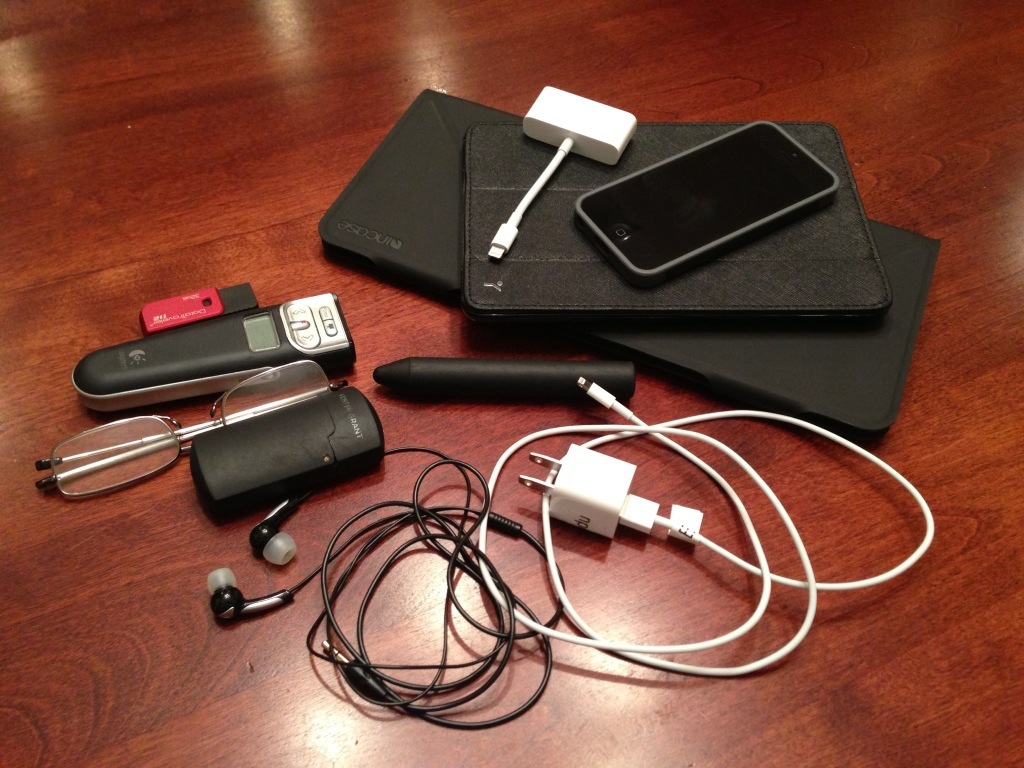
Above is the gear I brought for my presentations and for working in the hotel.

I’m using the iPad mini to run my slides with the Keynote app. I’ve got a VGA adapter to connect the iPad to the projector. I’ll use the Keynote Remote app on the iPhone to control the slideshow. (I’ve had some moments, though, when the Keynote Remote app let me down briefly. The bluetooth can disconnect randomly, but it usually comes right back. But I don’t completely trust it now.)

The flash drive is just a backup in case there are any difficulties getting the iPad connected. I could then load the document onto a local Mac or PC. Both presentations also are saved in iCloud and Dropbox. If I have to use a local PC, I’ve got a standard USB remote. I am so ready for technical difficulties. And if nothing works, I’ve got no problem going unplugged and presenting without slides. I experimented with some slideless talks this year, but I really like the oomph that images give when they support and don’t detract from the message. Images seem especially important with a larger audience, and my first presentation at the conference could have up to 300 people in the theater.

I’m continuing to love my Incase Origami Workstation Case for my Apple bluetooth keyboard. That’s what I’ve been writing almost all my posts on lately. It works with any iPad.

This is a great, minimal setup. I appreciate tools that fit their purpose and perform well. Here’s hoping I perform well regardless of the tools.

Smile

Three times each weekday I greet groups of campus visitors as they’re about to embark on our campus tour. I offer a brief overview and introduce the tour leaders.

Far too often, as I try to warm up the crowd, I’m greeted by a smattering of stone-faced expressions. These people are not waiting for a root canal or an IRS audit, where there may be less obvious reason to smile. They’re about to stroll through a lovely college campus with a couple of charming college students. Why the long faces, people? It’s my team’s aim, of course, to have them smiling by the time they leave.

But in pretty much every crowd there are smilers. Some are subtle with only a happy glint in their eyes. Others are nodding and grinning and practically glowing with positive energy. I love these people, those whose default expression is a smile. Just standing in the presence of smiling faces makes me happier and encourages me to be even a little more awesome myself.

Some children smile as many as 400 times a day. Many adults smile fewer than 10 times each day.

You want to be happy, right? No need to wait until you’ve reached some longed for accomplishment to be happy. Just act like you’re happy, and you likely will be. When you wake up, put a smile on your face. Make it a habit or ritual like brushing your teeth. When you greet people throughout your day, be intentional about smiling at them. Act like you’re happy to see them. Even if it’s just a nod and a quick smile. Fake it if you have to. Act like you are who you want to be. Use your body to inform your mind and your emotions.

There’s an old Peanuts cartoon where Charlie Brown is telling a friend that the worst thing you can do if you’re feeling depressed is hold your shoulders back and your head up and smile. Then you’ll start feeling better, and “that’s no good at all.”

Sages know this is true:

“Sometimes your joy is the source of your smile, but sometimes your smile can be the source of your joy.” Thich Nhat Hanh

Science backs this up:

“Even the simulation of an emotion tends to arouse it in our minds.” Charles Darwin

And smiling is contagious thanks to evolutionary wiring. Your smile can cause others to smile. What if one of your missions each day was to elicit as many smiles from others as possible? Make some mischief with your smile to subvert and co-opt the Charlie Browns of the world.

This is a delightful, short TED Talk from Ron Gutman about the power and surprising benefits of smiling:

There’s also this $2 e-book by Gutman that expands on his talk with plenty of support from researchers on how and why smiling is so powerful.

Good grief, Charlie Brown. Just smile.

Be awesome

I spoke to a group of college students yesterday. They are in training to run our university’s orientation program this summer. It’s a challenging job for these twelve students, who are stuck with each other in close quarters for sixty hours a week or more for two months. They will welcome thousands of new students, perform before large and small audiences multiple times each day, engage in countless conversations with nervous freshmen and anxious parents, and execute the logistics of a complex program that is crucial to our institution. I ran this program for thirteen years, so I greatly appreciate the challenge and the rewards of what these students are about to do.

At the end of my meeting with them yesterday, one of them asked me, “What’s your most important advice for us to keep in mind during our experience this summer?” I proceeded to offer some rambling discourse that I can’t exactly recall now. After I left, I realized what I should have told them: “Be awesome.”

This may sound trite and obvious and unhelpful. But it’s crucial to keep that intention, to be your best and do your best, at the center of your thoughts. If you’re constantly challenging yourself to be awesome, you will keep upping your game. You will get better. You will be discontent with cutting corners and doing “just enough to get by”. And this intent to be awesome applies to every area of your life – your work, your relationships, your health.

Awesome doesn’t phone it in. Awesome is awesome even when no one is watching. Awesome cares about the details.

When I drop my kids off at school each morning, my last words to them are, “Be awesome.” When I send off our student staff members to give a campus tour, I stand by the door to the bus and tell them, just before the door closes, “Be awesome.” When my wife leaves for work: “Be awesome.”

If you make this your mantra, if you wake up every day mindfully intent to be better on this day than the one before, you will put yourself on a path to excellence and deep satisfaction in all that you do. Before you go to sleep, assess the day. How did you do? How awesome were you? Note it in your journal to keep yourself accountable. If your actions didn’t meet your expectations, don’t beat yourself up. Being aware and caring are enough, and you get a fresh try the next morning.

I love this thought from Julien Smith:

I am a champion standing over my former self.

The only competition that matters is the one between who you want to become and who you are. Comparison with others will distract or discourage and put you off course. The you of one year from now should be able to kick the ass (in overall awesomeness and, maybe, physically as well) of the you from today.

Grow. Evolve. Rethink. Refine. Transcend your current limitations. One day at a time.

Be awesome.

IMG_0027

If You Want To Write

If You Want To Write by Brenda Ueland

I mentioned my favorite book, If You Want To Write, in a recent post. I discovered this little book back in the ’90s, and it remains one of the few books I’ve read more than once and recommended almost aggressively to others. The author, Brenda Ueland, was a writing instructor in the early 20th century. Reading this book is like sitting in her living room and having a pleasant conversation with a favorite aunt. She is kind and wise and funny, and her advice about writing is transferable to almost any endeavor. Really, the book could be titled, If You Want To Live A Happy Life.

Ueland’s book introduced me to the letters of Vincent van Gogh and the poetry of William Blake. Tolstoy is cited often as well. But it’s Ueland’s gentle, yet compelling, encouragement to take action, avoid being critical (of yourself and others), to be free, be bold, and be “microscopically truthful” with your work that stays with me. She says that everyone is an artist capable of creating something beautiful and meaningful. And we have the opportunity to help others express themselves. This quote from a van Gogh letter to his brother, Theo, has challenged me and informed my work ever since:

Many a man has a bonfire in his heart, and no one comes to warm himself at it. -Vincent van Gogh

How sad to imagine all the genius and insight and talent that has never been given a chance to grow and flourish in most people. Indeed, our culture is cruelly proficient at stamping out signs of originality and creative imaginings early in childhood even. It is a noble calling to be the one warming by the fire and fanning the flame that’s within someone who doesn’t think he’s got even a spark to share. If I produce nothing notable or lasting on my own but can help awaken possibility in others, that is a grand accomplishment.

If you ever need a dose of inspiration and a fresh perspective on what it means to be an artist, whether you want to write or perform or create a business or build a beautiful family, I highly recommend this sweet and powerful book.