A modern superpower

When is the last time you were in a conversation and felt someone was genuinely, deeply listening and trying to understand you? When is the last time you genuinely, deeply listened to someone? Not just going through the motions, nodding at key moments while actually just waiting your turn to speak. Not listening just enough to give the impression you care while you’re really composing your next thought to share when an acceptable pause gives you your chance to talk.

The gift of attention is as priceless a gift as you can offer or receive, especially in this age of distraction where so many stimuli are tugging at us, beeping, vibrating, pinging away at our limited supply of attention.

What if you put away your devices, ignored alerts, and zeroed in on the person in front of you? It’s not easy. Make it a practice to really listen, without judgment, without formulating your response. Just try to understand. You don’t have to be particularly wise or have great answers of your own. Paying attention is more powerful and more generous than offering advice, wit, or wisdom. It’s a skill anyone can cultivate, but so few do that it seems to be a rare, special power, a superpower even.

No cape required. No advanced degrees. No years of toil. Just listen and be present and be a hero for someone in need of genuine, old fashioned human connection.

20130707-220520.jpg

Ian McEwen on science

The novelist Ian McEwen on his fascination with science:

“Science is simply organised human curiosity and we should all take part. It’s a matter of beauty. Just as we treasure beauty in our music and literature, so there’s beauty to be found in the exuberant invention of science.”

This is from a great interview over on fivebooks.com, which is a site well worth getting lost in to explore lists of good books and interviews with book lovers.

For the love of science

We had a conversation with our campus tour leaders this week about science. Most tour leaders are not science majors. For whatever reason, few science students are drawn to our work. We get plenty of business and journalism majors, and there’s no shortage of English and political science students either.

But as campus tours unfold and they pass by science buildings, it’s easy for the non-science students on our team to dismiss science or apologize that we require at least a couple of science classes for all of our students.

I felt that way when I was an undergraduate. I just wanted to get past my science requirements with as little stress as possible. Now, I regret how little attention I paid to those subjects. Science has become significantly more fascinating to me in recent years.

In the history of humanity, it is the development of and amazing advances in science that stand out as our greatest achievements. Art and statecraft have their place, but science, even though it’s a relatively recent endeavor, has changed our lives exponentially for the better and sparked our inclination to explore and discover as never before. More people should honor and understand science. If we don’t do that in higher education, where will we?

I have begun trying to absorb more now about science and adding books to my reading list by or about Feynman, Darwin, Sagan, and Einstein. I don’t always understand. It’s like reading something written in a foreign language at times. But I can’t help but get excited about approaching the frontier of mysteries our ancestors could not even imagine.

This is the first video in the delightful Feynman Series. Check out the Sagan Series as well.

“I can live with doubt and uncertainty and not knowing. I think it’s much more interesting to live with not knowing than to have answers which might be wrong.” -Richard Feynman

Aim high

20130704-170555.jpg

There is more competition to be average than there is to be awesome. The fear of falling short keeps most people from aiming high. Most aim for safe and comfortable and unremarkable. So, if you pursue crazy big ideas you at least have the benefit of less competition.

The end is near

I was at a conference in Denver last year and saw a headline in the local newspaper that said astronomers had determined conclusively that the nearest galaxy to ours, the Andromeda galaxy, is on a collision course with our very own Milky Way. There’s no way around it. It will be catastrophic, cataclysmic. Andromeda definitely will collide with the Milky Way… in four billion years.

The good news is that our solar system, our tiny little corner of the galaxy won’t be impacted by the collision until about two billion years after the initial impact. So, we’ve only got six billion years.

Need perspective? Think big picture. Really big picture. While pondering the scale of galaxies and the mind-boggling expanse of time and space may make you feel small and insignificant, our smallness and our life’s brevity are reality. But how amazing is it that we are a part – and a conscious, intelligent, aware part – of such a grand, awesome, beautiful universe?

Pause and reflect regularly on the wonder of it all. Look up. Look closely at the mysteries that surround us, from the blade of grass underfoot to the galaxies spinning far beyond. Be wowed by all that is and that anything is at all.

“The most beautiful thing we can experience is the mysterious. It is the source of all true art and all science. He to whom this emotion is a stranger, who can no longer pause to wonder and stand rapt in awe, is as good as dead: his eyes are closed.” -Albert Einstein

20130703-211850.jpg

Adapt, survive, thrive

20130702-210224.jpg

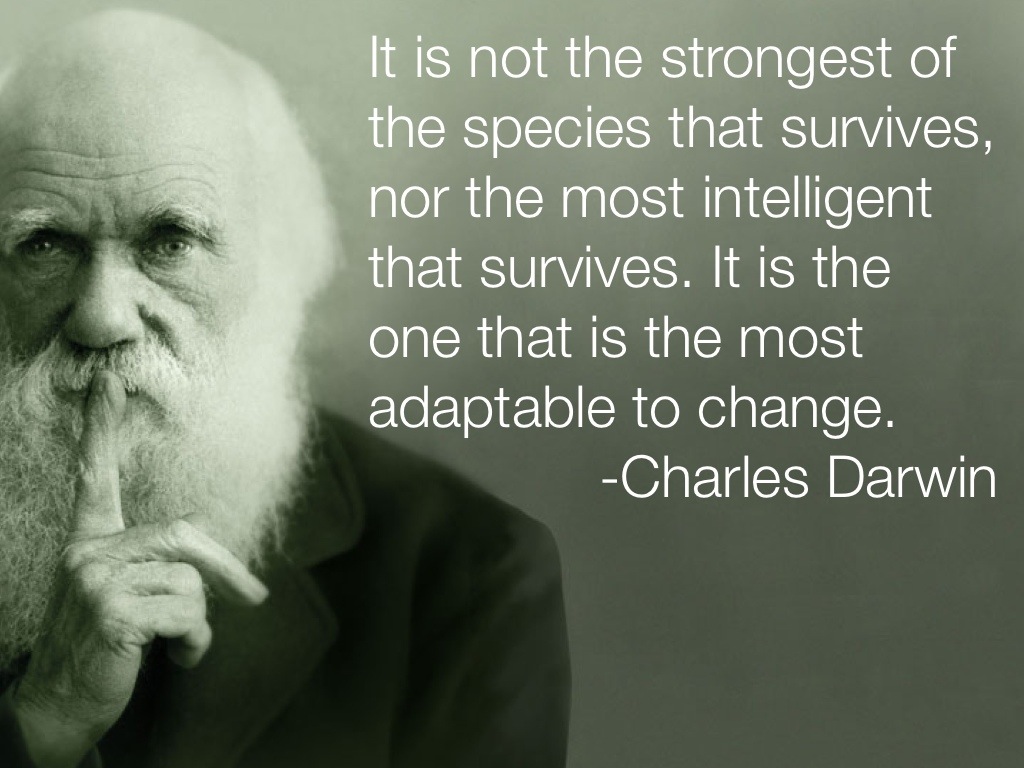
Strength and intelligence alone mean little when your environment changes. What was smart in one situation may be perilous when things change. The newspaper industry and the music industry seemed to have bulletproof business models for most of the twentieth century. Then the internet happened. Only the players who have adapted to those changes rather than clinging tightly to what used to be smart and strong are thriving now.

I’m in higher education, and I imagine it’s in for some major shifts and rethinking in the next decade. Broadcast television, government, small business, religion… This century will look very different than the previous one.

Those institutions and people that have the courage to let go of relying on outdated strengths and conventional wisdom are the ones likely to thrive as we face an era of unprecedented change.

How can you brace yourself and condition yourself for change personally? How can you shed habits and patterns and try on new approaches and behaviors to be prepared to adapt and thrive?

The ultimate mission for each generation

20130701-223316.jpg

The more we know, the more we realize we don’t know.

What an awesome, overwhelmingly mysterious universe we live in.

“He who thinks he knows, doesn’t know. He who knows he doesn’t know, knows.”

You want a calling, a noble mission that can consume your life? Make it your work to help push humanity’s understanding of the universe and our place in it even a little further into the vastness of the unknown.

Art is infection

Tolstoy said you shouldn’t have to puzzle over art and try hard to figure it out. Great art, he thought, should be able to be grasped by even a child. An artist has a feeling, an idea, something that moves him, and he wants to share it with others. If he makes good art, then others, those who read his writing or view his painting or hear his speech, will get that same feeling. “Art is infection,” he said.

All of us are artists. What is meaningful enough to you to want to share with others? How can you convey it simply and memorably, in such a way that even a child could get it?

20130630-223501.jpg

Bonfire within

20130629-211703.jpg

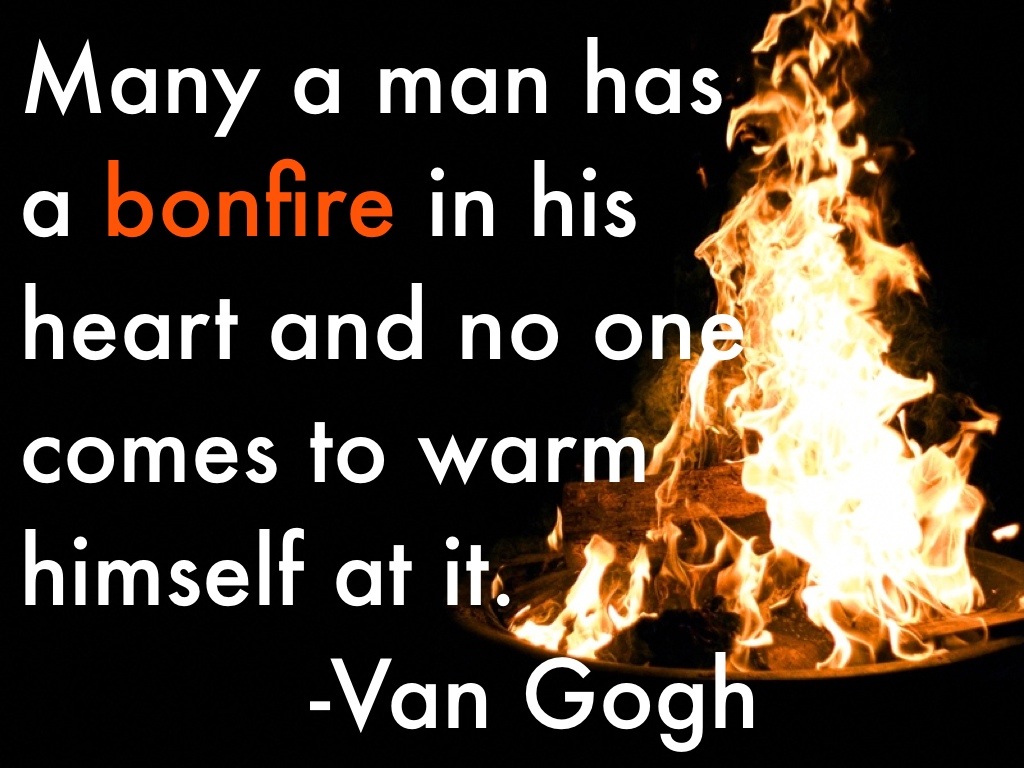
Whose fire can you warm yourself at who would benefit from a listening ear and genuine interest? Even those who don’t seem to be generating much smoke have a fire within that might just need a little tending, a bit of compassion and connection, to spark into a powerful flame.

In praise of ebooks

It’s great living in the future. The world’s information is in our pockets. We have no end of things to read and watch and play. Consequently, there also is no end of empty, worthless, even harmful diversions that can consume our time and attention.

Just as you should be mindful of what you put in your mouth, take care to put worthwhile things in your mind. Be a good curator of what merits your attention. Life is short. Use your very limited time and attention to consume books, articles, music, and other art that will make you better and happier.

I’m now a reader of ebooks. I have always been a book reader. I’ve collected and read books since I was old enough to read. Just picking up certain books in my collection can cause a rush of memories associated with reading them. But I’m not particularly nostalgic about the demise of paper books and newspapers and magazines. Paper is just a vehicle for the content. It’s the content that matters.

Ebooks ensure that you can easily access your entire collection of books from anywhere. John Adams advised his son, John Quincy, to “Always have a poet in your pocket”, to carry a book with you constantly to make good use of any down time. Now, there is no excuse not to have a good book or other reading material constantly available to you.

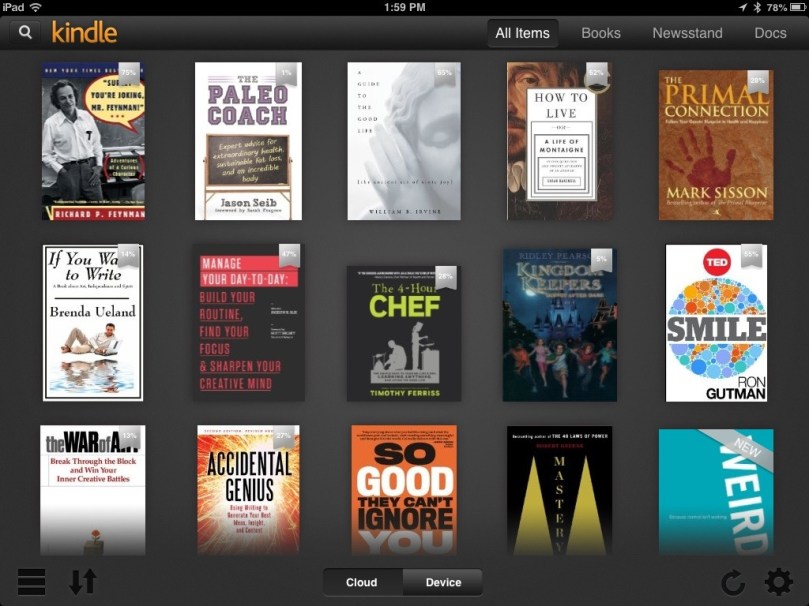
Ebooks make reading a pleasure for me. You can change the font and adjust the font size as well as the background. You can sync your books across multiple devices. You can highlight passages and make your own notes. I use both iBooks and Kindle. I prefer the iBooks reading experience. iBooks has a more pleasing page layout, including a ragged right edge, and offers a scroll option in addition to the conventional page turns. Kindle has a bigger selection of books to offer, though.

When people see my bookshelves, they often ask, “Have you read all of these?” Of course not. I have read some of most and all of some. I have no shame about stockpiling books. Ebooks make that even easier. Just a click on my iPad or my Mac, and the book is instantly downloaded. How cool is that? And now I don’t have to worry about having enough shelf space.

I do want a more disciplined reading routine, and this is one area where ebooks cause problems. I open my iPad and see dozens of books I might want to read or re-read. I plunge into one, and if my mind goes on a tangent, I can easily open another or go check Twitter. Paper books are much better at focusing my attention.
20130628-191712.jpg

Books have greatly affected my life and continue to do so. Choose your inputs wisely. Read classics. They are classics for a reason. Read the works of great writers and smart thinkers. Find an author that speaks to you and read everything she’s written. It’s the best way to really get an author. Ask friends and mentors what books have meant the most to them. This question alone can fill a dinner with great conversation. Challenge yourself to read at least one book each month. Some people read a book a week. Imagine going through 52 books every year. Make a wish list. Ask for iBooks or Amazon gift cards for holiday or birthday gifts. Start a reading group with kindred spirits.

Establish a reading habit. Family life makes it hard for me to disappear into a book regularly at home, so my daily lunch break works well for me.

Next time you find yourself channel surfing, flipping through the dismal array of reality shows on TV, grab a good book and get lost in the life of the mind that a book can create. Our culture is committed to extending literacy universally in the hopes there will be no one who can’t read. But the sad reality is that so many who can read actually do not.

In praise of email

Email gets a bad rap. But I like it.

I would rather receive or send an email about a task than receive or make a phone call or go to a meeting about a task. Email allows you to respond in your own time. A phone call does not. Email allows a person to assess and look into something, to build a potentially thoughtful, worthwhile gap between the stimulus and the response. Problems certainly arise when people don’t utilize that gap and instead respond thoughtlessly or too hastily. But email respects the time and attention of others better than conventional communication methods.

Most people need a couple of hours of uninterrupted time to get into a flow of productive work. Phone calls, especially, but meetings, too, have a skewed sense of urgency that does not respect the time and need for the deep focus of others. Certainly, some things have to be talked out or are best handled in person. But I appreciate someone who emails asking me to suggest a day and time when a call or face-to-face would be convenient. I have even set my phone’s voicemail message to encourage the caller to send an email instead of leaving a voicemail if possible.

Yes, email can be overwhelming if your email inbox is your de facto task list, especially if you don’t tend to your inbox consistently. But I’m an inbox zero guy. I process through my inbox every day and empty it almost every time I open my email app.

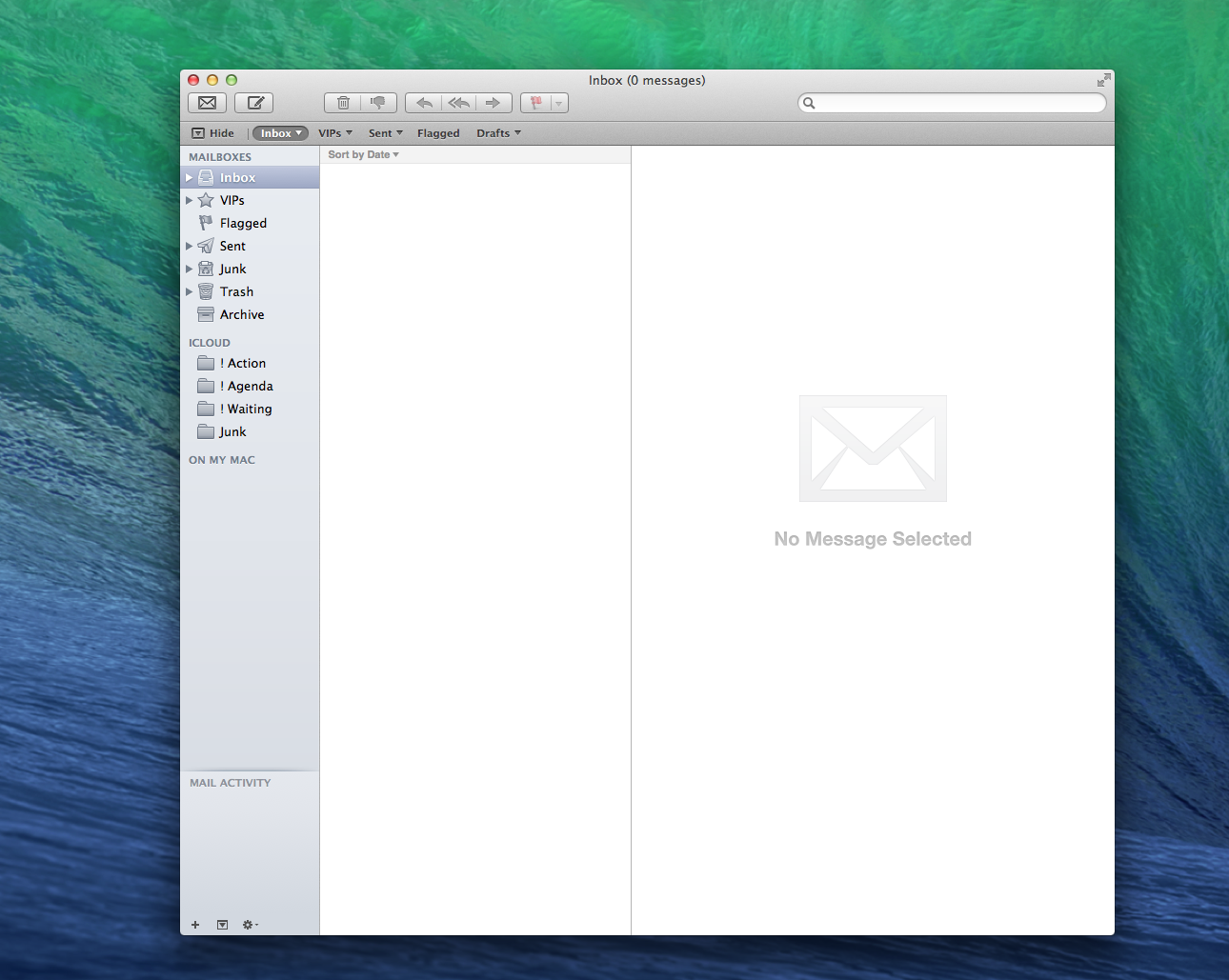
That doesn’t mean I respond to every email, and it doesn’t mean I respond quickly to every message. I just do triage. I decide which emails need a response from me and which can be deleted or archived. If an email needs a response, I do it right away if it will take less than a couple of minutes. If it will require more thought and take longer than two minutes, I file it in an “Action” folder in my Mail app for review at another time. Also, I only open my email app two or three times each day, ideally.

A good email should have a clear subject line, nothing cryptic, and the body of the email should be as short as possible. You’re more likely to get effective responses if you keep your emails clear, direct, and simple. Don’t cc unnecessarily, and there are very few cases where you need to bcc.

Tone is always important. Some people allow the impersonal nature of email or social media to enable bad manners. Be impeccable with your words, always. Read over everything you send or publish to check for errors, of course, but also to check your tone. Imagine anything you send being published for all to see. Don’t email anything you would regret becoming public. 

Email is just a tool, but used effectively it can help you work smarter and better.

My email inbox just minutes before this post was published


Peter Attia: Rethinking healthy eating

Peter Attia is a surgeon who struggled with being overweight even though he was active and fit. But he was eating a conventionally approved low-fat diet which was high in refined grains and carbohydrates. Once he flipped his diet to high-fat/low-carb, he dropped forty pounds. Now he has devoted his career to discovering answers to the most challenging questions about how to live a healthy life and spreading that knowledge to give others better lives.

This moving TED Talk tells a bit about his journey, but it focuses primarily on the probability that our assumed understanding of the roots of the obesity epidemic are completely wrong.

Astonishing facts from Dr. Attia’s web site:

  • 34% of Americans are obese and two thirds are overweight.  This represents more than a 200% increase from 1970.

  • Over 8% of Americans are diabetic, and if you include those undiagnosed, an additional 26% of Americans are pre-diabetic.  This represents more than a 400% increase from 1970.

  • Every 7 seconds someone in the world dies from a diabetic complication (this is not a typo).

  • Diabetes is also the leading cause of stroke, blindness, kidney failure requiring transplantation, all amputations combined, and many other medical problems.

  • According to McKinsey & Company, reducing the U.S. obesity rate to 15% (that of 1970) would save approximately $150 billion per year in Medicare spending alone, and close to $500 billion per year in overall U.S. healthcare spending.

  • A recent study in Obesity estimates that by 2030, 50% of Americans will be obese and 79% will be overweight.

  • The U.S. spends over $2.7 trillion per year on healthcare – nearly 19% of our GDP, and more than any other country.  Even if no other aspect of our spending increases in the next 20 years, the cost of healthcare alone will bankrupt us as a country.

As I’m being more mindful of what I eat this summer, Dr. Attia’s perspective just strengthens my resolve.

Doing hard things

I get to work each morning and regularly write down (in Day One) my MITs (Most Important Tasks). These are tasks that typically are important but not necessarily urgent, and getting them done will move my work forward in a meaningful way.

Yesterday I wrote down four tasks that had been nagging at me, none of which would take much time to complete. But each of them had enough friction or resistance to keep me from getting started on them. I did none of them yesterday. How could I get through the day and not start on even one of the tasks I had deemed most important?

I went home with those tasks still tugging at me, draining some mental energy that could have been better spent elsewhere. So, today, I just started, even though I didn’t feel inspired, and got three of the four done.

While the tasks weren’t complex, they each required some creativity, some thoughtfulness about how to express myself. And that can seem hard.

I often wait for inspiration to strike on those kinds of projects. Haven’t I learned that starting usually comes before inspiration? I may think, “I’ve got nothing”, but once I start I tend to come up with something. That something may be terrible, but it often primes my brain for another something that’s at least a little better.

I recently read about the McDonald’s Theory. You know what it’s like when friends can’t decide where to go to lunch together and everyone seems stymied? Just say, “Let’s go to McDonald’s!” Then, everyone suddenly comes up with lots of great lunch ideas because no one (usually) wants to go to McDonald’s.

Starting with something terrible gets you over the hump of having nothing, and then you can move on to something better than terrible.

Mary Oliver: West Wind #2

This is so good:

WEST WIND #2

By Mary Oliver

You are young. So you know everything. You leap into the boat and begin rowing. But listen to me. Without fanfare, without embarrassment, without any doubt, I talk directly to your soul. Listen to me. Lift the oars from the water, let your arms rest, and your heart, and heart’s little intelligence, and listen to me. There is life without love. It is not worth a bent penny, or a scuffed shoe. It is not worth the body of a dead dog nine days unburied. When you hear, a mile away and still out of sight, the churn of the water as it begins to swirl and roil, fretting around the sharp rocks – when you hear that unmistakable pounding – when you feel the mist on your mouth and sense ahead the embattlement, the long falls plunging and steaming – then row, row for your life toward it.

Girl power, word power, and charisma

This is a great presentation at TED by young Sarah Kay. She discovered spoken word poetry as a high school student and wow, did it make her come alive.

She delivers this on one of the most imposing stages imaginable with quite the intimidatingly impressive audience, and she flat out shines:

As the father of two young daughters, I especially admire what a powerful presence she has as a young woman. She is confident and charismatic and gets a standing ovation deservedly. Go girl, indeed. I want my girls to be able to plant their feet as firmly and connect with others as strongly as this young woman does.

She’s also spreading the good news of the power of expression, the magic of words.

“I write poems to figure things out.” -Sarah Kay

We all are artists with points of view and experiences that are unique in the universe. It’s a pity how many go to their graves having never truly expressed themselves or pursued a better understanding of their place in this universe by examining their life through art and self-expression.

Sarah Kay certainly does shine and commands the room like someone who’s been on stage for years. It’s easy to say she is just naturally charismatic, but I believe anyone can develop charisma. Charisma simply is caring deeply about something and having the courage to uncork some passion and share it with others. I love this thought from the speech coach Nick Morgan:

20130623-183910.jpg

I regularly assign Sarah Kay’s TED Talk to my student staff during training. She is (or was at the time) their age. I want them to see that they don’t need permission or seniority or a degree or years of paying their dues to be awesome. You don’t need permission, either. Express yourself. Be charismatic. Be awesome.

Cook your own food

I enjoy cooking. After I transformed my diet, I began caring a lot more about how our food is prepared. So, I’ve become the primary cook in our house, mostly to my wife’s delight. She still does the baking. The precision and linear nature of baking appeals to her, and I love the improvisation and intuitive approach of cooking. We are a good match.

My mom could whip up a great dinner almost effortlessly, putting a hearty home made meal on the table without much planning. I took for granted that everyone’s home was regularly filled with the aromas of home cooked meals. I realize now that most people do not cook. I suppose it seems hard or mysterious or just not worth the effort. But I’ve found it to be simple and satisfying.

It is nice to know exactly what you are eating and that is was prepared by a human you know and love and not by a corporation. You will eat healthier if you cook for yourself. The unhealthiest food is hard to make on your own. Deep frying? Hard. Twinkies? Give that a go in your kitchen. You want some cookies? Baking a batch from scratch takes a lot more time and effort than opening a pack of Oreos and will make eating cookies a rare splurge instead of a daily treat. Ice cream? Homemade is such a delight, but also not something you would do every day.

“Cooking is probably the most important thing you can do to improve your diet. What matters most is not any particular nutrient, or even any particular food: it’s the act of cooking itself. People who cook eat a healthier diet without giving it a thought. It’s the collapse of home cooking that led directly to the obesity epidemic.” –Michael Pollan

Yes, cooking is healthier, but it also can be a joyful, soul-satisfying daily task. I don’t often have much to show for a day’s work at the office. The output is hard to see, hard to measure, as it is for most of us today. Working with ideas and people has its merits, but working with your hands and making something tangible is primally satisfying. So, instead of seeing cooking as a chore when I get home, I get excited to make something, to use sharp knives and fresh ingredients and make a meal that delights and satisfies. I don’t even mind cleaning up after the meal.

I don’t do anything too complicated. I’m no chef, and you don’t have to go to culinary school to make good food. It’s so easy to sautee a pork chop in a skillet and lay some fresh green beans in a sheet pan for roasting. A whole roast chicken coming out of the oven on a cold winter night is a sensory pleasure that takes very little skill or effort. Baked sweet potato fries with coconut oil… so good and so simple to make.

If you’re not cooking at all now, just try cooking one or two dinners a week to get started. And, instead of cereal or a bagel for breakfast, try scrambling some eggs. It only takes a couple of minutes more to have a hot breakfast.

20130622-105302.jpg
My treasured cutting board

You just need a decent knife and some basic tools to get started. When you go to the grocery store, shop the perimeter of the store, where the fresh produce and meat are, and avoid the center aisles which are filled mostly with packaged, processed foods. Search online for recipe ideas. Ask your family and friends for favorite recipes. Watch cooking shows. I’ve learned a lot from watching America’s Test Kitchen, especially. Here are some great tips from Becoming Minimalist on how to enjoy cooking.

The more you cook, the better you’ll get at it and the more your friends and family who don’t cook will think you’re some sort of fantastic culinary wizard.

Cook your own food, for your health and for your happiness. Enjoy the making as well as the eating.

Update on my charity: water project

I gave up my birthday for charity: water, and, so far, 36 contributions have been made totaling more than $1,600. That’s enough to bring clean water to 25 people. Even though my birthday has passed already, donations can still go toward my campaign until August 9.

I am amazed at how many of my friends and family have donated. When I started my campaign I was asked to list a goal. I put down $1,000, thinking that was high enough to be a real challenge. There aren’t that many people in my life who would normally give me a birthday gift, so I didn’t expect much of a response. When donations started rolling in pretty quickly I realized I needed a bigger goal. I would rather aim high and fall short than aim low and reach it. I wrote down $2,000 and divided that by 49, the amount I was asking for my 49th birthday. That’s almost 41, so I decided to just multiply 49 by 49 and reset my goal to $2,401.

Several who donated to my campaign have already created their own birthday campaign. Looks like I’ll be giving back again, and gladly, when all these other birthdays roll around. Seeing my friends get excited enough about this charity to donate their birthdays, too, is as gratifying as them donating to my campaign.

Last week I came across the Charity Navigator web site which provides an independent, objective evaluation of charities. It’s an interesting site and well worth exploring to find out how they rate any charities you support or are considering. I was pleased to see charity: water was rated as one of the top overall charities in the nation.

And, just this morning I received an email from charity: water with this great new 3-minute video telling the founder’s story:

If you’re looking for a charity to support that you can be proud of, one that’s taking on a big problem and doing it in a transparent and awesome way, please check out charity: water.

Two words

Two words are enough to convey meaning and mission, to inspire and guide.

I came across Benjamin Zander’s fabulous TED Talk years ago. It is a must watch, and I require it of all our new student employees before their first training session. There is usually a bit of pause when they see it’s a talk about classical music. Classical music? How fascinating and relevant could this be? Watch and see:

Near the end of the talk Zander says he realized that while his occupation is a symphony conductor, his calling was to “awaken possibility” in others. When he said that I realized those two words speak for my calling as well. That’s what drives and delights me, awakening possibility in myself and others. And, as he said, you know you’ve done it when you see “shining eyes” looking back at you. I live for those moments.

In my work in higher education I tell our campus tour leaders their mission is to awaken possibility, too, as they introduce high school students to the wonders of college life. We want high school students to leave excited about new possibilities about what education could be for them no matter where they choose to enroll. We are not selling our brand. We are aiming higher and offering a gift they can take with them anywhere.

Too many organizations have committee-created mission statements that don’t resonate and can’t be recited by anyone except maybe those who were on the committee. But what if, instead of a mission statement, you had a mantra, even just two simple words, two words that articulate simply and powerfully why you do what you do, what you are about?

If being awesome is the goal, clarity and simplicity of purpose are crucial for an organization, a family, and, especially, an individual.

Steve Jobs returned to rescue Apple in 1997. The company was on the verge of bankruptcy. The products were not great and the employees were demoralized. One of his first and most important actions was the creation of the famous “Think different” campaign. Just those two words alongside the Apple logo overlaid on the image of an iconic, world-changing personality appeared on billboards and the back cover of magazines, reminding the world why Apple was special. Those two words reconnected Apple employees with its core values and reminded everyone why Apple became great originally. That two word campaign was the turning point for Apple, which continues to rock the world with its different approach to technology.

Can you sum up your organization’s purpose in a couple of words? What about your own work? What is your calling? Can you narrow it to a couple of meaningful words?

Do you…
spread love
create beauty
solve problems
connect people
generate ideas
serve selflessly
explore frontiers
research mysteries
make art
educate children
nurture health
empower underdogs
enlighten minds
arouse hearts
provoke action

You get the idea. Give this some thought and explore how to get to the essence of what’s most important for you or your organization. Then clarify and simplify and point yourself and your people in that direction with as few as two simple words.

Jim-Henson-Muppets-Think-Different

Life before death

Life after death? I have no solid information. Who does? (“Solid” being the key word.)

We can speculate, hope, imagine, doubt. Of course, the faithful can offer great certainty on this topic.

We all, however, have solid information about life before death. We are alive in the most amazing time in human history. Opportunities abound. Perils abound, too. The greatest peril for most of us is the threat of mis-living our one precious life, of getting to the end of it and looking back with regret.

“What is it you plan to do with your one wild and precious life?” -Mary Oliver

What if our highest art, our greatest work was crafting the quality of each day? What if we went to bed more days than not to the satisfying slumber only a day well spent can provide?

What makes for such a day for you? Here are some things that can make my day: genuine connection with the people I love, laughing with my wife and kids, authentic smiles and moments of kindness shared with friends and strangers, work that fully engages my imagination, making something, learning something, improving a skill even slightly, awakening possibilities in myself and in others, physical exertion, play, a delightful book, the pleasure of good food and thoughtful conversation, small sensory joys like the feel of grass on bare feet and the sound of rain falling on the roof and the taste of chocolate – dark, dark chocolate

The list could go on, but even having one or two great moments in a day can make it worthwhile. It’s remarkable how simple the elements of a good day are for most of us. Maybe just paying attention to what makes for a good day and being intentional about living those kinds of days is the simple secret to a good life.

String enough good days together you’ll have a good week, a good month, a good year. String good years together and you will have a good life.

I heard Joseph Campbell say in an interview that people claim they are searching for the meaning of life, but what they really want, he said, is a full, satisfying “experience of being alive”. That rings true. It’s the feel of a thing, not the think of it, right?

One day at a time, one step at a time on the journey that becomes a life well lived.

20130618-155452.jpg