What I’m reading: Ron Chernow’s Hamilton
I’ve been missing a compelling read in my life.
I’m starting Ron Chernow’s acclaimed and hefty biography of Alexander Hamilton. There’s a lot of hype right now around the new Broadway show that was inspired by this book. And I enjoyed Chernow’s similarly epic biography of Rockefeller.
Some of my favorite books have been biographies. A masterful author, like Edmund Morris or David McCullough, matched with a fascinating character, like Theodore Roosevelt or Harry Truman, can produce works that rival the best page-turning fiction.
Good evening, Mr. Hamilton (and Mr. Chernow). Let’s get started.
Aurelius 2016!
The Roosevelts, another Ken Burns masterpiece
I’ve been watching the Ken Burns documentary, The Roosevelts: An Intimate History, on Netflix.
Burns first fully captured the attention of the nation with his epic and innovative multipart documentary series, The Civil War, which was originally broadcast in 1990. It remains the most watched program ever to air on PBS and was a breakthrough in putting documentary filmmaking into the mainstream of popular culture.
I remember coming home from work to my little one bedroom apartment on Capitol Hill eager to settle in and watch each episode unfold. It brought to life the greatest event in the nation’s history and merged history and entertainment as never before. It provided the water-cooler conversation for the nation as we all discussed the people and politics of mid-19th century America. This was reality TV in its most noble and artistic form.
This new series (first airing in 2014) on Theodore, Eleanor, and Franklin Roosevelt is just as compelling. These icons of American history come across as profoundly gifted yet flawed people who embraced action and made a difference that still resonates to this day.
Burns is a master storyteller and mixes photos and film footage with music and voice-over along with interviews to spin a riveting narrative and evoke deep emotion. Meryl Streep voices Eleanor, with Paul Giamatti as T.R. and Edward Hermann as F.D.R.
I’ve been drawn to biography since my childhood. Studying how others lived their lives informs me on the possibilities for living my own life.
If you want something to watch that will be intellectually challenging and emotionally moving while possibly inspiring you to make your own life more excellent, give this series a go.
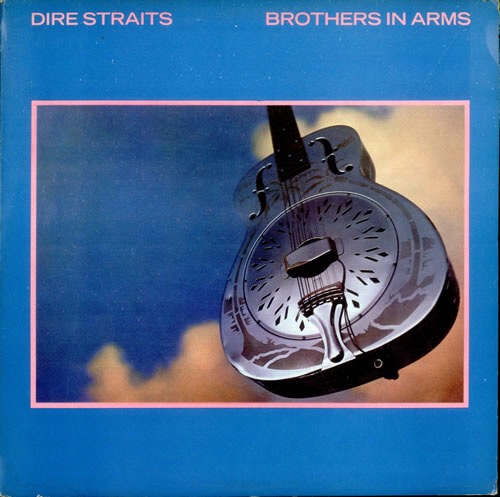
Brothers In Arms
During my senior year in college I was one of the first guys in my dorm to get a CD player.
This album by Dire Straits was THE CD to get to show how crispy good this new digital format was. Guys would come by my room just to listen to a track or two and marvel at the clarity compared to vinyl.
And this album still holds up and remains one of my favorites. It’s especially suited for a quiet night and for headphones.
The limits of self-improvement
“If we are unduly absorbed in improving our lives we may forget altogether to live them.” –Alan Watts
We are always getting ready.
We hope for a better future.
“What’s next?” is the question that occupies our thoughts almost constantly.
There is a lot I could improve about my life to make it better in the future.
But my life is here and now.
The future keeps receding into infinity. We are only ever living right now.
The only way to improve this very moment is to fully inhabit it.
Marcus Aurelius explains your options
A timely reminder from Marcus Aurelius:
“Everywhere, at each moment, you have the option:
to accept this event with humility
to treat this person as he should be treated
to approach this thought with care, so that nothing irrational creeps in.”
Another translation of that first line reads:
“Always and everywhere, it depends on you piously to be satisfied with the present conjunction of events.”
But what if “the present conjunction of events” sucks?
What is, already is. Resisting reality is futile and frustrating.
What if you simply observed even the most upsetting events and responded with fascination and curiosity?
Accept what has happened, bad and good, as though it is a gift to you to be used to expedite your own growth and propel you further and faster toward perfecting your character.
Michael Pollan and Netflix aim to inspire you to cook more often
Netflix recently released their newest documentary, Cooked. It’s a gorgeously filmed exploration of the impact cooking had on making us human and the perils of abandoning cooking and relying mostly on the packaged food-like substance industry.
The documentary is based on Pollan’s book of the same name.
The film is a delight to the eyes. Gorgeous scenery from around the world provides the backdrop for a clear and compelling case to get back to our primal connection with the food we eat.
As the primary cook for my family I’m in the kitchen almost every day. And it’s a pleasure. It’s one of the few tasks I do every day that is tangible and satisfying in the most visceral way. I make something real that I can smell and taste. And this daily act fuels, and hopefully delights, the people I love most.
I recommend that as often as you can, you should cook your own food.
Watching this new film will inspire you to appreciate your relationship with food and how you prepare it.
“Cooking is probably the most important thing you can do to improve your diet. What matters most is not any particular nutrient, or even any particular food: it’s the act of cooking itself. People who cook eat a healthier diet without giving it a thought. It’s the collapse of home cooking that led directly to the obesity epidemic.” –Michael Pollan

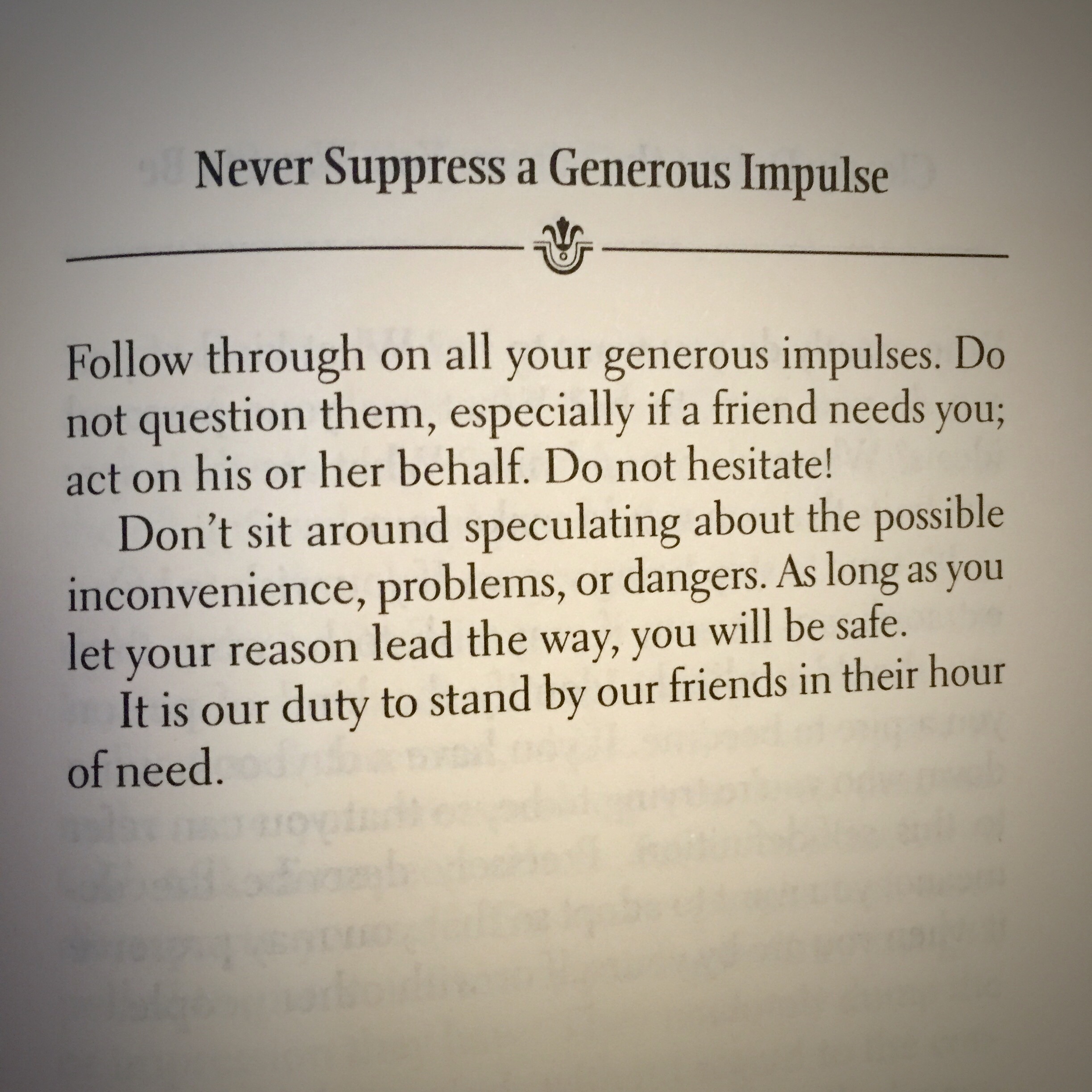
Sunday morning Stoic: Be more generous than seems reasonable
From Epictetus, via Sharon Lebell’s The Art of Living:
I can’t outgive my wife.
Often, we’ll see a need or be asked for a contribution to some cause we care about. When she asks me how much we should give, I’ll come up with an amount I think is a little bold, but not unreasonable. But before telling her, I’ll ask what she has in mind, and it’s always bigger and bolder.
I too often try to be reasonable with our generosity. But most of us can give more and do more than we think is reasonable.
Push your generosity comfort zone out to the edge where it’s slightly-uncomfortable-but-kind-of-thrilling. Push pass the resistance that guides you to caution, and follow your impulse to give more boldly.
Savor the world, or save it?
“I wake up in the morning unsure of whether I want to savor the world or save the world. This makes it hard to plan the day.” –E.B. White
This quotation introduced Ben Casnocha’s interesting account of his time as Reid Hoffman’s assistant.
Sunday morning Stoic: Your defining characteristic
Meditations 8.12:
“When you have trouble getting out of bed in the morning, remember that your defining characteristic—what defines a human being—is to work with others.”
Homo sapiens are wired to be tribal. That’s how we survived and flourished.
As much as I lean introvert and value alone time, it’s in community and connection and contribution where I thrive and feel most alive.
Why Seinfeld keeps touring
My wife and I are going to see Jerry Seinfeld perform here in our hometown tonight.
He’s set for life financially, and his reputation as one of the comedy greats is already a lock.
But he keeps touring because he loves the work.
I wrote about this previously, but I love his craftsman approach. From a 2012 New York Times profile:
For Seinfeld, whose worth Forbes estimated in 2010 to be $800 million, his touring regimen is a function not of financial necessity but rather of borderline monomania — a creative itch he can’t scratch. “I like money,” he says, “but it’s never been about the money.” Seinfeld will nurse a single joke for years, amending, abridging and reworking it incrementally, to get the thing just so. “It’s similar to calligraphy or samurai,” he says. “I want to make cricket cages. You know those Japanese cricket cages? Tiny, with the doors? That’s it for me: solitude and precision, refining a tiny thing for the sake of it.”
When he can’t tinker, he grows anxious. “If I don’t do a set in two weeks, I feel it,” he said. “I read an article a few years ago that said when you practice a sport a lot, you literally become a broadband: the nerve pathway in your brain contains a lot more information. As soon as you stop practicing, the pathway begins shrinking back down. Reading that changed my life. I used to wonder, Why am I doing these sets, getting on a stage? Don’t I know how to do this already? The answer is no. You must keep doing it. The broadband starts to narrow the moment you stop.”
More music, more happy
My family recently upgraded our primary television and added a Sonos Playbar as well. It was an expensive addition to an already costly purchase, but it’s proving to be well worth it. (Remember: “The things you use every day should be the best-designed things you can get.”)
We use TV almost exclusively for streaming Netflix, Hulu, and iTunes, and it’s our kids who use it the most. But this new soundbar has us listening to a lot more music.
I’m no audiophile, but the quality of the sound from this Sonos soundbar is remarkable for just a single device, at least compared to what we had before.
And having great audio in our living room and the new Apple TV prompted me to give Apple’s streaming music service another try.
So, we are listening to music more often now, and it’s been a delight. We click on a playlist or album while having dinner or doing chores or winding down for bed, and it’s added a wonderful extra bit of joy to our home.
It turns out that Sonos has been doing research about this and is actively marketing results that show that listening to music out loud in your home has measurable benefits for the whole family.
Their study shows that households that play music out loud laugh more and have less tension. There’s a long list of other benefits highlighted by their research.
I know that turning on music makes us less inclined to retreat into our devices. Cooking and dining together are just more fun with music in the background. We find ourselves often singing along out loud together as we go about our evening routines.
You don’t need a fancy sound system or a sophisticated taste in music to reap these benefits. Just put on some music and tune in with those you share your life with.
Obama’s excellent advice: Focus on what you want to do, not what you want to be
The White House posted this video on Facebook last night of the President talking to White House interns. (ht Ryan Scates)
Here’s a transcript of his message:
“Worry less about what you want to be, and think more about what you want to do. Because this town is full of people who want to be a congressman or want to be a senator or want to be president.
And if that’s your focus, if that’s your moral compass, then you’re consistently going to be making decisions solely on the basis of how do I get, for me, what I want.
If you think in terms of what do I want to do? ‘I want to solve climate change’ or ‘I want to employ disadvantaged youth’ or ‘I want to fix a broken healthcare system’, then even if you don’t get to the place you wanted to be or the office you wanted, during that entire time you’re going to be working on stuff that’s real and getting stuff done…
Do great things.”
So good.
The question to ask yourself is not “What can I get?”
The question that will propel you the furthest and offer the most meaningful and satisfying course of action is “What can I give?”
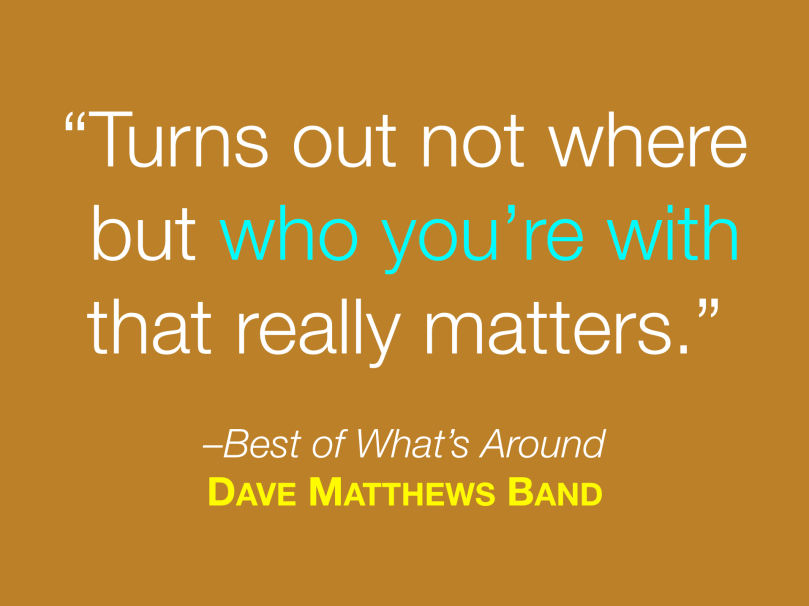
Not where, but who you’re with
It’s all about relationships
I somewhat randomly clicked on this TED Talk by Harvard researcher Robert Waldinger this week.
He has carried on the research in one of the longest running research projects of its kind, the Harvard Study of Adult Development. For more than 75 years data has been collected that has led to some clear answers about what makes for a good life.
Younger people tend to predict that fortune and fame will lead to happiness. That prediction doesn’t hold up.
Studying older people who have lived more life shows there is one key indicator for happier and healthier lives.
It’s actually simple and ultimately rather obvious. According to Waldinger and the study’s research, this is your ticket to a good life:
“Good relationships keep us happier and healthier. Period.”
It’s all about relationships.
Not only will you have a happier life if it’s built around positive relationships, you’ll live a healthier and longer life as well:
“The people who were the most satisfied in their relationships at age 50 were the healthiest at age 80.”
Even brain health and mental function were notably better later in life for those who reported stronger connections in their relationships.
Waldinger closed his talk with this:
“The people who fared the best were the people who leaned in to relationships—with family, with friends, with community.”
“The good life is built with good relationships.”
I think most people will say they want a life filled with good relationships, but how often are we intentional about investing in our connections with family and friends and community?
What if you “leaned in” to the relationships that matter most? Imagine making family and friends your true priority in the way you spend your time and where you devote your greatest energy and creativity.
If you want a satisfying life, career success and financial well-being should be subordinate to the strength of the connections you make with the people who matter most.
If you don’t have close friends, make some. If your family life is suffering, get busy making it better. If you don’t have a community that you support and that supports you, do something about it.
Life as a human here on Earth is ultimately all about relationships.
“There isn’t time—so brief is life—for bickerings, apologies, heartburnings, callings to account. There is only time for loving—and but an instant, so to speak, for that.” –Mark Twain

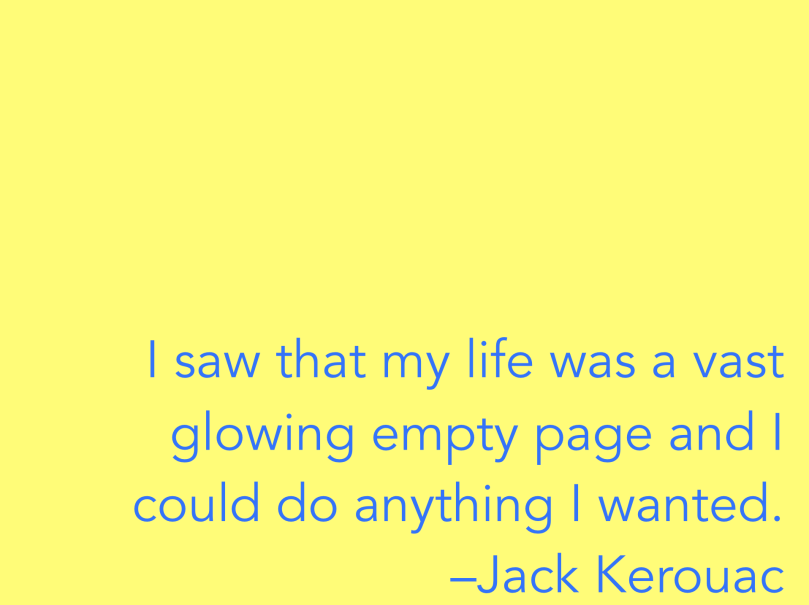
A vast glowing empty page

The next moment is unwritten.
The next hour, the next day, the next year—all completely empty and totally full of potential and possibility.
I routinely forget that I get to author my own moments. They don’t have to be the same as the ones before.
I don’t have to be the same and do the same things I’ve always done.
I can choose my adventures. I can be who I want to be and attempt what I’ve never tried before.
The unwritten moments unfolding before you glow with all that could be.
Or you could keep trudging along, oblivious to the possibility machine you truly are.

Every day luxuries: “The things you use every day should be the best-designed things you can get”
I don’t know where I found this, so I can’t give credit. I clipped it as soon I saw it and saved it, but I failed to include the link. Maybe I was too excited about the wisdom imparted here:
It’s not bad to own fine things that you like. What you need are things that you GENUINELY like. Things that you cherish, that enhance your existence in the world. The rest is dross. Do not “economize.” Please. That is not the point. The economy is clearly insane. Even its champions are terrified by it now. It’s melting the North Pole. So “economization” is not your friend. Cheapness can be value-less. Voluntary simplicity is, furthermore, boring. Less can become too much work.
The items that you use incessantly, the items you employ every day, the normal, boring goods that don’t seem luxurious or romantic: these are the critical ones. They are truly central. The everyday object is the monarch of all objects. It’s in your time most, it’s in your space most. It is “where it is at,” and it is “what is going on.”
It takes a while to get this through your head, because it’s the opposite of the legendry of shopping. However: the things that you use every day should be the best-designed things you can get.
Amen.
I don’t need or want a lot of stuff. But I want the stuff I use often to be great, to give me pleasure in using it.
“Less, but better” is the mantra for me.
Kitchen tools. My razor. The furniture I sit on. The phone in my pocket. I want to delight in using these everyday things because I do use them daily.
One of my favorite purchases in the past year was this kitchen trash can. Yes, silly, I know, and expensive for a trash can. But it’s actually quite nice looking. And, even better. I love that it’s open, that there’s no lid. There’s no friction in throwing something away—no pedal to step on or lid to lift. Both its form and function are a delight.
I get a tiny tingle of pleasure (maybe microscopically tiny in this case) from using that trash can every time I throw something away. But those tiny tingles add up, as do the tiny pains of annoyance from using subpar or ugly things.
I appreciate the grace of great things, and adding more moments of delight each day or eliminating more moments of frustration or “meh” will make my days shine a bit more.
Adam Grant on what thwarts creativity in kids
This was an enlightening New York Times column by the prolific young scholar, Adam Grant. He highlights research that shows that too much structure and a rules-focused environment are not conducive to sparking creative thinking:
So what does it take to raise a creative child? One study compared the families of children who were rated among the most creative 5 percent in their school system with those who were not unusually creative. The parents of ordinary children had an average of six rules, like specific schedules for homework and bedtime. Parents of highly creative children had an average of fewer than one rule.
Creativity may be hard to nurture, but it’s easy to thwart. By limiting rules, parents encouraged their children to think for themselves. They tended to “place emphasis on moral values, rather than on specific rules,” the Harvard psychologist Teresa Amabile reports.
My wife and I certainly fall into that “average of fewer than one rule” category. I’ve worried that we’re terrible slackers and need to give our kids more structure, like an actual bed time or chores and such.
But, thanks, Adam Grant. We will continue with our rule-free ways.
I do think there’s much merit to establishing a general sense of values and a clear direction and then leaving it up to the kids (or your team or organization) to use their own judgment and creativity to figure out how to proceed on their own. This less controlling approach is more interesting and organic and just more fun, too.
Precise rules and micromanaging might get the results you desire, but it precludes potentially better results you didn’t imagine.
The best gift: Your attention

I’m heading out today on a weekend getaway with my wife and daughters, trapped in the car for several hours together.
This will be a good time to practice giving my complete attention to the people I love most.
The aim is to turn off my mental autopilot that is great at creating the illusion that I’m paying attention. Our close confines will at least help eliminate many of the usual distractions.
Being genuinely present with others takes effort and practice.
When someone offers you their full attention, though, it’s a bit startling. It’s such a rare and wonderful experience and such a generous gift.
Imagine if that was what you were known for. It would be like having a kind of superpower.