Think different

This classic, much heralded ad campaign helped redefine Apple when the company was on the ropes in the 90s, fighting to be relevant again with Steve Jobs back in charge after his long exile. The version of this commercial that aired was narrated by the actor Richard Dreyfus. After Jobs died, this version, with Jobs narrating was released. It’s nice to hear this – his mantra, his vision – in his voice.

Here’s to the crazy ones.

http://vimeo.com/30169342

Here’s to the crazy ones, the misfits, the rebels, the troublemakers, the round pegs in the square holes… the ones who see things differently — they’re not fond of rules… You can quote them, disagree with them, glorify or vilify them, but the only thing you can’t do is ignore them because they change things… they push the human race forward, and while some may see them as the crazy ones, we see genius, because the ones who are crazy enough to think that they can change the world, are the ones who do.
–Apple’s “Think Different” ad

Be like a “dog chasing a tennis ball”

This commencement address by Dropbox founder and CEO Drew Houston is terrific. He’s speaking at his alma mater, M.I.T., and he’s only been out of college since 2005. He tells the story of how he got started as an entrepreneur, and he offers some great wisdom about choosing work that challenges and delights you like a “dog chasing a tennis ball”:

When I think about it, the happiest and most successful people I know don’t just love what they do, they’re obsessed with solving an important problem, something that matters to them. They remind me of a dog chasing a tennis ball: their eyes go a little crazy, the leash snaps and they go bounding off, plowing through whatever gets in the way. I have some other friends who also work hard and get paid well in their jobs, but they complain as if they were shackled to a desk.

My dog, Mosley, certainly gets crazy eyes when I fling a ball across the yard. He could be waking from a nap, but if he sees me with a ball in hand, he comes to life in a flash. I feel that puppy-like excitement when I get caught up in creating something worthwhile or working on solving a problem and making a dent in the universe.

I love how Houston concludes, with the call to tell an interesting story with your life:

Every day we’re writing a few more words of a story. And when you die, it’s not like “here lies Drew, he came in 174th place.” So from then on, I stopped trying to make my life perfect, and instead tried to make it interesting. I wanted my story to be an adventure — and that’s made all the difference.

We’ve got a limited stay here on this planet. If we’re lucky, Houston points out, we might get as many as 30,000 days. Today is my 49th birthday. I’ve lived 17,885 days, and I’m delighted to have made it this far. But I’m on the back side of my days. I just want to make the ones that are left worth talking about.

20130608-170057.jpg

Make the audience the hero of the story

Having just returned from a week of sitting in numerous presentations and giving a couple myself, I’m reminded of what a challenge it can be to create a presentation that makes a difference.

The best presenters put the audience first. An audience-focused speech is more likely to have been prepared with the intent to meet the listener where they are and offer them something of value for their time and attention. When the speaker is focused on his own agenda or is primarily concerned with what the audience will think of him, the odds are not in favor of a transformational moment for anyone present.

Yes, a speaker shouldn’t be attached to the outcome. But, the speaker should walk into the room with the sense of having a gift to offer. That’s why it is called “giving” a speech. Think of your message as a gift, and you will be compelled to create something that is tailored to the unique needs of the audience. Know who will be there and what challenges they face, what problems they want to solve. Then give them something that helps change them for the better, that awakens new possibilities.

Make the audience the hero of the story. Take them on a journey from “Why?” – Why should we care? Why is this important? – to “How?” – How then can we act on this thing that we now care about?

Pixar’s John Lasseter says that a story (at least one that Pixar wants to make) should be about “how the main character changes for the better”. The main character in a presentation is not the speaker, it’s the audience. Put them first, offer them a gift, and empower them to be heroes.

20130607-143105.jpg

Mise en place and “habit fields”

Chefs rely on “mise en place“, which is French for “putting in place”, for an orderly, efficient work space. All the kitchen tools and ingredients for the next meal are placed in a way that allows the work to flow with minimal resistance and maximum focus. We can arrange our work spaces for optimal effectiveness, too.

I just came across this thoughtful post, Habit Fields, by Jack Cheng. What if we arranged our work tools and surroundings to embed work habits that more readily get us into the “zone”, where we create with less distraction? Go read the whole post, but here are Cheng’s first and last paragraphs:

Consider the desk in your office. Maybe it reminds you of when you opened the box and put the pieces together. Or maybe it recalls your first day at work, when your colleague showed you where you would sit. The desk, the computer on top of it, the chair you sit in, and the space they comprise are all repositories for memory. But these things don’t just store our memories; they store our behaviors too. The sum of these stored behaviors is an object’s habit field, and merely being around it compels our bodies and minds to act in certain ways. By understanding these invisible forces and employing strategies to shape them, we can enjoy more frequent, sustained periods of flow.

We have the power to bestow our abilities onto the things around us. By being conscious of our tools, habits, and spaces, and actively conditioning them to help us behave the way we want to behave, maybe we can more efficiently tap into the thousands of hours of creative genius embedded in our everyday objects. Maybe we’ll be able to maximize the capabilities that new technologies afford us without being overwhelmed by the distractions. And, just maybe, we’ll remember what it feels like to be utterly engrossed in our daily work.

I love the idea of sitting in a different place or even facing a different way at your desk depending on whether you’re doing work or taking a mental break with some kind of distraction like Twitter. I have been doing most of my writing recently on my iPad, which makes switching to other apps just enough of a hassle to keep me on task. It’s a better uni-tasker than my Mac, and I’ve been building a writing habit around the iPad that I never did with a desktop computer.

Sharpen your “habit fields” and condition yourself to respond to your physical surroundings. Set up your work space for optimal focus when you’re working. Then the tools can better fulfill their purpose and allow you to cook up something awesome.

A conference mindset

I’ve been at a conference all week. I appreciate how just being away from a normal routine and in a different environment can spark possibilities and new ideas. There is a lot of sitting and listening time in conferences. Often, the speaker is thoughtful, effective, or even, ideally, provocative enough to challenge assumptions, rock the status quo, and make you rethink your work. It’s great to walk out of a presentation with new possibilities and a surge in energy that a dynamic speaker can provide. (If you’re going to speak to an audience, why not be awesome?)

Sometimes the speaker doesn’t connect, or maybe I walked in with a misperception about the published topic. Even then, just sitting still for forty-five minutes can lead to contemplation of new ideas. A quiet idea, maybe even poorly communicated, can take root just because I was forced to focus as I’m away from the day-in, day-out distractions of my typical routines. My mind often has been sent on productive tangents in the midst of an otherwise forgettable conference session.

Maybe we should try creating that conference mindset even in our normal day-to-day routines. Regularly disconnect from your place of distraction and put yourself in a place where you’re trapped for forty-five minutes or so with nowhere to escape. Find a remote place to do some work – a coffee shop or empty conference room or a lunch spot – where there’s more friction required to distract yourself.

Create a conference mindset regularly and see if new possibilities are awakened more regularly as well.

Audience karma

20130603-085709.jpg
I presented yesterday at the opening session of the Collegiate Information & Visitor Services Association (CiVSA) annual conference. What a great audience. These are big-hearted people who are used to standing in front of audiences themselves. They were smiling and nodding from the beginning, interacting, responding to my questions. Laughing at my jokes. They were engaged and supportive. They made me a better speaker.

We tend to focus exclusively on a speaker’s impact on the audience. But the audience definitely can affect the speaker as well and shape the overall effect of the presentation quite dramatically. Imagine standing in front of a blank-faced audience, or worse, a distracted one. People staring at their devices instead of at you. It’s hard to give your best to an audience like that. But how often are you that kind of audience member?

Even a poor speaker will perform better with an encouraging audience. Connect with the speaker. Make eye contact. Smile. Nod. Laugh. Interact when asked. You want to enjoy the presentation so put some effort into it to help the speaker along. Be the kind of audience member you hope to have in your audiences. And maybe audience karma will reward you when you’re the one up front.

Presentation travel gear

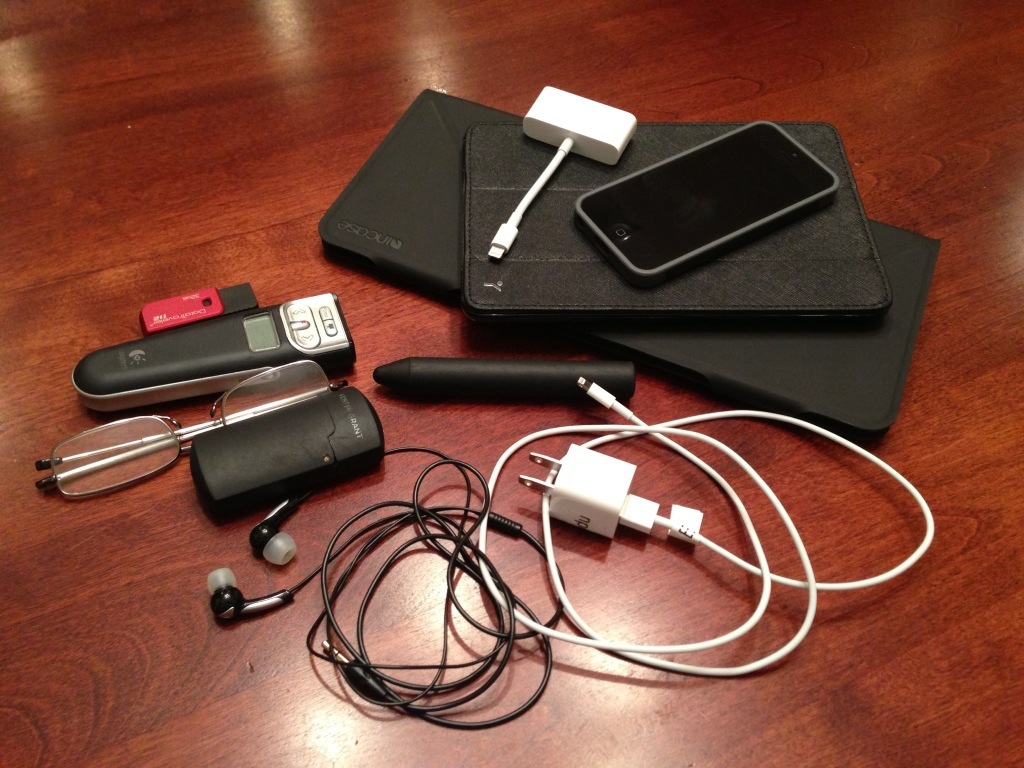
20130601-204716.jpg

I’m on the road this week, doing two presentations at a national conference.

I’m a minimalist when I travel. I take only one bag, and it’s small enough to carry on board.

Above is the gear I brought for my presentations and for working in the hotel.

I’m using the iPad mini to run my slides with the Keynote app. I’ve got a VGA adapter to connect the iPad to the projector. I’ll use the Keynote Remote app on the iPhone to control the slideshow. (I’ve had some moments, though, when the Keynote Remote app let me down briefly. The bluetooth can disconnect randomly, but it usually comes right back. But I don’t completely trust it now.)

The flash drive is just a backup in case there are any difficulties getting the iPad connected. I could then load the document onto a local Mac or PC. Both presentations also are saved in iCloud and Dropbox. If I have to use a local PC, I’ve got a standard USB remote. I am so ready for technical difficulties. And if nothing works, I’ve got no problem going unplugged and presenting without slides. I experimented with some slideless talks this year, but I really like the oomph that images give when they support and don’t detract from the message. Images seem especially important with a larger audience, and my first presentation at the conference could have up to 300 people in the theater.

I’m continuing to love my Incase Origami Workstation Case for my Apple bluetooth keyboard. That’s what I’ve been writing almost all my posts on lately. It works with any iPad.

This is a great, minimal setup. I appreciate tools that fit their purpose and perform well. Here’s hoping I perform well regardless of the tools.

Smile

Three times each weekday I greet groups of campus visitors as they’re about to embark on our campus tour. I offer a brief overview and introduce the tour leaders.

Far too often, as I try to warm up the crowd, I’m greeted by a smattering of stone-faced expressions. These people are not waiting for a root canal or an IRS audit, where there may be less obvious reason to smile. They’re about to stroll through a lovely college campus with a couple of charming college students. Why the long faces, people? It’s my team’s aim, of course, to have them smiling by the time they leave.

But in pretty much every crowd there are smilers. Some are subtle with only a happy glint in their eyes. Others are nodding and grinning and practically glowing with positive energy. I love these people, those whose default expression is a smile. Just standing in the presence of smiling faces makes me happier and encourages me to be even a little more awesome myself.

Some children smile as many as 400 times a day. Many adults smile fewer than 10 times each day.

You want to be happy, right? No need to wait until you’ve reached some longed for accomplishment to be happy. Just act like you’re happy, and you likely will be. When you wake up, put a smile on your face. Make it a habit or ritual like brushing your teeth. When you greet people throughout your day, be intentional about smiling at them. Act like you’re happy to see them. Even if it’s just a nod and a quick smile. Fake it if you have to. Act like you are who you want to be. Use your body to inform your mind and your emotions.

There’s an old Peanuts cartoon where Charlie Brown is telling a friend that the worst thing you can do if you’re feeling depressed is hold your shoulders back and your head up and smile. Then you’ll start feeling better, and “that’s no good at all.”

Sages know this is true:

“Sometimes your joy is the source of your smile, but sometimes your smile can be the source of your joy.” Thich Nhat Hanh

Science backs this up:

“Even the simulation of an emotion tends to arouse it in our minds.” Charles Darwin

And smiling is contagious thanks to evolutionary wiring. Your smile can cause others to smile. What if one of your missions each day was to elicit as many smiles from others as possible? Make some mischief with your smile to subvert and co-opt the Charlie Browns of the world.

This is a delightful, short TED Talk from Ron Gutman about the power and surprising benefits of smiling:

There’s also this $2 e-book by Gutman that expands on his talk with plenty of support from researchers on how and why smiling is so powerful.

Good grief, Charlie Brown. Just smile.

Be awesome

I spoke to a group of college students yesterday. They are in training to run our university’s orientation program this summer. It’s a challenging job for these twelve students, who are stuck with each other in close quarters for sixty hours a week or more for two months. They will welcome thousands of new students, perform before large and small audiences multiple times each day, engage in countless conversations with nervous freshmen and anxious parents, and execute the logistics of a complex program that is crucial to our institution. I ran this program for thirteen years, so I greatly appreciate the challenge and the rewards of what these students are about to do.

At the end of my meeting with them yesterday, one of them asked me, “What’s your most important advice for us to keep in mind during our experience this summer?” I proceeded to offer some rambling discourse that I can’t exactly recall now. After I left, I realized what I should have told them: “Be awesome.”

This may sound trite and obvious and unhelpful. But it’s crucial to keep that intention, to be your best and do your best, at the center of your thoughts. If you’re constantly challenging yourself to be awesome, you will keep upping your game. You will get better. You will be discontent with cutting corners and doing “just enough to get by”. And this intent to be awesome applies to every area of your life – your work, your relationships, your health.

Awesome doesn’t phone it in. Awesome is awesome even when no one is watching. Awesome cares about the details.

When I drop my kids off at school each morning, my last words to them are, “Be awesome.” When I send off our student staff members to give a campus tour, I stand by the door to the bus and tell them, just before the door closes, “Be awesome.” When my wife leaves for work: “Be awesome.”

If you make this your mantra, if you wake up every day mindfully intent to be better on this day than the one before, you will put yourself on a path to excellence and deep satisfaction in all that you do. Before you go to sleep, assess the day. How did you do? How awesome were you? Note it in your journal to keep yourself accountable. If your actions didn’t meet your expectations, don’t beat yourself up. Being aware and caring are enough, and you get a fresh try the next morning.

I love this thought from Julien Smith:

I am a champion standing over my former self.

The only competition that matters is the one between who you want to become and who you are. Comparison with others will distract or discourage and put you off course. The you of one year from now should be able to kick the ass (in overall awesomeness and, maybe, physically as well) of the you from today.

Grow. Evolve. Rethink. Refine. Transcend your current limitations. One day at a time.

Be awesome.

IMG_0027

If You Want To Write

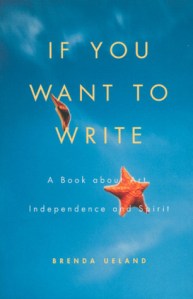
If You Want To Write by Brenda Ueland

I mentioned my favorite book, If You Want To Write, in a recent post. I discovered this little book back in the ’90s, and it remains one of the few books I’ve read more than once and recommended almost aggressively to others. The author, Brenda Ueland, was a writing instructor in the early 20th century. Reading this book is like sitting in her living room and having a pleasant conversation with a favorite aunt. She is kind and wise and funny, and her advice about writing is transferable to almost any endeavor. Really, the book could be titled, If You Want To Live A Happy Life.

Ueland’s book introduced me to the letters of Vincent van Gogh and the poetry of William Blake. Tolstoy is cited often as well. But it’s Ueland’s gentle, yet compelling, encouragement to take action, avoid being critical (of yourself and others), to be free, be bold, and be “microscopically truthful” with your work that stays with me. She says that everyone is an artist capable of creating something beautiful and meaningful. And we have the opportunity to help others express themselves. This quote from a van Gogh letter to his brother, Theo, has challenged me and informed my work ever since:

Many a man has a bonfire in his heart, and no one comes to warm himself at it. -Vincent van Gogh

How sad to imagine all the genius and insight and talent that has never been given a chance to grow and flourish in most people. Indeed, our culture is cruelly proficient at stamping out signs of originality and creative imaginings early in childhood even. It is a noble calling to be the one warming by the fire and fanning the flame that’s within someone who doesn’t think he’s got even a spark to share. If I produce nothing notable or lasting on my own but can help awaken possibility in others, that is a grand accomplishment.

If you ever need a dose of inspiration and a fresh perspective on what it means to be an artist, whether you want to write or perform or create a business or build a beautiful family, I highly recommend this sweet and powerful book.

Non-attachment for the win

Austin was a college freshman when he applied to work as one of the twelve orientation leaders who run our university’s summer orientation program that welcomes and transitions thousands of new students each summer. It’s a challenging, prestigious position, and there is always an impressive applicant pool, made up of the best and brightest leaders from a campus of more than 30,000 students.

Austin had a great interview during the first round, which was a group interview. He was thoughtful and enthusiastic and a strong communicator. We invited him back for the final round of interviews, which was an individual meeting with the program directors. He was even more impressive in his individual interview. We hired him. The next week we gathered the twelve newly selected student orientation leaders together for a first meeting to start planning their training and to meet each other.

After the meeting, Austin approached me privately and said he had a question for me. He looked a bit distressed. His question: “Why did you hire me?” That’s not the question I typically get the day someone begins a new position. I told him we hired him, of course, because he was a great fit for the job and would be terrific in the role.

He then related that, before he applied, his friends had told him that we do not hire freshmen for this particular job. Freshmen could apply, they said, but only to gain interview experience. He was stunned (and ended up being delighted) to actually be offered the position. Well, his friends were wrong. Freshmen were rarely selected because the competition was so strong, but they were just as eligible as any other student.

Austin walked into those interviews certain that getting the job was not even an option. He thought it was just practice. He was completely unattached to any outcome. And he was awesome.

Contrast that with a young woman, in the same selection process, who, when asked the very first question (which was a softball: “Tell us why you want this position”), immediately began crying. We scrounged up a box of tissue, and when she finally composed herself she said: “I’m sorry. I just want this… so… much.”

She was so attached to the outcome that she couldn’t even engage in a conversation. Austin was not attached at all and was able to focus completely on the moment and shine. For him, it was just a conversation, not a job interview.

There’s something powerful about this state of non-attachment. The great performers seem to have mastered the art of the present moment. Think of superstar athletes in clutch situations. The greatest ones aren’t weighed down by the stakes, the fear of failure or anticipation of the next day’s headlines.

There’s a classic story of football legend Joe Montana in the 49ers’ Super Bowl against the Bengals in 1989. Time was running out, and the 49ers were behind on the scoreboard. While his teammates are huddled on the field during a TV timeout, stressed about the challenge they were facing, Montana was unflappable, seemingly oblivious to the team’s dire straits. Just before the timeout ended, he pointed into the crowd and told one of his offensive linemen: “Hey, isn’t that the actor John Candy?” His teammate was incredulous that the quarterback was so relaxed in that high-stakes moment that he could point out celebrities in the stadium. When play resumed, Montana methodically moved the team down the field and into the end zone for the winning score with just 34 seconds left on the game clock.

The next time you’ve got an interview or a presentation or a first date, even, put your focus only on the moment at hand. In the interview and the date, make it your goal simply to have a great conversation, one where you listen intently and seek to understand before seeking to be understood. And then don’t be afraid to be interesting. And if you abandon any expectation of getting the job or a second date, you will be freed up to be your best and shine in the moment. Same with a presentation or any task you pursue, don’t attach to the outcome. Be awesome in the present moment and let the future unfold as it will. The more you practice getting yourself into that zone in low-stakes moments, the easier it will be when the stakes mount.

Day One: A life-tracking, life-changing app

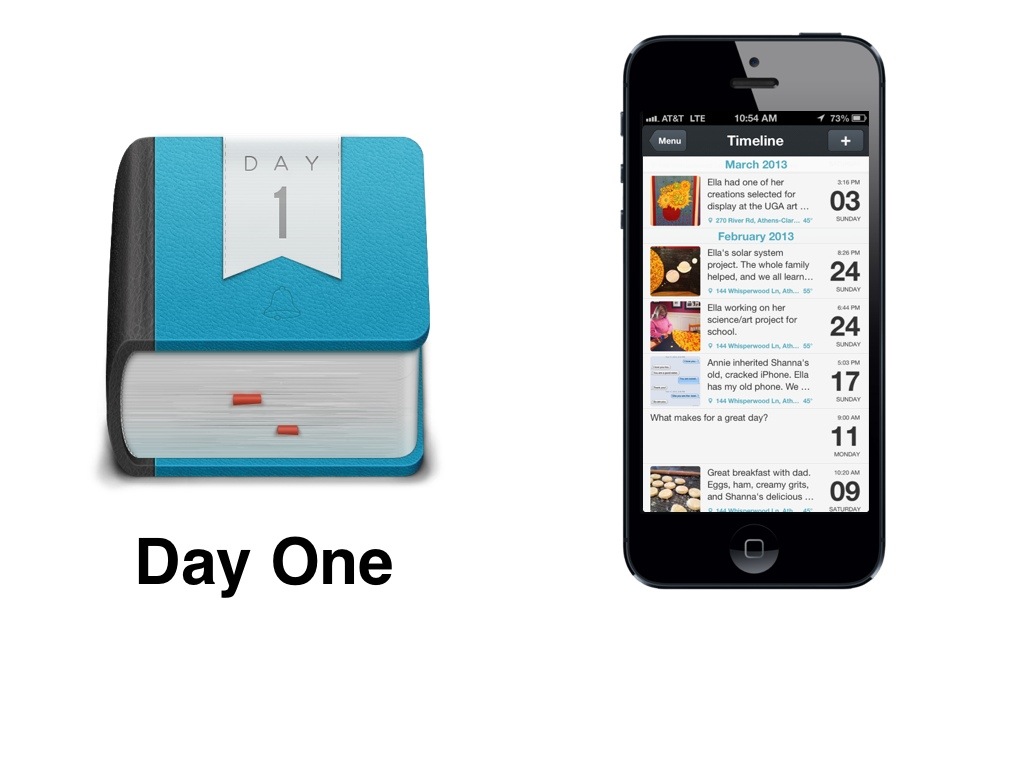
I just mentioned the Day One app in yesterday’s post, but it deserves some exploration. Day One is a simple-to-use, beautifully designed journaling app for iOS and Mac. I’ve always wanted to keep a journal. I just never have. There seemed to be too much friction to ever get started and then keep it going. I have terrible handwriting, so a paper journal never appealed to me. And I never put the effort into setting up a document on my computer.

Last year I discovered the Day One app for iPhone. I’ve now become a consistent journal keeper, using it on my Mac and iPad as well. (It syncs perfectly between all my devices.) The app is so thoughtfully made that you want to open it and use it often. I find myself dropping in photos and snippets of text throughout each day. I keep track of my kids’ activities, my meals, books I’m reading, movies, ideas to explore later, my daily “MITs” (most important tasks), and whatever comes to mind that might be worth recording. Knowing it’s private, I’m uninhibited by what others might think. I don’t worry about polishing my words for public consumption. It’s like my own private Twitter, and it’s been a delight to use.

Here is an inspiring list of uses from the Day One blog.

Why journal? It certainly leads to a more examined life. I find myself looking for interesting moments, maybe even creating more interesting moments, just to add them to Day One. I want my days to be more remarkable, more worth writing about. I do want to tell a good story with my life, and chronicling my thoughts and actions makes me more aware and more intentional about the quality of my day-to-day story.

E.M. Forster said, “How do I know what I think until I see what I say.”

Trying to express yourself, in private or public, helps you better understand yourself. Putting ideas into words ends up shaping the ideas.

Brenda Ueland, the author of my favorite book ever, says this:

The best way to know the Truth or Beauty is to try to express it. And what is the purpose of existence Here or Yonder but to discover truth and beauty and express it?

Truth and beauty. A story worth telling. Your life in your pocket. Express yourself every day.

20130527-103501.jpg

Best. Day. Ever?

Sunday is bittersweet for most of us. This day of rest that gradually and surely turns into a night of unease, or even dread, for too many. Today is an exception because tomorrow is a holiday, so this Sunday is sweeter than most.

My daughters love the movie Tangled. (Okay, I love the movie Tangled, too.) There’s a great scene where Rapunzel leaves the tower for the first time and is overwhelmed with how amazing it is to be free and doing things she’s never experienced before. As she’s swinging through the forest by her hair she exclaims, “Best. Day. Ever!”

My daughters now regularly use that phrase when things are going well. And, they say the opposite, “Worst. Day. Ever.”, almost as frequently. Often multiple times in the same day. We all know that feeling, right? Well, what makes for a great day? A great week? A great year? A great life? These are fundamental questions that don’t often get examined with any serious intent.

I often ask student applicants in our interview process to “describe their ideal day.” I’m confounded by how many struggle coming up with a response to this and how many just offer only a few superficial plans for an ideal day. “Sleep in…” is way too popular a response. Here’s a similar interview question we regularly ask: “When you get to the end of a particularly satisfying day, what was it about that day that made it so satisfying?”

Both are great questions to play with and see what you come up with. Explore the answers to these questions in your journal or in a conversation with friends. (The Day One app is a beautiful electronic journal that I use every day now. It’s like having your own private Twitter that only you can see. It’s iOS and Mac only, but there certainly are alternatives for you Android and PC people.) Then, be intentional about crafting days so they’re filled with those things that delight and satisfy you.

Clearly, some days are going to just be a struggle, so it’s not realistic to expect every day to top the one before. But it you put together enough great days, you’ll have a great week. String great weeks together, and you’re going to have a great year. Great years make for a great life.

Creative momentum and action overflow

I’m in the midst of final preparation for two presentations I’m giving at a national conference next week. As the conference week approaches my focus is sharpening, and I’m making good progress on my work. And I’m enjoying it. I wake up excited about fine-tuning my thoughts and the slides I’m creating. I get to the office and work with purpose. I find I’m less likely these last couple of weeks to wander off into internet distractions. I’ve been putting my headphones on mid-morning and working intently, shutting off the world for an hour or so at a time.

What has surprised me has been how productive I’ve been on other projects during this time. It’s as though working with focus on one project has spilled this extra energy into other areas of my work and my life. There’s been this wonderful overflow of action. Creative momentum has led me to post six days in a row on this blog, something I’ve never done. What if I did this every day? Instead of waiting for inspiration to strike, which seems to be an infrequent occurrence, what if I just treat every day like an important project deadline is looming? And just start doing something.

When you work regularly, inspiration strikes regularly. –Gretchen Rubin

Consume, create, share. That’s the cycle I’ve been on lately. Or, is it: create, consume, create, share? Creating has sparked consumption of new material as much as reading has sparked new ideas. As I’m trying to make things, I keep searching for and stumbling across new ideas which in turn spark more action, and then I want to share and keep going. I’ve been consuming much more information while working on this project, and ideas seem to be popping. I came across this quotation recently while exploring the power of taking action:

Our creativity comes from without, not from within. We are not self-made. We are dependent on one another, and admitting this to ourselves isn’t an embrace of mediocrity and derivativeness. It’s a liberation from our misconceptions, and it’s an incentive to not expect so much from ourselves and to simply begin.
 –Kirby Ferguson

“Everything is a Remix”, indeed. And if you’re holding off on your work until you’ve got a truly “original” idea, you’ll never do anything. “Simply begin” and see where the act of creation takes you.

I’m going to see how long I can keep this creative momentum rolling. I’m tempted to challenge myself to post something public every day. Seth Godin offers that challenge and says no one ever complains of getting “talker’s block”, so don’t complain of writer’s block:

Writer’s block isn’t hard to cure.

Just write poorly. Continue to write poorly, in public, until you can write better.

I believe that everyone should write in public. Get a blog. Or use Squidoo or Tumblr or a microblogging site. Use an alias if you like. Turn off comments, certainly–you don’t need more criticism, you need more writing.

Do it every day. Every single day. Not a diary, not fiction, but analysis. Clear, crisp, honest writing about what you see in the world. Or want to see. Or teach (in writing). Tell us how to do something.

If you know you have to write something every single day, even a paragraph, you will improve your writing. If you’re concerned with quality, of course, then not writing is not a problem, because zero is perfect and without defects. Shipping nothing is safe.

The second best thing to zero is something better than bad. So if you know you have to write tomorrow, your brain will start working on something better than bad. And then you’ll inevitably redefine bad and tomorrow will be better than that. And on and on.

Write like you talk. Often.

Stay tuned. (Or not. I realize I’m posting publicly, but I’m not looking for page views or to become an A-list blogger. If someone reads my stuff and has a new possibility awakened in them, I’m delighted. But I’m writing as much for my own benefit as I am for readers. And that you are reading this is amazing. How cool to live in the 21st century, right? Welcome to the future.)

Bruce Springsteen still rehearses

Keeping up the craftsmanship theme I have been exploring recently, I’ve been meaning to share this feature on Bruce Springsteen that I read last summer in The New Yorker. It’s an immensely interesting long profile on the enduring, iconic rock-and-roll star. (You’ve got to add the “roll” for Springsteen, don’t you? He’s more than just a “rock” star.) I was in college when his biggest album, Born In the U.S.A., dominated our music consciousness. It seemed like every song on that album was a huge hit. It was one of the first CDs I owned. (I was one of the first in my dorm to own a CD player and make the transition from vinyl. I have always been a bit of an early adopter.) Unfortunately, I have never seen Springsteen in concert, and his performances are considered epic. He goes for hours at high energy and gives the audience more than they expect. The man is in his sixties now and still going strong as an artist and performer. Here’s an excerpt from the article describing a rehearsal:

Springsteen arrived and greeted everyone with a quick hello and his distinctive cackle. He is five-nine and walks with a rolling rodeo gait. When he takes in something new—a visitor, a thought, a passing car in the distance—his eyes narrow, as if in hard light, and his lower jaw protrudes a bit. His hairline is receding, and, if one had to guess, he has, over the years, in the face of high-def scrutiny and the fight against time, enjoined the expensive attentions of cosmetic and dental practitioners. He remains dispiritingly handsome, preposterously fit. (“He has practically the same waist size as when I met him, when we were fifteen,” says Steve Van Zandt, who does not.) Some of this has to do with his abstemious inclinations; Van Zandt says Springsteen is “the only guy I know—I think the only guy I know at all—who never did drugs.” He’s followed more or less the same exercise regimen for thirty years: he runs on a treadmill and, with a trainer, works out with weights. It has paid off. His muscle tone approximates a fresh tennis ball. And yet, with the tour a month away, he laughed at the idea that he was ready. “I’m not remotely close,” he said, slumping into a chair twenty rows back from the stage.

Preparing for a tour is a process far more involved than middle-aged workouts designed to stave off premature infarction. “Think of it this way: performing is like sprinting while screaming for three, four minutes,” Springsteen said. “And then you do it again. And then you do it again. And then you walk a little, shouting the whole time. And so on. Your adrenaline quickly overwhelms your conditioning.” His style in performance is joyously demonic, as close as a white man of Social Security age can get to James Brown circa 1962 without risking a herniated disk or a shattered pelvis. Concerts last in excess of three hours, without a break, and he is constantly dancing, screaming, imploring, mugging, kicking, windmilling, crowd-surfing, climbing a drum riser, jumping on an amp, leaping off Roy Bittan’s piano. The display of energy and its depletion is part of what is expected of him. In return, the crowd participates in a display of communal adoration. Like pilgrims at a gigantic outdoor Mass—think John Paul II at Gdansk—they know their role: when to raise their hands, when to sway, when to sing, when to scream his name, when to bear his body, hand over hand, from the rear of the orchestra to the stage. (Van Zandt: “Messianic? Is that the word you’re looking for?”)

The article goes on to describe Springsteen leading his band through a meticulous, intense rehearsal in an empty hall they rent just to prepare for a tour. I’m sure after all those years of performing, The Boss could just walk out on stage and put on a good show without much preparation. But he doesn’t want to be just “good”. He’s great because he approaches his work with discipline (note above how he takes care of his body) and attention to detail. He’s a master, constantly refining his craft. And rehearsal is crucial.

My college speech teacher, Cal Logue, was insistent that we must rehearse our presentations out loud on our own multiple times before facing an audience. I was reluctant, feeling it silly to talk to myself in an empty room. But I did it, and in the process discovered problems and new ideas and connections that wouldn’t have been obvious had I not rehearsed out loud. I still do it when preparing a big presentation. I close the doors on the presentation room in our office, load my slides, and give my talk to a bunch of empty chairs. And I never fail to come up with improvements. Timing and flow especially benefit from live rehearsal, and you can’t get that from just reading over your notes multiple times and clicking through your slides over and over. If the first time you give a prepared talk is in front of a live audience, you’re giving them something less than your best. If Springsteen still rehearses, you should, too.

Seth Godin: What is school for?

This is Seth Godin’s take on what’s wrong with our education system:

Our 20th century model for how to educate kids needs a 21st century update. Godin offers some excellent suggestions for what to do next, like inverting the lecture and homework. Students can watch a world-class lecture online on their own at home and then do the work while they’re together at school and can discuss and ask questions. And no more memorizing when the world’s information is in everyone’s pocket. Open book all the time. Teachers become “coaches” who can help bring out the best in each student rather than spend too much time serving as compliance officers.

Godin has written at length about this in his manifesto Stop Stealing Dreams, which is free online and is well worth the time to read, especially if you’re an educator, a student, a parent, or a human who has ever been to school.

Jerry Seinfeld’s craftsmanship

It’s easy to think some people are just born gifted, with some divine spark that enables them to accomplish more and at a higher level than everyone else. But if you look closely at the lives of true masters, you’ll see discipline, focus, persistence, and a pursuit of intrinsic rewards.

I clipped this excellent New York Times profile of Jerry Seinfeld last year and have just dug it back up from my Instapaper files. Note what drives Seinfeld:

For Seinfeld, whose worth Forbes estimated in 2010 to be $800 million, his touring regimen is a function not of financial necessity but rather of borderline monomania — a creative itch he can’t scratch. “I like money,” he says, “but it’s never been about the money.” Seinfeld will nurse a single joke for years, amending, abridging and reworking it incrementally, to get the thing just so. “It’s similar to calligraphy or samurai,” he says. “I want to make cricket cages. You know those Japanese cricket cages? Tiny, with the doors? That’s it for me: solitude and precision, refining a tiny thing for the sake of it.”

When he can’t tinker, he grows anxious. “If I don’t do a set in two weeks, I feel it,” he said. “I read an article a few years ago that said when you practice a sport a lot, you literally become a broadband: the nerve pathway in your brain contains a lot more information. As soon as you stop practicing, the pathway begins shrinking back down. Reading that changed my life. I used to wonder, Why am I doing these sets, getting on a stage? Don’t I know how to do this already? The answer is no. You must keep doing it. The broadband starts to narrow the moment you stop.”

When he scored his first appearance on Johnny Carson’s “Tonight Show,” in 1981, he practiced his five-minute set “200 times” beforehand, jogging around Manhattan and listening to the “Superman” theme on a Walkman to amp up.

Seinfeld, an almost-billionaire, is more than set for life. He could stop working now and never want for money, and his reputation as one of the entertainment greats of our era is secure even if he doesn’t ever perform again. But he still works on his craft in small clubs and big theaters and continues to tour. He still keeps polishing tiny bits from his routine and searches for new material. He uses the freedom he’s earned to do more of the work that he clearly loves. I keep returning to this profound Walt Disney quotation that perfectly captures what I think we all should be aspiring to in our work lives:

We don’t make movies to make money. We make money so we can make more movies.

The great ones are motivated by the intrinsic rewards of their work. And work is a key word. You want to be great at something? Find the thing you’re willing to spend lots of time working on without any expectation of approval, applause, or money. And then work like crazy on it.

A world-changing speech – Scott Harrison and charity: water

I regularly quote JFK’s line: “The only reason to give a speech is to change the world.”

I recently watched this remarkable, world-changing presentation by charity: water founder Scott Harrison:

I first watched this because of the raves it received as an example of a great speech. And public speakers can learn from Harrison. He is confident, interesting, and enthusiastic. But he’s also vulnerable and humble and authentic. He builds his presentation around stories. He takes the audience on a journey from “why” to “how”. He makes masterful use of images and videos that make his message even more memorable.

He was so effective in this talk that I immediately went to his organization’s web site and pledged my next birthday on June 8 to charity: water. When almost 1 billion people do not have access to clean water, the least I can do is forego presents on my birthday. And charity: water seems to have crafted an impressive organization with real transparency and measurable effectiveness and a brand that can stand next to the best in the corporate world.

I’m in. And you can be, too. If you want to join the effort to bring clean water to people who need it, you can help me celebrate my upcoming 49th birthday by giving $49 to charity: water.

Here’s my page for donations:

http://my.charitywater.org/ej49water

Thanks!