Daily apps: Useful and delightful

IMG_6304
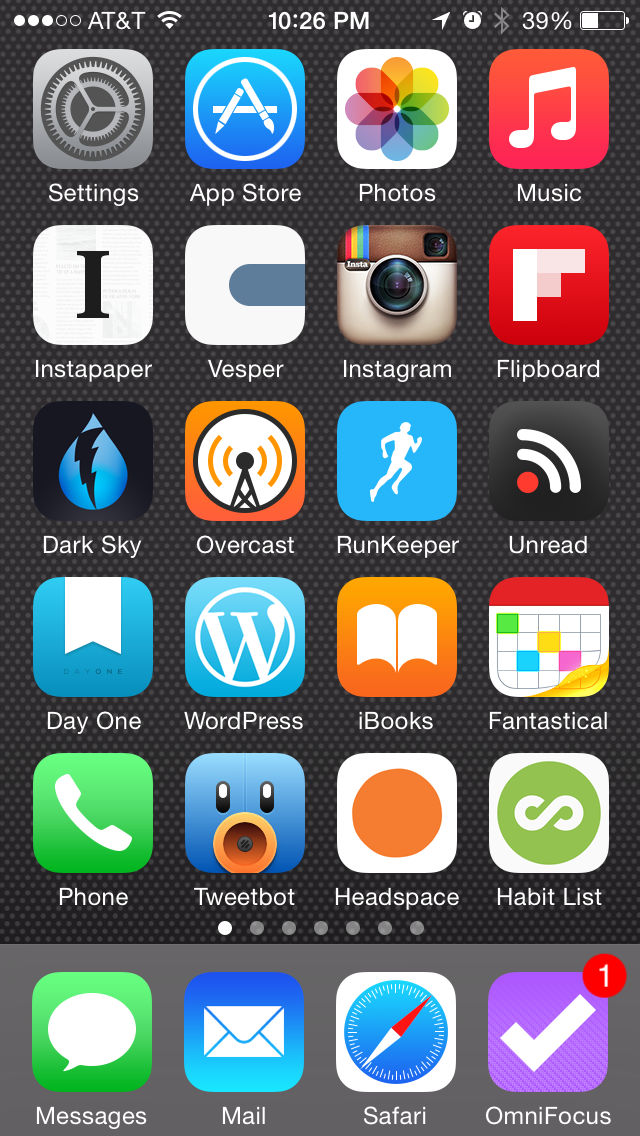
My current iPhone home screen.

These are my most frequently used apps at the moment. I have six other screens of apps that mostly don’t get much use.

Those apps that merit inclusion on my home screen are ones that serve a regular useful purpose and are a delight to use. They do their jobs well.

Useful and delightful. A solid couple of traits to value and aspire to in more than just the apps on your devices.

Four thoughts

This has been speech week for me. Three speaking gigs in four days, each on a different topic. My final one of the week is tomorrow morning as keynote for a student leadership honor society event.

I don’t actively pursue speaking opportunities. They just come to me, mostly through word of mouth and groups I’ve spoken to previously. I rarely decline an invitation. I’m not so much in demand that it becomes overwhelming. Three speeches in a week is more than usual, though.

I find a lot of value in having to think through what I want to say to a particular audience. Kind of like how writing on this site forces reflection and pursuit of insight that otherwise wouldn’t happen, regularly preparing for speeches has the same effect.

And the actual experience of standing before an audience of fellow human beings and capturing their attention is a rush. It’s this scary thing that most people avoid. I still feel the fear, even after a couple of decades of regular public speaking. But it’s more like riding a roller coaster fear. I know I’m going to be alright, but I’m braced for the unexpected and the potential, however remote, for everything to fall apart.

When you truly connect with an audience, though, and see their eyes alight with new possibility, it is so, so good. If I’m physically drained at the end of a talk, I know I’ve put out quality energy and done something worthwhile.

Here’s the light table view of my slides for tomorrow morning’s talk, Four Thoughts:

Screen Shot 2015-02-06 at 5.18.19 PM

Speak to spark change

Screenshot 2015-02-05 22.16.12

I was a guest lecturer in a class on campus today. I spoke about how to make effective presentations. A presentation about presentations. So meta.

I get excited talking to groups about effective presentations. So few people seem to relish the opportunity to speak publicly. Yet it’s such a worthwhile way to force yourself to think more clearly about a subject and to spark the possibility for action and new perspectives in others.

The JFK quote above is audacious. And it’s a worthwhile challenge to consider whenever you have to stand before fellow humans. If your aim in speaking is not to cause some sort of change, then what’s the point?

How many times, though, have you sat through a lecture, a meeting, a sermon, or a class and left feeling that your time and attention had been wasted?

But if even one person can be affected by what you have to say with a changed perspective or a new possibility awakened or the impetus to take action, mission accomplished.

Book backlog

IMG_1286

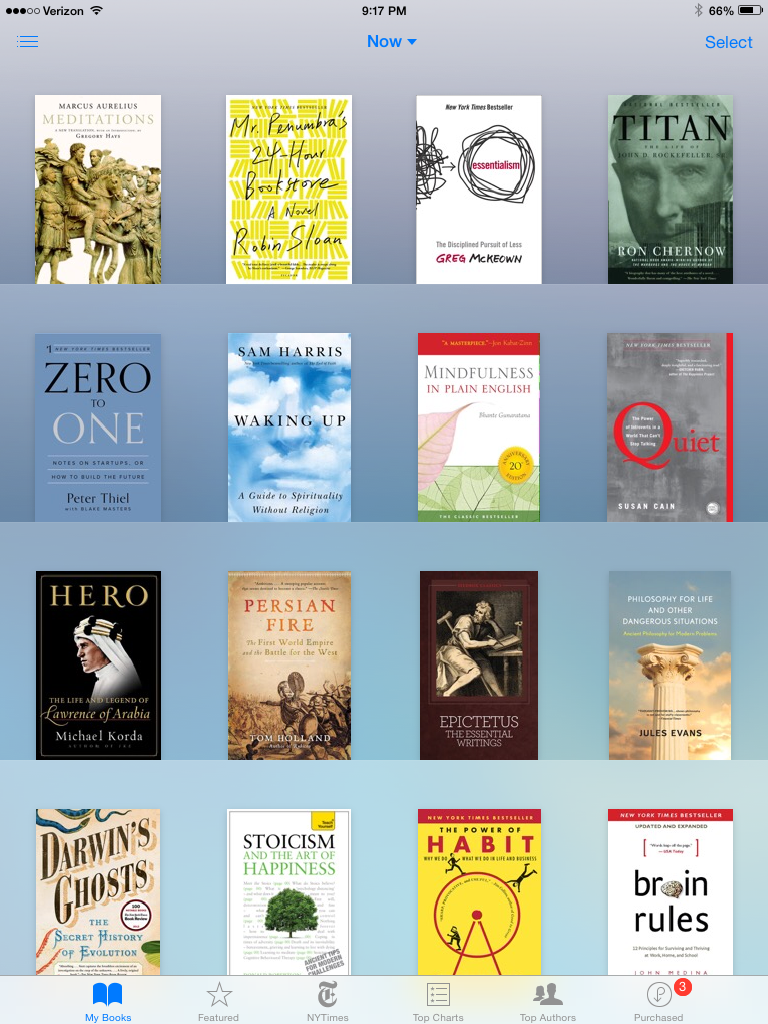
I’ve got so many books waiting for my attention. The busyness of daily life has squished my reading time the last couple of months.

But I can sense a dullness in my days when I don’t have an engaging book to pull me in and charge my thinking.

Make time for books. Real books. Internet reading doesn’t count.

Talk with, not at

IMG_1285

Note to self:

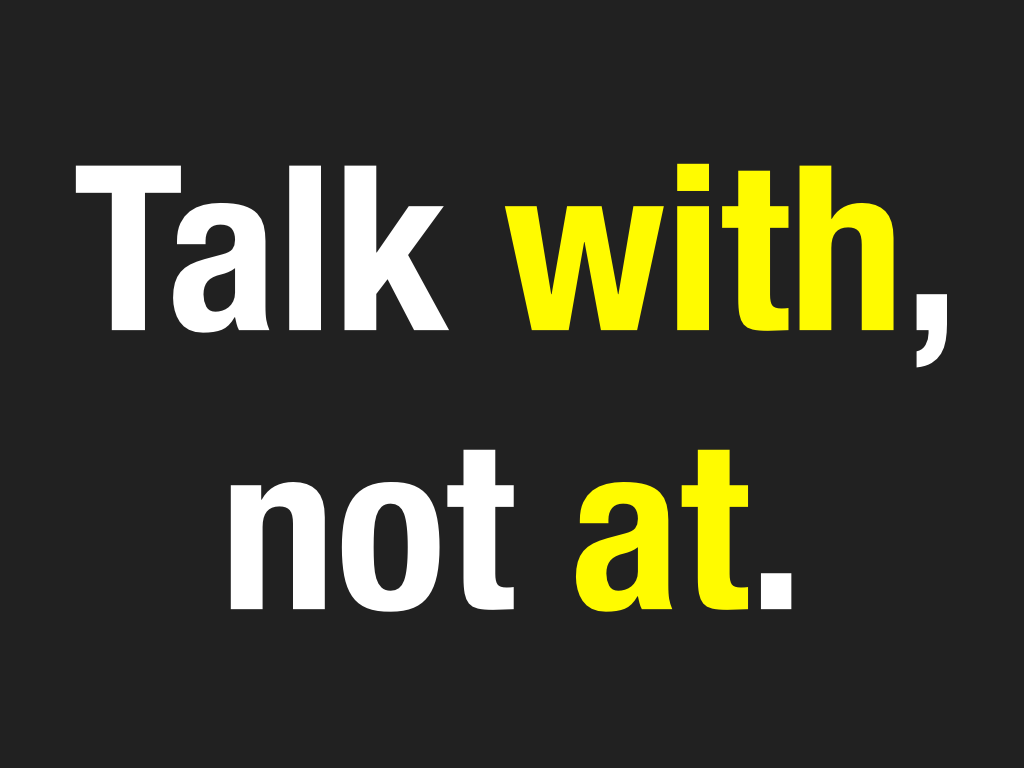
Even if it’s a speech, talk with, not at. It’s a stance, a tone, a shift in perspective that can make an audience of hundreds feel like the speaker is with them, connecting directly and personally.

Ask questions. Move. Make eye contact. Feel what they are feeling. Be with the audience.

And how much more important this is in dialogue, with your friend, a colleague, your boss, your spouse, your child. Talk with, not at.

Sunday morning Stoic: Past and future have no power over you

Meditations 8.35-36:

“35. We have various abilities, present in all rational creatures as in the nature of rationality itself. And this is one of them. Just as nature takes every obstacle, every impediment, and works around it—turns it to its purposes, incorporates it into itself—so, too, a rational being can turn each setback into raw material and use it to achieve its goal.

36. Don’t let your imagination be crushed by life as a whole. Don’t try to picture everything bad that could possibly happen. Stick with the situation at hand, and ask, “Why is this so unbearable? Why can’t I endure it?” You’ll be embarrassed to answer. Then remind yourself that past and future have no power over you. Only the present—and even that can be minimized. Just mark off its limits. And if your mind tries to claim that it can’t hold out against that … well, then, heap shame upon it.”

“Turn each setback into raw material” for your use. Convert obstacles into fuel. Welcome bad luck and bad news as if you chose them to somehow make yourself more awesome.

But remember that the past is gone, and we can’t even remember it exactly as it was. And the future is only in our imagination. Both are phantoms, unreal, empty.

The present is all any of us ever have. Face it with full attention, no matter what obstacles you may see in it. It’s manageable and, when fully inhabited and embraced, can be magnificent.

Investing in books

Adding to your library is no guilty pleasure. It’s your obligation as a human living in a vast and mysterious universe to feed your mind and spur on your curiosity and your yearning for wonder and delight.  When in doubt, buy the book.

“When I have a little money, I buy books; and if I have any left, I buy food and clothes.” ―Desiderius Erasmus

“Look up. Wake up. Show up.”

Screen Shot 2015-01-30 at 4.02.32 PM

I gave the keynote this morning at a regional science fair. As I was getting ready today I told my wife that I had low expectations because the majority of students in the audience were middle-school students. Maybe I’m just remembering my own awkward middle school years, but I had it in my head that 13-year-olds were probably not going to be the most engaged audience at 9 a.m. on a Friday with a dude their father’s age talking to them.

Boy, was I wrong. Maybe it’s because they’re all extra bright science fair winners, but they were as locked in and as attentive as the college students I typically speak to. Fortunately, I walked onto stage thinking I needed to bring extra energy to brace myself for a potentially tough crowd. Instead, they were an easy crowd, but the extra energy I started with was a bonus and carried through the entirety of the 45 minutes I was on stage.

Right before going on stage for a talk I visualize connecting deeply with the audience and see them in my imagination enjoying the encounter. Whether the audience got much out of my talk or not today, I left satisfied that I had given them all I had. And I walked away physically tired* yet mentally energized about polishing this talk for the next few gigs I have coming up in the month ahead.

Here’s a PDF of my slides, and below is the “light table” view I was working on in Keynote. I treat my slides more like a souvenir of the talk. They won’t make much sense if you weren’t in the room for the presentation, and that’s the way it should be.

Screen Shot 2015-01-30 at 4.11.07 PM


*If you don’t feel tired, like “I need to sit down” tired, after giving a presentation, you probably didn’t put enough energy into it. 


The upside of down thinking

“Misfortune weighs most heavily on those who expect nothing but good fortune.” —Seneca

I used to be a positive-thinking fundamentalist. Age and life experience have shown me the value of balancing with the negative.

Visualizing the negative and expecting the worst will brace you for whatever comes and make you appreciate even more what you have.

No need to dwell on the worst. Just visit the possibilities periodically and consider what could be. After briefly imagining even the most depressing circumstances, you return to the present with a deeper, more vital appreciation for people and things in your life that, moments before, had been taken for granted or even seemed invisible.

Have the courage to embrace life as it is, its good and bad, and be prepared for whatever may come. “Good” and “bad” define each other. Face the negative to strengthen the positive.

“The secret to happiness is low expectations.” –Barry Schwartz


“You are someone amazing. You are nobody special.”

Wow, right?

This is the ultimate existential tension we all face.

There has never been another you in the entire history of all that is. You are a unique part of this wondrous universe that is growing exponentially grander the more we know of it. You are the very consciousness of the universe, and only you can be you.

And yet you are so small, and your time here so fleeting. Your name and life history will fade from memory within a few generations of your death, which is approaching more rapidly than you want to imagine.

We are mortal inhabitants of a tiny planet orbiting an average star in a middling galaxy in a small speck of an incomprehensibly large and seemingly indifferent universe. Yet we are alive and aware and writing blog posts and hugging our kids and making art and dancing to the music of life as only we can.

Be awesome because you are indeed amazing. You are one in a billion. Be humble and grateful because you are just a mere human, nobody more special than anyone else. You are one of billions.


Band camp and intrinsic rewards

I was in the marching band in high school. Trumpet and French horn. I was no great musician, but I especially enjoyed the camaraderie. During the summer we all had to participate in band camp, where we learned the music and the show we would perform at football games and in competitions. (There was no actual camping, by the way. Not sure why it was called a camp.)

It was tedious and hot. Georgia-in-August hot. Putting the show in during the first days of camp took a lot of do-overs as everyone was learning where to go and when. After the band director would stop the show to correct something, we were then exhorted to hurry back to the sideline of the field to start over.

Well, it was hot. And tedious. And most teenagers in August who were waking up early maybe for the first time all summer are inclined to move slowly as they do this hard thing. And the director and the band officers would implore everyone to hurry, to run to get back to the starting point. It was mostly a futile effort getting a hundred high school students to run in the August heat across a dusty field.

I, however, was that kid who made a game out of it. I put a smile on my face and raced back across the field to the line every time, cheering and acting silly as I passed by many of my fellow band members. If I was going to have be out in the heat of an August day in Georgia doing this band practice, I might as well try to have fun.

If I’ve got a choice (and I do), I’m going to choose to be happy. And sprinting across the field at band camp while joking with friends made the tedium less tedious and added a dash of fun. I hoped to make someone else smile along the way as well. There were always a few of us who chose to make it fun.

Not many of my classmates, though, chose a similar response. Most dragged their feet and complained the whole way back to the line. Getting the band back in place to start over was a chore every time.

One day the director gathered the band up as practice was starting and offered a challenge. He would give fast food gift cards to those band members who showed the most spirit and energy running back to the line that day.

Well, every time we stopped and had to start over that day, the whole band went crazy, running back to the line with hyped up glee, yelling and cheering. One of my friends, who could have been the poster boy for the feet-dragging whiners previously, was all of a sudden Mr. Spirit, whooping and running each time we had a do-over.

Almost everyone seemed to be responding to this new motivational tactic. Except, it seemed to have the opposite effect on me. I hurried back, but not with my usual enthusiasm. Now, with a prize at stake, my motivation was gone. I didn’t want to be seen as faking it just to get some free food. And I did not win a spirit award that day. My friend, Mr. Spirit, did.

I remember feeling perplexed by my response. Why had I been bothered by the reward? Why was that enough to tone down my enthusiasm?

The reward for me previously had been an intrinsic one. It was the fun I had doing the thing. But when the reward was a free hamburger and being acknowledged in front of my peers, I put the brakes on. I didn’t understand the psychology then, but I now know that the extrinsic inducement sabotaged my motivation that day.

The next day at band camp there were no more gift cards to be awarded. And everyone went back to business as usual, with just the usual few choosing to delight in running back to the line just for the sake of it, not for any prizes. Those rewards had a very limited impact.

I know there is research now showing that extrinsic rewards turn out to have limited success and work primarily for tasks requiring a low level of mental and emotional investment. Bonuses and prizes and other external payoffs just don’t have the impact and staying power that everyone assumes.

Intrinsic rewards, though, are where the real juice is, especially for higher level work and organizational excellence. Finding how to tap those for yourself and those you lead can open possibilities for deep satisfaction and exceptional performance.

Check out Dan Pink’s TED Talk explaining what he discovered about the power of intrinsic motivation.
 

Balancing stock and flow

I just stumbled on this remarkable insight from the writer Robin Sloan who explains the economic terms “stock and flow” and relates them to the kinds of content we produce in this information age:

“Flow is the feed. It’s the posts and the tweets. It’s the stream of daily and sub-daily updates that remind people that you exist.

Stock is the durable stuff. It’s the content you produce that’s as interesting in two months (or two years) as it is today. It’s what people discover via search. It’s what spreads slowly but surely, building fans over time.

I feel like flow is ascendant these days, for obvious reasons—but we neglect stock at our own peril. I mean that both in terms of the health of an audience and, like, the health of a soul. Flow is a treadmill, and you can’t spend all of your time running on the treadmill. Well, you can. But then one day you’ll get off and look around and go: Oh man. I’ve got nothing here.”

So much of what I create is flow, fine for the moment but not particularly sticky, not worth talking about over time. Occasionally I make something reasonably solid that I know will still be meaningful, at least to me, months or years from now. But I mostly just stumble on those stock, substantive creations by simply showing up every day and attempting to do something small.

For better balance, more impact, and deeper satisfaction, I should be intentional about the kind of work that has staying power and makes a difference for more than just a day.

Posting on this site daily has been worthwhile and has rewired my attention each day in consistently surprising, constructive ways. But the daily updates don’t typically lead to the kind of substance that sticks.

What can I invest time in that will endure? What projects and pursuits could even have the potential to outlive me? Why not be bold and imagine doing work that just might resonate even a century from now?

I find real merit in the daily flow and the energy that it pulses through the rhythm of my routines. Now, balance that with the intention to dig deeper on work, on stock, that will last and structure habits and routines around that intention.

Aim high and dig deep. And keep showing up every day.

Quiet life, happy life

“A happy life must be to a great extent a quiet life, for it is only in an atmosphere of quiet that true joy can live.” –Bertrand Russell

Even when I’ve got the chance for quiet moments, I often fill them with noise and distraction.

Can I just be still?

Why not let the quiet steep? Let me sit past the restlessness to find the beauty and joy in the quiet.

“All of humanity’s problems stem from man’s inability to sit quietly in a room alone.” –Blaise Pascal

Unconventional wisdom

“Whenever you find yourself on the side of the majority, it is time to pause and reflect.” –Mark Twain

Running with the crowd may feel safe, but it shouldn’t make you feel comfortable.

The bold ideas, the original and courageous convictions, are most often at odds with popular opinion and conventional wisdom.

“When 99 percent of people doubt your ideas, you’re either completely wrong or about to make history.” –Scott Belsky

I’m an artist. You are, too.

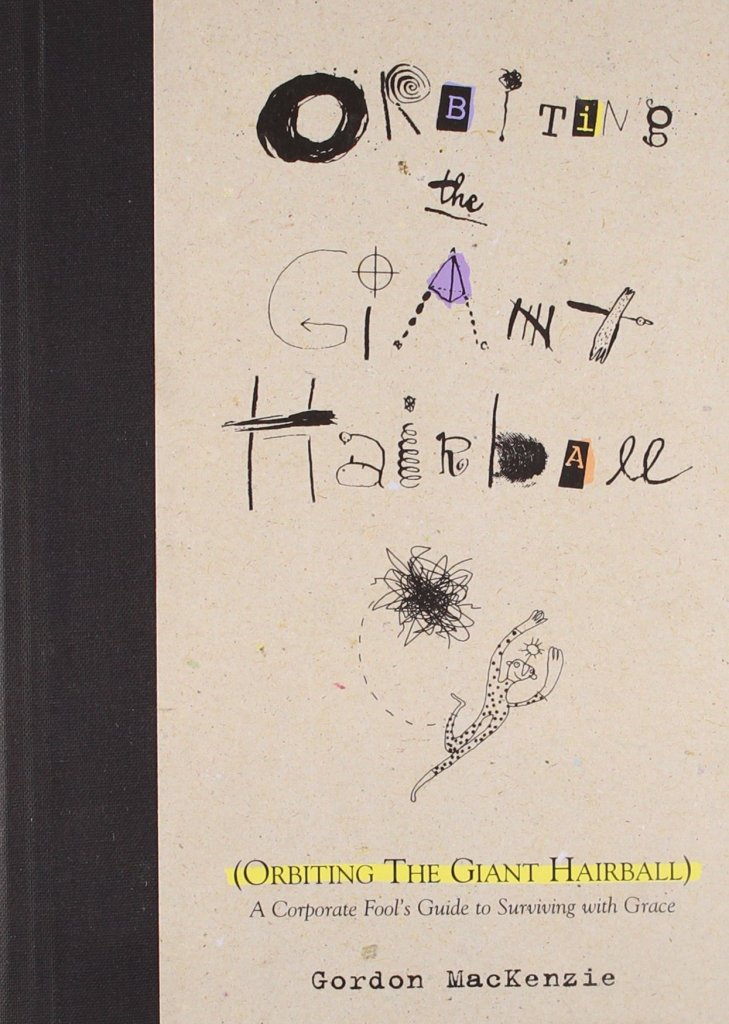
Orbiting the Giant Hairball is the kind of book that stays with you. I read it many years ago and still think of lessons from it. The author, Gordon McKenzie, worked at Hallmark, and the book explores his efforts to retain his independence and nurture his creativity within an often stifling bureaucratic organization.

In the most memorable story in the book McKenzie tells of his annual visit to an elementary school to share his art. He would start by presenting to the Kindergarten class and work his way up, talking to each grade level, all the way to the fifth-graders to finish the day. At each grade level he asked the students, “How many of you are artists?” Every Kindergarten student would quickly put a hand up. At the next class, though, a few first-graders did not raise a hand. A few more second-graders didn’t. Progressively, as he moved up in grade levels, fewer students raised a hand when he asked who were artists.

By fifth grade, no hands went up at his question. He then told the fifth-graders that every Kindergarten student had claimed to be an artist. “What is happening?” he asked them. “Are all the artists transferring out of this school?”

Of course, the point is something is happening to convince kids they are not artists. Parents or peers or teachers or culture or the system or some combination is turning off the default setting for creativity.

It’s on us to keep drilling back into the settings, our own settings and those of people we can impact, and turning back on the “I’m an artist” setting.

You don’t have to make a living off your art to be an artist. Just make something that only you can make – an experience, a photo, a meal, a poem or post, a song or video, a note to a friend. Express yourself. Make art. Go back to the Kindergarten default that you are an artist.

81OO-vQSZbL

Andromeda rising

This merits full screen. It’s a great video highlighting the most recent wonder from the Hubble Space Telescope, a stunning view into the galaxy nearest ours.

The density of stars in this image of just a portion of just one galaxy is incredible. And watch till the end of the video to appreciate the context. And remember that galaxy is headed straight for us.

If you need a regular dose of perspective, bookmark this video. When you feel the weight of the world on you, just pause and look into the sky and unburden yourself.

You are so, so small. But it’s glorious to be so small and yet able to ponder just how grand it all is.

A daily app: Pedometer++

IMG_6244


We have daily carry items. Everyday I put my keys, phone, and wallet in my pockets before leaving home. Now, most of us have daily apps, phone apps we use every day. These are the apps that stay on your home screen or not too far from it.

I’ve recently begun using Pedometer++ to track the number of steps I take each day. It only works with iPhone 5s, 6, and 6 Plus. The app design is simple and bright, and its function is basic: it just tracks how many steps you take in a day and the number of floors you may have climbed.

You can set the app to list your current steps on the little red badge on the app icon making it unnecessary to even open the app if you just want to check the number.

It makes me want to walk more. I love seeing the steps number go up. I’ll even make an extra effort to put my phone in my pocket at home, even in my pajamas, to make sure steps don’t go uncounted.

It’s a free app, but ads appear at the bottom of the display. With an in-app “tip”, you can support the developers and get rid of the ads. Yes, for me, to both.

This is a tiny little tool that is tweaking my routine and my consciousness in a healthy way and merits its use as one of my daily apps.

Advanced search for life’s big decisions

From Greg Mckeown’s excellent book, Essentialism:

“Applying tougher criteria to life’s big decisions allows us to better tap into our brain’s sophisticated search engine. Think of it as the difference between conducting a Google search for “good restaurant in New York City” and “best slice of pizza in downtown Brooklyn.” If we search for “a good career opportunity,” our brain will serve up scores of pages to explore and work through. Instead, why not conduct an advanced search and ask three questions: “What am I deeply passionate about?” and “What taps my talent?” and “What meets a significant need in the world?” Naturally there won’t be as many pages to view, but that is the point of the exercise. We aren’t looking for a plethora of good things to do. We are looking for the one where we can make our absolutely highest point of contribution.”

I need to remember to continually eliminate the good to hone in more clearly on the better. And then keep going, editing and discarding even those better options until I get to the best.

Be precise with your questions. Get specific, as detailed as possible, to find the best possible answer.