Thursday night Stoic: Wanting what you have

Meditations 7.27:

“Treat what you don’t have as nonexistent. Look at what you have, the things you value most, and think of how much you’d crave them if you didn’t have them.”

This is a great way to focus on wanting what you have instead of having what you want. Assess your life, and realize how much good is in it.


A book that goes the distance: Born To Run

Born-to-Run-

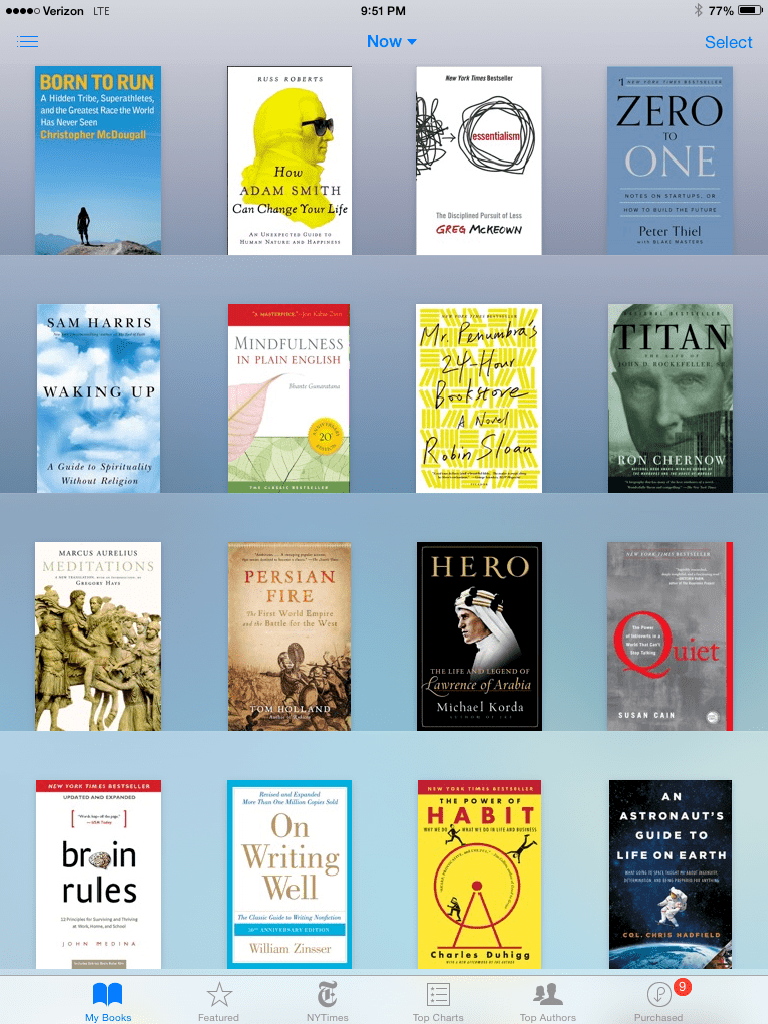
I have a stack (a virtual stack, that is) of unread books that I am genuinely interested in reading. I often go through long periods of dipping in and out of different books, making little progress on any one book. My potentially unlimited access to almost any book I want at any time is a bit overwhelming and regularly keeps me from actually reading a book all the way through.

However, Born To Run pulled me in and kept me intrigued all the way to the end and beyond. When I opened my iBooks app in the past week, I didn’t hesitate to open Born To Run, and only Born To Run. I didn’t stray or skim through another title in indecision. All Born To Run, all the time. It was a delight to read, and it was a delight to find a book that had the magnetism to hold my attention and push all other reading material behind it.

The author, Christopher McDougall, did a masterful job of weaving together a fascinating group of characters (real people that I found intriguing enough to google and explore further) into a narrative that was truly compelling. And I’m not even a runner.

But this book has sparked a new appreciation of distance runners and a curiosity about the science and engineering and anthropology behind truly great running form. I even, in preparation for an upcoming trip, bought a pair of the Luna Sandals whose design was inspired by the story in this book. And I have definitely never been a sandals guy. At all. (Though, the similarity of these particular sandals to what I think gladiator/Roman emperor sandals would have looked like makes them a bit easier to accept.)

A book that entertains with a page-turner of a story that also educates and challenges assumptions and has you trying a new approach to your basic daily habits (and buying sandals, of all things)… A fine accomplishment for an author.

I see that McDougall has a new book coming out this month with a similar vibe: Natural Born Heroes. Pre-ordered.


Tim Kreider’s manifesto on the merits of idleness

Tim Ferriss is featuring an audiobook version of Tim Kreider’s book, We Learn Nothing, on his podcast. He posted a sample of the audiobook with a free chapter, Lazy: A Manifesto.

The sample chapter is a terrific essay on the crazy obsession our culture has with being “busy”. When you ask someone how they’re doing, “Busy” is a common and depressingly acceptable, even admirable, response.

Go listen to that free chapter. It’s so good. And Kreider will have you questioning your own addiction to at least appearing to be busy.

From the book:

“Yes, I know we’re all very busy, but what, exactly, is getting done? Are all those people running late for meetings and yelling on their cellphones stopping the spread of malaria or developing feasible alternatives to fossil fuels or making anything beautiful?

This busyness serves as a kind of existential reassurance, a hedge against emptiness: obviously your life cannot possibly be silly or trivial or meaningless if you are *so busy*, completely booked, in demand every hour of the day. All this noise and rush and stress seem contrived to drown out or cover up some fear at the center of our lives.”

And this:

“Idleness is not just a vacation, an indulgence, or a vice: it is as indispensable to the brain as vitamin D is to the body, and deprived of it we suffer a mental affliction as disfiguring as rickets. The space and quiet that idleness provides is a necessary condition for standing back from life and seeing it whole, for making unexpected connections and waiting for the wild summer lightning strikes of inspiration—it is, paradoxically, necessary to getting any work done.”

There is not enough idleness in my life. And most of my busyness is probably not accomplishing much in the big scheme of a 13-billion-year-old universe.

“I can’t help but wonder whether all this histrionic exhaustion isn’t a way of covering up the fact that most of what we do doesn’t matter.” –Tim Kreider

Do less, better. That should be my mantra. What does matter? What will count for something worthwhile when I look back on it? What makes for a really good day? Focus on the quality of those things that will send me to bed each night with the satisfaction, not of having been busy, but of having spent my time wisely and joyfully.

TED inspired speaking advice

It seems the fundamental advice about how to give a good speech is pretty obvious by now. How often can you repeat the basics of effective public speaking?

But I saw two articles recently that had fresh takes worth reading, both inspired by the TED Talk experience.

5 Secrets of a Successful TED Talk highlights solid evidence that how you say what you say trumps even the most meaningful content in its impact on an audience. In a survey of viewers watching TED Talks with the sound turned off, those talks that had the most animated, confident looking speakers rated the highest. And that actually correlated with the popularity of those talks when the sound was on as well.

Smile, use your hands, turn your physical energy up, don’t come across as scripted, and you will have the best chance of connecting with your audience. And it starts immediately. The audience is making a judgment about you and your message in just the first few seconds.

And this article, A TED speaker coach shares 11 tips for right before you go on stage, is filled with thoughtful tips about the mental and physical approach the most successful speakers adopt.

Here’s tip #3 from the list:

Use your body’s nervous energy for good. Don’t try to contain all your nervous energy. Let it move through you and energize you for your talk. Do isometrics while you waiting backstage if it helps. Shake your hands out. Barnett remembers one TED speaker who found a private corner backstage to put on headphones and dance — and that speaker walked onstage feeling like a rockstar. And, if nothing else, always remember TED star Amy Cuddy and how to power pose.

I remain convinced that anyone can have charisma in front of an audience. Care about something enough to have the courage to fully express just how much you do care, and you will be charismatic.

Spending on experiences offers more value than buying things

From a FastCompany.com article, The Science of Why You Should Spend Your Money on Experiences, Not Things

There’s a very logical assumption that most people make when spending their money: that because a physical object will last longer, it will make us happier for a longer time than a one-off experience like a concert or vacation. According to recent research, it turns out that assumption is completely wrong.

“One of the enemies of happiness is adaptation,” says Dr. Thomas Gilovich, a psychology professor at Cornell University who has been studying the question of money and happiness for over two decades. “We buy things to make us happy, and we succeed. But only for a while. New things are exciting to us at first, but then we adapt to them.”

There have been things in my life, whether they’re still in my life now or not, that still glow in my memory for the happiness they sparked. But it’s true for me that unique experiences endure and resonate far more vividly.

My summer abroad in college was a singularly great adventure that even now is satisfying to recall. Vacations and shows and fun family outings, even trips to the local movie theater, continue to be sources of joy long after they happened.

Apparently, even unpleasant experiences have value:

One study conducted by Gilovich even showed that if people have an experience they say negatively impacted their happiness, once they have the chance to talk about it, their assessment of that experience goes up. Gilovich attributes this to the fact that something that might have been stressful or scary in the past can become a funny story to tell at a party or be looked back on as an invaluable character-building experience.

This is a great reminder to live my life. To fill my days with experiences worth remembering, not things that will be forgotten.

The book as a souvenir of ideas: Elle Luna’s new book

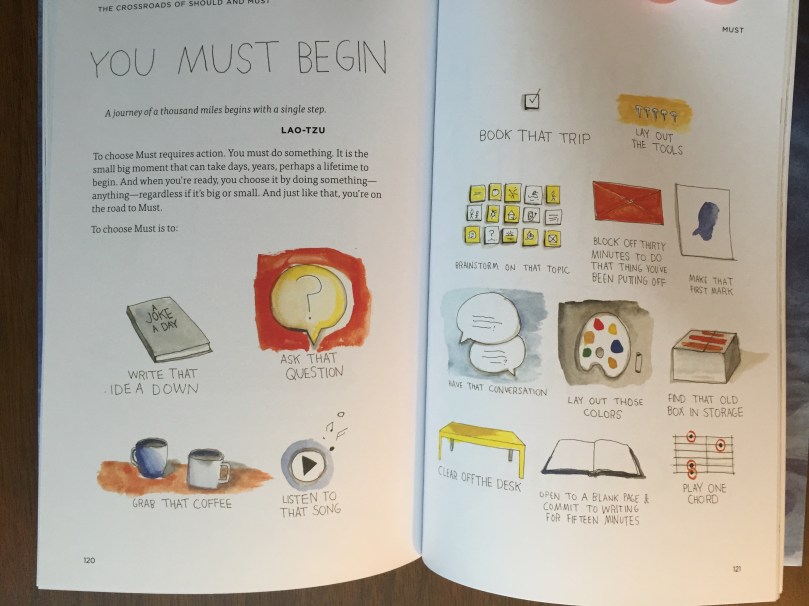
IMG_6550I received The Crossroads of Should and Must by Elle Luna today. I read the essay that ended up being the seed of the book earlier this week, and the book itself is a delight to hold and page through.

Books like this are why ebooks will not put an end to printed books. Beautifully crafted with striking colors throughout and hand-drawn illustrations, Luna’s book is a gift-worthy gem of a souvenir, a souvenir of ideas that will have more value because of the style that conveys the substance.

IMG_6552

Books like this offer an experience, not just information. The art is in more than just the words. The visual hooks connect more intensely than words alone could.

When I think back on some of my favorite reading experiences, the form of the book often is a vivid part of the memory. Even books that have no art other than the cover make a memory through their heft and their physical design. Recalling the thick paperback copy of Anna Karenina I read in 1991, I can still picture the cover image, and I remember the general feel and thickness of the book and even the position (left page, upper half about a quarter of the way through) of one of my favorite passages.

Picking up a Dr. Seuss book with my kids rockets my memories back to seeing those same whimsical drawings as a kid myself.

IMG_6553

Form matters. And you can make your ideas stick better and longer with art that resonates with the senses. Certainly visual appeal is important, but even the feel of the paper or the weight of the cover of a book can make a difference. It’s why Apple works so hard designing the boxes their devices are sold in.

I enjoy using slides when I present for this reason. Uncluttered, memorable images can make ideas pop and stick and can set an emotional tone for the delivery of a narrative.

I still mostly read ebooks. They’re convenient. It’s amazing to have a whole library a touch away no matter where I am. But beautiful books like Luna’s and Seth Godin’s most recent are reminders that a book as a work of art and as a tangible vehicle for compelling ideas has a bright future.


Notes to myself

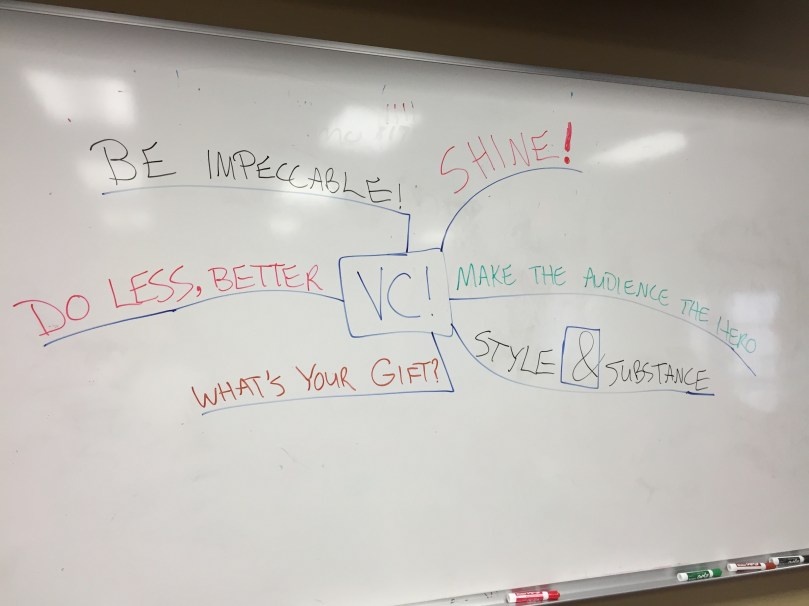
These are the notes I wrote on the board for our student staff meeting today.

I was reminding them of what I think are some key principles when connecting with all the visitors we encounter every day.

  • Make the audience the hero – It’s not about you. Put yourself in the mindset of those you’re speaking to. How can they come out of this encounter better and happier?
  • Style & substance – Offer more than charm and wit. Your style needs to support meaningful content, not just entertain superficially.
  • What’s your gift? – Don’t stand before an audience wondering what you can get from them – laughs, applause, approval.  Instead, focus on what you can give to your audience. What value can you add to those you encounter?
  • Do less, better – Focus on the essentials. Cut the excess, even good stuff, to shine a brighter light on what’s most important.
  • Be impeccable – Aim for perfection. Be careful with even small details. Get it right. Keep pushing yourself to constantly improve.
  • Shine! – Don’t be afraid to be awesome. Be bold and confident.

These are notes to my staff, but they’re just as much notes to myself. I need to be reminded regularly to not be content with good enough. Why not be extraordinary?

Elle Luna: The crossroads of should and must

This epic essay by Elle Luna was posted almost a year ago. I discovered it only today when Seth Godin linked to her new book that came from that essay.

The book looks beautiful. Purchased.

In this essay (and now in her book) Elle tells her story of finding her calling by resisting the path of Should and instead embracing the path of Must. Most of us are guided by what we think we should do while ignoring the call of our deepest desires and what we must do to be fully alive.

“What if who we are and what we do become one and the same? What if our work is so thoroughly autobiographical that we can’t parse the product from the person? What if our jobs are our careers and our callings?” –Elle Luna

I have struggled, though, with the notion that we have some innate passion we have to find and follow. Maybe it’s just semantics. What an authentic life needs is to be true to what you genuinely love and to make an art of it, to do it as well as you can.

Pick a path the excites you, that seems like fun, but that also will challenge you and will compel you to mastery. Course correct regularly. Change your mind. Try and fail, but stick with something long enough to know.

Elle Luna closes her essay with a strong call to choose Must over Should, to have the courage to live the life that is calling to you:

“If you believe that you have something special inside of you, and you feel it’s about time you gave it a shot, honor that calling in some small way — today.

If you feel a knot in your stomach because you can see the enormous distance between your dreams and your daily reality, do one thing to tighten your grip on what you want — today.

If you’ve been peering out over the edge of the cliff but can’t quite make the leap, dig a little deeper and find out what’s stopping you — today.

Because there is a recurring choice in life, and it occurs at the intersection of two roads. We arrive at this place again and again. And today, you get to choose.”

Born To Run: Christopher McDougall’s TED Talk

I am reading Christopher McDougall’s book, Born To Run, and it is fascinating. So much so that I’ve been Googling characters from the story and found the author’s web site and got lost in videos on his site today.

Again, I’m no runner, but the story McDougall tells is intriguing. It’s beyond just an exposition of running fundamentals. It gets to the heart of our potential as a species, physically and socially. What we were. What we’ve lost. And what still resides within and can be reawakened by getting in sync with our primal nature.

And the book is simply a good story, well told. And it will make you want to ditch your overly cushioned athletic shoes.

Here’s the book’s author giving a short talk about the key themes in his book:

Monday night Stoic: Take Antoninus as your model

Meditations 6.30:

“Take Antoninus as your model, always. His energy in doing what was rational … his steadiness in any situation … his sense of reverence … his calm expression … his gentleness … his modesty … his eagerness to grasp things. And how he never let things go before he was sure he had examined them thoroughly, understood them perfectly … the way he put up with unfair criticism, without returning it … how he couldn’t be hurried … how he wouldn’t listen to informers … how reliable he was as a judge of character, and of actions … not prone to backbiting, or cowardice, or jealousy, or empty rhetoric … content with the basics—in living quarters, bedding, clothes, food, servants … how hard he worked, how much he put up with … his ability to work straight through till dusk—because of his simple diet (he didn’t even need to relieve himself, except at set times) … his constancy and reliability as a friend … his tolerance of people who openly questioned his views and his delight at seeing his ideas improved on … his piety—without a trace of superstition …

So that when your time comes, your conscience will be as clear as his.”

Whether Antoninus (Marcus’s predecessor as emperor) was really this together or not, this description provides a great model of character for anyone to aspire to.

Books in the queue

I just finished two Walt Disney biographies, and I’ve started the new Steve Jobs biography. Those two men, Disney and Jobs, compare and contrast very interestingly, and it’s particularly compelling to read their stories back-to-back.

I can’t seem to stick to just one book at a time, of course, and I started another book this weekend: Born To Run by Christopher McDougall. I had heard of the book a few years ago, though I’m not a runner and have no plan to become one. But it has gotten rave reviews both for the phenomenal story and provocative ideas as well as for the excellent writing. I just started reading it yesterday, and it’s already grabbed my attention and will be a nice change-up from the Steve Jobs book.

My consumption of fiction is down significantly from last year. I need some good novels to mix in with all this non-fiction.

I continue to have plenty of unread books in my iBooks app. Some have been sampled. Others have been begun and put on hold. And a few are untouched. (I’m probably, though, on my fifth reading of Meditations.)

Just looking at this stack of books to read delights me. There’s such potential for new ideas and possibilities yet to be awakened and, certainly, the anticipated pleasure of the reading experience.

The unread book count doesn’t hold the cognitive burden of, say, your unread email count. It may be just the opposite kind of tension in the way that “Here it comes!” compares to “Here it comes.”

Nerding out

My ten-year-old and I walked the dog together last night. She was a chatterbox. Get her away from books and Netflix and conversation flows from her.

She changes topics pretty quickly. It’s a stream-of-consciousness kind of flow.

At one point she said, “Dad, what did you nerd out on when you were a kid?”

Me: “What do you mean by ‘nerd out’?”

Her: “You know. Like I’m reading those books about Egyptian mythology right now, and I get really into everything about it.”

And she does. Thanks to the Kane Chronicles books by Rick Riordan, my daughter is now well versed on all the Egyptian deities and their stories and is eager to share what she’s been learning in great detail.

This conversation was a proud moment for me, that she recognizes that “nerding out” is a thing and that she delights in it.

I told her that when I was her age I nerded out reading biographies and obsessing over NASA and astronauts. And I reminded her that, as cool as she knows I am, I’m still nerding out about a lot of things, like Apple and books and great gear.

I hope she will continue to embrace delightful obsessions all her life. Nerding out is really just following your curiosity and your joys and caring deeply.

Follow your bliss, no matter if anyone thinks it’s nerdy. It doesn’t matter if what you nerd out over will make you any money or win applause or approval or likes on Instagram. Pursue those things that bring you joy for their own sake, without any attachment to some external reward.

Go play

The latest TED Radio Hour episode is all about play and how vital it is even for, especially for, adults.

It turns out, play is not frivolous. It’s necessary for a healthy, fully functional human existence. Without regular doses of play, we become, physically and emotionally, more brittle, less resilient, and a lot less fun.

“The opposite of play is not work. It’s depression.” –Brian Sutton-Smith

As kids, we played like it was our job. What if, now, we did our jobs like it was just play? And what if we were intentional about seeking opportunities to play every day?

I had a colleague years ago who got me to bring my baseball glove to work so we could play catch, wearing our ties, during our lunch break. We got odd looks from passersby, but it was a delight.

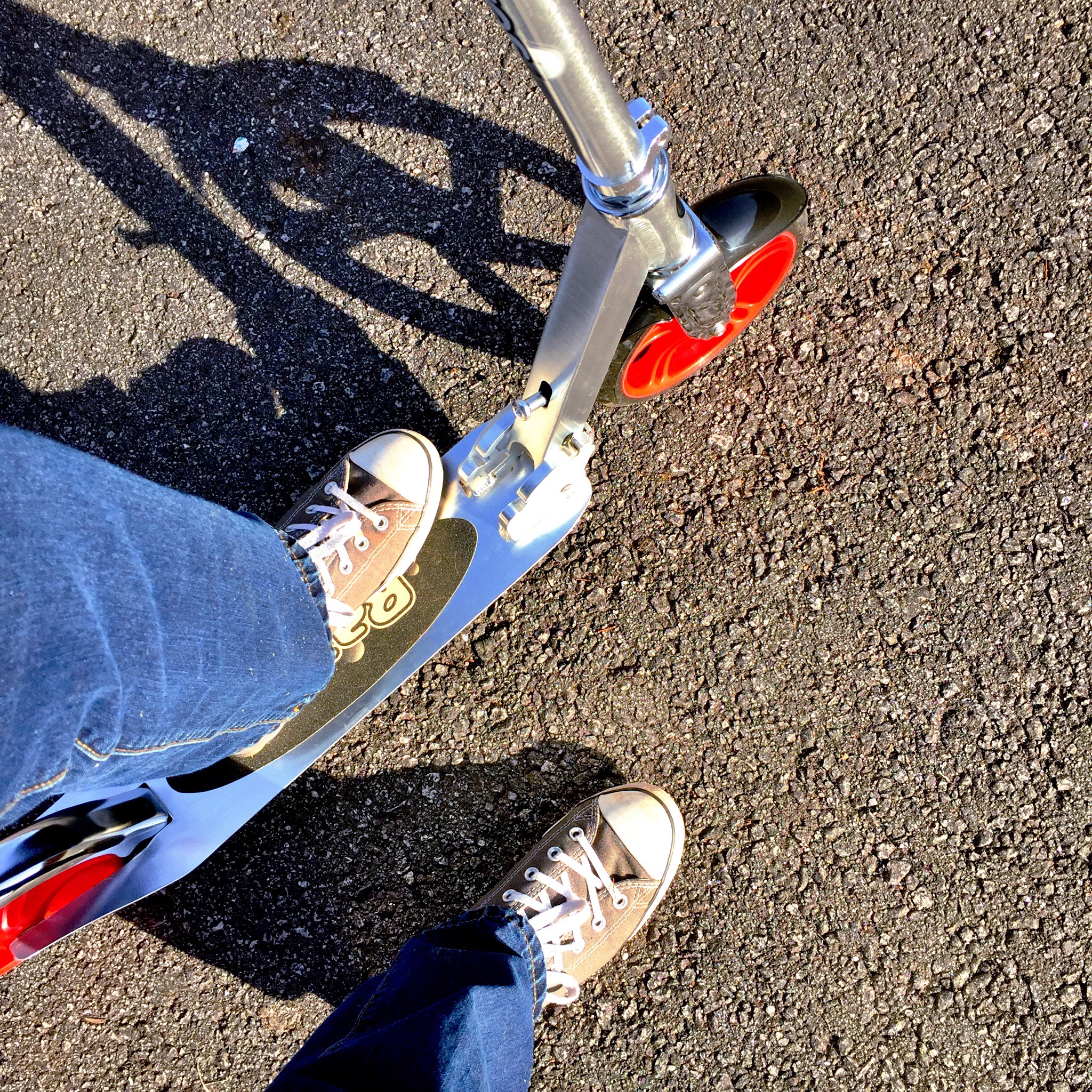
There is a distinctive pleasure in physical play that mental play like board games or video games can’t match. I’ve been enjoying dashing off on my daughter’s scooter recently. And there’s Slomo.

And today, after my TED Radio Hour inspiration, I came home and dug out our baseball gloves and played catch with my 10-year-old. We had more smiles than dropped catches. And we’ve promised to get back out there again tomorrow.

Go play this weekend. Like it’s your job.


Be The Punchline: Focus on what you can give, not what you can get

ht Presentation Zen

So good.

This comedian’s career flipped when he realized he should focus on what he could give the audience, not on what he hoped to get from them.

It’s called giving a speech, right? So, if you’re called on to speak, consider this an opportunity to give something to your audience. What gift would be worthwhile and meaningful? Don’t apologize or half-heart it. Be solid and come strong with your gift.

Don’t be like so many who start a talk with “I’m sorry to be taking your time” or otherwise apologize for standing in front of them. If you’ve got a meaningful gift to share, be confident and bold.

I do like getting a great response from an audience – laughs, smiles, applause, questions. But if I focus on what I have to give, I’m more likely to get a response that matters.

Beyond public speaking and stand-up comedy, this question just works. “What can I give that would be valuable to someone?”

Becoming Steve Jobs: Adversity and failure before triumph

IMG_6482


The new, much-hyped biography, Becoming Steve Jobs, was released yesterday, and my pre-ordered copy was on my porch when I got home last night. This is the rare book that I’m choosing to purchase as a physical book instead of an ebook. The advance praise was sufficient enough and the topic is one I find fascinating. I’m thinking it will be a keeper.

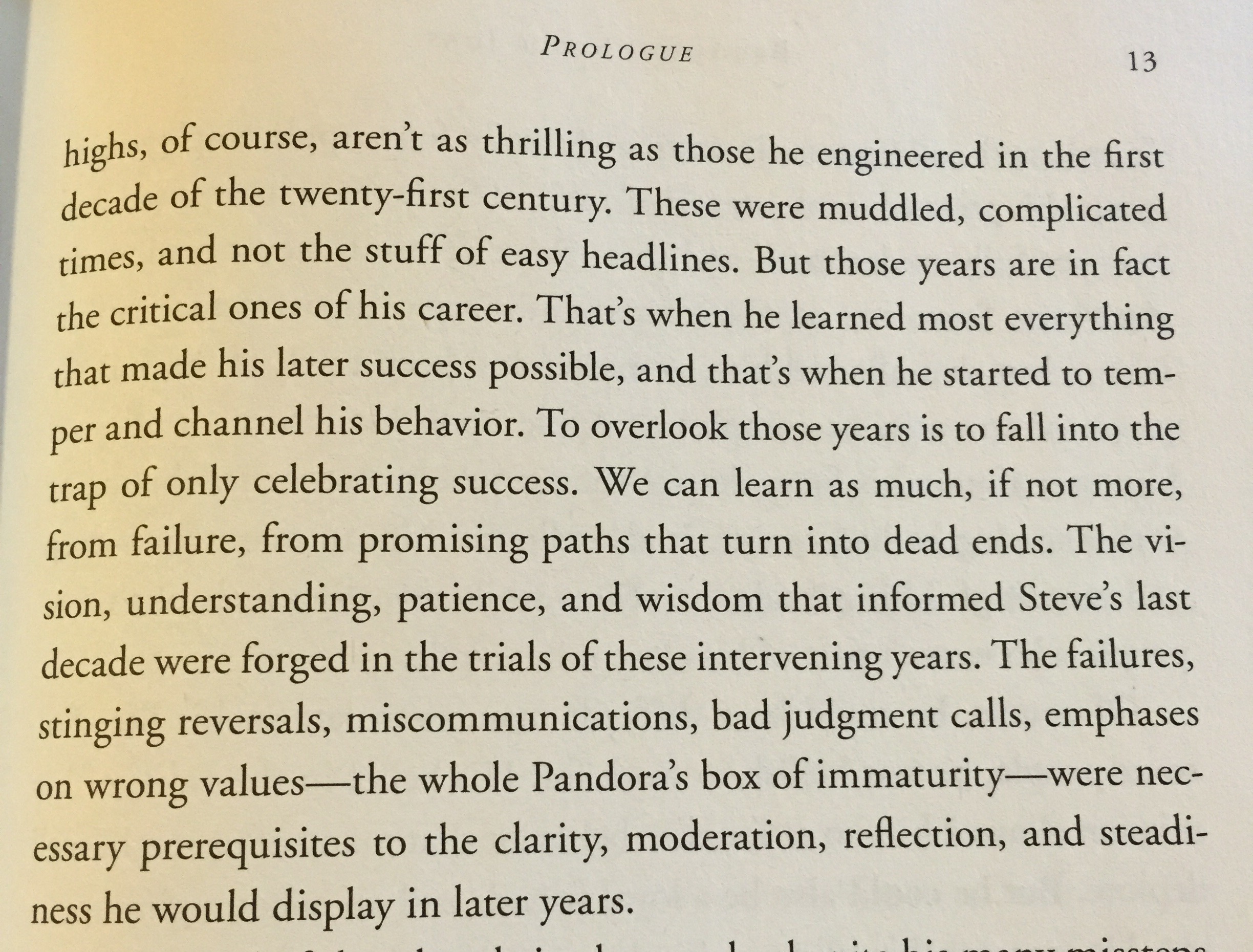
The book explores how someone who seemed so insensitive and reckless at the beginning of his career could end up as THE visionary business leader of our time. I just started reading it and came to this passage in the prologue:

FullSizeRender 2

“We can learn as much, if not more, from failure, from promising paths that turn into dead ends. The vision, understanding, patience, and wisdom that informed Steve’s last decade were forged in the trials of these intervening years.”

The greatness of the company that Steve Jobs fashioned in his last decade would not have been possible without the failures and shortcomings of his first couple of decades.

I’ve been fascinated recently by those who have turned adversity and failure to their advantage. We all seem to know that facing difficulties and enduring setbacks make us stronger and better. Yet we resist even the thought of coming up short or of taking on hardship.

Maybe we all should regularly and intentionally fling ourselves into the teeth of surefire heartbreak and dismal failure just so we can grow and learn faster.


SLOMO: “Do what you want to!”

This short film is well worth fifteen minutes of your attention:

ht Charlie Hoehn

This former doctor has found bliss roller-blading* by the beach. He chucked his living-by-the-rules-and-society’s-defaults kind of life and just started doing what he wanted to do.

He was inspired by a chance encounter years before with a 93-year-old whose life advice was: “Do what you want to!”

That story reminded me of Joseph Campbell recounting this story in his 1980s television series with Bill Moyers:

Campbell: Remember the last line [of Babbitt]? “I have never done the thing that I wanted to in all my life.” That is a man who never followed his bliss. Well, I actually heard that line when I was teaching at Sarah Lawrence. Before I was married, I used to eat out in the restaurants of town for my lunch and dinners. Thursday night was the maid’s night off in Bronxville, so that many of the families were out in restaurants. One fine evening, I was in my favorite restaurant there, and at the next table there was a father, a mother, and a scrawny boy about twelve years old. The father said to the boy, “Drink your tomato juice.”

And the boy said, “I don’t want to.”

Then the father, with a louder voice, said, “Drink your tomato juice.”

And the mother said, “Don’t make him do what he doesn’t want to do.”

The father looked at her and said, “He can’t go through life doing what he wants to do. If he only does what he wants to do, he’ll be dead. Look at me. I’ve never done a thing I wanted to in all my life.”

And I thought, “There’s Babbitt incarnate.”

That’s the man who never followed his bliss. You may have a success in life, but then just think of it—what kind of life was it? What good was it—you’ve never done the thing you wanted to do in all your life. I always tell my students, go where your body and soul want to go. When you have the feeling, then stay with it, and don’t let anyone throw you off.

 “Follow your bliss” is not a call to a shallow, selfish life. It’s the call to listen and to act. To not just follow the expectations of others. To not just get locked into a groove that someone else made. Live your life.

***

*As an aside, I was intrigued by Slomo’s neurological explanation in the documentary of the science of the joy of accelerating. Because, the inner ear and gravity and the center of the earth…

Recently, I’ve been borrowing my seven-year-old daughter’s scooter at every chance.

Me, to my kids: “Hey, girls! Do you want to go ride your bikes…?!”

Me, to myself: *…so I have an excuse to ride the scooter*

I delight in zooming down our steep driveway and onto the road. And when we go around the block, I live for the smooth, even descent where I can just glide downhill back to our house, the wind in my gray hair. It puts a smile on my face and creates this simple little pleasure that most fifty-year-old men rarely experience.

Slomo, I get it. Skate on.

IMG_6222


Walt Disney and the long, long game

Screen Shot 2015-03-23 at 5.14.41 PM

I’ve referred to the long game previously, the perspective of considering the long arc of your story and a patient pursuit of an awesome life.

In the two Walt Disney biographies I’ve been reading, I keep coming across an even longer perspective. Disney was driven by a vision of a future he knew he would never personally reach.

Imagine that your work will outlive you by 50-plus years or so. Even if the memory of you fades, what can you contribute that will endure? How can what you do and what you make now reverberate into future generations?

“Make a fifty-year master plan. A fifty-year master plan will change how you look at opportunities in the present.” –Walt Disney

It’s not about ego. You’re going to be gone in just a few years. But thinking through the long, long game can add possibilities to your work that a shorter perspective just can’t.


Sunday evening Stoic: Alexander the Great and his mule driver

Neither still exists. Nor does everyone’s favorite emperor, Marcus Aurelius, who wrote this in Meditations (6.24):

“Alexander the Great and his mule driver both died and the same thing happened to both. They were absorbed alike into the life force of the world, or dissolved alike into atoms.”

How nice to be remembered, and especially if your life is still making a difference for others, even centuries later. But what good does it do Alexander? Or Marcus?

Your life will be merely other people’s memories in a few years when you’re gone. And a century or two from now, it’s likely no one will know of you at all.

You can try really hard to be one of the few whose mark on our culture endures for a long time. Or you can focus simply on making the most of your limited time here.

Put your problems and your worries in perspective. Live excellently. Be kind. Have patience with those around you. Enjoy your life.


Thoreau and the most encouraging fact

Henry David Thoreau (via Brain Pickings):

The millions are awake enough for physical labor; but only one in a million is awake enough for effective intellectual exertion, only one in a hundred millions to a poetic or divine life. To be awake is to be alive. I have never yet met a man who was quite awake. How could I have looked him in the face?

We must learn to reawaken and keep ourselves awake, not by mechanical aids, but by an infinite expectation of the dawn, which does not forsake us in our soundest sleep. I know of no more encouraging fact than the unquestionable ability of man to elevate his life by conscious endeavor.