Pluto: To boldly go

We can actually see Pluto for the first time ever. Incredible!

We (meaning the brilliant humans of NASA and the New Horizons team) launched this piano sized spacecraft nine years ago and sent it hurtling toward the edge of the solar system.

It is now more than 3 billion (!) miles from home and sending back stunningly detailed information about what was the most mysterious world in our planetary neighborhood.

That we can do something like this, that we can truly “boldly go where no one has gone before”, burnishes my optimism for our species.

The lucky ones 

Richard Dawkins from his book, Unweaving The Rainbow:

“We are going to die, and that makes us the lucky ones. Most people are never going to die because they are never going to be born. The potential people who could have been here in my place but who will in fact never see the light of day outnumber the sand grains of Arabia. Certainly those unborn ghosts include greater poets than Keats, scientists greater than Newton. We know this because the set of possible people allowed by our DNA so massively exceeds the set of actual people. In the teeth of these stupefying odds it is you and I, in our ordinariness, that are here.”

The limits of the possible

“Do not aspire to immortal life but exhaust the limits of the possible.”–Pindar

My aspiration should be to fulfill my potential, to be the most excellent version of myself possible. 

Posterity, my reputation when I’m gone, is beyond my control. And what does it matter anyway? 

Life here and now is enough for me. I’ve not come close to exhausting my limits. 

But every day offers a new chance and a fresh start. 

What’s possible tomorrow?  How can I be even slightly better than I was today? 

Show your work: Star Wars

Seeing inside the process of a craftsman or artist makes me appreciate their work more. Knowing how the magic is made doesn’t diminish the magic; it enhances it. 

And that kind of transparency inspires me to push through the messy misfires and tedious small steps on the way to making my own art. 

Even the world’s greatest masterpieces didn’t emerge instantly pristine. Imagine how many discarded drafts and crumpled sketches and trashed recipes came before the lauded final product. Trial and error and daily effort and persistence don’t grab headlines, but the art wouldn’t be art without the work. 

Want to make something great? Do the work. 

Inspired by Austin Kleon’s “Show Your Work”, I regularly share behind-the-scenes glimpses of projects I’m working on. Let’s demystify the creative process and encourage others to dive in and make something remarkable, too.  

All of us can make art. If it’s something you care about and making it would be meaningful to others, it’s art. Your work, your hobby, your passion. 

I love this video that was just released showing the work being done now on the upcoming film, Star Wars: The Force Awakens:

This is the kind of thing you would usually see only after a film has been released. But the creators are “showing their work” in progress, and it gives a sense of just how much they care about what they’re making. Now I have a new hope (see what I did there?) for the future of this grand story. 

Perspective

Screen Shot 2015-07-10 at 4.56.44 PM

The big picture provides perspective.

Regularly seeing yourself in the context of the universe—just how small and insignificant you really are—will nudge you back off the ledge.

You are unique. There has never been and will never be another you. Be the best expression of you you can be.

But you are just an infinitesimally small part of the universe. It doesn’t spin around you. It’s mostly indifferent to you. It will go on just fine with or without you.

And maybe that should hurt my ego, but instead it frees me to not take myself too seriously.

Thinking this way can free us to just enjoy the ride and relish our good fortune to have made it onto the stage in our bit part in this grand cosmic extravaganza.

Where you are

When you get there you will only be right here, right now

How I can live now and not defer my living to some future now?

Sampling books

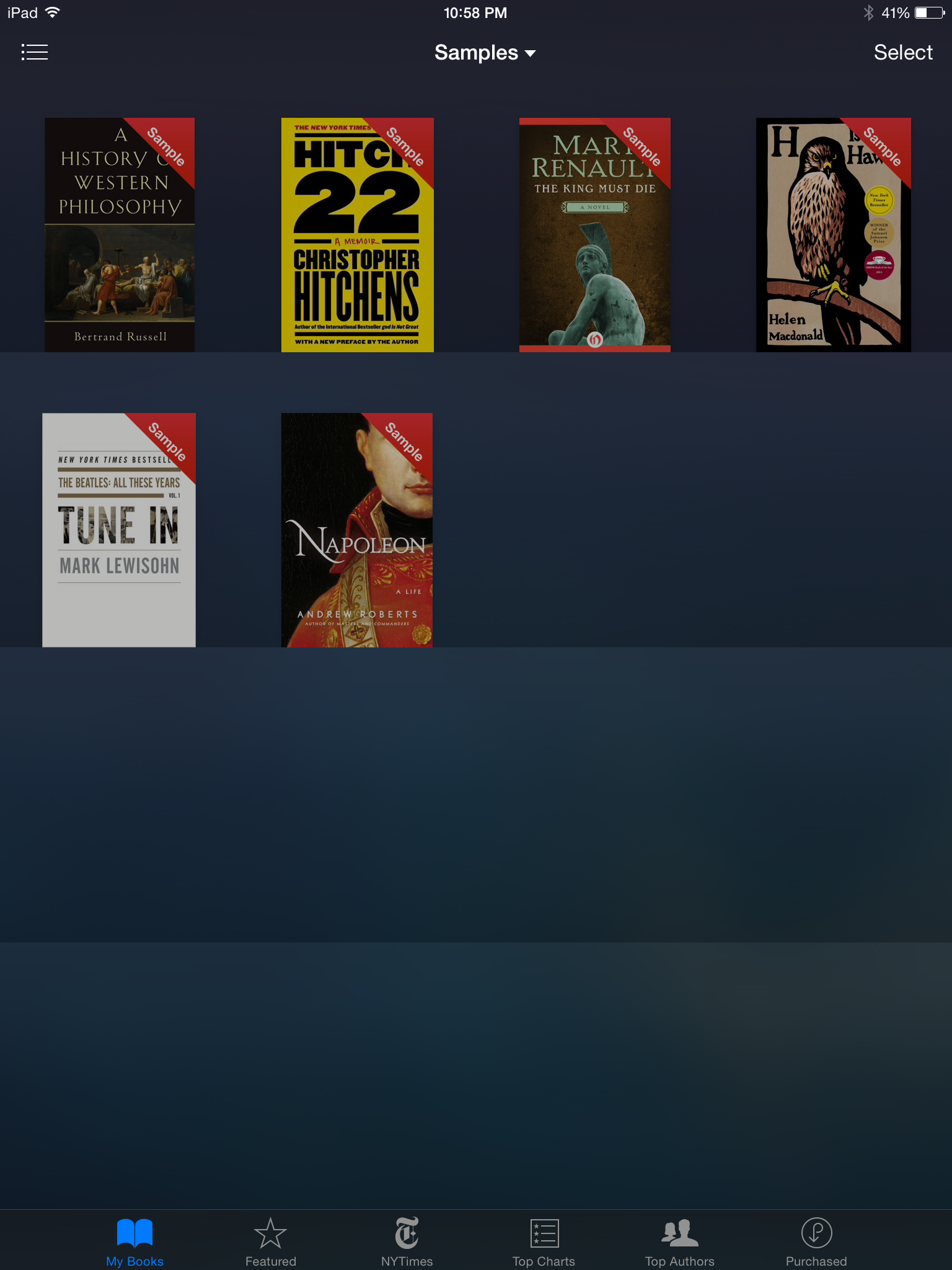
I typically have at least two books or more in play at any time. Right now it’s Sapiens, a “history of humankind”, and the sci-fi novel Seveneves by Neal Stephenson. 

But I can’t resist adding to my reading list. E-books make it easy to try samples of books before buying. 

Here’s what’s on my to-consider-next list for books:


Philosophy, a memoir, historical fiction, something about training a hawk, what appears to be THE definitive account of The Beatles, and an epic biography. 

It’s a delight to ponder what might be next in capturing my attention and inspiring new thoughts and different ways of understanding. 

Keep your reading fresh and varied. And just keep reading. 

The right things

Or as Peter Drucker put it:

“Management is doing things right. Leadership is doing the right things.”

Efficiency is meaningless, or even harmful, without effectiveness. What’s the point in going in the wrong direction faster?

Focus on the essentials first. Keep checking your direction. Then drill down to efficiency and methods. 

Why before how. 

Creativity has to start somewhere

Suck is a default starting point for almost all truly great work.

From Ed Catmull’s great book, Creativity, Inc.:

“And yet, candor could not be more crucial to our creative process. Why? Because early on, all of our movies suck. That’s a blunt assessment, I know, but I make a point of repeating it often, and I choose that phrasing because saying it in a softer way fails to convey how bad the first versions of our films really are. I’m not trying to be modest or self-effacing by saying this. Pixar films are not good at first, and our job is to make them so—to go, as I say, “from suck to not-suck.” This idea—that all the movies we now think of as brilliant were, at one time, terrible—is a hard concept for many to grasp. But think about how easy it would be for a movie about talking toys to feel derivative, sappy, or overtly merchandise-driven. Think about how off-putting a movie about rats preparing food could be, or how risky it must’ve seemed to start WALL-E with 39 dialogue-free minutes. We dare to attempt these stories, but we don’t get them right on the first pass. And this is as it should be. Creativity has to start somewhere, and we are true believers in the power of bracing, candid feedback and the iterative process—reworking, reworking, and reworking again, until a flawed story finds its throughline or a hollow character finds its soul.”

You don’t need to be a kid or have a kid to go see Pixar’s latest sensational film, Inside Out. It’s so good and has a depth that has you pondering its message long after you leave the theater.

But it started out sucking at first, too. The Pixar team kept at it, though, and ended up making remarkable art.

Start somewhere. Awful is a good place to begin. In fact, try to be as dreadful as you can, as laughably bad as you can imagine, just to take the pressure off.

Then see how you can make it just a little better.

Then keep going.

ht Parislemon

Tyranny

“I have sworn upon the altar of god, eternal hostility against every form of tyranny over the mind of man.” –Thomas Jefferson

Reverse sear

  
The reverse sear is my preferred steak grilling method. 

Ideally, salt the steaks and let them chill in the refrigerator for a day or more. I then put them in the freezer for fifteen minutes before grilling to keep the inside of the meat from cooking too quickly.  

Build a two-zone charcoal fire and put the cold steaks on the cooler side of the grill away from the coals. Open all the grill vents and leave the lid slightly ajar. 

Flip the steaks after a few minutes and check the temperature with a meat thermometer

When the internal temperature reaches about 100 degrees move the steaks to the hot side and sear them for a few minutes on each side, flipping often to get a uniform sear. 

I cook mine to 125-130 and add a dollop of grass-fed butter before serving. 

My favorite online resource for grilling is AmazingRibs.com

Open conversations

Today I shared this old Seth Godin post with my staff. It’s about open conversations where authentic dialogue is encouraged. Here’s the hook:

A guy walks into a shop that sells ties. He’s opened the conversation by walking in.

Salesman says, “can I help you?”

The conversation is now closed. The prospect can politely say, “no thanks, just looking.”

Consider the alternative: “That’s a [insert adjective here] tie you’re wearing, sir. Where did you buy it?”

Conversation is now open. Attention has been paid, a rapport can be built. They can talk about ties. And good taste.

A guest told me yesterday our students offered the best experience of any campus tour she’s been on. I could have been happy with just that, thanked her, and moved on.

But I responded, “Why?”

“Why was ours the best? What did we do that you appreciated, that made our tour stand out?”

And then we had a good conversation, and I learned something from her insight.

I’m a bit of an introvert, and I’m a little too content too often with getting easy outs for conversation.

But meaningful conversations are rare and valuable and can make a day worthwhile like few other activities can. And they offer a chance to learn and grow. And, even better, they let you truly see and acknowledge others in the most primal, human way.

My wife is great at asking conversation-opening questions of our daughters. She’s not content with hearing they’ve had a good day. She wants to know exactly what was good about it and what were the highlights and lowlights and the best stories.

Avoid simple yes/no questions and cliched greetings. Safe and boring and superficial.

Make an art of opening conversations and sparking genuine connection and understanding.

Time machine

Consider what life was like 100 years ago.

World War I was engulfing Europe. It was the first “modern” war, and it was ultimately tragically pointless and horrifying. (Go listen to the epic podcast series, Blueprint for Armageddon, in Dan Carlin’s Hardcore History.)

The U.S. population in 1915 was one-third what it is now. The world population was one-fourth what it is now.

Women in the U.S. did not have the right to vote. Racial segregation was entrenched in the south. The Civil Rights Act was almost fifty years away.

There were few rights for workers and not much of a safety net for anyone for health care or retirement.

Air travel was for daredevils. Space travel was just a sci-fi dream. More vehicles were powered by animals than by engines. Radio was the chief source of home entertainment, and silent films were the only option at theaters.

If you had a time machine and brought someone from 1915 to 2015, imagine how astounded they would be by our world—our technology and medicine; the discoveries about the universe that have shown us just how incomprehensibly massive it is and how small we are; and how far we have progressed in human rights in a century.

And how are we worse off now compared to then? There was no obesity epidemic, no addiction to electronic devices, and no chance for nuclear disaster. I’m sure there are many ways life was better a century ago, but I wouldn’t want to swap places with that generation.

Now, imagine you could go in a time machine to the year 2115. How backwards might our current generation look one hundred years from now? What have we got completely wrong? How inhumane and small-minded will we look to our great-grandchildren? What assumptions are we taking for granted now that will seem laughable in the very near future?

We can’t assume a positive trajectory of progress. There is certainly a chance that we could very well end up going backwards and falling into another “dark ages” if we survive for another century, but let’s be optimistic.

How can taking the long view open us to possibilities and ways of thinking that make an even brighter future more likely? What would be an ideal world in 2115, and what can we do in 2015 to point in that direction?

That idea of yours that seems daring right now, or a little too farfetched to take seriously, might just seem so obvious a generation from now. It’s the crazy ones who craft the future the rest of us can’t even imagine. 

Dream big. Dream far. 
See for yourself

“Place no head above your own.” –The Buddha

Don’t believe something because someone says to believe.  

Use your own head. 

See for yourself. 

Follow reason. 

Discard what doesn’t hold up to honest inquiry. 

Pursue truth, no matter the cost. 

Sunday night Stoic: How to act

Remember, Meditations was written by Marcus Aurelius as a sort of ongoing “note to self” while he was the Roman emperor, essentially the most powerful and influential person in the western world at the time.

He’s not lecturing someone else. He’s exhorting himself, calling for his own best, reminding himself of the kind of man he aspired to be. He could have gotten away with murder, much less selfish and boorish behavior.

Which makes passages like this (3.5) so remarkable:

“How to act:

Never under compulsion, out of selfishness, without forethought, with misgivings.

Don’t gussy up your thoughts.

No surplus words or unnecessary actions.

Let the spirit in you represent a man, an adult, a citizen, a Roman, a ruler. Taking up his post like a soldier and patiently awaiting his recall from life. Needing no oath or witness.

Cheerfulness. Without requiring other people’s help. Or serenity supplied by others.

To stand up straight—not straightened.”

Unsatisfactory

From Sam Harris’s book, Waking Up:

“The Buddha taught mindfulness as the appropriate response to the truth of dukkha, usually translated from the Pali, somewhat misleadingly, as ‘suffering.’ A better translation would be ‘unsatisfactoriness.’ Suffering may not be inherent in life, but unsatisfactoriness is. We crave lasting happiness in the midst of change: Our bodies age, cherished objects break, pleasures fade, relationships fail. Our attachment to the good things in life and our aversion to the bad amount to a denial of these realities, and this inevitably leads to feelings of dissatisfaction. Mindfulness is a technique for achieving equanimity amid the flux, allowing us to simply be aware of the quality of experience in each moment, whether pleasant or unpleasant. This may seem like a recipe for apathy, but it needn’t be. It is actually possible to be mindful—and, therefore, to be at peace with the present moment—even while working to change the world for the better.”