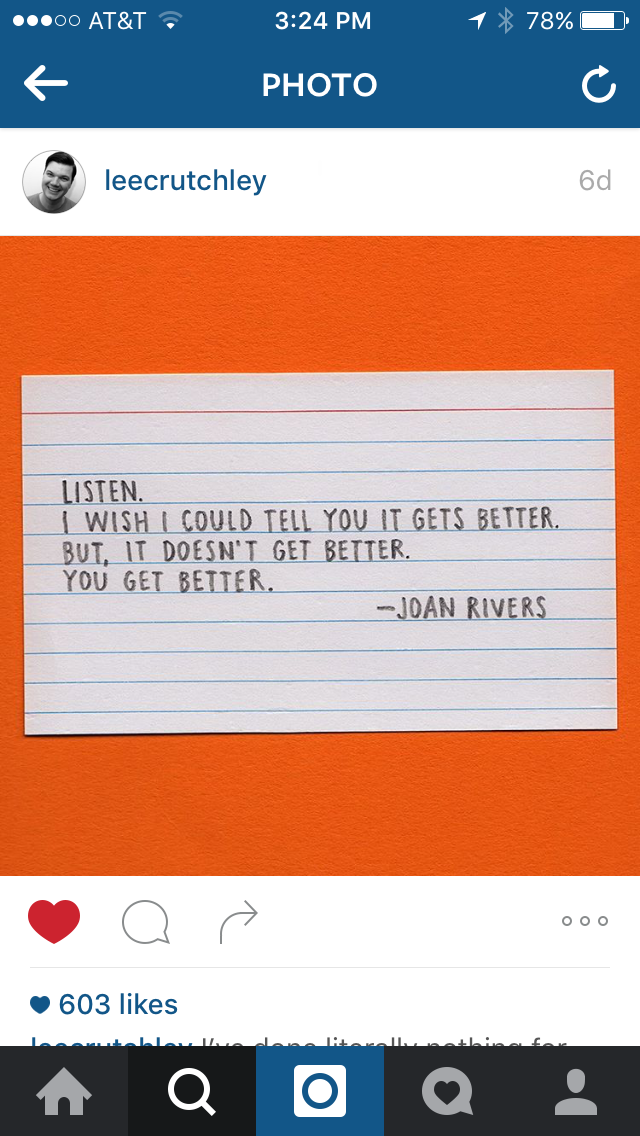
Often, it’s better. It may take hindsight to bear it out, though.
Not too much. Not too little. Enough.
Enough is just right.
The middle way regularly turns out to be a better way.
Often, it’s better. It may take hindsight to bear it out, though.
Not too much. Not too little. Enough.
Enough is just right.
The middle way regularly turns out to be a better way.
“Unless you’re working on the biggest thing you could be working on, you’re procrastinating.” –Paul Graham
Damn.
But, right on.
That quote is from a Paul Graham essay from ten years ago—Good and Bad Procrastination.
Graham makes a solid and sobering case that most people occupy their time with “small stuff” at the expense of work that really matters:
There are three variants of procrastination, depending on what you do instead of working on something: you could work on (a) nothing, (b) something less important, or (c) something more important. That last type, I’d argue, is good procrastination.
That’s the “absent-minded professor,” who forgets to shave, or eat, or even perhaps look where he’s going while he’s thinking about some interesting question. His mind is absent from the everyday world because it’s hard at work in another.
That’s the sense in which the most impressive people I know are all procrastinators. They’re type-C procrastinators: they put off working on small stuff to work on big stuff.
What’s “small stuff?” Roughly, work that has zero chance of being mentioned in your obituary. [Emphasis added] It’s hard to say at the time what will turn out to be your best work (will it be your magnum opus on Sumerian temple architecture, or the detective thriller you wrote under a pseudonym?), but there’s a whole class of tasks you can safely rule out: shaving, doing your laundry, cleaning the house, writing thank-you notes—anything that might be called an errand.
Good procrastination is avoiding errands to do real work.
Would the work you spend most of your time on be something that merits a mention in your obituary or at your memorial service?
But, “small” doesn’t always mean “small”. Just being fully present with and kind to a colleague or friend or child or stranger is actually big stuff, and if those small moments shine throughout your life, they will indeed shine in your obituary.
However, most of us do spend our days focused on very small stuff. I know it’s satisfying to “get things done” and go to bed with a completed to-do list for the day. But a collection of checked off to-do lists doesn’t lead to a meaningful legacy if those to-do’s were just a lot of small stuff.
I keep putting off big stuff that I know I want to do eventually. The big stuff is the hardest stuff, with the most at stake and the potential for the most satisfaction and meaning. Yet there’s a fear factor that ratchets up the resistance when I try to tackle the big stuff—a fear of coming up short or revealing my inadequacy or just the fear of the pain that comes with doing hard things.
I regularly feel like I need a certain mood or the right conditions or a vast expanse of unscheduled time to get started on truly important work. That’s the resistance whispering to me, though. It’s sneaky clever like that. But just starting on something big, even if it’s a tiny action, can reveal the resistance as the hollow fraud it really is.
So, put off the superficial, inconsequential work. Procrastinate if you have to on things that ultimately matter least. Figure out what the big stuff is for you and then get busy taking action on what will matter most.
I love the holiday season, really I do. But most Christmas music wears pretty thin really quickly for me.
However, the only Christmas music you need is Vince Guaraldi’s soundtrack for A Charlie Brown Christmas. You can put it on repeat for the whole month and never wear it out. It’s a truly great jazz album, not just a great holiday album.
Here it is on YouTube. Or go buy it on iTunes.
Also, Bruce Springsteen’s version of Santa Claus Is Coming To Town is as joyful and hip as any Christmas song I know. My kids know I’ll sing my heart out whenever this one comes on.
There’s been something missing from my life lately.
Fiction.
My reading has been sporadic and mostly non-fiction over the last couple of months.
My wife and I haven’t even made time for television or movies.
And I can feel that something is off.
Maybe we need regular doses of story and mental escape. Too much reality (and online news and social media especially) dulls the imagination. All work and no play is not a good recipe for a creative mind.
Regular doses of fiction stoke the imagination and spark more wonder and delight.
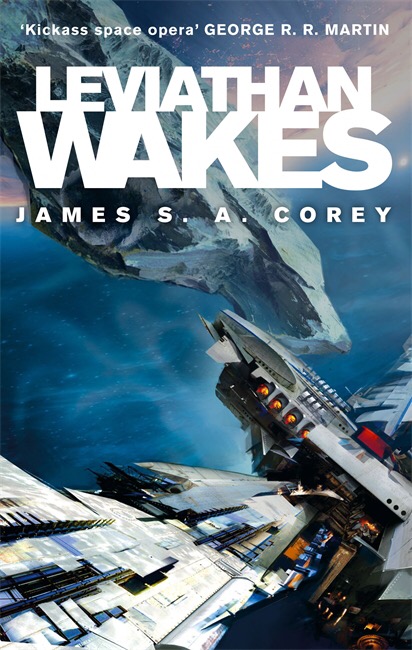
So, after seeing it mentioned again by Jason Snell, I’m giving this well-reviewed science fiction series a go.
Meditations 6.32:
“I am composed of a body and a soul. Things that happen to the body are meaningless. It cannot discriminate among them.
Nothing has meaning to my mind except its own actions. Which are within its own control. And it’s only the immediate ones that matter. Its past and future actions too are meaningless.”
This is hard stuff. This is graduate-level “sticks and stones may break my bones, but words will never hurt me.”
You control your mind and how it responds to whatever happens.
Between stimulus and response there is a gap. In that gap is your ability to choose your response. It’s not easy to mind the gap, so to speak, but we get to try again and again all day long every day.
But only the present moment matters. Only the present moment is real. Past and future are phantoms.
This moment is where life is.
Your mind is the portal and the instrument for living.
Right here. Right now.
Live now in the full power of your ability to choose—to choose your attitude, your actions, your thoughts.
You have little control over how long your body will keep your mind in the game. (Eat well. Do your pushups. Don’t sit too much. Don’t drink and drive or text and drive. Avoid doing stupid things.)
Live while you can. And live wisely, in sync with your nature.
Seize the day.

This is a good week to load up an audiobook or three for road-tripping.
I just added SPQR and Stumbling on Happiness to my Audible queue.
SPQR is Mary Beard’s new history of ancient Rome, and it’s gotten strong reviews. And I can’t seem to get enough of Roman history.
Daniel Gilbert’s Stumbling on Happiness has been on my wish list for a while.
Audiobooks can pick up the slack when I’m finding it hard to squeeze in all that I want to read.
I also downloaded a couple of favorite audiobooks to listen to again: Tim Kreider’s We Learn Nothing and Steve Martin’s Born Standing Up. Both are excellent, and both are read by the authors. You can’t go wrong with either if you want a good listen.
And I just saw that the whole Harry Potter series is now available on Audible. (It previously had been available only through J.K. Rowling’s Pottermore web site.) This audio series has been acclaimed not just for the phenomenon that Harry Potter is, but for the performance of the narrator, Jim Dale. Maybe this will give my kids a nice change of pace from playing games and watching movies on iPads in the car.
If hours-long books seem daunting, listen to podcasts instead. We are in a golden age of podcasting. There are so many amazing choices. Start with the Overcast podcast app, and use its recommendation feature if you don’t know where to start. Or ask me, and I can send you a long list of great podcasts.
Feed your mind and your imagination as you’re traveling this week. Happy travels. Happy listening.
Seneca:
“We suffer more often in imagination than in reality.”
The world is too much with us. Our own lives are enough to live. But now we’ve got the worries of the whole world to ponder every day streaming through our devices and pinging our brains with a ceaseless flow of bad news and heartbreaking stories.
I don’t think the world is particularly more woeful now or humans more horrid. In fact, compared to every other generation of our species, we probably are living in the safest, most peaceful time ever.
Steven Pinker makes just that case in his book, The Better Angels of Our Nature. Humans living today are less likely to suffer violent deaths or experience any kind of physical violence than in any century in human history.
One of my favorite podcasts is Dan Carlin’s Hardcore History. A consistent theme throughout every historical era he describes is how brutally violent people have been to each other. Atrocities we see in the news today wouldn’t seem shocking or out of place to people a millennia or two ago. They saw worse and lived with much more reason to be afraid.
People behaving badly has been the rule rather than the exception. Humans are the worst, right?
But we’re getting better. And we are more troubled than we ought to be.
I don’t watch television news. I scan the headlines each morning, and I can’t help noticing the latest trending topics in social media.
But I don’t spend much time exploring the details of current events. Why should I? Why fuel irrational fears about things that are unlikely to ever happen to me.
Our perception of reality is in most cases more fearful than is warranted. What we imagine is way worse than what we are likely to experience.
If you’re feeling like the world’s got you down, take a mental vacation. Tune out the constant blast of news that feeds your fear.
Focus your attention on what matters most to you. Use your imagination instead to make the best of whatever is in your control.
“The price of human consciousness is the knowledge of mortality.” –Adam Gopnik
The end is near. And we know it.
No tears in the writer, no tears in the reader. No surprise in the writer, no surprise in the reader. –Robert Frost
via Darren Rowse
Write what’s real for you, what moves you and what delights and confounds you.
Reveal yourself, to the point of discomfort if necessary.
Be direct and clear and true, but honor the mystery and relish surprise.
Allow the reader to explore and discover and be provoked.
I used to think my thoughts were somewhat magical, that if I thought only good things, only good things would happen.
It’s a powerful, but flawed, mindset.
There is power in intentionally choosing the bright side, of seeing the best in circumstances and in others. But willful disregard of undesired outcomes will leave you vulnerable to the whims of fate and the blunt trauma of real life.
The Boy Scout motto is “Be prepared.” This should be a wise person’s motto as well.
Be prepared for your plans to fail, for bad news to arrive, for heartbreak and for disappointment.
Before beginning a new venture, consider what could go wrong. It’s a lot more fun to imagine smooth sailing, but the calm waters you see now could be roiling tomorrow. Be prepared.
Stoics practice negative visualization regularly. They imagine the worst that could happen—the loss of all they hold dear. And they hold that thought for a moment and feel the pain of their worst fears realized. Even doing this for a few seconds will sober you and then revitalize your appreciation that those fears have not actually happened. Yet.
When my grandmother was gravely ill and years later when my mother was as well, I refused both times to acknowledge they might not make it through their illnesses. I wanted to think and speak only as though they would recover, especially in their presence.
I was not prepared when they died. My illusion of perpetual happy endings was shattered.
And I regret, now, that I didn’t get over my avoidance of discouraging thoughts and words enough to have a final, meaningful conversation with each of them, letting them know how much I loved and appreciated them and thanking them for giving me such a good life.
Fortunately, I had close relationships with both, and I know they knew I loved them. It would have been so nice, though, to have had a moment of closure before they were gone.
Love your family and friends while you can, and let them know how much they mean to you.
Imagine, regularly, what it would be like to not have your health and your wealth and your relationships. Doing so will make you more grateful and will lead you to a more authentic and meaningful life and will move you to act rather than passively and naively defer and delay.
Steel yourself for the worst that could happen. Prepare for things to not go as planned. And prepare to use whatever comes as fuel to propel you further and higher.
“And let silence be the general rule, or let only what is necessary be said, and in few words.”
Austin Kleon on what he does if he’s feeling blocked creatively:
“When I stall out, it’s time to start taking things in again: read more, re-read, watch movies, listen to music, go to art museums, travel, take people to lunch, etc. Just being open and alert and on the lookout for That Thing that will get me going again. Getting out the jumper cables and hunting down a battery.”
When I’m in a creative lull, I usually find I’m in a reading lull as well.
I need to consume good stuff in order to make good stuff.
I took a seminar style freshman English course in college. There were just twelve students, and we sat around a conference table with Professor Patterson, a distinguished teacher who was in his final year before retirement.
We had an eight page paper due every week. I don’t think I had a paper that long due over any single semester in high school.
The first assignment was to analyze a sonnet. Sonnets are fourteen line poems. How was I going to write eight pages about about such a short poem?
Dr. Patterson noticed the collective chagrin and low level panic around the table as he explained the assignment.
I remember his advice well, almost 33 years later. He smiled and encouraged us to make this a pleasant experience. He suggested that as we tackled this project over the weekend we should find a comfortable chair and a tasty beverage and savor the work.
Somehow, his unexpected suggestion encouraged me and dulled the dread. I ended up doing just fine on that paper and throughout that class.
A comfortable chair and a tasty beverage. That image arises regularly when I’m confronted by an overwhelming or seemingly dreary task.
It’s a matter of mindset. Instead of resisting and dreading, I was able to see the work as an experience to be enjoyed.
It’s worth giving this a try when you face something difficult or unappealingly tedious. Find a way to flip your mindset and make it a pleasure.
Go to a happy place. Listen to lovely music. Find a comfortable chair and a tasty beverage. Act as if the unwanted task is something you chose and eagerly anticipate, and then delight in completing it.
True.
The best way to know something is to try to express it.
I’ve heard people say they don’t want to pursue a relationship until they figure themselves out first. There’s nothing like being in a relationship, though, to reveal yourself to yourself.
And don’t wait till you feel inspired to start creating. It’s the starting and the doing that summons the inspiration.
Have a bias for action, for doing and making, even when—especially when—you don’t think you know enough or feel it enough to get started.
“The best way to increase the odds that your team will see things you don’t is to assemble incredibly different incredible people.” –Scott Belsky
This is a great post by Scott Belsky.
The team members that have pushed me further and helped transform our work are usually the ones that ask the most questions and express their discontent most effusively.
Groupthink is comfortable, but it’s deadly to innovation and meaningful improvement.
Gather contrarians and outliers and annoyingly curious people into your team.
Embrace the hard questions and the counterpoints to make sure you don’t coast into complacency.
“There is indeed a limit fixed for us, just where the remorseless law of Fate has fixed it; but none of us knows how near he is to this limit. Therefore let us so order our minds as if we had come to the very end. Let us postpone nothing. Let us balance life’s account every day.” –Seneca
We all know sad stories of people whose lives ended suddenly, of children taken by illness or accident, of good men and women gone too soon, their lives artlessly unfinished.
Real life is not a novel or a movie. There is no guarantee of a tidy ending with satisfying closure and a happy exit from the stage.
Reality is indifferent to your story, to your sense of justice, to the poetry you are crafting as the artist of your life.
This indifference, if I pause to comprehend it, is the most terrifying thing I know.
There are no guarantees, and my hopes for my own story ultimately have little power over circumstances beyond my control, over the capriciousness of fate.
But I do have power over how I respond to what reality brings my way today.
Tomorrow is not promised. But I can make the best of today. I can stop deferring dreams and postponing plans.
Make this day remarkable, a day worth talking about.
Live while you can. Craft your life one day at a time.
Paul Graham has simple advice on improving your writing: write like you talk.
If you simply manage to write in spoken language, you’ll be ahead of 95% of writers. And it’s so easy to do: just don’t let a sentence through unless it’s the way you’d say it to a friend.
Don’t overthink it or use words you don’t normally use in conversation. Keep it simple. Be direct. Write like you talk.
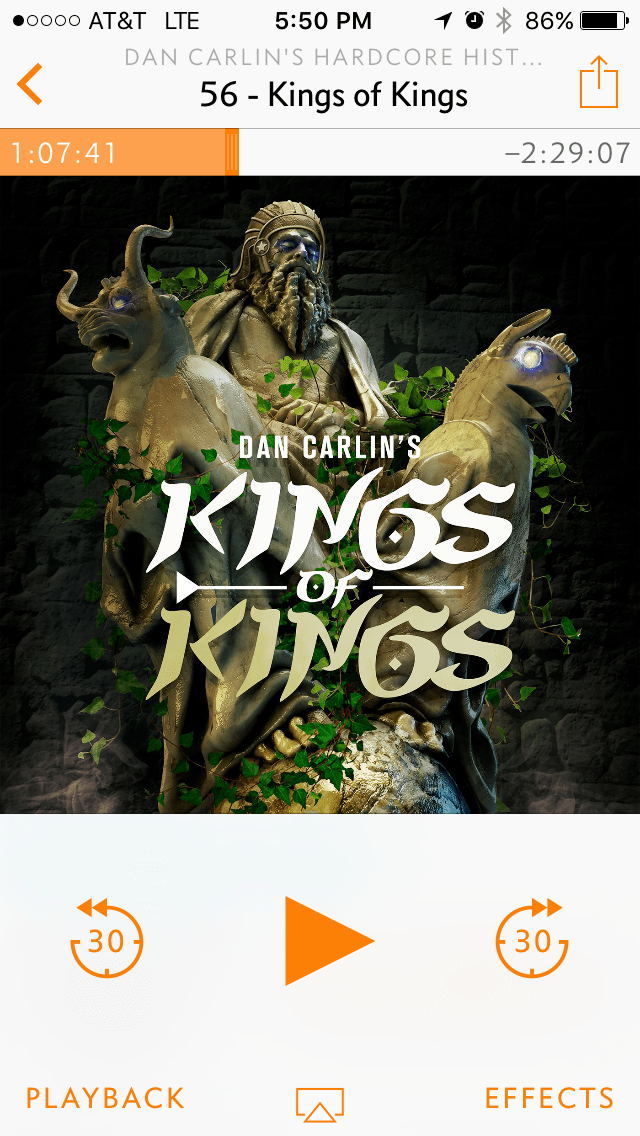
Today I opened the Overcast app (my favorite podcast player) and scrolled through my recently downloaded episodes and was delighted to discover the first episode in a new Hardcore History series, King of Kings, about the ancient Persian empire.
Dan Carlin’s Hardcore History is my favorite podcast. In each series he explores one topic in history over several multi-hour episodes.
Carlin is a compelling, thorough, and passionate story teller, and it’s clear he puts in a lot of work to make these podcasts flow so smoothly and cover so much detail while maintaining an engaging, conversational style.
The downside is waiting for the next episodes to be made.
You don’t have to be obsessed with history to enjoy his work. If you love good stories well told (and you do), you will enjoy this podcast and accidentally learn a lot as you listen.
“There is good in everything, if only we look for it.” –Laura Ingalls Wilder
There is good in everything?
You certainly have the choice to find the good in even the worst circumstances.
Don’t resist what is. Love, somehow, even the heartbreak and tragedy that comes your way. Use everything—every setback, every obstacle—to learn and grow and to continually improve.