More great public speaking advice from Nick Morgan

Nick Morgan keeps giving away solid advice about public speaking. If you speak in public ever, you really should be following his blog. (And his book, Give Your Speech, Change The World, has been required reading for my team.)

Today he posted an excellent list of twelve public speaking rules.

Rules three and four on his list particularly resonate with me:

3. By the end of the hour, you should be talking love. You get attention by identifying a problem and playing it up. Look at the current American presidential candidates; you’d be pardoned for thinking that Armageddon was around the corner if you took them seriously. But by the end of the talk, you should be covering what it is that you love and what’s working in your world. Long-term careers are based on positive trajectories, not negative ones.

4. You put your ideas out there; you can’t control what the audience does with them. It’s your job to present your case with passion. The audience has its own issues, and you have no control over the extent to which they take up your ideas or not. Success is making your case, not in getting the most votes – or even a standing ovation.

Indeed, “you should be talking love” as you make your call to action. What’s the point of standing in front of an audience if not to give them something you care about that can send them away transformed for the better?

It’s called “giving” a speech, right? Have a gift to offer. Talk about something you truly care about, that you love, and leave your audience with that gift, whether it’s awakening them to new possibilities or calling them to action in a worthwhile pursuit.

And Morgan’s fourth rule can be magical for not just your speaking events, but for all that you do.

Don’t be attached to the outcome. Focus on what you can control—your effort, your energy, your emotion, your authentic in-the-moment presence. The intrinsic rewards should take precedence over the extrinsic ones.

Give your speech with as much craftsmanship and energy as you can. Offer your gift. Then let it go.

Every audience is unique. Some may not give you the feedback you hope for or the smiling, engaged expressions that let you know they’re with you.

I’ve had audiences that seemed to just stare blankly at me only to find out later that several found the experience to be transformational.

Regardless, do your best. Give the audience all you have. If you don’t feel a bit drained when you finish, you probably didn’t summon enough energy or uncork enough emotion.

When in doubt, especially when facing an audience that’s not showing you the love, ramp up the awesome rather than scaling it back in self-defense.

Put out more energy, connect more intently, and be bigger on stage than seems reasonable to you.

Spread your love. Give your gift. And be content with that.


Take more time to do better work

The author of Deep Work, Cal Newport, has upped his activity on his blog in the wake of his new book.

Today he shared this quote from a book published by an academic in 1912:

“To save time, take time in large pieces. Do not cut time up into bits…The mind is like a locomotive. It requires time for getting under headway. Under headway it makes its own steam. Progress gives force as force makes progress. Do not slow down as long as you run well and without undue waste. Take advantage of momentum. Prolonged thinking leads to profound thinking.”

I’ve found this to be true for me. I would have a lot more profound thoughts if I more regularly carved out big swaths of time for focused work sessions.

Getting started on doing serious work, work that really matters, can be completely uncomfortable. And then sticking with a hard thing for the first 20-30 minutes takes patience and diligence.

But once the distracted part of your brain gives up and allows your mind to get into a focused flow, the work actually becomes a delight.

The key is having the will to trudge through the initial resistance and overcome the pain and friction required to get into a groove.

Be strong. Be patient.

Your best work is just past that godawful hill you’ve got to climb to get started.

Screen Shot 2015-04-10 at 4.57.14 PM

My two favorite books of 2015

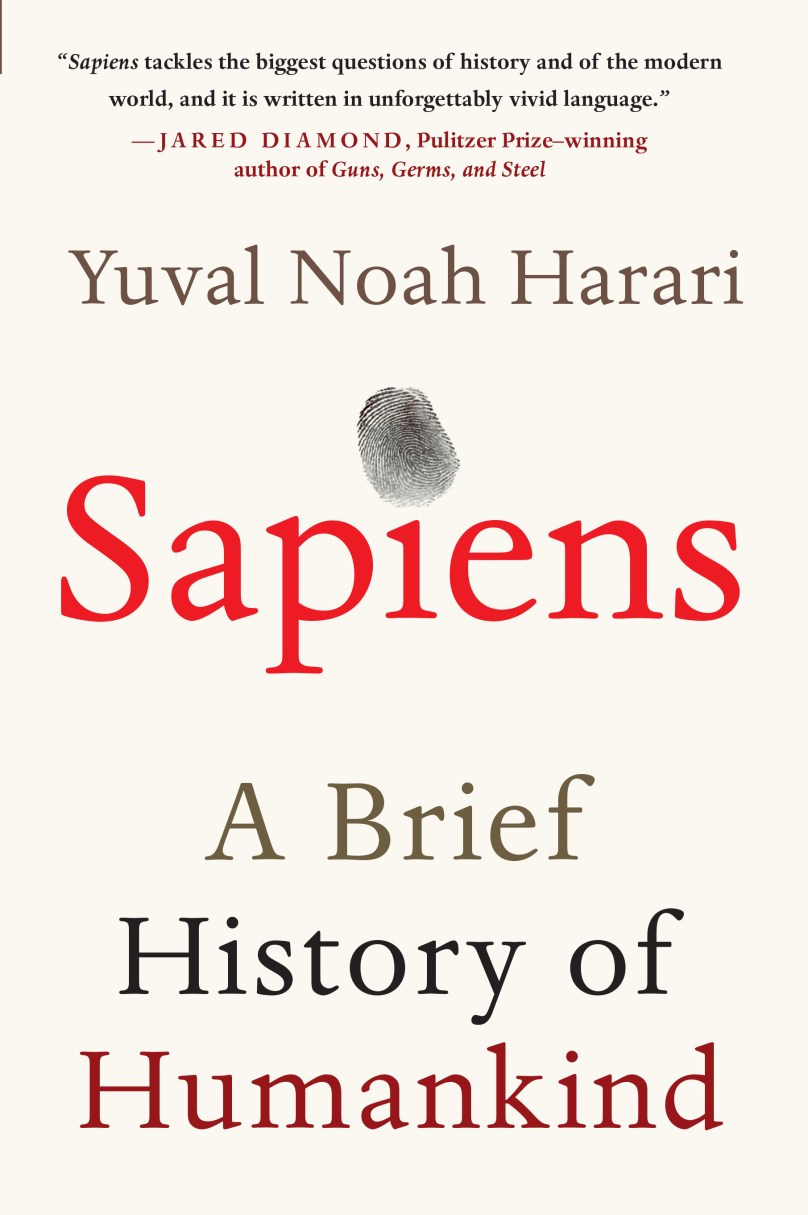
The best book I read last year was Sapiens: A Brief History of Humankind by Yuval Noah Harari. It’s an effectively audacious survey of all of human history. It’s grand scale doesn’t overwhelm and is remarkably concise.

Harari fills the narrative with fascinating facts and profound insights (and some whimsy) as he details where we came from and hints at where we might go from here. This is one I’m tempted to read all over again to better process the many insights into what it means to be a human.

Sapiens_hc_c

The best novel I read last year was Seveneves by Neal Stephenson. It begins with the destruction of the moon by some unknown cause. Scientists soon discover that means the Earth is doomed, and there are two years to come up with a plan to save the human species by sending a select few into space.

The engineering details Stephenson describes can be mind-boggling and tedious. But the technical insight adds credibility to the grand and emotionally stunning, and ultimately satisfying, narrative.

I felt a persistent twinge of sadness as doomsday approached for Earth as we know it. Part two wasn’t as moving as the epic first part, but it offered a clever and hopeful conclusion.

81iR9C6vQbL


Sunday morning Stoic: Assemble your life yourself

Meditations 8.32:

“You have to assemble your life yourself—action by action. And be satisfied if each one achieves its goal, as far as it can. No one can keep that from happening.

—But there are external obstacles.…

Not to behaving with justice, self-control, and good sense.

—Well, but perhaps to some more concrete action.

But if you accept the obstacle and work with what you’re given, an alternative will present itself—another piece of what you’re trying to assemble. Action by action.”

It’s on me to put my own life together, to craft myself into the person I aim to be, to create opportunities worthy of my time here.

Don’t wait on others or on the right conditions or on a feeling you hope will propel you forward.

Just take action, whether you feel like it or not. And then keep acting.

Of course, it won’t go as planned. But act like the obstacles and setbacks you encounter are actually a part of your plan.

Don’t resist what is. Use everything, even unwanted obstacles, as building blocks in the creation of the life you are assembling for yourself.

Flow states and peak moments

IMG_0039Cal Newport’s new book, Deep Work, is doing some deep work on me. His challenge to focus more intently and work with more depth is hitting a nerve.

We are living in a shallow, distraction-filled age, and those who can defy the pull of the shallow and the frivolously urgent will be able to stand out and create more meaningful work.

And those who go deep will fill their lives with more happiness.

Newport quotes famed psychologist Mihaly Csikszentmihalyi who did groundbreaking research on what he called “flow states”:

“The best moments usually occur when a person’s body or mind is stretched to its limits in a voluntary effort to accomplish something difficult and worthwhile.”

The resistance to getting into such a mind or body stretching activity is strong. But the payoff to overcoming that resistance could be the peak moments of your day, your week, your life.


John Gardner: Life is an endless unfolding

From the writings of John Gardner (ht John Maeda), who served in LBJ’s administration as secretary of Health, Education, and Welfare: 

One of the enemies of sound, lifelong motivation is a rather childish conception we have of the kind of concrete, describable goal toward which all of our efforts drive us. We want to believe that there is a point at which we can feel that we have arrived. We want a scoring system that tells us when we’ve piled up enough points to count ourselves successful. 

So you scramble and sweat and climb to reach what you thought was the goal. When you get to the top you stand up and look around and chances are you feel a little empty. Maybe more than a little empty. 

You wonder whether you climbed the wrong mountain. 

But life isn’t a mountain that has a summit, Nor is it — as some suppose — a riddle that has an answer. Nor a game that has a final score. 

Life is an endless unfolding, and if we wish it to be, an endless process of self-discovery, an endless and unpredictable dialogue between our own potentialities and the life situations in which we find ourselves. By potentialities I mean not just intellectual gifts but the full range of one’s capacities for learning, sensing, wondering, understanding, loving and aspiring. 

This has the flavor of Alan Watts’s comparison of life to music.

“Life is an endless unfolding.” Lovely.

It’s common to see life as a mission to get somewhere, a journey with a shining final destination somewhere out there just beyond the horizon.

But, you’ll never get there, because there is no there there.

The journey, of course, is the destination. You will never arrive.

Or, actually, you’re constantly arriving.


Paul Graham on the shortness of life

Paul Graham has a thoughtful post about savoring life and making the most of whatever time remains for you.  

“Cultivate a habit of impatience about the things you most want to do.” –Paul Graham

His message is a great reminder to ruthlessly prune the meaningless clutter from your life and get busy doing what you will look back on as truly meaningful. 

MLK and the long arc of the moral universe

 This is a fitting day to reflect on a couple of profound thoughts from Dr. King.

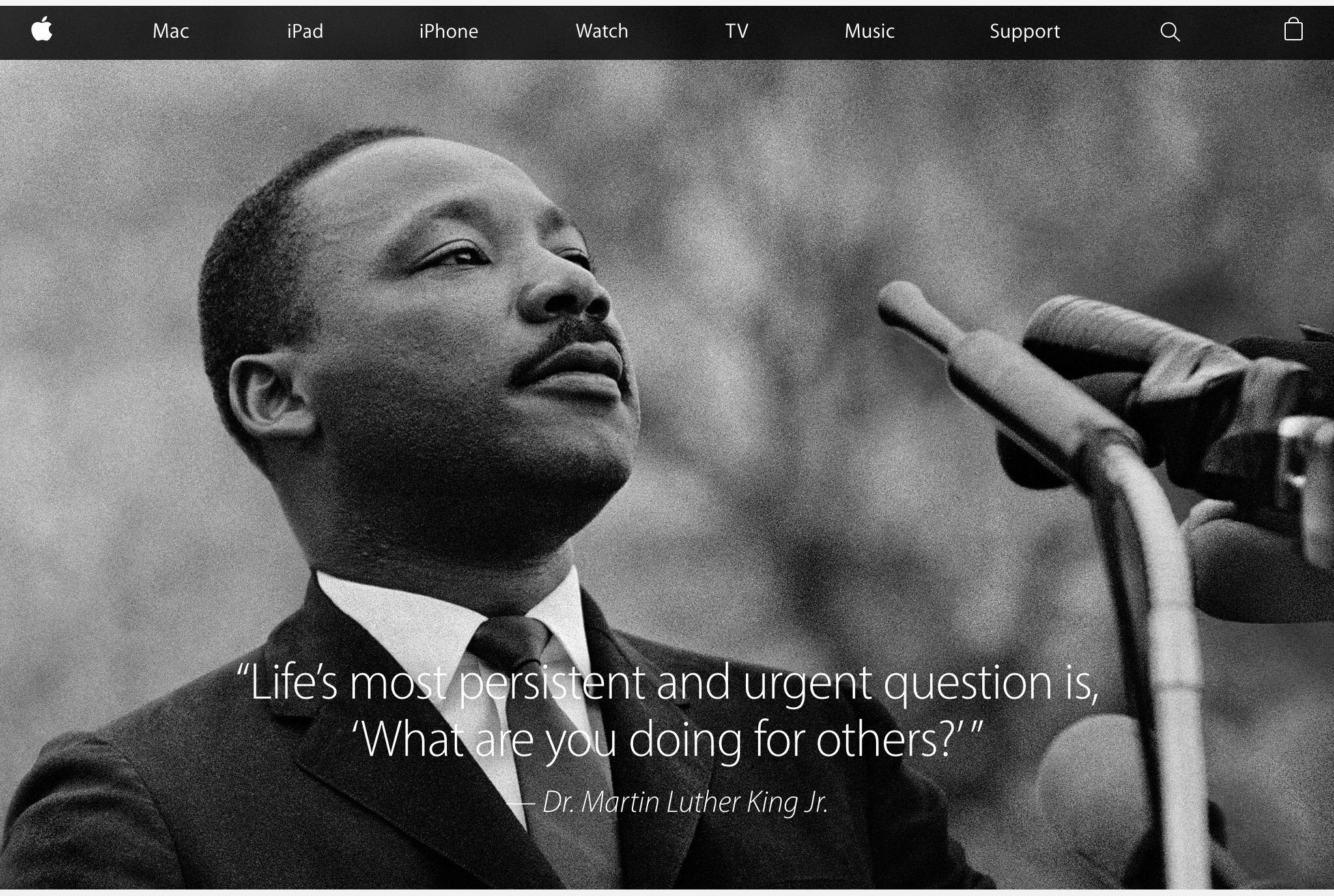
The first is on Apple’s home page today: 

And this one offers credible hope when the future appears dismal: 

“The arc of the moral universe is long, but it bends toward justice.” -Dr. Martin Luther King, Jr.

No matter how bleak or infuriating human progress may look in the moment, we have come a long way. 

And in the long run, we will go even further. 

We will get there faster, though, if more people more regularly pondered the question in the first quote above. 

What can you give?

gift

It’s typical to start a new year with grand plans for your life, with goals and dreams and visions of a better you just around the corner of the next month or four or ten.

Well, yes, aim to get better and to fill your life with more meaningful pursuits.

But such goal planning can get a bit self-indulgent.

“What do I want?”

“What can I get?”

“How can I be happier, better-looking, richer…?”

What if instead you asked, “What can I give this year?”

“How can I contribute and make a difference?”

“What do I have to offer the world that only I can offer?”

“What is a significant problem I can begin to help solve?”

These questions spark in me a more engaging level of curiosity and enthusiasm than the self-focused questions.

Imagine winning the ultra-mega-awesome lottery jackpot. It’s fun to dream of what you would buy and to envision how the financial freedom would change your life. (For me, I’ll take a couple of Teslas and one of everything from the Apple Store and a long trip to Hawaii.)

But it’s even more fun to imagine what good you could do for others and for your community and for the world with a sudden fortune at your disposal.

It’s in giving and serving and offering something useful to others that we truly get satisfaction and joy.

Where can your voice, your creativity make a difference? How can you be distinctly useful? How can you help awaken possibility in others this year?

By focusing on what you can give, you’re also more likely to end up getting something more meaningful in return.

Imagine looking back on the year 2016 and delighting in what you contributed rather than in what you acquired.

So, if you’re feeling stuck or lost or you’ve abandoned your resolutions already, consider crafting your days around what you can give. 

*I couldn’t find the source to credit for the lovely photo above. Thank you, anonymous photographer. 

Sunday night Stoic: Forward progress

Meditations 8.7:

“Nature of any kind thrives on forward progress. And progress for a rational mind means not accepting falsehood or uncertainty in its perceptions, making unselfish actions its only aim, seeking and shunning only the things it has control over, embracing what nature demands of it—the nature in which it participates, as the leaf’s nature does in the tree’s.”

Even just bringing order to my workspace or cleaning my house feels like moving forward, like I’m making room for new possibilities.

Instead of asking “What do I need?” or “What can I get?”, what if I asked “What do I have to offer?” or “What can I contribute to lift others?”

Here’s to a week of forward progress, of making and doing and listening and of looking for opportunities to give and to contribute something worthwhile.

Boston keynote slides

  
Here are the slides from the keynote I’m giving tonight to a group of more than 200 college students at a conference in Boston.

Of course, my slides are not the presentation, they’re just there to support the interaction between the speaker and the audience and to add the power of visuals to help the ideas stick.

Showing my work: Boston

I’m giving the keynote speech at a conference for college students Friday night in Boston. 

It’s easy to think of the effort of giving a speech as the 30-60 minutes it takes to stand and deliver the talk. But, for me at least, I spend many hours mulling ideas, putting the structure together, designing slides, and rehearsing.

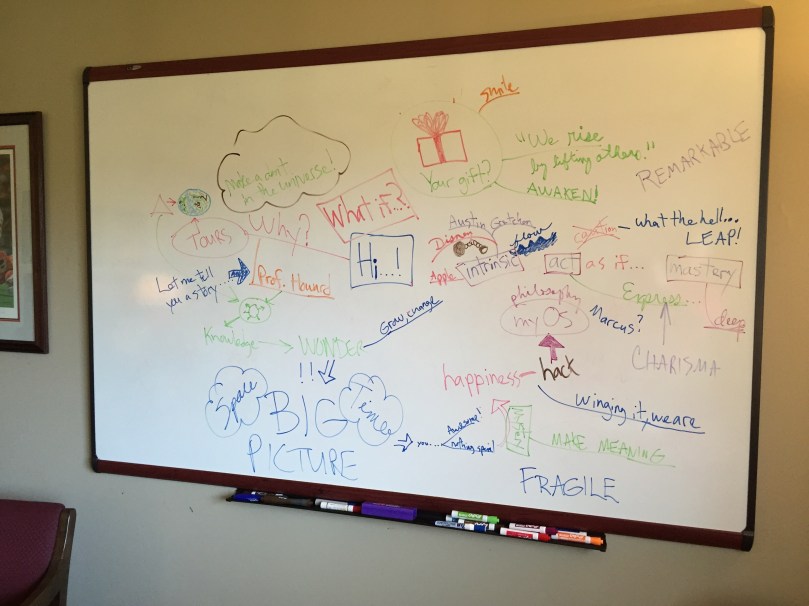
Here’s my office whiteboard from earlier this week when I was trying to make sense of all the ideas I was considering for this keynote: 

IMG_8007

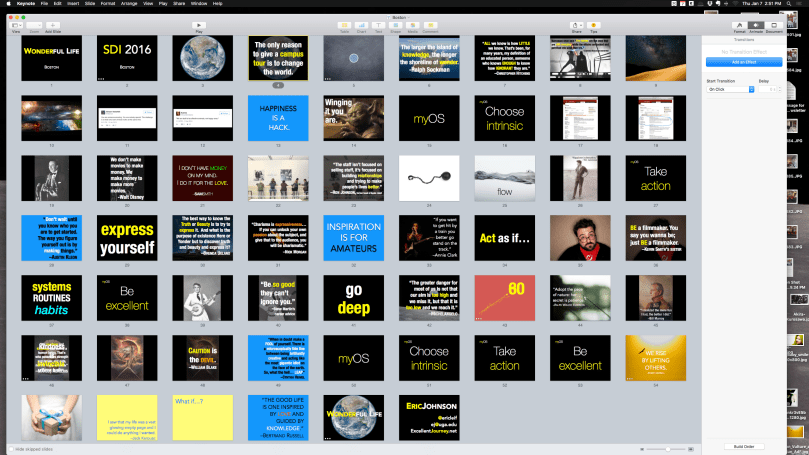
And here’s a screenshot from today of the slide sorter view in the Keynote app as I neared completion of my slide design:

Screen Shot 2016-01-07 at 2.51.33 PM

I’m not satisfied yet. I’ve rehearsed it out loud twice, and I like where it’s heading. But it hasn’t completely clicked yet. 

I’m afraid I’m trying to include too much, and I’m inclined to cut as much as a third of it when I review it again on the flight up tomorrow. 

This is a lot of effort for 45 minutes in front of an audience, and there are no guarantees my presentation will be well received. 

I do get absorbed in the best way, though, when I plunge into preparing for a new talk.

Much like signing up to run in a race weeks from now focuses your commitment to your fitness, committing to give a speech focuses your mind on ideas. My brain has been in a more aware and alert mode, scanning for relevant information and making connections and discoveries I otherwise would have passed by. 

Regardless of how the actual speech is received by the audience, the time spent in preparation has been a worthwhile commitment of my time and my creative energy. 

Cal Newport on the power of “deep work”

I read this Cal Newport post today and was inspired to lock in for a session of what he calls “deep work”.

He suggests that when most of us think we are truly focused at work, we actually are far from it. We tend to work in tiny bursts that are regularly interrupted by distractions—checking email or browsing online or talking with colleagues. 

In fact, the distractions probably occupy more of our time than actual work. 

So, taking up his challenge, I closed my office door this morning and quit the apps on my Mac that are most likely to distract—Mail, Tweetbot, Reeder, Slack, and Chrome. 

I then spent close to an hour at my whiteboard thinking through and mapping out ideas for the keynote I’m scheduled to give on Friday. After a brief walk outside to stretch my legs and get fresh air, I shut myself back in my office for another hour, this time at my desk using the Keynote app to synthesize those ideas and design and tweak the slides. 

Two hours of focused, distraction-free, “deep” work made a huge difference in my day and in an important project.

Resistance to getting started and to staying engaged with this level of focus is strong. At the first sign of boredom or discomfort it’s easy to bail and go get a hit of pleasure from some less important activity. You rationalize by saying you need a break or you’re just staying on top of other tasks. And you don’t want to seem inaccessible to others or unresponsive to requests that might be coming to you.

But there’s a momentum that comes from staying with a task in depth and pushing through the temptation to let your mind wander elsewhere. Some ideas are shy and only show up when they trust you will have the patience to allow them to appear. The flow state may only come after a prolonged period of seemingly fruitless drudgery. 

If you’re looking to rejuvenate your work life as the year begins, consider regularly blocking off two to three distraction-free hours at a time to focus and plunge into deep work on things that matter most.

Coincidentally, after those two hours of deep work ended this afternoon, I saw that Newport’s new book on this topic, Deep Work: Rules for Focused Success in a Distracted World, was released today. Purchased. 


Make something you like

Today was my first day back at work after a week off for the holidays. 

I had a long meeting in the middle of the day and, of course, spent some time catching up with colleagues.

I wasn’t very productive. 

But I did make this one slide for a keynote I’m giving on Friday night. 

Just one slide. 

But I like it, and it adds some visual punch to a key point I hope to make in my talk. 

If you can make just one thing you like, that’s not a lost day. 

I’m calling this day a modest success. 

Tomorrow, maybe I can make two things I like. 

Sunday night Stoic: Step one and step two

Meditations 8.5:

“The first step: Don’t be anxious. Nature controls it all. And before long you’ll be no one, nowhere—like Hadrian, like Augustus.

The second step: Concentrate on what you have to do. Fix your eyes on it. Remind yourself that your task is to be a good human being; remind yourself what nature demands of people. Then do it, without hesitation, and speak the truth as you see it. But with kindness. With humility. Without hypocrisy.”

Easy. Just two steps to become an awesome human. 

Two simple, overwhelmingly challenging steps

This is a good week to step anew into the life you want to live.

Bill Walsh’s leadership and life lessons

  
Ryan Holiday had this book on his recommended reading list, and I was intrigued enough to put it on my holiday wish list.

Bill Walsh was the cerebral, stoic coach who created the San Francisco 49ers football dynasty. He wasn’t known for sideline bluster or emotional outbursts. He was John Wooden-esque in his sage-like approach to leading his team as well as in his remarkable success. 

He set an expectation of excellence within the whole organization, from the receptionists to the star quarterback. And he didn’t put his focus or his team’s on anything out of their control. Do your absolute best in this moment, repeat that approach continually, and “the score will take care of itself.”

This approach just makes sense. Focus on systems, not goals. Refine the process that brings out your best, and let the results take care of themselves. Don’t get attached to outcomes. 

I’ve just started reading and can already tell that there is a lot of wisdom here. Walsh, whose public persona was one of the complete calm and control, begins the book with a story about his second season coaching the 49ers and his emotional collapse after losing yet another game in a disappointing season. He cried uncrontollably on a cross-country flight with his team after losing a heart-breaking game in Miami, with his assistant coaches shielding him at the front of the plane to keep the players from seeing him in such a state. His response to that emotional breakdown led the way to his first Super Bowl title the very next season. 

I didn’t expect Bill Walsh to open the book with such vulnerability, and that let me know this was not just another superficial leadership pep talk from an ex-coach. 

I’m looking forward to gleaning some wisdom from this book that I can take back to my team and be a better resource and leader for those I serve.