What not to do

Screen Shot 2015-01-02 at 3.37.08 PM

What can I eliminate from my life to enlarge my life? I’m more aware of the clutter around me at the end of all the holiday excess than at any other time of year, and I need to use this season to propel me to hone in on the essentials.

I’ve already stopped some monthly services that were automatically billing my credit card but that just were not so useful any longer. I am going to take stock of the physical things that take up space around me but offer little value in return. If I don’t need it or love it, let it go.

What about my routines, most of which are unexamined? What is sapping energy from me or diverting me from more important priorities?

What about my work? What do I do that doesn’t add value? What can I cut that will free up resources for what’s truly essential?

What can I say “No” to that will make space for a more meaningful “Yes”?

Little by little obligations and habits and things accrue and impede or completely divert us from what we really want to do or be. Like how a controlled burn in a forest clears out the brush and makes room for new life, a regular, conscious purge of the inessential in my life can spark new possibilities or simply a return to first things.


Laura Hillenbrand on using obstacles as fuel

I enjoyed this feature in the New York Times by Wil S. Hylton on author Laura Hillenbrand, who has written two great books, Seabiscuit and Unbroken. Hillenbrand suffers from chronic fatigue syndrome and is mostly homebound with intense episodes of vertigo. She cannot travel to do research or interview her subjects, but she’s turned what seem like obstacles into advantages.

This portion of the article is about Hillenbrand’s research for her book about World War II hero, Louie Zamperini:

“I thought it was actually an advantage to be unable to go to Louie,” she said. Because neither of them had to dress for the interviews and they were in their own homes, their long phone calls enjoyed a warmth and comfort that might otherwise be missing. She could pose the deeply personal questions that even her father had trouble answering. “I would ask a lot of questions about his emotional state,” she said. “ ’What did you feel right in this moment? Were you frightened?’ ” The distance also allowed Hillenbrand to visualize Zamperini in the time period of the book. “He became a 17-year-old runner for me, or a 26-year-old bombardier,” she said. “I wasn’t looking at an old man.”

She goes through periods where her vertigo makes it impossible to read, so she turned to audiobooks and found an advantage:

“It has taught me a lot more about the importance of the rhythm of language,” she said. “Good writing has a musical quality to it, a mathematical quality, a balance and a rhythm. You can feel that much better when it’s read aloud.”

She could easily have given up on trying audacious writing projects. She had a pretty solid excuse. But, instead, she used what should have been disadvantages to produce remarkable work.

And, then, there’s this from near the end of the piece:

“I feel so fully alive when I’m really into a story,” she said. “I feel like all my faculties are engaged, and this is where I’m meant to be. It’s probably what a racehorse feels like when it runs. This is what it’s meant to do, what its body is meant to do.” She paused. “This is what my mind is meant to do.”

To find work, or even a hobby, that produces this kind of flow should be everyone’s aim. When are you most “fully alive”, and what are the circumstances that make you feel like all your faculties are “engaged”? What is your mind meant to do?

Perfectionism is dangerous

David Foster Wallace:

“You know the whole thing about perfectionism – perfectionism is very dangerous, because of course if your fidelity to perfectionism is too high, you never do anything. Because doing anything results in … It’s actually kind of tragic because it means you sacrifice how gorgeous and perfect it is in your head for what it really is.”

The perfect is the enemy of the good. Aiming for perfection is worthwhile, but you can’t be paralyzed by the reality that you will likely never reach the ideal you envision.

Just starting is an accomplishment. Don’t wait for inspiration. Inspiration is for amateurs. Most people never beat the resistance that keeps good ideas as ideas only.

But you’ve got to finish, too. It’s hard to draw the line. When is something good enough? At some point, as reasonably close to your ideal as you can get, you’ve just got to ship. Get your art out the door.

The world is in need of more beauty and insight and kindness. Have the courage to take action in spite of the pain falling short of your ideal will cause you.

Three weeks left in 2014: Incremental change you can believe in

december-31stThere are only three weeks left in 2014. (By the way, I say “twenty-fourteen”. You? It’s saving just a single syllable, I know, but it feels less unwieldy than saying “two-thousand-fourteen”. And no one ever said “Let’s party like it’s one-thousand-nine-hundred-ninety-nine”.)

I’ve been counting down to the end of the year in an attempt to finish strong, to end the year with momentum rather than in a carb-fueled haze of regret. I’ve been grooving some new habits into my daily routine and building my days around them. I wake up and check my Habit List app first thing and know I’ve got to check off those habits I’ve chosen for the day. And it’s been a success so far. I’ve transformed my mornings by rising early and meditating daily. (This habit is the one that has the potential for the greatest impact over the long term. I’m starting to get what a game-changer meditation can be.) I’m walking at least a mile every day. I’ve stuck to my push-ups routine. And here I am posting every day.

Granted, this is over a fairly short period of time. But as the new year approaches, I’m now excited about the possibility of building habits and routines to stick with over an entire year and seeing where that gets me. I can see the power of just plugging away at a habit or a simple routine without worrying about some distant, possibly arbitrary, goal. And then I imagine looking up months from now and being surprised at the transformation.

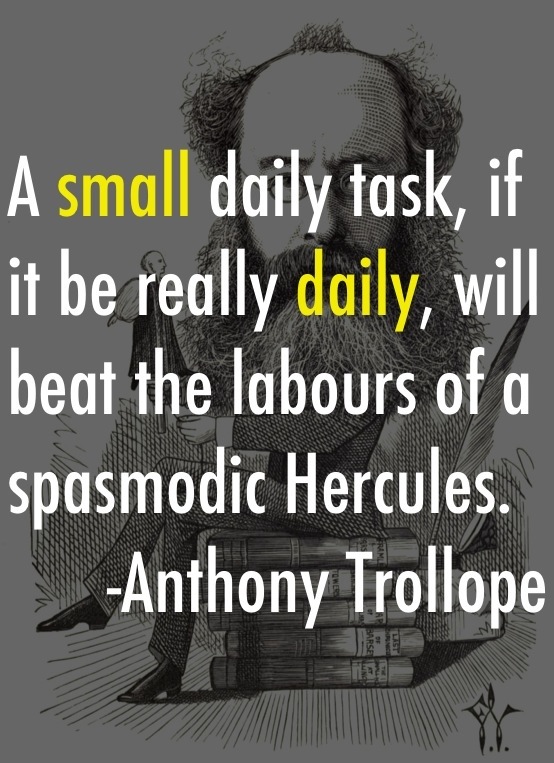
Doing a small thing consistently over a long period of time can lead to a big change in a way that trying to cram big things into a short time never will.

20140421-204913.jpg


Empty desk, clear mind

FullSizeRender

I used to be a messy-desk guy, and proud of it. I wanted to be like Indiana Jones and project cool amidst chaos, as if “I’m making this up as I go” like any other superhero. As my work responsibilities grew and family life began to take priority, though, I found I was juggling too much in my head too often, and looking at piles wasn’t helping. I got things done, but probably not as well as I could have and at some cost to my peace of mind.

So, I converted. I went over to the clean-desk side. David Allen’s Getting Things Done (GTD) became my bible for organizing my life. I completely changed my approach to work and personal tasks. Lessons from that epic book still resonate. I’m wired now to keep defaulting to an empty desk and empty email in-box. I can stray for a while but then find a nagging unease underlying my mood. “What’s off?” I wonder. Ah. Disorder has crept in, and piles on my desk or working too often from my email in-box are the cues to take action and impose order again.

I used to do a weekly Friday review as suggested in the GTD philosophy. I would put it on my calendar each week. That made sure I regularly corralled loose ends and kept order. I’ve gotten away from that habit and need a revival. Friday is a great day for a weekly review. You can then go into the weekend having dumped and processed the mental load of the work week and be more open to the rest of your life.

Daily and weekly rituals for tidying your life can give you clarity and allow you focus on what is most essential. Cut the clutter. Eliminate the inessential. Clean your desk. Point your life toward what matters most, which may be obscured if there are piles in the way, literally or in your mind.

Showing my work: Mind map for the win

In the regular attempt to show my work and be transparent about the imperfect and messy nature of creation, here’s a peek into my planning for our new staff kickoff this weekend.

We will spend four hours on Sunday brainwashing our new staff about our mission and values and the way we do our work. And we will begin getting to know each other and begin building a sense of community. I’ve done this kind of event many times, and it’s one of my favorite things to do every year.

FullSizeRender

I went to the big whiteboard in my office (the bigger the whiteboard the more room for possibilities, right?) to draft out the agenda and got stuck right away. I know in general what we’re going to do, but I was trying to assign start times to each part of the agenda. So, I just stared blankly for a while. Then, I remembered that a linear approach regularly stymies me, and I erased what I had and started over with a mind map. Mind maps allow you to ditch lists and hierarchies and let ideas flow more freely, unconstrained by any external sense of order.

Once I started over on my agenda by mind-mapping it first, the ideas came quickly and easily, and possibilities I hadn’t considered before suddenly appeared. And once the ideas were all out there and easy to visualize, I could then begin putting the ideas into some order.

If you’re stuck planning a project or an event or a night out, even, try mind-mapping it. Go crazy, with no restraints on the ideas. This method can help you see connections and possibilities that a conventional outline or list might never lead you to.


Showing my work: Connecting a new team to the mission

We just selected nineteen college students to join our work team, and I’m getting ready for their first training session on Sunday. We always begin with a big picture focus. I feel strongly that Why comes before How. If you want a sense of purpose and a clear mission for everyone on your team (and you do), then begin with the big picture and hone in, as precisely as you can, on what’s the point, why you do what you do.

It seems every organization has a mission statement, but if you’re in an organization, do you know what yours is? Most are filled with P.R. jargon that seems far removed from the reality of your work. If you can’t clearly state your team’s purpose in a sentence or two, there is a lack of focus and clarity at the top.

So, when we bring on new team members we begin with an examination of our primary purpose as an organization. And it’s healthy for us to revisit this each year with returning staff as well and keep reminding ourselves of the big picture and the compelling reasons why we do what we do.

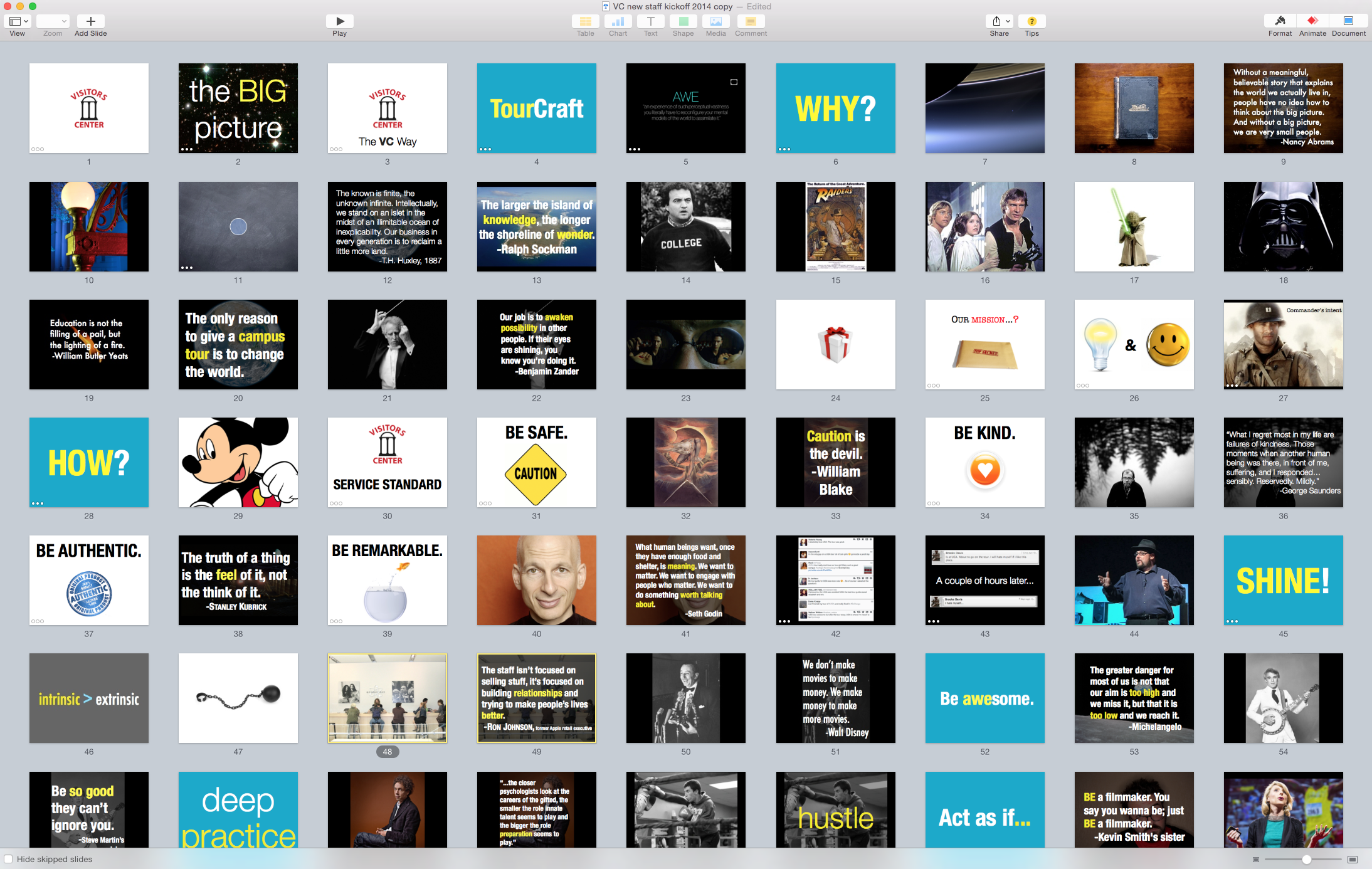
I’m working on slides for this weekend’s kickoff meeting for the new staff. I’m showing my work in progress here to remind myself that I can’t just repeat what I’ve done before. I’ve been tweaking the design and in the process rethinking the ideas and the flow. And it’s so worthwhile to take something you think you’ve got down and take a fresh look at it and be willing to discard and edit and redo. Every organization could benefit from regular revivals and periodic rethinks of just why you do what you do.

Screen Shot 2014-12-04 at 3.25.55 PM

Sam Smith: Do it for the love

Screen Shot 2014-11-21 at 11.00.39 AM
I spent the last two weeks interviewing college students for openings on our staff. My colleague regularly asks students in the interviews what music they’re listening to now. It sparks some good discussions, but it also enlightens me about the current music scene. Otherwise, I’m pretty oblivious to new music.

Every year after interview season I go get some of the music the students recommend. This year, Sam Smith was the most mentioned name. One student described him as the male version of Adele. That sold me. I’m not a streaming service fan (yet) because I just don’t need that much music in my life, so I went to iTunes and downloaded Sam Smith’s album, In The Lonely Hour. And it’s really good. He’s got a powerful, soulful voice for such a young guy.

The first track, though, Money On My Mind, has this line: “I don’t have money on my mind. I do it for the love.”

Intrinsic rewards for the win. Put your focus on the thing itself and honing and fine-tuning it for your delight. Don’t be distracted by any potential extrinsic reward.

We don’t make movies to make money. We make money so we can make more movies. –Walt Disney

Find those things you do just for the love, not for the money or the recognition. Even if you can’t make a living from the things you do for love, do them anyway. Make them hobbies and side-hustles. Your best work comes from that place, and it’s the path to a more authentic, more alive kind of life.


End-of-year resolutions and a report from the 4th-grade

I’ve been advocating end-of-year resolutions lately. The New Year’s resolution bandwagon is always too crowded, right? Why not beat the goal-setting rush and finish the year with momentum instead of letting it fizzle in a haze of holiday distraction and carb overload.

So, I was invited to talk with my daughter’s 4th-grade class yesterday morning to discuss their goals for the end of the year. I was delighted by these kids and their genuine interest in coming up with worthwhile personal goals and plans to make them happen.

I told the students this story about Herschel Walker, the greatest college football player ever, and how the habits he developed as a kid transformed his life:

He says that he was an overweight kid who got bullied by others and was just an afterthought on his school team. When he asked his coach how to get better, the coach said, “Do pushups and sit-ups and sprints.” So, Herschel did just that. And then some. 

He loved watching TV, and every time a commercial came on he would do pushups until the show came back on. The next commercials would have him switch to sit-ups. He would do thousands of reps every night, and he would go in his yard and race his sister, who went on to be a track star at UGA. 

And that’s all he did. He didn’t lift weights and work with a trainer. Just pushups, sit-ups, and sprints. Over and over and over. And he became the athlete we now know.

While his goal was to get strong and become a better football player, it was his obsession with his daily push-ups and sit-ups and sprinting habit that made the difference and transformed him into maximizing his physical potential. Even today, at 50+-years-old, Herschel continues to do thousands of push-ups and sit-ups each day.

So, after sharing Herschel’s story with my 10-year-old friends yesterday, we talked about the importance of building habits and routines in order to reach their goals.

I was not expecting these 4th-graders to be so interested in this discussion, but they came strong with a variety of ideas and genuine enthusiasm for accomplishing something meaningful by the end of this year. They were not shy about raising their hands and sharing the goals that got them excited. From learning to play “Here Comes The Sun” on the guitar to a plan to high-five everyone in the school, our conversation yesterday yielded a wide array of December 31 goals.

I told them about Jerry Seinfeld marking out days on a calendar to motivate him to stick to his routine. Their teacher, Ms. Davis, distributed index cards for the kids to write their goals, and she’s giving them each a calendar to track their habits and routines over the next six weeks. Our neighbor let my wife know that her daughter came home yesterday committed to doing push-ups now. And my daughter asked me to load the Habit List app on her device so she could keep track of the habits she wants maintain to reach her goal. So proud.

I promised to come back to visit the class in January so everyone could report back on how it went. Now I’ve got a class full of 4th-graders holding me accountable. Stick with it, man. Finish strong.

Six weeks left in 2014: 4th-graders showing the way

december-31st

I’ve been invited to speak to my daughter’s 4th-grade-class this morning. One of her teachers reads this site and was inspired by my countdown of the remaining weeks in the year. She’s been talking with her students about finishing strong this year and having them come up with some goals and habits for themselves.

Fourth-graders are not my typical audience, except for my daughter who hears me way too much. (I think she still thinks I’m pretty cool for now, though. Don’t know how much longer that will last.) Maybe there’s not too much difference between college students and 4th-graders. Both groups seem to have an eager, appealing, puppy-like quality about them that gets hidden by some of them in the early teen years. And both 10-year-olds and 20-year-olds seem open to new possibilities in a way that people my age rarely are.

I’ll be curious to hear what goals these 9- and 10-year-olds have come up with for the last few weeks of the year. I’ve not got any prepared presentation or slides to show. I plan to hear what’s on their minds and talk through the process of creating routines and building habits to craft their lives into becoming who they want to be.

And I’m drafting this in order to help me think through what exactly I want to say. I’ve been stuck trying to think of how to approach these kids, and the best way I know of getting unstuck is to just write, to get moving in some direction even if it’s a wrong one.

I want to leave their classroom today with these kids having a clearer understanding of their own power to shape their lives and some strategies to take action right away. And I hope we have some fun talking about possibilities and new ideas and how to be more awesome.

I’ll report back on how it goes and what these kids are dreaming of to finish the year strong. Counting today there are only 43 days left in 2014. Let’s make these last six weeks the best weeks of the year.

Thoughts on job interviews and college students

It’s interview season at my work. Last week we interviewed almost 300 college students who applied to work as campus tour guides. We conducted group interviews with six applicants at a time being interviewed by a four-person committee. I was in every interview and wouldn’t have it any other way.

This week I’m interviewing the 39 finalists we selected from last week’s group interviews. These are individual, half-hour interviews.

It’s the two most important weeks of the year for my work. It takes a lot of time to go through these interviews, but there’s nothing more crucial to our culture and our mission. The students we select to serve on our staff almost completely determine our organization’s culture as well as the quality of the work we do. Our logistics and process and web site cannot make up for a mediocre interaction with our people. The experience is our product.

Hire for attitude, and train for skill. I would rather have a team member with no experience and a thin resume than one short on kindness and sincerity and charisma. And charisma is a thing. There’s an intangible likeability quality that jumps out with some interviews. It’s confidence, but not too much. It’s charm, but not forced. It’s interestingness, but not so much or so different that it’s distracting or seeming to be contrived.

Years ago I interviewed Craig to be a student orientation leader. Before his interview I reviewed his application, and the only activity on it was intramural basketball. This guy didn’t have the usual list of college accomplishments and organizations, so I wasn’t expecting much. But he shined in his interview. He was confident and kind and funny and showed that he had the kind of charisma that would make him a great fit. We hired him, and he was terrific in his job.

I admire all the students who have the courage to apply and give it a go and show up for an interview. For many it’s the first interview experience of their lives. We are doing a service by giving them the opportunity to have this experience, and I’m happy to spend two weeks listening.

Occasionally, an applicant will ask, “What are you looking for in a candidate?” And it’s not a particular resume item or demographic check box. We are looking for people who have genuine enthusiasm and a commitment to our calling and kindness and the eagerness to connect with prospective students and to possibly infect them with the same feelings they now have for higher education and its potential to transform their lives.

Charisma is caring deeply and having the courage to wholeheartedly express what it is you care about.

Charisma is caring deeply and having the courage to wholeheartedly express what it is you care about. I don’t think it’s a matter of having it or not having it. Everyone has it, somewhere within. And we let it out with varying degrees of frequency and intensity.

The best interviewees are the ones who walk in with the intent to connect without too much regard for the outcome, without being attached to the stakes. If you can go into an interview with the sole goal of having a great conversation with your fellow humans, where you listen and understand and express what’s most meaningful to you, you will be a success whether you’re hired or not. If you walk in too caught up in getting the thing, you will be less than your best self. The attachment will restrict and confine you.

You can’t control what other people do, whether they like you or want to hire you. Get those thoughts out of your head. Focus only on what you can control: your attitude, your body language, your enthusiasm for you what you care about.

Don’t be afraid to shine. Why not unleash your charisma?

As I am sitting through this final week of interviews, I am delighting in great conversations with young people who are interesting and passionate and kind. I get to watch as some of them come alive as they may never have before. I get to learn from watching 19- and 20-year-olds in the spotlight. It’s a good gig.

Make a fool of yourself

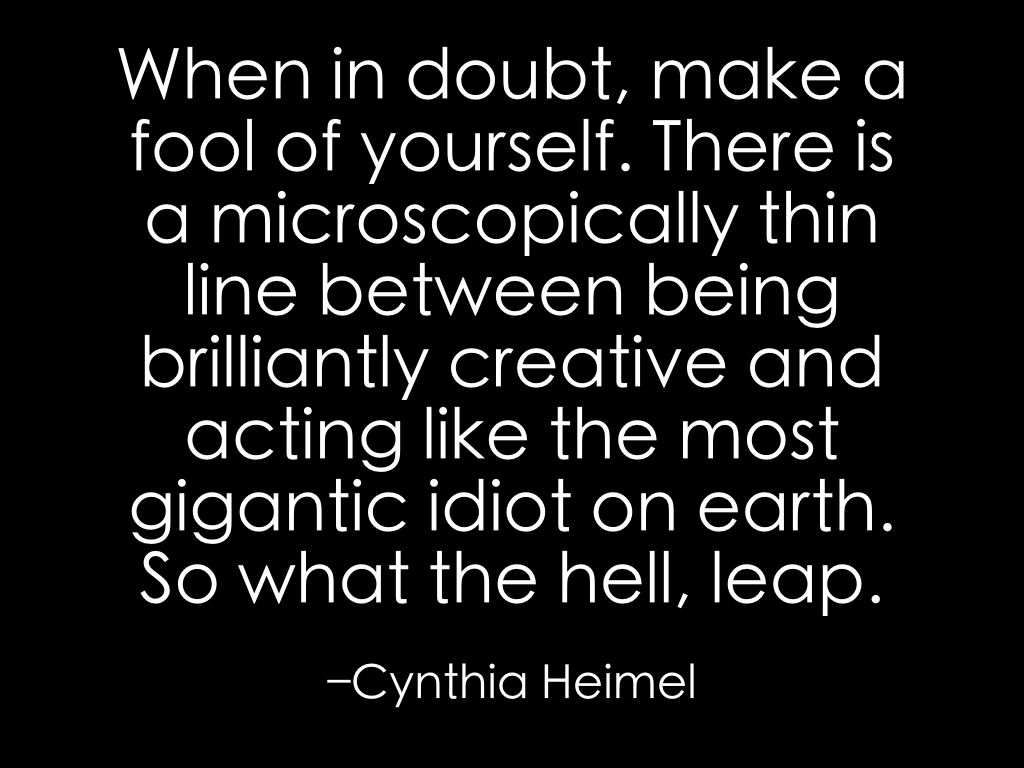
“Compulsive avoidance of embarrassment is a form of suicide.” –Colin Miller

Austin Kleon shared this quote in his excellent, short book, Show Your Work!

To risk being vulnerable takes courage, and there’s no guarantee of success to reward your courage. In fact, failure and disappointment are more likely than success when you attempt hard things and open yourself to disapproval and even ridicule.

But not much good will come from the safety and caution of avoiding embarrassment. Keep flinching and you risk dousing the creative fire inside you.

I’m too proud of how cool I am, or appear to be. Throw off your coolness. Make a fool of yourself if you have to to bring out your best self and your best work.

And cheer for and stand up for those with the guts to risk embarrassment in their attempt to be or do something excellent.

IMG_1263.PNG

Steve Martin and innovation

2013-04-17

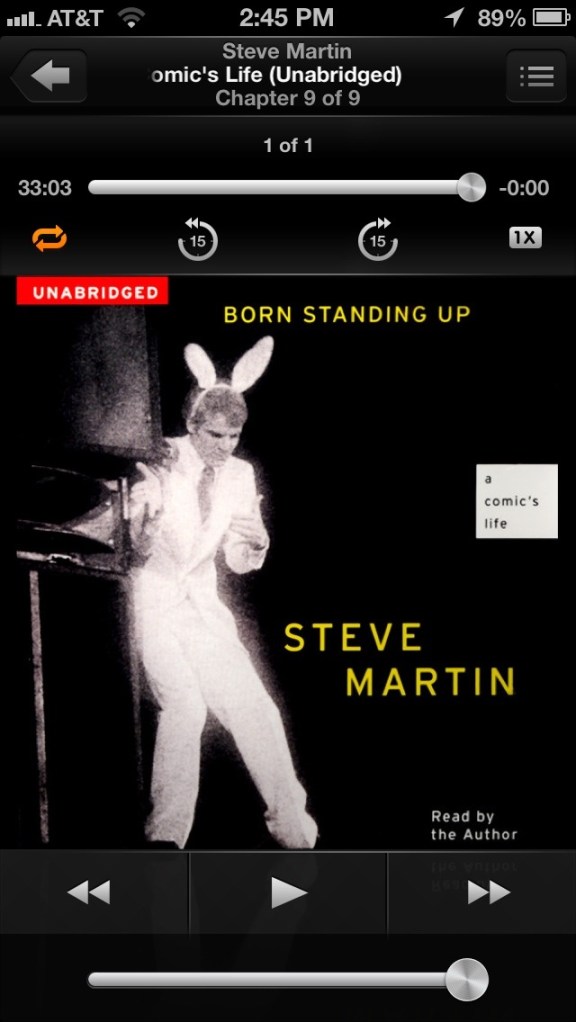
I’ve shared before that my favorite audiobook is Steve Martin’s Born Standing Up. He narrates his own story, which is immensely entertaining as well as instructive about what it takes to stand out in your field.

Cal Newport, author of So Good They Can’t Ignore You, linked to one of his older posts about Martin’s influence on his career philosophy. Here’s Newport explaining a key element of Martin’s success – innovating, not just polishing:

Paying your dues is overrated. Simply putting in the time is not enough. Martin’s story is one of a constant urge to innovate. He was trying to figure out the essence of “funny.” He then yielded these insights to move beyond the static structure of the punchline that dominated performance comedy at the time. This restless urge to understand then innovate led him to be outstanding. Without it, he would have just become another good comedian. Like hundreds of others.

You need to do the same. Understand what the best exemplars in your field do well. Figure out why. Then ask how you can mix, match, and reconstruct these elements into something new and even better.

It’s not just about working hard. You’ve got to think hard, too, and determine how you can go where no one has gone.

I just downloaded a sample of Peter Thiel’s new book, Zero to One, which is about this concept. Greatness is more than iteration and improvement. It is creating something remarkable where before there was nothing at all. If you want to shine, you’ve got make the leap from merely good at more of the same to remarkably great in a way never done before.

Peaking at 80

Screen Shot 2014-11-04 at 8.27.12 AM

I’ve been telling students recently they should make decisions with the intent to peak at 60. The long game will reward you.

I chose 60 because it seemed distant enough for a college student to imagine the long arc of a career. As a 50-year-old myself, though, 60 is shockingly close now and not much of a long game for me.

Then I came across a post from Kottke who linked to this excellent New York Times feature on masters in their field who are still doing great work into their 80s and beyond.

Here’s Tony Bennett:

“Here I am at 88, and I still feel like I have an awful lot to learn, today and tomorrow and the next day and the next day. About my craft. About how to become a better artist. About coming up with creative ideas.”

There are profiles of people from a variety of professions, and the recurring theme is a discontent that propels constant growth and a relentless commitment to learning and improving.

Don’t ever arrive. Keep striving.

“The tree of knowledge and the fountain of youth are one and the same.” –Lewis Lapham

Only nine weeks left to make 2014 awesome

december-31st

It’s Wednesday. As of today there are only nine weeks left in 2014, one week down in my ten week countdown to make 2014 more awesome.

What will you have to show for this year? How do you want to finish? Schedule some time for a meeting with yourself on New Year’s Eve to assess the year, to review what was great about 2014 and what could have been better. Really, go put this on your calendar now. I just added it to mine. (By the way, I use Fantastical, a killer calendar app for Mac and iOS. So good.)

I’m imagining Wednesday, December 31. There will be football on TV and a family gathering that night probably. But that morning will most likely be a quiet time to get away and reflect on the year and on these last ten weeks especially. I’m hoping I’m stronger (I’m one week closer in the hundred pushups challenge) and a bit smarter (my book reading plan is slow go for now, though). I plan to have written something I’m proud of, and I’m counting on having even better relationships with the people I love.

What can you do to finish well? What actions can you take this week that will create momentum for the habits and routines you want to build. Systems trump goals, and these final weeks can give you a good foundation to build systems that will endure and that can truly transform your life over time.

Nine weeks is plenty of time to make remarkable progress on something you truly care about. Don’t wait till there are only eight weeks left to get started on finishing strong in 2014.

Start. Now.

Claim your place on the internet

Everyone should claim their place on the internet. Go grab the URL of your choice for just a few bucks a year and own your online identity.* Why not? We are living in the future! The internet offers the chance to express and connect in a way humans have never been able to before. Don’t sit this out.

Of course, I think everyone should write. Even if you create a site that no one other than your mom ever visits, it’s worthwhile for your own benefit to have a platform to build your ideas and share your creations. The attempt to create something, to express yourself, will help you see and understand in ways that just thinking passively never can. And posting something publicly, that anyone in the world might come across, will focus your attention more finely and compel you to hone and craft your ideas with more care. Kind of like how you clean your house so much better when you’re expecting company, writing something with the awareness that others might read it will lead to clearer thinking and better work.

Writing something with the awareness that others might read it will lead to clearer thinking and better work.

Young people, especially, who are just getting started on their careers, should be expected to have a thoughtful online presence. To heck with your resume, show me what you’ve done. If you want to go into marketing or advertising, for example, wouldn’t it be more impressive to show a prospective employer your blog filled with posts analyzing marketing and advertising instead of just your grades in classes. If you’re passionate about public health, why not chronicle what you’re learning about health policy. If you’re an artist, make and share your art.

The college students I work with are getting it. From a design student to a mass media student to a fashion merchandising student, they know that they should go ahead and start acting like and creating like they are who they want to be. Sarah, the fashion merchandising student, was in a college class I spoke to a few weeks ago. After my talk she came up and told me she’d been wanting to create a web site about her interest in fashion. The next week, she sent me a link to her new site, and it’s terrific. And it’s going to help her figure out what she really cares about and what’s worth sharing and how to express her ideas more effectively. And when she’s pursuing career opportunities she will have a tangible body of work to share, not just a resume. Or maybe her web site will become a career. It happens.

Write the internet you want to read.

But don’t see your online presence just as a means to an end, as a sort of obligatory extended resume. The best stuff on the internet is created as an end in itself, for fundamental reasons rather than instrumental reasons. Write the internet you want to read. Craft and share work that delights you intrinsically without any expectation of a payoff and see if you don’t make better work than if you were trying to get some extrinsic reward.

You don’t need permission to do work you find meaningful, nor do you have to wait till you’ve earned a degree to get busy getting better at what you want to do. Even if no one pays you for it, ever, go make something and share it with the world.


*I use WordPress.com and pay them each year for my custom domain name. It’s a hassle-free, low-maintenance option that I’ve been happy with.

The question to awaken possibility

IMG_1254.PNG
What if you asked “What if …?” like it was your job?

What if you put no limits on the answers?

What if you asked this about your work, your relationships, your dreams for who you want to become?

What if asking this became a habit, a part of your weekly, or daily, routine?

What if you become known for your embrace of possibility?

What if you helped awaken possibility in others?

What if you actually did something to make even a handful of those possibilities become reality?

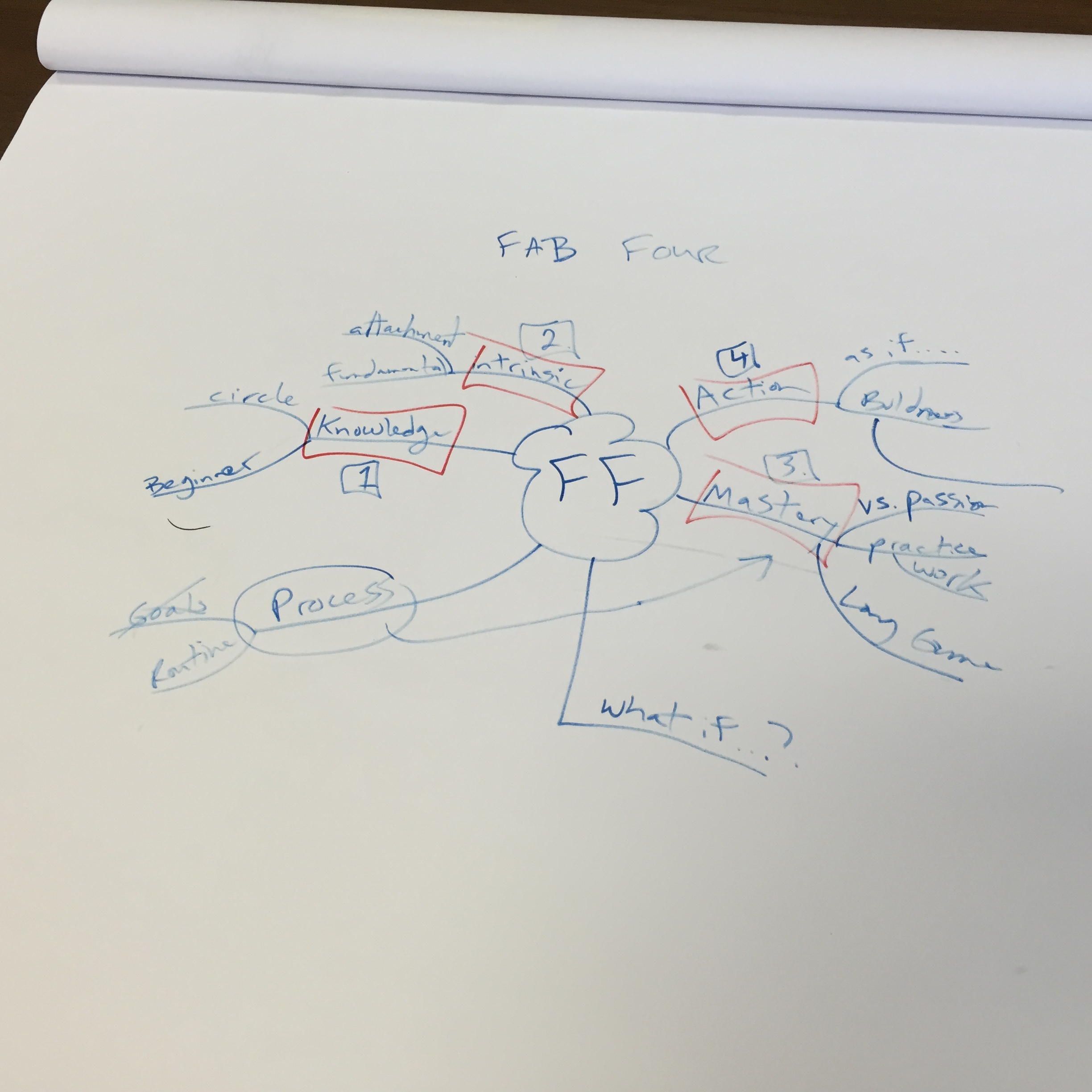
Showing my work: FAB 4

Screen Shot 2014-10-20 at 1.25.40 PM

Showing my work helps remind me what a rewardingly messy process creation is. An audience typically only sees the well honed final creation, but it’s worthwhile to share openly the process that creates the product. I take heart when I see an artist show the rough drafts and discarded wrong steps.

I’m remixing a presentation for tonight. I’m speaking to a group of college freshmen and sharing wisdom I’ve learned from a career working with campus superstars. I’ve got a handful of ideas and stories I rely on for these kinds of talks, but this morning I decided to scrap a version of the talk I’ve used recently and rethink the structure and design.

I turned my chair around, away from the computer, and took some markers to the jumbo scratch pad on my desk. I mapped out the most important ideas and rearranged the flow before turning back around and designing the slides in Keynote.

It helps to change tools and switch from digital to analog to jump start a fresh approach. And it’s worthwhile to take something you’ve got down pat and jumble it up and start over. New possibilities appear that otherwise would have been hidden behind old, safe patterns.


IMG_5758


Be the CEO of your life

IMG_1251.PNG
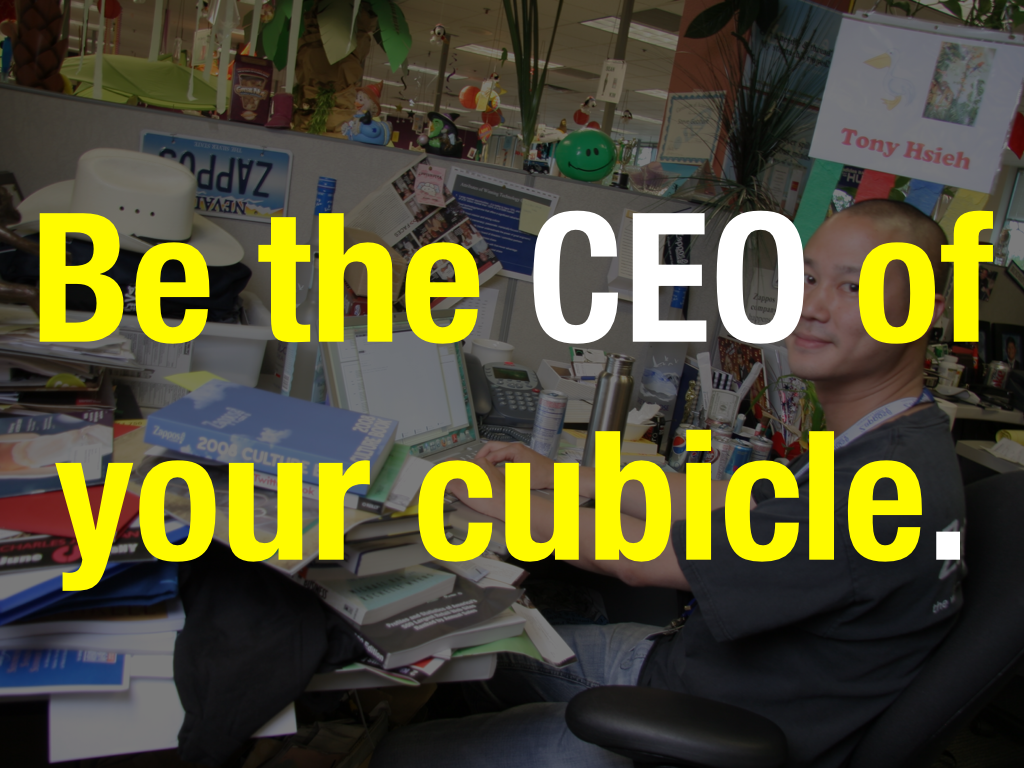
You may not be anyone’s boss. You might have a whole corporate ladder of bosses above you. But you are your own boss whether you’re self-employed or not.

You might just have only a puny little cubicle from which to stake your claim on great work. But make the most of where you are. Fully inhabit that cubicle like it’s the corner executive suite. Be awesome right there.

Own your job. Master your roles. Work like a boss. Be the CEO of your life.

Putting the work in

Screen Shot 2014-10-14 at 4.44.19 PM

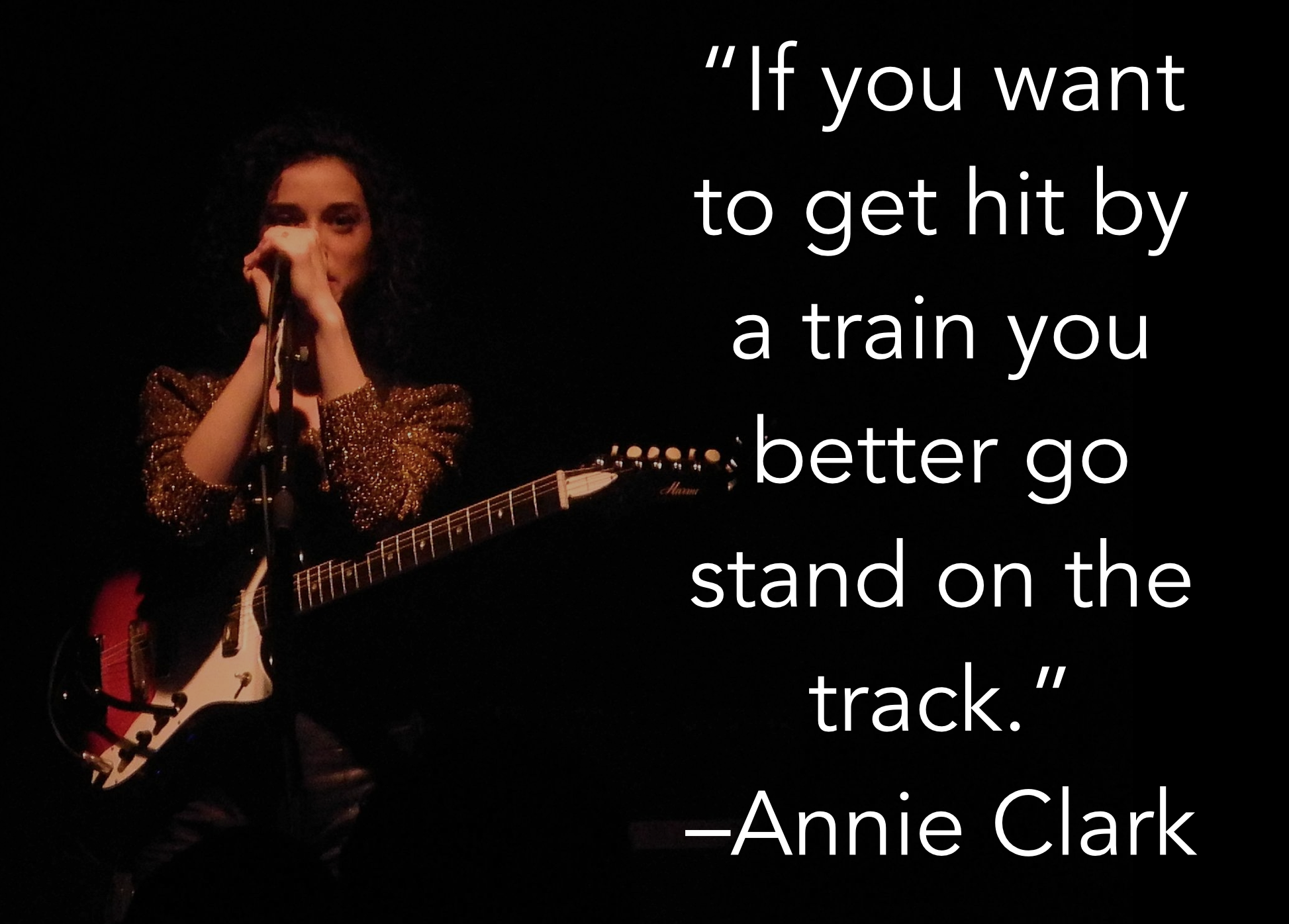
“When writing, I adhere to the old adage that if you want to get hit by a train you better go stand on the track. There’s no substitute for just putting the work in and writing with a very concerted, focused effort. At the end of the day it all comes down to synthesizing a whole host of ideas, so you better have a lot of ideas at the ready when it comes time to put the little Frankenstein monster together.” –St. Vincent’s Annie Clark

An Austin Kleon tweet pointed to this excellent interview with the musician Annie Clark, a.k.a. St. Vincent, about her creative process.

This jibes with everything I’m finding lately about creative people. Inspiration is for amateurs. Pros just do work. They show up and get busy whether they feel like it or not.