Category: quotations
Fundamentals
 Einstein
Mark Twain On Being Unafraid Of Dying
The fear of death follows from the fear of life. A man who lives fully is prepared to die at any time.
And this:
I do not fear death. I had been dead for billions and billions of years before I was born, and had not suffered the slightest inconvenience from it.
Doing summons feeling
From R.J.Baughan’s The Joy of Doing:
“Men do not really live for honors or for pay; their gladness is not in the taking and holding, but in the doing, the striving, the building, the living. It is a higher joy to teach than to be taught. It is good to get justice, but better to do it; fun to have things, but more to make them. The happy man is he who lives the life of love, not for the honors it may bring, but for the life itself.”
There’s magic in action. Just start. Do the thing you want to do for the simple joy of doing the thing.
And even when — especially when — you don’t feel like doing the thing, do it anyway. Doing usually summons feeling.
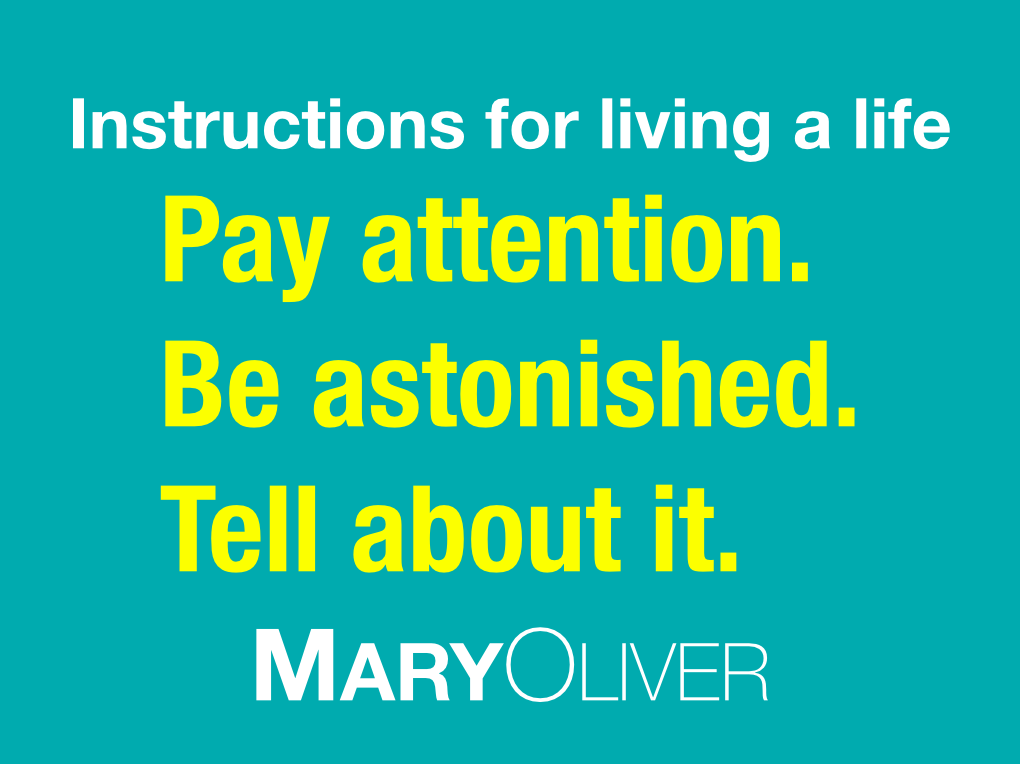
Mary Oliver’s instructions for living a life
 via author Elizabeth Gilbert’s Instagram
More better
You are going to die.
I am, too.
(Warm, happy way to kick off a conversation. I’m fun at parties.)
The universe is staggeringly massive.
For every grain of sand* on Earth, there are at least 10,000 stars in the visible universe.
Amazing, right?!
*And yes, there’s an algorithm for determining the number of grains of sand on Earth. Also amazing.
We are infinitesimally small.
Our time is limited.
(The average human lifespan fills just .000001 percent of the entire history of the planet.)
In the big scheme of things — the REALLY big scheme — who we are and what we do doesn’t seem to, in the words of Humphrey Bogart in Casablanca, “amount to a hill of beans in this crazy world”.
Yet we all are so busy and in a hurry and stressed out.
Our to-do lists tug at us and unsettle both our conscious minds and our subconscious and even sneak into our dreams at night.
Our calendars are filled with meetings and appointments and projects and task-forces and so many things that won’t be worth remembering or talking about.
How much of what we do makes a real difference and is truly meaningful?
How often do you get to the end of a day and lay your head on your pillow and feel genuine, wholehearted satisfaction about the way you spent a precious day in your short life?
Maybe it’s unspoken existential angst or cultural brainwashing from childhood or tyrannical bosses that fling us into the futile effort to do MORE, check MORE off our lists, accomplish MORE…
…in the effort to have more and be more and somehow win at life.
MORE. MORE. MORE.
But what if…?
What if you apply “MORE” to quality rather than quantity?
What if you did LESS, but did it BETTER?
Do LESS, but do it MORE BETTER.
(Grammar police, look away.)
Here is almost the entire product line of the biggest, richest company in the world:

All of Apple’s products could fit on a conference room table.
Steve Jobs attributed much of his success to saying “No” to make room for a better “Yes”.
Steve Jobs:
“Innovation is saying no to 1,000 things.”
Albert Einstein, too:
“I soon learned to scent out what was able to lead to fundamentals and to turn aside from everything else, from the multitude of things that clutter up the mind.”
Warren Buffett:
“The difference between successful people and unsuccessful people is that really successful people say no to almost everything.”
Jazz great Thelonius Monk:
“What you don’t play can be more important that what you do play.”
Steve Jobs, Albert Einstein, Warren Buffett, Thelonius Monk — all champions of doing less, but doing it better.
Imagine honing your focus and investing more of your limited time and attention in things that matter most.
Imagine the rewards of deep work and quality time on fewer projects.
Imagine more quiet moments and eye contact and actually taking time to listen intently.
What would intense focus on fewer things do for your work life, your relationships, your peace of mind?
But, to have that kind of focus, you have to be ruthless at saying “No” to even really good and noble things as well as to time-wasters and trivial distraction.
And you have to say “No” to nice people and to “good” opportunities.
Derek Sivers says when he’s confronted with a new opportunity, if his response is not a “Hell, YEAH!”, then it’s simply a “no” for him.
“Hell, YEAH!”
Or
“no”
That may be extreme, but exceptional, more better lives tend to defy convention.
Consider the things in your life, professional and personal, that are most important.
Make a list. Prioritize it.
What if you cut that list down to just a few key priorities, the things that would have the biggest impact and matter the most?
And what if you structured your time around giving those few key priorities more of your attention?
Peter Drucker, paraphrased:
Management is doing things right. Leadership is doing the right things.
What if you built habits around the few priorities that have the biggest impact in your work and your life?
Consider whittling your daily to-do list down to one or two key tasks, tasks that would benefit from close attention and deep focus.
Consider overhauling your schedule by cutting out most meetings.
Turn off notifications on your devices.
There are people who only check email at designated intervals — first thing in the morning, around noon, and in the afternoon.
Crazy, right? Who does this?
I’m guessing Warren Buffett doesn’t live out of his email in-box.
Einstein didn’t surf the internet. 😉
(We’ll give Steve Jobs a pass on this one.)
What can you: streamline, unclutter, simplify, clarify?
Instead of a buffet, a smorgasbord even, of services and options, what if you offered just a few truly great choices?
Is your purpose, your mission — for your team, your family, your work, your life — clear?
Crystal clear?
How much stuff do you possess that you don’t really need, that’s not either useful or beautiful?
Less stuff, but better stuff.
Fewer pursuits, but more rewarding pursuits.
Picture the end of your life.
What kind of life do you want to look back on?
It will be quality, not quantity, that will matter most at that point.
And that should matter most now.
Do less…
… better.
*This is the thought stream for a presentation I will be leading at a conference next month. I posted a PDF of this from a Keynote document for use by the audience prior to the presentation. It can stand alone but is intended to be a warm up for what I hope will be a lively conversation.
Be obsessed
Justine Musk (Elon Musk’s wife) had this as part of her response to a question on Quora about how to be as successful as Bill Gates, Steve Jobs, Elon Musk, and Richard Branson:
Be obsessed.
Be obsessed.
Be obsessed.
If you’re not obsessed, then stop what you’re doing and find whatever does obsess you. […] Don’t pursue something because you “want to be great”. Pursue something because it fascinates you, because the pursuit itself engages and compels you. Extreme people combine brilliance and talent with an insane work ethic, so if the work itself doesn’t drive you, you will burn out or fall by the wayside or your extreme competitors will crush you and make you cry.
Intrinsic rewards over extrinsic rewards.
A poverty of attention
Nobel Prize winner Herbert Simon:
“In an information-rich world, the wealth of information means a dearth of something else: a scarcity of whatever it is that information consumes. What information consumes is rather obvious: it consumes the attention of its recipients. Hence a wealth of information creates a poverty of attention and a need to allocate that attention efficiently among the overabundance of information sources that might consume it.”
And he said this in the 1970s, long before the internet.
There is more information available now than ever before in human history. This is uncharted territory.
Is our attention strained and scattered more than ever before? Mine is. My hunger for information seems insatiable. But my ability to focus on one thing, or one person, for a meaningful amount of time has gotten more fragile.
Paying attention — deep, focused attention — has become a kind of superpower. That’s the muscle I need to be trying to strengthen.

Thich Nhat Hanh: Understanding is love’s other name
“Understanding someone’s suffering is the best gift you can give another person. Understanding is love’s other name. If you don’t understand, you can’t love.” –Thich Nhat Hanh
If you truly understand someone, you can’t help but love them.
Consider making the attempt to understand the perspective of anyone you feel you don’t, or can’t, love.
Even if you could never approve of his actions, understanding—seeing the world even for a moment the way he does—will give you compassion for him.
The pace of nature

“Happiness is a smoothly flowing life.”

Thoreau and the most encouraging fact
Henry David Thoreau (via Brain Pickings):
The millions are awake enough for physical labor; but only one in a million is awake enough for effective intellectual exertion, only one in a hundred millions to a poetic or divine life. To be awake is to be alive. I have never yet met a man who was quite awake. How could I have looked him in the face?
We must learn to reawaken and keep ourselves awake, not by mechanical aids, but by an infinite expectation of the dawn, which does not forsake us in our soundest sleep. I know of no more encouraging fact than the unquestionable ability of man to elevate his life by conscious endeavor.
Richard Feynman: “This is not yet a scientific age”

The irrepressible Professor Feynman, a poetic scientist of the highest order, was speaking in the 20th century. Even now this statement holds, though there seems to me more optimism for an approaching age of widespread wonder based on the sharpening image of our ever more awe-inspiring universe.
Admittedly unsure and wholeheartedly curious
“The presence of those seeking the truth is infinitely to be preferred to the presence of those who think they’ve found it.” –Terry Pratchett
The admittedly unsure, but wholeheartedly curious… Those are my people. And the kind of person I aspire to be.
Live your life on your own terms
Donald Miller, in his new book, Scary Close, refers to a story I saw last year about a nurse who worked with patients as they approached death and the lessons she learned about their regrets:
“Remarkably, the most common regret of the dying was this: they wish they’d had the courage to live a life true to themselves and not the life others expected of them.”
You’ve got one shot at life. Don’t live on someone else’s terms. Their life is enough for them. Your life is your life. Live it as best you can.
Sunday evening Stoic: The good fortune of bad things
Meditations 4.49:
“So remember this principle when something threatens to cause you pain: the thing itself was no misfortune at all; to endure it and prevail is great good fortune.”
Even the saddest, most emotionally painful turn of events can be considered good fortune if you use it to grow and get stronger and to live a more wholehearted life.
This is no easy lesson, and I keep forgetting to welcome the seemingly unwelcome, to embrace what I am inclined to resist.
What is, is. I can only control my response. I can take action toward a course I prefer, but much is out of my hands.
Accept what you can’t control. The world isn’t striving to make you feel good. Welcome to reality.
But why not use even “bad” fortune, especially bad fortune, to propel you a little further on your journey to becoming a more excellent version of yourself?
Good days are the material of a good life
The Art of Manliness just concluded an excellent, in-depth series on Winston Churchill, The Churchill School of Adulthood.
What a remarkable life. Churchill was THE linchpin in keeping the free world free in the darkest years of the twentieth century. And he was arguably the authentic and original most interesting man in the world. Scholar, prolific author, adventurer, humorist, iconic orator. With his incredible intellectual depth and transparent, colorful personality, he defied the stereotype many hold of politicians.
In the last post in this web series, there’s this quote from Churchill:
“Every night,” he said, “I try myself by court martial to see if I have done anything effective during the day. I don’t mean just pawing the ground — anyone can go through the motions — but something really effective.”
This is much like Benjamin Franklin who began each day by asking himself “What good shall I do this day?” and ended each night with “What good have I done today?”
I don’t need to have accomplished big, Churchillian things in a day. But I do want to have been intentional about doing something meaningful, even a small thing. A genuine connection with someone, a memorable conversation, an act of kindness. Making something or moving a valued endeavor a little further toward completion.
If I can get to the end of a day with something to look back on with satisfaction, it’s a good day. Good days strung together more often than lost days will ultimately lead to a good life.
Churchill’s life was epic. I don’t need an epic life. Yet taking stock at the end of each day and holding myself to a standard of quality, like Churchill and Franklin did, can point me more effectively toward the good life I do aspire to lead.
“How we spend our days is, of course, how we spend our lives.” –Annie Dillard
The hardest thing
“The hardest thing is spending the most time on the most important things.” –Matt Mullenweg
Mullenweg is the very young founder of WordPress (the home of this web site and many more). He said this in the most recent episode of The Tim Ferriss Show podcast when talking about his work and his company’s focus. (Ferriss’s podcast has been killing it recently with quality guests.)
Knowing what’s most important is one thing. Relentlessly devoting most of your time, at the expense of good things that just are not most important, is another thing. But these two things are everything.
Choose what to focus on, what will have the biggest impact over the long term, and keep checking that your time and attention are pointed there. This means eliminating good stuff, but the most important stuff likely won’t get done otherwise.
Sunday morning Stoic: Past and future have no power over you
Meditations 8.35-36:
“35. We have various abilities, present in all rational creatures as in the nature of rationality itself. And this is one of them. Just as nature takes every obstacle, every impediment, and works around it—turns it to its purposes, incorporates it into itself—so, too, a rational being can turn each setback into raw material and use it to achieve its goal.
36. Don’t let your imagination be crushed by life as a whole. Don’t try to picture everything bad that could possibly happen. Stick with the situation at hand, and ask, “Why is this so unbearable? Why can’t I endure it?” You’ll be embarrassed to answer. Then remind yourself that past and future have no power over you. Only the present—and even that can be minimized. Just mark off its limits. And if your mind tries to claim that it can’t hold out against that … well, then, heap shame upon it.”
“Turn each setback into raw material” for your use. Convert obstacles into fuel. Welcome bad luck and bad news as if you chose them to somehow make yourself more awesome.
But remember that the past is gone, and we can’t even remember it exactly as it was. And the future is only in our imagination. Both are phantoms, unreal, empty.
The present is all any of us ever have. Face it with full attention, no matter what obstacles you may see in it. It’s manageable and, when fully inhabited and embraced, can be magnificent.
The upside of down thinking
“Misfortune weighs most heavily on those who expect nothing but good fortune.” —Seneca
I used to be a positive-thinking fundamentalist. Age and life experience have shown me the value of balancing with the negative.
Visualizing the negative and expecting the worst will brace you for whatever comes and make you appreciate even more what you have.
No need to dwell on the worst. Just visit the possibilities periodically and consider what could be. After briefly imagining even the most depressing circumstances, you return to the present with a deeper, more vital appreciation for people and things in your life that, moments before, had been taken for granted or even seemed invisible.
Have the courage to embrace life as it is, its good and bad, and be prepared for whatever may come. “Good” and “bad” define each other. Face the negative to strengthen the positive.
“The secret to happiness is low expectations.” –Barry Schwartz
 Excellent Journey