I’m an artist. You are, too.

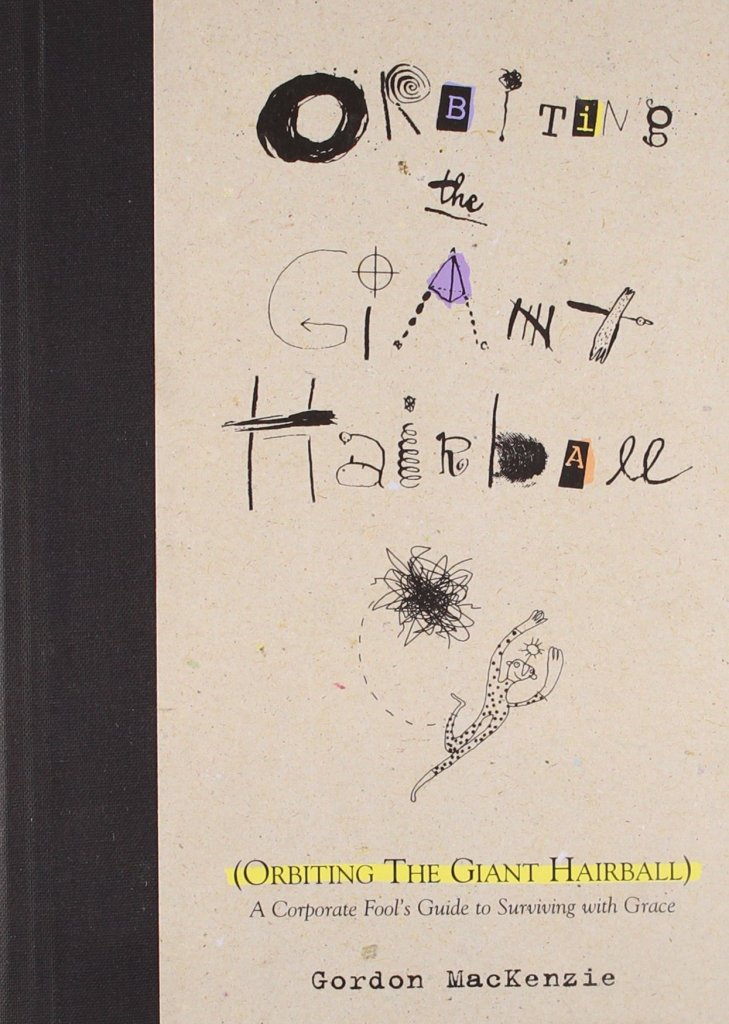
Orbiting the Giant Hairball is the kind of book that stays with you. I read it many years ago and still think of lessons from it. The author, Gordon McKenzie, worked at Hallmark, and the book explores his efforts to retain his independence and nurture his creativity within an often stifling bureaucratic organization.

In the most memorable story in the book McKenzie tells of his annual visit to an elementary school to share his art. He would start by presenting to the Kindergarten class and work his way up, talking to each grade level, all the way to the fifth-graders to finish the day. At each grade level he asked the students, “How many of you are artists?” Every Kindergarten student would quickly put a hand up. At the next class, though, a few first-graders did not raise a hand. A few more second-graders didn’t. Progressively, as he moved up in grade levels, fewer students raised a hand when he asked who were artists.

By fifth grade, no hands went up at his question. He then told the fifth-graders that every Kindergarten student had claimed to be an artist. “What is happening?” he asked them. “Are all the artists transferring out of this school?”

Of course, the point is something is happening to convince kids they are not artists. Parents or peers or teachers or culture or the system or some combination is turning off the default setting for creativity.

It’s on us to keep drilling back into the settings, our own settings and those of people we can impact, and turning back on the “I’m an artist” setting.

You don’t have to make a living off your art to be an artist. Just make something that only you can make – an experience, a photo, a meal, a poem or post, a song or video, a note to a friend. Express yourself. Make art. Go back to the Kindergarten default that you are an artist.
81OO-vQSZbL

Advanced search for life’s big decisions

From Greg Mckeown’s excellent book, Essentialism:

“Applying tougher criteria to life’s big decisions allows us to better tap into our brain’s sophisticated search engine. Think of it as the difference between conducting a Google search for “good restaurant in New York City” and “best slice of pizza in downtown Brooklyn.” If we search for “a good career opportunity,” our brain will serve up scores of pages to explore and work through. Instead, why not conduct an advanced search and ask three questions: “What am I deeply passionate about?” and “What taps my talent?” and “What meets a significant need in the world?” Naturally there won’t be as many pages to view, but that is the point of the exercise. We aren’t looking for a plethora of good things to do. We are looking for the one where we can make our absolutely highest point of contribution.”

I need to remember to continually eliminate the good to hone in more clearly on the better. And then keep going, editing and discarding even those better options until I get to the best.

Be precise with your questions. Get specific, as detailed as possible, to find the best possible answer.

Sunday morning Stoic: Invisible man

Meditations 7.67:

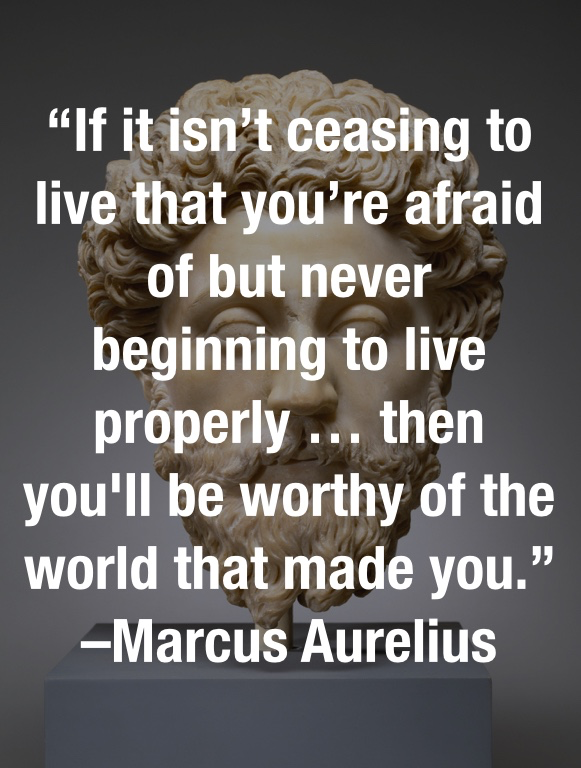
“Nature did not blend things so inextricably that you can’t draw your own boundaries—place your own well-being in your own hands. It’s quite possible to be a good man without anyone realizing it. Remember that.”

It’s quite possible to be a good man without anyone realizing it.

What if your character was so strong, your virtue so impeccable, your goodness so subtle that you flew completely under the radar?

What if you were practically invisible, with no awards or glory or killer job offers or huge number of Twitter followers?

Be good, be honorable and virtuous and strong, not for any external reward or acclaim, but just for the virtue of the action itself. Don’t do this for that. Do this for this.

And don’t be discouraged or distracted from your focus on excellence if no one acknowledges you. This thought from Marcus is mirrored in this passage (chapter 17) from the Tao Te Ching:

“When the Master governs, the people are hardly aware that he exists. Next best is a leader who is loved. Next, one who is feared. The worst is one who is despised. If you don’t trust the people, you make them untrustworthy. The Master doesn’t talk, he acts. When his work is done, the people say, ‘Amazing: we did it, all by ourselves!'”

The Master doesn’t talk, he acts. When his work is done, the people say, “Amazing: we did it, all by ourselves!”

Being open to uncertainty

/home/wpcom/public_html/wp-content/blogs.dir/8f0/33929258/files/2014/12/img_6165-0.jpg

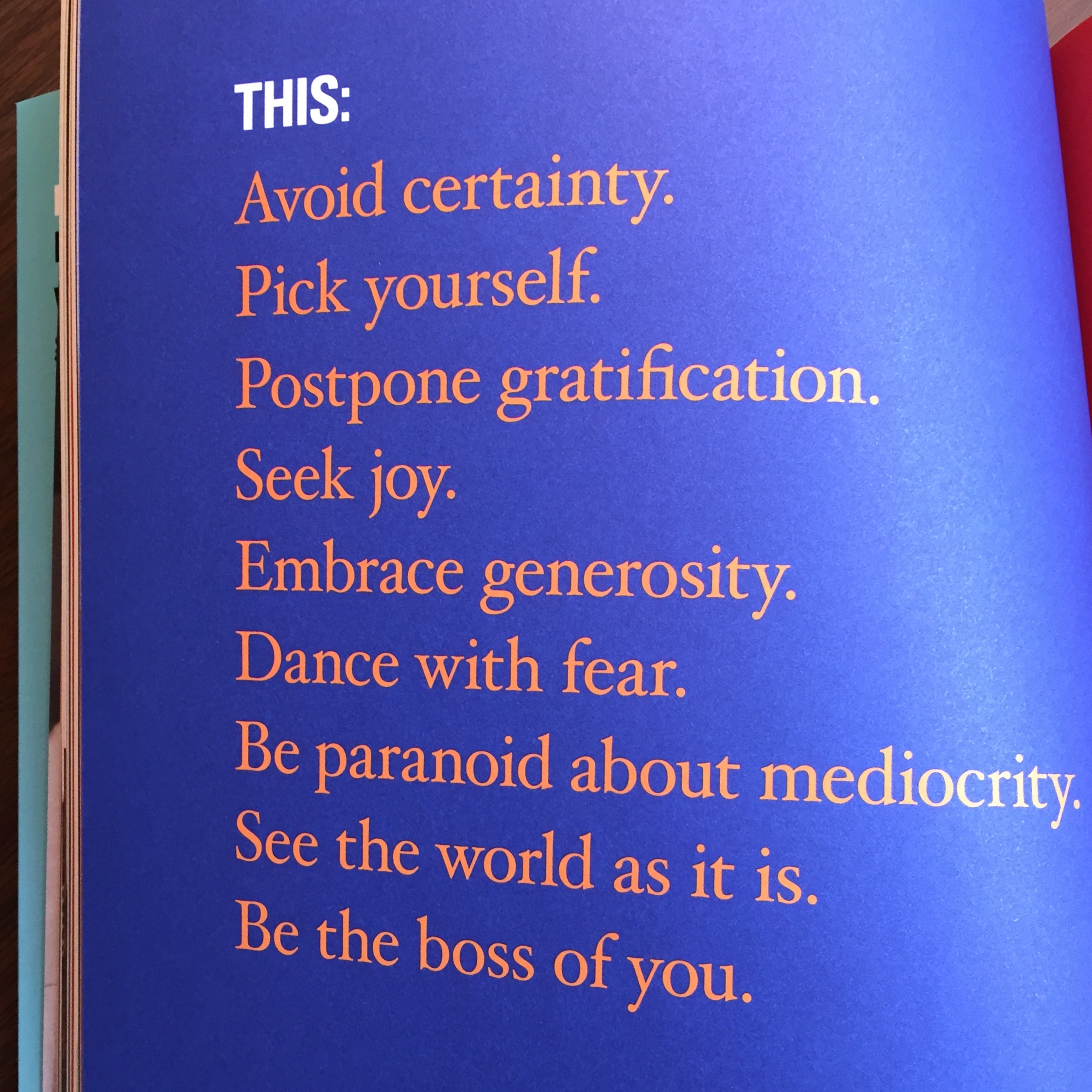
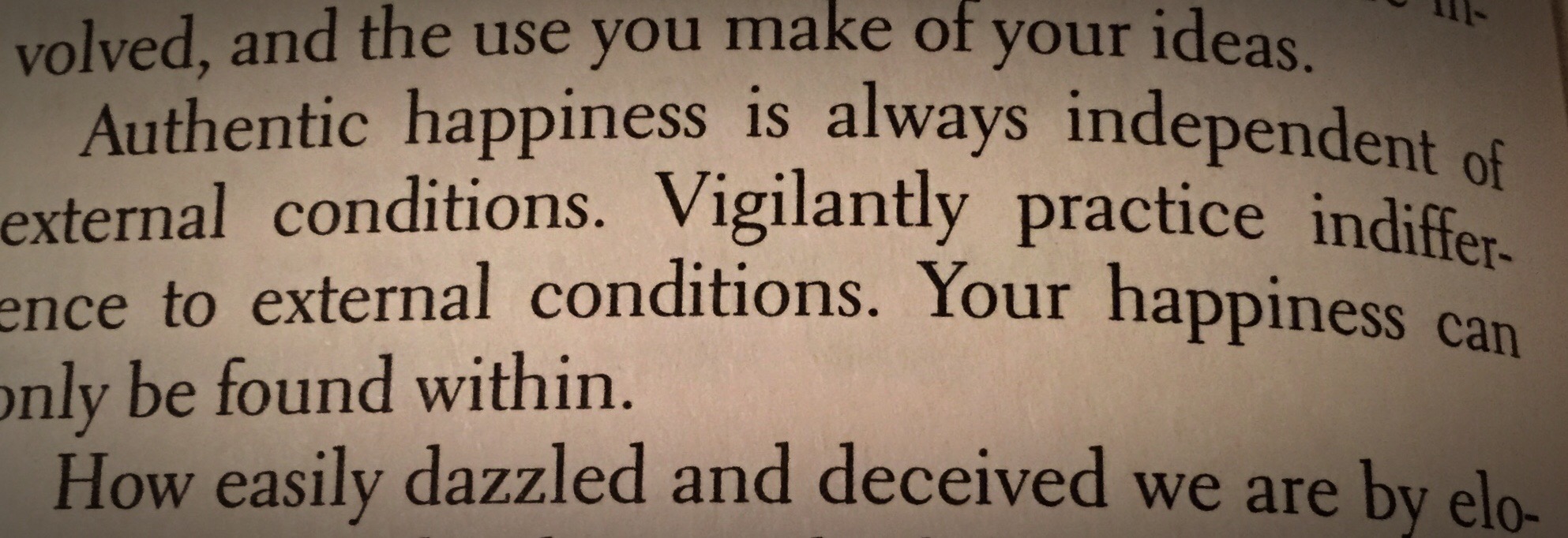
I find myself photographing memorable portions of books, actual paper books. It seems a bit odd, but it’s a way of collecting and noting thoughts that stand out to me. And since most of my notes are of the digital variety now, photos are a way to get these analog bits into my digital system.

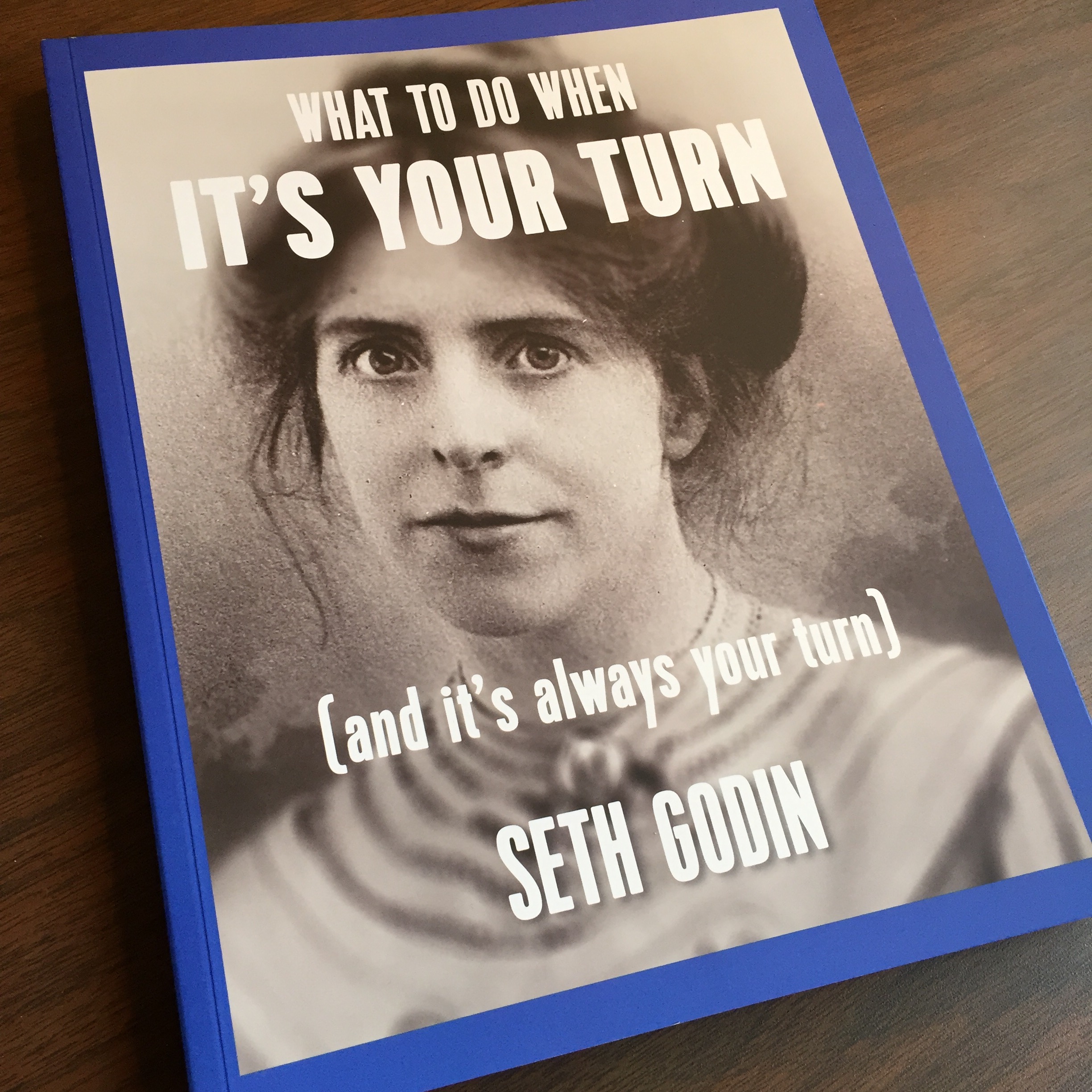
The quote above is from Seth Godin’s new book, What To Do When It’s Your Turn. I’ve posted previously about what a beautifully made book it is, and the content holds up to the design.

The thought above, though, is well timed as a new year approaches. We tend to want to cling tightly to an illusion of certainty and stability. But the universe is energy, constantly in motion. Nothing stays constant except the fact that everything changes. Resisting this fact is futile. And the default for most of us.

Those who lean into the uncertainty of life are the ones most likely to make cool stuff happen. Why not brace yourself for not knowing and for insecurity and for uncertainty in the year ahead? Go with the flow of life’s crazy, unconstrained energy. Be a pathfinder.

Laura Hillenbrand on using obstacles as fuel

I enjoyed this feature in the New York Times by Wil S. Hylton on author Laura Hillenbrand, who has written two great books, Seabiscuit and Unbroken. Hillenbrand suffers from chronic fatigue syndrome and is mostly homebound with intense episodes of vertigo. She cannot travel to do research or interview her subjects, but she’s turned what seem like obstacles into advantages.

This portion of the article is about Hillenbrand’s research for her book about World War II hero, Louie Zamperini:

“I thought it was actually an advantage to be unable to go to Louie,” she said. Because neither of them had to dress for the interviews and they were in their own homes, their long phone calls enjoyed a warmth and comfort that might otherwise be missing. She could pose the deeply personal questions that even her father had trouble answering. “I would ask a lot of questions about his emotional state,” she said. “ ’What did you feel right in this moment? Were you frightened?’ ” The distance also allowed Hillenbrand to visualize Zamperini in the time period of the book. “He became a 17-year-old runner for me, or a 26-year-old bombardier,” she said. “I wasn’t looking at an old man.”

She goes through periods where her vertigo makes it impossible to read, so she turned to audiobooks and found an advantage:

“It has taught me a lot more about the importance of the rhythm of language,” she said. “Good writing has a musical quality to it, a mathematical quality, a balance and a rhythm. You can feel that much better when it’s read aloud.”

She could easily have given up on trying audacious writing projects. She had a pretty solid excuse. But, instead, she used what should have been disadvantages to produce remarkable work.

And, then, there’s this from near the end of the piece:

“I feel so fully alive when I’m really into a story,” she said. “I feel like all my faculties are engaged, and this is where I’m meant to be. It’s probably what a racehorse feels like when it runs. This is what it’s meant to do, what its body is meant to do.” She paused. “This is what my mind is meant to do.”

To find work, or even a hobby, that produces this kind of flow should be everyone’s aim. When are you most “fully alive”, and what are the circumstances that make you feel like all your faculties are “engaged”? What is your mind meant to do?

Sunday morning Stoic: Count each separate day as a separate life

From Seneca: Letters from a Stoic, Letter 101 – On the futility of planning ahead:

“There is indeed a limit fixed for us, just where the remorseless law of Fate has fixed it; but none of us knows how near he is to this limit. Therefore, let us so order our minds as if we had come to the very end. Let us postpone nothing. Let us balance life’s account every day.

One who daily puts the finishing touches to his life is never in want of time.

…begin at once to live, and count each separate day as a separate life. He who has thus prepared himself, he whose daily life has been a rounded whole, is easy in his mind.”

Seneca wrote these words just after telling his friend about an acquaintance who had risen from poverty to wealth and prestige and was on the verge of great accomplishment. And then he suddenly died.

Nothing is promised. We ultimately are fragile and mortal. It is foolish and reckless to assume we have time unlimited for our grand plans and for our intention to eventually live an excellent life.

As we end a year and begin a new one, it’s tempting to want to make grand plans for the distant future. While there is value in aiming your life in a general direction, coming up with specific goals and detailed plans for the long-term seems pointless.

How we spend our days is, of course, how we spend our lives. –Annie Dillard

But what if you make grand plans for the quality of each day? Do as Seneca says, and “Count each separate day as a separate life.” String together enough great days and you will live your way into a great year. Instead of resolutions for the year, come up with resolutions each day. Instead of New Year resolutions, hold fast to “new day” resolutions as you awake each morning.

Consider daily habits and routines instead of goals. Screw up? You get a fresh start, a clean slate, every 24 hours. And as you prepare for bed each night, take an accounting of your day and prepare to adjust as necessary for the new day you hope to wake up to in the morning.

And “begin at once to live.”

Sunday morning Stoic: Do right, accept what happens, speak the truth

Meditations 12.3:

If you can cut yourself—your mind—free of what other people do and say, of what you’ve said or done, of the things that you’re afraid will happen, the impositions of the body that contains you and the breath within, and what the whirling chaos sweeps in from outside, so that the mind is freed from fate, brought to clarity, and lives life on its own recognizance—doing what’s right, accepting what happens, and speaking the truth—
If you can cut free of impressions that cling to the mind, free of the future and the past—can make yourself, as Empedocles says, “a sphere rejoicing in its perfect stillness,” and concentrate on living what can be lived (which means the present) … then you can spend the time you have left in tranquillity. And in kindness. And at peace with the spirit within you.

“…doing what’s right, accepting what happens, and speaking the truth.” Simple and clear, if not easy.

Marcus keeps reminding himself that life is in the present. See through the illusion of past and future and just do what’s right, right now.

Seth Godin’s delightful new book: What To Do When It’s Your Turn

FullSizeRender 2

Yesterday I received Seth Godin’s new book, What To Do When It’s Your Turn. I haven’t read it yet, but it’s a delight to hold and thumb through. The design is rich, colorful, and compelling, with big photos and pulled quotes and blog-like bursts of wisdom throughout.

FullSizeRender 3

It is giving me new hope for the printed word, for books with real pages to turn. If you’re book is going to just be words, I can appreciate it just as well on an iPad or a Kindle. But if it aims to connect beyond just words, if there is a feel to it you hope to convey, an aesthetic quality that moves the reader visually and kinesthetically, then digital bits won’t be enough.

Godin’s new book has a pleasing heft, literal and metaphorical weight that you wouldn’t feel if you were reading it on a device. This is the kind of book that’s a bit like a souvenir for ideas. You’ll want to show it off and pass it around, and that’s his aim. Spread great ideas. Ideas with depth deserve a vehicle, a medium, to match.

FullSizeRender 4

As we consider the spread of ideas in the internet age, don’t pour one out for physical books just yet. When you make the whole book a work of art ––not just the art in writing the words, but in crafting the physical container of those words (and images)–– possibilities emerge that take the connection between a creator and an audience to a new level.

Audiobook season: Taleb’s Antifragile

antifragile-e1357363505650My reading habit has been weak lately, so I’m going to supplement with audiobooks. I’ve been listening to nothing but podcasts while I drive, so it will be simple to switch in some audiobooks. And there will be plenty of drive time over the next few weeks around the holiday to make good progress.

My first audiobook will be Nassim Nicholas Taleb’s Antifragile. I’ve been intrigued with this book for a while but had only downloaded a sample until today. It’s about the value of disorder and stressors and uncertainty. You don’t want to just be able to withstand difficulty; you want the difficulty to make you stronger. You want to be the opposite of fragile. You want to become antifragile.

I’ve started listening and can already tell that Taleb’s provocative writing style and counterintuitive approach will make for a worthwhile read/listen.

This theme, embracing uncertainty and disorder, is right in my Stoic wheelhouse. A Stoic sage would purposely take on hardship – forgoing food or shelter for a short time, for example – in order to strengthen his appreciation for what he has. A daily cold shower (which is actually part of my morning routine) or regularly visualizing the loss of what you hold most dear are the kinds of strategies a Stoic might pursue to steel himself and strengthen his character.

I’m looking forward to seeing how well a challenging topic like this takes hold by listening rather than reading.

Always have a poet in your pocket.

John Adams advised his son to “always have a poet in your pocket”, to be prepared to make good use of found reading time. With our technology, we’ve got no good excuse for not always having quality information at hand. Whether it’s a conventional book or e-book or audiobook, fill your mind with wisdom and insight and occasional doses of contrariness from smart people. And if you get stuck in a rut of not finding time to sit and read, give an audiobook a chance.

Empty desk, clear mind

FullSizeRender

I used to be a messy-desk guy, and proud of it. I wanted to be like Indiana Jones and project cool amidst chaos, as if “I’m making this up as I go” like any other superhero. As my work responsibilities grew and family life began to take priority, though, I found I was juggling too much in my head too often, and looking at piles wasn’t helping. I got things done, but probably not as well as I could have and at some cost to my peace of mind.

So, I converted. I went over to the clean-desk side. David Allen’s Getting Things Done (GTD) became my bible for organizing my life. I completely changed my approach to work and personal tasks. Lessons from that epic book still resonate. I’m wired now to keep defaulting to an empty desk and empty email in-box. I can stray for a while but then find a nagging unease underlying my mood. “What’s off?” I wonder. Ah. Disorder has crept in, and piles on my desk or working too often from my email in-box are the cues to take action and impose order again.

I used to do a weekly Friday review as suggested in the GTD philosophy. I would put it on my calendar each week. That made sure I regularly corralled loose ends and kept order. I’ve gotten away from that habit and need a revival. Friday is a great day for a weekly review. You can then go into the weekend having dumped and processed the mental load of the work week and be more open to the rest of your life.

Daily and weekly rituals for tidying your life can give you clarity and allow you focus on what is most essential. Cut the clutter. Eliminate the inessential. Clean your desk. Point your life toward what matters most, which may be obscured if there are piles in the way, literally or in your mind.

2014 books

I’ve seen a couple of book lists pop up as the year-end and holiday shopping and reading seasons are upon us.

Here’s Maria Popova’s list of 2014’s Best Books on Psychology, Philosophy, and How to Live Meaningfully.

The New York Times has a list of 100 Notable Books of 2014.

The books I’ve read this year that I finished and that I recommend:

Non-fiction –

Meditations: A New Translation by Marcus Aurelius, translated by Gregory Hays – Yes, I’m reading from this at least weekly if not daily.

Dying Every Day: Seneca at the Court of Nero by James Romm

The Obstacle is the Way by Ryan Holiday

Show Your Work by Austin Kleon

The Antidote: Happiness for People Who Can’t Stand Positive Thinking by Oliver Burkeman

Daily Rituals by Mason Currey

Destiny of the Republic by Candice Millard

Fiction –

Ready Player One by Ernest Cline

The Martian by Andy Weir

The Sisters Brothers by Patrick deWitt

The Signature of All Things by Elizabeth Gilbert

Beautiful Ruins by Jess Walter

The Way of Kings by Brandon Sanderson

Words of Radiance by Brandon Sanderson


Sunday morning Stoic: It’s time to stop being vague

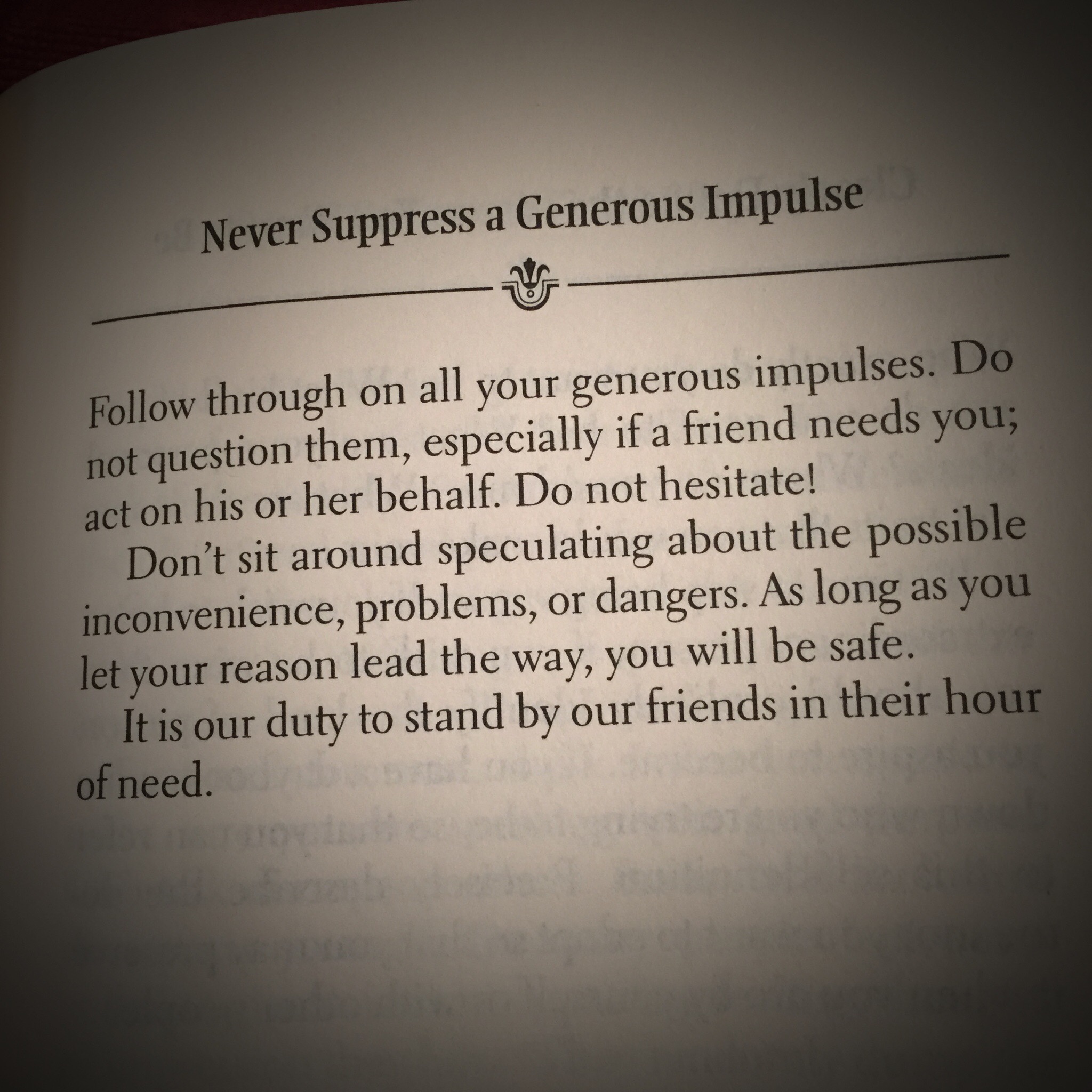
From Epictetus, in Sharon Lebell’s excellent collection of his sayings, The Art of Living:

IMG_5926.JPG

I spend a lot time with college students, and many of them invest a disproportionate amount of mental and emotional energy worrying about what they want to be.

What if, instead, they focused more on who they want to be, on the kind of character and disposition they want to mark their lives?

People of my generation, though, are mostly resigned to what they do. (It’s never too late to rethink that, however.) Yet, who you are matters much more than your job or your career path.

You have the power to make yourself into the person you want to become. Be clear about the kind of person that is. Envision your ideal self in as much detail as you can – habits, demeanor, character. Write down a description of that person. Keep it in a journal or in your computer or on your phone.

Read about people you admire. Seek out mentors and kindred spirits. Fill your mind with what you’re aiming for.

And start acting like you already are who you want to become. Live your way into the person you deserve to be.

You won’t regret being generous

Epictetus in The Art of Living:
IMG_5866.JPG

My 10-year-old will still occasionally remind me of the time a few years ago when she saw me decline a stranger’s request for a couple of dollars. I was in a hurry and didn’t want to be bothered to fish around in my wallet for a guy on the street I would never see again.

My daughter was surprised, and clearly disappointed, I didn’t help the man. I regret the message that sent to her. I regret my failure to model generosity in front of her.

I have never regretted being too generous, though. When you consider an impulse to give, in money or service, see how it feels to up the ante, to offer even more than you think reasonable.

My wife is good like that. I will suggest a reasonable, safe gift, and she will trump it with an offer to do even more. And then I think, “Of course! Why not do better and give more if we can?”

Honor your impulses to do good, to give, and to be kind.

Sunday morning Stoic: Perspective

Meditations 9.32:

“You can discard most of the junk that clutters your mind—things that exist only there—and clear out space for yourself:
… by comprehending the scale of the world
… by contemplating infinite time
… by thinking of the speed with which things change—each part of every thing; the narrow space between our birth and death; the infinite time before; the equally unbounded time that follows.”

I remember even years ago walking into work, feeling burdened and stressed by whatever seemed pressing at the time, and visualizing a view from above. Like in a dramatic scene in a movie, the picture in my mind would zoom out from wherever I was and let me see just how small I was until I was the size of an ant scurrying across this grand landscape. And then I couldn’t help but smile at the foolishness of my little worries.

When you fly and look out the plane window you can get the same sense of the smallness and insignificance of whatever petty concerns are tugging at you.

Seeing the really big picture – from the vast scale of the universe to the fleeting nature of our experience of it – can restore perspective and shine a light on the insanity of our daily worries.

If it freaks you out a bit to be reminded how small we are, how brief our time here is, welcome to reality. But it’s important, also, to appreciate how special it is that we can even think at all and ponder and marvel at our place in this perplexing, magnificent universe.

Imagining a better future


IMG_1264

I just started reading Zero to One, the new book by entrepreneur Peter Thiel. He opens the book with this contrarian question he asks in job interviews: “What important truth do very few people agree with you on?”

He’s usually disappointed by the answers. He says a good answer takes this form: “Most people believe in x, but the truth is the opposite of x.” He goes on to say that good answers to the question can point us to the future:

“But what makes the future distinctive and important isn’t that it hasn’t happened yet, but rather that it will be a time when the world looks different from today. In this sense, if nothing about our society changes for the next 100 years, then the future is over 100 years away. If things change radically in the next decade, then the future is nearly at hand. No one can predict the future exactly, but we know two things: it’s going to be different, and it must be rooted in today’s world. Most answers to the contrarian question are different ways of seeing the present; good answers are as close as we can come to looking into the future.”

I was 5-years-old when Apollo 11 landed on the moon. I assumed we would all have flying cars and be living in a completely peaceful and prosperous Jetsons-like world by the time I was 50.

But progress in our time has been mostly iterative, fine-tuning of previous breakthroughs, not revolutionary. Cars are a little safer and more comfortable and a bit more energy efficient than when I was a kid, for example. Communication technology has been the exception.

I’m inspired by the possibility of what could be if we put our intellectual horsepower to work on asking better questions about the future.

What do we take for granted that needs challenging? What basic assumptions are just wrong? What could the world look like 50 years from now if we stretched our collective imagination for the best possible options for humanity and all life on this planet?

What is an important truth that most of us are just wrong about?

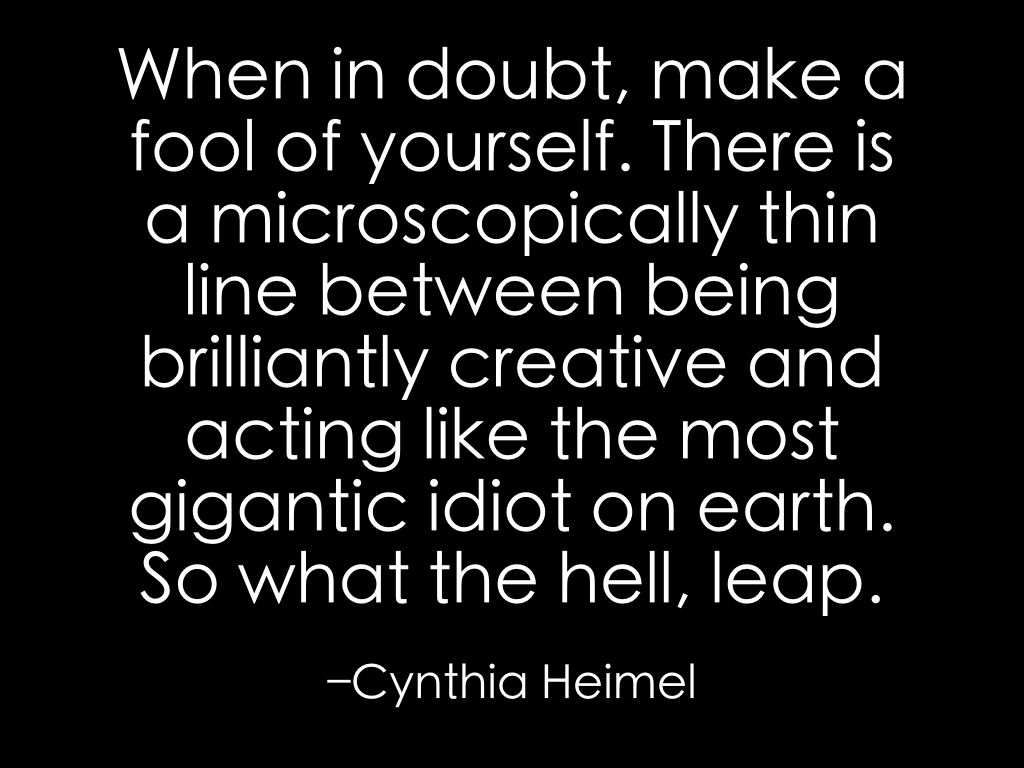
Make a fool of yourself

“Compulsive avoidance of embarrassment is a form of suicide.” –Colin Miller

Austin Kleon shared this quote in his excellent, short book, Show Your Work!

To risk being vulnerable takes courage, and there’s no guarantee of success to reward your courage. In fact, failure and disappointment are more likely than success when you attempt hard things and open yourself to disapproval and even ridicule.

But not much good will come from the safety and caution of avoiding embarrassment. Keep flinching and you risk dousing the creative fire inside you.

I’m too proud of how cool I am, or appear to be. Throw off your coolness. Make a fool of yourself if you have to to bring out your best self and your best work.

And cheer for and stand up for those with the guts to risk embarrassment in their attempt to be or do something excellent.

IMG_1263.PNG

The magical math of marriage

IMG_1261.JPG

I was intrigued by this book on marriage and ordered it last week. It just arrived, and I haven’t started it yet. I have not read many books on marriage. But I’m looking forward to thinking more clearly about how my wife and I can make our marriage even better.

I want to be more intentional about nurturing the most important relationship in my life. It’s easy to let the crush of busyness and routine, especially with two genuine, full-speed kids ruling our schedules, keep us from making space for our marriage.

I heard Joseph Campbell say that the key for a successful relationship is to put the marriage ahead of any individual interests. The marriage is a separate, unique entity. You don’t make sacrifices for the other person; you do it for the marriage, something bigger than even the two of you separately. And what we have together is more dynamic and has more creative potential than what either of us can realize on our own.

That’s some magical math. It’s synergy, where the whole is greater than the sum of the parts. 1+1 is somehow more than two.

Strong relationships are possibility machines.

Strong relationships are possibility machines, in families and business and in friendships. It’s worth making the effort to examine and nurture the most important relationship of all. Honoring my marriage will pay dividends to my kids. Loving my wife well is as much a gift to my kids as anything I could do for them directly.

What will matter most, what will mark the true success of our lives, is the quality of our most significant relationships.

Toughen yourself

Looking back through my highlights in Ryan Holiday’s The Obstacle is the Way, I found this:

You’ll have far better luck toughening yourself up than you ever will trying to take the teeth out of a world that is—at best—indifferent to your existence.

It’s the same sentiment as this from Ramana Maharshi:

WANTING TO REFORM THE WORLD WITHOUT DISCOVERING ONE’S TRUE SELF IS LIKE TRYING TO COVER THE WORLD WITH LEATHER TO AVOID THE PAIN OF WALKING ON STONES AND THORNS. IT IS MUCH SIMPLER TO WEAR SHOES.

Setting out to change the world seems noble, but the direct path to epic transformation is as simple as changing yourself, steeling yourself against the blows that are bound to come in this world. And helping others do the same would surely change their world.