Author: Eric Johnson
"The best way to know the truth or beauty is to try to express it."
Sagan’s Pale Blue Dot sermon, animated
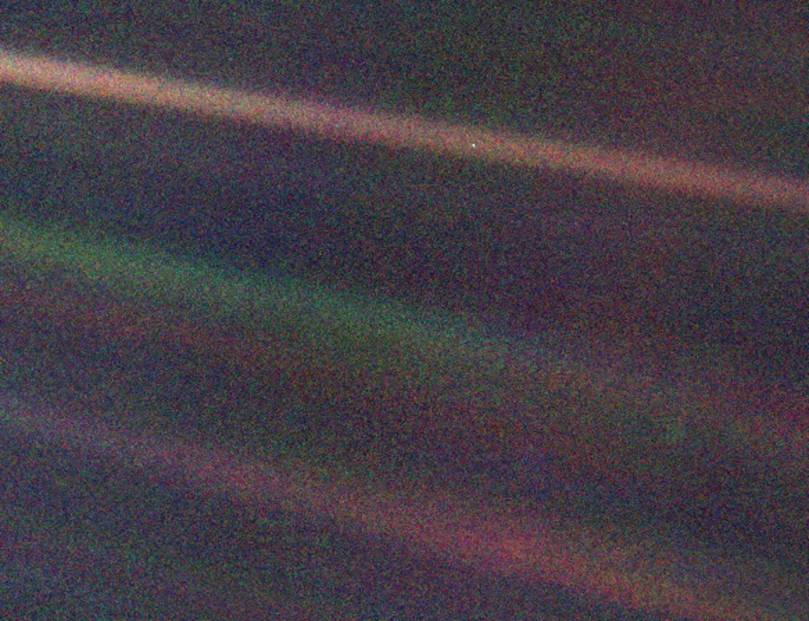
In 1990 the Voyager I spacecraft was leaving our solar system, and at Carl Sagan’s suggestion the mission team had it turn and take a photo of Earth from 4 billion miles away — the ultimate long-distance selfie.
That’s us in that photo, that tiny speck of reflected light near the top — a pale blue dot suspended in a sunbeam.
That image inspired Sagan to write one of the most profound pieces of writing I’ve ever read, this passage from his book, Pale Blue Dot:
Look again at that dot. That’s here. That’s home. That’s us. On it everyone you love, everyone you know, everyone you ever heard of, every human being who ever was, lived out their lives. The aggregate of our joy and suffering, thousands of confident religions, ideologies, and economic doctrines, every hunter and forager, every hero and coward, every creator and destroyer of civilization, every king and peasant, every young couple in love, every mother and father, hopeful child, inventor and explorer, every teacher of morals, every corrupt politician, every “superstar,” every “supreme leader,” every saint and sinner in the history of our species lived there-on a mote of dust suspended in a sunbeam.
The Earth is a very small stage in a vast cosmic arena. Think of the endless cruelties visited by the inhabitants of one corner of this pixel on the scarcely distinguishable inhabitants of some other corner, how frequent their misunderstandings, how eager they are to kill one another, how fervent their hatreds. Think of the rivers of blood spilled by all those generals and emperors so that, in glory and triumph, they could become the momentary masters of a fraction of a dot.
Our posturings, our imagined self-importance, the delusion that we have some privileged position in the Universe, are challenged by this point of pale light. Our planet is a lonely speck in the great enveloping cosmic dark. In our obscurity, in all this vastness, there is no hint that help will come from elsewhere to save us from ourselves.
The Earth is the only world known so far to harbor life. There is nowhere else, at least in the near future, to which our species could migrate. Visit, yes. Settle, not yet. Like it or not, for the moment the Earth is where we make our stand.
It has been said that astronomy is a humbling and character-building experience. There is perhaps no better demonstration of the folly of human conceits than this distant image of our tiny world. To me, it underscores our responsibility to deal more kindly with one another, and to preserve and cherish the pale blue dot, the only home we’ve ever known.
As they say here in the south, “That’ll preach.” Meaning, basically, RIght on, brother!
I can’t imagine a finer sermon to inspire wonder and appreciation and perspective.
Farnam Street shared this lovely animation accompanying Carl Sagan’s narration:
Excellent.
Lawrence of Arabia on happiness

What triggers a flow state for you? Can you make that happen more often?
More happiness is there to be tapped, and it’s those flow states where you’re most likely to produce remarkable work, meaningful art, and deep connection with others.
Presenting? Rehearse, out loud.

I gave a new presentation at a conference last weekend. I had been unsure about how it was going to be received. The topic was more esoteric than I usually do for a conference session. And in the days leading up to the session, I still wasn’t “feeling” it. My ideas and the narrative structure were not quite clicking into place.
But, the morning of my session I got up early, went out to breakfast with my iPad, and made a couple of tweaks to the structure that did begin to make it all click. It was a “Duh, why didn’t I see that before” moment. Weeks of stewing on a topic can have you just treading water, but the urgency of a shipping date can force clarity.
Then I found the meeting room where my presentation would take place later that morning. The projector was already set up and on for a session that was to start in the room an hour later. So I dicconnected the hotel PC, hooked up my iPad, and quietly rehearsed with my slides, working an empty room in my t-shirt and shorts. And I walked out finally “feeling” it, ready to go on just a couple of hours later.
I used to scoff at the thought of rehearsing a presentation. But a college speech professor emphasized it so much I gave it a go for a speech in his class. And I was surprised at how transformational it was. Saying my presentation in advance, out loud, just as I would with an audience, helped smooth out the transitions and find flaws and opportunities and even good jokes that I wouldn’t have if I had just gone over the notes in my mind.
And that happened last weekend again. I should have started talking this presentation out much earlier in the process, especially with new material. If I had rehearsed even a few days sooner, I doubt I would have struggled as much with having this talk click for me.
If you’re giving a talk or leading a meeting or performing for others in any way, make time to rehearse it, out loud. Find the room you’ll be in if you can. If not, any space will do where you can practice without feeling self-conscious.
I don’t know if my audience last Saturday left any better for having been in my presentation. (Surveys will come in later.) But I left feeling that I had given good energy and thoughtful insight, and it seemed I had made a genuine connection wtih the people in the room.
Leaving with that feeling wouldn’t have been likely had I not walked in with the confidence that only solid preparation and rehearsal can provide.
Your path
“If you can see your path laid out in front of you step by step, you know it’s not your path. Your own path you make with every step you take. That’s why it’s your path.” –Joseph Campbell
Excellent.
The supreme excellence

My presentation today: Do less, better

I’m presenting at a conference today. I’m posting a PDF of my slides here for those in the session or for any who are interested.
I use slides to support what I say, not to make what I say redundant. So, seeing my slides is not the same as seeing the presentation.
Conference organizers tend to ask presenters to send their “presentation” ahead of time. Well, that can’t really be done. A live presentation is the unique dynamic of the speaker and the audience. So, to satisfy the request for slides in advance, I did create a set of slides to serve as a sort of preview for this talk. These can stand on their own.
Ants marching
 Whether you’re doing things right or just doing things to stay in step with the crowd, to stay busy and to complain (or brag) about being busy, it’s pointless if you’re not doing the right things.
Less is more

Beautifully empty
Our living room right now:  We are not moving. We just had our floors repaired after our water heater died and tried taking as much of the rest of the house with it as it could.
We’ve been in this house for thirteen years. In spite of the hassle of fixing the floors, it’s worth it for the delight of seeing this floor look like new again.
But now I’m loving the stark emptiness. I’m not eager to have our furniture and stuff returned to where it was.
Of course, it’s not a museum piece. We live here and need somewhere to sit.
Or do we?
The photo above reminded me of this famous photo below of a young and newly rich Steve Jobs, who was so loath to possess anything of merely average beauty that for a while he lived with just this Tiffany lamp and his stereo in his living room:

Showing my work: Analog color
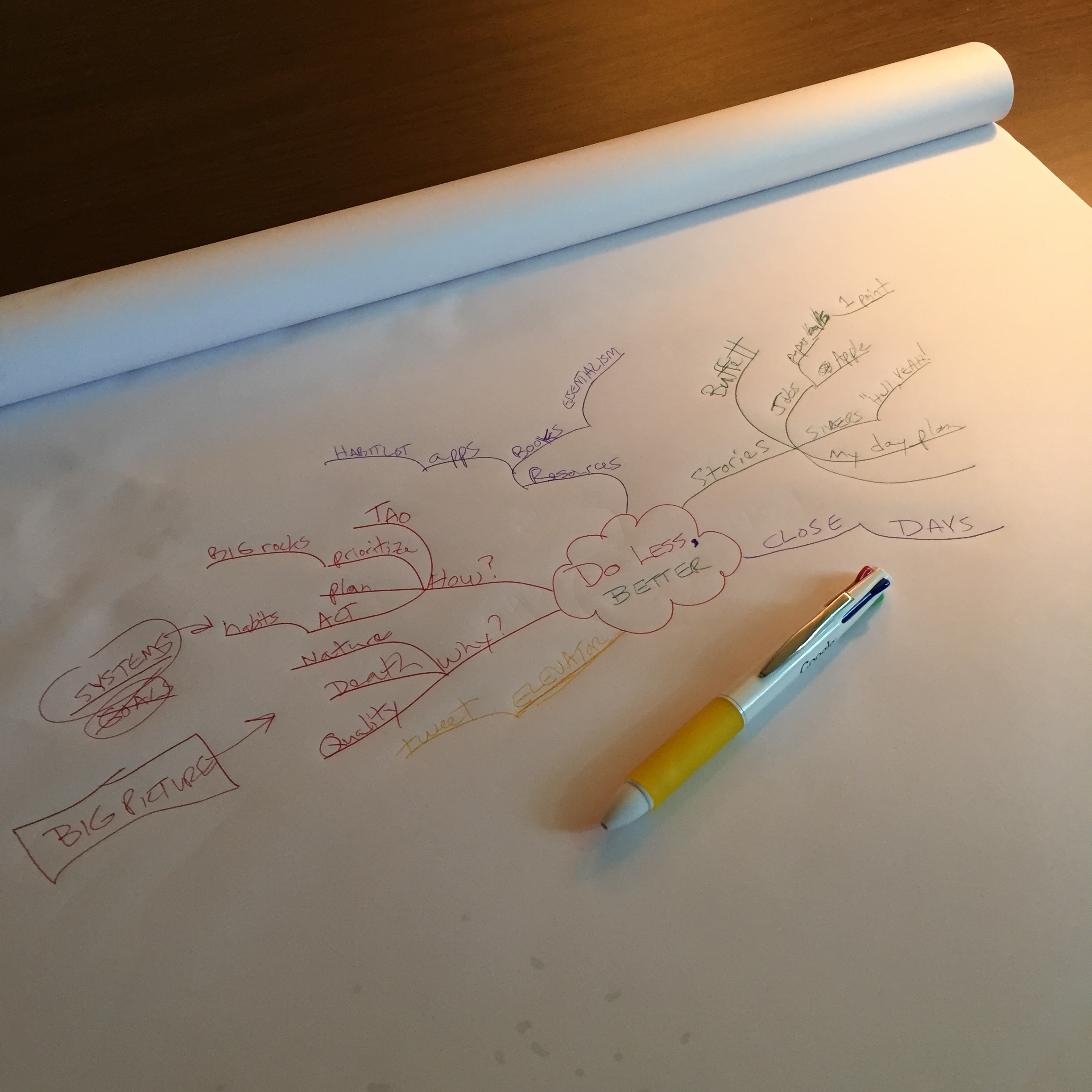
I’m leading an educational session at a conference this week. It’s a first for this topic for me, and I don’t feel I’ve found my framework yet. It just hasn’t clicked.
I’ve floundered around with digital tools — Keynote, Mindnode, text editors — but the flow hasn’t come yet.
So, today I turned around to my desk, away from my Mac, and took my multi-colored pen to actual paper and mind-mapped my ideas. And they flowed better than at any time in my thinking on this topic.
Analog before digital. Why can’t I stick to that?
It’s still not there yet. I’m imagining people sitting in my session wondering why they chose it and what the heck I was trying to accomplish. But I’ve done this enough times to know that something at least partially intelligible and maybe even meaningful will come out of me.
Priming my creativity with a pen in hand, some color, and a big sheet of paper is a reliable way to force some flow.
Now, I’ve got to gather up those thoughts and string them together in a way that sparks some kind of transformation in my audience. What’s the point otherwise?
“The only reason to give a speech is to change the world.” –John F. Kennedy
Small mercies
The power of low expectations and the joy of “small mercies”:
“I am thankful for small mercies. I compared notes with one of my friends who expects everything of the universe and is disappointed when anything is less than the best, and I found that I begin at the other extreme, expecting nothing, and am always full of thanks for moderate goods.” –Ralph Waldo Emerson
via BrainPickings
If I’m expecting the universe to grant me a great parking space or extravagant prosperity or fairy tale love, I better get used to disappointment.
The universe is busy spinning galaxies into infinity and keeping my atoms together so I can go on being me for a little while longer.
But wonders abound, and I just need to see and be grateful for the small joys I continually stumble across every day.
I’m thankful for a car to park anywhere, my average middle-class comfortable prosperity, and my sweet, everyday-joy kind of love.
Small mercies and authentic wonders can fill a day — and a life’s worth of days — with the best the universe has to offer.
Sunday morning Stoic: A formula for savoring life
The author William Irvine (whose book, A Guide To The Good Life, is a great introduction to Stoic thought) shared the Stoic formula for happiness in this post on Stoicism Today.
Here’s the formula: X = the number of days you have left to live
It’s not exactly a formula, just a reminder that each of us has a finite, unknown number for X. Keeping this thought in mind daily, knowing the end of this day reduces X by 1, can offer perspective that makes each day richer and more meaningful.
Irvine goes on to suggest another helpful formula: X = the number of times you will do something in the remainder of your life
You have X number of times left to call your mom or kiss your love or hug your kid or eat Green & Black’s organic 85 percent cacao dark chocolate.
As you do a thing, if you for a moment imagine it might be the last time you do it, you will experience it more mindfully, more vividly. It turns autopilot off, even if for just a second or two.
I took my daughters to the swimming pool yesterday. As they were clamoring for me to jump in and join them, I paused at the edge of the deep end of the pool, my toes poised on the edge of the warm cement, and imagined this would be my last time ever jumping into water. And then I stepped off and truly saw my feet splash in first and felt my body drop into the cool water and the delightful sensation of floating. The slight sting in my nose and eyes. The feeling of defying gravity for a moment. It was a joy. And, of course, it wasn’t the last time. I jumped in several times yesterday, but the only one I can recall clearly was the first jump which I had imagined as my last jump ever.
I think even a small moment here and there thinking in this way could have a big impact on your daily joy.
And as Irvine suggests in his post, it can encourage you to create more moments worth savoring:
And there is another important thing to realize about the above formula: you probably have it in your power to turn X into X+1! You need only go out of your way to do something one extra time. At this very moment, there are X more times you will kiss the person you love. But if, as the result of reading this, you go give him or her a kiss that you otherwise wouldn’t have given, you will increase this number to X+1. And chances are you will have fun doing it!
Busy Saturday
“BEWARE THE BARRENNESS OF A BUSY LIFE.
—Socrates”
My busy Saturday today centers around two key commitments with my daughters: the pool this afternoon and the movie Tomorrowland tonight. I might squeeze in some reading if I find some down time.
This is my kind of packed schedule.
The encouragement of noticers
My friend Alex was a student on my staff a couple of years ago when he came to me and asked why I, at that time, posted on this site so infrequently.
I was surprised he was aware I even had this blog, much less that he cared how often I wrote. But he challenged me to write more often. He liked reading my stuff.
That conversation sparked a much more consistent writing habit for me. It’s one thing to share your writing publicly. It’s so simple now to publish and post and share on the internet. It’s another thing altogether to write with the expectation that someone actually will read it and care.
Before that conversation with Alex I had been writing without much awareness of an audience. There is great value in writing to better understand what you think, without regard to any audience. But writing with readers in mind will sharpen your thinking and your prose.
I said this last year (which was paraphrased from something I had read online somewhere):
Kind of like how you clean your house so much better when you’re expecting company, writing something with the awareness that others might read it will lead to clearer thinking and better work.
Today happens to be Alex’s birthday. We had lunch together today, and he reminded me again that he’s continuing to read my stuff. And I was reminded how potent an encouraging challenge from a friend can be.
And I’m also reminded that I need to be a more diligent noticer of the art and craft and kindness of others. I need to be like Alex more often (and Tim and Trey and Angie and Emily and other friends who regularly notice my work) and challenge those whose work I admire to offer their best.
Make art, people. Express yourselves. Do your part to make sense of it all and to enjoy the ride we’re all taking together.
Change happens
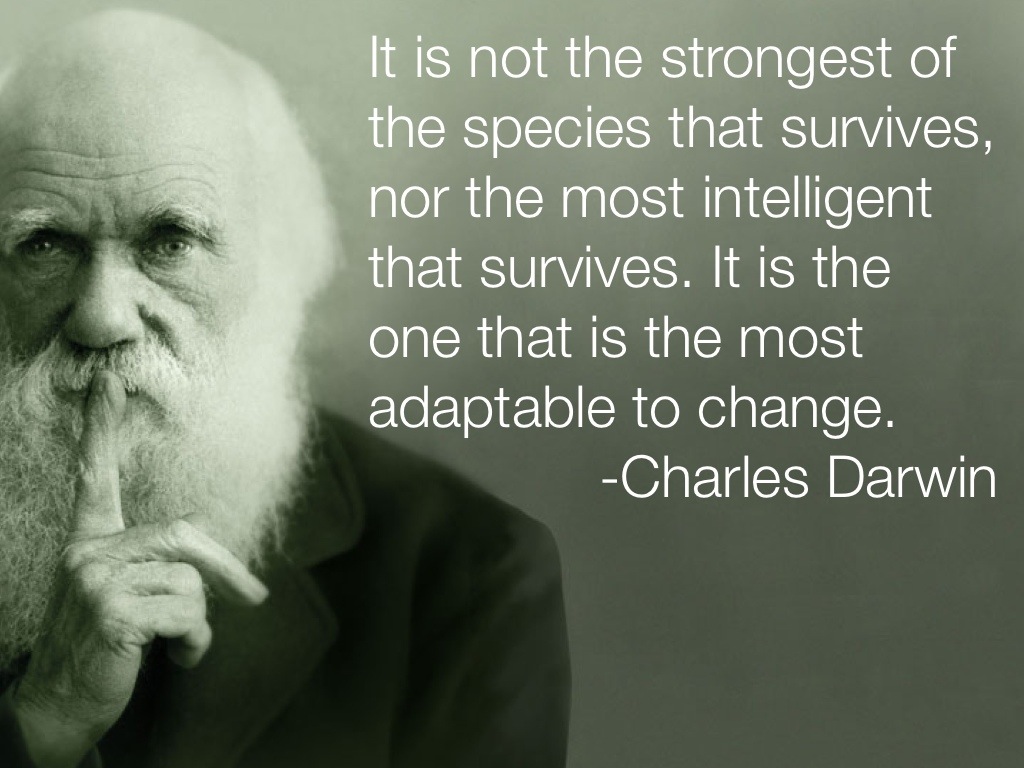
My work team had a facilitated workshop today on the subject of change.
One of my colleagues, when asked by the facilitator for his first reaction when thinking about upcoming change, simply responded with “Resistance is futile.”
Exactly.
Change is the constant of reality. Accept what comes. You don’t have to like it. But, you get to choose your response. Resistance is a futile response.
Be like water. Flow with, around, over the obstacles bound to come your way.
Don’t just survive. Master change to thrive.
Don’t hold back when you present
I gave a couple of presentations already this week. Both were somewhat informal. No slides. Fewer than 25 in each group.
Today I was Skyped into a student staff meeting at Stanford. That was a first for me. It’s an odd experience to not be physically in the room with the audience. It was a challenge to read the room as I was staring at a fuzzy image on my computer screen while talking in a louder voice than normal, trying extra hard to be heard far away on the west coast. The faces were somewhat pixelated (or maybe that’s just how people in Palo Alto look), so I couldn’t rely on the subtle feedback cues of expressions and body language that I usually adjust my energy to during a talk.
I left both presentations this week, though, feeling satisfyingly drained. I don’t know if what I said connected, or if I made a difference in any way. There were no surveys to give me direct feedback. I seemed to be received warmly and thanked enthusiastically, but the satisfaction for me was intrinsic. I just enjoyed the experience and felt that I gave both audiences something worthwhile.
If I finish a presentation and don’t immediately feel the need to sit and chill for a few minutes, then I know I probably didn’t give enough energy to the effort. And energy can make up for a lack of eloquence or clumsy structure or even lame slides. (But don’t make lame slides.)
Care enough to uncork enthusiasm and give your audience all you can. It takes courage. Enthusiasm and caring somehow seem risky and vulnerable. But it’s a low risk and one, unfortunately, too few presenters take.
Don’t hold back next time you present. Don’t give in to caution and the inner voice of resistance that wants to keep you safely mediocre and forgettable. Be awesome instead.
David Letterman and the power of turning obstacles into fuel
I’m of the Letterman generation. I began college the same year Late Night debuted on NBC.
Better observers of television and comedy have better summed up why Letterman is significant. (I love Jimmy Kimmel’s take.) But to me he was just real. He didn’t treat television like it was a big deal, and he didn’t treat people who thought they were a big deal like they were a big deal.
His show was irreverent and unpredictable and fun. His timing and self-deprecating humor and wry asides influenced the way I communicate and attempt humor and the way I respond to others. I’ve realized even some of my facial expressions are Letterman inspired.
I listened to Jason Snell’s The Incomparable podcast about Letterman yesterday on a long drive home from the holiday weekend. The podcast was really well done and right in the wheelhouse of someone who would regularly stay up late in the dorm lobby to catch at least a portion of Late Night.
The podcast reminded me that when Letterman got the Late Night gig airing immediately following The Tonight Show, Johnny Carson’s team at NBC put some restrictions on what Letterman could do on his show. He could have no more than four band members and could tell only four jokes in his monologue. They wanted to protect their turf at The Tonight Show and not risk some young upstart stealing their stuff.
But Letterman used those restrictions to reinvent the talk show and to come up with something unique to him. Bizarre, wacky, occasionally cringe-inducing, but so refreshingly unique.
Years later when Carson retired, everyone assumed The Tonight Show would go to Letterman. It was Letterman’s dream, and Carson saw him as his natural successor. But the suits at NBC gave the job to Jay Leno instead.
Again, though, Letterman ended up embracing this setback and used that disappointment to do something better. He moved to CBS, started The Late Show, and competed head-to-head with The Tonight Show.
But he got to stay in New York and keep doing his unique version of a talk show, just on a bigger stage and an hour earlier. He’s even said that if he had been given The Tonight Show, he probably would have just followed Carson’s formula out of respect for the institutions that The Tonight Show and Carson were.
It was the restrictions and the disappointment and the obstacles that Letterman used to shape himself and his show into the cultural forces they became. He didn’t end up winning the ratings war, but his influence resonates as no other television personality’s has since Carson.
Heartbreak? Disappointment? Obstacles in the way? Dream job falls through? Accept a bad turn of events as if you had chosen it to happen that way. Then get busy transforming that setback into previously unimagined possibilities. Turn your obstacles into fuel to propel you further and higher.
Apple’s new iPhone dock
A dock came with the first couple of iPhones. There was one in the box with my iPhone 3G in 2008.
It was a nice touch and gave the phone a home, a more definite sense of place. And it was more of an incentive to just put it away when you got home.
But docks went away as an Apple option eventually. Third party solutions have been available, but there’s been nothing from Apple in the Lightning connector era.
But last week Apple announced a new dock to fit all the Lightning connector devices. That’s the iPhone 5, 5s, 6, and 6 Plus. Apparently, even iPads will fit.
I ordered a couple as soon as I saw them available and got them this weekend.
Here’s my wife’s iPhone 6 (sporting the new red Apple leather case I just got her for Mother’s Day) in the new Apple dock: 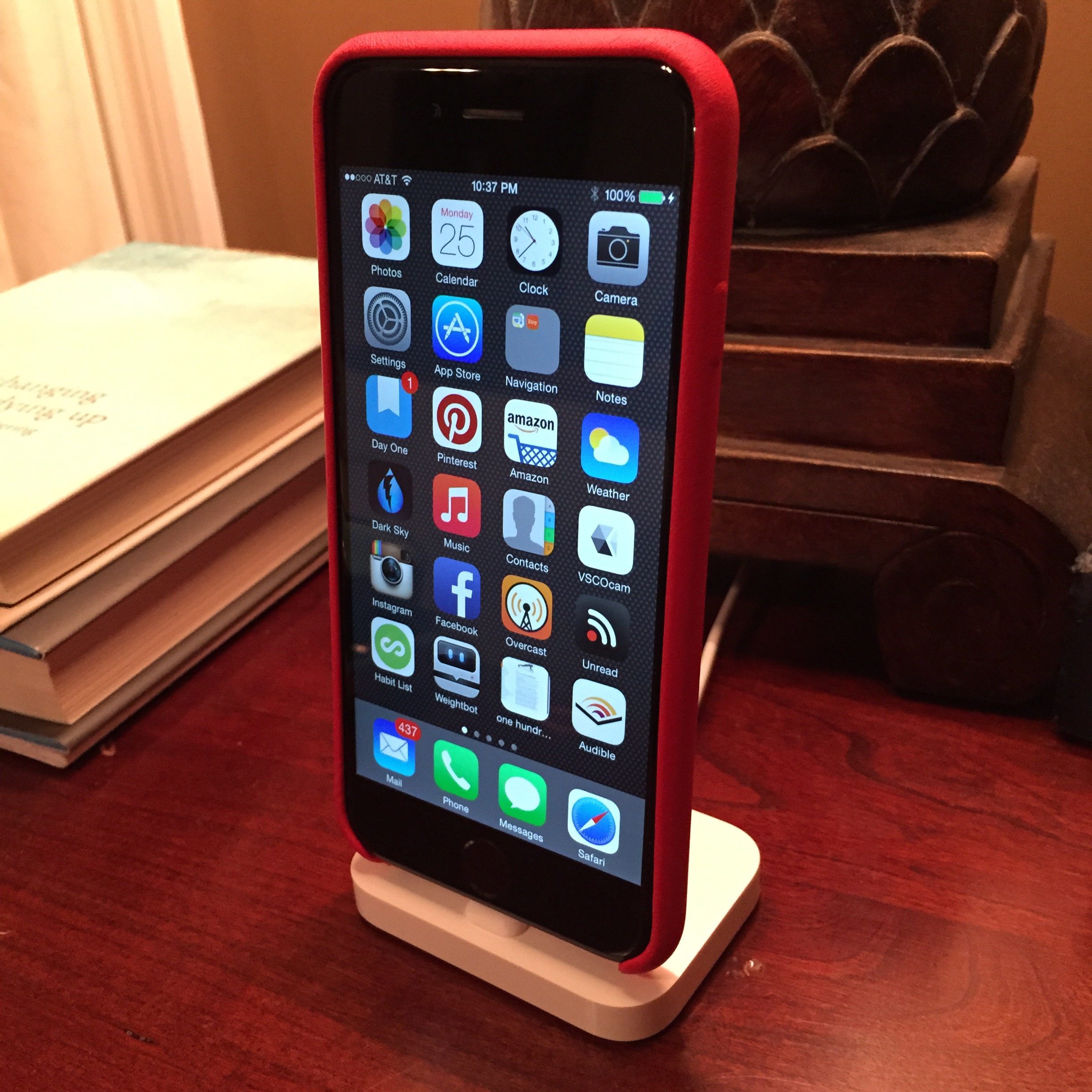
The dock is very simple and offers a minimalist, elegant alternative to just laying the phone on a nightstand or desk. Even with the case on the phone fits perfectly onto the dock. It’s easy to connect one-handed, but it’s not so easy to disconnect without using two hands.

The dock itself is barely there, with just enough of a form to fulfill its function. No flourishes. Nothing unnecessary. Classic Apple design for even a lowly phone dock.
“A place for everything, and everything in its place.” This new dock is a simple way to fulfill that declutterer’s mantra and give your iPhone a place to call home.
Sunday morning Stoic: The shortest route
Meditations 4.51:
“Take the shortest route, the one that nature planned—to speak and act in the healthiest way. Do that, and be free of pain and stress, free of all calculation and pretension.”
No games. Don’t overthink. Just say what is essential. Do the right thing.

