On belief

I came across this post today and found this insightful, provocative statement on belief:

“Believing something is not an accomplishment. I grew up thinking that beliefs are something to be proud of, but they’re really nothing but opinions one refuses to reconsider. Beliefs are easy. The stronger your beliefs are, the less open you are to growth and wisdom, because “strength of belief” is only the intensity with which you resist questioning yourself. As soon as you are proud of a belief, as soon as you think it adds something to who you are, then you’ve made it a part of your ego. Listen to any “die-hard” conservative or liberal talk about their deepest beliefs and you are listening to somebody who will never hear what you say on any matter that matters to them — unless you believe the same. It is gratifying to speak forcefully, it is gratifying to be agreed with, and this high is what the die-hards are chasing. Wherever there is a belief, there is a closed door. Take on the beliefs that stand up to your most honest, humble scrutiny, and never be afraid to lose them.” –David Cain

We all have believed things that turned out not to be true, from small inconsequential trivia to major life-shaping philosophies. Santa and fairies and such just don’t work as reasonable options for most adults.

There are 7 billion people on this planet. Consider all the conflicting beliefs that exist, all the misplaced certainty. All the meanness and pain and wasted opportunities spent on cherished beliefs.

I remember arguing passionately when I was in college for beliefs that I now no longer hold. As I’ve aged and grown in knowledge, and I may be an exception, believing has been less of a force in my life. I would rather know something than believe it. And that ends up leaving me with a lot more questions than answers. While I may no longer have the fixed stars I once used to navigate through life with, I’m okay with the mystery, with not knowing.

It is harder, though. Having your beliefs locked in is much easier. Less thinking required. And it’s kind of cozy and comfortable and safe. But, it’s also a lot less interesting, and, ultimately, it’s not real.

It’s okay, healthy and normal, exciting even, to question what simply has been handed to you as truth and move further into not-knowing. It takes courage to ask tough questions, but if a belief can’t withstand honest inquiry, it’s not worth holding on to.

One day left for my charity: water campaign

Tomorrow is the last day to donate to my charity: water birthday campaign.

I came across charity: water after seeing a video of founder Scott Harrison’s dynamic presentation telling his story and explaining how the charity got started. This charity, unlike many non-profits, is aggressively transparent and promises that all donations go directly to serve its primary purpose: providing clean water for those who otherwise would not have it. Administrative costs are paid through separate fundraising efforts, and individual contributors are sent follow up details of exactly where their money was spent, including GPS coordinates for wells.

And charity: water has created a brand identity that compares favorably with some of the best in the for-profit sector. Their birthday campaigns, where donors give up their birthday celebrations for charity: water, have been a touchstone for raising the profile of their cause and tapping into social media to spread the word.

There’s a very interesting long article in today’s New York Times profiling Scott Harrison and his efforts to get people of influence and means on board.

Consider giving up your next birthday. I’ve enjoyed connecting with friends and family through my birthday campaign, and it’s been rewarding to see several who contributed to my effort also pledge to give up their next birthday.

And, if you’re so motivated, you’ve got until midnight tomorrow to add to my birthday campaign.

charity: water

Planets everywhere

This recent New York Times piece, A Universe Full of Planets, is astonishing. We’ve always speculated about life elsewhere in the universe, but it just wasn’t possible to see any planets out there. And even if there are planets around other stars, what are the odds any of them would have the fortunate qualities that sparked life on our home planet?

Well, now we can see that there are plenty of planets outside of our little solar system. Even more, we can identify that a significant number are quite similar to Earth:

No matter how conservative or optimistic we are, the statistics tell us that something like an astonishing one out of every seven stars must harbor a planet similar in size to the Earth, and at roughly the right orbital distance to allow for the possibility of a temperate surface environment. In other words, roughly 15 percent of all suns could, in principle, be hosting a place suitable for life as we know it.

Since our galaxy contains at least 200 billion stars, this implies a vast arena for the universe’s ubiquitous carbon chemistry to play in — a process that, as here on Earth, might lead to the complex machinery of life. Indeed, there is a 95-percent confidence — give or take a few percent — that one of these worlds could be within a mere 16 light years of us. That’s a stone’s throw, practically our galactic backyard.

Fifteen percent of stars might have Earth-like planets? Wow! Imagine that our technology and science advance enough in the next few decades to see even more clearly the planets that might be closest to us. To discover that we are not alone, even if the cosmic distances remain too prohibitive to ever make direct contact, would have a profound effect on our species.

It would be humbling and cause quite a shift in our self perception. And it would be as exciting and as inspiring as anything that’s ever happened on this little planet of ours.

20130807-220712.jpg

Read good books. Get smarter.

I really enjoyed this recent post on the Farnam Street blog: The Buffett Formula – How To Get Smarter.

Warren Buffett and his partner, Charlie Munger, have done something right in their careers. They attribute much of their success and a lot of their time to one key activity: reading.

Warren Buffett says, “I just sit in my office and read all day.” What does that mean? He estimates that he spends 80% of his working day reading and thinking.

“You could hardly find a partnership in which two people settle on reading more hours of the day than in ours,” Charlie Munger commented.

When asked how to get smarter, Buffett once held up stacks of paper and said “read 500 pages like this every day. That’s how knowledge builds up, like compound interest.”

The reading they recommend is deep and challenging, not news and Twitter updates. I’ve got a stack of great books piled up in my iPad, but I need to be more intentional and structured about digging into and finishing them, not just grazing randomly through portions.

Reading good books throughout my life has affected my worldview and my character more than any other activity. As a new academic year begins this week, I’m going to put together my own personal syllabus for getting smarter and reading books that spark new possibilities.

20130806-225905.jpg

Beginner’s mind

Today was “meet the teachers” day at my kids’ school. Tomorrow is the last day of summer break. Rather than being sad, my girls are excited. (For now…)

A new school year is a new beginning. New teachers. Different classmates. New possibilities. I remember the little thrill even of picking out school supplies.

“In the beginner’s mind there are many possibilities. In the expert’s mind there are few.” -Shunryu Suzuki

In the real world we lose a bit of that built-in reset each year that comes with the academic calendar. A regular reset, a return to a beginner mindset can rejuvenate and awaken.

It’s worth manufacturing an opportunity regularly to rethink your work and your personal or family life every three or four months, or at least a couple of times a year. A retreat, an event, a built in breather to assess and plan and dream. Discard old habits, try new ones, and imagine some “what ifs” that just might change everything.

A small daily task

Cal Newport has a post today about Woody Allen’s prolific productivity. The man is a movie making machine, having written and directed 44 movies in 44 years.

Allen works a few hours every day on what he considers his most worthwhile effort: writing. Like Jerry Seinfeld, he’s committed to sitting down day after day to make something. A little bit of quality effort done consistently over time can produce something of great value.

It can seem overwhelming to consider getting from where you are now – in a project or a dream or your life – to where you want to go. But if, instead, you just take a little bit of action, and do it every day, you might surprise yourself with what you can do or become. Do your work, the work you think is most valuable, and do it daily. It might sneak up on you, but awesome is usually not an overnight sensation.

20130804-220006.jpg

On kindness

I just read this lovely, short speech by author George Saunders. He’s addressing the Syracuse University class of 2013 and avoids the typical exhortations and conventional tips on how to be successful. Instead, he discusses his greatest regret: failures of kindness.

“What I regret most in my life are failures of kindness.

Those moments when another human being was there, in front of me, suffering, and I responded…sensibly. Reservedly. Mildly.

Or, to look at it from the other end of the telescope: Who, in your life, do you remember most fondly, with the most undeniable feelings of warmth?

Those who were kindest to you, I bet.

It’s a little facile, maybe, and certainly hard to implement, but I’d say, as a goal in life, you could do worse than: Try to be kinder.” -George Saunders

Go read the whole speech. It’s short, and it’s sweet in the noblest way. And it rings true with me. Moments of regret in my life are almost exclusively a failure to be courageous with kindness. A missed opportunity to encourage, to protect, to listen to someone in their moment of sadness or pain or embarrassment.

We focus too much on “success” and productivity and achievement, but a truly good life is marked by kindness, don’t you think?

After my mom passed away, there was a line of people waiting outside the funeral home for hours just to pay their respect. I was in awe. They didn’t stand in line, though, because of her success in business or leadership in the community or any major accomplishment. They were there because she was remarkably kind, and they had countless stories to tell about her compassion and big heart. I witnessed it all my life, of course.

I vividly remember tiny moments where she pursued opportunities to be kind. A little red-haired boy that she didn’t even know was in tears on a field after a children’s soccer match, and it was my mom who sought him out with a hug and an encouraging word. She would light up with a genuine smile when an acquaintance or stranger walked in to my parents’ photography studio. She listened wholeheartedly. The twinkle in her eyes let you know you were special, that you had her complete attention. People loved the way she made them feel.

She lived a truly great, and too short, life. Kindness may not make headlines, but it makes for a life with few regrets and a legacy marked by the abundant admiration and appreciation of those fortunate to have been warmed by its glow.

Be kind. Be intentional about it. Make it your craft, your calling, your legacy.

h/t Jesse Thorn, Put This On

Jason Silva: “We are the gods now”

I can’t get enough Jason Silva. He spoke last year at The Festival of Dangerous Ideas in Sydney. His talk is provocative, entertaining, and refreshingly optimistic about our future:

I appreciate his passion and rapid-fire incitement of excitement about the wonder of being alive.

It’s about awakening the mind’s attention from the lethargy of custom and the film of familiarity and redirecting it instead to the wonders of existence. -Jason Silva

I know what we’re going to do today…

I’m off for the next six days to celebrate the end of summer with my kids. We’ve got no set plan. Yet.

But they go back to school next Wednesday, so we are going to make like Phineas and Ferb and come up with fun adventures each day until then. If you don’t know Phineas and Ferb, it’s one of the few kid TV shows I genuinely enjoy watching with my girls. It’s clever and big hearted. Phineas and Ferb are all about getting the most out of their summer, and each day they dive into remarkable adventures. Every episode begins with the sparking of a fun idea, and Phineas proclaiming, “I know what we’re going to do today!”

Imagine if every day you had an adventure worth talking about.

I_know_what_we're_gonna_do_today

A self-portrait from 900 million miles away

I saw this great photo today of Earth taken from Cassini, the spacecraft orbiting Saturn:

Earth from Cassini

Earth is the blue dot just under the rings of Saturn. This is a self-portrait from 900 million miles away.

Our home is just another smudge of light in space. It looks so small and fragile and not so impressive from this vantage point. But it’s our home and our smudge, and it’s glorious.

I keep coming back to the big picture to put my own little picture into context and give it meaning. Humans have gone from hunter-gatherers to cosmic explorers in a blink of time. Your problems got you down? They’re not so big after all when you change your vantage point.

Seeing this image made me search for Carl Sagan’s famous ode to our “pale blue dot”, as he calls the image of Earth in a similar photo from many years ago.

Here’s a lovely video with Sagan reading his famous prose reflecting on what a precious home we have:

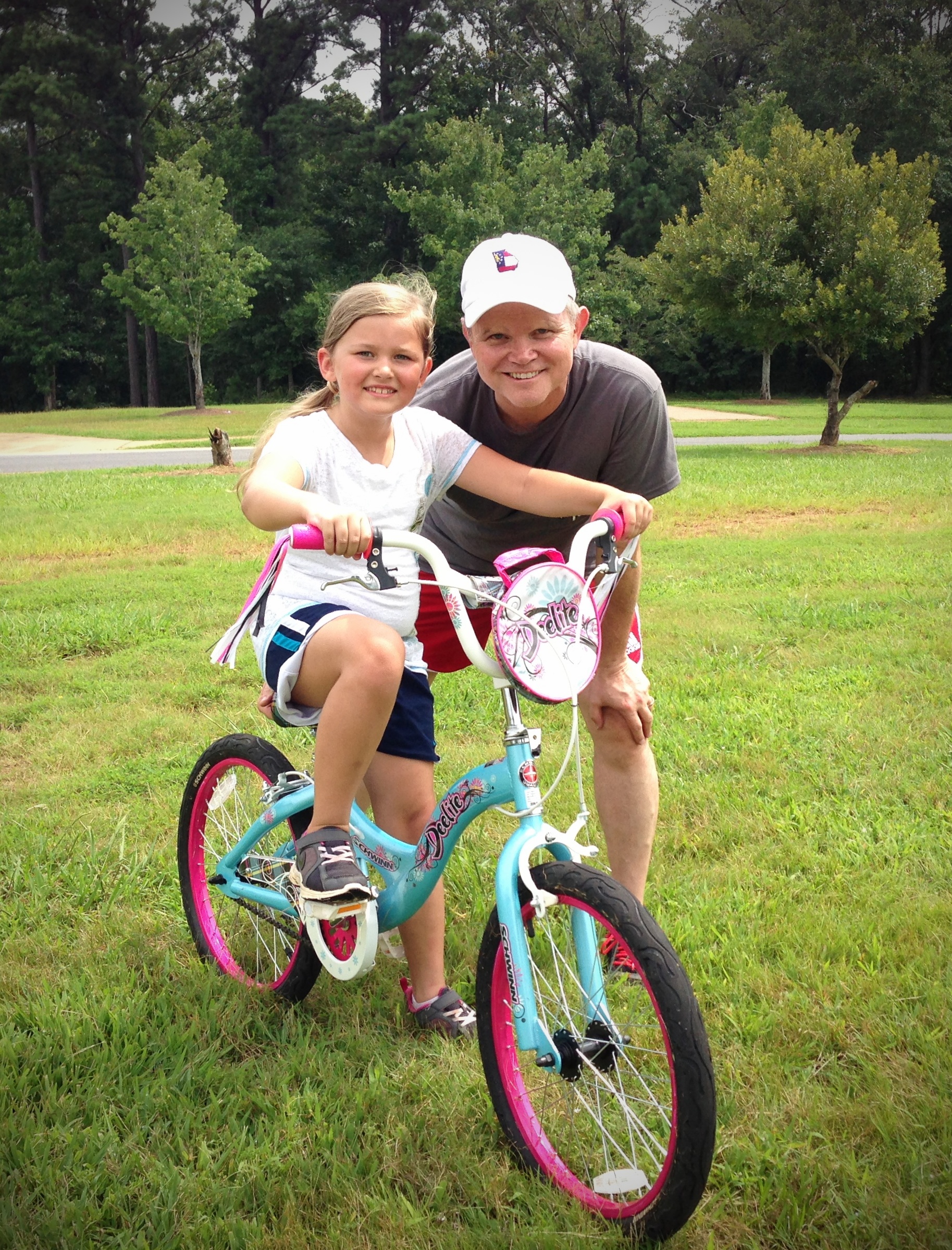
Learning to ride a bike: Lessons on practice and perseverance

My 8-year-old daughter learned to ride a bike this weekend. We took her with her bike to the field next to her school and found a slight incline where she could practice balancing before she tried pedaling. She struggled the first few times. But she kept going back and starting over, taking fewer steps on each subsequent attempt to master balancing on the bike.

We moved to the school driveway for more balancing work, and it just seemed to click for her then. Finally, she was ready to give it a go. She was successful as soon as she began pedaling. Her mom and I were as giddy and proud as she was.

I’ve been thinking a lot about mastery and practice and doing hard things. My daughter just gave me a great demonstration. She was motivated and eager to learn. She was a little embarrassed that she didn’t already know how to ride a bike. She took instruction well. As she began learning, she encountered struggle. It wasn’t easy. There were a couple of moments early on where I could see the frustration mounting. (And I’m worrying I’m going to scar her for life somehow and fail completely in my parental responsibilities.) I just kept telling her that she is great at sticking with something, even when it gets hard. (I wanted her to think that, at least.) I reminded her of an award she got for “perseverance” when she was a first-grader, trying to embed that thought in her more deeply. I said, “What was that award you got? What was it for… persistence?” “Perseverance,” she corrected me. And she did stick with it until she got it.

The next day she had her first wipe out and scraped her knee and shed some tears. I was ready to put the bike up for the night, but, an hour later, she asked if she could go back out and ride some more. Success.

I’ve seen her learn to swim and roller skate and now ride a bike. These skills don’t come naturally, but once you’ve got them, they stay with you forever. As we become adults, there seem to be fewer obvious opportunities to learn hard things and master new skills. We usually can get by with what we already know.

I want to find some new skills to learn, something that will be hard enough that I will want to quit but rewarding enough that I will have an incentive to stay with it.

If we can keep attacking life the way a kid on a mission goes after skills we take for granted, we can’t help but keep getting better and enjoying the journey along the way.

Ella after conquering the bike

Love and gravity

Gravity rules the universe. There would be no Earth, no solar system, no sun or stars or galaxies without gravity.

Gravity is attraction. The earth is pulling on the moon, keeping it close. The sun keeps tugging at the planets. Galaxies spin in infinity in its grasp. Gravity holds everything together.

Newton enlightened. Einstein clarified and corrected. And smiled.

What gravity is to the cosmos is what love is to the human experience. Love brings people together, puts hearts in orbit around each other. Connects and binds. Builds community and family.

It can be defied, with great effort if not with Saturn V rockets. It gives order and chaos at the same time.

We all are connected, biologically and cosmically. We are star stuff, held together and propelled onward by love and gravity.

The power of awe, as in awe-some

This:

I’ve just discovered the work of Jason Silva, a sort of spoken-word philosopher who has created mind-shifting, eye-opening videos like the one above.

We do need regular doses of awe, reminders of how grand and overwhelmingly incomprehensible this universe is and what a kick it is that we are not just in it, but we’re aware that we’re in it and can wonder and ponder and imagine.

The big picture is really, really big. We are really, really small.

But just big enough to see and to dream.

Leo Buscaglia: Learn every day

The late, great Leo Buscaglia was a dynamic whirlwind of positive energy. He was a professor at USC and became famous on campus for teaching a non-credit class about love that would overflow the lecture hall with standing room only for the crowd of interested students. He wrote several books and took his wisdom and hugs on the road spreading the good news of love.

I had a few of his lectures on tape (cassette tapes, kids) and would listen on road trips. When he was a child, Leo and his family ate dinner together every night, and his dad would begin the nightly family dinner by asking everyone at the table what they had learned that day. And he expected everyone to have learned something. Leo said there were many days that, just before dinner time, he would rush to find an encyclopedia (that’s a tiny internet in a big stack of books, kids) and look up something new to learn just to make sure he wouldn’t come up empty when his dad asked that question at dinner.

I like that daily expectation, pressure even, to learn at least one thing each day. That’s what this blog is doing for me. I’m committed to writing daily, and there have been days when, just before bed time, I scramble to find something worth sharing. A quotation. A video. A book recommendation. A minor epiphany.

By committing to sharing regularly, I’m committing to learning regularly. Learn something every day. And share what you learn.

“Too often we underestimate the power of a touch, a smile, a kind word, a listening ear, an honest compliment, or the smallest act of caring, all of which have the potential to turn a life around.” -Leo Buscaglia

Here’s a brief bit of video from one of Buscaglia’s lectures, just to give you a sense of this guy’s energy:

Where the light is: John Mayer’s career wisdom

John Mayer is among my favorite performers. He broke onto the scene seeming like he might just be another pop sensation, but he has become quite the soulful virtuoso with thoughtful music that keeps evolving.

I’ve been wearing out his latest album, Born and Raised, which has a 70’s, Eagles kind of vibe to it. I appreciate that his music is not predictable and formulaic. And he does, too.

His fabulous live performance in Los Angeles in December 2007 was made into a concert film, Where The Light Is. The whole thing is available on YouTube now. He does three different performances during the concert. He opens with a solo acoustic set. Then he changes clothes and comes back to the stage with his blues band for a blues concert. Finally, he returns to the stage with his full touring band to wrap up the night.

He keeps stretching his musical chops, trying on different styles and formats. It would be easy for a guy who hit it big at such a young age to just stick with what brought him his success. He could phone it in for decades and play the same kind of stuff to big crowds of loyal fans. But, instead, he’s taking risks and going in directions that his fans may not want to follow.

He says this at the beginning of the “Where the light is” concert film:

“It’s only fun when you’re trying to get it in your grasp. It’s like, you know, once you catch it, throw it back in the water then catch it again. That’s really what I want to do my whole career.”

A good reminder for anyone who realizes it’s about the journey rather than the destination.

Say it forward

A close friend visited recently. He worked for me almost ten years ago when he was an undergraduate. His late father had been my professor when I was an undergraduate.

I told him the story of how his father continues to influence me. He was a well respected professor, and I ended up taking two or three of his classes. I never sought him out to build a genuine friendship with him. I, regrettably, never did that with any of my instructors, not wanting to seem like I was sucking up and not wanting to be a bother.

(College students: Don’t do as I did. Get to know your teachers. Seek out the good ones, and find a mentor or two each year you’re in school.)

However, as I told my friend, I wrote an essay for an assignment in his father’s class. He later returned it to me with a big red “A” at the top. Always a nice sight. And he wrote a note on it that said something like “You should consider becoming a writer. You’ve got some talent.”

Twain said, “I can live for two months off a good compliment.” Twain understates. That compliment and encouragement from my professor still motivates me, almost three decades later. Writing has been a part of my career from day one of my first job. And when I lose focus and am feeling a bit lost in my work, that short line of encouragement written on a college homework assignment reminds me of a skill I need to return to and nurture.

After sharing this story with my professor’s son, he told me that he is now pursuing comedy and improv on the side and remembers me encouraging him when he was a student to stick with his talent for comedy. I had paid forward the father’s gift without being conscious of it.

Never underestimate the power of a genuine compliment, an acknowledgement of someone’s talent, even if, especially if, that talent is unrefined or just barely glimmering. Don’t hold back when you see something in someone that ought to be nurtured. Master the art of giving encouragement. Be specific and clear. Write a note. Seek them out in person. Just say it.

I need to be more intentional about this with my own family and with the people I work with. I’m surrounded by such big-hearted, talented people, and they need to be told regularly not only how awesome they are in general but specifically what I see that is remarkable in them.

Hopefully, receiving that kind of encouragement will spark the desire to pass it along to others. Appreciate when you receive words of encouragement, and then say it forward.

Improv Wisdom

“Don’t prepare. Just show up.”

Seems to defy not just conventional wisdom but common sense as well. I’ve recently been all about the need for “deep practice” and rehearsal. But hear this out. This is different. What if you let go of your scripts, your automatic responses to typical situations, your inclination to live in your head most of the time?

Consider those icebreaker activities where everyone in a circle is asked a question like, “What’s your favorite book?” The point is to have everyone get to know each other a little better. But what really happens is that most people in the circle spend their time preparing their response in their mind and not actually listening to the responses of others.

What if you truly spent that time, instead, trying to understand the responses of the others and gave absolutely zero thought to what you will say when it’s your turn? Would you really draw a complete blank when your name is called or offer something embarrassingly inelegant? Trust that your amazing brain would be able to shift gears from listening mode and summon an intelligible, maybe even intelligent response on the spot. In fact, a spontaneous, improvised response without any forethought might be more authentic and original and more interesting than what you would have rehearsed.

Now, imagine a job interview or a date or a conversation with a friend or family member. Instead of using the time when others are speaking to prepare and rehearse for when you get a turn to speak, simply “show up” and listen and try your best to understand, and then have confidence that you’ll do just fine when it’s your turn to speak.

Just showing up, just being present and focused on the moment at hand, is not easy. Those cool cats on that improv TV show are quite brilliant in their zaniness. But their brilliance is hard won through years of experience, through countless moments of stretching their capacity to create on the spot. They have prepared to be unprepared.

The best jazz musicians and teachers and public speakers are ones who have prepared so thoroughly that they can create something new in the moment as they respond to the audience in front of them. Their preparation has earned them the right and the ability to “wing it” and improvise and create something beautiful.

There’s a terrific little book, Improv Wisdom by Patricia Ryan Madson, that explores this topic. Madson, an improv teacher, challenges readers to live a more unscripted life and applies lessons from improvisational theater to everyday situations we all face.

We all need to practice being unpracticed. Prepare for spontaneity and improvisation. We will look silly at times and occasionally say and do things that are far from excellent. But we will be more real. We will be more interesting and find others more interesting as well. And we will laugh more.

Improv Wisdom

Think small for big career growth

If you’re just getting started in the work world, I recommend finding work in a small shop instead of a large organization.

My first job was on Capitol Hill working for a member of the U.S. House of Representatives. I had the good fortune of working for a truly kind and smart man who cared about his employees and his responsibility to his constituents. He served as an excellent mentor, which is clutch to find early on in your work life. (If you’re choosing between job options, go for the one that offers the best potential for finding a great mentor. Pay and benefits and prestige and even the level of responsibility in your job pale compared to the quality of leadership in an organization as you’re searching for a good fit early in your career.)

Members of the U.S. House have relatively small staffs. There were just around ten of us in the D.C. office when I was there. And, because there were so few of us, we all got to know the boss well, and we all got to do a little bit of everything. My peers who worked for U.S. Senators had a completely different experience. Senate staffs are much larger because the Senator represents a whole state. Many of the Senate staffers I knew had never even had a substantive conversation with their boss. One Senator famously instructed his staff to keep their hands in their pockets as he greeted guests at receptions so he would know they were his employee and not be embarrassed by introducing himself publicly to his own staff member. And Senate staffers had narrower fields of expertise and more clearly defined daily tasks because there were so many in their office.

While it might have seemed more prestigious to work on the Senate side, only a handful of staffers in each office got the quality of experience that everyone on a House member’s staff did. If you do work in a big organization, you may have to be more intentional about getting your hands on projects that interest you and connecting with potential mentors.*

One way to guarantee substantive work no matter where you end up is to create your own side hustle. Set up you own little business or create a web site or publish your own book or make that film you’ve been imagining. That’s the ultimate small shop, and you can’t help but learn a lot by trying to bring a project to life by yourself.


*Orbiting The Giant Hairball is a terrific book for anyone trying to thrive creatively in a large, bureaucratic organization. The author was a creative maverick at Hallmark Cards and  shares wonderful insights about navigating big companies with your soul intact.

Quick, easy, and bad

My wife and I gave an excellent pepper mill as a wedding gift to a sweet young couple today. Shanna asked me to write a short note to accompany the gift, so I came up with this:

“In marriage, as in cooking, it takes only a little more effort to add a lot more flavor.”

I thought it was a clever message. But, it rings true to me, not just for marriage and cooking, but as a general guide to being awesome.

A pepper mill is a small example, but freshly ground pepper, requiring very little extra effort, is so much more flavorful than the dull pre-ground pepper most people use.

Over the Christmas holiday last year a family member was showing off their new coffee-making contraption, one of those devices that promises to make coffee fast and with little fuss or effort on the user’s part. I’m a tea guy, so I was handed a cup of hot tea produced by this device. It was bad. Quick, easy, and bad.

I remarked at the time to my wife, as I discreetly disposed of this so-called tea, “I will stick with my fussy way* of making tea, thank you.” The extra few minutes required to boil water and brew loose leaf tea is rewarded with a truly excellent cup of tea that more than makes up for the time and effort invested. And the making of the tea and being mindful of the steps involved can be just as much a pleasure as drinking it.

Convenient, quick, and easy often are just shortcuts to mediocre and forgettable. Efficient does not necessarily mean effective. A small bit of effort and creativity can go a long way toward delighting someone, including yourself.

What little extra bit of thoughtfulness, effort, and attention to detail can I offer to delight my wife, my kids, my colleagues, and those I serve in my work?

*My tea cup and infuser. And if you’re looking for a tea, try Irish Breakfast Tea.