Intense obsessions

Screen Shot 2014-09-12 at 4.15.18 PM

Follow what delights you, not for applause or money or validation or any external reward. You may not be able to make a living off your obsessions, but you can make your life richer and more meaningful by intensely following those pursuits that most make you come alive.

“You must cultivate activities that you love. You must discover work that you do, not for its utility, but for itself. Think of something that you love to do for itself, whether it succeeds or not, whether you are praised for it or not, whether you are loved and rewarded for it or not, whether people know about it and are grateful to you for it or not. How many activities can you count in your life that you engage in simply because they delight you and grip your soul? Find them out. Cultivate them, for they are your passport to freedom and to love.”

–Anthony De Mello

ht: Emily

Image credit: invaderxan

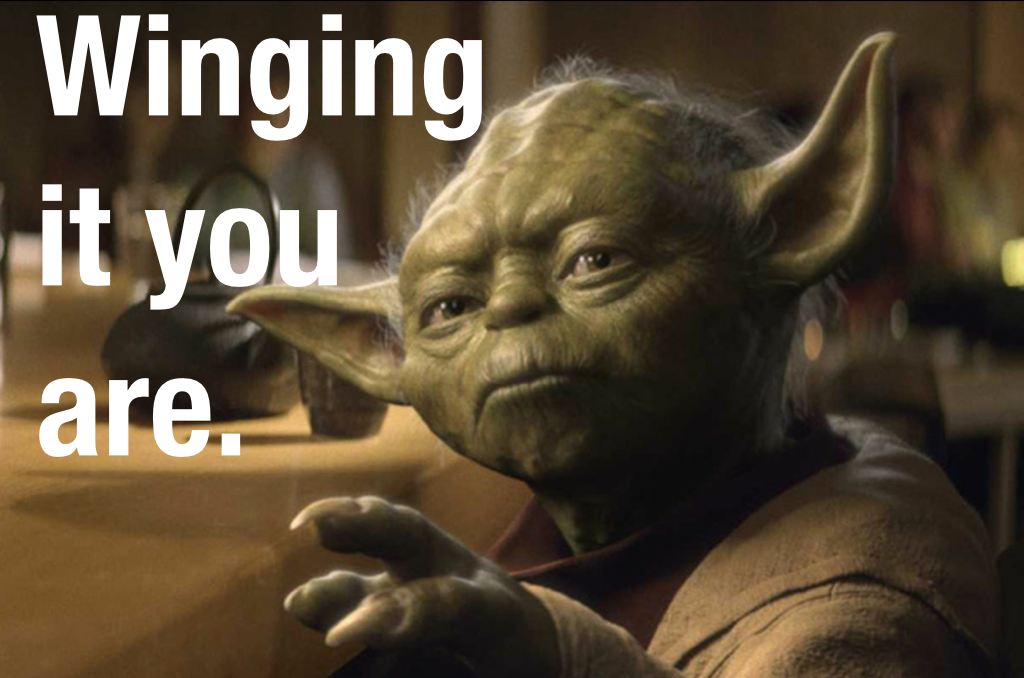
I’m totally winging it. You are, too.

IMG_1205.PNG
Confession: I’m 50 years old, and I’m still completely winging it.

I don’t have rock solid answers to the big questions. I don’t have a sure fire plan, long-term or short-term. Age hasn’t given me the wisdom and confidence I was always sure everyone past middle age must have. Peace of mind can be more elusive now than when I was younger. I’ve even recently had occasional moments of irrational anxiety.

The college students I work with treat me like I’m their resident Yoda, and I oblige with whatever wisdom I can summon. They nod and seem satisfied and leave me to sit and ponder if I’m a complete fraud who’s just making stuff up.

I’m not a mess, mind you. I’m just fessing up to not having it all together in spite of how cool I’m sure I appear to be.

I’m like the duck on the pond appearing to glide effortlessly along while below the surface paddling like hell.

Yet, I am pretty sure this describes you, too.

I’m comforted somewhat by the dawning realization that everyone is winging it with varying degrees of cluelessness, comedy, and sheer terror. Presidents and CEOs and celebrities (definitely celebrities) and parents and grandparents and supposedly wise sages… they all regularly struggle with what the heck to do and why in the world are we here anyway. Not everyone will acknowledge it, certainly not publicly. But I’m convinced that everyone who honestly searches themselves has to say, “Yes, I don’t really know what I’m doing.”

Most of us will fake it as best we can to appear cool and confident, and we sort of have to in order to keep from becoming existential roadkill and bringing chaos down all around us. We will cling to answers handed to us, to a system that seems to keep everything together and that seems to make some kind of sense of the utter mystery we’re all swimming in.

Your level of confidence may be higher than mine, but the only people who seem supremely and inerrantly confident are the ones you need to run away from as fast as you can. They’re kidding themselves more than anyone and have the greatest potential to screw up more than just their own lives.

I’m guessing this growing awareness of my uncertainty is a byproduct of living and learning. The more you know, the more you realize you don’t know.

However, the quiet fears, big and small, we face each day are countered somewhat by the genuine and often awe inspiring wonder of living in such a grand mystery. Moments of sweetness and connection are even more meaningful as I accept just how heartbreakingly short and random I’m discovering life to be.

Being vulnerable is unsettling. And freeing. It’s being real and squarely facing the uncertainties that are part of the deal of getting to live as a human on this planet. But negotiating life honestly, knowing I am indeed winging it more often than not, is a bold way to open myself to what actually is as well as what could be.

Keep on winging it as you best you can, fellow travelers. I’m making this up as I go, too.

Sampling books

After just finishing a massive novel I find myself a bit lost, wondering what to invest my reading time in next.

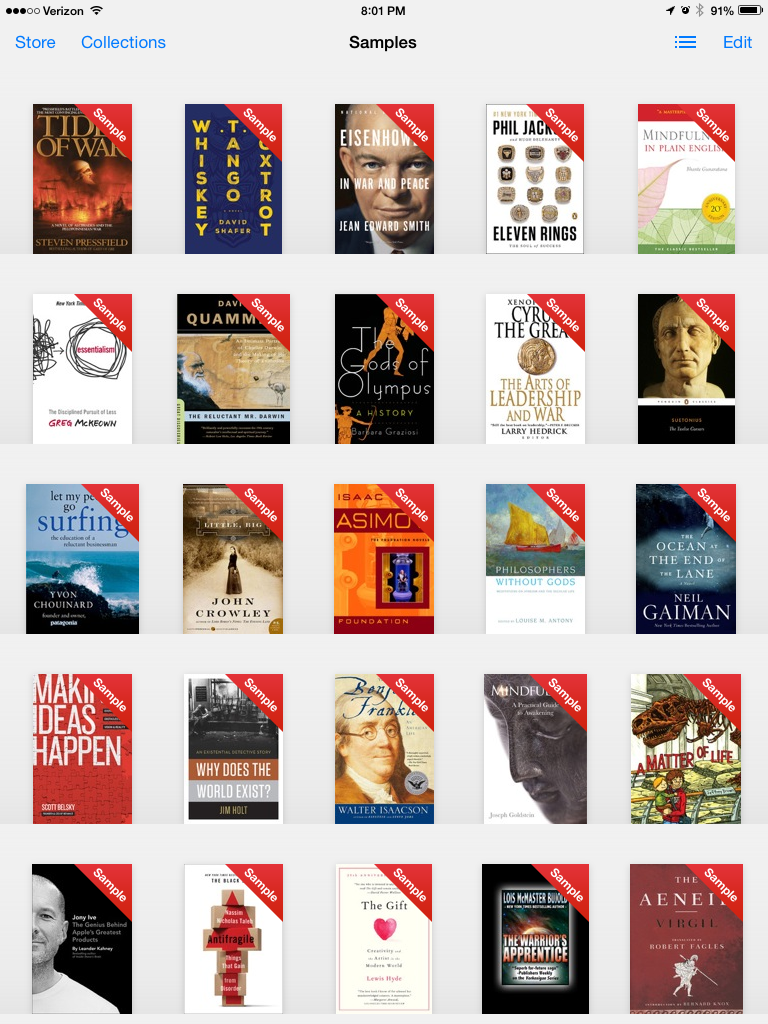
I’ve got a good collection of unread non-fiction in my iBooks library, but I can’t resist searching for new discoveries. I keep a separate collection of book samples I’ve downloaded. It’s a great way to remind myself of books to consider and try them out before purchasing.

I never feel guilty about spending on books, though. It’s a virtuous vice. Err on the side of overdoing it with books rather than scrimping on what is easily one of the most beneficial habits for living an excellent life.

Here’s my current collection of samples I’m exploring:

IMG_1201.PNG

When I get a little money I buy books; and if any is left I buy food and clothes. –Erasmus

Fantasy recommendation: Words of Radiance

I started reading a fantasy series this summer. I like to have a novel in my reading rotation along with whatever non-fiction I’m reading. It’s nice to end the night with fiction. It’s less likely to spark ideas that get my brain going when I’m trying to wind down.

Fantasy is not my usual genre, though. I read The Lord Of the Rings when I was younger and have enjoyed lighter fantasy like Neil Gaiman’s Stardust. But I’ve never gotten into the breadth of fantasy literature.

A friend recommended Brandon Sanderson’s The Way of Kings when I was looking for beach reads. I gave it a look and ended up enjoying it. It’s a massive first book in a projected ten book series. The author creates a richly intricate and original world and crafts a compelling narrative around three strong main characters.

I ended up downloading the second book, Words of Radiance, as soon as I had finished the first. It’s another 1,000+ page epic, and it’s a page-turner with as satisfying a payoff as any novel I’ve read. Now, a long wait until the third in the series is released.

I read these two books in awe of the author’s ability to hone the details of his story. His vision of the setting and the countless back stories is impressive. What a gift he has to make these stories come to life with such imagination and daring.

If you’re willing to invest some time in a long, long read and invest in a fascinating world of escape, this series will delight you.

IMG_1198.PNG

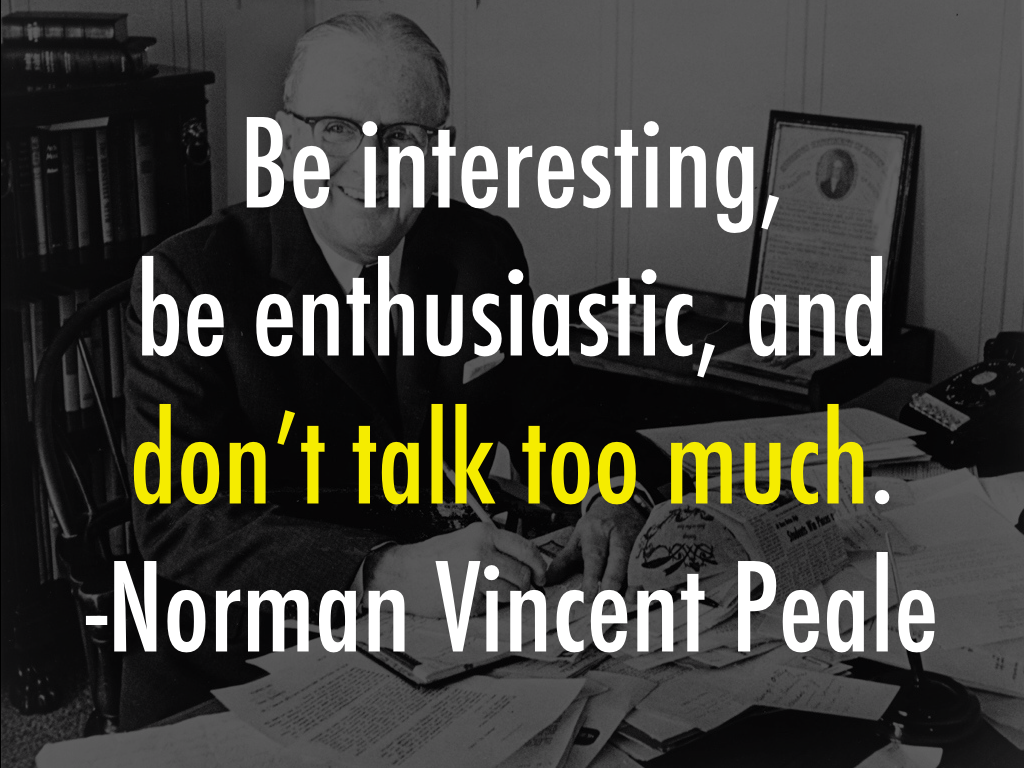
Don’t talk too much

IMG_1192.PNG

The best conversationalists, when you examine what they say, don’t seem to speak as much as they ask good questions and listen intently and with enthusiasm. You don’t have to be clever or well versed in current events or culture to be the kind of person people want to talk to. You just need to be genuinely interested in others and care enough to inquire and listen.

I want to be a better friend to my dog

I heard this Billy Collins poem about dogs today while listening to the TED Radio Hour*:

I laughed, but now I want to be a better friend to my dog, Mosley.

*The TED Radio Hour is such a stellar podcast. If you haven’t discovered podcasts yet, this is a great one to subscribe to to get started. Every episode is solid.

The Revenant
by Billy Collins

I am the dog you put to sleep,
as you like to call the needle of oblivion,
come back to tell you this simple thing:
I never liked you – not one bit.

When I licked your face,
I thought of biting off your nose.
When I watched you toweling yourself dry,
I wanted to leap and unman you with a snap.

I resented the way you moved,
your lack of animal grace,
the way you would sit in a chair and eat,
a napkin on your lap, knife in your hand.

I would have run away,
but I was too weak, a trick you taught me
while I was learning to sit and heel,
and – greatest of insults – shake hands without a hand.

I admit the sight of the leash
would excite me
but only because it meant I was about
to smell things you had never touched.

You do not want to believe this,
but I have no reason to lie.
I hated the car, the rubber toys,
disliked your friends and, worse, your relatives.

The jingling of my tags drove me mad.
You always scratched me in the wrong place.
All I ever wanted from you
was food and fresh water in my metal bowls.

While you slept, I watched you breathe
as the moon rose in the sky.
It took all my strength
not to raise my head and howl.

Now I am free of the collar,
the yellow raincoat, monogrammed sweater,
the absurdity of your lawn,
and that is all you need to know about this place

except what you already supposed
and are glad it did not happen sooner –
that everyone here can read and write,
the dogs in poetry, the cats and the others in prose.

Low-carb > low-fat

Big news in health this week. A major new study has shown that eating a low-carb diet is healthier than eating a low-fat diet.

From the New York Times story about the study:

By the end of the yearlong trial, people in the low-carbohydrate group had lost about eight pounds more on average than those in the low-fat group. They had significantly greater reductions in body fat than the low-fat group, and improvements in lean muscle mass — even though neither group changed their levels of physical activity.

While the low-fat group did lose weight, they appeared to lose more muscle than fat.

And this:

In the end, people in the low-carbohydrate group saw markers of inflammation and triglycerides — a type of fat that circulates in the blood — plunge. Their HDL, the so-called good cholesterol, rose more sharply than it did for people in the low-fat group.

Blood pressure, total cholesterol and LDL, the so-called bad cholesterol, stayed about the same for people in each group.

Nonetheless, those on the low-carbohydrate diet ultimately did so well that they managed to lower their Framingham risk scores, which calculate the likelihood of a heart attack within the next 10 years. The low-fat group on average had no improvement in their scores.

This story, that a low-fat diet is less beneficial than previously assumed, has been brewing quietly for the past decade. I switched to a mostly low-carb, high-fat diet in 2009 and very quickly lost 20 pounds without any exercise routine. And my blood work has been excellent since then.

Conventional wisdom is hard to turn around, but it finally seems it could happen on this topic. So many people have followed bad advice since the low-fat guidelines became a sort of dogma in the 1970’s. And obesity has only skyrocketed since then. At least, maybe we can now begin to take a fresh approach to what it means to eat a healthy diet.

A Stoic creed

My young friend Nick is impressive. He’s a full-time student who works as a Resident Assistant and as a personal trainer, and he’s a serious student of life wisdom. He shares my fascination with Meditations by Marcus Aurelius, and he came to me early in the summer and told me he was researching Marcus with plans to write something somewhat audacious about Meditations.

He just posted the result of his recent Stoic studies, a great essay that takes the key points from Meditations and culls out what he considers the most significant themes. He’s calling it a sort of “Stoic creed”.

Nick has a nice insight about “grooving the pattern”, impressing thoughts and habits in a way that sticks in your life:

To “groove the pattern” its been helpful to keep small axioms and maxims around. I decorate the inside of my weekly planners and the walls around my workspace with words and lists that resonate with me so that I can give them a glance occasionally in idle time.

He then goes on to share the seventeen precepts of Stoic conduct as drawn from his readings of Meditations. It’s a thoughtful collection of reminders and guiding principles well worth anyone’s time to consider and imprint in your memory for when you need to know how to respond to life’s challenges.

Go read Nick’s post and consider collecting your own personal scripture, your own creed, to guide your thoughts and actions.

Just as doctors always keep their implements and scalpels ready at hand in case of emergency treatment, so should you have your guiding principles ready in order to understand things human and divine… –Meditations 3.13

Five C’s of leadership

Kevin and Melissa, two of the university students I work with, are taking a leadership class and were assigned to ask questions about leadership. They both had this question for me: “What are the characteristics of an effective leader?”

“Effective” is subject to interpretation. Gengis Khan was effective… in conquering, destroying, and subjugating, but he was a heck of a leader, as were many violent tyrants throughout history.

For this purpose, however, let’s assume effective has a threshold of moral propiety that makes no room for obvious bad behavior or world domination.

Leadership is not a topic I’ve explored with much intention. I’ve always felt like I’ve known it when I’ve seen it, and, more commonly, been very aware where it’s lacking. As I pondered this question from my students, though, some key attributes came to mind. (And after I thought of the first couple, I couldn’t resist continuing with alliteration. Hence, five “C’s”.)

Here’s what I see or hope to see in the most honorable and effective leaders:

Clarity – Effective leaders have a clear vision of the big picture and can communicate with clarity the “why” of an organization or business or movement. “Why?” comes first, and if a leader hasn’t asked and can’t answer that question about the endeavor they’re hoping to lead, they still may be leading effectively but in a completely wrong direction.

Caring – A good leader cares deeply about the mission and the people involved and all the “how’s” and “what’s” necessary for excellence. The leader cares about even small details, about the process as much as (if not more than) the outcome. The intrinsic rewards of a job well done, of creating something of value and quality, outweigh any extrinsic rewards.

Competence – Mastery inspires confidence. We will follow someone who is clearly competent in their abilities, who knows their stuff. Teammates will rally around someone who is committed to excellence and demonstrates extraordinary competence, even if that person has not been entrusted with any official leadership role.

Character – The authentic person of integrity, who treats everyone with fairness and is impeccable with their actions, that person is a leader I want to follow. A leader of character will be wholly themselves regardless of the circumstances or the people around them. And trust is the most valuable asset an effective leader has to offer.

Compassion – A leader I admire is one who is kind and compassionate and who treats everyone with respect regardless of position or title. She is quick to forgive, eager to reconcile, and open to listening to and understanding even, or especially, divergent viewpoints.

My favorite description of a master leader comes from the Tao te Ching, one of the most profound books of wisdom:

When the Master governs, the people
are hardly aware that he exists.
Next best is a leader who is loved.
Next, one who is feared.
The worst is one who is despised.

If you don’t trust the people,
you make them untrustworthy.

The Master doesn’t talk, he acts.
When his work is done,
the people say, “Amazing:
we did it, all by ourselves!”

You don’t need to be offered a promotion or run for office to be a leader. Be the CEO of your cubicle or your desk. Lead yourself. Act like you are who you want to be and embody the attributes that lead to an excellent life well lived.
Mesmerized by routine

Mason Currey’s fascinating book, Daily Rituals, is filled with details of how prolifically creative people structure their days. Here’s the opening paragraph on novelist Haruki Murakami’s daily rituals:

When he is writing a novel, Murakami wakes at 4:00 A.M. and works for five to six hours straight. In the afternoons he runs or swims (or does both), runs errands, reads, and listens to music; bedtime is 9:00. “I keep to this routine every day without variation,” he told The Paris Review in 2004. “The repetition itself becomes the important thing; it’s a form of mesmerism. I mesmerize myself to reach a deeper state of mind.”

A repetitive daily routine seems monotonous, but consistently flipping the switch on a work mode will eventually let the muse know you are in it for the long haul. And the muse will be expected to show up, too. The sameness can lull your inner critic, that voice of caution that kills your creative fight. Mesmerized by routine, you can summon more consistently the creative force that may never otherwise appear randomly.

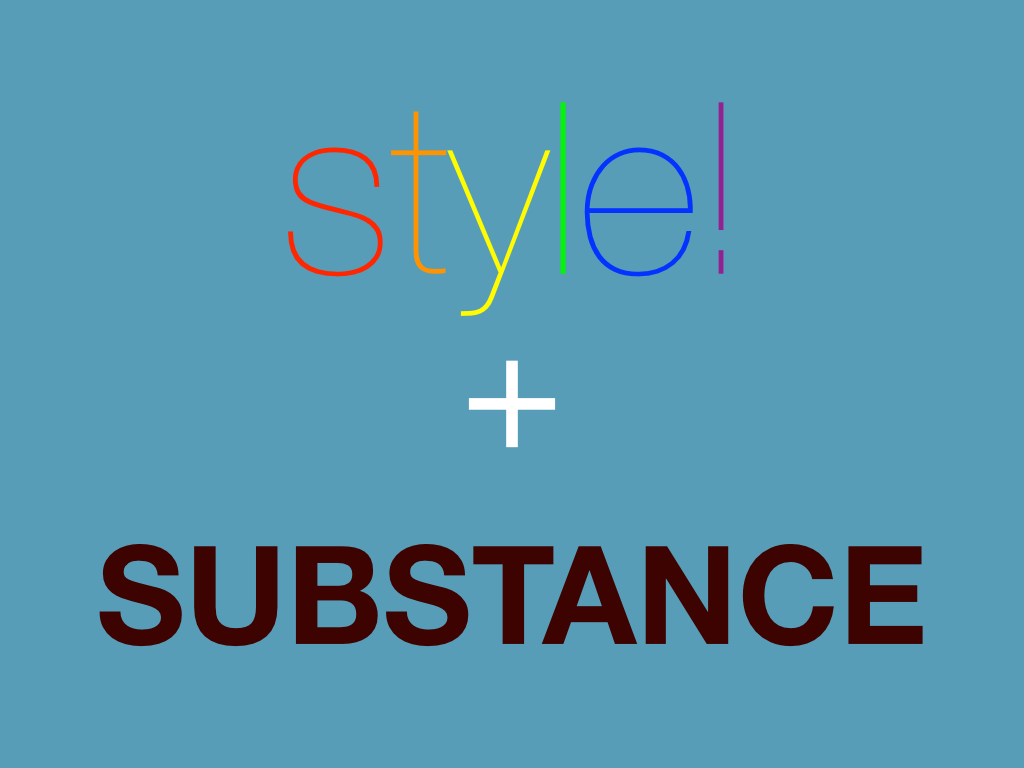
Style + substance

IMG_1104.PNG

Form AND function. Both should be remarkable. Quality content can get lost in poor delivery. Details matter. Presentation matters.

I love how Apple cares as much about the package design as they do about the hardware and software engineering of their products.

Tweaking the details of a design often leads to new insights in the content for me. And if I care enough about the content, I want to present it as beautifully as I can.

Herschel: Train hard, be hard to beat

IMG_1141.PNG

Herschel Walker won the Heisman Trophy during my freshman year at UGA. He had already been a phenom and was the talk of the college football world from his very first game. I was in awe of him at the time and still am. He remains a freak of an athlete even in his 50s.

In the early 1980s Herschel was the this soft-spoken, humble kid from rural Georgia who was an athletic outlier among athletic outliers. So fast and so strong. He seemed so much better than any other player on the field, and I can attest to the thrill of watching him take over games and put a charge into 80,000 spectators.

He says that he was an overweight kid who got bullied by others and was just an afterthought on his school team. When he asked his coach how to get better, the coach said, “Do pushups and sit-ups and sprints.” So, Herschel did just that. And then some.

He loved watching TV, and every time a commercial came on he would do pushups until the show came back on. The next commercials would have him switch to sit-ups. He would do thousands of reps every night, and he would go in his yard and race his sister, who went on to be a track star at UGA.

And that’s all he did. He didn’t lift weights and work with a trainer. Just pushups, sit-ups, and sprints. Over and over and over. And he became the athlete we now know.

Clearly he’s got good genes, but they wouldn’t have been realized without his relentless, obsessive work ethic.

How strong would you be if you did a thousand pushups a day? What price are we willing to pay in effort and discomfort, even pain, to get really good at something?

Herschel is still doing a crazy number of pushups every day. He’s still working on being awesome.

What routines do I need to pursue with Herschel’s level of obsessiveness? What hard things should I take on so that I might be hard to beat?

Try to be alive

Screen Shot 2014-08-27 at 11.42.42 AM

via @Parislemon

This was Hemingway’s advice on writing, but it works for advice on living an excellent life as well.

I went home for lunch today and had a bite of watermelon while thinking about this quotation. As I was trying to really taste it like Hemingway suggests, I bit my tongue. (I won’t try quite so hard next time.)

Hemingway’s advice is that we should live a more engaged and aware life.

“Try to be alive.”

What does it take to NOT sleepwalk through our days? How is it that we seem to be programmed to be numb and only those who have simply awakened to the full technicolor, surround-sound experience of life shine as artists and enlightened souls? (Young children have this by nature and most of us lose it as if that’s the price to pay for becoming an adult.)

We all fear dying, yet we should be afraid instead of not living while we have the chance. Life after death is a mystery, but life before death… that should be our primary concern every day.

The creative life is a bit of an antidote to the numbness. It’s why people write and make art and sing songs and post thoughts on the internet. Your effort to capture and express your unique human experience is like telling your consciousness to send out scouts to the present and bring back prizes of delight and insight and even pain.

The intention to express yourself can awaken you to see what’s around you so much more clearly. Don’t you know a photographer sees a different world than most of us. He’s looking intentionally at the world, hoping to find something worth expressing. If we all thought of ourselves as artists, even if we never share any creative output, we might all live a more awake and aware life. It’s a good reason to start a creative habit, to begin journaling or painting or learning an instrument or building web sites or making movies.

The challenge is to inhabit the present moment as often as you can, to live deeply while you’re still alive and to taste the sweetness and, sometimes, the bitterness of the now.

But be careful not to bite your tongue.

Everything you need to know about life can be learned from a genuine and ongoing attempt to write.

–Dani Shapiro


Make excellence a habit

Screen Shot 2014-08-26 at 4.49.24 PM

What do you do repeatedly, consistently, every day? Is that who you want to be?

Make excellence a habit. Determine the actions that are most meaningful to you. Writing? Speaking? Reading? Art? Service? Work skills? Giving quality attention to your family and friends? Taking care of your health?

Whatever you want to master, make a habit out of the skills required. In the short term, repeated action may have little to show for the effort. But it’s the long game that matters. Patience and consistency will eventually sneak up on excellence.

Do the thing you want to do with intention. Build routines around it. Craft your habits and inch your way to a remarkable life.

A small daily task, if it be really daily, will beat the labours of a spasmodic Hercules. –Anthony Trollope

Get out of bed and go to work

At dawn, when you have trouble getting out of bed, tell yourself: “I have to go to work—as a human being. What do I have to complain of, if I’m going to do what I was born for—the things I was brought into the world to do? Or is this what I was created for? To huddle under the blankets and stay warm?”
—But it’s nicer here.…
So you were born to feel “nice”? Instead of doing things and experiencing them? Don’t you see the plants, the birds, the ants and spiders and bees going about their individual tasks, putting the world in order, as best they can? And you’re not willing to do your job as a human being? Why aren’t you running to do what your nature demands?
—But we have to sleep sometime.…
Agreed. But nature set a limit on that—as it did on eating and drinking. And you’re over the limit. You’ve had more than enough of that. But not of working. There you’re still below your quota.

From Meditations by Marcus Aurelius

Tomorrow

​​Think of all the years passed by in which you said to yourself “I’ll do it tomorrow,” and how the gods have again and again granted you periods of grace of which you have not availed yourself. It is time to realize that you are a member of the Universe, that you are born of Nature itself, and to know that a limit has been set to your time. —Marcus Aurelius

The day has come. When you wake up it will be tomorrow, the day you’ve promised to take action, to be the person you’ve dreamed you could be.

If not now, when? Be awesome while you can.

Via Farnam Street