…of the moon, from a million miles away.
Best thing I saw on the internet this week.
…of the moon, from a million miles away.
Best thing I saw on the internet this week.
Our dog Mosley is “spirited”.
Taking him on a walk when he was a puppy was an ordeal. He would pull at the leash, stop suddenly, veer off course constantly, sniff everything he came upon, get agitated if we came across any other dogs, and totally freak out if he saw a cat anywhere. (Cats… they drive him to barking fits like nothing else does.)
But, over time, he began to settle down for our walks. He still gets a little frantic at the start of a walk, but he quickly calms himself and gets into a smooth flow with me. Unless he spies a cat, of course.
I’ve been meditating somewhat regularly over the past year. Some weeks I sit for ten to twenty minutes every day. Other weeks I may sit only once or twice.
But I’m not very good at it when I do make the time to sit. My mind is like the puppy version of Mosley. It won’t stay still and pulls and veers and gets so easily distracted. Some days it settles enough to flow smoothly along with my breath for at least a few minutes. Most days it tugs at the leash the whole time.
I’m sticking with it, though. I’m clearly still in the puppy phase of my mindfulness practice. But I know my mind and my emotional well-being need at least a portion of the attention and discipline I focus on my physical body and my work.
I’m even more aware lately that humans “were built to be effective animals, not happy ones”, and it’s on me to upgrade my own operating system if I want more happiness and peace and wholeheartedness. Mindful calm is not our default state.
Tim Ferriss recently interviewed the meditation teacher Tara Brach. It’s an interesting conversation which included this big statement:
“Meditation is evolution’s strategy to bring out our full potential.” –Tara Brach
Certainly, if more humans were better able to master their minds and their emotions, we would be a lot further along as a species.
This is a hard practice, but if even a little of the benefits spill over into my life and the way I interact with my family, my friends, and anyone I encounter, it will be worth persisting in the effort.
I want to see reality more clearly and embrace whatever comes without resistance.
Maybe I’m a slow learner with this—even a perpetual puppy. I will keep giving it a go and just see how often my mind will let the leash draw some slack and flow along.
Even if there are cats.
I was browsing in a local independent book shop with my daughter today. The serendipity of discovery in a book shop has an organic vitality to it that Amazon’s algorithms just can’t match.
The staff had placed copies of famed Japanese novelist Haruki Murakami’s newest release, Wind/Pinball: Two Novels (which, actually, were his first two novels), on a front table, and I opened it to the introduction and read this remarkable story of how his writing career began:
One bright April afternoon in 1978, I attended a baseball game at Jingu Stadium, not far from where I lived and worked. It was the Central League season opener, first pitch at one o’clock, the Yakult Swallows against the Hiroshima Carp. I was already a Swallows fan in those days, so I sometimes popped in to catch a game—a substitute, as it were, for taking a walk.
Back then, the Swallows were a perennially weak team (you might guess as much from their name) with little money and no flashy big-name players. Naturally, they weren’t very popular. Season opener it may have been, but only a few fans were sitting beyond the outfield fence. I stretched out with a beer to watch the game. At the time there were no bleacher seats out there, just a grassy slope. The sky was a sparkling blue, the draft beer as cold as could be, and the ball strikingly white against the green field, the first green I had seen in a long while. The Swallows first batter was Dave Hilton, a skinny newcomer from the States and a complete unknown. He batted in the leadoff position. The cleanup hitter was Charlie Manuel, who later became famous as the manager of the Cleveland Indians and the Philadelphia Phillies. Then, though, he was a real stud, a slugger the Japanese fans had dubbed “the Red Demon.”
I think Hiroshima’s starting pitcher that day was Yoshiro Sotokoba. Yakult countered with Takeshi Yasuda. In the bottom of the first inning, Hilton slammed Sotokoba’s first pitch into left field for a clean double. The satisfying crack when the bat met the ball resounded throughout Jingu Stadium. Scattered applause rose around me. In that instant, for no reason and on no grounds whatsoever, the thought suddenly struck me: I think I can write a novel.
I can still recall the exact sensation. It felt as if something had come fluttering down from the sky, and I had caught it cleanly in my hands. I had no idea why it had chanced to fall into my grasp. I didn’t know then, and I don’t know now. Whatever the reason, it had taken place. It was like a revelation. Or maybe epiphany is the closest word. All I can say is that my life was drastically and permanently altered in that instant—when Dave Hilton belted that beautiful, ringing double at Jingu Stadium.
He then went home and began writing his first novel, thus beginning a distinguished career as one of the most significant writers of the generation.
What an odd way to have a career epiphany. Maybe I’ve had similar moments where my attention was on one thing and an insight from elsewhere struck me.
But Murakami’s story is remarkable because the next morning he arose early and started writing. And he kept at it over many months until he had written his first novel. That first attempt ended up winning a writing prize and made him into a full-time author.
The Dave Hilton double and its resulting epiphany wouldn’t amount to much of a story if Murakami hadn’t taken action, if he hadn’t begun doing what novelists do.
And that’s the real lesson for me. Don’t hope for a light-bulb moment (or a lead-off double moment). Just decide what gift you want to share and get busy doing something about it.
Act as if you are who you want to be and do what that person would do.
It’s my daughters’ last week off before school starts next week. And I’m taking the week off to be with them for one last bit of relaxation before the school-year grind begins.
I’ve done this the last couple of years. My wife has to work, so we don’t head to the beach. The kids and I just stay home and play.
The lack of structure is already wearing on me a bit. It should be a dream to have no schedule, no obligations. But I’m on day two and feeling restless. And occasionally feeling inept as a parent.
The three of us went to the pool yesterday afternoon. Usually that’s a sure-fire couple of hours of frivolous fun. This trip, however, was not a delight.
Walking in, the 8-year-old got mad at the 10-year-old about something and stuck chewing gum in her sister’s hair to make her point. (She later said she was aiming for her shoulder and her hair was just sort of in the way. Right…)
Gum in hair is a major kid crisis. And a parent nightmare.
Both girls ran into the bathroom and hid in separate stalls—the older sister to cry, the younger sister to hide. And I’m just dad, sitting outside the women’s locker room, waiting, wondering how to salvage the staycation afternoon.
They eventually emerged, a tangle of gum still in big sister’s hair and tears in her eyes and little sister still defiant, proclaiming her justification if not her innocence.
Injustice and plain meanness are the combination most likely to trigger any ill temper from me. But their delay in the locker room gave me time to pause and consider a response rather than a reaction.
I talked it out in the pool with each of them. It was lose-lose for me for a while. The 10-year-old didn’t think I was mad enough at the 8-year-old. The 8-year-old thought I was too mad at her. I was on the right track.
From a distance it’s easy to say how someone should react. But in the parenthood arena, face-to-face with your own kids and your own shortcomings, wisdom is a lot more elusive.
I do know that I would have regretted reacting out of anger. Pausing, even if you have to physically remove yourself from the emotion of the moment, will give you the best chance of choosing an effective response rather than simply reacting.
I know some people think a leader needs to show emotion, to let the team see some fire, even anger at the right time.
Not me. Seeing a leader rage at others or a parent going off on their child is a discouraging sight. I aspire to be the kind of leader and parent who chooses a response rather than vents a reaction. My ideal is a cool, calm, rational approach, even in the midst of the most stressful moments.
I don’t always, or even often, pull this off, and those are the cringe-worthy moments that stick with me in my regrets.
The girls ended the pool trip and the day with good spirits and sisterly affection. And with gum still attached to hair.
Fortunately, their mom came home that night and expertly removed the gum from the hair. She’s a superhero.
Thinking back on the gum incident, I’m reminded I should welcome the annoying little frictions of family life as well as all the toe-stubbing annoyances and button-pushing outrages we all face regularly with friends and strangers. They are opportunities to test our ability to respond, to master our emotions, to see even the most negative circumstance as a chance to learn and grow.
David Cain writes great stuff and is well worth adding to your must-reads.
This is from his post, “An Open Letter to My 15-Year-Old Self Just Before the Start of High School”:
“None of the respect you earn in high school will buy you anything after you leave high school. It’s like working at Canadian Tire for a summer and getting paid only in Canadian Tire money. Waste no energy earning respect in high school. Spend it instead wandering every sidestreet of geekdom and subculture you pass by. Instead of finding scraps of approval from uncool people, you will end up finding something real and lasting in Brian Eno or Nietzsche or Margaret Atwood or Public Radio. Find those grooves of meaning that you can follow into adulthood. When people give you a hard time for liking what you like, that’s a sign you’re on the right track. You are uncovering veins of precious metals; they are scrounging for nearly-expired coupons.”
True.
And this, too:
“Get over any desire to be normal. The desire to be normal is its own perversion. Some people do achieve the appearance of normalness, which means they have successfully hidden or beaten down everything about them that is interesting or memorable in the hopes that they become impervious to criticism. Go the other way. The great joke here is that nobody has ever been normal.”
The whole post is solid. There is probably a teenager in your life who ought to read it. But most of us are still challenged by some of the same tensions we faced in high school.
Meditations 8.22:
“Stick to what’s in front of you—idea, action, utterance.”
Life is right here, right now.
Make an art of this moment.
Keep doing that and the past will have fewer regrets, and the future will take care of itself.
Merlyn’s lesson to young Arthur in T.H. White’s The Once And Future King:
“You may grow old and trembling in your anatomies, you may lie awake at night listening to the disorder of your veins, you may miss your only love, you may see the world about you devastated by evil lunatics, or know your honour trampled in the sewers of baser minds. There is only one thing for it then — to learn. Learn why the world wags and what wags it. That is the only thing which the mind can never exhaust, never alienate, never be tortured by, never fear or distrust, and never dream of regretting.”
“The tree of knowledge and the fountain of youth are one and the same.” –Lewis Lapham
Jane McGonigal shines in this TED Talk. She has a strong and approachable presence on stage, and she clearly cares about her topic and the audience and connects with genuine enthusiasm.
She will have you respecting gamers and wanting to play games yourself.
Happiness is a hack, not a default state. You have to overcome your programming to find the joy potentially present in the mundane, in each moment.
Tim Ferriss has an interview with Jane McGonigal* on his podcast that’s worth listening to. She’s an expert in the value of playing games, and hearing her made me go load Tetris on my phone.
(*Also see her TED Talks: Gaming can make a better world and The game that can give you 10 extra years of life.)
In their conversation, though, this quote was discussed:
“Pain is inevitable. Suffering is optional.”
It’s not from the Buddha, and I couldn’t find a definitive source to credit. But it is very Buddhist. And Stoic.
From the Buddhist teaching in the Sallata Sutha:
“When touched with a feeling of pain, the uninstructed run-of-the-mill person sorrows, grieves, & laments, beats his breast, becomes distraught. So he feels two pains, physical & mental. Just as if they were to shoot a man with an arrow and, right afterward, were to shoot him with another one, so that he would feel the pains of two arrows.”
From Marcus Aurelius’s Meditations (4.49):
“So remember this principle when something threatens to cause you pain: the thing itself was no misfortune at all; to endure it and prevail is great good fortune.”
Between stimulus and response there is a gap. In that gap you get to choose your response. The stimulus may cause pain, but you can choose to respond in a way that doesn’t add suffering on top of the pain.
We cannot control what happens. We can control our response to what happens.
Easier said than done, I know. But this is worth remembering whenever you’re confronted with pain of any sort.
This has been in my favorite tweets list since last year:
It’s easy to castigate the obsession most people have with their phones.
It’s rare to see anyone alone in a waiting mode—standing in line or waiting on an appointment, for example—who isn’t staring at a phone. If they were reading a book or newspaper, it would seem just fine, even a worthwhile use of their time.
John Adams advised his son, John Quincy, to carry a book with him wherever he went so he would always have a “poet in his pocket” to make good use of any down time.
All of the information the world has collected is right there, in your pocket. Every poet in your pocket! Holy smoke, why not avail yourself of this modern marvel?
And social connections are no less real because the messages from friends and family are digital.
But what about when you’re with others? When is it okay to take your attention away from those physically present and instead focus on your phone?
If it’s clear that you’re prioritizing whoever or whatever is on your device over someone who is right in front of you, you’re probably coming across as rude, and you’re missing a chance for connection in the here and now.
You need to know your own boundaries and draw a line where your devices are distracting versus adding value. If it’s keeping you from being present, from seeing what’s right in front of you, from making connections in real time, put it in your pocket.
My kids won’t know a world without the internet. Their generation won’t have to struggle with making sense of this like mine is.
Imagine what will be the challenge for them, though. What’s after glowing glass rectangles?
The tools we now have to improve our lives certainly can have detrimental consequences along with their incredible opportunities. But the tools are ours. We get to decide how our devices will be used.
As awesome as it is to have so much information and communication power at our fingertips, it’s also awesome to fully inhabit the here and now, to master the present moment and the people who share it with us.
Meditations 4.51:
“Take the shortest route, the one that nature planned—to speak and act in the healthiest way. Do that, and be free of pain and stress, free of all calculation and pretension.”
Direct, clear, healthy.
Speak the truth. Do what’s right.
If you say “It’s complicated”, consider that might just be code for pain and stress and possibly calculation and pretension.
Overthinking and delay prolong the pain.
Do what you know to be right.
Take the shortest route.
I don’t drink milk very often. I don’t eat cereal. Occasionally I’ll have a glass with a warm cookie fresh out of the oven–a nostalgic pleasure from childhood.
But my daughters drink milk, and we’ve always given them whole milk. It just seems right. The less processed, the better, right? And we spring not just for organic milk, we buy a brand produced by pastured cows, cows that eat grass, not grains.
I don’t recall seeing whole milk in other people’s refrigerators when we visit family or friends. It’s almost as if whole milk is considered dangerous.
So, I was heartened recently to see this article: The case for drinking whole milk.
From the article:
In 2013, the Scandinavian Journal of Primary Health Care published findings from a study that tracked the impact of dairy fat intake on 1,782 men. Twelve years after researchers took the initial measurements, they found that consumption of butter, high-fat milk, and cream several times a week were related to lower levels of central obesity, while “a low intake of dairy fat… was associated with a higher risk of developing central obesity.” (Central obesity means a waist-to-hip ratio equal to or greater than one—i.e. big in the middle.)
Still skeptical? Shortly after that study came out, the European Journal of Nutrition published a meta-analysis of 16 studies on the relationship between dairy fat, obesity, and cardiometabolic disease. (A meta-analysis combines findings from multiple, independent studies, and when done correctly, provides better coverage of a question than any single study usually can.) Its findings will be revelatory for anyone who drinks skim for weight control:
The observational evidence does not support the hypothesis that dairy fat or high-fat dairy foods contribute to obesity or cardiometabolic risk, and suggests that high-fat dairy consumption within typical dietary patterns is inversely associated with obesity risk.
This continues the recent surge of research showing that we’ve been wrong all along about fat, especially saturated fat. Our culture saw a sharp rise in obesity rates after fat was demonized and after we were told to fill the base of our food pyramid with grains.
The low fat push ended up making us fat.
I’m not saying “milk does a body good”. (Humans consuming the milk of cows sparks a whole other set of questions.) But fat, even saturated fat, may not be the culprit we’ve been led to believe.
Sugar, however, is poison. Tasty, tasty poison…
This lovely Zen Pencils post introduced me to the pianist James Rhodes, who has an incredible personal story to go along with his immense musical talent.
He came through an abusive childhood and was given new life by music.
I listened to his Live in Brighton album while I worked today. Between pieces he discusses the stories of the musicians and the compositions he’s playing. His language is frank, funny, and a bit off-color, and it’s the most refreshing experience I’ve had with classical music since I first discovered composer Benjamin Zander’s TED Talk.
He talks about how lacking the term “classical” is for the genre and wonders if it’s “serious” music.
How many classical albums have earned an “Explicit” label in iTunes?
Intrigued? Check it out.
I just returned from a quick beach getaway with my wife’s family.
I took a few days off from posting on this site while I was gone, and I came home to an email from a friend wondering if everything was okay. He was used to me posting something daily. How nice that he was concerned when I went missing from the internet for a few days.
I do try to find something to share here every day, and I had a nice streak going before this recent break.
Some days I post just a quote or a link to something I’ve found online or a book I’m reading. Occasionally it will be something more substantial.
But I’ve discovered that this daily discipline adds some juice to my days. I wake up knowing I need to find something worthwhile to share. And my antennae are up. I’m on the search for interesting. I learn things I otherwise wouldn’t because I’m actively seeking something new to share.
I’m sure photographers actually see things most of us don’t because they’re in the business of finding and creating things worth seeing.
It’s a double pleasure if something I share is meaningful to someone else, because my initial audience is just me. If no one reads what I write, at least I have benefitted from the experience of trying to find something worthwhile and understand it well enough to communicate it.
Making a regular habit of expressing yourself, in whatever medium works for you, will have you seeing and feeling and finding in ways you never would otherwise.
“The best way to understand something is to try to express it.” –Brenda Ueland
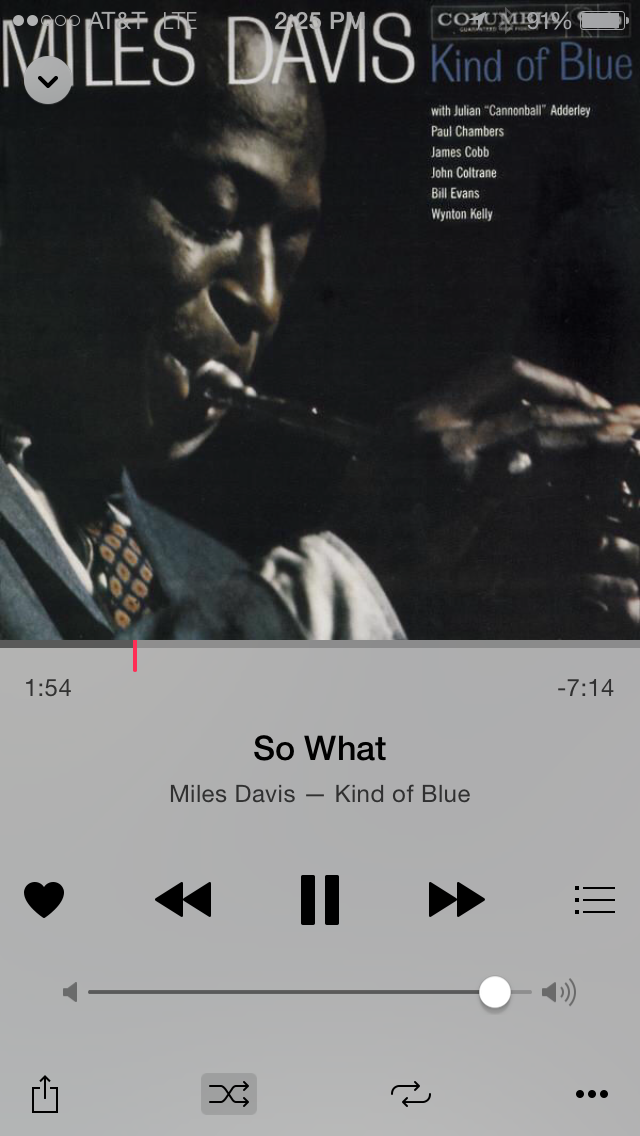
If you don’t know know where to start with jazz music but have a feeling you ought to explore the genre, start with Kind of Blue.
It’s Miles Davis, yes, but he’s accompanied by Coltrane and Cannonball Adderly and Bill Evans and Paul Chambers and Jimmy Cobb. A dream team at their artistic peak.
The iTunes description of the album closes with “Modern jazz starts here.”
This article makes a compelling case for why electric cars will dominate sooner than you might think.
Tesla will do for electric cars what’s Apple did for smartphones:
Gas stations are not massively profitable businesses [4]. When 10% of the vehicles on the road are electric many of them will go out of business. This will immediately make driving a gasoline powered car more inconvenient. When that happens even more gasoline car owners will be convinced to switch and so on. Rapidly a tipping point will be reached, at which point finding a convenient gas station will be nearly impossible [5] and owning a gasoline powered car will positively suck. Then, there will be a rush to electric cars not seen since, well, the rush to buy smartphones.
I’m on a big picture, big history kick right now.
I’ve been reading a great history of Homo sapiens, and I’ve started listening to the audio version of Bill Bryson’s A Short History of Nearly Everything.
Bryson’s book is a delightful survey of the biggest ideas and discoveries that explain what we know about the universe.
What stands out is just how much we got wrong and how certain we were in our errors.
The steps forward were usually dependent on those who were willing to embrace uncertainty and not-knowing, who could follow their curiosity rather than their egos.
“Until you have done something for humanity you should be ashamed to die.” –Horace Mann