“If you think, you stink.”

From Ed Catmull’s book Creativity, Inc.:

Byron Howard, one of our directors at Disney, told me that when he was learning to play the guitar, a teacher taught him the phrase, “If you think, you stink.” The idea resonated with him—and it informs his work as a director to this day. “The goal is to get so comfortable and relaxed with your instrument, or process, that you can just get Zen with it and let the music flow without thinking,” he told me. “I notice the same thing when I storyboard. I do my best work when I’m zipping through the scene, not overthinking, not worrying if every drawing is perfect, but just flowing with and connecting to the scene—sort of doing it by the seat of my pants.”

Too much thinking will mess things up. When I’m struggling or discouraged or anxious and uptight, it’s my mind that’s getting in the way. Instead of try hard, I should try easy, right? Or, just skip trying and simply do.

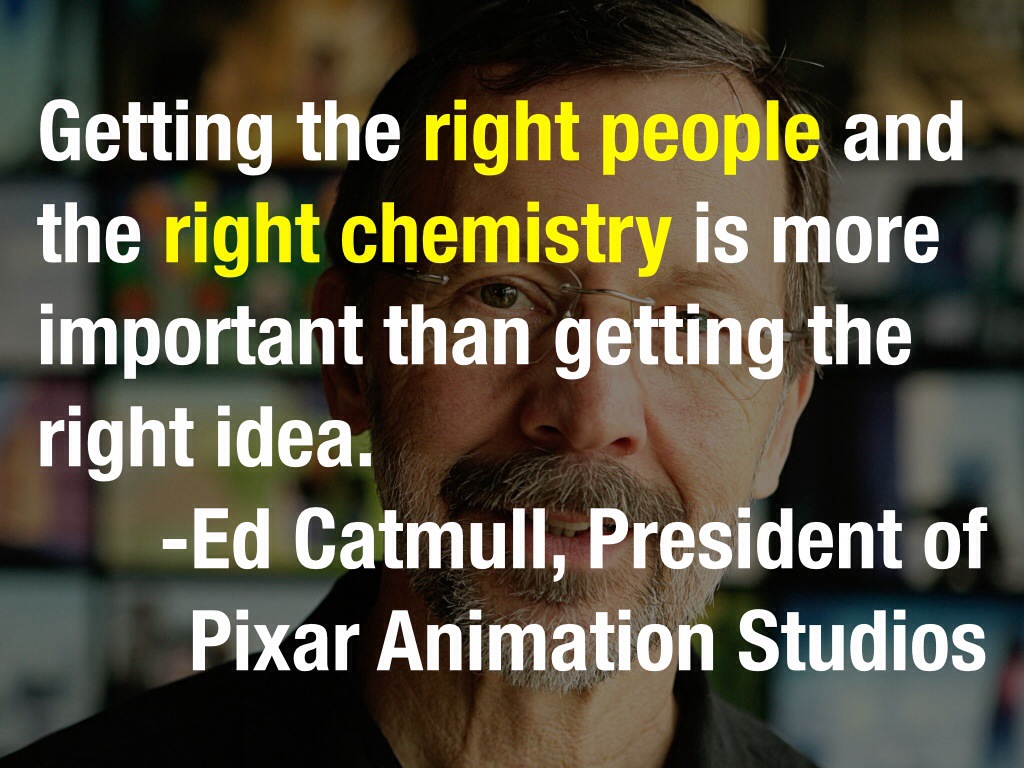
Get the right people and the right chemistry

I have been reading Ed Catmull’s excellent book, Creativity, Inc. Catmull is one of Pixar’s founders and now leads both Pixar and Disney Animation. He knows plenty about running a successful organization, and his book is refreshingly unlike the typical business book. It’s humble and candid and authentic in ways most business insider books are not.

I will post later with more that I gleaned from Catmull’s compelling stories and heartfelt advice, but I completely connect with this insight about centering your priorities around people:

20140618-212925-77365460.jpg

This is in sync with all I’ve experienced about strong organizations and great teams. Find people who fit the vision and the culture, and then tend the culture gently, get the heck out of the way, and allow your people the freedom to be awesome.

Offstage beat

The excellent public speaking coach and author, Nick Morgan, encourages speakers to do as actors do and master the offstage beat before beginning a presentation.

Actors are trained to get the emotion and perspective of their character fully in mind before walking on stage. If your character is angry in a scene, feel that emotion before you appear. If you’re supposed to be amused or confused or delighted or sad, find that state just before facing the audience. (Some actors have been known to inhabit their character’s personality for long periods off stage or throughout the filming of a movie. Heath Ledger’s Joker is a notable, maybe infamous, example.)

As someone who speaks regularly, I’ve sort of accidentally done this kind of mental preparation without being particularly intentional about it. However, since reading Morgan’s post, I have begun making a tiny ritual of capturing my offstage beat just before beginning a presentation. Before I go on I find a quiet place to be alone and put in mind just who I want to be when I begin my talk. I put my body in the posture I want to have and breathe deeply and smile and feel the emotion that is right for the occasion. I fill my mind with the happiest of thoughts and envision a deep connection with the audience. Then I can go on and hopefully begin with the energy and emotion I desire.

Doing this helps calm pre-talk jitters, too. If you’re focusing on the state you want to be in, it’s harder to dwell on your fears. Filling your mind with emotions you choose makes less room for unwanted anxiousness.

This is a good strategy for other situations as well. Before asking someone on a date or walking in to a job interview it would be wise to get yourself mentally and emotionally where you want to be.

I can even see myself doing this before working on a creative project or tackling a challenging task. What have my most productive flow states felt like, and what if I just acted like I was in such a state before sitting down at my computer? This would be the no-audience, no-stage offstage beat. 🙂

“All the world’s a stage”, right, so don’t feel there’s anything insincere about mastering your role in life’s grand play. Act like you are who you want to be, or need to be, and you just might become the character, the person you’ve only imagined yourself to be.


Enthusiasm

Screen Shot 2014-06-16 at 4.34.29 PM

All the chasing we do after stuff and to please others and to build what we think is security for a comfortable life…

What if the greatest comfort, though, is the deep, satisfying happiness that comes from getting lost in something you love just for the thing itself? What generates genuine enthusiasm in you, not for any extrinsic rewards but for the simple joy of the pursuit, for the intrinsic rewards?

Enthusiasm in some people can seem trivial or insincere or even silly, especially when it comes across as contrived emotion worked up artificially on command like a salesman trying to make his quota or a manager in a dysfunctional bureaucracy trying vainly to rally her demoralized charges. But the real thing, genuine enthusiasm, delightful absorption, is an obvious marker that someone embarking on an excellent journey should heed. Go in that direction.

Culture is destiny

Screen Shot 2014-06-03 at 4.35.59 PM

Tony Hsieh, Zappos CEO, is a visionary business leader and a crusader for the primacy of organizational culture. His excellent book, Delivering Happiness, tells the story of the creation of Zappos, a company with one of the most lauded customer service operations anywhere. Zappos has a reputation for being one of the happiest places to work, and Hsieh’s books goes into great detail about how they have cultivated the unique culture responsible for their public success and their rewarding work environment.

How would you describe the culture of your organization? Most organizations have some official mission statement posted on a corner of their web site and maybe even a statement of values, but the true culture of a place defies artificial attempts to mandate it from a PR document.

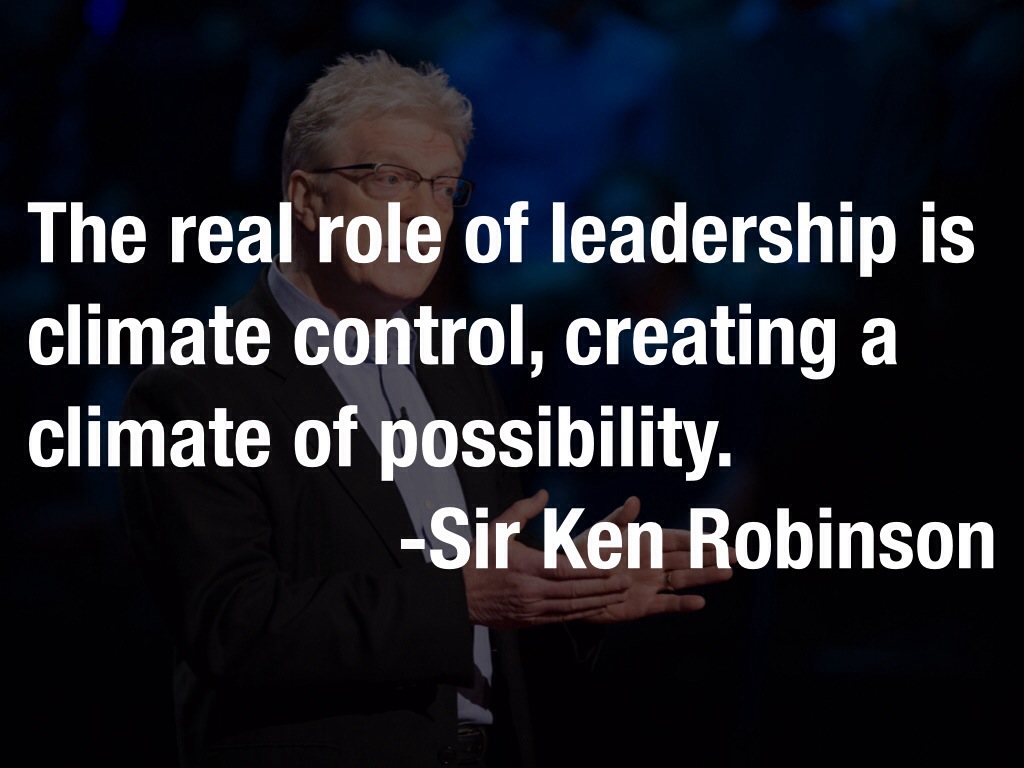
Effective leaders know that culture should be their primary focus. Create and nurture an environment that provides vision and frees each person to unleash their best work. Create a climate of possibility.

20140615-224941-82181191.jpg

Well played, college superstars. Well played.

I’ve been flying solo at work this week. My two colleagues have been out of town at a conference, so it’s been just me and our excellent team of college students running the shop. And the students have been great, showing up early and performing their duties with distinction. They are mature beyond their years, bright beyond their peers, and make my job about as much fun as anyone could imagine a workplace can be.

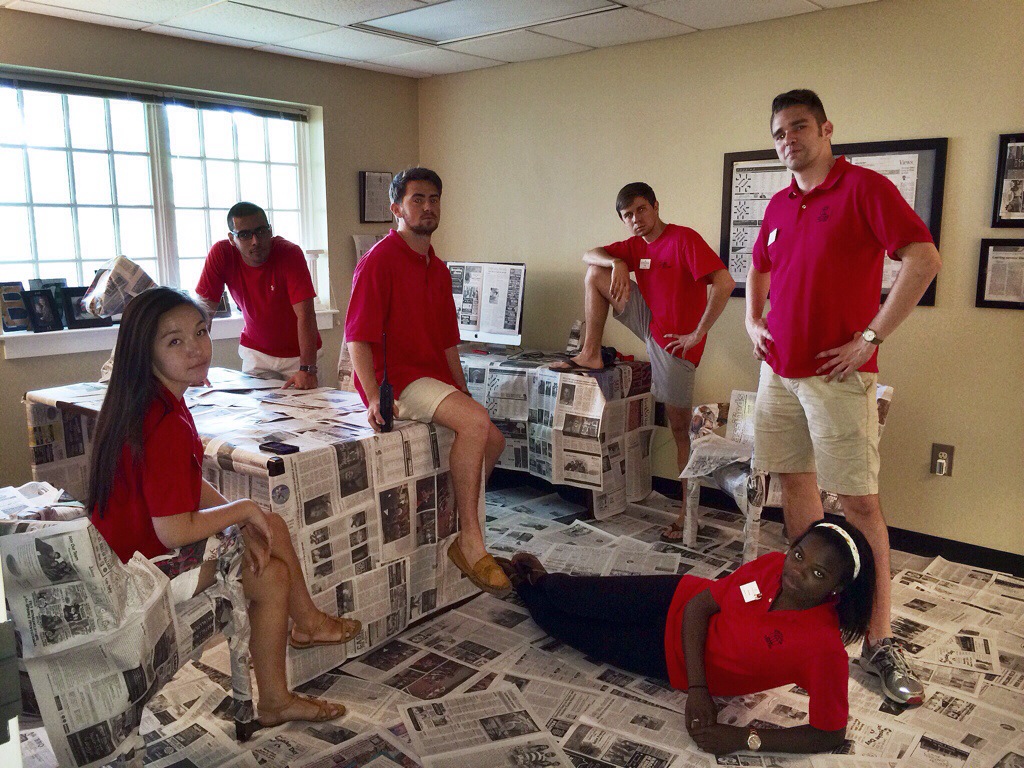
Today was my last day before a weeklong vacation (and before my birthday this weekend). When I returned from lunch I found my office door closed with a note on it wishing me a happy birthday. Opening the door revealed this:

20140606-222154-80514899.jpg

20140606-222155-80515871.jpg

Impressive work, no? My first impulsive thought, though, was “What an annoyance this will be to clean…”

Then, as I surveyed the scene, I was genuinely delighted by the meticulous attention to detail and by the fun spirit that prompted this. The two primary culprits were cautiously awaiting my response and were preparing to start removing it right away. I paused and pondered for a moment, then I said, “Don’t clean up. We’ve got to leave it. Everyone needs to see this.”

This is practically a work of art, right? And it was inspired, I know, by their genuine affection for their old-enough-to-be-their-father boss who they were counting on being a good sport. I realized this was a high honor, a prank to be thankful for.

So, while I’m away on vacation, my office will remain a newspapered tribute to not taking work too seriously.

Well played, college superstars. Well played.

20140606-223712-81432222.jpg

Designing my next decade

I’ve been thinking about the “long game” since last week’s post. With a big birthday for me this weekend – both digits are turning over – I’m in a reflective mood.

If the long game is, say, to peak at 60, I’ve only got ten years till maximum awesome. We tend to overestimate what can be done in a year’s time and way underestimate what we can accomplish in five or ten years. What if I were intentional about thinking through the kind of person I hope to be in ten years? What would be ideal at 60, in a range of categories? Health and vitality, family, work, friendships, accomplishments, lifestyle, daily routines…?

I’m going on vacation next week and will use some of my time at the beach reflecting on this and discussing it with my wife and daughters. What kind of person do I want to be? What do I want my life as a 60-year-old to look like? How can I fulfill my potential as a husband and father and friend? What can I contribute? How can I awaken possibility in myself and others?

In the spirit of showing my work, here’s a mind map I started on today. Once I have some goals in mind, I’ll work back towards creating some systems, some habits to lead me in that direction. Systems and process trump goals, of course, and I can begin immediately acting as if I am the kind of person I hope to be.

Why not invest time in planning for the long view? Why not design the ideal you for the next decade or more and begin crafting habits to realize that vision?

Screen Shot 2014-06-04 at 4.43.20 PM

“Resistance”: Using fear to find your way

This afternoon I made a trip to the backyard hammock. I had survived my daughter’s 7th birthday Frozen slumber party and was looking forward to a quiet day. I picked up my old Kindle e-reader, the one with no touch screen and no apps. I usually read on my iPad mini, but reading in a hammock outside is a Kindle occasion.

The book that happened to be at the top of the list when I powered the Kindle on was Steven Pressfield’s The War of Art. Such a great read. It’s the ultimate kick in the seat of the pants for anyone who wants to get something done but who keeps not doing the thing they want to do.

Pressfield is a novelist (his Gates of Fire is terrific), but The War of Art is non-fiction and non-B.S. It’s straight talk about the battle we all face when confronted by the desire to make something meaningful or to live a nobler life. He names the force that opposes our efforts the “Resistance”. From the opening pages:

“Most of us have two lives. The life we live, and the unlived life within us. Between the two stands Resistance.”

The greats are great because they mustered the will to overcome this Resistance. The greats didn’t wait on inspiration; they put their butts in their chairs and did work, whether they felt like it or not.

Instant gratification, comfort, pleasure, pain-avoidance of any sort are all forms of Resistance. Beating Resistance is a daily undertaking. It’s not a one and done kind of battle. Pressfield encourages us, though, to use Resistance to our advantage:

“Like a magnetized needle floating on a surface of oil, Resistance will unfailingly point to true North – meaning that calling or action it most wants to stop us from doing.

We can use this. We can use it as a compass. We can navigate by Resistance, letting it guide us to that calling or action that we must follow before all others.

Rule of thumb: The more important a call or action is to our soul’s evolution, the more Resistance we will feel toward pursuing it.”

So, search yourself and explore the grand plans of your imagination. The plans for the kind of person you would like to be and the dreams of the work you want to do. Find where there is the most Resistance, those things that seem to be too much of a stretch, where the fear of action is greatest. There’s your calling. Head in that direction.

warofart

The Long Game and the patient pursuit of awesomeness

This two-part video series was inspired by one of my favorite recent books, Mastery by Robert Greene.

It takes a long time and focused effort to become an “overnight” success. Imagine being a 20-year-old whose primary focus was to peak at 60? How would such a mindset change your decisions? It’s so natural to be in a hurry, to be ambitious for success right away. But consider focusing on the “long game”, the steady, patient pursuit of awesomeness over the long arc of a life worth talking about.

via BrainPickings.org

Richard Sherman on craftsmanship: “meticulous attention to detail”

Kottke just shared this fascinating video of Seattle Seahawks star cornerback Richard Sherman talking about his craft. (Sherman is one of the more interesting personalities in the NFL. A Stanford grad with some serious smarts who is most well known now for his colorful comments. He talks, but he sure can back it up.)

I feel like I’m a decent athlete, but my tape study and my meticulous attention to detail are what make me a good ball player. -Richard Sherman

This video feature on Sherman is worth watching, even if you don’t have any interest in football. Sherman acknowledges he’s not the most athletically gifted at his position, but he’s considered maybe the best cornerback in the NFL. And it’s all because of how he prepares. He pursues his work with an obsessive attention to detail. Practice doesn’t necessarily make perfect, but thoughtful, strategic, relentless preparation can set you apart because so few, even the most gifted, pursue excellence with such focus.

Screen Shot 2014-05-09 at 4.07.54 PM

John Mayer on craftsmanship

I’ve written before about my appreciation of John Mayer’s artistry as a musician. I just saw this new documentary, Someday I’ll Fly, about his career and came away impressed. It’s a thorough review of how he got to mastery. Mayer narrates and offers several gems of insight throughout:

“I used to be at home in my bedroom and pretend that I was on stage, and now I’m on stage and I pretend that I’m home in my bedroom.”

“I want to bring my playing all the way up to the the top of ability…there are some nights my playing goes over my ability. I kind of hit that place where I’m unsure. But then I always find that I get a little further into the craft by doing that.”

“That craft responds to truth, and you’ve got to stay truthful. No matter how many records you’ve sold or performances you’ve played, you come home, the whirlwind stops and you go back to the craft.”

When he was a teenager Mayer was so obsessed with getting good at playing guitar that his mom had to give him a “guitar curfew”, a time he had to stop playing every night. John Mayer wasn’t born with a gift for guitar. He worked hard to become great.

It’s both comforting and convicting to know that our own levels of mastery are completely up to us. If we want to get really good at something, we only need to be willing to obsess enough to consistently devote quality time and smart effort.

via shawnblanc.net

“Talent is not stopping.”

This interview with Everything Is A Remix creator Kirby Ferguson is solid. Love his advice for those just getting started:

What would your advice be to the 20-year-old version of you, who’s just starting their career?

I wish I had Everything Is A Remix when I was younger. I wish I knew that you can just start copying other people’s stuff and fiddling with it, and putting stuff into it, and just sort of build from there. It’s okay to be primitive. That’s a perfectly fine way to start making things.

I wish the earlier me understood work and practice more. Just the repeated concerted effort to get better at things. I wish I didn’t have the notions of talent and genius I had back then. I thought, “Oh, these other people, they just have something that I don’t have.” When really, they are just people who work more.

I wish I understood work. Work is the key to anything you want to do. If you want to play the guitar—anybody can learn to play the fucking guitar—you can be good at it. Maybe you won’t get to be a genius but you could be good.

You can be good enough to write good songs or make a good film or whatever. There’s no such thing as not having enough talent to get to that level. I mean, persistence is talent, really. Just sticking with it. Talent is not stopping.

I keep coming across this simultaneously reassuring and frightening notion that genuine talent is not based on innate ability. We’ve got no excuse for not being great. It’s all about effort and persistence and thoughtful, incremental improvement. Sure, some people have genetic advantages, but the hard work and clear focus of someone of average ability can overtake the half-hearted efforts of a genius slacker.

Do the work. Be awesome.

Systems, not goals

This is from the cartoonist, Scott Adams, as quoted in The Farnam Street blog (Farnam Street is regularly excellent, by the way.):

“If you do something every day, it’s a system. If you’re waiting to achieve it someday in the future, it’s a goal.

[O]ne should have a system instead of a goal. The system-versus-goals model can be applied to most human endeavours. In the world of dieting, losing twenty pounds is a goal, but eating right is a system. In the exercise realm, running a marathon in under four hours is a goal, but exercising daily is a system. In business, making a million dollars is a goal, but being a serial entrepreneur is a system.

Goal-oriented people exist in a state of continuous pre-success failure at best, and permanent failure at worst if things never work out. Systems people succeed every time they apply their systems, in the sense that they did what they intended to do. The goals people are fighting the feeling of discouragement at each turn. The systems people are feeling good every time they apply their system. That’s a big difference in terms of maintaining your personal energy in the right direction …”

This is great insight. Instead of aiming for some goal out there, arbitrary as most goals are, aim instead to be the kind of person and do the kinds of things that someone who achieves those goals would be and do. And then don’t obsess on the goals. Just do the work and live the life. Act as if you are who you want to be.

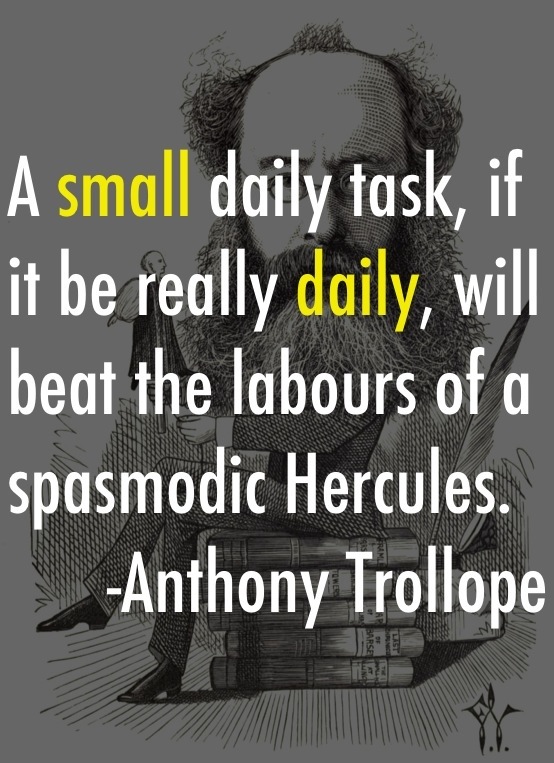
A daily or weekly routine, a consistent application of even small habits, will transform our lives more effectively than striving for some overwhelmingly large goal.

20140421-204913.jpg

Showing my work: Utah

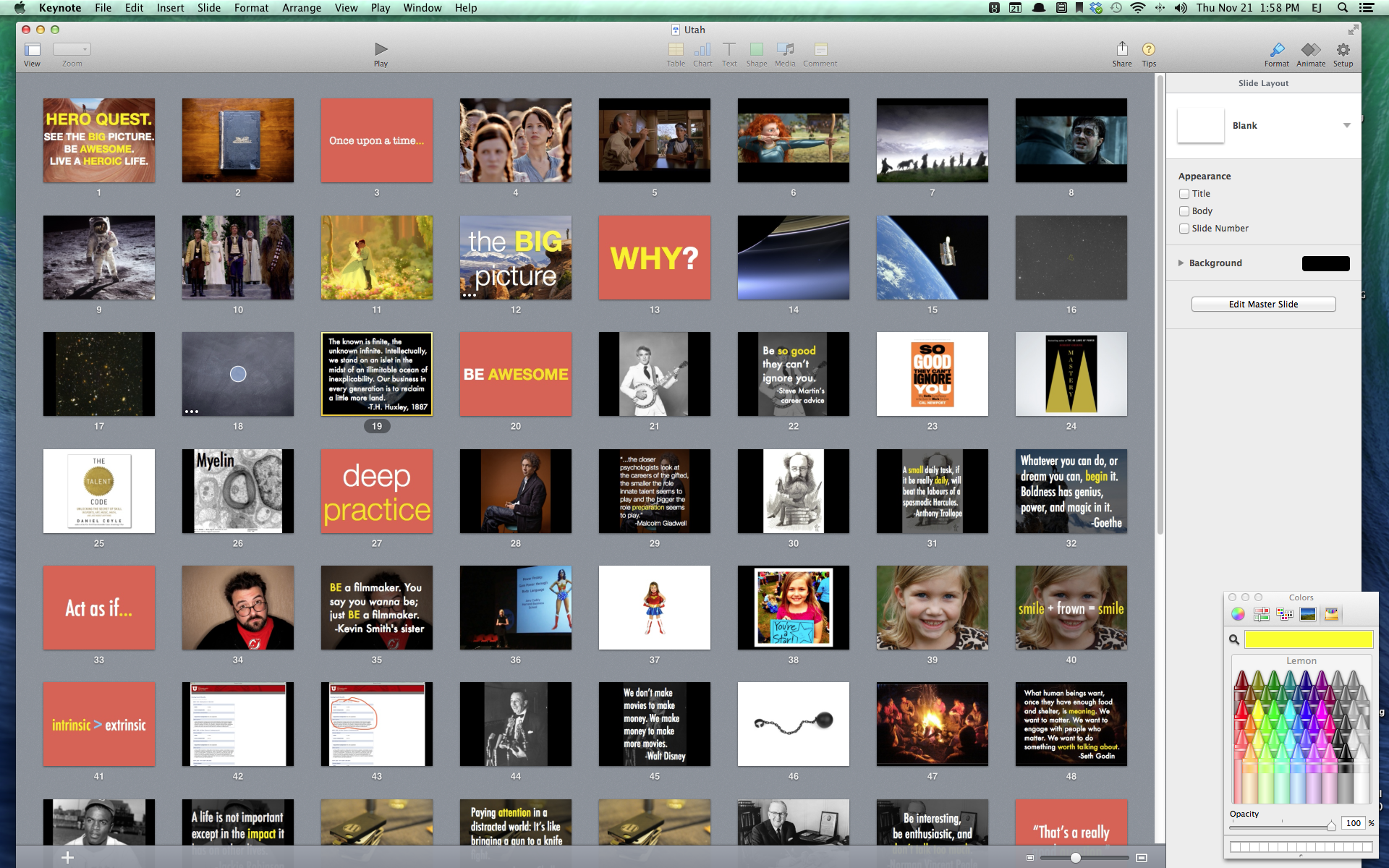
I’m finishing up work on a keynote presentation I’m giving at a student leadership conference in Utah on Saturday. As I’ve done previously, I’m showing my work in progress. Here’s a screenshot of my Keynote app in “Light Table” view, which I think is a magical mode for thinking through ideas and putting together a narrative arc:

Screen Shot 2013-11-21 at 1.58.43 PM

I’ve already discarded and rearranged significantly in the past few days. And with less than two days till my talk, I’m still not satisfied. I take a bit of a kitchen sink approach, throwing everything in, and then I try to pare back to what I hope is a core message for the audience and the occasion. I’m rehearsing today and tomorrow (standing in front of my computer giving the talk to an empty room), and I expect this arrangement of slides and ideas to look somewhat different by the time I get to Saturday. Talking out a presentation shines a light on problems and possibilities that would never appear otherwise.

I asked some of my students this week what college students ought to hear in a talk like this, and they kept mentioning points they’ve gotten from my talks that were connected to specific images on the screen. “Remember that picture of the band on your slide…” This reaffirms my delight in using slides in general, and powerful images especially. I go acoustic and speak without slides occasionally, but I keep coming back to using images for their impact on emotion and on recall.

I keep searching for a way to take these talks to another level, to string together a cohesive narrative rather than just listing interesting, related points. I want the whole talk to tell a story, not just tell a bunch of stories. The more stories, the better, of course. But stories and anecdotes and images should all serve to support the primary narrative. This quote from Kubrick continues to challenge me:

“If you really want to communicate something, even if it’s just an emotion or an attitude, let alone an idea, the least effective and least enjoyable way is directly. It only goes in about half an inch. But if you can get people to the point where they have to think a moment what it is you’re getting at, and then discover it … the thrill of discovery goes right through the heart.” -Stanley Kubrick

The “thrill of discovery”. That’s what I’ll be searching to build into this before standing before the students I’m privileged to address in Utah this weekend. If they’ve got to sit and listen to me for 45 minutes, I want to awaken possibility and give them something worth thinking about and talking about. Okay, back to work, back to the quest.

The only competition that matters

The only competition that matters is the one between who you want to become and who you are.

(Can I quote myself?)

Some weeks, I fall short of the week before. But just being aware is enough to make me want to do better the next week. No need to kick myself and make it worse. Just know that funks happen. And then they pass. And then take action to be more awesome next week.

20131005-094459.jpg

Inspiration is for amateurs

An Austin Kleon interview led me to this Brain Pickings post with this from painter Chuck Close:

“Inspiration is for amateurs — the rest of us just show up and get to work. And the belief that things will grow out of the activity itself and that you will — through work — bump into other possibilities and kick open other doors that you would never have dreamt of if you were just sitting around looking for a great ‘art idea.’ And the belief that process, in a sense, is liberating and that you don’t have to reinvent the wheel every day. Today, you know what you’ll do, you could be doing what you were doing yesterday, and tomorrow you are gonna do what you did today, and at least for a certain period of time you can just work. If you hang in there, you will get somewhere.” -Chuck Close

I’m still trying to learn this. Too often I’m waiting for the right mood, for an idea to grab me before getting busy making something.

I need to “just show up and get to work” every day and maybe working will lead to me grabbing an idea rather than the other way around. And if I do nothing but bad work, it’s better than no work. And bad work just might lead to something that’s kind of good. You can’t get to great without starting somewhere. Starting is the essential thing.

I keep coming back to Gretchen Rubin‘s starkly simple reminder from the potent little book on work habits, Manage Your Day-to-Day:

20131001-112815.jpg

Monday rocks!

“Monday rocks!”

I heard this from my first-grader early this Sunday evening. She was busy doing something creative in the living room, and my wife was talking with her about the week ahead.

Her words surprised me, and I had to step in and make sure I heard her correctly. She reiterated her fondness for Monday and explained that she gets to go to music on Monday, and she loves her music class at school. Plus, she gets to see Calli, who is a terrifically fun college student who babysits my girls every Monday.

This 6-year-old is unapologetic about her enthusiasm for the start of a new week. What if everyone took on the week with such gusto?

Rock on, Monday.

20130929-230604.jpg

Our first responsibility

Maria Popova is prolific with her regular output of curated wisdom on brainpickings.org. I recently read an interview with her on The Great Discontent (another great site). She has an interesting story. Here’s a bit of wisdom from the interview:

I truly, truly believe that our first responsibility is to ourselves—to be true to our sense of right and wrong, our sense of purpose and meaning. That’s how we contribute to the world. Anyone who is able to do that for him or herself is already contributing a great deal of human potential into our collective, shared pool of humanity.

Don’t let other people’s ideas of success and good or meaningful work filter your perception of what you want to do. Listen to your heart and mind’s purpose; keep listening to that and even when the “shoulds” get really loud, try to stay in touch with what you hear within yourself. -Maria Popova

The opinions and expectations of others can be instructive as well as destructive. To be your best and do your best means first being true to your own vision of what that means for you.

Getting stronger

This is another great TED Talk*. Here, psychologist Kelly McGonigal shares research showing that facing stress head on rather than avoiding it or being crushed by it has beneficial effects:

Adversity and responding effectively to it generate growth. I’ve been learning that masters get great at something because they keep doing hard things, bumping up against their limits, and persevering to get better.

“No pain, no gain” is a real thing. But I’ve prided myself on avoiding stress when I can. This talk lets me know I should throw myself into the fray regularly and embrace difficulty and challenge more often.

Next time I get the panicky, tight feeling inside about a hard thing approaching, I should welcome it as an opportunity to get stronger.

*HT Getting Stronger blog