The merits of doubt

As I was trying to wake up my 7-year-old for school this morning, I reminded her that today is St. Patrick’s Day. That got her attention, and she asked if I thought leprechauns were real. Apparently, there’s been talk at her school this week about leprechauns making mischief.

Without giving it much thought, I just said, “Of course, leprechauns are NOT real.” I suppose I should have played along, but I was still waking up myself, and I thought I was providing some relief from her being anxious about the thought that leprechauns might be lurking about. I usually smile and nod at the fairy tale wishes of my kids, but I just blurted out my first reaction to the leprechaun musings this morning.

But she shot back that I couldn’t prove they aren’t real. “Ah!” I responded. “The burden of proof is not on me, but on those who say leprechauns are real.”

Her adamance and our brief conversation about “proving” beliefs got me thinking that we tend to overly deprecate doubt and overvalue belief.

I shouldn’t have to prove the non-existence of something. Believers are the ones with the burden to substantiate the thing they say is true if they want others to believe along with them.

“Doubting Thomas” is a term of derision. “Just believe!”, conversely, comes across in our culture as a worthwhile exhortation. But shouldn’t it be the opposite? Shouldn’t doubt be an honorable and logical default for any thinking person? Belief without reason or evidence is hollow.

Later in the day I came across this essay, Teaching Doubt, by the physicist Lawrence Krauss in the online version of The New Yorker. He makes the case that a modern society that values reason and education should make it a priority to “plant the seeds of doubt” in the next generation.

From Krauss’s essay:

Doubt about one’s most cherished beliefs is, of course, central to science: the physicist Richard Feynman stressed that the easiest person to fool is oneself. But doubt is also important to non-scientists. It’s good to be skeptical, especially about ideas you learn from perceived authority figures. Recent studies even suggest that being taught to doubt at a young age could make people better lifelong learners. That, in turn, means that doubters—people who base their views on evidence, rather than faith—are likely to be better citizens.

And he closes with this:

One thing is certain: if our educational system does not honestly and explicitly promote the central tenet of science—that nothing is sacred—then we encourage myth and prejudice to endure. We need to equip our children with tools to avoid the mistakes of the past while constructing a better, and more sustainable, world for themselves and future generations. We won’t do that by dodging inevitable and important questions about facts and faith. Instead of punting on those questions, we owe it to the next generation to plant the seeds of doubt.

I don’t want to steal the wonder and delight of childhood by killing the magic of fairy tales or by pouring cold water on imaginative flights of fancy. But I do want my kids, and you should want yours, to not just take some authority’s word for the way things are. Instead of handing them answers, I need to free them to ask questions, whether I’m confident of what I think the answers are or not.

I’m not envisioning a cynical, “prove-it-to-me”, arms folded, hard-hearted kind of doubt. The posture that seems most promising is an open-minded, skeptical, yet optimistic curiosity. The attitude that responds with “Fascinating” and “Help me understand” and “I wonder why…” and “I might be wrong, but…”

What if the next generation grows up more curious than they are certain, more inclined to seek evidence and understanding than being content with hand-me-down answers? There will still be room for imagination and fantasy and maybe leprechaun stories, but there also will be more possibilities for making sense of the mystery we all are swimming in.
David Malham on dying: “Let’s not save our affection”

Yesterday there was an essay on the New York Times opinion page by a retired grief therapist, David Malham, who has been diagnosed with A.L.S. and is facing his imminent death.

It’s a thoughtful and light-hearted reflection by someone well acquainted with the grief of others. It’s a worthwhile read in whole. He highlights the absurdity of coming to grips with your own mortality:

But it’s not that we forget that we will die; it’s that we work hard to not remember it. Yes, we accept the plural “we will die,” but it’s the particular, the “I” that we have trouble with. It’s easier to accept “we” because the “I” believes it can hide when the others in the “we” are taken. When it comes to the particular, we are, each of us, facing death new and uncomprehending. 

Woody Allen wryly said: “I’m not afraid to die. I just don’t want to be there when it happens.”

But it’s coming for each of us. My life is terminal. Yours is, too.

Thinking about your death too obsessively can send you into an existential funk and shadow the light from the life you’re living. But living in denial of your ultimate fate will make meaningfulness elusive.

Malham suggests, though, that it’s the prospect of the deaths of those we love that is more troubling even than accepting our own demise.

My mom would have turned 73 today. (Happy birthday, mom!) She died almost ten years ago. Her absence from our lives still stings, a decade later. Our family has not recovered, and likely will not recover, the bond we once had when she was alive. She was such a joyful, dynamic presence and was the heart of not just our immediate family but even, somewhat, of both extended families. Life goes on, though. Or, the living keep living. For now.

Stoic sages advise periodically envisioning the loss of those you love. Sounds like an unappealing practice, right? It’s meant to be. The point is to face that kind of momentary pain often enough to make you better appreciate your loved ones while they’re with you.

Malham’s closing exhortation is tinged with just such a Stoic perspective:

We want to be (lightly, only lightly) aware of death not because our story will end, but because the stories of those we hold dear will end, perhaps before ours. The awareness of premature or unexpected endings can motivate us to routinely demonstrate our love to those important to us. Let’s not save our affection, as if a rare wine, for special occasions. Give and receive it as essential nourishment.

“Grief, after all, is the price we pay for love.” –David Malham

Alan Watts: Hurry is fatal

I found these thoughts on the @AlanWattsDaily Twitter stream today:

A hurried feeling is a good sign that I need to pause and reflect.

The great (greatest?) coach John Wooden would regularly say to his team: “Be quick, but never hurry.”

Take cues from nature. Let life come. Don’t force. Take it easy.

Be like the amazing Bruce Lee and be water.

Hurry is fatal, at least to any possibility of being awake to the present moment, which is the only place my life ever is.

*I had a set of Alan Watts lectures on cassette tapes that I literally wore out fifteen years ago. Watts was as engaging and as challenging and as entertaining a thinker as any I’ve heard. His books, The Wisdom of Insecurity and The Book on the Taboo Against Knowing Who You Are, are two of the most mind-stretching I’ve ever read.

Oliver Sacks: “There will be no one like us when we are gone”

A couple of years ago the author Oliver Sacks wrote an insightful essay about his delight at growing old. He was surprised to find himself in his eighties and to find how gratifying it was. I posted about what an encouragement that essay was to me. 

However, Sacks recently found that he is terminally ill and wrote about facing his rapidly approaching demise. Go read the whole essay in the New York Times. He is eloquently reflective as he shares his news and explores his response in his final days. He closes with a measured and gracious appreciation for having had what he clearly considers a meaningful, well-lived life:

“I have been increasingly conscious, for the last 10 years or so, of deaths among my contemporaries. My generation is on the way out, and each death I have felt as an abruption, a tearing away of part of myself. There will be no one like us when we are gone, but then there is no one like anyone else, ever. When people die, they cannot be replaced. They leave holes that cannot be filled, for it is the fate — the genetic and neural fate — of every human being to be a unique individual, to find his own path, to live his own life, to die his own death.

I cannot pretend I am without fear. But my predominant feeling is one of gratitude. I have loved and been loved; I have been given much and I have given something in return; I have read and traveled and thought and written. I have had an intercourse with the world, the special intercourse of writers and readers.

Above all, I have been a sentient being, a thinking animal, on this beautiful planet, and that in itself has been an enormous privilege and adventure.”

That’s a fine epitaph for anyone. Imagine facing your own imminent death with such poise and perspective, not flailing or grasping futilely in panic.

Of course, to make it past 80 after a notable life of accomplishment might have a calming effect as death approaches. I would like to think I could have such a healthy acceptance of my fate even without the gift of all those years and accomplishments. (Personally, I’m fine with not having to ponder this more directly until I approach, say, the century mark.)

However, none of us know our expiration date. But we all, like Oliver Sacks, have the privilege of being alive and aware right now and able to make our unique mark on this human experience like no other human ever has or ever will.

I suppose the best way to be prepared for a gracious end is to keep living as excellent of a now as you can–delighting in the mystery, loving deeply, making this place even a bit more beautiful with the art that only you can create.

Live your life on your own terms

Donald Miller, in his new book, Scary Close, refers to a story I saw last year about a nurse who worked with patients as they approached death and the lessons she learned about their regrets:

“Remarkably, the most common regret of the dying was this: they wish they’d had the courage to live a life true to themselves and not the life others expected of them.”

You’ve got one shot at life. Don’t live on someone else’s terms. Their life is enough for them. Your life is your life. Live it as best you can.

IMG_1042

Good days are the material of a good life

The Art of Manliness just concluded an excellent, in-depth series on Winston Churchill, The Churchill School of Adulthood.

What a remarkable life. Churchill was THE linchpin in keeping the free world free in the darkest years of the twentieth century. And he was arguably the authentic and original most interesting man in the world. Scholar, prolific author, adventurer, humorist, iconic orator. With his incredible intellectual depth and transparent, colorful personality, he defied the stereotype many hold of politicians.

In the last post in this web series, there’s this quote from Churchill:

“Every night,” he said, “I try myself by court martial to see if I have done anything effective during the day. I don’t mean just pawing the ground — anyone can go through the motions — but something really effective.”

This is much like Benjamin Franklin who began each day by asking himself “What good shall I do this day?” and ended each night with “What good have I done today?”

I don’t need to have accomplished big, Churchillian things in a day. But I do want to have been intentional about doing something meaningful, even a small thing. A genuine connection with someone, a memorable conversation, an act of kindness. Making something or moving a valued endeavor a little further toward completion.

If I can get to the end of a day with something to look back on with satisfaction, it’s a good day. Good days strung together more often than lost days will ultimately lead to a good life.

Churchill’s life was epic. I don’t need an epic life. Yet taking stock at the end of each day and holding myself to a standard of quality, like Churchill and Franklin did, can point me more effectively toward the good life I do aspire to lead.

“How we spend our days is, of course, how we spend our lives.” –Annie Dillard

Upgrading your life “operating system”

I listened to this Tim Ferriss interview with entrepreneur Peter Diamandis recently. Diamandis is promoting his new book, Bold, which is a challenge to aim higher, dream crazier dreams, and take bold action.

The podcast is a solid interview, filled with perspective shifting insights and stories.

I was particularly struck by Diamandis’s notion that we should periodically reevaluate our mind’s OS, our operating system for how we think and behave. I upgrade my computer’s OS almost yearly, but how often do I tinker with my primary mental default settings?

We add “apps” (a new language or skill, for example), but rarely do people examine, tweak, or completely upgrade their default “OS”, the set of assumptions and beliefs about life most people are handed by family, friends, and culture.

Computer software tends to get buggy and slow down over time, and to keep up and remain effective it needs regular updates and occasional wholesale upgrades.

But don’t most of us still rely on unexamined beliefs and principles and buggy habits and potentially outdated modes of operating?

My recent immersion in Stoic philosophy, for example, has led me to rewire my approach to obstacles and setbacks. I’m less of the blind optimist and more willing to embrace the negative.

The primary worldview I had at age 20 is mostly gone now, replaced, however, by an approach that is more realistic, more challenging, and ultimately more empowering. I know, though, how difficult it is to upgrade and debug a long-established mindset. Maybe I’m just slow and particularly resistant to change, but it’s taken three decades to reboot some fairly basic, outdated patterns.

The unexamined life, though… Not. Worth. Living.

“You are someone amazing. You are nobody special.”

Wow, right?

This is the ultimate existential tension we all face.

There has never been another you in the entire history of all that is. You are a unique part of this wondrous universe that is growing exponentially grander the more we know of it. You are the very consciousness of the universe, and only you can be you.

And yet you are so small, and your time here so fleeting. Your name and life history will fade from memory within a few generations of your death, which is approaching more rapidly than you want to imagine.

We are mortal inhabitants of a tiny planet orbiting an average star in a middling galaxy in a small speck of an incomprehensibly large and seemingly indifferent universe. Yet we are alive and aware and writing blog posts and hugging our kids and making art and dancing to the music of life as only we can.

Be awesome because you are indeed amazing. You are one in a billion. Be humble and grateful because you are just a mere human, nobody more special than anyone else. You are one of billions.


Balancing stock and flow

I just stumbled on this remarkable insight from the writer Robin Sloan who explains the economic terms “stock and flow” and relates them to the kinds of content we produce in this information age:

“Flow is the feed. It’s the posts and the tweets. It’s the stream of daily and sub-daily updates that remind people that you exist.

Stock is the durable stuff. It’s the content you produce that’s as interesting in two months (or two years) as it is today. It’s what people discover via search. It’s what spreads slowly but surely, building fans over time.

I feel like flow is ascendant these days, for obvious reasons—but we neglect stock at our own peril. I mean that both in terms of the health of an audience and, like, the health of a soul. Flow is a treadmill, and you can’t spend all of your time running on the treadmill. Well, you can. But then one day you’ll get off and look around and go: Oh man. I’ve got nothing here.”

So much of what I create is flow, fine for the moment but not particularly sticky, not worth talking about over time. Occasionally I make something reasonably solid that I know will still be meaningful, at least to me, months or years from now. But I mostly just stumble on those stock, substantive creations by simply showing up every day and attempting to do something small.

For better balance, more impact, and deeper satisfaction, I should be intentional about the kind of work that has staying power and makes a difference for more than just a day.

Posting on this site daily has been worthwhile and has rewired my attention each day in consistently surprising, constructive ways. But the daily updates don’t typically lead to the kind of substance that sticks.

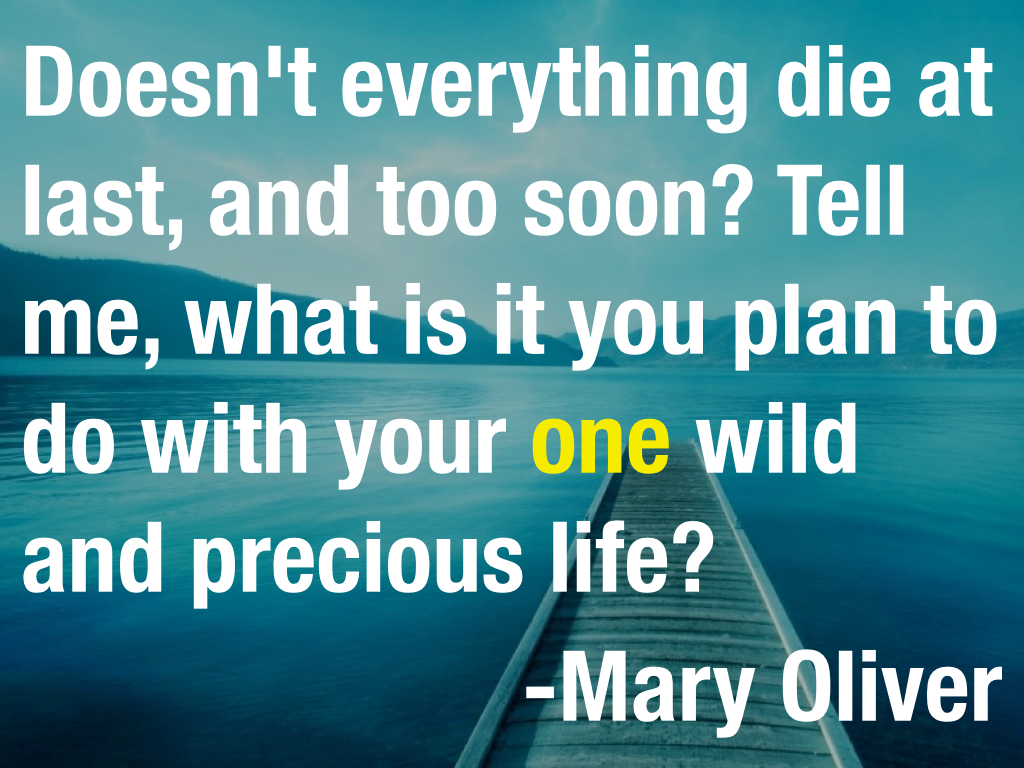
What can I invest time in that will endure? What projects and pursuits could even have the potential to outlive me? Why not be bold and imagine doing work that just might resonate even a century from now?

I find real merit in the daily flow and the energy that it pulses through the rhythm of my routines. Now, balance that with the intention to dig deeper on work, on stock, that will last and structure habits and routines around that intention.

Aim high and dig deep. And keep showing up every day.

Unconventional wisdom

“Whenever you find yourself on the side of the majority, it is time to pause and reflect.” –Mark Twain

Running with the crowd may feel safe, but it shouldn’t make you feel comfortable.

The bold ideas, the original and courageous convictions, are most often at odds with popular opinion and conventional wisdom.

“When 99 percent of people doubt your ideas, you’re either completely wrong or about to make history.” –Scott Belsky

Live immediately

Seneca, possibly the most eloquent of the Stoic sages, from the work most consider his masterpiece, On the Shortness of Life (via BrainPickings):

“Putting things off is the biggest waste of life: it snatches away each day as it comes, and denies us the present by promising the future. The greatest obstacle to living is expectancy, which hangs upon tomorrow and loses today. You are arranging what lies in Fortune’s control, and abandoning what lies in yours. What are you looking at? To what goal are you straining? The whole future lies in uncertainty: live immediately.”

Just start.

The invincible human being

I had previously filed away this article, “Why Stoicism is one of the best mind-hacks ever“, and just dug it up out of Instapaper. It’s a good summary of some basics of Stoic philosophy. And, at the center is this, beautifully explained by the author:

What the whole thing comes down to, distilled to its briefest essence, is making the choice that choice is really all we have, and that all else is not worth considering. ‘Who […] is the invincible human being?’ Epictetus once asked, before answering the question himself: ‘One who can be disconcerted by nothing that lies outside the sphere of choice.’

Any misfortune ‘that lies outside the sphere of choice’ should be considered an opportunity to strengthen our resolve, not an excuse to weaken it. This is one of the truly great mind-hacks ever devised, this willingness to convert adversity to opportunity, and it’s part of what Seneca was extolling when he wrote what he would say to one whose spirit has never been tempered or tested by hardship: ‘You are unfortunate in my judgment, for you have never been unfortunate. You have passed through life with no antagonist to face you; no one will know what you were capable of, not even you yourself.’ We do ourselves an immense favour when we consider adversity an opportunity to make this discovery – and, in the discovery, to enhance what we find there.

“Choice is really all we have.”

You can choose your response, your attitude, no matter the circumstances.  Some “bad” event can be redefined as “good” if you use it to learn, to grow, to become a stronger person. Imagine embracing all that occurs as though it was part of a master plan to refine you into an invincible human being.

What not to do

Screen Shot 2015-01-02 at 3.37.08 PM

What can I eliminate from my life to enlarge my life? I’m more aware of the clutter around me at the end of all the holiday excess than at any other time of year, and I need to use this season to propel me to hone in on the essentials.

I’ve already stopped some monthly services that were automatically billing my credit card but that just were not so useful any longer. I am going to take stock of the physical things that take up space around me but offer little value in return. If I don’t need it or love it, let it go.

What about my routines, most of which are unexamined? What is sapping energy from me or diverting me from more important priorities?

What about my work? What do I do that doesn’t add value? What can I cut that will free up resources for what’s truly essential?

What can I say “No” to that will make space for a more meaningful “Yes”?

Little by little obligations and habits and things accrue and impede or completely divert us from what we really want to do or be. Like how a controlled burn in a forest clears out the brush and makes room for new life, a regular, conscious purge of the inessential in my life can spark new possibilities or simply a return to first things.


Alan Watts: Spontaneity is total sincerity

/home/wpcom/public_html/wp-content/blogs.dir/8f0/33929258/files/2014/12/img_1277.png
via @alanwattsdaily

This is from Watts’s brilliant The Book on the Taboo Against Knowing Who You Are:

“Living, loving, being natural or sincere—all these are
spontaneous forms of behavior: they happen ‘of themselves’ like
digesting food or growing hair. As soon as they are forced they acquire that unnatural, contrived, and phony atmosphere which everyone deplores—weak and scentless like forced flowers and tasteless like forced fruit. Life and love generate effort, but effort will not generate them. Faith—in life, in other people, and in oneself—is the attitude of allowing the spontaneous to be spontaneous, in its own way and in its own time.”

Improv wisdom. The authentic, the most real things flow naturally without being forced or contrived. Go with the flow. Don’t resist. The spontaneous action is filled with energy that’s missing from most actions which are overthought.

Life happens. Here and now. Just show up.

Joseph Campbell’s samurai tale

H_Moyers_Campbell

I first saw the TV series, Joseph Campbell and the Power of Myth with Bill Moyers, when it was first broadcast on PBS in 1988. I was a young Congressional staff member living in D.C., trying to figure out adult life. That series changed the way I think about my place in the universe. It came at a great time to help me make sense of what it meant to be the hero of my own life.

Campbell is a captivating storyteller, and as a prolific scholar of mythology and world religions he drew from a deep well of human wisdom.

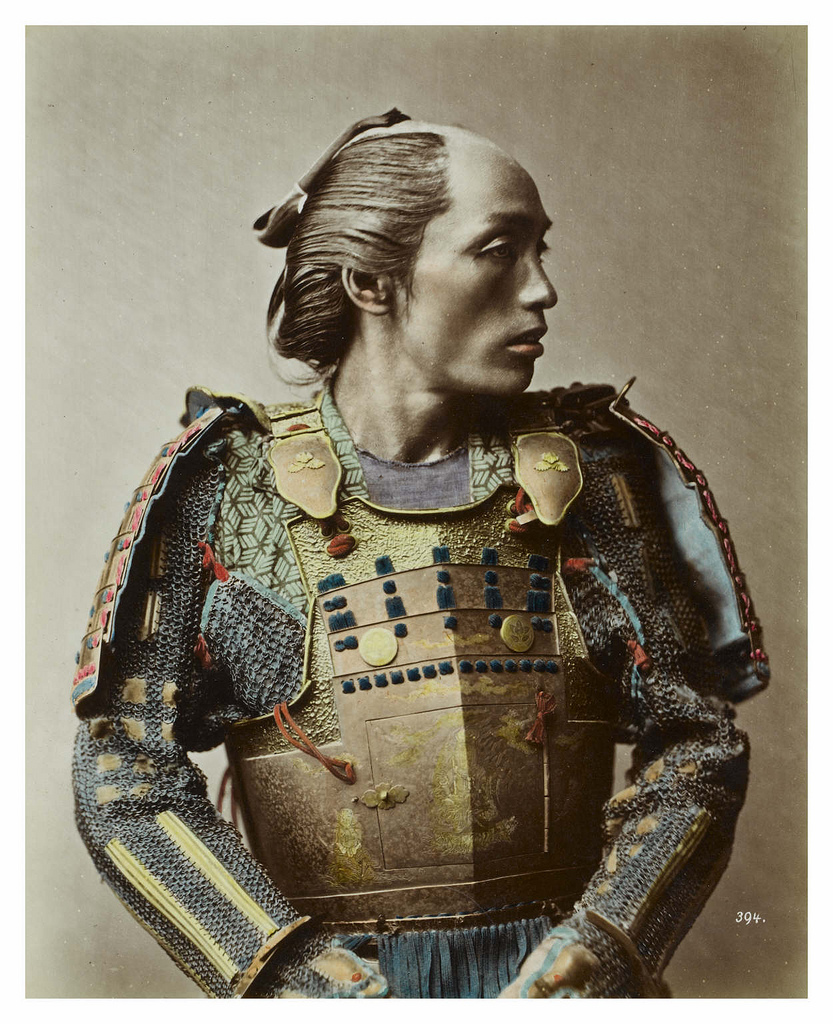
Stillfried_-_Samurai

One of my favorite stories he tells is of a samurai warrior on a quest to kill his overlord’s murderer. This is from the transcript of that episode:

JOSEPH CAMPBELL: I will participate in the game. It’s a wonderful, wonderful opera, except that it hurts. And that wonderful Irish saying, you know, “Is this a private fight, or can anybody get into it?” This is the way life is, and the hero is the one who can participate in it decently, in the way of nature, not in the way of personal rancor, revenge or anything of the kind.

Let me tell you one story here, of a samurai warrior, a Japanese warrior, who had the duty to avenge the murder of his overlord. And he actually, after some time, found and cornered the man who had murdered his overlord. And he was about to deal with him with his samurai sword, when this man in the corner, in the passion of terror, spat in his face. And the samurai sheathed the sword and walked away. Why did he do that?

BILL MOYERS: Why?

JOSEPH CAMPBELL: Because he was made angry, and if he had killed that man then, it would have been a personal act, of another kind of act, that’s not what he had come to do.

The samurai’s mission was not simply to kill the murderer, but to honor his master and fulfill his duty. Killing the murderer out of anger would not have fulfilled the intrinsic call of his duty. To an observer, whether he killed the culprit motivated by honor or anger, it wouldn’t have mattered. The murderer would be dead either way.

But to the samurai, his own motivation made all the difference. He needed a crystal clear answer for why he was taking action, and a reactive response out of anger would not only be dishonorable, it would negate the reason for his quest.

You can choose your response. You can observe an unhelpful emotion take hold, but you don’t have to react. You always can choose to act in a way that honors the vision of the person you truly want to be.

Nothing is just a means to an end. Every action is an end in itself. The path is the destination, right? It’s the journey that matters.

Less, but better

Screen Shot 2014-12-11 at 12.22.39 PM

“Less, but better” was the design philosophy of the iconic Dieter Rams, whose work has inspired some of our greatest creators, including, and especially, Apple.

Focus on the essential. Eliminate the inessential. In your work, in your relationships, in your life. Go for quality over quantity. (Of course, quantity can lead to quality.)

Emptiness has energy. Clutter sucks energy.

Simplify. Hone. Get rid of what doesn’t add value.

We are living in a time of sensory overload. Harmony lies beyond the overwhelming complexity and distraction of too much. Instead of trying to do it all and have it all, do less, better.

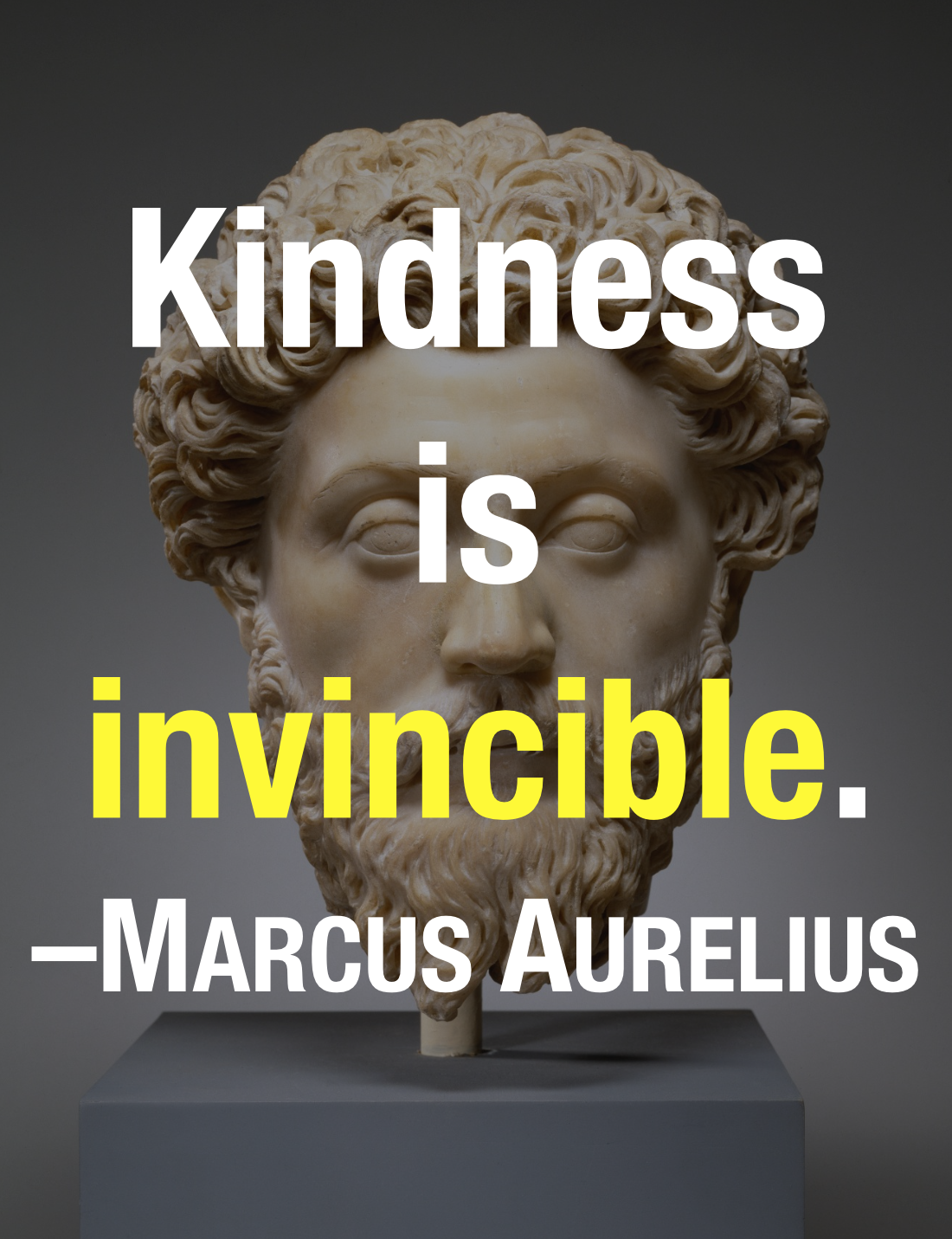
Kindness is invincible

Screen Shot 2014-12-06 at 9.42.00 AM

Meditations 11.18 ix

This from a man who had more power than anyone alive at the time, the emperor of Rome with armies and riches and total authority. Easy for him to say, I suppose. Of course, this was written in his private journal for no one’s benefit but his own. Marcus was the man.

Sincere kindness, not for show or put on in some way, is strong and resilient and ultimately persuasive and even healing. Marcus goes on to say this about kindness:

“What can even the most vicious person do if you keep treating him with kindness and gently set him straight—if you get the chance—correcting him cheerfully at the exact moment that he’s trying to do you harm. “No, no, my friend. That isn’t what we’re here for. It isn’t me who’s harmed by that. It’s you.” And show him, gently and without pointing fingers, that it’s so. That bees don’t behave like this—or any other animals with a sense of community. Don’t do it sardonically or meanly, but affectionately—with no hatred in your heart. And not ex cathedra or to impress third parties, but speaking directly. Even if there are other people around.”

I am not impressed with those who try to exert their authority or express righteous indignation or intimidate their way into getting their way. Give me authentic, wholehearted kindness above all.

How we spend our days

IMG_1265.PNG
We wake up to a gift every morning. No matter the worry and heartache, here we stand each day, surrounded by wonder and found joys and mystery enough to fill a life of days.

I want a good life, a life I can look back on with gratitude and satisfaction. A good life, though, is crafted day by day, one morning after another.

What does it take for you to put your head on the pillow for a night of satisfied sleep? What makes for a good day for you? When you think back on really good days in your life, days that were wholeheartedly satisfying, what was it about those days that made them good? How can you be intentional about building the elements of satisfying days into every one of your days?

Some days are just going to suck, I know. And much of what happens to you is out of your control. But you can control your actions and your responses and your attitude. Why not be the artist of your days, taking the initiative to build your days around what you know to be good and worthwhile?

Your daily habits and daily rituals and routines will over time shape your life and make you into who you become, whether those actions are mindful and intentional or not. Act now like you are who you want to become and choose to live your way into the kind of of life you aspire to have, one day at a time.

Sunday morning Stoic: Stop complaining

Meditations 10.3:

“Everything that happens is either endurable or not.
If it’s endurable, then endure it. Stop complaining.
If it’s unendurable … then stop complaining. Your destruction will mean its end as well.
Just remember: you can endure anything your mind can make endurable, by treating it as in your interest to do so.
In your interest, or in your nature.”

So, Marcus, you’re saying there’s never any excuse to complain about anything. Where’s the fun in that?

Actually, I’ve got the complain-out-loud habit mostly under control. I have my moments, like while watching a football game or while driving or while venting to my wife or colleagues. Yes, so under control. But, mostly, my complaining takes place silently in my mind. It’s just as unproductive, though, even if unspoken.

“you can endure anything your mind can make endurable, by treating it as in your interest to do so.”

That last point though: “you can endure anything your mind can make endurable, by treating it as in your interest to do so.”

This thought has challenged and delighted me since first reading a passage in the novel Memoirs of Hadrian this summer where the emperor Hadrian, one of Marcus’s predecessors, explained that as a young man he treated anything difficult that happened as though he had chosen it to happen. He embraced trials and hardships and setbacks as something to accept and use for his benefit, not resist.

It is in your interest to make the best of what is, even if it’s repellant or tragic or just annoying. Instead of complaining, what if you accepted what is as if it was somehow part of your master plan for refining and perfecting your character?

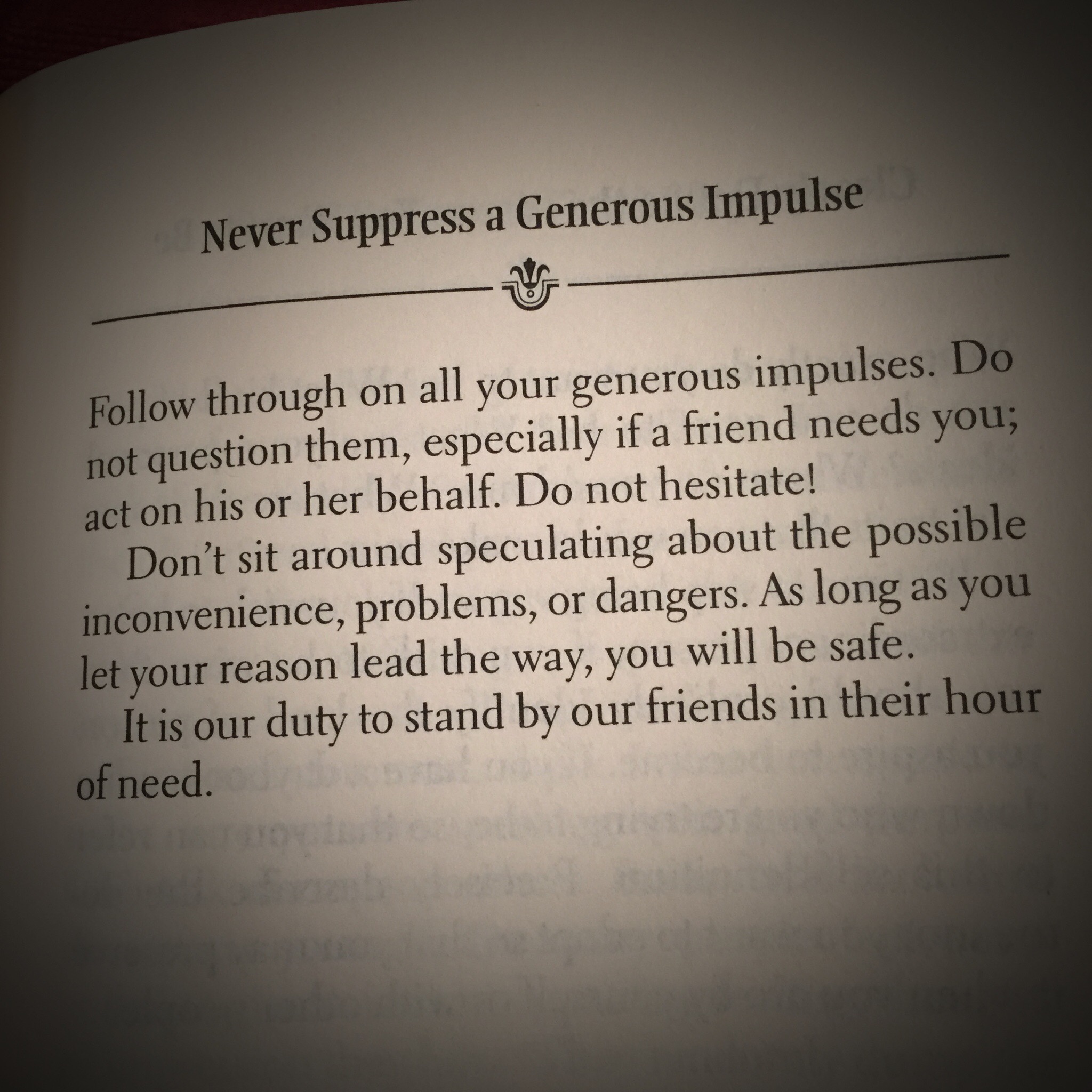
You won’t regret being generous

Epictetus in The Art of Living:
IMG_5866.JPG

My 10-year-old will still occasionally remind me of the time a few years ago when she saw me decline a stranger’s request for a couple of dollars. I was in a hurry and didn’t want to be bothered to fish around in my wallet for a guy on the street I would never see again.

My daughter was surprised, and clearly disappointed, I didn’t help the man. I regret the message that sent to her. I regret my failure to model generosity in front of her.

I have never regretted being too generous, though. When you consider an impulse to give, in money or service, see how it feels to up the ante, to offer even more than you think reasonable.

My wife is good like that. I will suggest a reasonable, safe gift, and she will trump it with an offer to do even more. And then I think, “Of course! Why not do better and give more if we can?”

Honor your impulses to do good, to give, and to be kind.