Not your average bread and butter

Kottke shared this video today of a chef, Dan Richer, who is taking bread and butter as seriously as entrees:

I love his delight in his craft. He exudes joy as he talks about making bread and butter, and his passion for getting it just right is inspiring. You can roll your eyes that it’s just bread and butter, or you can admire that he cares deeply about doing something really well. (And butter is one of the all time greatest edible delights ever created. Please don’t tell me you eat margarine.)

Restaurants can get by just fine with average bread and butter. That’s what customers expect. But amazing bread and butter? Bread and butter that inspires short films? Richer is doing this for his own delight and for those he serves, but it certainly sets his restaurant apart from all the others that are fine with average. I would love to visit this chef’s restaurant.

Satisfactory is forgettable. There’s nothing heroic or inspiring about average. Why not make the thing you do, even if it seems basic or simple, as awesome as you can?

Near the end of the video, Chef Richer says this:

I’m like the anti-chef. I want to do less to something, and I want to put less on the plate. If there’s an ingredient that I can take off of the plate to make it more simple and more pure so you can actually experience the essence of what it is that we’re serving… That’s what’s special to me.

I am more wowed by simple elegance and clarity of execution than by complex and convoluted products and experiences. Simplify. Eliminate inessentials. Make the basics beautiful.

And eat butter. (Take it easy on the bread, though.)
“How do I move the needle?”

I enjoyed this video about screenwriter Dustin Lance Black’s writing process shawnblanc.net linked to today:

Black, who wrote the screenplays for J. Edgar and Milk, has a richly complex, yet clear and beautiful process for putting together his screenplays. Watching him lay out all those note cards on that giant table sparked memories, happy memories, of working on a research paper in college. I wrote an honors thesis in a religion class my senior year and used a similar process where I researched like crazy and then sorted my note cards like I was playing a delightfully challenging game of solitaire. I would rearrange and discard and rethink and see it all eventually unfold into a meaningful narrative that flowed logically and came to a satisfying conclusion.

Black has a clear commitment to digging deeply into a subject, doing meticulous, even excruciating work, and taking his time to let the story come to him. And he’s willing to let go of ideas he loves to better serve the story.

I find a similar workflow works for me in light table view in Keynote. It’s the digital equivalent for me of a table full of note cards. Analog or digital, there’s much to value in a process where you can see the big picture of a story or a project or an idea and make connections and rearrange and discard to better serve the narrative arc.

Do the hard work. Dig deep for details. Spend the time necessary to know your stuff. Then zoom out and find the big picture. That zoomed out perspective might show you a completely different direction than you had originally expected.

Of course, the big picture, the point of your work, has to begin and end with “Why?” Black says just this at the beginning of the video:

“That’s where I start, taking an idea, whether it’s fiction or non-fiction, and figuring out why. Not just what you’re going to tell, not that it’s entertaining or interesting. But why are you telling that story? What is the purpose of that story? For me it’s always, How do I move the needle? How do I change the culture? Now.”

We all want to “move the needle”, to do something worth talking about, to make a difference. I’m inspired to invest in a crisp, new stack of note cards and get busy crafting a story worth telling.

Happiness, the pursuit

Screen Shot 2014-07-07 at 2.40.38 PM

After celebrating Independence Day here in the U.S.A. last week, we should remember the goal for those revolutionaries ultimately was a nation that would especially protect the rights to “life, liberty, and the pursuit of happiness“.

A government cannot grant you happiness. But it’s nice of ours to at least promise to get out of the way and not impede our pursuit of it.

How’s the pursuit going for you? Me? I think I probably have moments of happiness at a slightly above average rate. Happiness, though, is an elusive state. If you notice yourself feeling happy and try to dissect why, you lose the feeling. You can look back on truly happy moments after the fact, but it’s hard to catch happiness in the act. What if the act of pursuing actually prevents you from reaching the desired state?

Can you list distinct, indisputable happy moments in your life? This is a good exercise for your journal. What are the peak happy times from throughout your life, the big falling-in-love and birth-of-your-children moments, and the small, quiet sitting-on-a-covered-porch-during-a-gentle-rain moments?

It’s worthwhile to excavate those memories and try to understand why those moments stand out. You might discover some common elements to help set yourself up for even more happiness, to create the conditions most likely to spark more happy memories. Why not be happy on purpose?

This enlightening TED Talk from Matt Killingsworth highlights his research showing that people are happiest when they are lost in a moment, when their minds do NOT wander.

This seems true for many of my happiest moments. The chatty part of my brain, the happiness-killing part prone to near constant monologuing, disappears when I’m in a zone, whether that’s work or play or reading or watching a movie or riding a roller coaster. Happiness is absorption.

Jason Silva, in a recent interview on the Tim Ferriss Podcast, said that his aim is to build his life around flow states. Excellent idea.

How can I set myself up for more flow states, more moments getting lost in something that quiets that inner monologue, that stops my mind from wandering away from the present moment? What are the conditions that tend to lead to this kind of absorption?

Can I craft my day around creating flow states for work and for play? Set up my work area, tune out distractions, and just begin, whether I feel like it or not. Maybe by creating the climate for happy moments and engaging in activities that require complete absorption, happiness will pursue me rather than the other way around.

More happiness, less pursuit.


You don’t need a job to go to work every day

I was talking with my friend, Emily, today about the awesome career ahead of her. She just finished college and has no solid plans for where to begin this awesome career or what exactly she really wants to do. Which means, of course, her possibilities are infinite. And awesome.

I am no career coach. I’m still figuring out what I want to be when I grow up. Emily and I puzzled over her options for a while, brainstorming and dreaming. I ended up suggesting to Emily that she should go ahead and “go to work” every day starting now.

She could build a routine of an hour or two at least each day when she will show up and get busy making her career happen. Go to a coffee shop or the library and do research, read books, write, connect online with others to explore career possibilities.

She doesn’t need an employer or a salary to do work. She could make something every day – a blog post or an article or a video. (She’s a creative type with mad skills behind AND in front of the camera.) She does not need an office or a boss or permission from anyone to make something and share it with the world. And the act of doing work every day can lead to her getting really good at something and even to figuring out just what career path she should pursue. And if she gets a lead on an actual real-world job she’s excited about, she will have an actual body of work she’s created and is proud to show them.

Talking about this with Emily made me remember the song-a-day guy who every day posts a new song he’s created. His bio video tells his story and explains his 70-20-10 theory. 70 percent of the songs he creates will be mediocre. 20 percent will suck. But 10 percent just might be awesome. Check it out:

It’s the 90 percent of your work that’s average or worse that makes possible the 10 percent that’s awesome. Show up. Even when you don’t feel like it. Quantity leads to quality. Go to work every day.

Real freedom

The late David Foster Wallace on real freedom, overcoming our default settings and responding to life, or the “real world”, wholeheartedly and authentically:

The really important kind of freedom involves attention, and awareness, and discipline, and effort, and being able truly to care about other people and to sacrifice for them, over and over, in myriad petty little unsexy ways, every day. -David Foster Wallace

https://vimeo.com/75422173

Video by Max Temkin

The Long Game and the patient pursuit of awesomeness

This two-part video series was inspired by one of my favorite recent books, Mastery by Robert Greene.

It takes a long time and focused effort to become an “overnight” success. Imagine being a 20-year-old whose primary focus was to peak at 60? How would such a mindset change your decisions? It’s so natural to be in a hurry, to be ambitious for success right away. But consider focusing on the “long game”, the steady, patient pursuit of awesomeness over the long arc of a life worth talking about.

via BrainPickings.org

John Mayer on craftsmanship

I’ve written before about my appreciation of John Mayer’s artistry as a musician. I just saw this new documentary, Someday I’ll Fly, about his career and came away impressed. It’s a thorough review of how he got to mastery. Mayer narrates and offers several gems of insight throughout:

“I used to be at home in my bedroom and pretend that I was on stage, and now I’m on stage and I pretend that I’m home in my bedroom.”

“I want to bring my playing all the way up to the the top of ability…there are some nights my playing goes over my ability. I kind of hit that place where I’m unsure. But then I always find that I get a little further into the craft by doing that.”

“That craft responds to truth, and you’ve got to stay truthful. No matter how many records you’ve sold or performances you’ve played, you come home, the whirlwind stops and you go back to the craft.”

When he was a teenager Mayer was so obsessed with getting good at playing guitar that his mom had to give him a “guitar curfew”, a time he had to stop playing every night. John Mayer wasn’t born with a gift for guitar. He worked hard to become great.

It’s both comforting and convicting to know that our own levels of mastery are completely up to us. If we want to get really good at something, we only need to be willing to obsess enough to consistently devote quality time and smart effort.

via shawnblanc.net

What movies teach kids

I enjoyed this TED Talk by Colin Stokes about the way movies are affecting his young children. He makes some great points about the role of female characters, but his key point is what movies are teaching boys.

As the dad of two young daughters, I want my girls regularly to see strong and smart female characters in movies. (And they love movies.) But I want boys to see that, too. I want the boys and men who will be in my daughters’s lives to see women as just as strong and smart as my girls do.

Certainly, my kids are informed about their possibilities more from their family and the people around them in their actual life, but there’s no doubt the stories they consume affect them.

But it goes beyond just having more female lead characters. The stories need to be smart regardless of the gender of the characters. Some of the Barbie shows I’ve seen my kids watch are filled with girl characters, but they don’t model a level of thoughtfulness and intelligence that make the viewer better for the experience.

The quality of the stories we consume can shape the stories we tell with our lives. I want my girls to get lost in books and movies and comics that inspire wonder and delight and challenge them to live a great story themselves.

On not knowing

A neuroscientist offers a compelling case for the value of ignorance, of knowing that you don’t know:

Reminds me of a quote from Joseph Campbell that continues to resonate with me:

He who thinks he knows, doesn’t know. He who knows he doesn’t know, knows.

Instead of being sure of answers, it’s better to know the next questions to ask.

Getting stronger

This is another great TED Talk*. Here, psychologist Kelly McGonigal shares research showing that facing stress head on rather than avoiding it or being crushed by it has beneficial effects:

Adversity and responding effectively to it generate growth. I’ve been learning that masters get great at something because they keep doing hard things, bumping up against their limits, and persevering to get better.

“No pain, no gain” is a real thing. But I’ve prided myself on avoiding stress when I can. This talk lets me know I should throw myself into the fray regularly and embrace difficulty and challenge more often.

Next time I get the panicky, tight feeling inside about a hard thing approaching, I should welcome it as an opportunity to get stronger.

*HT Getting Stronger blog

The greatness of kindness

From an interview with Stephen Fry where he discussed what he wished he had known at age 18:

“I suppose the thing I’d most would have like to have known or be reassured about is that in the world is what counts more than talent, what counts more than energy or concentration or commitment or anything else is kindness. And the more in the world you encounter kindness, and cheerfulness (which is kind of its amiable uncle or aunt), just the better the world always is – and all the big words: virtue, justice, truth, are dwarfed by the greatness of kindness.”

Kindness just keeps surfacing as a primary theme when pondering what makes for an excellent life. All the striving for achievement and wealth and happiness… Just being kind can change a moment, your day, your life and the lives of those you meet.

IMG_0149

Impermanence

Jason Silva’s latest short video, a bittersweet meditation on transience:

Everything changes. Motion is constant. You never step into the same river twice. This moment is gone already.

How do we live with impermanence? How do we make sense of knowing that we are unique, once in a universe creatures who will be gone soon? All that we love and hold dear will escape our grasp.

I was at my aunt’s funeral last week. Our family has lost her, but the universe keeps spinning. We have memories of happy times and moments shared, and we have the sadness that we will not look her in the eyes ever again. And all of us know that one day we will be the ones that our family and friends mourn.

What a world.

We are the only animals that live in the light of our own mortality. Yet we also are the only ones who can experience the awe of just being alive.

Do not go gentle into that good night. Rage, rage against the dying of the light. -Dylan Thomas

Kiss your brain, and get moving

Here’s a fascinating TED Talk explaining that our brains developed primarily to facilitate movement:

Wolpert points out that computers can “outthink” a human chess master, but that even a five-year-old has dexterity that blows away anything the most sophisticated robot can do.

Physical movement is our primal and primary strength. Regrettably, we as a culture seem to be living more in our heads and on our butts than fully maximizing our amazing physical gifts.

Go take a walk, and make it a mindful, fully present experience. Learn to juggle. Swim. Play catch. Ride a bike. Balance on a curb. Enjoy, glory in, your remarkable dexterity and physical skills.

I have a teacher friend who regularly tells her kids, “Kiss your brain.” Be smart, certainly. Challenge yourself mentally. But also embrace your physical nature and kiss your brain by moving like a human.

Via Movnat

20130909-214228.jpg

“Happiness is absorption.”

Another lovely video from Jason Silva, this one about creative absorption and flow:

Love the intro quotation:

“Happiness is absorption.” -T.E. Lawrence

Getting lost in a video game or a movie or a novel is delightful, but getting lost in creative imaginings and work that compels and pulls you along to the point where all else falls away, where time is compressed, that’s transcendent. And blissful.

It’s easy to assume you’ve got to wait for those moments of flow to somehow strike. But my experience is that you’ve got to do your part to meet flow along the path.

Just start, even if you’re not feeling it, especially if you’re not feeling it. Tackle the blank page with words, even awkward, awful ones.

Terrible is better than nothing, and opening the door of possibility just a bit can be enough to get something better flowing.

Ben Dunlap: Keep learning

This is a favorite TED Talk, Wofford College president Ben Dunlap telling stories about a remarkable individual and the joys of lifelong learning:

What a great storyteller. His accents of the various characters are delightful.

And he ends with a fitting summary and call to action:

“Live like you’re going to die tomorrow. Learn like you’re going to live forever.” -Gandhi

Jason Silva: “We are the gods now”

I can’t get enough Jason Silva. He spoke last year at The Festival of Dangerous Ideas in Sydney. His talk is provocative, entertaining, and refreshingly optimistic about our future:

I appreciate his passion and rapid-fire incitement of excitement about the wonder of being alive.

It’s about awakening the mind’s attention from the lethargy of custom and the film of familiarity and redirecting it instead to the wonders of existence. -Jason Silva

A self-portrait from 900 million miles away

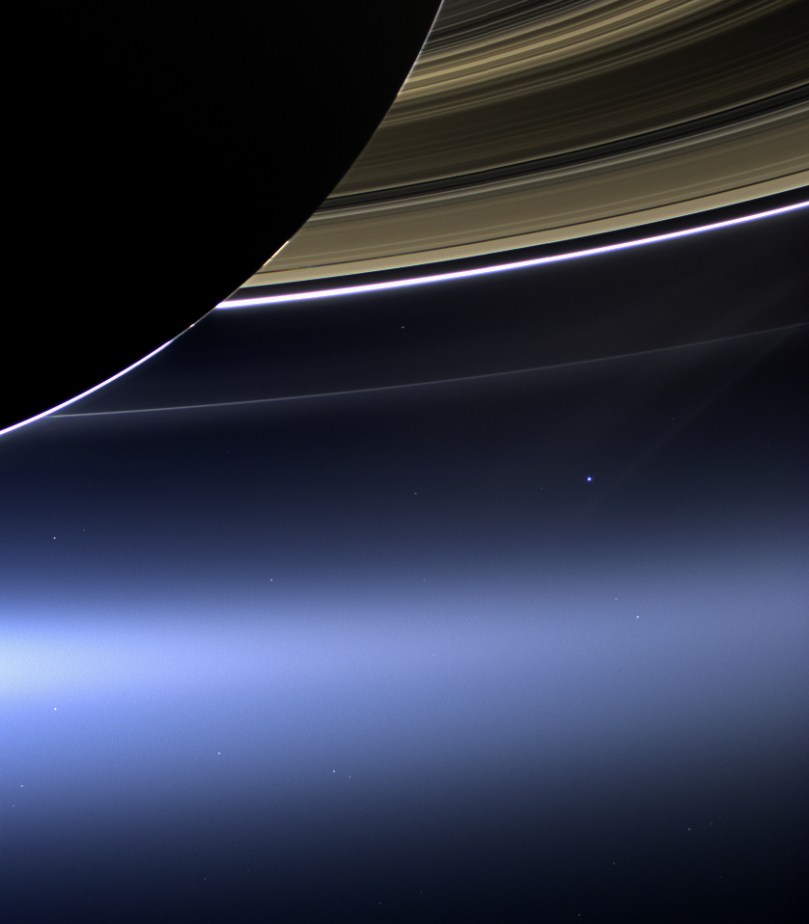
I saw this great photo today of Earth taken from Cassini, the spacecraft orbiting Saturn:

Earth from Cassini

Earth is the blue dot just under the rings of Saturn. This is a self-portrait from 900 million miles away.

Our home is just another smudge of light in space. It looks so small and fragile and not so impressive from this vantage point. But it’s our home and our smudge, and it’s glorious.

I keep coming back to the big picture to put my own little picture into context and give it meaning. Humans have gone from hunter-gatherers to cosmic explorers in a blink of time. Your problems got you down? They’re not so big after all when you change your vantage point.

Seeing this image made me search for Carl Sagan’s famous ode to our “pale blue dot”, as he calls the image of Earth in a similar photo from many years ago.

Here’s a lovely video with Sagan reading his famous prose reflecting on what a precious home we have:

http://www.youtube.com/watch?v=4PN5JJDh78I

The power of awe, as in awe-some

This:

http://youtu.be/yF15TekHVV0

I’ve just discovered the work of Jason Silva, a sort of spoken-word philosopher who has created mind-shifting, eye-opening videos like the one above.

We do need regular doses of awe, reminders of how grand and overwhelmingly incomprehensible this universe is and what a kick it is that we are not just in it, but we’re aware that we’re in it and can wonder and ponder and imagine.

The big picture is really, really big. We are really, really small.

But just big enough to see and to dream.