Take more time to do better work

The author of Deep Work, Cal Newport, has upped his activity on his blog in the wake of his new book.

Today he shared this quote from a book published by an academic in 1912:

“To save time, take time in large pieces. Do not cut time up into bits…The mind is like a locomotive. It requires time for getting under headway. Under headway it makes its own steam. Progress gives force as force makes progress. Do not slow down as long as you run well and without undue waste. Take advantage of momentum. Prolonged thinking leads to profound thinking.”

I’ve found this to be true for me. I would have a lot more profound thoughts if I more regularly carved out big swaths of time for focused work sessions.

Getting started on doing serious work, work that really matters, can be completely uncomfortable. And then sticking with a hard thing for the first 20-30 minutes takes patience and diligence.

But once the distracted part of your brain gives up and allows your mind to get into a focused flow, the work actually becomes a delight.

The key is having the will to trudge through the initial resistance and overcome the pain and friction required to get into a groove.

Be strong. Be patient.

Your best work is just past that godawful hill you’ve got to climb to get started.

Screen Shot 2015-04-10 at 4.57.14 PM

Showing my work: Boston

I’m giving the keynote speech at a conference for college students Friday night in Boston. 

It’s easy to think of the effort of giving a speech as the 30-60 minutes it takes to stand and deliver the talk. But, for me at least, I spend many hours mulling ideas, putting the structure together, designing slides, and rehearsing.

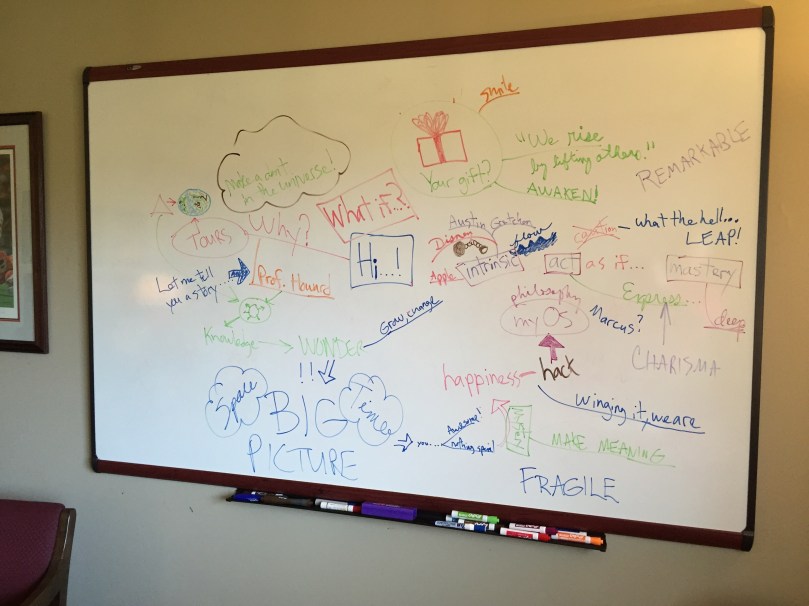
Here’s my office whiteboard from earlier this week when I was trying to make sense of all the ideas I was considering for this keynote: 

IMG_8007

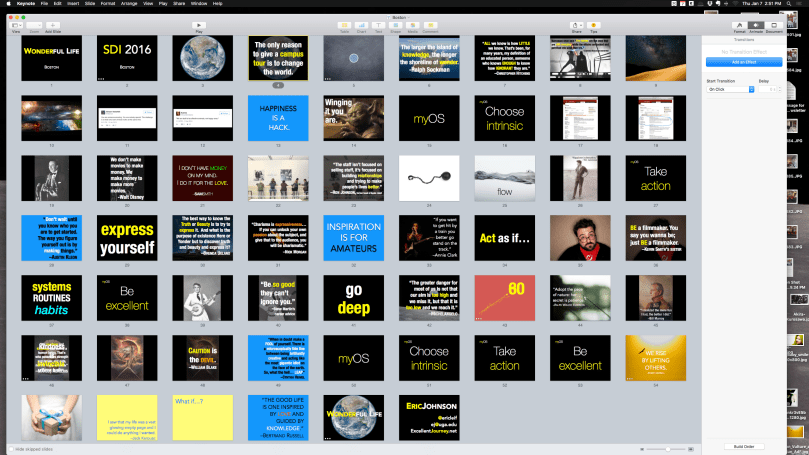
And here’s a screenshot from today of the slide sorter view in the Keynote app as I neared completion of my slide design:

Screen Shot 2016-01-07 at 2.51.33 PM

I’m not satisfied yet. I’ve rehearsed it out loud twice, and I like where it’s heading. But it hasn’t completely clicked yet. 

I’m afraid I’m trying to include too much, and I’m inclined to cut as much as a third of it when I review it again on the flight up tomorrow. 

This is a lot of effort for 45 minutes in front of an audience, and there are no guarantees my presentation will be well received. 

I do get absorbed in the best way, though, when I plunge into preparing for a new talk.

Much like signing up to run in a race weeks from now focuses your commitment to your fitness, committing to give a speech focuses your mind on ideas. My brain has been in a more aware and alert mode, scanning for relevant information and making connections and discoveries I otherwise would have passed by. 

Regardless of how the actual speech is received by the audience, the time spent in preparation has been a worthwhile commitment of my time and my creative energy. 

Road-trip audiobooks

IMG_7782

This is a good week to load up an audiobook or three for road-tripping.

I just added SPQR and Stumbling on Happiness to my Audible queue.

SPQR is Mary Beard’s new history of ancient Rome, and it’s gotten strong reviews. And I can’t seem to get enough of Roman history.

Daniel Gilbert’s Stumbling on Happiness has been on my wish list for a while.

Audiobooks can pick up the slack when I’m finding it hard to squeeze in all that I want to read.

I also downloaded a couple of favorite audiobooks to listen to again: Tim Kreider’s We Learn Nothing and Steve Martin’s Born Standing Up. Both are excellent, and both are read by the authors. You can’t go wrong with either if you want a good listen.

And I just saw that the whole Harry Potter series is now available on Audible. (It previously had been available only through J.K. Rowling’s Pottermore web site.) This audio series has been acclaimed not just for the phenomenon that Harry Potter is, but for the performance of the narrator, Jim Dale. Maybe this will give my kids a nice change of pace from playing games and watching movies on iPads in the car.

If hours-long books seem daunting, listen to podcasts instead. We are in a golden age of podcasting. There are so many amazing choices. Start with the Overcast podcast app, and use its recommendation feature if you don’t know where to start. Or ask me, and I can send you a long list of great podcasts.

Feed your mind and your imagination as you’re traveling this week. Happy travels. Happy listening.

There is good in everything

“There is good in everything, if only we look for it.” –Laura Ingalls Wilder

via Ryan Holiday

There is good in everything?

You certainly have the choice to find the good in even the worst circumstances.

Don’t resist what is. Love, somehow, even the heartbreak and tragedy that comes your way. Use everything—every setback, every obstacle—to learn and grow and to continually improve.

The element of surprise

Certainty kills the fun. 

Not-knowing provides the necessary tension for drama and suspense and a reason to keep turning the page, to keep leaping into the fray each day. 

Having the answers is boring. 

Having more questions is more fun. 

David Foster Wallace predicts our current reality

Merlin Mann linked to this comment the late author David Foster Wallace made in 1996(!):

“’Cause the technology is just gonna get better and better and it’s gonna get easier and easier and more and more convenient and more and more pleasurable to sit alone with images on a screen given to us by people who do not love us but want our money and that’s fine in low doses but if it’s the basic main staple of your diet you’re gonna die.” –David Foster Wallace

Prescient.

If what you regularly pump into your consciousness is processed pap prodding you to passiveness—numbing, mindless, turn-off-your-brain-and-scroll-Facebook-or-binge-on-Netflix passiveness—you will die indeed.

Not physical death—though sedentary leads to cemetery quicker—but that kind of junk diet for your mind certainly will kill off some of what makes you an authentic, free-range human being.

Your brain needs to be challenged regularly. You need to more regularly inhabit your physical body and be aware that you are alive—right here, right now.

Read something with substance, something challenging. Be with other humans, really with them. Engage in conversations that provoke and cause pause. Make something. Try expressing yourself more often. Do hard things. Take risks. Inhabit your senses more fully and more intentionally. Go primal. Go back to the basics of what shaped us into the incredible creatures we became.

Live while you can.

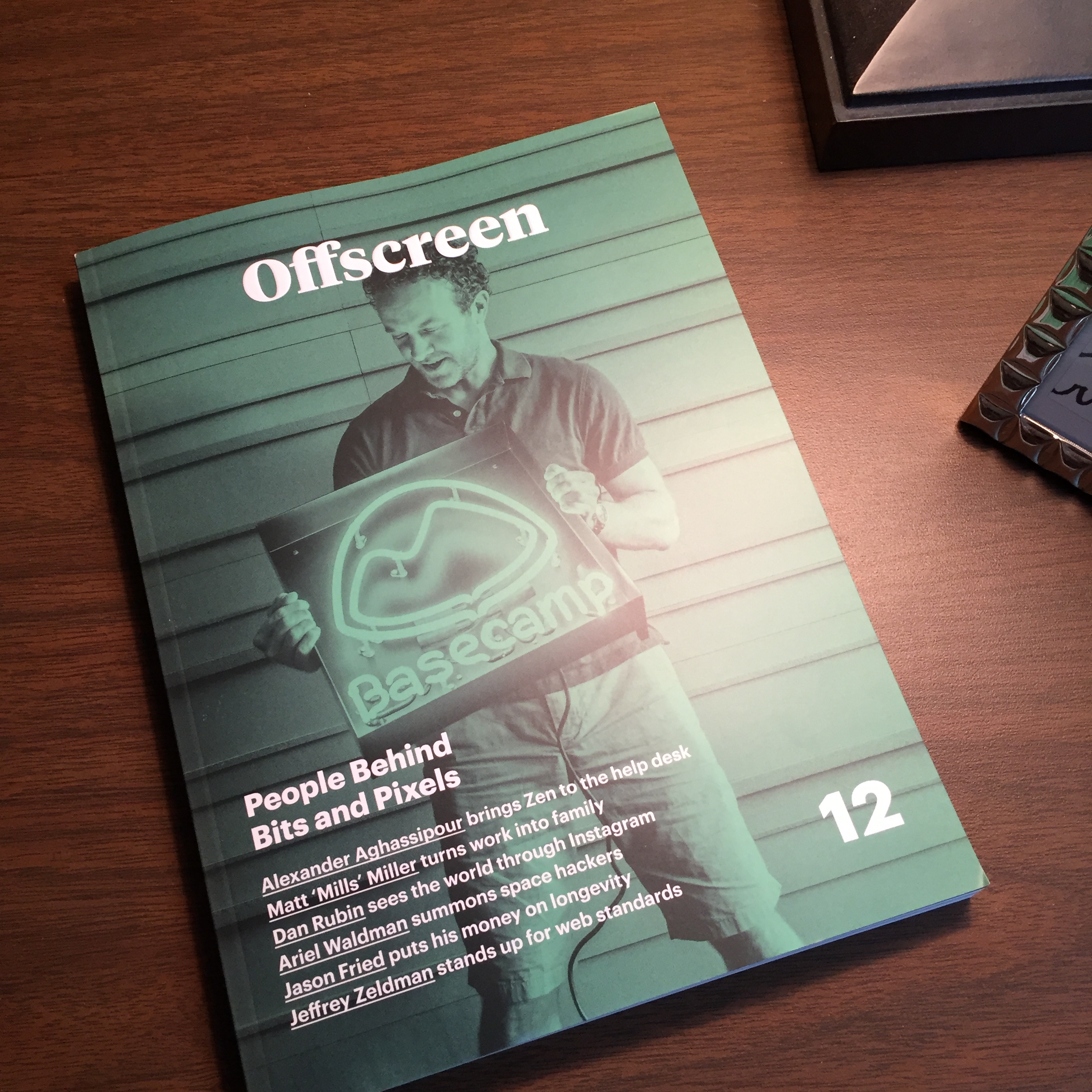
Weekend reading: Offscreen Magazine, #12

IMG_7526

This is my only magazine subscription.

It’s not available in a digital version.

This is it. Paper and ink.

It’s a delight to hold and to look through and to smell.

As powerful as the internet is for the spread of ideas, I’m sure that most of what makes a splash online now won’t have much of a shelf life. Because, well, you can’t put it on a shelf.

My kids won’t grow up with nostalgia for a blog post they read once or keep a favorite old viral video on a loop in their living rooms.

Tangible things will endure, though. Especially beautiful ones that spark joy.

Even this delightful little magazine reminds me of the joy of great things.

I keep fretting over the best way to organize the thousands of digital photos I have.

The solution, though, is to print them, to make the best ones into photo books that will someday grace the shelves of my future grandchildren’s homes.

Things are just things. But there is real beauty in the grace of great things, offscreen, in your hands and literally in your life.

Worse than Nero

Religious violence has a long and terrible history.

From Sapiens by Yuval Noah Harari:

“In the 300 years from the crucifixion of Christ to the conversion of Emperor Constantine, polytheistic Roman emperors initiated no more than four general persecutions of Christians. Local administrators and governors incited some anti-Christian violence of their own. Still, if we combine all the victims of all these persecutions, it turns out that in these three centuries, the polytheistic Romans killed no more than a few thousand Christians. In contrast, over the course of the next 1,500 years, Christians slaughtered Christians by the millions to defend slightly different interpretations of the religion of love and compassion.”

And he adds this for perspective:

“On 23 August 1572, French Catholics who stressed the importance of good deeds attacked communities of French Protestants who highlighted God’s love for humankind. In this attack, the St Bartholomew’s Day Massacre, between 5,000 and 10,000 Protestants were slaughtered in less than twenty-four hours. … More Christians were killed by fellow Christians in those twenty-four hours than by the polytheistic Roman Empire throughout its entire existence.”

Harari’s book is an epic survey of the history of humans on earth. It’s filled with sobering details like this along with a hopeful perspective on how far we have come.

Steer into the fear

From Neil Gaiman’s masterful 2012 “Make Good Art” commencement address:

Do the stuff that only you can do.

The urge, starting out, is to copy. And that’s not a bad thing. Most of us only find our own voices after we’ve sounded like a lot of other people. But the one thing that you have that nobody else has is you. Your voice, your mind, your story, your vision. So write and draw and build and play and dance and live as only you can.

The moment that you feel that, just possibly, you’re walking down the street naked, exposing too much of your heart and your mind and what exists on the inside, showing too much of yourself. That’s the moment you may be starting to get it right.

The things I’ve done that worked the best were the things I was the least certain about…

That vulnerable feeling—as if you’re opening yourself too much, exposing more than feels safe—is worth the risk.

The best things—love, art, any act of authentic creation or wholehearted kindness—come from that place which seems so fragile but which is actually your singular source of strength.

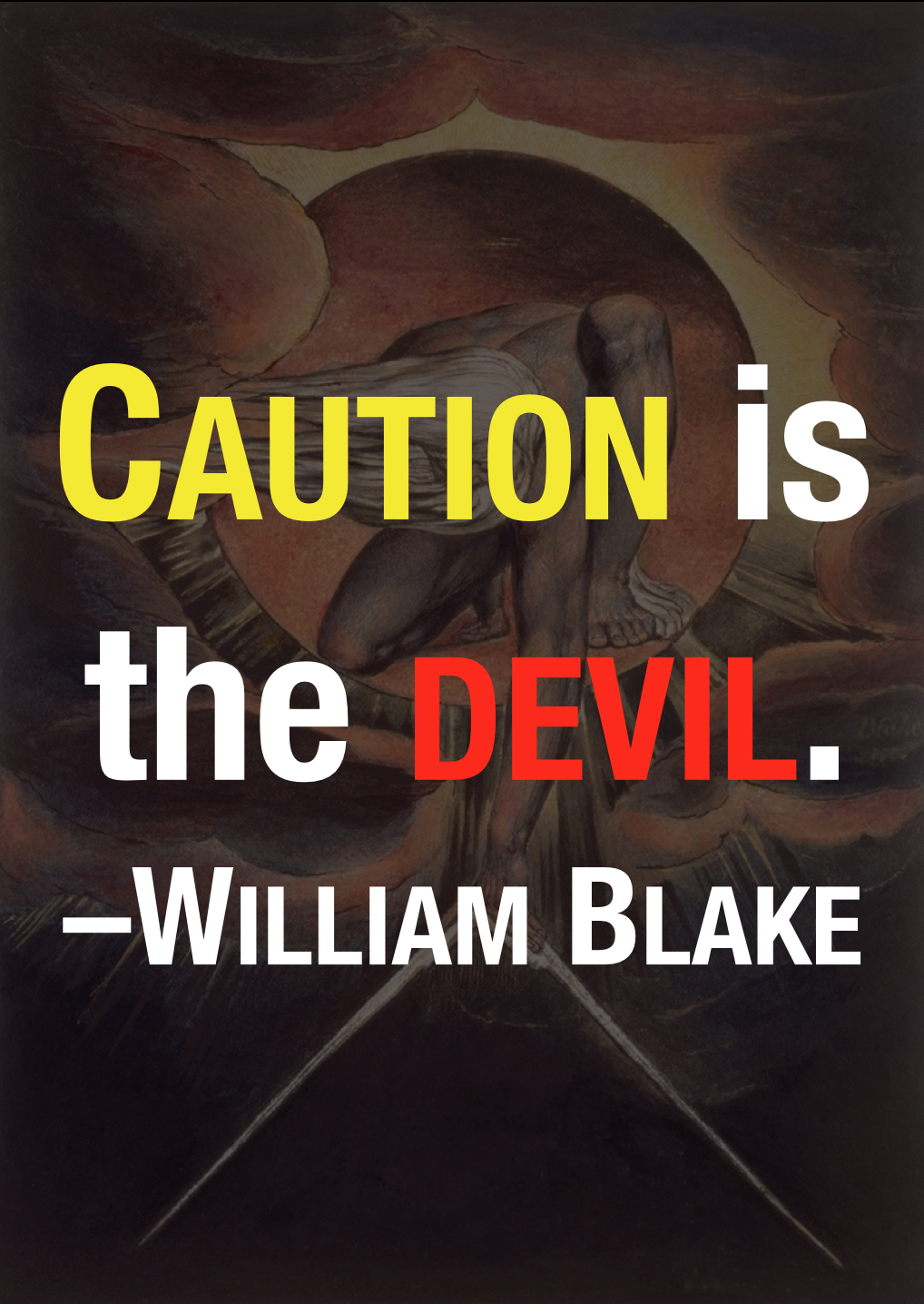
“Caution is the devil” said William Blake. The resistance within is powerful.

It takes courage. If there was no fear, courage would be pointless. Fear gives you the opportunity to craft a better version of yourself.

Steer into the fear if that’s what it takes to bring out what is best in you, to produce the kind of love and beauty that only you—the one and only you—can ever make.

Screen Shot 2015-09-01 at 4.35.44 PM

James Rhodes: “Serious” music

71Yes9sYRnL._SL1100_

This lovely Zen Pencils post introduced me to the pianist James Rhodes, who has an incredible personal story to go along with his immense musical talent.

He came through an abusive childhood and was given new life by music. 

I listened to his Live in Brighton album while I worked today. Between pieces he discusses the stories of the musicians and the compositions he’s playing. His language is frank, funny, and a bit off-color, and it’s the most refreshing experience I’ve had with classical music since I first discovered composer Benjamin Zander’s TED Talk

He talks about how lacking the term “classical” is for the genre and wonders if it’s “serious” music. 

How many classical albums have earned an “Explicit” label in iTunes?

Intrigued? Check it out. 

The approaching inevitability of our electric car future

This article makes a compelling case for why electric cars will dominate sooner than you might think.

Tesla will do for electric cars what’s Apple did for smartphones:

Gas stations are not massively profitable businesses [4]. When 10% of the vehicles on the road are electric many of them will go out of business. This will immediately make driving a gasoline powered car more inconvenient. When that happens even more gasoline car owners will be convinced to switch and so on. Rapidly a tipping point will be reached, at which point finding a convenient gas station will be nearly impossible [5] and owning a gasoline powered car will positively suck. Then, there will be a rush to electric cars not seen since, well, the rush to buy smartphones.

Open conversations

Today I shared this old Seth Godin post with my staff. It’s about open conversations where authentic dialogue is encouraged. Here’s the hook:

A guy walks into a shop that sells ties. He’s opened the conversation by walking in.

Salesman says, “can I help you?”

The conversation is now closed. The prospect can politely say, “no thanks, just looking.”

Consider the alternative: “That’s a [insert adjective here] tie you’re wearing, sir. Where did you buy it?”

Conversation is now open. Attention has been paid, a rapport can be built. They can talk about ties. And good taste.

A guest told me yesterday our students offered the best experience of any campus tour she’s been on. I could have been happy with just that, thanked her, and moved on.

But I responded, “Why?”

“Why was ours the best? What did we do that you appreciated, that made our tour stand out?”

And then we had a good conversation, and I learned something from her insight.

I’m a bit of an introvert, and I’m a little too content too often with getting easy outs for conversation.

But meaningful conversations are rare and valuable and can make a day worthwhile like few other activities can. And they offer a chance to learn and grow. And, even better, they let you truly see and acknowledge others in the most primal, human way.

My wife is great at asking conversation-opening questions of our daughters. She’s not content with hearing they’ve had a good day. She wants to know exactly what was good about it and what were the highlights and lowlights and the best stories.

Avoid simple yes/no questions and cliched greetings. Safe and boring and superficial.

Make an art of opening conversations and sparking genuine connection and understanding.

Time machine

Consider what life was like 100 years ago.

World War I was engulfing Europe. It was the first “modern” war, and it was ultimately tragically pointless and horrifying. (Go listen to the epic podcast series, Blueprint for Armageddon, in Dan Carlin’s Hardcore History.)

The U.S. population in 1915 was one-third what it is now. The world population was one-fourth what it is now.

Women in the U.S. did not have the right to vote. Racial segregation was entrenched in the south. The Civil Rights Act was almost fifty years away.

There were few rights for workers and not much of a safety net for anyone for health care or retirement.

Air travel was for daredevils. Space travel was just a sci-fi dream. More vehicles were powered by animals than by engines. Radio was the chief source of home entertainment, and silent films were the only option at theaters.

If you had a time machine and brought someone from 1915 to 2015, imagine how astounded they would be by our world—our technology and medicine; the discoveries about the universe that have shown us just how incomprehensibly massive it is and how small we are; and how far we have progressed in human rights in a century.

And how are we worse off now compared to then? There was no obesity epidemic, no addiction to electronic devices, and no chance for nuclear disaster. I’m sure there are many ways life was better a century ago, but I wouldn’t want to swap places with that generation.

Now, imagine you could go in a time machine to the year 2115. How backwards might our current generation look one hundred years from now? What have we got completely wrong? How inhumane and small-minded will we look to our great-grandchildren? What assumptions are we taking for granted now that will seem laughable in the very near future?

We can’t assume a positive trajectory of progress. There is certainly a chance that we could very well end up going backwards and falling into another “dark ages” if we survive for another century, but let’s be optimistic.

How can taking the long view open us to possibilities and ways of thinking that make an even brighter future more likely? What would be an ideal world in 2115, and what can we do in 2015 to point in that direction?

That idea of yours that seems daring right now, or a little too farfetched to take seriously, might just seem so obvious a generation from now. It’s the crazy ones who craft the future the rest of us can’t even imagine. 

Dream big. Dream far. 

Primal summer, redux

Summer is on. It’s time to make the most of the sunshine and warmth and green grass.

In my house we are committing to getting back to basics, to living more primal lives, to simplifying and culling and embracing the essential.

The days are long. Make an art of crafting days worth remembering this summer.

Walk barefoot in the grass. Jump into the water. Eat real food. Dream in a hammock. Read books. Take walks. Gaze at the stars.

Have real conversations where you listen deeply without even considering what you might say.

Get stronger and leaner. Physically and mentally. Shed your shoes and discard your clutter.

Embrace a crazy idea. Encourage a discouraged friend. Start something audacious.

Shine in the sun. Live now. Have a story worth telling when the chill of autumn blows in.

“‘Cause a little bit of summer’s what the whole year’s all about.” –John Mayer

Sagan’s Pale Blue Dot sermon, animated

2545256-5747645598-skyimage_2267_201134165

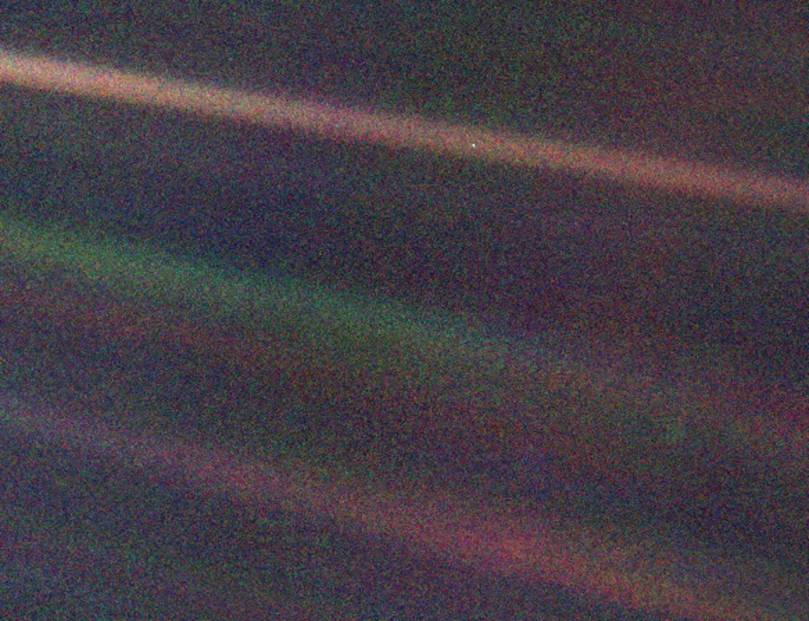
In 1990 the Voyager I spacecraft was leaving our solar system, and at Carl Sagan’s suggestion the mission team had it turn and take a photo of Earth from 4 billion miles away — the ultimate long-distance selfie.

That’s us in that photo, that tiny speck of  reflected light near the top — a pale blue dot suspended in a sunbeam.

That image inspired Sagan to write one of the most profound pieces of writing I’ve ever read, this passage from his book, Pale Blue Dot:

Look again at that dot. That’s here. That’s home. That’s us. On it everyone you love, everyone you know, everyone you ever heard of, every human being who ever was, lived out their lives. The aggregate of our joy and suffering, thousands of confident religions, ideologies, and economic doctrines, every hunter and forager, every hero and coward, every creator and destroyer of civilization, every king and peasant, every young couple in love, every mother and father, hopeful child, inventor and explorer, every teacher of morals, every corrupt politician, every “superstar,” every “supreme leader,” every saint and sinner in the history of our species lived there-on a mote of dust suspended in a sunbeam.

The Earth is a very small stage in a vast cosmic arena. Think of the endless cruelties visited by the inhabitants of one corner of this pixel on the scarcely distinguishable inhabitants of some other corner, how frequent their misunderstandings, how eager they are to kill one another, how fervent their hatreds. Think of the rivers of blood spilled by all those generals and emperors so that, in glory and triumph, they could become the momentary masters of a fraction of a dot.

Our posturings, our imagined self-importance, the delusion that we have some privileged position in the Universe, are challenged by this point of pale light. Our planet is a lonely speck in the great enveloping cosmic dark. In our obscurity, in all this vastness, there is no hint that help will come from elsewhere to save us from ourselves.

The Earth is the only world known so far to harbor life. There is nowhere else, at least in the near future, to which our species could migrate. Visit, yes. Settle, not yet. Like it or not, for the moment the Earth is where we make our stand.

It has been said that astronomy is a humbling and character-building experience. There is perhaps no better demonstration of the folly of human conceits than this distant image of our tiny world. To me, it underscores our responsibility to deal more kindly with one another, and to preserve and cherish the pale blue dot, the only home we’ve ever known.

As they say here in the south, “That’ll preach.” Meaning, basically, RIght on, brother!

I can’t imagine a finer sermon to inspire wonder and appreciation and perspective.

Farnam Street shared this lovely animation accompanying Carl Sagan’s narration:

https://vimeo.com/22582065

Excellent.

Movement and play and real life

Today I took my daughters to the swimming pool for the first time this year. It was a warm, sunny afternoon, and they were so eager to swim after such a long time away from the water.

And it was a delight. That first plunge into a cool pool is such a sensory pleasure. Time stands still. You feel your body, momentarily weightless. Your skin tingles. Your inner compass spins. Your physical presence comes alive after a long hiatus of being bound to just the ground.

We played silly games in the pool and stretched our limbs and soaked in just a bit of sunshine.

And we smiled. My kids were smiling and laughing and actually enjoying each other with a freedom I haven’t seen in a while. Disconnected from screens, with nothing but water and their bodies, they played and wearied themselves the old-fashioned way. With movement.

Our bodies are too often just the vehicle for our minds. We are so busy thinking, mostly about things not truly worth thinking about, that we rarely feel even the weight of our bodies, much less the subtle interactions of our senses.

But jump into the water and you will rediscover that you are more than just a worry-fillled mind.

I need more movement, more mindful movement at least. To feel the ground under my bare feet, to actually taste and smell the food I eat, to float and splash and play.

Physical play, I think, is our default state. Being a dad has returned me to real play, and I need more of it. Swimming and freeze tag and tickle fights. Movement. Touch. Laughter. This is real life. Not passive staring at screens and sitting. So much sitting.

Take off your shoes and jump into real life this spring.

Nerding out

My ten-year-old and I walked the dog together last night. She was a chatterbox. Get her away from books and Netflix and conversation flows from her.

She changes topics pretty quickly. It’s a stream-of-consciousness kind of flow.

At one point she said, “Dad, what did you nerd out on when you were a kid?”

Me: “What do you mean by ‘nerd out’?”

Her: “You know. Like I’m reading those books about Egyptian mythology right now, and I get really into everything about it.”

And she does. Thanks to the Kane Chronicles books by Rick Riordan, my daughter is now well versed on all the Egyptian deities and their stories and is eager to share what she’s been learning in great detail.

This conversation was a proud moment for me, that she recognizes that “nerding out” is a thing and that she delights in it.

I told her that when I was her age I nerded out reading biographies and obsessing over NASA and astronauts. And I reminded her that, as cool as she knows I am, I’m still nerding out about a lot of things, like Apple and books and great gear.

I hope she will continue to embrace delightful obsessions all her life. Nerding out is really just following your curiosity and your joys and caring deeply.

Follow your bliss, no matter if anyone thinks it’s nerdy. It doesn’t matter if what you nerd out over will make you any money or win applause or approval or likes on Instagram. Pursue those things that bring you joy for their own sake, without any attachment to some external reward.

Action hero, no excitement required

Oliver Burkeman has a great post this week on embracing discomfort. If you’re waiting for the right feeling to get busy, you are not truly free. If you need to be excited before you take action, you are no action hero:

It’s eye-opening to think of excitement this way: not as the thing we should all seek in life, but as a mildly embarrassing affliction that’s as likely to distract you from what matters as guide you towards it. “The only way to really deal with the problem of excitement,” Krech writes, “is to stop becoming dependent on it”: it’s after excitement fades that you discover what you’re made of. This needn’t mean resigning yourself to a relationship or job you hate; it just means not relying on excitement, or the avoidance of discomfort, to decide what to do next. Life (to paraphrase the Buddha) is inherently unsatisfactory. And that’s liberating: you never have to wonder if the path you’re on will lead to unbroken thrills and zero frustrations, because you can be certain it won’t.

What if you didn’t wait to get excited about that thing you want to do, or to feel like doing the work you know needs to be done to be the person you want to be? To be the hero of your own life takes action, whether you feel like taking action or not.

As Chuck Close says, “Inspiration is for amateurs – the rest of us just show up and get to work.”

“To be able to do what needs doing, whether or not you feel like it, is pretty close to a superpower.” –Oliver Burkeman