Sunday morning Stoic: Past and future have no power over you

Meditations 8.35-36:

“35. We have various abilities, present in all rational creatures as in the nature of rationality itself. And this is one of them. Just as nature takes every obstacle, every impediment, and works around it—turns it to its purposes, incorporates it into itself—so, too, a rational being can turn each setback into raw material and use it to achieve its goal.

36. Don’t let your imagination be crushed by life as a whole. Don’t try to picture everything bad that could possibly happen. Stick with the situation at hand, and ask, “Why is this so unbearable? Why can’t I endure it?” You’ll be embarrassed to answer. Then remind yourself that past and future have no power over you. Only the present—and even that can be minimized. Just mark off its limits. And if your mind tries to claim that it can’t hold out against that … well, then, heap shame upon it.”

“Turn each setback into raw material” for your use. Convert obstacles into fuel. Welcome bad luck and bad news as if you chose them to somehow make yourself more awesome.

But remember that the past is gone, and we can’t even remember it exactly as it was. And the future is only in our imagination. Both are phantoms, unreal, empty.

The present is all any of us ever have. Face it with full attention, no matter what obstacles you may see in it. It’s manageable and, when fully inhabited and embraced, can be magnificent.

The upside of down thinking

“Misfortune weighs most heavily on those who expect nothing but good fortune.” —Seneca

I used to be a positive-thinking fundamentalist. Age and life experience have shown me the value of balancing with the negative.

Visualizing the negative and expecting the worst will brace you for whatever comes and make you appreciate even more what you have.

No need to dwell on the worst. Just visit the possibilities periodically and consider what could be. After briefly imagining even the most depressing circumstances, you return to the present with a deeper, more vital appreciation for people and things in your life that, moments before, had been taken for granted or even seemed invisible.

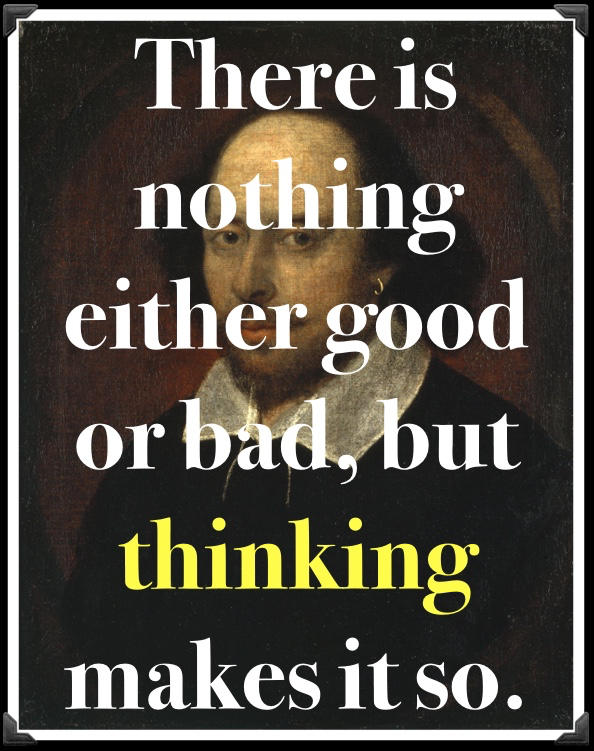
Have the courage to embrace life as it is, its good and bad, and be prepared for whatever may come. “Good” and “bad” define each other. Face the negative to strengthen the positive.

“The secret to happiness is low expectations.” –Barry Schwartz


Sunday morning Stoic: Invisible man

Meditations 7.67:

“Nature did not blend things so inextricably that you can’t draw your own boundaries—place your own well-being in your own hands. It’s quite possible to be a good man without anyone realizing it. Remember that.”

It’s quite possible to be a good man without anyone realizing it.

What if your character was so strong, your virtue so impeccable, your goodness so subtle that you flew completely under the radar?

What if you were practically invisible, with no awards or glory or killer job offers or huge number of Twitter followers?

Be good, be honorable and virtuous and strong, not for any external reward or acclaim, but just for the virtue of the action itself. Don’t do this for that. Do this for this.

And don’t be discouraged or distracted from your focus on excellence if no one acknowledges you. This thought from Marcus is mirrored in this passage (chapter 17) from the Tao Te Ching:

“When the Master governs, the people are hardly aware that he exists. Next best is a leader who is loved. Next, one who is feared. The worst is one who is despised. If you don’t trust the people, you make them untrustworthy. The Master doesn’t talk, he acts. When his work is done, the people say, ‘Amazing: we did it, all by ourselves!'”

The Master doesn’t talk, he acts. When his work is done, the people say, “Amazing: we did it, all by ourselves!”

Live immediately

Seneca, possibly the most eloquent of the Stoic sages, from the work most consider his masterpiece, On the Shortness of Life (via BrainPickings):

“Putting things off is the biggest waste of life: it snatches away each day as it comes, and denies us the present by promising the future. The greatest obstacle to living is expectancy, which hangs upon tomorrow and loses today. You are arranging what lies in Fortune’s control, and abandoning what lies in yours. What are you looking at? To what goal are you straining? The whole future lies in uncertainty: live immediately.”

Just start.

The invincible human being

I had previously filed away this article, “Why Stoicism is one of the best mind-hacks ever“, and just dug it up out of Instapaper. It’s a good summary of some basics of Stoic philosophy. And, at the center is this, beautifully explained by the author:

What the whole thing comes down to, distilled to its briefest essence, is making the choice that choice is really all we have, and that all else is not worth considering. ‘Who […] is the invincible human being?’ Epictetus once asked, before answering the question himself: ‘One who can be disconcerted by nothing that lies outside the sphere of choice.’

Any misfortune ‘that lies outside the sphere of choice’ should be considered an opportunity to strengthen our resolve, not an excuse to weaken it. This is one of the truly great mind-hacks ever devised, this willingness to convert adversity to opportunity, and it’s part of what Seneca was extolling when he wrote what he would say to one whose spirit has never been tempered or tested by hardship: ‘You are unfortunate in my judgment, for you have never been unfortunate. You have passed through life with no antagonist to face you; no one will know what you were capable of, not even you yourself.’ We do ourselves an immense favour when we consider adversity an opportunity to make this discovery – and, in the discovery, to enhance what we find there.

“Choice is really all we have.”

You can choose your response, your attitude, no matter the circumstances.  Some “bad” event can be redefined as “good” if you use it to learn, to grow, to become a stronger person. Imagine embracing all that occurs as though it was part of a master plan to refine you into an invincible human being.

Sunday evening Stoic: Wash off the mud

Meditations 7.47:
2015/01/img_1283.png

Of course, you do revolve with the stars. And, our view of the stars and the perspective they provide has magnified profoundly since the second century when the emperor wrote those words.

The image in the slide above is the latest bit of wonder from the Hubble space telescope. It’s an incredible new photo of Andromeda, the galaxy nearest to our Milky Way. You can see so many far, far away stars, and in just one little speck of the nearby universe. (Consider this image for a good sense of how massive Andromeda is, but also for an appreciation of what a small speck we are in relation to the wonders of the universe.)

The world too much with you? Weighing you down? Stuck in the mud of life and not seeing the light? Look up. Look within. Let the big picture cascade over you and wash away the mud.

We are living in wonder land.

Sunday morning Stoic: Sanity

Meditations 6.51:

“Ambition means tying your well-being to what other people say or do.
Self-indulgence means tying it to the things that happen to you.
Sanity means tying it to your own actions.”

You can’t control the weather. You can’t control what others say or do. You can’t control what happens to you.

But you can control your response to whatever happens.

Accept what happens. It’s futile, and ultimately harmful to your sanity, to resist what is. You don’t have to approve of what happens. You can just say to yourself, “Fascinating.” And then choose your action in response.

Welcome everything that happens, even bad things, as opportunities to grow and learn and get stronger.

Sunday morning Stoic: Count each separate day as a separate life

From Seneca: Letters from a Stoic, Letter 101 – On the futility of planning ahead:

“There is indeed a limit fixed for us, just where the remorseless law of Fate has fixed it; but none of us knows how near he is to this limit. Therefore, let us so order our minds as if we had come to the very end. Let us postpone nothing. Let us balance life’s account every day.

One who daily puts the finishing touches to his life is never in want of time.

…begin at once to live, and count each separate day as a separate life. He who has thus prepared himself, he whose daily life has been a rounded whole, is easy in his mind.”

Seneca wrote these words just after telling his friend about an acquaintance who had risen from poverty to wealth and prestige and was on the verge of great accomplishment. And then he suddenly died.

Nothing is promised. We ultimately are fragile and mortal. It is foolish and reckless to assume we have time unlimited for our grand plans and for our intention to eventually live an excellent life.

As we end a year and begin a new one, it’s tempting to want to make grand plans for the distant future. While there is value in aiming your life in a general direction, coming up with specific goals and detailed plans for the long-term seems pointless.

How we spend our days is, of course, how we spend our lives. –Annie Dillard

But what if you make grand plans for the quality of each day? Do as Seneca says, and “Count each separate day as a separate life.” String together enough great days and you will live your way into a great year. Instead of resolutions for the year, come up with resolutions each day. Instead of New Year resolutions, hold fast to “new day” resolutions as you awake each morning.

Consider daily habits and routines instead of goals. Screw up? You get a fresh start, a clean slate, every 24 hours. And as you prepare for bed each night, take an accounting of your day and prepare to adjust as necessary for the new day you hope to wake up to in the morning.

And “begin at once to live.”

Sunday morning Stoic: Do right, accept what happens, speak the truth

Meditations 12.3:

If you can cut yourself—your mind—free of what other people do and say, of what you’ve said or done, of the things that you’re afraid will happen, the impositions of the body that contains you and the breath within, and what the whirling chaos sweeps in from outside, so that the mind is freed from fate, brought to clarity, and lives life on its own recognizance—doing what’s right, accepting what happens, and speaking the truth—
If you can cut free of impressions that cling to the mind, free of the future and the past—can make yourself, as Empedocles says, “a sphere rejoicing in its perfect stillness,” and concentrate on living what can be lived (which means the present) … then you can spend the time you have left in tranquillity. And in kindness. And at peace with the spirit within you.

“…doing what’s right, accepting what happens, and speaking the truth.” Simple and clear, if not easy.

Marcus keeps reminding himself that life is in the present. See through the illusion of past and future and just do what’s right, right now.

Audiobook season: Taleb’s Antifragile

antifragile-e1357363505650My reading habit has been weak lately, so I’m going to supplement with audiobooks. I’ve been listening to nothing but podcasts while I drive, so it will be simple to switch in some audiobooks. And there will be plenty of drive time over the next few weeks around the holiday to make good progress.

My first audiobook will be Nassim Nicholas Taleb’s Antifragile. I’ve been intrigued with this book for a while but had only downloaded a sample until today. It’s about the value of disorder and stressors and uncertainty. You don’t want to just be able to withstand difficulty; you want the difficulty to make you stronger. You want to be the opposite of fragile. You want to become antifragile.

I’ve started listening and can already tell that Taleb’s provocative writing style and counterintuitive approach will make for a worthwhile read/listen.

This theme, embracing uncertainty and disorder, is right in my Stoic wheelhouse. A Stoic sage would purposely take on hardship – forgoing food or shelter for a short time, for example – in order to strengthen his appreciation for what he has. A daily cold shower (which is actually part of my morning routine) or regularly visualizing the loss of what you hold most dear are the kinds of strategies a Stoic might pursue to steel himself and strengthen his character.

I’m looking forward to seeing how well a challenging topic like this takes hold by listening rather than reading.

Always have a poet in your pocket.

John Adams advised his son to “always have a poet in your pocket”, to be prepared to make good use of found reading time. With our technology, we’ve got no good excuse for not always having quality information at hand. Whether it’s a conventional book or e-book or audiobook, fill your mind with wisdom and insight and occasional doses of contrariness from smart people. And if you get stuck in a rut of not finding time to sit and read, give an audiobook a chance.

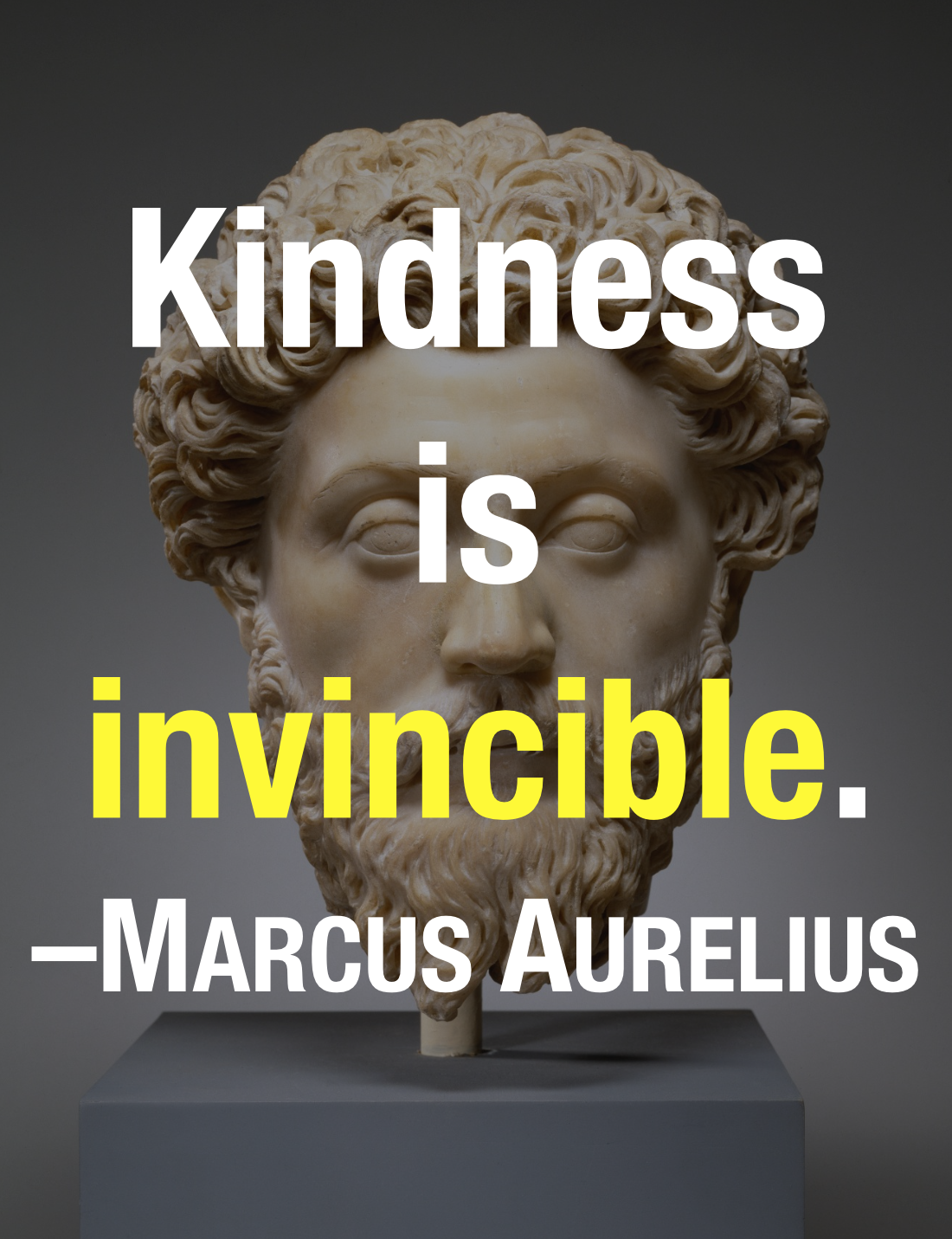
Kindness is invincible

Screen Shot 2014-12-06 at 9.42.00 AM

Meditations 11.18 ix

This from a man who had more power than anyone alive at the time, the emperor of Rome with armies and riches and total authority. Easy for him to say, I suppose. Of course, this was written in his private journal for no one’s benefit but his own. Marcus was the man.

Sincere kindness, not for show or put on in some way, is strong and resilient and ultimately persuasive and even healing. Marcus goes on to say this about kindness:

“What can even the most vicious person do if you keep treating him with kindness and gently set him straight—if you get the chance—correcting him cheerfully at the exact moment that he’s trying to do you harm. “No, no, my friend. That isn’t what we’re here for. It isn’t me who’s harmed by that. It’s you.” And show him, gently and without pointing fingers, that it’s so. That bees don’t behave like this—or any other animals with a sense of community. Don’t do it sardonically or meanly, but affectionately—with no hatred in your heart. And not ex cathedra or to impress third parties, but speaking directly. Even if there are other people around.”

I am not impressed with those who try to exert their authority or express righteous indignation or intimidate their way into getting their way. Give me authentic, wholehearted kindness above all.

Sunday morning Stoic: It’s time to stop being vague

From Epictetus, in Sharon Lebell’s excellent collection of his sayings, The Art of Living:

IMG_5926.JPG

I spend a lot time with college students, and many of them invest a disproportionate amount of mental and emotional energy worrying about what they want to be.

What if, instead, they focused more on who they want to be, on the kind of character and disposition they want to mark their lives?

People of my generation, though, are mostly resigned to what they do. (It’s never too late to rethink that, however.) Yet, who you are matters much more than your job or your career path.

You have the power to make yourself into the person you want to become. Be clear about the kind of person that is. Envision your ideal self in as much detail as you can – habits, demeanor, character. Write down a description of that person. Keep it in a journal or in your computer or on your phone.

Read about people you admire. Seek out mentors and kindred spirits. Fill your mind with what you’re aiming for.

And start acting like you already are who you want to become. Live your way into the person you deserve to be.

Sunday morning Stoic: Stop complaining

Meditations 10.3:

“Everything that happens is either endurable or not.
If it’s endurable, then endure it. Stop complaining.
If it’s unendurable … then stop complaining. Your destruction will mean its end as well.
Just remember: you can endure anything your mind can make endurable, by treating it as in your interest to do so.
In your interest, or in your nature.”

So, Marcus, you’re saying there’s never any excuse to complain about anything. Where’s the fun in that?

Actually, I’ve got the complain-out-loud habit mostly under control. I have my moments, like while watching a football game or while driving or while venting to my wife or colleagues. Yes, so under control. But, mostly, my complaining takes place silently in my mind. It’s just as unproductive, though, even if unspoken.

“you can endure anything your mind can make endurable, by treating it as in your interest to do so.”

That last point though: “you can endure anything your mind can make endurable, by treating it as in your interest to do so.”

This thought has challenged and delighted me since first reading a passage in the novel Memoirs of Hadrian this summer where the emperor Hadrian, one of Marcus’s predecessors, explained that as a young man he treated anything difficult that happened as though he had chosen it to happen. He embraced trials and hardships and setbacks as something to accept and use for his benefit, not resist.

It is in your interest to make the best of what is, even if it’s repellant or tragic or just annoying. Instead of complaining, what if you accepted what is as if it was somehow part of your master plan for refining and perfecting your character?

Sunday morning Stoic: Perspective

Meditations 9.32:

“You can discard most of the junk that clutters your mind—things that exist only there—and clear out space for yourself:
… by comprehending the scale of the world
… by contemplating infinite time
… by thinking of the speed with which things change—each part of every thing; the narrow space between our birth and death; the infinite time before; the equally unbounded time that follows.”

I remember even years ago walking into work, feeling burdened and stressed by whatever seemed pressing at the time, and visualizing a view from above. Like in a dramatic scene in a movie, the picture in my mind would zoom out from wherever I was and let me see just how small I was until I was the size of an ant scurrying across this grand landscape. And then I couldn’t help but smile at the foolishness of my little worries.

When you fly and look out the plane window you can get the same sense of the smallness and insignificance of whatever petty concerns are tugging at you.

Seeing the really big picture – from the vast scale of the universe to the fleeting nature of our experience of it – can restore perspective and shine a light on the insanity of our daily worries.

If it freaks you out a bit to be reminded how small we are, how brief our time here is, welcome to reality. But it’s important, also, to appreciate how special it is that we can even think at all and ponder and marvel at our place in this perplexing, magnificent universe.

Sunday night Stoic: Calm, purposeful, authentic

IMG_1256.PNG
A new week to practice the traits you want to characterize your life.

Keep calm and rise above the frenzy. Breathe and observe. Choose to respond with poise.

Be intentional in your actions. Don’t worry about appearing to be busy, but know that purposeful action is powerful. Don’t wait and waste what little time you’ve been afforded. Just begin.

And be real, be authentic. Don’t try to be. Just be. Don’t overthink how you are perceived. Speak and act and think as best you know how right now.

Just keep going

IMG_1255.PNG
ht Jason Silva

Times are tough for you? Patience. This will pass.

All is well? Life seems good? This, too, shall pass.

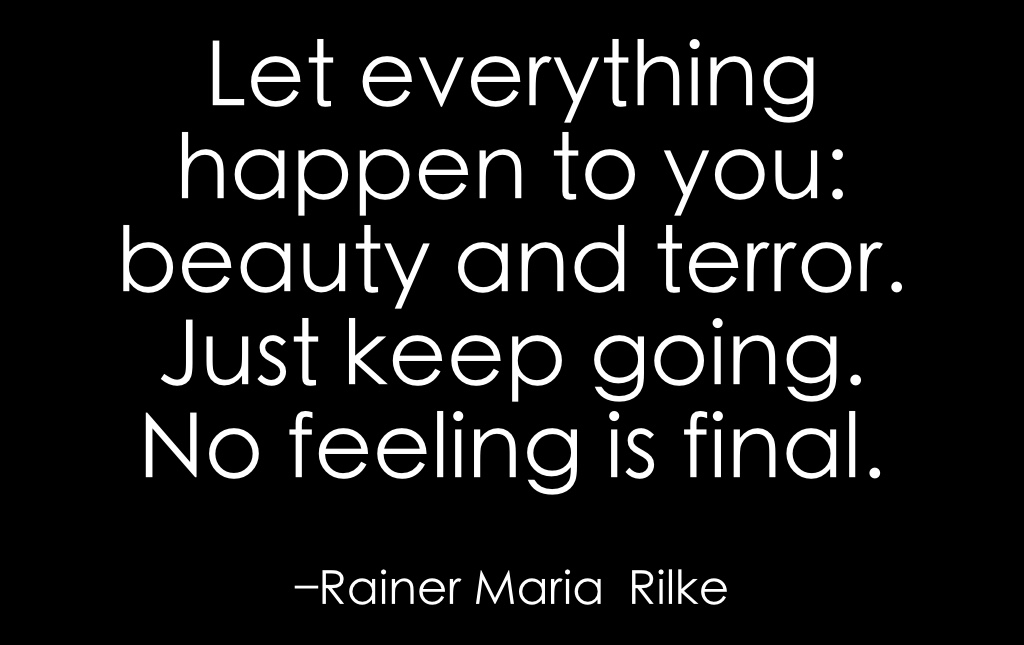
Anxiety, elation, frustration, satisfaction, boredom… No feeling is permanent.

It doesn’t matter how you feel. Just keep going. It’s what you do and how you respond that matters most.

Can you simply observe your emotions and your thoughts without getting lost in them? Me, neither.

But those who are masters of mindfulness have described a state where you can watch your thoughts and feelings flow by as if you were in that empty space behind a waterfall. Sign me up for a comfortable chair in that blissful spot.

Observe and inhabit all you think and feel knowing it’s all impermanent. Don’t get down on yourself for being unable to control the torrent. Learn to observe and be curious. And just keep going.

Toughen yourself

Looking back through my highlights in Ryan Holiday’s The Obstacle is the Way, I found this:

You’ll have far better luck toughening yourself up than you ever will trying to take the teeth out of a world that is—at best—indifferent to your existence.

It’s the same sentiment as this from Ramana Maharshi:

WANTING TO REFORM THE WORLD WITHOUT DISCOVERING ONE’S TRUE SELF IS LIKE TRYING TO COVER THE WORLD WITH LEATHER TO AVOID THE PAIN OF WALKING ON STONES AND THORNS. IT IS MUCH SIMPLER TO WEAR SHOES.

Setting out to change the world seems noble, but the direct path to epic transformation is as simple as changing yourself, steeling yourself against the blows that are bound to come in this world. And helping others do the same would surely change their world.