Asking unanswerable questions

Ann Druyan, writer and executive producer of Cosmos: A Spacetime Odyssey, in a recent interview:

I have no problem asking the unanswerable questions, or in asking the as-yet-unanswerable questions. I have no problem with asking them, and I certainly have no issue with how we get through those dark nights of the soul by answering them. I would never presume to tell anyone how to answer them for themselves, not even my own children. I wouldn’t even think of it. I can only speak for myself when I say, “Yeah, asking questions – the more the better.” It’s just that if you come up with answers that make no adjustment to the scale of space and time that we find ourselves in, we see a failure of the imagination.

 
I happen to be surprisingly okay with uncertainty, but I’m not interested in intentionally rocking the world of someone who is not. All of our fellow humans are on their own, unique journey and traveling, presumably, as excellently as they think they can.

Keep asking questions and don’t settle for easy answers or answers that happen to work for someone else and have been handed to you in a tidy package. And have the courage to move on from the comfort of answers that were once cherished, or even sacred, but now don’t hold up to reason and have no compelling evidence to sustain them. The boat that got me across the river is no longer useful to me as I try to cross the mountain now in front of me. It’s okay to put the boat down and keep going.

Who are we?

Who are we, if not measured by our impact on others? That’s who we are! We’re not who we say we are, we’re not who we want to be — we are the sum of the influence and impact that we have, in our lives, on others. -Neil deGrasse Tyson speaking in tribute to the great Carl Sagan
via Brain Pickings

On a night when I sat with my 9-year-old to watch the new version of the Cosmos TV series, I was reminded just how overwhelmingly vast and dark and inexplicable our universe is. And how awesome it is to be alive and aware of how very little we know.

If we can shine a little light as we journey, light that just might illuminate the path of a fellow traveler, even for a mere moment, we have done something noble, something heroic.

Humans are so new to the universe and so alone as far as we can see. Our significance is not much in relation to the cosmos. But in relation to each other, we are all we have to share meaning and kindness and to make this journey worthwhile.

20140309-231621.jpg

Earthrise

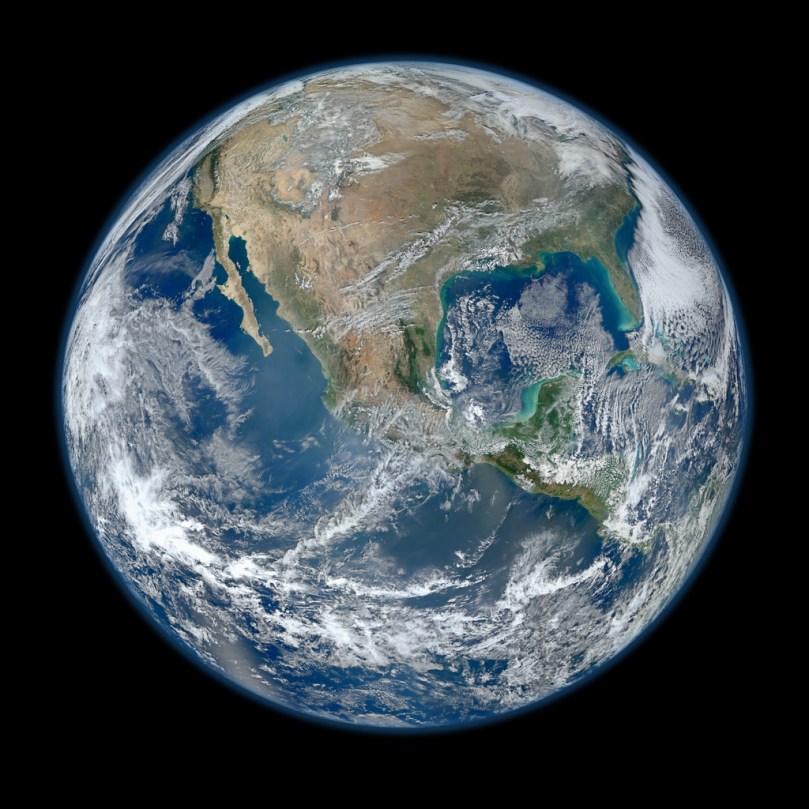
Any image of the earth from space is powerful. That we can take a photo of our planet, the ultimate self-portrait, is remarkable. And seeing our lovely blue, green, and white home set against the blackness of space reminds us how amazingly fortunate we are to be here.

The most famous image of the Earth, and one of the most famous photographs ever, is the “Earthrise” photo the Apollo 8 astronauts took when they were on the first mission to orbit the moon in 1968. This delightful video recreates that moment and captures the excitement those astronauts had when they first saw it.

What if that photo or any other of the beautiful images of Earth from space was in every classroom and in homes and workplaces?* Would seeing the big picture regularly make us even a little more mindful of our fragile, noble place in the universe and make us even a little more kind and big-hearted?

*I’ve just set this image as the desktop wallpaper on my Mac.53858-earthrise

On not knowing

A neuroscientist offers a compelling case for the value of ignorance, of knowing that you don’t know:

Reminds me of a quote from Joseph Campbell that continues to resonate with me:

He who thinks he knows, doesn’t know. He who knows he doesn’t know, knows.

Instead of being sure of answers, it’s better to know the next questions to ask.

Wildness

Two things on this TED Talk:

1. Our modern world could use some rewilding. We are so disconnected from nature and have done so much damage to the real world. But nature is resilient. And even if we can’t bring the Serengeti to our back yard, we can be more intentional about building some wildness into our lives.

2. What a great presentation style by this speaker. He goes without notes and slides and commands his time on the stage. He tells stories and is completely engaging. And he’s obviously passionate about his topic. He knows his stuff, and I’m guessing he prepared thoroughly for this moment because it looks almost effortless.

“In wildness is the preservation of the world.” -Henry David Thoreau

Wired for story

There’s an interesting story in The Atlantic about the evolutionary advantages of story telling. Humans have been sharing stories for possibly a million years. Story tellers thrived and survived.

We long to be pulled along by a narrative. Even a poorly told story is more compelling than just disconnected facts. We are wired for story from generations of story tellers binding us together and guiding us as a culture.

And now stories are filling up even more of our attention each day. From The Atlantic article:

Thanks to Gutenberg and the inventions of film and television, we immerse ourselves in more narratives than our ancestors could have imagined, which means we’re cutting back, along the way, on real-life experience.

This means our choice of which stories to consume is more crucial than ever. They need to be as useful as lived experience, or more so, or we’re putting ourselves at a disadvantage.

Mediocrity abounds in popular culture. Seek out quality. Time-wasting entertainment is like junk food. Fill your time with real life and meaningful experiences. Make a great story of your own life. And when you do seek to get lost in someone else’s narrative, choose wisely. The classics are classics for a reason. They’ve stood the test of time and are probably worthy of your attention.

Seek out the greatest authors and filmmakers. And when you find an artist that connects with you, go feast on everything they’ve produced rather than sampling lightly and bouncing around to other creators. Do a deep dive into an artist’s work. If War and Peace grabs you, don’t stop there. Go read all of Tolstoy. Loved 2001? Make time to watch all of Kubrick’s films.

Our story is a million years in the making. Fill your life with stories worth your attention.

Kiss your brain, and get moving

Here’s a fascinating TED Talk explaining that our brains developed primarily to facilitate movement:

Wolpert points out that computers can “outthink” a human chess master, but that even a five-year-old has dexterity that blows away anything the most sophisticated robot can do.

Physical movement is our primal and primary strength. Regrettably, we as a culture seem to be living more in our heads and on our butts than fully maximizing our amazing physical gifts.

Go take a walk, and make it a mindful, fully present experience. Learn to juggle. Swim. Play catch. Ride a bike. Balance on a curb. Enjoy, glory in, your remarkable dexterity and physical skills.

I have a teacher friend who regularly tells her kids, “Kiss your brain.” Be smart, certainly. Challenge yourself mentally. But also embrace your physical nature and kiss your brain by moving like a human.

Via Movnat

20130909-214228.jpg

Planets everywhere

This recent New York Times piece, A Universe Full of Planets, is astonishing. We’ve always speculated about life elsewhere in the universe, but it just wasn’t possible to see any planets out there. And even if there are planets around other stars, what are the odds any of them would have the fortunate qualities that sparked life on our home planet?

Well, now we can see that there are plenty of planets outside of our little solar system. Even more, we can identify that a significant number are quite similar to Earth:

No matter how conservative or optimistic we are, the statistics tell us that something like an astonishing one out of every seven stars must harbor a planet similar in size to the Earth, and at roughly the right orbital distance to allow for the possibility of a temperate surface environment. In other words, roughly 15 percent of all suns could, in principle, be hosting a place suitable for life as we know it.

Since our galaxy contains at least 200 billion stars, this implies a vast arena for the universe’s ubiquitous carbon chemistry to play in — a process that, as here on Earth, might lead to the complex machinery of life. Indeed, there is a 95-percent confidence — give or take a few percent — that one of these worlds could be within a mere 16 light years of us. That’s a stone’s throw, practically our galactic backyard.

Fifteen percent of stars might have Earth-like planets? Wow! Imagine that our technology and science advance enough in the next few decades to see even more clearly the planets that might be closest to us. To discover that we are not alone, even if the cosmic distances remain too prohibitive to ever make direct contact, would have a profound effect on our species.

It would be humbling and cause quite a shift in our self perception. And it would be as exciting and as inspiring as anything that’s ever happened on this little planet of ours.

20130807-220712.jpg

Jason Silva: “We are the gods now”

I can’t get enough Jason Silva. He spoke last year at The Festival of Dangerous Ideas in Sydney. His talk is provocative, entertaining, and refreshingly optimistic about our future:

I appreciate his passion and rapid-fire incitement of excitement about the wonder of being alive.

It’s about awakening the mind’s attention from the lethargy of custom and the film of familiarity and redirecting it instead to the wonders of existence. -Jason Silva

A self-portrait from 900 million miles away

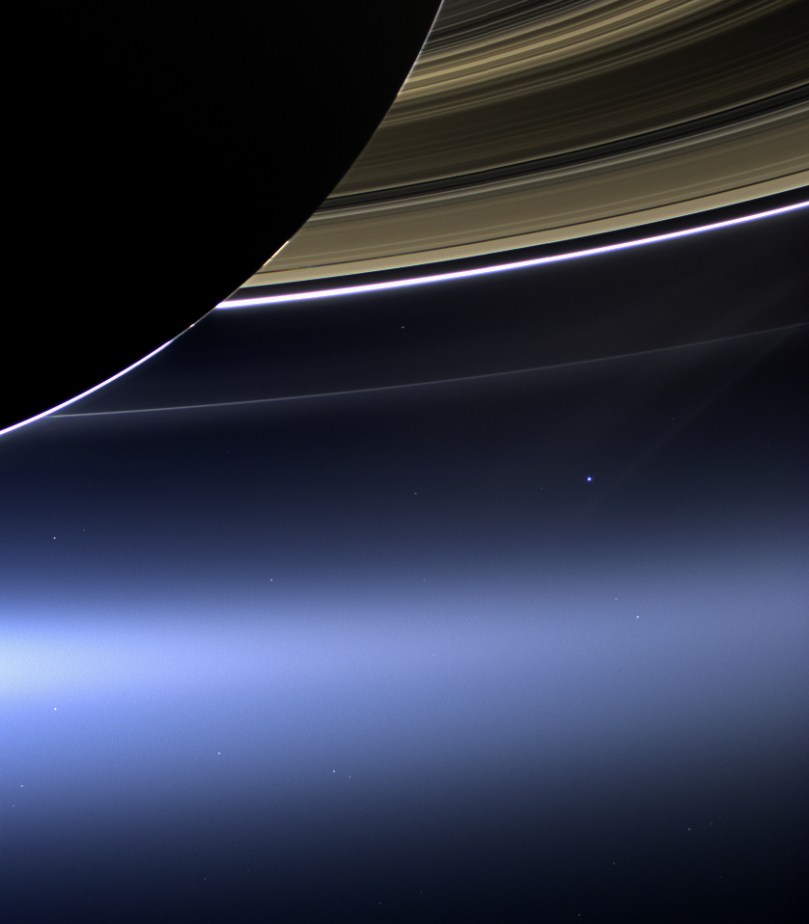
I saw this great photo today of Earth taken from Cassini, the spacecraft orbiting Saturn:

Earth from Cassini

Earth is the blue dot just under the rings of Saturn. This is a self-portrait from 900 million miles away.

Our home is just another smudge of light in space. It looks so small and fragile and not so impressive from this vantage point. But it’s our home and our smudge, and it’s glorious.

I keep coming back to the big picture to put my own little picture into context and give it meaning. Humans have gone from hunter-gatherers to cosmic explorers in a blink of time. Your problems got you down? They’re not so big after all when you change your vantage point.

Seeing this image made me search for Carl Sagan’s famous ode to our “pale blue dot”, as he calls the image of Earth in a similar photo from many years ago.

Here’s a lovely video with Sagan reading his famous prose reflecting on what a precious home we have:

http://www.youtube.com/watch?v=4PN5JJDh78I

Love and gravity

Gravity rules the universe. There would be no Earth, no solar system, no sun or stars or galaxies without gravity.

Gravity is attraction. The earth is pulling on the moon, keeping it close. The sun keeps tugging at the planets. Galaxies spin in infinity in its grasp. Gravity holds everything together.

Newton enlightened. Einstein clarified and corrected. And smiled.

What gravity is to the cosmos is what love is to the human experience. Love brings people together, puts hearts in orbit around each other. Connects and binds. Builds community and family.

It can be defied, with great effort if not with Saturn V rockets. It gives order and chaos at the same time.

We all are connected, biologically and cosmically. We are star stuff, held together and propelled onward by love and gravity.

The power of awe, as in awe-some

This:

http://youtu.be/yF15TekHVV0

I’ve just discovered the work of Jason Silva, a sort of spoken-word philosopher who has created mind-shifting, eye-opening videos like the one above.

We do need regular doses of awe, reminders of how grand and overwhelmingly incomprehensible this universe is and what a kick it is that we are not just in it, but we’re aware that we’re in it and can wonder and ponder and imagine.

The big picture is really, really big. We are really, really small.

But just big enough to see and to dream.

Practice makes awesome

I’m reading a brilliant book, The Talent Code by Daniel Coyle, which was recommended by one of my students. (Thanks, Sarah Elizabeth.) The author explores what accounts for those people who possess extraordinary talent. How do the greats get great? This book points toward an unexpected answer which just might be the Holy Grail for anyone who wants to be world class, who wants to get really, really good at something.

There is some fascinating science explained in the book, and a previously mysterious and lightly regarded substance in our bodies, myelin, takes the spotlight. Just being aware of this substance and how it works could change your life. Go read the book, but I will tell you that the more myelin you develop in your body, the more awesome you will become. LeBron, Tiger, Yo-Yo Ma… those guys and anyone who are masters of their crafts are loaded with myelin.

You want the shortcut, the quick recipe for loading up on myelin and generating the kind of awesomeness that has made masters out of regular humans for centuries? Here you go:

Practice.

You knew this, right? Most of us have now heard of the 10,000 hour rule: it takes 10,000 hours of practice to get really good at something. But there’s a bit more to it. Masters practice in a certain way that makes all the difference. “Deep practice” is necessary to get great. It’s the kind of practice where you keep bumping up against your limitations and sticking with it till you overcome and move on to a higher level.

I learned to juggle when I was a teenager, thinking girls would be impressed. They were not. (Toddlers, though, are wowed. Who knew?) It was a struggle when I was learning. I dropped a lot of bean bags, got frustrated, but kept going until I mastered the basic three bag juggle. But, from then on, whenever I practiced juggling I just did the same trick over and over. And I never got better. Never learned anything more than how to juggle three items in the same pattern. A master juggler would have kept going, pushing past the basics, failing again and again with new moves and tricks until finally gaining mastery.

Deep practice requires facing struggle and persevering. And repeating. Over and over. Don’t just practice the easy stuff, the stuff you’ve already got. Push yourself to conquer the hard stuff.

And practice daily. Myelin, which is created by this repetitive, deep practice, is living tissue and needs to be nurtured and replenished

You want to be a writer? Write every day, even when, especially when you don’t feel it flowing. Want to perform? Seek out every opportunity to perform, to stand before audiences. See what works and what doesn’t, and then hone in on getting every little detail sharpened.

What’s the Kryptonite that can weaken the skills of a master? Don’t let them practice. From Coyle’s book:

As Vladimir Horowitz, the virtuoso pianist who kept performing into his eighties, put it, “If I skip practice for one day, I notice. If I skip practice for two days, my wife notices. If I skip for three days, the world notices.”

Same for the great Louis Armstrong:

“You can’t take it for granted. Even if we have two, three days off I still have to blow that horn a few hours to keep up the chops. I mean I’ve been playing 50 years, and that’s what I’ve been doing in order to keep in that groove there.” -Louis Armstrong via Kottke

I’ve been guilty in the past of almost pridefully disdaining preparation and practice, confident I could wing it and still be good. I’ve been learning, though, that practice, deep practice, makes the difference between being good enough and being awesome.

How great do you want to be? Target the skills that you want to strengthen and get busy practicing. Embrace frustration and struggle and pain as the signs you’re on the right path to mastery. If it’s easy, you’re doing it wrong. But if it were easy, everyone would be a master.

20130717-145232.jpg

The end is NOT near

What if the end is not near? What if we are just getting started on this planet?

The earth is, what, 4.5 billion years old give or take a few million years and may have at least another billion years or more to support life before the sun scorches it. Modern Homo sapiens, though, have been here for only a mere 200,000 years, possibly. We look at 2,000 years ago as though it’s ancient history. That’s actually just a blip in time on the cosmic clock.

Every century has had its doomsday fervor. First century Christians, for example, were certain Jesus would be right back. There have been countless proclamations and errant prophecies of when everything would end. It’s as though people want to be in the last generation.

But, what if humans have a run like the dinosaurs did? Dinosaurs ruled the planet in various species for millions of years. Maybe we are at the very beginning, relatively, rather than close to the end. Of course, dinosaurs didn’t have the power to wipe themselves out the way we humans do now.

Let’s be optimistic for a moment, though, and, barring another cataclysmic asteroid collision, assume the human penchant for massive self-destruction as demonstrated throughout the past hundred years is just a phase we will get through. What if these are our “teenage” years as a species and we will mature into truly rational beings who use our big brains exclusively for constructive ends? Imagine what a fascinating world could lie ahead for our descendants.

What could human life look like 1,000 years from now? 10,000 years, 100,000 years from now? Surely, humans, if we make it another century or two, will be smarter and kinder and more civilized. The intelligence it will take to get past this phase of self-destructiveness almost ensures that, if we do survive, we will be better than we are now.

What can we do now to live our lives in such a way that we can help our species mature in the direction of a long, bright future for humanity? I do think about how my decisions affect my children’s future. I should also take the long view and consider the ramifications for generations yet unborn.

If we don’t blow ourselves up or destroy our environment, I’m certain we can continue to evolve and adapt and get better as a species. We each can do our part by being discontent with just getting by and striving to improve ourselves a little each day. Evolve intentionally. You, by being a bit more awesome this week than you were last week, can nudge the whole human race forward and toward an unimaginably fascinating future.

Taking the really long view can really change your perspective. Let’s think of this time we’re living in as just the beginning of the magnificent and very long human era on earth. Centuries from now our descendants could look back on our generation as the one that made the difference, that began a golden age of human existence.

6760135001_58b1c5c5f0_b
Image via NASA Goddard Space Flight Center

Ian McEwen on science

The novelist Ian McEwen on his fascination with science:

“Science is simply organised human curiosity and we should all take part. It’s a matter of beauty. Just as we treasure beauty in our music and literature, so there’s beauty to be found in the exuberant invention of science.”

This is from a great interview over on fivebooks.com, which is a site well worth getting lost in to explore lists of good books and interviews with book lovers.

For the love of science

We had a conversation with our campus tour leaders this week about science. Most tour leaders are not science majors. For whatever reason, few science students are drawn to our work. We get plenty of business and journalism majors, and there’s no shortage of English and political science students either.

But as campus tours unfold and they pass by science buildings, it’s easy for the non-science students on our team to dismiss science or apologize that we require at least a couple of science classes for all of our students.

I felt that way when I was an undergraduate. I just wanted to get past my science requirements with as little stress as possible. Now, I regret how little attention I paid to those subjects. Science has become significantly more fascinating to me in recent years.

In the history of humanity, it is the development of and amazing advances in science that stand out as our greatest achievements. Art and statecraft have their place, but science, even though it’s a relatively recent endeavor, has changed our lives exponentially for the better and sparked our inclination to explore and discover as never before. More people should honor and understand science. If we don’t do that in higher education, where will we?

I have begun trying to absorb more now about science and adding books to my reading list by or about Feynman, Darwin, Sagan, and Einstein. I don’t always understand. It’s like reading something written in a foreign language at times. But I can’t help but get excited about approaching the frontier of mysteries our ancestors could not even imagine.

This is the first video in the delightful Feynman Series. Check out the Sagan Series as well.

“I can live with doubt and uncertainty and not knowing. I think it’s much more interesting to live with not knowing than to have answers which might be wrong.” -Richard Feynman

The end is near

I was at a conference in Denver last year and saw a headline in the local newspaper that said astronomers had determined conclusively that the nearest galaxy to ours, the Andromeda galaxy, is on a collision course with our very own Milky Way. There’s no way around it. It will be catastrophic, cataclysmic. Andromeda definitely will collide with the Milky Way… in four billion years.

The good news is that our solar system, our tiny little corner of the galaxy won’t be impacted by the collision until about two billion years after the initial impact. So, we’ve only got six billion years.

Need perspective? Think big picture. Really big picture. While pondering the scale of galaxies and the mind-boggling expanse of time and space may make you feel small and insignificant, our smallness and our life’s brevity are reality. But how amazing is it that we are a part – and a conscious, intelligent, aware part – of such a grand, awesome, beautiful universe?

Pause and reflect regularly on the wonder of it all. Look up. Look closely at the mysteries that surround us, from the blade of grass underfoot to the galaxies spinning far beyond. Be wowed by all that is and that anything is at all.

“The most beautiful thing we can experience is the mysterious. It is the source of all true art and all science. He to whom this emotion is a stranger, who can no longer pause to wonder and stand rapt in awe, is as good as dead: his eyes are closed.” -Albert Einstein

20130703-211850.jpg

The ultimate mission for each generation

20130701-223316.jpg

The more we know, the more we realize we don’t know.

What an awesome, overwhelmingly mysterious universe we live in.

“He who thinks he knows, doesn’t know. He who knows he doesn’t know, knows.”

You want a calling, a noble mission that can consume your life? Make it your work to help push humanity’s understanding of the universe and our place in it even a little further into the vastness of the unknown.