The near win

Reaching a goal can derail you. Accomplish it and then what? New goals, I suppose. But a life built around systems and process and thoughtful routines will bring more excellence and more consistent satisfaction than the ups and downs of goal-setting.

There’s something transcendent about striving, reaching for what you know may actually be unreachable. It keeps you hungry and sharp and makes you open to change and growth.

Success is an ending, and can leave you feeling lost on a regular basis. Mastery, though, is a pursuit. It’s a journey, not a destination.

I enjoyed this brief TED Talk by art historian Sarah Lewis, who champions the merits of the “near win”, of falling short, yet, or consequently, continuing to strive and improve and ending up further along than success would have propelled you.

Seeing this resurrects the desire in me to find some sideline activity that I can pursue in an attempt to achieve mastery. A hobby or craft or physical discipline that has no end other than a path of excellence.

By the way, I appreciated Lewis’s speaking style. Her stage presence is not effusive, not charismatic, and not quite conversational. But she’s quietly solid and impressively clear. It seems like it’s more of a spoken-word essay than a talk, but it works for her. This seems like who she is, and she clearly cares about what she’s saying and what she’s learned.

Seeing her on stage reminds me that there is no one best way for speakers to connect. Well, there is one way, and that is authenticity. That works for every speaker.

Daring in design, cautious in execution

Screen Shot 2014-07-24 at 3.29.04 PM

I’m reading Titan, Ron Chernow’s massive biography of John D. Rockefeller. Early in Rockefeller’s career, his approach to business is described as “daring in design, cautious in execution.”

That’s a good motto for undertaking any endeavor. Be bold with your vision. Go where no one has gone. Go bigger. Go better. Have the courage to be audacious with your plan.

Then pursue that vision with care and meticulous attention to detail. Be patient and plodding, even, as you painstakingly nurture and craft the small things that are necessary to make your big plan truly daring and worth talking about.

Apple works this way. Their vision is bold. They want to change the world with their products. But they are conservative with their execution, famous for patiently and secretly refining and iterating, unwilling to release anything that doesn’t meet their high standards, even if profit is assured.

The big picture is crucial, and having a daring goal can spark action and unleash possibilities previously unimagined. But it’s the execution – the follow-through and the commitment to the countless difficult decisions and unglamorous hours honing and reworking the details – that determines the destiny of the dream.

Dream your big dreams. Open to a blank page and put down those daring, scary ideas. Commit to the vision that most delights you, and then get busy doing the deep, detailed work necessary to make that dream fulfill its promise.

Inspiration will jilt you. Move on without it.

From Erin Rooney Doland‘s chapter in the excellent book, Manage Your Day-to-Day:

Leigh Michaels, prolific author of more than eighty romance novels, once said that “waiting for inspiration to write is like standing at the airport waiting for a train.” Conditions to produce one’s craft are rarely ideal, and waiting for everything to be perfect is almost always an exercise in procrastination.

Inspiration will leave you in the lurch and repeatedly break your heart. You still will love it and long for it and put up with its philandering ways. And you will wait and postpone good things in hopes that it will arrive any moment now.

The best way to summon it is to ignore it, play hard-to-get, and just start doing your work, whether you feel like it or not.

I aim to write something every day. Some days I wait and wait, longing for even a tiny nudge of inspiration, and the day gets late with no love from the muse. Then I just have to start writing something to keep that daily commitment, even if I’m sure what I write will be lame or trite or completely unoriginal. This is one of those posts.

Inspiration did not arrive, but I did.

Advice for getting started after college

My first job out of college was on Capitol Hill, working on the staff of a member of Congress. I lived alone on the Hill and walked to work every day. There was no internet in 1987, of course, and no cable TV then, surprisingly, on the Hill. I didn’t have much money and didn’t socialize much. Dinner was often finger food from whatever Congressional reception was on my boss’s schedule for the night. My family was far away. I had friends, but it was a very introspective, often delightfully solitary, relatively distraction-free time in my life.

My primary pastime when I wasn’t working was reading. I spent whatever I could on acquiring books, mostly biographies and history. As I was beginning my adult life with audacious dreams of greatness I wanted to be instructed by the examples of the lives of great men and women. I particularly remember reading Plutarch’s Lives and biographies of U.S. presidents. A fun Friday night for me was browsing the shelves of a bookstore.

It wasn’t exactly a monk-like existence, but I often wondered if I shouldn’t have been more social and had more fun. Looking back on it, though, I realize it was a great way to begin forming my identity and learning to think for myself and being intentional about who I wanted to be. I wasn’t molded by peers or social expectations or distracted by frivolities. That alone time was worthwhile. Much of who I am now and the way I think was formed in those years as a bachelor with books.

I was reminded of this time in my life by a post on Brain Pickings. The author Florence King gives her advice to young people on getting started in their adult lives, and it sounds a lot like what I did:

Put yourself on cruise control and go into limbo for a year. I’m not talking about a neo-grand tour; don’t bop around Europe, you’ll just get in trouble. Nor am I talking about what your parents’ generation called “dropping out.” I mean forget about success for a while, get yourself an ordinary job, an ordinary place to live, and live without worrying about what Americans call, in uppercase, the Future.

Go somewhere different, but stay away from big cities. If you’re from a place you call “godforsaken,” go to a small city in another part of the country…

Get a dead-end job — they’re plentiful now because nobody wants them. Tell your employer the truth: that you’ll be around only a year or so, but promise to work hard. Keep your promise. Little triumphs are the pennies of self-esteem. If you do well in such a job and make yourself indispensable to somebody, you will realize Robert E. Lee’s farewell words to his men after the surrender at Appomattox: “You will take with you the satisfaction that proceeds from a knowledge of duty faithfully performed.”

Live alone, even at a financial sacrifice. If you have a roommate, the whole college uproar will just start all over again…

Read, read, read. When you don’t have to worry about passing exams on them, subjects you studied in school suddenly become interesting…

What I am recommending is traditionally called “finding yourself.” The difference is, there is no bohemian excess here, none of the “experiencing everything” that comprises nostalgia de la boúe. It’s productive, constructive goofing-off.

This was close to my experience of being on my own for the first time. I was in a big city but was not particularly living a big city life. I was alone, far from family and old friends, and I used that time to read and think and start figuring out what was important to me. I didn’t have a “dead-end” job. It was intense, yet fun, and I learned what it meant to do good work and to be part of a team. But it didn’t end up being the field I would devote my career to.

I remember about that time discovering the work of Joseph Campbell, the great expert on mythology and comparative religion. His influence continues to resonate with me. He told of a similar period early in his career during the Great Depression when he couldn’t land an academic job. He ended up living in an isolated place for a few years, and all he did was read. Campbell credits that quiet time in his life for the success he ultimately found in his work life.

I know what it’s like to be 22 and eager to make your mark, to prove you’ve “arrived” and are bound for something big. Our connected and distracting world today only makes this impulse more irresistable and more burdensome. But understanding that it’s the long game that’s more meaningful is so reassuring. Attempt to peak at age 60 rather than, say, 27, and you’ll likely be more awesome at 27 than you would have been playing the short game, trying to succeed fast.

Take the time to ease your way into your adult life, to ponder and reflect and get to know who you are and who you want to be outside of the expectations of your family and the influence of your friends. There’s no hurry, people. The future is arriving fast enough.

Write what you want to read

I’m reading The Way of Kings by Brandon Sanderson now. (Thanks to my friend, Jesse, for the recommendation.) It’s an epic fantasy novel (1,000 pages in this first of a planned ten book series) and not my usual reading fare. But I’m immersed in it and marveling at the compelling narrative and level of detail the author has created. Years ago, before the movies ever came out, I read Tolkien’s Lord of the Rings and felt a similar level of awe at the marvelous world an author can create.

Intrigued by this young author’s career, I found this interview with Sanderson and appreciated his approach:

I can only speak from my own experience, which may be abnormal, but I really feel that the times where I worried too much about the market were the times I wrote my worst fiction. And the times where I wrote: “this is what I want to read — this is what I’m passionate about,” I wrote my best fiction. And so that’s what I would advise.

That being said, I was very steeped in this genre. You can say what I wanted to read was very naturally an outgrowth of what a lot of what the fandom wanted to read because I was one of them. That’s why it worked for me. And I’m sure there are a number of people who are writing to their passion, and it just doesn’t end up catching on. I wrote 13 books before I got published, and at the end of the day I decided I would rather keep writing and never publish than give up writing or go do something else. And if I reached the end of my life and had 70 unpublished novels, I’d still consider myself a successful writer. That decision has driven me ever since and it’s worked out for me. -Brandon Sanderson

He’s writing what he wants to read and seems as if he would be content if he was never published.

That’s a good formula for work in general, not just writing. Make things that will delight you. Do your best, not for the chance for advancement or to impress bosses or to win some sales competition. Be awesome in all that you do whether anyone else notices or not. You will notice. And you will delight in the intrinsic rewards of work that shines regardless of any extrinsic rewards.

And that approach is more likely to produce quality work that does resonate and connect with others in a more meaningful way than trying to figure out what will sell.

Striving

Screen Shot 2014-07-16 at 4.17.02 PM

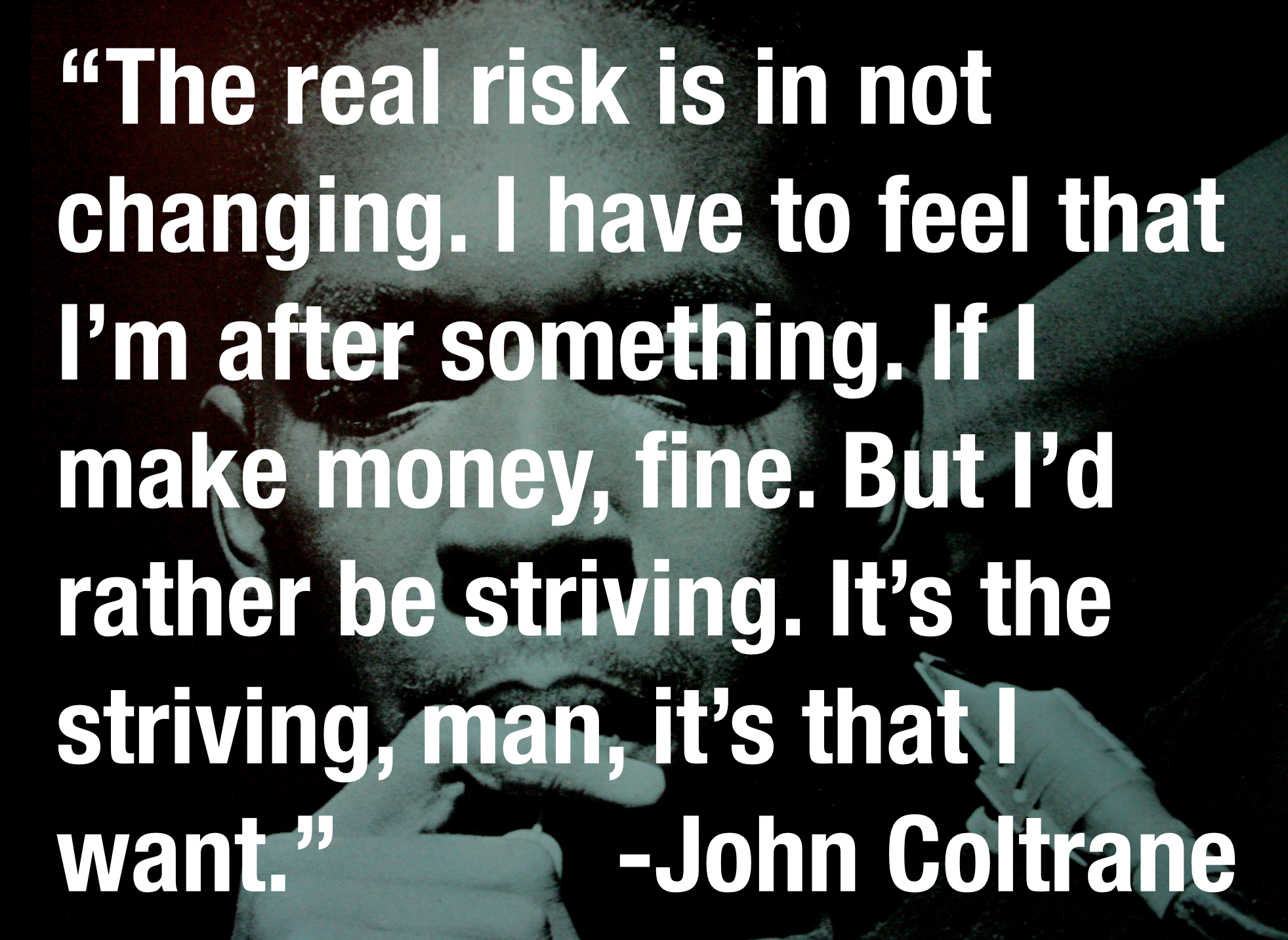
If the most satisfying rewards are the intrinsic ones, striving for mastery, for artistry in your work, becomes a joyful end in itself. “Making it” is an illusion. You never get there. There is no there there. Imagine how dull life would be if you did “arrive” and just sat by the pool all day. I could take a week by the pool, mind you, maybe even two, but a life of leisure with nothing to strive for, nothing to keep you sharp, sounds miserable.

John Mayer expressed practically the same sentiment as Coltrane’s:

It’s only fun when you’re trying to get it in your grasp. It’s like, you know, once you catch it, throw it back in the water then catch it again. That’s really what I want to do my whole career. -John Mayer

Comfortable? Got it figured out? Time to get busy upping your game, mastering something new, starting from scratch, striving.

“How do I move the needle?”

I enjoyed this video about screenwriter Dustin Lance Black’s writing process shawnblanc.net linked to today:

Black, who wrote the screenplays for J. Edgar and Milk, has a richly complex, yet clear and beautiful process for putting together his screenplays. Watching him lay out all those note cards on that giant table sparked memories, happy memories, of working on a research paper in college. I wrote an honors thesis in a religion class my senior year and used a similar process where I researched like crazy and then sorted my note cards like I was playing a delightfully challenging game of solitaire. I would rearrange and discard and rethink and see it all eventually unfold into a meaningful narrative that flowed logically and came to a satisfying conclusion.

Black has a clear commitment to digging deeply into a subject, doing meticulous, even excruciating work, and taking his time to let the story come to him. And he’s willing to let go of ideas he loves to better serve the story.

I find a similar workflow works for me in light table view in Keynote. It’s the digital equivalent for me of a table full of note cards. Analog or digital, there’s much to value in a process where you can see the big picture of a story or a project or an idea and make connections and rearrange and discard to better serve the narrative arc.

Do the hard work. Dig deep for details. Spend the time necessary to know your stuff. Then zoom out and find the big picture. That zoomed out perspective might show you a completely different direction than you had originally expected.

Of course, the big picture, the point of your work, has to begin and end with “Why?” Black says just this at the beginning of the video:

“That’s where I start, taking an idea, whether it’s fiction or non-fiction, and figuring out why. Not just what you’re going to tell, not that it’s entertaining or interesting. But why are you telling that story? What is the purpose of that story? For me it’s always, How do I move the needle? How do I change the culture? Now.”

We all want to “move the needle”, to do something worth talking about, to make a difference. I’m inspired to invest in a crisp, new stack of note cards and get busy crafting a story worth telling.

Pick a date and make your idea happen

My wife and I hosted a cookout tonight for the students I work with. It’s our way of thanking them for all the hours they put in during the summer.

We decided just this week to move the cookout to today. And we were busy the last couple of days getting the house ready, doing yard work, and buying and preparing food. We got a lot done in a short time, and our home and yard are in better shape than they’ve been all summer.

Without this cookout to prepare for, those chores around the house would not have gotten done anytime soon.

Deadlines make things happen, especially public ones. It’s worth setting a deadline just to spark action.

Need to clean your house? Invite someone over. Want to make an idea of yours come to life? Pick a date and put something on the line that will force you to get moving.

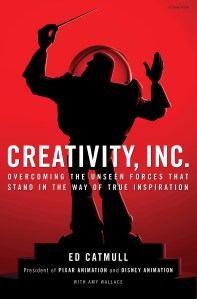
Creativity, Inc.

© Disney • Pixar

I recently finished reading Creativity, Inc. by Ed Catmull, the President of Pixar and Disney Animation. It’s really good. So many business books come across as superficial or self-serving PR pieces. But Catmull has created an enlightening, useful book filled with candid insights into the creative powerhouses he has helped to build.

Catmull tells the fascinating story of how Pixar came to be and then goes on to share how they have adapted in response to internal challenges to continue making remarkable movies. This is a particularly great read if you are responsible for leading other creative people or if you are part of a team of creatives. Catmull doesn’t sugarcoat Pixar’s success. He focuses repeatedly on failures and stresses that have forced the company to keep reinventing its processes.

This book is worthwhile for anyone who wants to understand what it takes to create and cultivate a great organizational culture.

If you’re part of an organization or a team or a family even, and you care about it being the best it can be, you must care about the group’s culture. If you’re not intentional about shaping and cultivating the culture, then brace yourself for the culture to be shaped randomly, and possibly destructively. Culture is everything for an organization.

It’s clear that Catmull and his partner John Lasseter (and the late Steve Jobs) were meticulous in crafting the culture of Pixar to bring out the best in the creative people on their team. And they’re still learning and failing and trying new approaches.

Here are some passages I highlighted as I read:

“Figuring out how to build a sustainable creative culture—one that didn’t just pay lip service to the importance of things like honesty, excellence, communication, originality, and self-assessment but really committed to them, no matter how uncomfortable that became—wasn’t a singular assignment. It was a day-in-day-out, full-time job. And one that I wanted to do.”

“My hope was to make this culture so vigorous that it would survive when Pixar’s founding members were long gone, enabling the company to continue producing original films that made money, yes, but also contributed positively to the world.”

“Getting the right people and the right chemistry is more important than getting the right idea.”

“Candor isn’t cruel. It does not destroy. On the contrary, any successful feedback system is built on empathy, on the idea that we are all in this together, that we understand your pain because we’ve experienced it ourselves.”

“You need storms. It’s like an ecology. To view lack of conflict as optimum is like saying a sunny day is optimum. A sunny day is when the sun wins out over the rain. There’s no conflict. You have a clear winner. But if every day is sunny and it doesn’t rain, things don’t grow. And if it’s sunny all the time—if, in fact, we don’t ever even have night—all kinds of things don’t happen and the planet dries up. The key is to view conflict as essential, because that’s how we know the best ideas will be tested and survive. You know, it can’t only be sunlight.”

“My rule of thumb is that any time we impose limits or procedures, we should ask how they will aid in enabling people to respond creatively. If the answer is that they won’t, then the proposals are ill suited to the task at hand.”

“Better to have train wrecks with miniature trains than with real ones.”

“Paying attention to the present moment without letting your thoughts and ideas about the past and the future get in the way is essential. Why? Because it makes room for the views of others. It allows us to begin to trust them—and, more important, to hear them. It makes us willing to experiment, and it makes it safe to try something that may fail. It encourages us to work on our awareness, trying to set up our own feedback loop in which paying attention improves our ability to pay attention. It requires us to understand that to advance creatively, we must let go of something. As the composer Philip Glass once said, ‘The real issue is not how do you find your voice, but … getting rid of the damn thing.'”

“My goal has never been to tell people how Pixar and Disney figured it all out but rather to show how we continue to figure it out, every hour of every day. How we persist. The future is not a destination—it is a direction. It is our job, then, to work each day to chart the right course and make corrections when, inevitably, we stray. I already can sense the next crisis coming around the corner. To keep a creative culture vibrant, we must not be afraid of constant uncertainty. We must accept it, just as we accept the weather. Uncertainty and change are life’s constants. And that’s the fun part.”

“Unleashing creativity requires that we loosen the controls, accept risk, trust our colleagues, work to clear the path for them, and pay attention to anything that creates fear. Doing all these things won’t necessarily make the job of managing a creative culture easier. But ease isn’t the goal; excellence is.”

What a refreshing book. Great stories. Candid insights. Humble confessions. Helpful advice from many of the key players at Pixar on how to work in a more effective and creative way. Pixar can seem to do no wrong. (Except for Cars 2. What happened there?) This book continues the string of excellent stories from what has become maybe our nation’s most iconic story teller.


A day’s work

20140706-224534-81934524.jpg

Bring on a new week, a new chance to make things and make things better.

A new chance to make a difference and awaken possibility.

A fresh start to connect and share and to be kind to someone who might need only a heartfelt smile or a listening ear to come alive and offer the same to others.

Best week ever, because it is this week. It is now. And it is on.

“Teach them to long for the endless immensity of the sea”

Screen Shot 2014-07-01 at 12.46.28 PM


Before what and how should come why. If you want to bring people along with you and bring out their best, first tell a story. Why are we here? Imagine journeying together on a grand adventure? Imagine what could be?

Tolstoy said “Art is infection.” An artist has a feeling she wants to share, and if she makes good art, effective art, the audience catches that very same feeling.

Lead others with rules and procedures and how-tos and you might end up with a seaworthy ship. Lead, though, with vision, with artfulness, with a compelling why, and you have a chance at an excellent journey, a shared life-worthy adventure worth talking about and remembering.

The only competition that matters

Screen Shot 2014-06-25 at 4.04.32 PM

How much better are you today than you were a year ago? Not better off. Better as a human, regardless of any change in circumstances beyond your control. I should be embarrassed to be virtually the same man I was even a few months ago. Principles should remain. Performance should improve.

Don’t look with envy at what others are doing. Don’t let the pace others set determine your pace. Don’t try to win some competition that doesn’t even exist. Live your life as excellently as you can.

As I said previously:

The only competition that matters is the one between who you want to become and who you are. Comparison with others will distract or discourage and put you off course. The you of one year from now should be able to kick the ass (in overall awesomeness and, maybe, physically as well) of the you from today.

“If you think, you stink.”

From Ed Catmull’s book Creativity, Inc.:

Byron Howard, one of our directors at Disney, told me that when he was learning to play the guitar, a teacher taught him the phrase, “If you think, you stink.” The idea resonated with him—and it informs his work as a director to this day. “The goal is to get so comfortable and relaxed with your instrument, or process, that you can just get Zen with it and let the music flow without thinking,” he told me. “I notice the same thing when I storyboard. I do my best work when I’m zipping through the scene, not overthinking, not worrying if every drawing is perfect, but just flowing with and connecting to the scene—sort of doing it by the seat of my pants.”

Too much thinking will mess things up. When I’m struggling or discouraged or anxious and uptight, it’s my mind that’s getting in the way. Instead of try hard, I should try easy, right? Or, just skip trying and simply do.

Get the right people and the right chemistry

I have been reading Ed Catmull’s excellent book, Creativity, Inc. Catmull is one of Pixar’s founders and now leads both Pixar and Disney Animation. He knows plenty about running a successful organization, and his book is refreshingly unlike the typical business book. It’s humble and candid and authentic in ways most business insider books are not.

I will post later with more that I gleaned from Catmull’s compelling stories and heartfelt advice, but I completely connect with this insight about centering your priorities around people:

20140618-212925-77365460.jpg

This is in sync with all I’ve experienced about strong organizations and great teams. Find people who fit the vision and the culture, and then tend the culture gently, get the heck out of the way, and allow your people the freedom to be awesome.

Offstage beat

The excellent public speaking coach and author, Nick Morgan, encourages speakers to do as actors do and master the offstage beat before beginning a presentation.

Actors are trained to get the emotion and perspective of their character fully in mind before walking on stage. If your character is angry in a scene, feel that emotion before you appear. If you’re supposed to be amused or confused or delighted or sad, find that state just before facing the audience. (Some actors have been known to inhabit their character’s personality for long periods off stage or throughout the filming of a movie. Heath Ledger’s Joker is a notable, maybe infamous, example.)

As someone who speaks regularly, I’ve sort of accidentally done this kind of mental preparation without being particularly intentional about it. However, since reading Morgan’s post, I have begun making a tiny ritual of capturing my offstage beat just before beginning a presentation. Before I go on I find a quiet place to be alone and put in mind just who I want to be when I begin my talk. I put my body in the posture I want to have and breathe deeply and smile and feel the emotion that is right for the occasion. I fill my mind with the happiest of thoughts and envision a deep connection with the audience. Then I can go on and hopefully begin with the energy and emotion I desire.

Doing this helps calm pre-talk jitters, too. If you’re focusing on the state you want to be in, it’s harder to dwell on your fears. Filling your mind with emotions you choose makes less room for unwanted anxiousness.

This is a good strategy for other situations as well. Before asking someone on a date or walking in to a job interview it would be wise to get yourself mentally and emotionally where you want to be.

I can even see myself doing this before working on a creative project or tackling a challenging task. What have my most productive flow states felt like, and what if I just acted like I was in such a state before sitting down at my computer? This would be the no-audience, no-stage offstage beat. 🙂

“All the world’s a stage”, right, so don’t feel there’s anything insincere about mastering your role in life’s grand play. Act like you are who you want to be, or need to be, and you just might become the character, the person you’ve only imagined yourself to be.


Enthusiasm

Screen Shot 2014-06-16 at 4.34.29 PM

All the chasing we do after stuff and to please others and to build what we think is security for a comfortable life…

What if the greatest comfort, though, is the deep, satisfying happiness that comes from getting lost in something you love just for the thing itself? What generates genuine enthusiasm in you, not for any extrinsic rewards but for the simple joy of the pursuit, for the intrinsic rewards?

Enthusiasm in some people can seem trivial or insincere or even silly, especially when it comes across as contrived emotion worked up artificially on command like a salesman trying to make his quota or a manager in a dysfunctional bureaucracy trying vainly to rally her demoralized charges. But the real thing, genuine enthusiasm, delightful absorption, is an obvious marker that someone embarking on an excellent journey should heed. Go in that direction.

Culture is destiny

Screen Shot 2014-06-03 at 4.35.59 PM

Tony Hsieh, Zappos CEO, is a visionary business leader and a crusader for the primacy of organizational culture. His excellent book, Delivering Happiness, tells the story of the creation of Zappos, a company with one of the most lauded customer service operations anywhere. Zappos has a reputation for being one of the happiest places to work, and Hsieh’s books goes into great detail about how they have cultivated the unique culture responsible for their public success and their rewarding work environment.

How would you describe the culture of your organization? Most organizations have some official mission statement posted on a corner of their web site and maybe even a statement of values, but the true culture of a place defies artificial attempts to mandate it from a PR document.

Effective leaders know that culture should be their primary focus. Create and nurture an environment that provides vision and frees each person to unleash their best work. Create a climate of possibility.

20140615-224941-82181191.jpg

Well played, college superstars. Well played.

I’ve been flying solo at work this week. My two colleagues have been out of town at a conference, so it’s been just me and our excellent team of college students running the shop. And the students have been great, showing up early and performing their duties with distinction. They are mature beyond their years, bright beyond their peers, and make my job about as much fun as anyone could imagine a workplace can be.

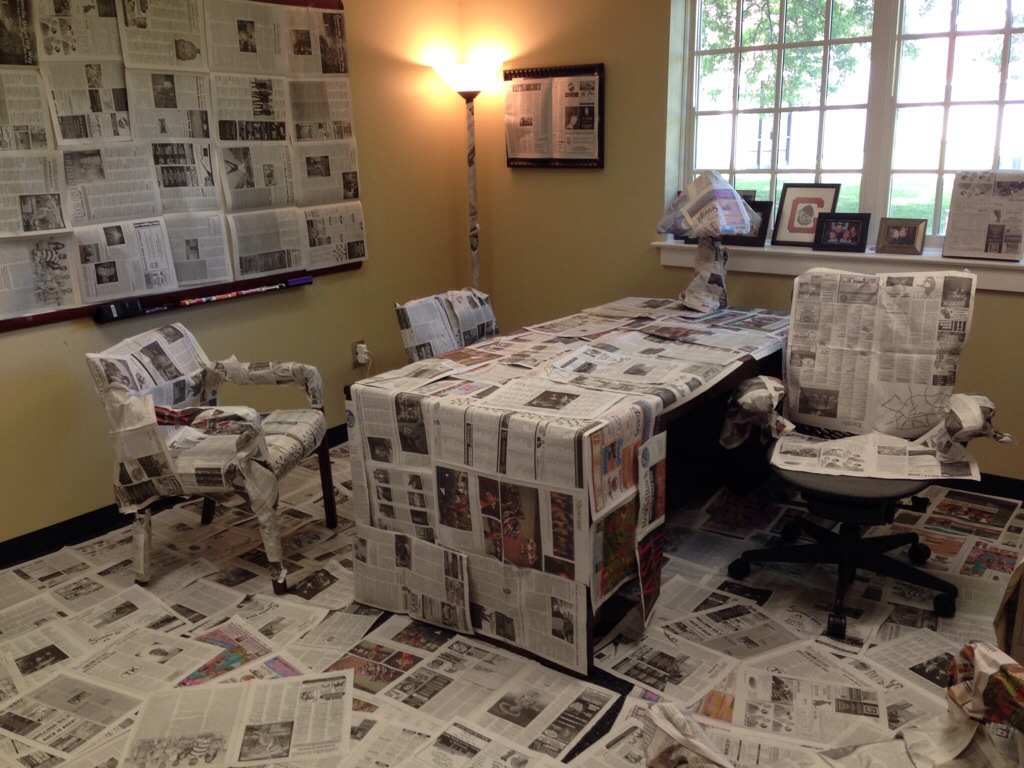
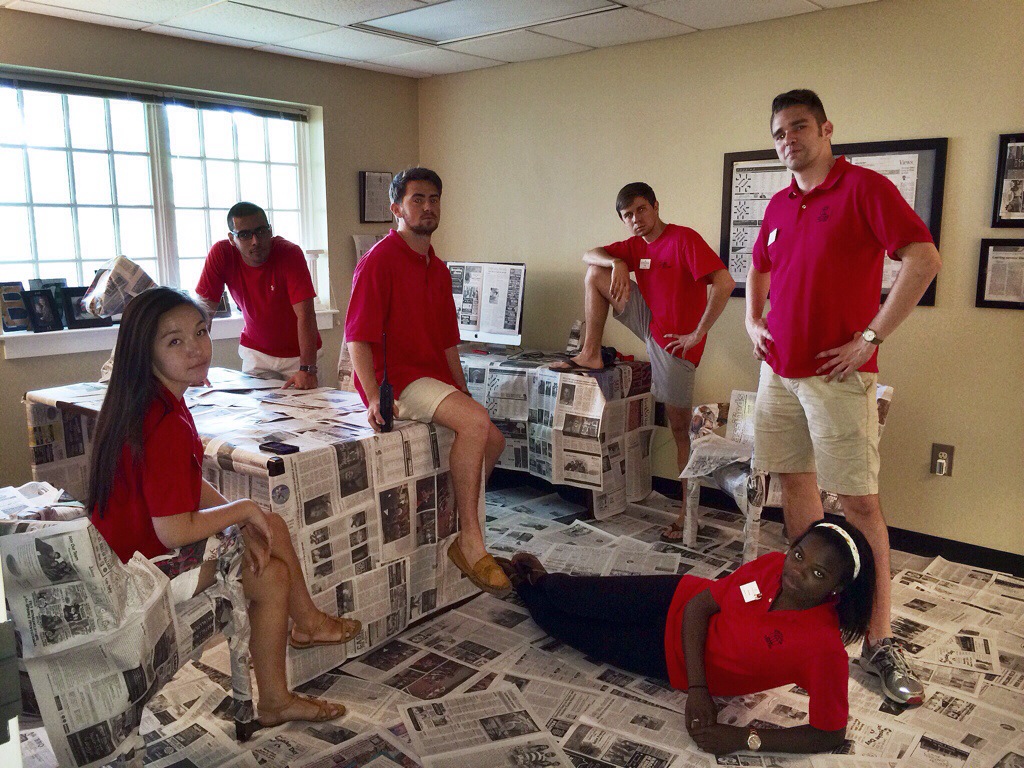
Today was my last day before a weeklong vacation (and before my birthday this weekend). When I returned from lunch I found my office door closed with a note on it wishing me a happy birthday. Opening the door revealed this:

20140606-222154-80514899.jpg

20140606-222155-80515871.jpg

Impressive work, no? My first impulsive thought, though, was “What an annoyance this will be to clean…”

Then, as I surveyed the scene, I was genuinely delighted by the meticulous attention to detail and by the fun spirit that prompted this. The two primary culprits were cautiously awaiting my response and were preparing to start removing it right away. I paused and pondered for a moment, then I said, “Don’t clean up. We’ve got to leave it. Everyone needs to see this.”

This is practically a work of art, right? And it was inspired, I know, by their genuine affection for their old-enough-to-be-their-father boss who they were counting on being a good sport. I realized this was a high honor, a prank to be thankful for.

So, while I’m away on vacation, my office will remain a newspapered tribute to not taking work too seriously.

Well played, college superstars. Well played.

20140606-223712-81432222.jpg

“Resistance”: Using fear to find your way

This afternoon I made a trip to the backyard hammock. I had survived my daughter’s 7th birthday Frozen slumber party and was looking forward to a quiet day. I picked up my old Kindle e-reader, the one with no touch screen and no apps. I usually read on my iPad mini, but reading in a hammock outside is a Kindle occasion.

The book that happened to be at the top of the list when I powered the Kindle on was Steven Pressfield’s The War of Art. Such a great read. It’s the ultimate kick in the seat of the pants for anyone who wants to get something done but who keeps not doing the thing they want to do.

Pressfield is a novelist (his Gates of Fire is terrific), but The War of Art is non-fiction and non-B.S. It’s straight talk about the battle we all face when confronted by the desire to make something meaningful or to live a nobler life. He names the force that opposes our efforts the “Resistance”. From the opening pages:

“Most of us have two lives. The life we live, and the unlived life within us. Between the two stands Resistance.”

The greats are great because they mustered the will to overcome this Resistance. The greats didn’t wait on inspiration; they put their butts in their chairs and did work, whether they felt like it or not.

Instant gratification, comfort, pleasure, pain-avoidance of any sort are all forms of Resistance. Beating Resistance is a daily undertaking. It’s not a one and done kind of battle. Pressfield encourages us, though, to use Resistance to our advantage:

“Like a magnetized needle floating on a surface of oil, Resistance will unfailingly point to true North – meaning that calling or action it most wants to stop us from doing.

We can use this. We can use it as a compass. We can navigate by Resistance, letting it guide us to that calling or action that we must follow before all others.

Rule of thumb: The more important a call or action is to our soul’s evolution, the more Resistance we will feel toward pursuing it.”

So, search yourself and explore the grand plans of your imagination. The plans for the kind of person you would like to be and the dreams of the work you want to do. Find where there is the most Resistance, those things that seem to be too much of a stretch, where the fear of action is greatest. There’s your calling. Head in that direction.

warofart

The Long Game and the patient pursuit of awesomeness

This two-part video series was inspired by one of my favorite recent books, Mastery by Robert Greene.

It takes a long time and focused effort to become an “overnight” success. Imagine being a 20-year-old whose primary focus was to peak at 60? How would such a mindset change your decisions? It’s so natural to be in a hurry, to be ambitious for success right away. But consider focusing on the “long game”, the steady, patient pursuit of awesomeness over the long arc of a life worth talking about.

via BrainPickings.org