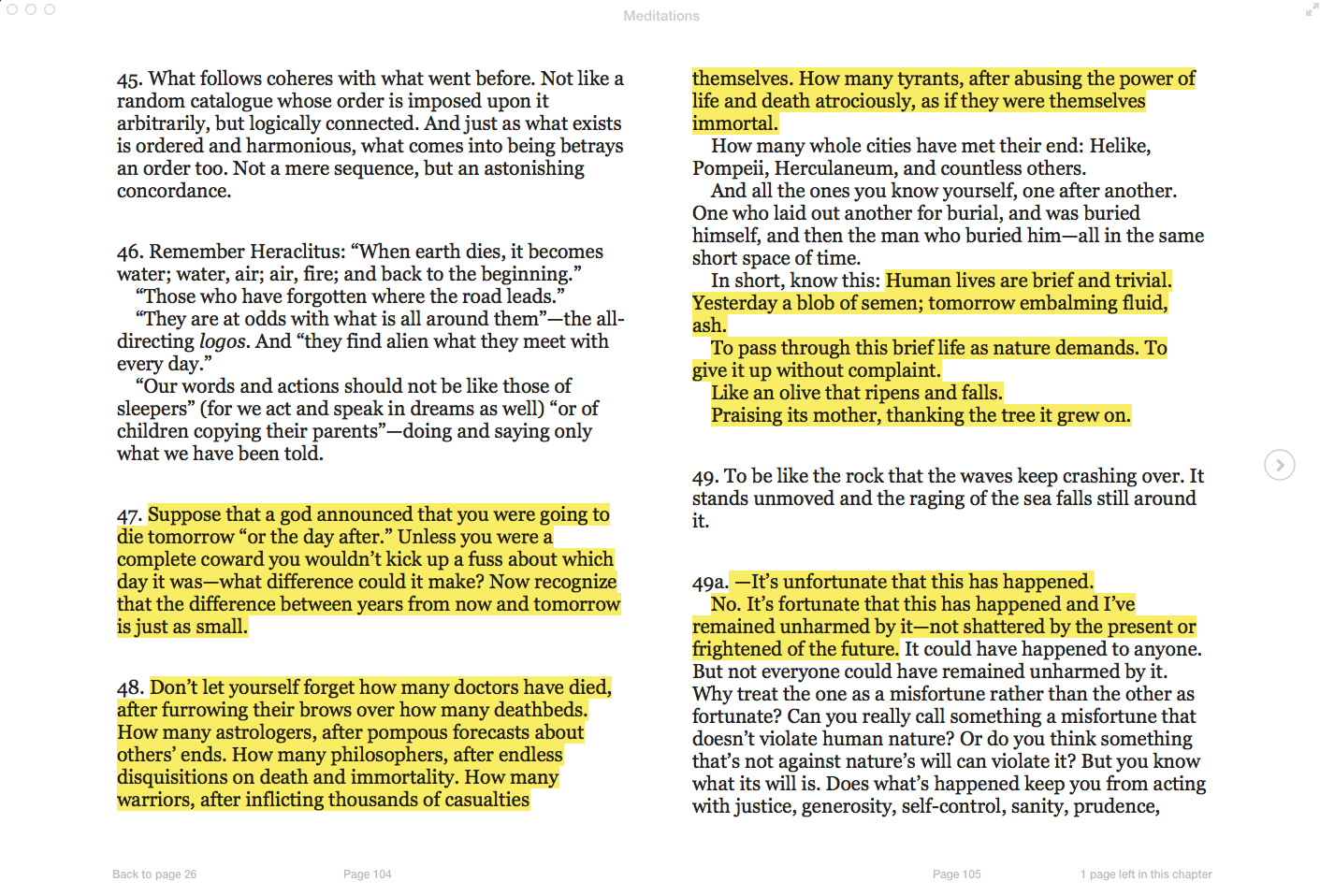
I’m rereading Marcus Aurelius’s Meditations. It’s the kind of book that you can open anywhere and find something worthwhile to ponder. My copy is filled with yellow highlights, and I marvel at his prolifically quote-worthy (and tweet-worthy) insights into the challenges of living an excellent human life.
What makes this book so remarkable, I think, is that he was not writing it for anyone but himself. He had no intent to publish what was the private diary of the most powerful man in the world. Instead of filling this journal, though, with the people and events of his life, which certainly would have been of great historical value, he instead wrote of his efforts to master his own mind and live in a virtuous, excellent way. The philosophical value more than makes up for what was lost to history.
Meditations is a sort of extended “note to self” wherein he is clearly talking only to Marcus Aurelius and chiding and encouraging and reminding himself of what should be his focus. There are sentence fragments galore. Some make no sense to me, and others are as starkly profound as anything I’ve read.
Uninhibited by what others might think, Aurelius was free to write with a remarkable rawness and candor that would be unlikely if he were writing for an audience.
This site is my attempt to somehow publicly share a sort of note-to-self journal. I keep a private journal (using Day One), and I find my writing there is not nearly as well thought out as what I post here. Being aware that someone else might read this (hello, lone reader) forces me to craft my thoughts with more care and intention.
Just as inviting people over forces you to clean up your apartment, writing something that other people will read forces you to think well. -Paul Graham
But I don’t want to come across as some pretentious expert with answers and solutions for all. I’m far from it. Yet I want the kind of candor and directness that Marcus has in writing to himself.
How to balance the authenticity a note-to-self approach with the benefits of writing for others? It’s a worthwhile challenge to attempt. Squelch the self-consciousness of being observed yet write with enough awareness of an audience to focus my thinking more sharply.
My imperative sentences are addressed to myself. “Do this…” “Think in this way…” Those are directed at me, and if a reader finds some value as well, excellent. But if I am the only person who derives any benefit from sharing my notes-to-self online, if this effort moves me just a little further along the path toward living a better life, that is excellent, too.
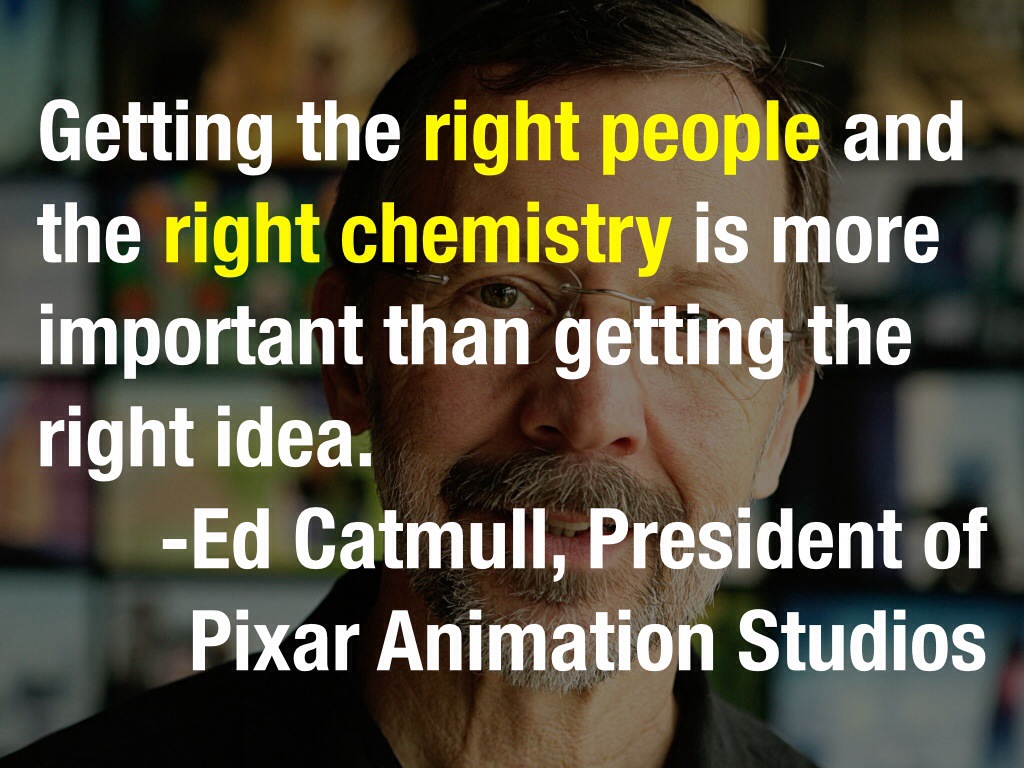
I have been reading Ed Catmull’s excellent book, Creativity, Inc. Catmull is one of Pixar’s founders and now leads both Pixar and Disney Animation. He knows plenty about running a successful organization, and his book is refreshingly unlike the typical business book. It’s humble and candid and authentic in ways most business insider books are not.
I will post later with more that I gleaned from Catmull’s compelling stories and heartfelt advice, but I completely connect with this insight about centering your priorities around people:
This is in sync with all I’ve experienced about strong organizations and great teams. Find people who fit the vision and the culture, and then tend the culture gently, get the heck out of the way, and allow your people the freedom to be awesome.
All the chasing we do after stuff and to please others and to build what we think is security for a comfortable life…
What if the greatest comfort, though, is the deep, satisfying happiness that comes from getting lost in something you love just for the thing itself? What generates genuine enthusiasm in you, not for any extrinsic rewards but for the simple joy of the pursuit, for the intrinsic rewards?
Enthusiasm in some people can seem trivial or insincere or even silly, especially when it comes across as contrived emotion worked up artificially on command like a salesman trying to make his quota or a manager in a dysfunctional bureaucracy trying vainly to rally her demoralized charges. But the real thing, genuine enthusiasm, delightful absorption, is an obvious marker that someone embarking on an excellent journey should heed. Go in that direction.
Tony Hsieh, Zappos CEO, is a visionary business leader and a crusader for the primacy of organizational culture. His excellent book, Delivering Happiness, tells the story of the creation of Zappos, a company with one of the most lauded customer service operations anywhere. Zappos has a reputation for being one of the happiest places to work, and Hsieh’s books goes into great detail about how they have cultivated the unique culture responsible for their public success and their rewarding work environment.
How would you describe the culture of your organization? Most organizations have some official mission statement posted on a corner of their web site and maybe even a statement of values, but the true culture of a place defies artificial attempts to mandate it from a PR document.
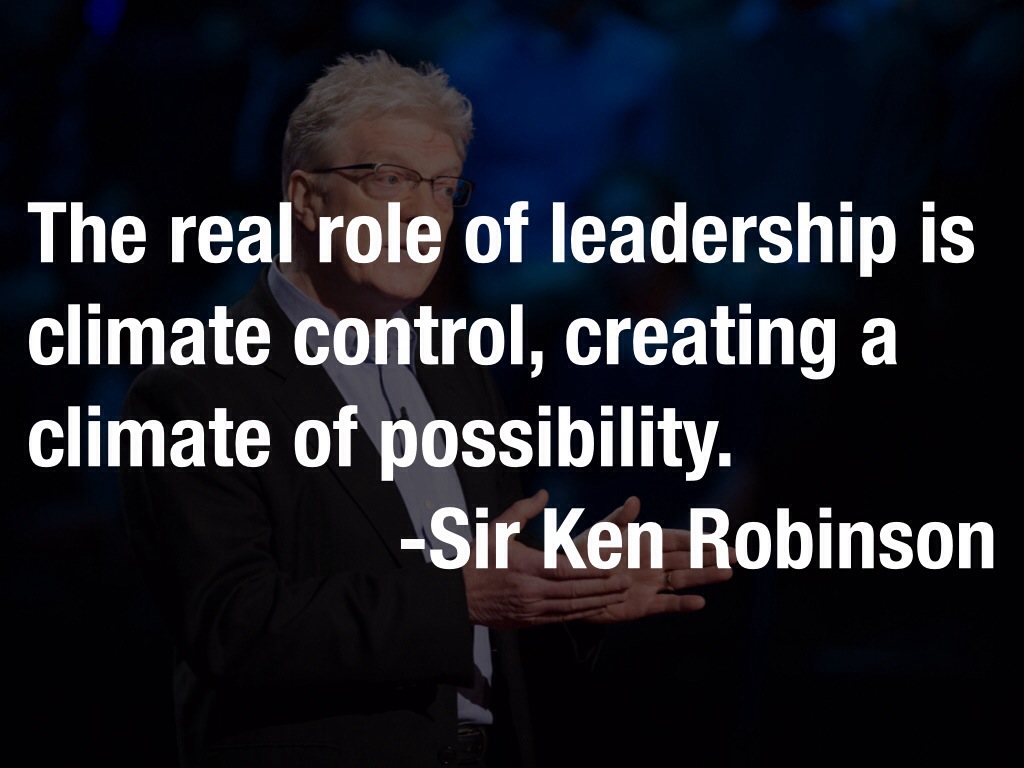
Effective leaders know that culture should be their primary focus. Create and nurture an environment that provides vision and frees each person to unleash their best work. Create a climate of possibility.
“It never ceases to amaze me: we all love ourselves more than other people, but care more about their opinion than our own. If a god appeared to us—or a wise human being, even—and prohibited us from concealing our thoughts or imagining anything without immediately shouting it out, we wouldn’t make it through a single day. That’s how much we value other people’s opinions—instead of our own.” -Marcus Aurelius, Meditations
We all are a bit crazy. Our minds are so occupied with what others may think of us, how something we do or how we look is being judged by other people. Of course, the reality is others aren’t thinking of us much at all. They are thinking of themselves and how they are being perceived by others. What a ridiculous cycle and what a waste of mental and emotional energy.
The freest people are those who have enough control of their own minds to either block out or be relatively unphased by the imagined opinions of others. Imagine what would be possible if we could free up all that space in our minds that is otherwise occupied by our concern for what other people think.
May your world be rocked every day by a moment or two of wonder, when you catch yourself fully in the present moment in awe of the beauty and mystery we all are swimming in.
Following up on my post last week about Ryan Holiday’s wise little book, The Obstacle is the Way, here’s Holiday’s recent TEDx talk on Stoic Optimism:
There are some good stories in this talk. I loved the anecdote about Edison’s factory burning down and the inventor summoning the family to come because they would never likely see such a spectacle of a fire ever again. Find the good even in the really, really bad.
Some quotations from the talk:
Nothing either good or bad, but thinking makes it so. –Shakespeare
There is good in everything if only we look for it. –Laura Ingalls Wilder
Objective judgment, now at this very moment. Unselfish action, now at this very moment. Willing acceptance – now at this very moment – of all external events. That’s all you need. –Marcus Aurelius
“Learn to ask of all actions, ‘Why are they doing that?’
Starting with your own.” -Marcus Aurelius, Meditations
Reading those lines this morning reminded me of some great Stephen Covey insights I wish I was more inclined to consistently apply in my life.
I’m paraphrasing, but Covey, author of The 7 Habits of Highly Effective People, suggested when you’re inclined to judge, stop yourself and attempt, instead, to try to understand.
“Why?” is the king of questions. And if you ask “I wonder why…?” on a regular basis, you will open yourself to possibilities and to compassion, for others and for yourself.
Asking “I wonder why that driver is driving so recklessly?” can transform you from an angry observer to a curious one. What if the driver was on the way to the hospital for an emergency? Unlikely? Sure. But just framing the question can give you pause and defuse an unhelpful emotion.
Got some bad habits or frustrating tendencies in your own life? Wonder why and you just might go a little easier on yourself while sparking the possibility for genuine understanding and possibly a breakthrough.
Instead of labeling or judging or reacting, use the gap between stimulus and response to try to understand.
Want to spark more meaningful conversations? Ask “Why?” often, not in a pestering way, but with the intent to truly understand the other.
Want a clear vision for your family or your organization or your work? Ask “Why?” and pursue the answers relentlessly.
Why not make “Why?” your go-to question, the spark for possibilities that otherwise would remain undiscovered.
“External things are not the problem. It’s your assessment of them. Which you can erase right now.
If the problem is something in your own character, who’s stopping you from setting your mind straight?
And if it’s that you’re not doing something you think you should be, why not just do it?
—But there are insuperable obstacles.
Then it’s not a problem. The cause of your inaction lies outside you.
—But how can I go on living with that undone?
Then depart, with a good conscience, as if you’d done it, embracing the obstacles too.”
“Concentrate on what you have to do. Fix your eyes on it. Remind yourself that your task is to be a good human being; remind yourself what nature demands of people. Then do it, without hesitation, and speak the truth as you see it. But with kindness. With humility. Without hypocrisy.”
I feel like I’m a decent athlete, but my tape study and my meticulous attention to detail are what make me a good ball player. -Richard Sherman
This video feature on Sherman is worth watching, even if you don’t have any interest in football. Sherman acknowledges he’s not the most athletically gifted at his position, but he’s considered maybe the best cornerback in the NFL. And it’s all because of how he prepares. He pursues his work with an obsessive attention to detail. Practice doesn’t necessarily make perfect, but thoughtful, strategic, relentless preparation can set you apart because so few, even the most gifted, pursue excellence with such focus.
I’ve written before about my appreciation of John Mayer’s artistry as a musician. I just saw this new documentary, Someday I’ll Fly, about his career and came away impressed. It’s a thorough review of how he got to mastery. Mayer narrates and offers several gems of insight throughout:
“I used to be at home in my bedroom and pretend that I was on stage, and now I’m on stage and I pretend that I’m home in my bedroom.”
…
“I want to bring my playing all the way up to the the top of ability…there are some nights my playing goes over my ability. I kind of hit that place where I’m unsure. But then I always find that I get a little further into the craft by doing that.”
…
“That craft responds to truth, and you’ve got to stay truthful. No matter how many records you’ve sold or performances you’ve played, you come home, the whirlwind stops and you go back to the craft.”
When he was a teenager Mayer was so obsessed with getting good at playing guitar that his mom had to give him a “guitar curfew”, a time he had to stop playing every night. John Mayer wasn’t born with a gift for guitar. He worked hard to become great.
It’s both comforting and convicting to know that our own levels of mastery are completely up to us. If we want to get really good at something, we only need to be willing to obsess enough to consistently devote quality time and smart effort.
I met with a group of university freshmen yesterday. They were part of a leadership program that required them to interview faculty and administrators to collect advice on how to have a great college experience.
One of the students asked which college activities I recommend. Several organizations came to mind, and I shared a list of the ones that seem to have strong reputations and offer worthwhile experiences.
But I cautioned them not to spend their college years trying to build a long and seemingly impressive resume. There’s some merit to trying a lot of activities early on. But the most remarkable students I’ve known were those who focused on depth over breadth, who invested deeply in a few activities they genuinely cared about
These college superstars invariably chose their pursuits, academic and extracurricular, for their intrinsic worth, not necessarily as a means to an end or for their potential to move them up the ladder of accomplishment. And their focus allowed them to shine in ways that those who spread themselves across more obligations did not.
Explore possibilities thoroughly and “try on” a variety of pursuits to see what might fit well. But commit to only those activities that resonate and are most worthy of your limited time. And then go be awesome there.
This is not just a strategy for college success. I need this in real world life. Do less, but do it better. I need to say “no” consistently to inessential opportunities and commitments, even noble ones, in order to give my best effort to the few, key priorities I’ve chosen to build my work and my life around.
“If you seek tranquillity, do less.” Or (more accurately) do what’s essential—what the logos of a social being requires, and in the requisite way. Which brings a double satisfaction: to do less, better.
Because most of what we say and do is not essential. If you can eliminate it, you’ll have more time, and more tranquillity. Ask yourself at every moment, “Is this necessary?”
But we need to eliminate unnecessary assumptions as well. To eliminate the unnecessary actions that follow” –Marcus Aurelius
On a day of silly pranks, how blind were we to the magnificent mysteries all around us? The unfamiliar warmth of the spring sun and the shower of blossoms floating from the trees were enough to catch me by surprise. The seasonal awakening of nature can stir us from our winter lethargy. Let’s come alive with wonder and delight.
We are walking in a wonderland every day and yet tread ploddingly, numbly along.
“It’s about awakening the mind’s attention from the lethargy of custom and the film of familiarity and redirecting it instead to the wonders of existence.” -Jason Silva
“If you do the job in a principled way, with diligence, energy and patience, if you keep yourself free of distractions, and keep the spirit inside you undamaged, as if you might have to give it back at any moment—
If you can embrace this without fear or expectation—can find fulfillment in what you’re doing now, as Nature intended, and in superhuman truthfulness (every word, every utterance)—then your life will be happy.”
It’s hard to open Meditations without finding something worth highlighting.
“Superhuman truthfulness”, now that’s a worthy aspiration.
Who are we, if not measured by our impact on others? That’s who we are! We’re not who we say we are, we’re not who we want to be — we are the sum of the influence and impact that we have, in our lives, on others. -Neil deGrasse Tyson speaking in tribute to the great Carl Sagan
via Brain Pickings
On a night when I sat with my 9-year-old to watch the new version of the Cosmos TV series, I was reminded just how overwhelmingly vast and dark and inexplicable our universe is. And how awesome it is to be alive and aware of how very little we know.
If we can shine a little light as we journey, light that just might illuminate the path of a fellow traveler, even for a mere moment, we have done something noble, something heroic.
Humans are so new to the universe and so alone as far as we can see. Our significance is not much in relation to the cosmos. But in relation to each other, we are all we have to share meaning and kindness and to make this journey worthwhile.
More wisdom from the philosopher-king, Marcus Aurelius, in his Meditations:
“Forget everything else. Keep hold of this alone and remember it: Each of us lives only now, this brief instant. The rest has been lived already, or is impossible to see. The span we live is small—small as the corner of the earth in which we live it.”
Here and now. That’s all we have. But how often do we give our attention to the present moment?
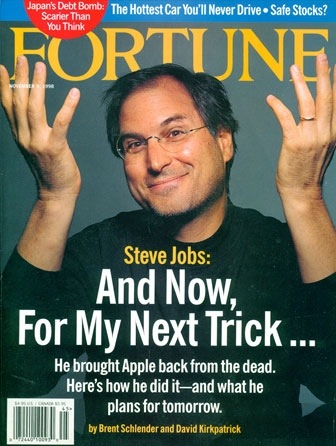
“One of my role models is Bob Dylan. As I grew up, I learned the lyrics to all his songs and watched him never stand still. If you look at the artists, if they get really good, it always occurs to them at some point that they can do this one thing for the rest of their lives, and they can be really successful to the outside world but not really be successful to themselves. That’s the moment that an artist really decides who he or she is. If they keep on risking failure, they’re still artists. Dylan and Picasso were always risking failure. This Apple thing is that way for me. I don’t want to fail, of course. But even though I didn’t know how bad things really were, I still had a lot to think about before I said yes. I had to consider the implications for Pixar, for my family, for my reputation. I decided that I didn’t really care, because this is what I want to do. If I try my best and fail, well, I’ve tried my best.” -Steve Jobs in 1998 discussing his return to Apple
Never stand still. The greats keep pushing, experimenting, reaching further. And risking failure.






 Excellent Journey