Note to self

I’m rereading Marcus Aurelius’s Meditations. It’s the kind of book that you can open anywhere and find something worthwhile to ponder. My copy is filled with yellow highlights, and I marvel at his prolifically quote-worthy (and tweet-worthy) insights into the challenges of living an excellent human life.

What makes this book so remarkable, I think, is that he was not writing it for anyone but himself. He had no intent to publish what was the private diary of the most powerful man in the world. Instead of filling this journal, though, with the people and events of his life, which certainly would have been of great historical value, he instead wrote of his efforts to master his own mind and live in a virtuous, excellent way. The philosophical value more than makes up for what was lost to history.

Meditations is a sort of extended “note to self” wherein he is clearly talking only to Marcus Aurelius and chiding and encouraging and reminding himself of what should be his focus. There are sentence fragments galore. Some make no sense to me, and others are as starkly profound as anything I’ve read.

Uninhibited by what others might think, Aurelius was free to write with a remarkable rawness and candor that would be unlikely if he were writing for an audience.

This site is my attempt to somehow publicly share a sort of note-to-self journal. I keep a private journal (using Day One), and I find my writing there is not nearly as well thought out as what I post here. Being aware that someone else might read this (hello, lone reader) forces me to craft my thoughts with more care and intention.

Just as inviting people over forces you to clean up your apartment, writing something that other people will read forces you to think well. -Paul Graham

But I don’t want to come across as some pretentious expert with answers and solutions for all. I’m far from it. Yet I want the kind of candor and directness that Marcus has in writing to himself.

How to balance the authenticity a note-to-self approach with the benefits of writing for others? It’s a worthwhile challenge to attempt. Squelch the self-consciousness of being observed yet write with enough awareness of an audience to focus my thinking more sharply.

My imperative sentences are addressed to myself. “Do this…” “Think in this way…” Those are directed at me, and if a reader finds some value as well, excellent. But if I am the only person who derives any benefit from sharing my notes-to-self online, if this effort moves me just a little further along the path toward living a better life, that is excellent, too.
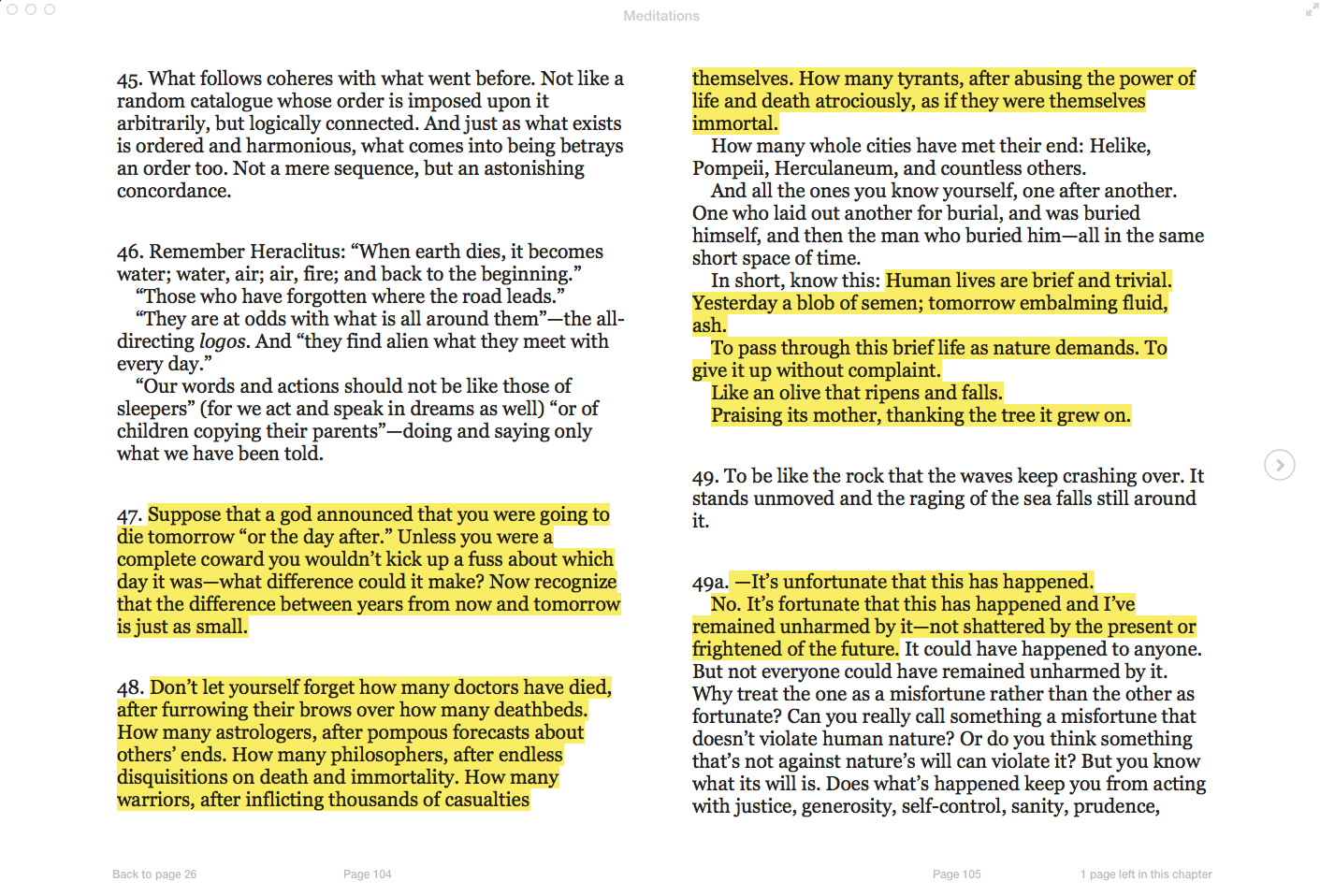
Screen Shot 2014-06-21 at 9.49.47 AM
screenshot from my copy of Meditations

“Resistance”: Using fear to find your way

This afternoon I made a trip to the backyard hammock. I had survived my daughter’s 7th birthday Frozen slumber party and was looking forward to a quiet day. I picked up my old Kindle e-reader, the one with no touch screen and no apps. I usually read on my iPad mini, but reading in a hammock outside is a Kindle occasion.

The book that happened to be at the top of the list when I powered the Kindle on was Steven Pressfield’s The War of Art. Such a great read. It’s the ultimate kick in the seat of the pants for anyone who wants to get something done but who keeps not doing the thing they want to do.

Pressfield is a novelist (his Gates of Fire is terrific), but The War of Art is non-fiction and non-B.S. It’s straight talk about the battle we all face when confronted by the desire to make something meaningful or to live a nobler life. He names the force that opposes our efforts the “Resistance”. From the opening pages:

“Most of us have two lives. The life we live, and the unlived life within us. Between the two stands Resistance.”

The greats are great because they mustered the will to overcome this Resistance. The greats didn’t wait on inspiration; they put their butts in their chairs and did work, whether they felt like it or not.

Instant gratification, comfort, pleasure, pain-avoidance of any sort are all forms of Resistance. Beating Resistance is a daily undertaking. It’s not a one and done kind of battle. Pressfield encourages us, though, to use Resistance to our advantage:

“Like a magnetized needle floating on a surface of oil, Resistance will unfailingly point to true North – meaning that calling or action it most wants to stop us from doing.

We can use this. We can use it as a compass. We can navigate by Resistance, letting it guide us to that calling or action that we must follow before all others.

Rule of thumb: The more important a call or action is to our soul’s evolution, the more Resistance we will feel toward pursuing it.”

So, search yourself and explore the grand plans of your imagination. The plans for the kind of person you would like to be and the dreams of the work you want to do. Find where there is the most Resistance, those things that seem to be too much of a stretch, where the fear of action is greatest. There’s your calling. Head in that direction.

warofart

The daily grind, the daily find

A year ago I committed myself to sharing something daily on this site. It didn’t have to be a well composed, lengthy essay about weighty matters. It could have been something small I had found or something I was trying to learn more about. I was fine with reaching the end of a night and simply posting a quotation or link just to fulfill my commitment to sharing something every day.

Often, that attempt to post some small item led to more searching and insight than I had expected. And I loved surprising myself with unanticipated output, with creative pursuits that wouldn’t have been given a chance except for my humble attempt to find just one little thing to share every day, to keep that commitment. I had a blast and looked forward to what would surprise me each day.

I kept that commitment for several months and felt, eventually, like I had accomplished a goal and could go back to posting sporadically. My posting was feeling more like a daily grind, a burden to come up with something worth sharing.

I realize now that I miss trying to fulfill the daily writing commitment. My life seemed clearer, more intentional when I had this tiny task every day. My brain was on a regular search to find something worth writing about. I’m reminded of Leo Buscaglia whose childhood was enriched by a father who expected every kid in the family to share at dinner each night something new they learned that day. Leo said he often would rush to the encyclopedias right before dinner, desperate to find something worth sharing.

The quest to better understand and better experience life is speeded along by an effort to express, to articulate, to share.

I don’t presume to have an audience (thank you lone reader, this one’s for you), but my target audience is myself. I write to know myself better, to figure things out, to see what I have to say. To write the internet I would enjoy reading. Secondarily, I write to my young daughters, who have no interest now in any of this. But, maybe someday they will find some value buried in here.

Even if I’m writing for myself alone, I owe it to myself to be as awesome as I can be. Sharing every day will produce a lot of bad writing and banal ideas. But bad could lead to okay. And okay might eventually produce something pretty good. The road to awesome is paved with a whole lot of mediocre, but mediocre action is better than no action.

So, brace yourself, lone reader. I’m back to the daily grind.

Inspiration is for amateurs

An Austin Kleon interview led me to this Brain Pickings post with this from painter Chuck Close:

“Inspiration is for amateurs — the rest of us just show up and get to work. And the belief that things will grow out of the activity itself and that you will — through work — bump into other possibilities and kick open other doors that you would never have dreamt of if you were just sitting around looking for a great ‘art idea.’ And the belief that process, in a sense, is liberating and that you don’t have to reinvent the wheel every day. Today, you know what you’ll do, you could be doing what you were doing yesterday, and tomorrow you are gonna do what you did today, and at least for a certain period of time you can just work. If you hang in there, you will get somewhere.” -Chuck Close

I’m still trying to learn this. Too often I’m waiting for the right mood, for an idea to grab me before getting busy making something.

I need to “just show up and get to work” every day and maybe working will lead to me grabbing an idea rather than the other way around. And if I do nothing but bad work, it’s better than no work. And bad work just might lead to something that’s kind of good. You can’t get to great without starting somewhere. Starting is the essential thing.

I keep coming back to Gretchen Rubin‘s starkly simple reminder from the potent little book on work habits, Manage Your Day-to-Day:

20131001-112815.jpg

Neil Gaiman’s main rule of writing

From Neil Gaiman’s 8 Rules of Writing:

“The main rule of writing is that if you do it with enough assurance and confidence, you’re allowed to do whatever you like. (That may be a rule for life as well as for writing. But it’s definitely true for writing.) So write your story as it needs to be written. Write it ­honestly, and tell it as best you can. I’m not sure that there are any other rules. Not ones that matter.” -Neil Gaiman

“Write as if you were dying.”

Brain Pickings is as prolifically wise and challenging and enlightening as any site on the internet. Hooray for it’s creator, Maria Popova! It’s worthwhile to subscribe to her free weekly email newsletter so you don’t miss out.

I found this post about Annie Dillard’s book, The Writing Life, in yesterday’s newsletter. I have the paperback version of the book, but I’ve never read it. I will remedy that now that I’ve read the book excerpts highlighted in the post.

This passage is a powerful reminder of why we create and how our mortality, and that of our audience, should inform our work:

“Write as if you were dying. At the same time, assume you write for an audience consisting solely of terminal patients. That is, after all, the case. What would you begin writing if you knew you would die soon? What could you say to a dying person that would not enrage by its triviality?

[…]

Why are we reading if not in hope that the writer will magnify and dramatize our days, will illuminate and inspire us with wisdom, courage, and the possibility of meaningfulness, and will press upon our minds the deepest mysteries, so we may feel again their majesty and power? What do we ever know that is higher than that power which, from time to time, seizes our lives, and reveals us startlingly to ourselves as creatures set down here bewildered? Why does death so catch us by surprise, and why love? We still and always want waking.” -Annie Dillard from The Writing Life

Wow.

Consider yourself and everyone else, for that matter, to be terminal. It is true. And living and thinking in the light of dying should add perspective and meaning that we would otherwise shut our eyes to.

I often imagine that my audience is just my two young daughters who will read this as adults, maybe after I’m gone. Thinking like that can’t help but shape my words and shame me away from pettiness and silliness.

We should not get lost in fretting over our mortality and miss out on actually living. But summoning the ultimate and embracing our impermanence are crucial to writing anything or making anything that lets us touch immortality.

anniedillard_thewritinglife