The joy of Monday. A new week. A chance to begin again, to rethink and give it another go.
It’s the delight of an empty sheet of paper, a blank screen, a freshly erased whiteboard. The possibilities are unlimited, right?
The joy of Monday. A new week. A chance to begin again, to rethink and give it another go.
It’s the delight of an empty sheet of paper, a blank screen, a freshly erased whiteboard. The possibilities are unlimited, right?
“But I do think that we sense when somebody has cared. And one thing that is incontrovertible is how much we’ve cared.” -Jony Ive, Apple’s design visionary on the Apple way.
It certainly seems that those people and organizations that really care are the ones worth talking about.
Most encounters are marked by the kind of caring that is just enough to not get someone in trouble or to avoid awkwardness. How remarkable when the level of caring is striking, when someone sweats the details and puts in extraordinary effort, even if there’s no obvious extrinsic reward.
Care more. Be more awesome.
“One of my role models is Bob Dylan. As I grew up, I learned the lyrics to all his songs and watched him never stand still. If you look at the artists, if they get really good, it always occurs to them at some point that they can do this one thing for the rest of their lives, and they can be really successful to the outside world but not really be successful to themselves. That’s the moment that an artist really decides who he or she is. If they keep on risking failure, they’re still artists. Dylan and Picasso were always risking failure. This Apple thing is that way for me. I don’t want to fail, of course. But even though I didn’t know how bad things really were, I still had a lot to think about before I said yes. I had to consider the implications for Pixar, for my family, for my reputation. I decided that I didn’t really care, because this is what I want to do. If I try my best and fail, well, I’ve tried my best.” -Steve Jobs in 1998 discussing his return to Apple
Never stand still. The greats keep pushing, experimenting, reaching further. And risking failure.
ESPN has a terrific Ivan Maisel story on their web site about the late, great Alabama football coach Bear Bryant.
Coach Bryant was born on this date 100 years ago and is easily the most iconic college football coach ever. The houndstooth hat, the affably gruff toughness, and all those championships make him stand out from his peers in the profession.
He was famous for pushing his players hard, for demanding more than was thought possible. But his high expectations and relentless pursuit of excellence paid off with six national titles for his teams. David Cutcliffe, Duke’s current head coach, worked for Coach Bryant:
Cutcliffe said what sticks in his mind is Bryant’s reasoning for pushing his coaches and players so hard.
“He used to say, ‘You can’t tell how a mule will pull until you hook it up to a heavy load,'” Cutcliffe said.
Championships are won in practice, and mastery and excellence are forged by taking on hard things, refining and tweaking, pushing to failure, and overcoming.
Bryant didn’t win his first national title until his sixteenth season as a head coach. You can bet the fifteen years before were filled with hard work and disappointment and discarded strategies and incremental improvements that didn’t make headlines. All of that made him into the championship coach he became.
John Wooden, the iconic basketball coach who is just as legendary for his attention to detail and commitment to continuous improvement, didn’t win the first of his ten national titles until his seventeenth season as a head coach.
Being awesome is not typically an overnight endeavor.

“If everyone had the luxury to pursue a life of exactly what they love, we would all be ranked as visionary and brilliant. … If you got to spend every day of your life doing what you love, you can’t help but be the best in the world at that. And you get to smile every day for doing so. And you’ll be working at it almost to the exclusion of personal hygiene, and your friends are knocking on your door, saying, ‘Don’t you need a vacation?!,’ and you don’t even know what the word ‘vacation’ means because what you’re doing is what you want to do and a vacation from that is anything but a vacation — that’s the state of mind of somebody who’s doing what others might call visionary and brilliant.” -Neil DeGrasse Tyson
via Brain Pickings
Another lovely video from Jason Silva, this one about creative absorption and flow:
Love the intro quotation:
“Happiness is absorption.” -T.E. Lawrence
Getting lost in a video game or a movie or a novel is delightful, but getting lost in creative imaginings and work that compels and pulls you along to the point where all else falls away, where time is compressed, that’s transcendent. And blissful.
It’s easy to assume you’ve got to wait for those moments of flow to somehow strike. But my experience is that you’ve got to do your part to meet flow along the path.
Just start, even if you’re not feeling it, especially if you’re not feeling it. Tackle the blank page with words, even awkward, awful ones.
Terrible is better than nothing, and opening the door of possibility just a bit can be enough to get something better flowing.
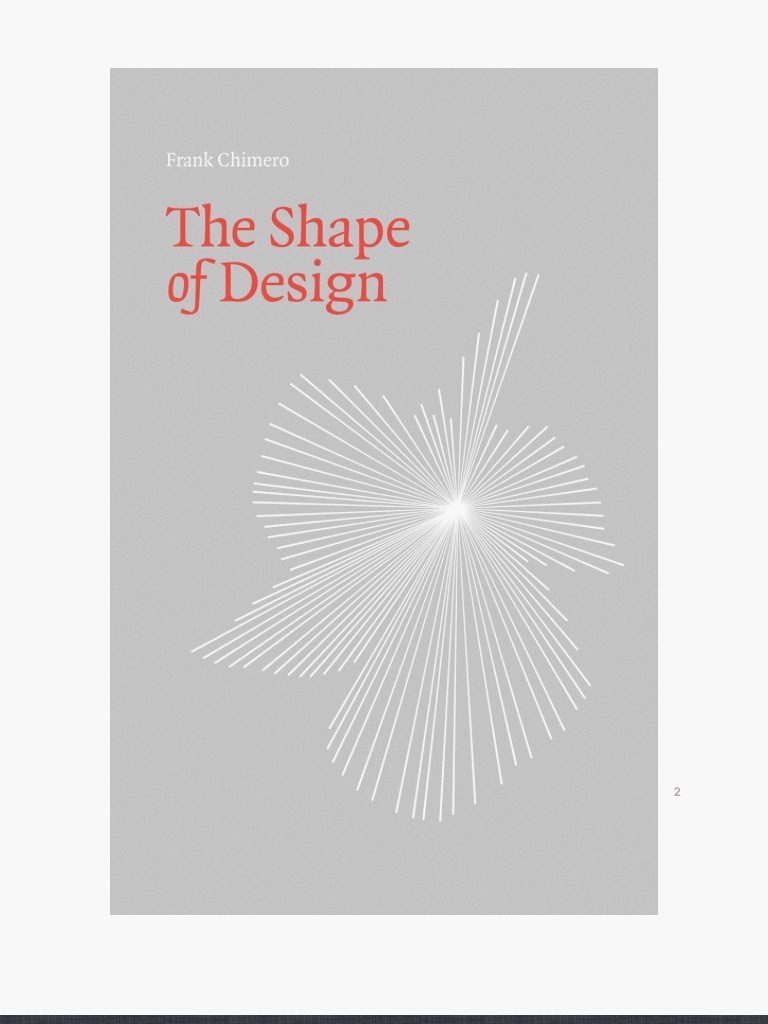
“Not enough love.” That was the response from Frank Chimero’s design professor after looking through some of his work.
“My work was flat, because it was missing the spark that comes from creating something you believe in for someone you care about. This is the source of the highest craft, because an affection for the audience produces the care necessary to make the work well.”
…
“The work has enough love when enthusiasm transfers from the maker to the audience and bonds them.”
This is from Chimero’s excellent book, The Shape of Design. The passage above reminds me of Tolstoy’s claim that “Art is infection.” An artist, a teacher, a maker of any sort, has an idea or feeling and wants to share it. It’s effective, it’s art, when the audience gets that very same feeling or sees that idea just as the maker did.
You’ve got to care enough about your work and those you serve – an audience, a customer, a student – that you fill your work with all the love you can, with care and attention to detail and enthusiasm.
When I write, I often imagine my audience to be my young daughters reading this many years from now, maybe even after I’m gone. Don’t you know that informs my efforts. When I lose sight of my ultimate audience, it’s easy to lapse into just going through the motions. Then flatness abounds.
What if we examined all our work in this light? What gift can we offer to our audiences? Our colleagues or customers? Our families? Are we putting enough love into our labors?
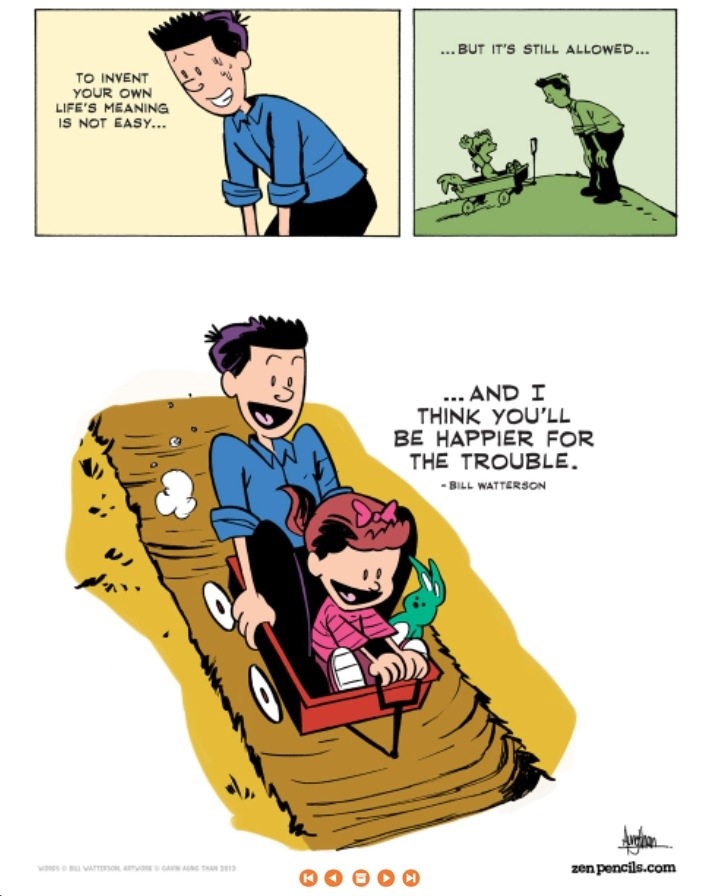
This Zen Pencils cartoon won the Internet this week.
It’s a lovely tribute to Bill Watterson, the amazing and enigmatic creator of Calvin and Hobbes, and it’s a profound exhortation to live an excellent, authentic life.
Click through, read, and enjoy. And then get lost in Zen Pencils. The creator, Gavin Aung Than, is doing beautiful work, mixing cartooning with life wisdom, and he is living the story he’s telling in this Watterson tribute. He abandoned the conventional career path and is making his own way. And using his talent to help awaken possibilities in others.
More about Watterson’s Kenyon College commencement speech, on which the Zen Pencils cartoon is based, is over on Brain Pickings. I love this part about playfulness and creativity:
It’s surprising how hard we’ll work when the work is done just for ourselves. And with all due respect to John Stuart Mill, maybe utilitarianism is overrated. If I’ve learned one thing from being a cartoonist, it’s how important playing is to creativity and happiness. My job is essentially to come up with 365 ideas a year.
If you ever want to find out just how uninteresting you really are, get a job where the quality and frequency of your thoughts determine your livelihood. I’ve found that the only way I can keep writing every day, year after year, is to let my mind wander into new territories. To do that, I’ve had to cultivate a kind of mental playfulness.
[…]
At school, new ideas are thrust at you every day. Out in the world, you’ll have to find the inner motivation to search for new ideas on your own. With any luck at all, you’ll never need to take an idea and squeeze a punchline out of it, but as bright, creative people, you’ll be called upon to generate ideas and solutions all your lives. Letting your mind play is the best way to solve problems.
[…]
A playful mind is inquisitive, and learning is fun. If you indulge your natural curiosity and retain a sense of fun in new experience, I think you’ll find it functions as a sort of shock absorber for the bumpy road ahead.
I’m inspired to go dig out my old Calvin and Hobbes collections and share with my daughters. And to play more.
Kottke linked to science writer Robert Krulwich’s 2011 commencement speech at Berkeley Journalism School.
His message is to aspiring journalists, but it works for most anyone exploring the new world of work. Here’s the heart of his message:
“Suppose, instead of waiting for a job offer from the New Yorker, suppose next month, you go to your living room, sit down, and just do what you love to do. If you write, you write. You write a blog. If you shoot, find a friend, someone you know and like, and the two of you write a script. You make something. No one will pay you. No one will care, No one will notice, except of course you and the people you’re doing it with. But then you publish, you put it on line, which these days is totally doable, and then… you do it again.
…think about getting together with friends that you admire, or envy. Think about entrepeneuring. Think about NOT waiting for a company to call you up. Think about not giving your heart to a bunch of adults you don’t know. Think about horizontal loyalty. Think about turning to people you already know, who are your friends, or friends of their friends and making something that makes sense to you together, that is as beautiful or as true as you can make it.”
Your dream job is less likely than ever to be “out there”. What if you just started making and doing and acting like who you want to be? You don’t need permission. You don’t have to wait to be discovered or to climb the ladder.
There are fewer guarantees, fewer safe careers, but so many more possibilities.
Herbert Lui has a post on Medium, Why Quantity Should be Your Priority, that fits nicely with what I’ve been learning about practice.
Don’t get too hung up initially on polishing your work to perfection. Instead, focus on cranking out as much as you can. Doing something often will lead to doing it well.
“…quantity should be a higher priority than quality, because it leads to higher quality. The shorter path to maximized quality is in maximized quantity, and executing on the feedback after each finished product.” -Herbert Lui
I’m fascinated by Shinji, who is considered the “most graceful” swimmer in the world. He didn’t start swimming regularly until he was in his late 30’s, and now the YouTube video of his swimming is the most popular swimming video on the Internet, more popular than Michael Phelps’s videos.
How did an average guy with a job and a family get so good? He practiced. A lot.
“I made it my goal to become the ‘most graceful swimmer in the world.’ Whenever I was in Japan I spent 3 to 4 hours in the endless pool, usually from 10PM to 2AM, four days a week, recording my swim, analyzing it frame by frame, finding and fixing small flaws, one by one.” -Shinji
This is a great example of deep practice, where you work to your potential, bump up against your current limits, and keep going till you improve and move to a higher level.
Here’s that most-watched swim video by Shinji, demonstrating the quality that comes from well focused quantity:
Cal Newport, author of So Good They Can’t Ignore You, shared this story on his blog about a 15-year-old who followed an interest (not even a passion) with consistent, daily action and just a bit of audacity and had remarkable success.
You don’t have to be amazingly gifted to stand out, to make a difference. You will stand out just by showing up regularly and taking action. That’s exceptional and worth talking about because so few people actually do anything beyond talking.
Farnam Street has a post today, Complexity and the Ten-Thousand-Hour-Rule, that explores the conversation about innate talent and preparation. Is it hard work that makes the difference, or is it something you’ve just got, something you’re born with that ultimately determines achievement?
We all have differing levels of innate ability, physically and mentally, and different temperaments. But focus and drive and grit count for more than can be easily measured. Imagine the countless would-be masters throughout history, people with the talent to be world class, who didn’t put in the effort, who didn’t persevere through difficulty and failure to become remarkable at something.
If you’ve got some talent, good for you. Now, figure out how to be awesome and get to work.
I’m creating a presentation for our student staff for our annual fall kickoff event this Saturday. It’s a half-day retreat/workshop to get our team reconnected with each other and to our mission as we begin a new school year. This is easily one of my favorite work days of the year.
We’ve got our agenda set, and now I just need to finalize my opening presentation. I’ve had ideas about this for a couple of months, and I’ve dumped slides into a Keynote document throughout the summer. But I’ve only just this week begun putting it together and sorting through the ideas. I discard, rearrange, tweak, and fine tune the ideas to get to some sort of narrative flow. I want to take the audience on a journey from “Why?” to “How?” and spark action.
I borrow ideas and slides from other talks I’ve done recently. Key themes seem to pop up in my life every year, and I stick with them even across different presentations and formats and audiences.
Below is a screen shot from Keynote showing my “light table” view. I live in this view when I’m working on a presentation. It’s such a great way to see everything at once and put some order to what otherwise would be a choppy, disconnected collection of ideas. Not everything on a slide is meant to be projected. At this point in the process, I use slides like note cards.

I had been dragging my feet on this all week, but something clicked this afternoon when I plunged in and started working on it. I got into a flow and ideas and connections started clicking. That state, when time falls away and focus is sharp, is a delight. And it’s when my best work gets done.
Flow seems to follow action rather than the other way around. Waiting for the state to somehow arrive is futile in most cases. Action does not always lead to flow, but it’s the only way I know to attempt to summon it.
“Why?” is the children’s question that we too often grow out of asking. I suppose kids get shushed enough or stump their elders to frustration so often that it becomes uncomfortable to keep asking it.
But we ought to ask Why regularly. Ask our bosses our elders our leaders our peers and kindred spirits.
“Why exactly do we do this or do it this way…?”
“Can you remind me again what we’re hoping to accomplish?”
“Why do we exist as an organization?”
“Why, again, are we meeting? What’s the purpose, the desired outcome?”
“What are we about?”
If it’s asked with sincerity, snark-free, the Why question just might spark a fresh perspective that clarifies everything, that cuts through the clutter and distraction.
We tend to default to How before ever even asking Why.
Peter Drucker said: “Management is doing things right. Leadership is doing the right things.”
Answering How questions is crucial to “doing things right”, but it’s Why that will make sure you’re doing the “right things”.
A genuine answer to the Why might be painful, might make the effort moot. But it would be better to abandon and redirect toward a more meaningful Why, right?
Embrace the Why like a relentless 5-year-old with a curiosity problem. Figure out the Why then follow the How to previously unimagined possibilities.
Today was “meet the teachers” day at my kids’ school. Tomorrow is the last day of summer break. Rather than being sad, my girls are excited. (For now…)
A new school year is a new beginning. New teachers. Different classmates. New possibilities. I remember the little thrill even of picking out school supplies.
“In the beginner’s mind there are many possibilities. In the expert’s mind there are few.” -Shunryu Suzuki
In the real world we lose a bit of that built-in reset each year that comes with the academic calendar. A regular reset, a return to a beginner mindset can rejuvenate and awaken.
It’s worth manufacturing an opportunity regularly to rethink your work and your personal or family life every three or four months, or at least a couple of times a year. A retreat, an event, a built in breather to assess and plan and dream. Discard old habits, try new ones, and imagine some “what ifs” that just might change everything.
Cal Newport has a post today about Woody Allen’s prolific productivity. The man is a movie making machine, having written and directed 44 movies in 44 years.
Allen works a few hours every day on what he considers his most worthwhile effort: writing. Like Jerry Seinfeld, he’s committed to sitting down day after day to make something. A little bit of quality effort done consistently over time can produce something of great value.
It can seem overwhelming to consider getting from where you are now – in a project or a dream or your life – to where you want to go. But if, instead, you just take a little bit of action, and do it every day, you might surprise yourself with what you can do or become. Do your work, the work you think is most valuable, and do it daily. It might sneak up on you, but awesome is usually not an overnight sensation.

I’m off for the next six days to celebrate the end of summer with my kids. We’ve got no set plan. Yet.
But they go back to school next Wednesday, so we are going to make like Phineas and Ferb and come up with fun adventures each day until then. If you don’t know Phineas and Ferb, it’s one of the few kid TV shows I genuinely enjoy watching with my girls. It’s clever and big hearted. Phineas and Ferb are all about getting the most out of their summer, and each day they dive into remarkable adventures. Every episode begins with the sparking of a fun idea, and Phineas proclaiming, “I know what we’re going to do today!”
Imagine if every day you had an adventure worth talking about.

John Mayer is among my favorite performers. He broke onto the scene seeming like he might just be another pop sensation, but he has become quite the soulful virtuoso with thoughtful music that keeps evolving.
I’ve been wearing out his latest album, Born and Raised, which has a 70’s, Eagles kind of vibe to it. I appreciate that his music is not predictable and formulaic. And he does, too.
His fabulous live performance in Los Angeles in December 2007 was made into a concert film, Where The Light Is. The whole thing is available on YouTube now. He does three different performances during the concert. He opens with a solo acoustic set. Then he changes clothes and comes back to the stage with his blues band for a blues concert. Finally, he returns to the stage with his full touring band to wrap up the night.
He keeps stretching his musical chops, trying on different styles and formats. It would be easy for a guy who hit it big at such a young age to just stick with what brought him his success. He could phone it in for decades and play the same kind of stuff to big crowds of loyal fans. But, instead, he’s taking risks and going in directions that his fans may not want to follow.
He says this at the beginning of the “Where the light is” concert film:
“It’s only fun when you’re trying to get it in your grasp. It’s like, you know, once you catch it, throw it back in the water then catch it again. That’s really what I want to do my whole career.”
A good reminder for anyone who realizes it’s about the journey rather than the destination.
A close friend visited recently. He worked for me almost ten years ago when he was an undergraduate. His late father had been my professor when I was an undergraduate.
I told him the story of how his father continues to influence me. He was a well respected professor, and I ended up taking two or three of his classes. I never sought him out to build a genuine friendship with him. I, regrettably, never did that with any of my instructors, not wanting to seem like I was sucking up and not wanting to be a bother.
(College students: Don’t do as I did. Get to know your teachers. Seek out the good ones, and find a mentor or two each year you’re in school.)
However, as I told my friend, I wrote an essay for an assignment in his father’s class. He later returned it to me with a big red “A” at the top. Always a nice sight. And he wrote a note on it that said something like “You should consider becoming a writer. You’ve got some talent.”
Twain said, “I can live for two months off a good compliment.” Twain understates. That compliment and encouragement from my professor still motivates me, almost three decades later. Writing has been a part of my career from day one of my first job. And when I lose focus and am feeling a bit lost in my work, that short line of encouragement written on a college homework assignment reminds me of a skill I need to return to and nurture.
After sharing this story with my professor’s son, he told me that he is now pursuing comedy and improv on the side and remembers me encouraging him when he was a student to stick with his talent for comedy. I had paid forward the father’s gift without being conscious of it.
Never underestimate the power of a genuine compliment, an acknowledgement of someone’s talent, even if, especially if, that talent is unrefined or just barely glimmering. Don’t hold back when you see something in someone that ought to be nurtured. Master the art of giving encouragement. Be specific and clear. Write a note. Seek them out in person. Just say it.
I need to be more intentional about this with my own family and with the people I work with. I’m surrounded by such big-hearted, talented people, and they need to be told regularly not only how awesome they are in general but specifically what I see that is remarkable in them.
Hopefully, receiving that kind of encouragement will spark the desire to pass it along to others. Appreciate when you receive words of encouragement, and then say it forward.
If you’re just getting started in the work world, I recommend finding work in a small shop instead of a large organization.
My first job was on Capitol Hill working for a member of the U.S. House of Representatives. I had the good fortune of working for a truly kind and smart man who cared about his employees and his responsibility to his constituents. He served as an excellent mentor, which is clutch to find early on in your work life. (If you’re choosing between job options, go for the one that offers the best potential for finding a great mentor. Pay and benefits and prestige and even the level of responsibility in your job pale compared to the quality of leadership in an organization as you’re searching for a good fit early in your career.)
Members of the U.S. House have relatively small staffs. There were just around ten of us in the D.C. office when I was there. And, because there were so few of us, we all got to know the boss well, and we all got to do a little bit of everything. My peers who worked for U.S. Senators had a completely different experience. Senate staffs are much larger because the Senator represents a whole state. Many of the Senate staffers I knew had never even had a substantive conversation with their boss. One Senator famously instructed his staff to keep their hands in their pockets as he greeted guests at receptions so he would know they were his employee and not be embarrassed by introducing himself publicly to his own staff member. And Senate staffers had narrower fields of expertise and more clearly defined daily tasks because there were so many in their office.
While it might have seemed more prestigious to work on the Senate side, only a handful of staffers in each office got the quality of experience that everyone on a House member’s staff did. If you do work in a big organization, you may have to be more intentional about getting your hands on projects that interest you and connecting with potential mentors.*
One way to guarantee substantive work no matter where you end up is to create your own side hustle. Set up you own little business or create a web site or publish your own book or make that film you’ve been imagining. That’s the ultimate small shop, and you can’t help but learn a lot by trying to bring a project to life by yourself.
*Orbiting The Giant Hairball is a terrific book for anyone trying to thrive creatively in a large, bureaucratic organization. The author was a creative maverick at Hallmark Cards and shares wonderful insights about navigating big companies with your soul intact.
 Excellent Journey