Beginner’s mind

Today was “meet the teachers” day at my kids’ school. Tomorrow is the last day of summer break. Rather than being sad, my girls are excited. (For now…)

A new school year is a new beginning. New teachers. Different classmates. New possibilities. I remember the little thrill even of picking out school supplies.

“In the beginner’s mind there are many possibilities. In the expert’s mind there are few.” -Shunryu Suzuki

In the real world we lose a bit of that built-in reset each year that comes with the academic calendar. A regular reset, a return to a beginner mindset can rejuvenate and awaken.

It’s worth manufacturing an opportunity regularly to rethink your work and your personal or family life every three or four months, or at least a couple of times a year. A retreat, an event, a built in breather to assess and plan and dream. Discard old habits, try new ones, and imagine some “what ifs” that just might change everything.

On kindness

I just read this lovely, short speech by author George Saunders. He’s addressing the Syracuse University class of 2013 and avoids the typical exhortations and conventional tips on how to be successful. Instead, he discusses his greatest regret: failures of kindness.

“What I regret most in my life are failures of kindness.

Those moments when another human being was there, in front of me, suffering, and I responded…sensibly. Reservedly. Mildly.

Or, to look at it from the other end of the telescope: Who, in your life, do you remember most fondly, with the most undeniable feelings of warmth?

Those who were kindest to you, I bet.

It’s a little facile, maybe, and certainly hard to implement, but I’d say, as a goal in life, you could do worse than: Try to be kinder.” -George Saunders

Go read the whole speech. It’s short, and it’s sweet in the noblest way. And it rings true with me. Moments of regret in my life are almost exclusively a failure to be courageous with kindness. A missed opportunity to encourage, to protect, to listen to someone in their moment of sadness or pain or embarrassment.

We focus too much on “success” and productivity and achievement, but a truly good life is marked by kindness, don’t you think?

After my mom passed away, there was a line of people waiting outside the funeral home for hours just to pay their respect. I was in awe. They didn’t stand in line, though, because of her success in business or leadership in the community or any major accomplishment. They were there because she was remarkably kind, and they had countless stories to tell about her compassion and big heart. I witnessed it all my life, of course.

I vividly remember tiny moments where she pursued opportunities to be kind. A little red-haired boy that she didn’t even know was in tears on a field after a children’s soccer match, and it was my mom who sought him out with a hug and an encouraging word. She would light up with a genuine smile when an acquaintance or stranger walked in to my parents’ photography studio. She listened wholeheartedly. The twinkle in her eyes let you know you were special, that you had her complete attention. People loved the way she made them feel.

She lived a truly great, and too short, life. Kindness may not make headlines, but it makes for a life with few regrets and a legacy marked by the abundant admiration and appreciation of those fortunate to have been warmed by its glow.

Be kind. Be intentional about it. Make it your craft, your calling, your legacy.

h/t Jesse Thorn, Put This On

A self-portrait from 900 million miles away

I saw this great photo today of Earth taken from Cassini, the spacecraft orbiting Saturn:

Earth from Cassini

Earth is the blue dot just under the rings of Saturn. This is a self-portrait from 900 million miles away.

Our home is just another smudge of light in space. It looks so small and fragile and not so impressive from this vantage point. But it’s our home and our smudge, and it’s glorious.

I keep coming back to the big picture to put my own little picture into context and give it meaning. Humans have gone from hunter-gatherers to cosmic explorers in a blink of time. Your problems got you down? They’re not so big after all when you change your vantage point.

Seeing this image made me search for Carl Sagan’s famous ode to our “pale blue dot”, as he calls the image of Earth in a similar photo from many years ago.

Here’s a lovely video with Sagan reading his famous prose reflecting on what a precious home we have:

The power of awe, as in awe-some

This:

I’ve just discovered the work of Jason Silva, a sort of spoken-word philosopher who has created mind-shifting, eye-opening videos like the one above.

We do need regular doses of awe, reminders of how grand and overwhelmingly incomprehensible this universe is and what a kick it is that we are not just in it, but we’re aware that we’re in it and can wonder and ponder and imagine.

The big picture is really, really big. We are really, really small.

But just big enough to see and to dream.

Leo Buscaglia: Learn every day

The late, great Leo Buscaglia was a dynamic whirlwind of positive energy. He was a professor at USC and became famous on campus for teaching a non-credit class about love that would overflow the lecture hall with standing room only for the crowd of interested students. He wrote several books and took his wisdom and hugs on the road spreading the good news of love.

I had a few of his lectures on tape (cassette tapes, kids) and would listen on road trips. When he was a child, Leo and his family ate dinner together every night, and his dad would begin the nightly family dinner by asking everyone at the table what they had learned that day. And he expected everyone to have learned something. Leo said there were many days that, just before dinner time, he would rush to find an encyclopedia (that’s a tiny internet in a big stack of books, kids) and look up something new to learn just to make sure he wouldn’t come up empty when his dad asked that question at dinner.

I like that daily expectation, pressure even, to learn at least one thing each day. That’s what this blog is doing for me. I’m committed to writing daily, and there have been days when, just before bed time, I scramble to find something worth sharing. A quotation. A video. A book recommendation. A minor epiphany.

By committing to sharing regularly, I’m committing to learning regularly. Learn something every day. And share what you learn.

“Too often we underestimate the power of a touch, a smile, a kind word, a listening ear, an honest compliment, or the smallest act of caring, all of which have the potential to turn a life around.” -Leo Buscaglia

Here’s a brief bit of video from one of Buscaglia’s lectures, just to give you a sense of this guy’s energy:

Where the light is: John Mayer’s career wisdom

John Mayer is among my favorite performers. He broke onto the scene seeming like he might just be another pop sensation, but he has become quite the soulful virtuoso with thoughtful music that keeps evolving.

I’ve been wearing out his latest album, Born and Raised, which has a 70’s, Eagles kind of vibe to it. I appreciate that his music is not predictable and formulaic. And he does, too.

His fabulous live performance in Los Angeles in December 2007 was made into a concert film, Where The Light Is. The whole thing is available on YouTube now. He does three different performances during the concert. He opens with a solo acoustic set. Then he changes clothes and comes back to the stage with his blues band for a blues concert. Finally, he returns to the stage with his full touring band to wrap up the night.

He keeps stretching his musical chops, trying on different styles and formats. It would be easy for a guy who hit it big at such a young age to just stick with what brought him his success. He could phone it in for decades and play the same kind of stuff to big crowds of loyal fans. But, instead, he’s taking risks and going in directions that his fans may not want to follow.

He says this at the beginning of the “Where the light is” concert film:

“It’s only fun when you’re trying to get it in your grasp. It’s like, you know, once you catch it, throw it back in the water then catch it again. That’s really what I want to do my whole career.”

A good reminder for anyone who realizes it’s about the journey rather than the destination.

Say it forward

A close friend visited recently. He worked for me almost ten years ago when he was an undergraduate. His late father had been my professor when I was an undergraduate.

I told him the story of how his father continues to influence me. He was a well respected professor, and I ended up taking two or three of his classes. I never sought him out to build a genuine friendship with him. I, regrettably, never did that with any of my instructors, not wanting to seem like I was sucking up and not wanting to be a bother.

(College students: Don’t do as I did. Get to know your teachers. Seek out the good ones, and find a mentor or two each year you’re in school.)

However, as I told my friend, I wrote an essay for an assignment in his father’s class. He later returned it to me with a big red “A” at the top. Always a nice sight. And he wrote a note on it that said something like “You should consider becoming a writer. You’ve got some talent.”

Twain said, “I can live for two months off a good compliment.” Twain understates. That compliment and encouragement from my professor still motivates me, almost three decades later. Writing has been a part of my career from day one of my first job. And when I lose focus and am feeling a bit lost in my work, that short line of encouragement written on a college homework assignment reminds me of a skill I need to return to and nurture.

After sharing this story with my professor’s son, he told me that he is now pursuing comedy and improv on the side and remembers me encouraging him when he was a student to stick with his talent for comedy. I had paid forward the father’s gift without being conscious of it.

Never underestimate the power of a genuine compliment, an acknowledgement of someone’s talent, even if, especially if, that talent is unrefined or just barely glimmering. Don’t hold back when you see something in someone that ought to be nurtured. Master the art of giving encouragement. Be specific and clear. Write a note. Seek them out in person. Just say it.

I need to be more intentional about this with my own family and with the people I work with. I’m surrounded by such big-hearted, talented people, and they need to be told regularly not only how awesome they are in general but specifically what I see that is remarkable in them.

Hopefully, receiving that kind of encouragement will spark the desire to pass it along to others. Appreciate when you receive words of encouragement, and then say it forward.

Improv Wisdom

“Don’t prepare. Just show up.”

Seems to defy not just conventional wisdom but common sense as well. I’ve recently been all about the need for “deep practice” and rehearsal. But hear this out. This is different. What if you let go of your scripts, your automatic responses to typical situations, your inclination to live in your head most of the time?

Consider those icebreaker activities where everyone in a circle is asked a question like, “What’s your favorite book?” The point is to have everyone get to know each other a little better. But what really happens is that most people in the circle spend their time preparing their response in their mind and not actually listening to the responses of others.

What if you truly spent that time, instead, trying to understand the responses of the others and gave absolutely zero thought to what you will say when it’s your turn? Would you really draw a complete blank when your name is called or offer something embarrassingly inelegant? Trust that your amazing brain would be able to shift gears from listening mode and summon an intelligible, maybe even intelligent response on the spot. In fact, a spontaneous, improvised response without any forethought might be more authentic and original and more interesting than what you would have rehearsed.

Now, imagine a job interview or a date or a conversation with a friend or family member. Instead of using the time when others are speaking to prepare and rehearse for when you get a turn to speak, simply “show up” and listen and try your best to understand, and then have confidence that you’ll do just fine when it’s your turn to speak.

Just showing up, just being present and focused on the moment at hand, is not easy. Those cool cats on that improv TV show are quite brilliant in their zaniness. But their brilliance is hard won through years of experience, through countless moments of stretching their capacity to create on the spot. They have prepared to be unprepared.

The best jazz musicians and teachers and public speakers are ones who have prepared so thoroughly that they can create something new in the moment as they respond to the audience in front of them. Their preparation has earned them the right and the ability to “wing it” and improvise and create something beautiful.

There’s a terrific little book, Improv Wisdom by Patricia Ryan Madson, that explores this topic. Madson, an improv teacher, challenges readers to live a more unscripted life and applies lessons from improvisational theater to everyday situations we all face.

We all need to practice being unpracticed. Prepare for spontaneity and improvisation. We will look silly at times and occasionally say and do things that are far from excellent. But we will be more real. We will be more interesting and find others more interesting as well. And we will laugh more.

Improv Wisdom

Quick, easy, and bad

My wife and I gave an excellent pepper mill as a wedding gift to a sweet young couple today. Shanna asked me to write a short note to accompany the gift, so I came up with this:

“In marriage, as in cooking, it takes only a little more effort to add a lot more flavor.”

I thought it was a clever message. But, it rings true to me, not just for marriage and cooking, but as a general guide to being awesome.

A pepper mill is a small example, but freshly ground pepper, requiring very little extra effort, is so much more flavorful than the dull pre-ground pepper most people use.

Over the Christmas holiday last year a family member was showing off their new coffee-making contraption, one of those devices that promises to make coffee fast and with little fuss or effort on the user’s part. I’m a tea guy, so I was handed a cup of hot tea produced by this device. It was bad. Quick, easy, and bad.

I remarked at the time to my wife, as I discreetly disposed of this so-called tea, “I will stick with my fussy way* of making tea, thank you.” The extra few minutes required to boil water and brew loose leaf tea is rewarded with a truly excellent cup of tea that more than makes up for the time and effort invested. And the making of the tea and being mindful of the steps involved can be just as much a pleasure as drinking it.

Convenient, quick, and easy often are just shortcuts to mediocre and forgettable. Efficient does not necessarily mean effective. A small bit of effort and creativity can go a long way toward delighting someone, including yourself.

What little extra bit of thoughtfulness, effort, and attention to detail can I offer to delight my wife, my kids, my colleagues, and those I serve in my work?

*My tea cup and infuser. And if you’re looking for a tea, try Irish Breakfast Tea.

Lay down your boat

Imagine a traveler on an epic journey, a quest. He’s making progress through tough terrain and comes to a wide, roiling river with no bridge in sight. But he discovers a small, abandoned row boat near the river bank. He takes the boat and uses it to get across the river. Once he reaches the other side he picks up the boat, lofts it overhead, and begins to carry the boat as he continues his quest on foot.

His journey would be easier and more reasonable if he put the boat down and left it behind. But the boat was valuable to him, precious even. It got him across what seemed to be an uncrossable river, and he wasn’t going to let go of such a useful tool, even though it was no longer serving its useful purpose. In fact, the boat was impeding the traveler’s quest now. Why not put it down and continue the journey unburdened?

A story like this is attributed to the Buddha. And it resonates with me. I’ve had boats – philosophies, habits, opinions, beliefs – that were useful in my life’s journey, that got me further along the path and helped me grow. And then I clung to them even though I had moved into territory where they weren’t needed any longer. I was convinced the boat was crucial because of the good it had done me. I feared letting go of the boat – the cherished idea or belief – would leave me lost and stall my journey.

But I’ve learned I can honor the role the boat played in my quest and still put it down and move on. And if I get to another roiling river on my journey, I’ll go get another boat or find a bridge or swim.

Attach yourself only to this step on the path, to this moment. Drop old boats and any other cherished but unnecessary burdens and lighten your load for a more excellent journey.

Practice makes awesome

I’m reading a brilliant book, The Talent Code by Daniel Coyle, which was recommended by one of my students. (Thanks, Sarah Elizabeth.) The author explores what accounts for those people who possess extraordinary talent. How do the greats get great? This book points toward an unexpected answer which just might be the Holy Grail for anyone who wants to be world class, who wants to get really, really good at something.

There is some fascinating science explained in the book, and a previously mysterious and lightly regarded substance in our bodies, myelin, takes the spotlight. Just being aware of this substance and how it works could change your life. Go read the book, but I will tell you that the more myelin you develop in your body, the more awesome you will become. LeBron, Tiger, Yo-Yo Ma… those guys and anyone who are masters of their crafts are loaded with myelin.

You want the shortcut, the quick recipe for loading up on myelin and generating the kind of awesomeness that has made masters out of regular humans for centuries? Here you go:

Practice.

You knew this, right? Most of us have now heard of the 10,000 hour rule: it takes 10,000 hours of practice to get really good at something. But there’s a bit more to it. Masters practice in a certain way that makes all the difference. “Deep practice” is necessary to get great. It’s the kind of practice where you keep bumping up against your limitations and sticking with it till you overcome and move on to a higher level.

I learned to juggle when I was a teenager, thinking girls would be impressed. They were not. (Toddlers, though, are wowed. Who knew?) It was a struggle when I was learning. I dropped a lot of bean bags, got frustrated, but kept going until I mastered the basic three bag juggle. But, from then on, whenever I practiced juggling I just did the same trick over and over. And I never got better. Never learned anything more than how to juggle three items in the same pattern. A master juggler would have kept going, pushing past the basics, failing again and again with new moves and tricks until finally gaining mastery.

Deep practice requires facing struggle and persevering. And repeating. Over and over. Don’t just practice the easy stuff, the stuff you’ve already got. Push yourself to conquer the hard stuff.

And practice daily. Myelin, which is created by this repetitive, deep practice, is living tissue and needs to be nurtured and replenished

You want to be a writer? Write every day, even when, especially when you don’t feel it flowing. Want to perform? Seek out every opportunity to perform, to stand before audiences. See what works and what doesn’t, and then hone in on getting every little detail sharpened.

What’s the Kryptonite that can weaken the skills of a master? Don’t let them practice. From Coyle’s book:

As Vladimir Horowitz, the virtuoso pianist who kept performing into his eighties, put it, “If I skip practice for one day, I notice. If I skip practice for two days, my wife notices. If I skip for three days, the world notices.”

Same for the great Louis Armstrong:

“You can’t take it for granted. Even if we have two, three days off I still have to blow that horn a few hours to keep up the chops. I mean I’ve been playing 50 years, and that’s what I’ve been doing in order to keep in that groove there.” -Louis Armstrong via Kottke

I’ve been guilty in the past of almost pridefully disdaining preparation and practice, confident I could wing it and still be good. I’ve been learning, though, that practice, deep practice, makes the difference between being good enough and being awesome.

How great do you want to be? Target the skills that you want to strengthen and get busy practicing. Embrace frustration and struggle and pain as the signs you’re on the right path to mastery. If it’s easy, you’re doing it wrong. But if it were easy, everyone would be a master.


20130717-145232.jpg

Dogma

20130712-162457.jpg

Inspired by Stephen Covey’s 7 Habits of Highly Successful People, I wrote a personal mission for myself close to twenty years ago. The first line was: “Pursue truth no matter the cost.” I’m no martyr. I have not had to face hardships to pursue truth. The biggest cost I’ve paid in pursuit of truth is the loss of comfort, the kind of comfort that comes with a set worldview. I don’t always have fixed stars to guide my journey through uncertain seas. But it makes for a more interesting journey.

Now, who can really say what capital-T Truth is? Some “true” things I have believed are no longer true for me, while some truths remain. Letting go of “truths” that were cherished, that shaped my identity and character, was not easy.

I still keep shifting in my understanding and experience of truths, big and small. It would be easy and comfortable to just accept what is assumed by most to be true, to embrace conventional wisdom and the dogma that has informed generations, to pick an opinion and stick with it. But to be a human and not use your amazing ability to reason, to question and explore and think for yourself… That would be a hollow life.

“I’m glad I’m not dead!”

The great author Oliver Sacks has this delightful essay, The Joy Of Old Age. (No Kidding), in the New York Times.

We who are younger often imagine life diminishing as we get older. Sacks is celebrating being 80 and the perspective on life it gives him.

Eighty! I can hardly believe it. I often feel that life is about to begin, only to realize it is almost over. My mother was the 16th of 18 children; I was the youngest of her four sons, and almost the youngest of the vast cousinhood on her side of the family. I was always the youngest boy in my class at high school. I have retained this feeling of being the youngest, even though now I am almost the oldest person I know.

I relate to this, still thinking of myself as this kid who’s just getting started even though I just turned 49. In my mind I’m still the kid brother, the boy wonder, the wide-eyed, brown-haired guy on the verge of my life’s adventure. Of course, my young daughters, when they draw family portraits, reach only for the grey crayon to fill in my hair. And the college students I work with think of me as a father figure instead of the cool older brother figure I imagine myself to be.

Maybe it’s having a wife ten years younger and coming to parenthood late that’s prolonging my illusion of youthfulness. But I do think age is such a state of mind. I’m proud to have reached 49. It’s better than the alternative, to not have made it this far. (As Sacks proclaims, “I’m glad I’m not dead!”)

And each decade of my life completed seems better than the one before. My thirties topped my twenties, and my forties have been richer and more meaningful than any decade in my life so far. I’m looking forward to turning 50 next year.

Here’s Sacks’s similar sentiment:

My father, who lived to 94, often said that the 80s had been one of the most enjoyable decades of his life. He felt, as I begin to feel, not a shrinking but an enlargement of mental life and perspective.

I do feel I’m only now beginning to embrace how little I truly know. And I’m excited at what I hope the decades ahead of me will unfold in knowledge and experiences. Sacks in his essay yearns for even a little more time “to continue to love and work, the two most important things, Freud insisted, in life”.

I agree. I will gladly embrace the good fortune of aging if I continue to fill my days with love and kindness and people I care deeply about and with meaningful, engaging work that seems more like play.

The happiest people I know are often the oldest people I know. The sweetness of life seems to expand for many as its end nears.

I’m looking forward to this final year of my forties. But bring on 50.

A modern superpower

When is the last time you were in a conversation and felt someone was genuinely, deeply listening and trying to understand you? When is the last time you genuinely, deeply listened to someone? Not just going through the motions, nodding at key moments while actually just waiting your turn to speak. Not listening just enough to give the impression you care while you’re really composing your next thought to share when an acceptable pause gives you your chance to talk.

The gift of attention is as priceless a gift as you can offer or receive, especially in this age of distraction where so many stimuli are tugging at us, beeping, vibrating, pinging away at our limited supply of attention.

What if you put away your devices, ignored alerts, and zeroed in on the person in front of you? It’s not easy. Make it a practice to really listen, without judgment, without formulating your response. Just try to understand. You don’t have to be particularly wise or have great answers of your own. Paying attention is more powerful and more generous than offering advice, wit, or wisdom. It’s a skill anyone can cultivate, but so few do that it seems to be a rare, special power, a superpower even.

No cape required. No advanced degrees. No years of toil. Just listen and be present and be a hero for someone in need of genuine, old fashioned human connection.

20130707-220520.jpg

Adapt, survive, thrive

20130702-210224.jpg

Strength and intelligence alone mean little when your environment changes. What was smart in one situation may be perilous when things change. The newspaper industry and the music industry seemed to have bulletproof business models for most of the twentieth century. Then the internet happened. Only the players who have adapted to those changes rather than clinging tightly to what used to be smart and strong are thriving now.

I’m in higher education, and I imagine it’s in for some major shifts and rethinking in the next decade. Broadcast television, government, small business, religion… This century will look very different than the previous one.

Those institutions and people that have the courage to let go of relying on outdated strengths and conventional wisdom are the ones likely to thrive as we face an era of unprecedented change.

How can you brace yourself and condition yourself for change personally? How can you shed habits and patterns and try on new approaches and behaviors to be prepared to adapt and thrive?

Bonfire within

20130629-211703.jpg

Whose fire can you warm yourself at who would benefit from a listening ear and genuine interest? Even those who don’t seem to be generating much smoke have a fire within that might just need a little tending, a bit of compassion and connection, to spark into a powerful flame.

Two words

Two words are enough to convey meaning and mission, to inspire and guide.

I came across Benjamin Zander’s fabulous TED Talk years ago. It is a must watch, and I require it of all our new student employees before their first training session. There is usually a bit of pause when they see it’s a talk about classical music. Classical music? How fascinating and relevant could this be? Watch and see:

Near the end of the talk Zander says he realized that while his occupation is a symphony conductor, his calling was to “awaken possibility” in others. When he said that I realized those two words speak for my calling as well. That’s what drives and delights me, awakening possibility in myself and others. And, as he said, you know you’ve done it when you see “shining eyes” looking back at you. I live for those moments.

In my work in higher education I tell our campus tour leaders their mission is to awaken possibility, too, as they introduce high school students to the wonders of college life. We want high school students to leave excited about new possibilities about what education could be for them no matter where they choose to enroll. We are not selling our brand. We are aiming higher and offering a gift they can take with them anywhere.

Too many organizations have committee-created mission statements that don’t resonate and can’t be recited by anyone except maybe those who were on the committee. But what if, instead of a mission statement, you had a mantra, even just two simple words, two words that articulate simply and powerfully why you do what you do, what you are about?

If being awesome is the goal, clarity and simplicity of purpose are crucial for an organization, a family, and, especially, an individual.

Steve Jobs returned to rescue Apple in 1997. The company was on the verge of bankruptcy. The products were not great and the employees were demoralized. One of his first and most important actions was the creation of the famous “Think different” campaign. Just those two words alongside the Apple logo overlaid on the image of an iconic, world-changing personality appeared on billboards and the back cover of magazines, reminding the world why Apple was special. Those two words reconnected Apple employees with its core values and reminded everyone why Apple became great originally. That two word campaign was the turning point for Apple, which continues to rock the world with its different approach to technology.

Can you sum up your organization’s purpose in a couple of words? What about your own work? What is your calling? Can you narrow it to a couple of meaningful words?

Do you…
spread love
create beauty
solve problems
connect people
generate ideas
serve selflessly
explore frontiers
research mysteries
make art
educate children
nurture health
empower underdogs
enlighten minds
arouse hearts
provoke action

You get the idea. Give this some thought and explore how to get to the essence of what’s most important for you or your organization. Then clarify and simplify and point yourself and your people in that direction with as few as two simple words.

Jim-Henson-Muppets-Think-Different

Doing vs. trying

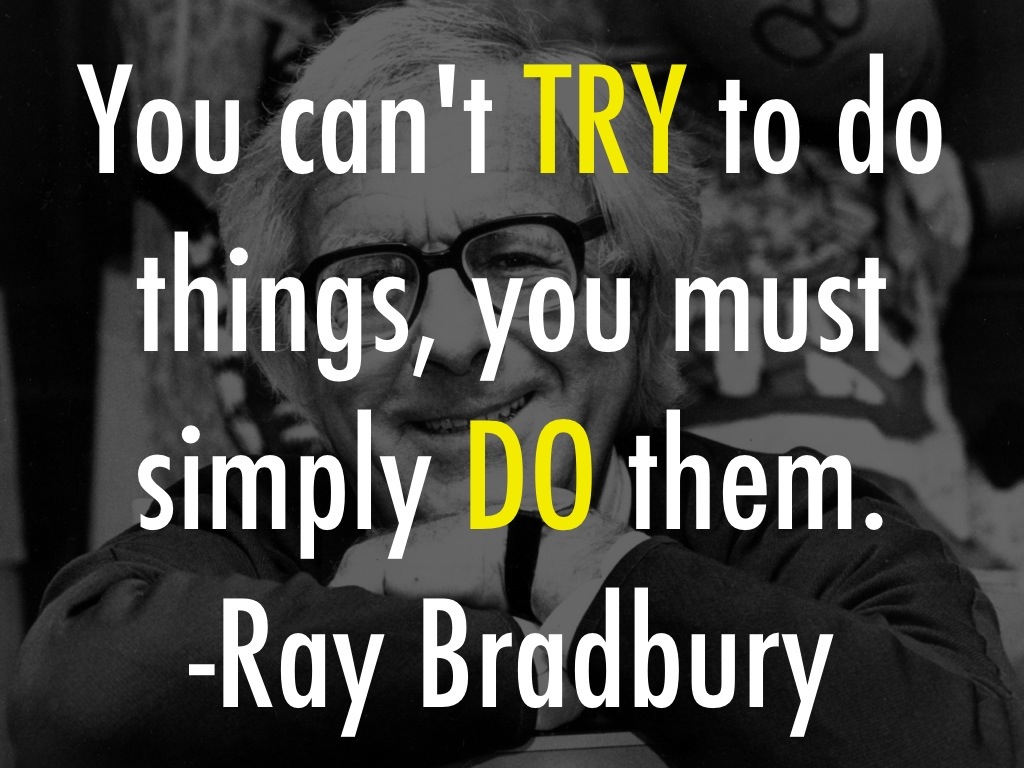
I can try to eat better, or I can eat better. I can try to write something every day, or I can write every day. I can try to get started on that big project at work that’s scary exciting, or I can just start. I can try to be a better listener and try to be a more attentive, present parent. Or I can just do it.

I find myself couching my commitments in the safety of “try”, giving myself room to not actually follow through. Dropping the “try”, though, takes away the net and calls my bluff. Will I do it or not? No points for just trying.

Where do you need to drop “try” and just do it?

20130617-140335.jpg

20130617-140350.jpg