Sunday night Stoic: How to act

Remember, Meditations was written by Marcus Aurelius as a sort of ongoing “note to self” while he was the Roman emperor, essentially the most powerful and influential person in the western world at the time.

He’s not lecturing someone else. He’s exhorting himself, calling for his own best, reminding himself of the kind of man he aspired to be. He could have gotten away with murder, much less selfish and boorish behavior.

Which makes passages like this (3.5) so remarkable:

“How to act:

Never under compulsion, out of selfishness, without forethought, with misgivings.

Don’t gussy up your thoughts.

No surplus words or unnecessary actions.

Let the spirit in you represent a man, an adult, a citizen, a Roman, a ruler. Taking up his post like a soldier and patiently awaiting his recall from life. Needing no oath or witness.

Cheerfulness. Without requiring other people’s help. Or serenity supplied by others.

To stand up straight—not straightened.”

Sunday morning Stoic: A formula for savoring life

The author William Irvine (whose book, A Guide To The Good Life, is a great introduction to Stoic thought) shared the Stoic formula for happiness in this post on Stoicism Today.

Here’s the formula: X = the number of days you have left to live

It’s not exactly a formula, just a reminder that each of us has a finite, unknown number for X. Keeping this thought in mind daily, knowing the end of this day reduces by 1, can offer perspective that makes each day richer and more meaningful.

Irvine goes on to suggest another helpful formula: X = the number of times you will do something in the remainder of your life

You have X number of times left to call your mom or kiss your love or hug your kid or eat Green & Black’s organic 85 percent cacao dark chocolate.

As you do a thing, if you for a moment imagine it might be the last time you do it, you will experience it more mindfully, more vividly. It turns autopilot off, even if for just a second or two.

I took my daughters to the swimming pool yesterday. As they were clamoring for me to jump in and join them, I paused at the edge of the deep end of the pool, my toes poised on the edge of the warm cement, and imagined this would be my last time ever jumping into water. And then I stepped off and truly saw my feet splash in first and felt my body drop into the cool water and the delightful sensation of floating. The slight sting in my nose and eyes. The feeling of defying gravity for a moment. It was a joy. And, of course, it wasn’t the last time. I jumped in several times yesterday, but the only one I can recall clearly was the first jump which I had imagined as my last jump ever.

I think even a small moment here and there thinking in this way could have a big impact on your daily joy.

And as Irvine suggests in his post, it can encourage you to create more moments worth savoring:

And there is another important thing to realize about the above formula: you probably have it in your power to turn X into X+1! You need only go out of your way to do something one extra time. At this very moment, there are X more times you will kiss the person you love. But if, as the result of reading this, you go give him or her a kiss that you otherwise wouldn’t have given, you will increase this number to X+1. And chances are you will have fun doing it!


David Letterman and the power of turning obstacles into fuel

I’m of the Letterman generation. I began college the same year Late Night debuted on NBC.

Better observers of television and comedy have better summed up why Letterman is significant. (I love Jimmy Kimmel’s take.) But to me he was just real. He didn’t treat television like it was a big deal, and he didn’t treat people who thought they were a big deal like they were a big deal.

His show was irreverent and unpredictable and fun. His timing and self-deprecating humor and wry asides influenced the way I communicate and attempt humor and the way I respond to others. I’ve realized even some of my facial expressions are Letterman inspired.

I listened to Jason Snell’s The Incomparable podcast about Letterman yesterday on a long drive home from the holiday weekend. The podcast was really well done and right in the wheelhouse of someone who would regularly stay up late in the dorm lobby to catch at least a portion of Late Night.

The podcast reminded me that when Letterman got the Late Night gig airing immediately following The Tonight Show, Johnny Carson’s team at NBC put some restrictions on what Letterman could do on his show. He could have no more than four band members and could tell only four jokes in his monologue. They wanted to protect their turf at The Tonight Show and not risk some young upstart stealing their stuff.

But Letterman used those restrictions to reinvent the talk show and to come up with something unique to him. Bizarre, wacky, occasionally cringe-inducing, but so refreshingly unique.

Years later when Carson retired, everyone assumed The Tonight Show would go to Letterman. It was Letterman’s dream, and Carson saw him as his natural successor. But the suits at NBC gave the job to Jay Leno instead.

Again, though, Letterman ended up embracing this setback and used that disappointment to do something better. He moved to CBS, started The Late Show, and competed head-to-head with The Tonight Show.

But he got to stay in New York and keep doing his unique version of a talk show, just on a bigger stage and an hour earlier. He’s even said that if he had been given The Tonight Show, he probably would have just followed Carson’s formula out of respect for the institutions that The Tonight Show and Carson were.

It was the restrictions and the disappointment and the obstacles that Letterman used to shape himself and his show into the cultural forces they became. He didn’t end up winning the ratings war, but his influence resonates as no other television personality’s has since Carson.

Heartbreak? Disappointment? Obstacles in the way? Dream job falls through? Accept a bad turn of events as if you had chosen it to happen that way. Then get busy transforming that setback into previously unimagined possibilities. Turn your obstacles into fuel to propel you further and higher.

Stoic Zen: The glass is already broken

Kottke shared this paragraph from Mark Epstein’s book Thoughts Without a Thinker: Psychotherapy From a Buddhist Perspective:

“You see this goblet?” asks Achaan Chaa, the Thai meditation master. “For me this glass is already broken. I enjoy it; I drink out of it. It holds my water admirably, sometimes even reflecting the sun in beautiful patterns. If I should tap it, it has a lovely ring to it. But when I put this glass on the shelf and the wind knocks it over or my elbow brushes it off the table and it falls to the ground and shatters, I say, ‘Of course.’ When I understand that the glass is already broken, every moment with it is precious.”

This is Zen. But also very Stoic.

Negative visualization is a Stoic practice. Imagining and accepting the worst case can help me better appreciate what is while preparing me for what could be.

Sunday morning Stoic: Only the present

A crisp, bright, quiet spring Sunday morning.

A cup of tea (coconut) and Marcus Aurelius’s Meditations.

A Sunday morning ritual for me.

It’s hard to open this book without reading a passage that delights or challenges and refreshes my mind with its clarity and straightforward insight.

This passage today, 8.35:

“Don’t let your imagination be crushed by life as a whole. Don’t try to picture everything bad that could possibly happen. Stick with the situation at hand, and ask, “Why is this so unbearable? Why can’t I endure it?” You’ll be embarrassed to answer.

Then remind yourself that past and future have no power over you. Only the present—and even that can be minimized. Just mark off its limits. And if your mind tries to claim that it can’t hold out against that … well, then, heap shame upon it.”

Only the present.

No pointless actions

Meditations 8.17:

“If it’s in your control, why do you do it? If it’s in someone else’s, then who are you blaming? Atoms? The gods? Stupid either way.

Blame no one. Set people straight, if you can. If not, just repair the damage. And suppose you can’t do that either. Then where does blaming people get you?

No pointless actions.”

Thursday night Stoic: Wanting what you have

Meditations 7.27:

“Treat what you don’t have as nonexistent. Look at what you have, the things you value most, and think of how much you’d crave them if you didn’t have them.”

This is a great way to focus on wanting what you have instead of having what you want. Assess your life, and realize how much good is in it.


Monday night Stoic: Take Antoninus as your model

Meditations 6.30:

“Take Antoninus as your model, always. His energy in doing what was rational … his steadiness in any situation … his sense of reverence … his calm expression … his gentleness … his modesty … his eagerness to grasp things. And how he never let things go before he was sure he had examined them thoroughly, understood them perfectly … the way he put up with unfair criticism, without returning it … how he couldn’t be hurried … how he wouldn’t listen to informers … how reliable he was as a judge of character, and of actions … not prone to backbiting, or cowardice, or jealousy, or empty rhetoric … content with the basics—in living quarters, bedding, clothes, food, servants … how hard he worked, how much he put up with … his ability to work straight through till dusk—because of his simple diet (he didn’t even need to relieve himself, except at set times) … his constancy and reliability as a friend … his tolerance of people who openly questioned his views and his delight at seeing his ideas improved on … his piety—without a trace of superstition …

So that when your time comes, your conscience will be as clear as his.”

Whether Antoninus (Marcus’s predecessor as emperor) was really this together or not, this description provides a great model of character for anyone to aspire to.

Becoming Steve Jobs: Adversity and failure before triumph

IMG_6482


The new, much-hyped biography, Becoming Steve Jobs, was released yesterday, and my pre-ordered copy was on my porch when I got home last night. This is the rare book that I’m choosing to purchase as a physical book instead of an ebook. The advance praise was sufficient enough and the topic is one I find fascinating. I’m thinking it will be a keeper.

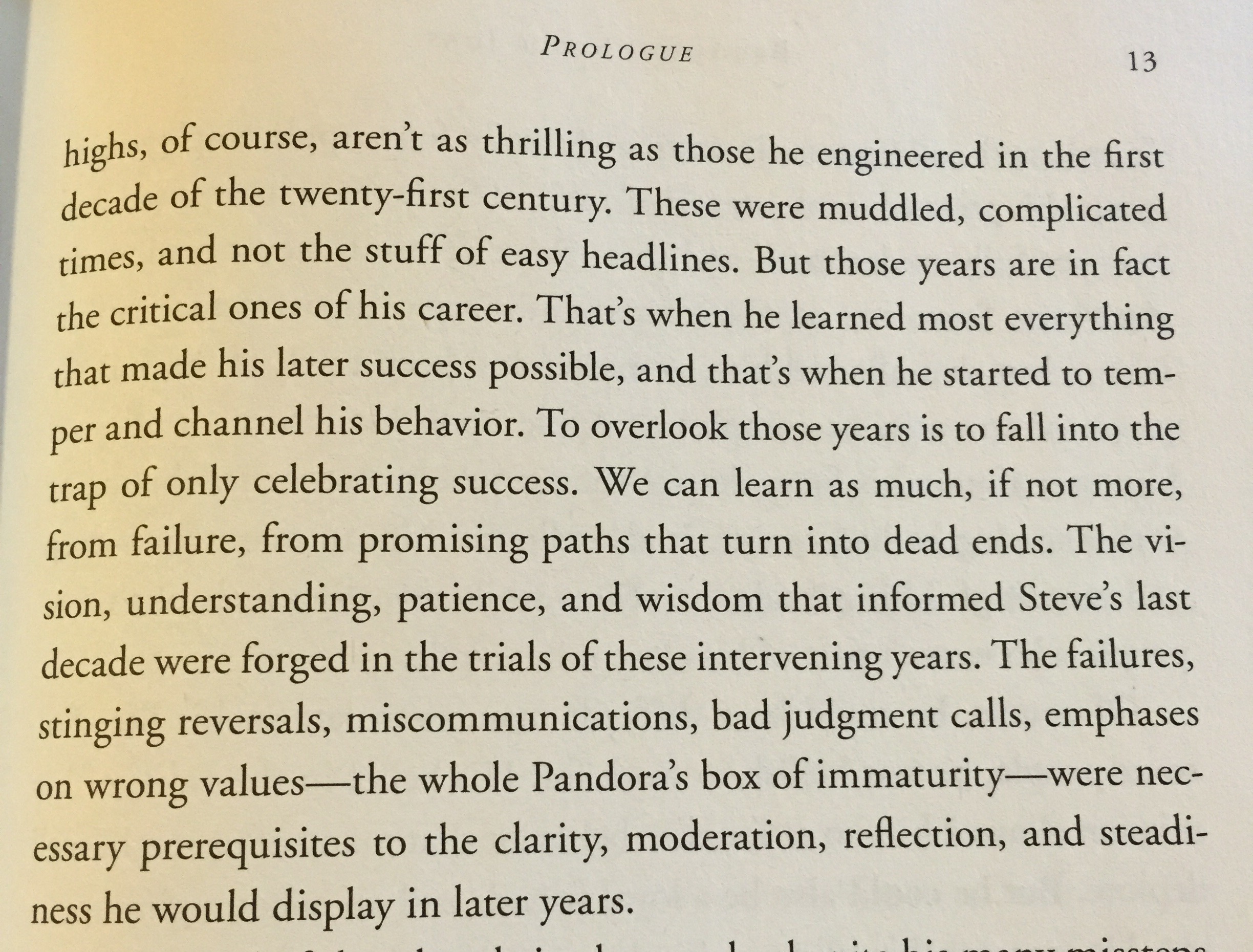
The book explores how someone who seemed so insensitive and reckless at the beginning of his career could end up as THE visionary business leader of our time. I just started reading it and came to this passage in the prologue:

FullSizeRender 2

“We can learn as much, if not more, from failure, from promising paths that turn into dead ends. The vision, understanding, patience, and wisdom that informed Steve’s last decade were forged in the trials of these intervening years.”

The greatness of the company that Steve Jobs fashioned in his last decade would not have been possible without the failures and shortcomings of his first couple of decades.

I’ve been fascinated recently by those who have turned adversity and failure to their advantage. We all seem to know that facing difficulties and enduring setbacks make us stronger and better. Yet we resist even the thought of coming up short or of taking on hardship.

Maybe we all should regularly and intentionally fling ourselves into the teeth of surefire heartbreak and dismal failure just so we can grow and learn faster.


Sunday evening Stoic: Alexander the Great and his mule driver

Neither still exists. Nor does everyone’s favorite emperor, Marcus Aurelius, who wrote this in Meditations (6.24):

“Alexander the Great and his mule driver both died and the same thing happened to both. They were absorbed alike into the life force of the world, or dissolved alike into atoms.”

How nice to be remembered, and especially if your life is still making a difference for others, even centuries later. But what good does it do Alexander? Or Marcus?

Your life will be merely other people’s memories in a few years when you’re gone. And a century or two from now, it’s likely no one will know of you at all.

You can try really hard to be one of the few whose mark on our culture endures for a long time. Or you can focus simply on making the most of your limited time here.

Put your problems and your worries in perspective. Live excellently. Be kind. Have patience with those around you. Enjoy your life.


Cinderella’s Stoic virtues: Courage and kindness

I took my wife and daughters to see the new live-action Cinderella movie yesterday. I’m no movie critic, but I thought it was really good.

It’s visually sumptuous. The costume design, the sets, the locations, the sweeping camera movements all were dazzling and crafted on an epic scale.

Kenneth Branagh, the Shakespearean actor, directed and played the story straight and with a classic, elegant style. No clever updates. It’s in essence the same Cinderella story you know from the original Disney animated feature. But it’s done so well.

The acting performances are solid. Lily James as Cinderella lights up the screen. She’s earnest and charming and quietly strong without being sappy sweet. The prince is not a bore or a boor. The ailing king is endearing. The wicked stepmother, Cate Blanchett, is suitably cruel but finishes by coming across as pitiable.

It’s not high art, but it’s a worthwhile story, especially for my young daughters. Early in the story Cinderella’s dying mother exhorts her to always “have courage and be kind.” That mantra gets repeated throughout. It could seem simplistic, but the character solidly embodies those traits.

When Cinderella gets banished to the attic, she could have become a teary-eyed damsel in distress in typical princess fairy tale style. But this Cinderella embraces her fate with a twinkle of optimism and hope and makes the best of it. She deals with her cruel treatment and bad fortune with similar fortitude throughout the story without coming across as weak and woeful. She exhibits Stoic-like acceptance of all that happens outside of her control and remains kind in spite of the cruelty she endures.

“Have courage and be kind”, simple and obvious as it is, is a decent motto for anyone, aspiring princess or not.

No one is fearless, but we can all show courage by taking action in spite of our fears. And life is too short to be short on kindness.

Four thumbs up for Cinderella from me and my three princesses.

David Malham on dying: “Let’s not save our affection”

Yesterday there was an essay on the New York Times opinion page by a retired grief therapist, David Malham, who has been diagnosed with A.L.S. and is facing his imminent death.

It’s a thoughtful and light-hearted reflection by someone well acquainted with the grief of others. It’s a worthwhile read in whole. He highlights the absurdity of coming to grips with your own mortality:

But it’s not that we forget that we will die; it’s that we work hard to not remember it. Yes, we accept the plural “we will die,” but it’s the particular, the “I” that we have trouble with. It’s easier to accept “we” because the “I” believes it can hide when the others in the “we” are taken. When it comes to the particular, we are, each of us, facing death new and uncomprehending. 

Woody Allen wryly said: “I’m not afraid to die. I just don’t want to be there when it happens.”

But it’s coming for each of us. My life is terminal. Yours is, too.

Thinking about your death too obsessively can send you into an existential funk and shadow the light from the life you’re living. But living in denial of your ultimate fate will make meaningfulness elusive.

Malham suggests, though, that it’s the prospect of the deaths of those we love that is more troubling even than accepting our own demise.

My mom would have turned 73 today. (Happy birthday, mom!) She died almost ten years ago. Her absence from our lives still stings, a decade later. Our family has not recovered, and likely will not recover, the bond we once had when she was alive. She was such a joyful, dynamic presence and was the heart of not just our immediate family but even, somewhat, of both extended families. Life goes on, though. Or, the living keep living. For now.

Stoic sages advise periodically envisioning the loss of those you love. Sounds like an unappealing practice, right? It’s meant to be. The point is to face that kind of momentary pain often enough to make you better appreciate your loved ones while they’re with you.

Malham’s closing exhortation is tinged with just such a Stoic perspective:

We want to be (lightly, only lightly) aware of death not because our story will end, but because the stories of those we hold dear will end, perhaps before ours. The awareness of premature or unexpected endings can motivate us to routinely demonstrate our love to those important to us. Let’s not save our affection, as if a rare wine, for special occasions. Give and receive it as essential nourishment.

“Grief, after all, is the price we pay for love.” –David Malham

Sunday Evening Stoic: Brace Yourself

From the philosopher-emperor:

The art of living is more like wrestling than dancing, in so far as it stands ready against the accidental and the unforeseen, and is not apt to fall. –Marcus Aurelius

And there’s this, from the creator of the Magic Kingdom:

All the adversity I’ve had in my life, all my troubles and obstacles, have strengthened me… You may not realize it when it happens, but a kick in the teeth may be the best thing in the world for you. –Walt Disney

Welcome the occasional kick in the teeth. Brace yourself for difficulty and setbacks and heartbreak. And use them to get stronger. Use your obstacles as fuel.

Sunday evening Stoic: Do good, expect nothing in return

Meditations 5.6:

“Some people, when they do someone a favor, are always looking for a chance to call it in. And some aren’t, but they’re still aware of it—still regard it as a debt. But others don’t even do that. They’re like a vine that produces grapes without looking for anything in return.

A horse at the end of the race …

A dog when the hunt is over …

A bee with its honey stored …

And a human being after helping others.

They don’t make a fuss about it. They just go on to something else, as the vine looks forward to bearing fruit again in season.

We should be like that. Acting almost unconsciously.”


Sunday evening Stoic: The good fortune of bad things

Meditations 4.49:

“So remember this principle when something threatens to cause you pain: the thing itself was no misfortune at all; to endure it and prevail is great good fortune.”

Even the saddest, most emotionally painful turn of events can be considered good fortune if you use it to grow and get stronger and to live a more wholehearted life.

This is no easy lesson, and I keep forgetting to welcome the seemingly unwelcome, to embrace what I am inclined to resist.

What is, is. I can only control my response. I can take action toward a course I prefer, but much is out of my hands.

Accept what you can’t control. The world isn’t striving to make you feel good. Welcome to reality.

But why not use even “bad” fortune, especially bad fortune, to propel you a little further on your journey to becoming a more excellent version of yourself?

Sunday morning Stoic: All you need

Meditations 9.6:

“Objective judgment, now, at this very moment.
Unselfish action, now, at this very moment.
Willing acceptance—now, at this very moment—of all external events.
That’s all you need.”

No matter what came before, who you’ve been, or what you’ve done, the present moment is pure possibility, untainted by what was or will be.

All you need is the courage to embrace this moment, see clearly, act boldly, and do what you think is best.

Each new moment is a blank page, a fresh start on being the human you aspire to be. Why not be awesome?