Smile

Three times each weekday I greet groups of campus visitors as they’re about to embark on our campus tour. I offer a brief overview and introduce the tour leaders.

Far too often, as I try to warm up the crowd, I’m greeted by a smattering of stone-faced expressions. These people are not waiting for a root canal or an IRS audit, where there may be less obvious reason to smile. They’re about to stroll through a lovely college campus with a couple of charming college students. Why the long faces, people? It’s my team’s aim, of course, to have them smiling by the time they leave.

But in pretty much every crowd there are smilers. Some are subtle with only a happy glint in their eyes. Others are nodding and grinning and practically glowing with positive energy. I love these people, those whose default expression is a smile. Just standing in the presence of smiling faces makes me happier and encourages me to be even a little more awesome myself.

Some children smile as many as 400 times a day. Many adults smile fewer than 10 times each day.

You want to be happy, right? No need to wait until you’ve reached some longed for accomplishment to be happy. Just act like you’re happy, and you likely will be. When you wake up, put a smile on your face. Make it a habit or ritual like brushing your teeth. When you greet people throughout your day, be intentional about smiling at them. Act like you’re happy to see them. Even if it’s just a nod and a quick smile. Fake it if you have to. Act like you are who you want to be. Use your body to inform your mind and your emotions.

There’s an old Peanuts cartoon where Charlie Brown is telling a friend that the worst thing you can do if you’re feeling depressed is hold your shoulders back and your head up and smile. Then you’ll start feeling better, and “that’s no good at all.”

Sages know this is true:

“Sometimes your joy is the source of your smile, but sometimes your smile can be the source of your joy.” Thich Nhat Hanh

Science backs this up:

“Even the simulation of an emotion tends to arouse it in our minds.” Charles Darwin

And smiling is contagious thanks to evolutionary wiring. Your smile can cause others to smile. What if one of your missions each day was to elicit as many smiles from others as possible? Make some mischief with your smile to subvert and co-opt the Charlie Browns of the world.

This is a delightful, short TED Talk from Ron Gutman about the power and surprising benefits of smiling:

There’s also this $2 e-book by Gutman that expands on his talk with plenty of support from researchers on how and why smiling is so powerful.

Good grief, Charlie Brown. Just smile.
Non-attachment for the win

Austin was a college freshman when he applied to work as one of the twelve orientation leaders who run our university’s summer orientation program that welcomes and transitions thousands of new students each summer. It’s a challenging, prestigious position, and there is always an impressive applicant pool, made up of the best and brightest leaders from a campus of more than 30,000 students.

Austin had a great interview during the first round, which was a group interview. He was thoughtful and enthusiastic and a strong communicator. We invited him back for the final round of interviews, which was an individual meeting with the program directors. He was even more impressive in his individual interview. We hired him. The next week we gathered the twelve newly selected student orientation leaders together for a first meeting to start planning their training and to meet each other.

After the meeting, Austin approached me privately and said he had a question for me. He looked a bit distressed. His question: “Why did you hire me?” That’s not the question I typically get the day someone begins a new position. I told him we hired him, of course, because he was a great fit for the job and would be terrific in the role.

He then related that, before he applied, his friends had told him that we do not hire freshmen for this particular job. Freshmen could apply, they said, but only to gain interview experience. He was stunned (and ended up being delighted) to actually be offered the position. Well, his friends were wrong. Freshmen were rarely selected because the competition was so strong, but they were just as eligible as any other student.

Austin walked into those interviews certain that getting the job was not even an option. He thought it was just practice. He was completely unattached to any outcome. And he was awesome.

Contrast that with a young woman, in the same selection process, who, when asked the very first question (which was a softball: “Tell us why you want this position”), immediately began crying. We scrounged up a box of tissue, and when she finally composed herself she said: “I’m sorry. I just want this… so… much.”

She was so attached to the outcome that she couldn’t even engage in a conversation. Austin was not attached at all and was able to focus completely on the moment and shine. For him, it was just a conversation, not a job interview.

There’s something powerful about this state of non-attachment. The great performers seem to have mastered the art of the present moment. Think of superstar athletes in clutch situations. The greatest ones aren’t weighed down by the stakes, the fear of failure or anticipation of the next day’s headlines.

There’s a classic story of football legend Joe Montana in the 49ers’ Super Bowl against the Bengals in 1989. Time was running out, and the 49ers were behind on the scoreboard. While his teammates are huddled on the field during a TV timeout, stressed about the challenge they were facing, Montana was unflappable, seemingly oblivious to the team’s dire straits. Just before the timeout ended, he pointed into the crowd and told one of his offensive linemen: “Hey, isn’t that the actor John Candy?” His teammate was incredulous that the quarterback was so relaxed in that high-stakes moment that he could point out celebrities in the stadium. When play resumed, Montana methodically moved the team down the field and into the end zone for the winning score with just 34 seconds left on the game clock.

The next time you’ve got an interview or a presentation or a first date, even, put your focus only on the moment at hand. In the interview and the date, make it your goal simply to have a great conversation, one where you listen intently and seek to understand before seeking to be understood. And then don’t be afraid to be interesting. And if you abandon any expectation of getting the job or a second date, you will be freed up to be your best and shine in the moment. Same with a presentation or any task you pursue, don’t attach to the outcome. Be awesome in the present moment and let the future unfold as it will. The more you practice getting yourself into that zone in low-stakes moments, the easier it will be when the stakes mount.

Bruce Springsteen still rehearses

Keeping up the craftsmanship theme I have been exploring recently, I’ve been meaning to share this feature on Bruce Springsteen that I read last summer in The New Yorker. It’s an immensely interesting long profile on the enduring, iconic rock-and-roll star. (You’ve got to add the “roll” for Springsteen, don’t you? He’s more than just a “rock” star.) I was in college when his biggest album, Born In the U.S.A., dominated our music consciousness. It seemed like every song on that album was a huge hit. It was one of the first CDs I owned. (I was one of the first in my dorm to own a CD player and make the transition from vinyl. I have always been a bit of an early adopter.) Unfortunately, I have never seen Springsteen in concert, and his performances are considered epic. He goes for hours at high energy and gives the audience more than they expect. The man is in his sixties now and still going strong as an artist and performer. Here’s an excerpt from the article describing a rehearsal:

Springsteen arrived and greeted everyone with a quick hello and his distinctive cackle. He is five-nine and walks with a rolling rodeo gait. When he takes in something new—a visitor, a thought, a passing car in the distance—his eyes narrow, as if in hard light, and his lower jaw protrudes a bit. His hairline is receding, and, if one had to guess, he has, over the years, in the face of high-def scrutiny and the fight against time, enjoined the expensive attentions of cosmetic and dental practitioners. He remains dispiritingly handsome, preposterously fit. (“He has practically the same waist size as when I met him, when we were fifteen,” says Steve Van Zandt, who does not.) Some of this has to do with his abstemious inclinations; Van Zandt says Springsteen is “the only guy I know—I think the only guy I know at all—who never did drugs.” He’s followed more or less the same exercise regimen for thirty years: he runs on a treadmill and, with a trainer, works out with weights. It has paid off. His muscle tone approximates a fresh tennis ball. And yet, with the tour a month away, he laughed at the idea that he was ready. “I’m not remotely close,” he said, slumping into a chair twenty rows back from the stage.

Preparing for a tour is a process far more involved than middle-aged workouts designed to stave off premature infarction. “Think of it this way: performing is like sprinting while screaming for three, four minutes,” Springsteen said. “And then you do it again. And then you do it again. And then you walk a little, shouting the whole time. And so on. Your adrenaline quickly overwhelms your conditioning.” His style in performance is joyously demonic, as close as a white man of Social Security age can get to James Brown circa 1962 without risking a herniated disk or a shattered pelvis. Concerts last in excess of three hours, without a break, and he is constantly dancing, screaming, imploring, mugging, kicking, windmilling, crowd-surfing, climbing a drum riser, jumping on an amp, leaping off Roy Bittan’s piano. The display of energy and its depletion is part of what is expected of him. In return, the crowd participates in a display of communal adoration. Like pilgrims at a gigantic outdoor Mass—think John Paul II at Gdansk—they know their role: when to raise their hands, when to sway, when to sing, when to scream his name, when to bear his body, hand over hand, from the rear of the orchestra to the stage. (Van Zandt: “Messianic? Is that the word you’re looking for?”)

The article goes on to describe Springsteen leading his band through a meticulous, intense rehearsal in an empty hall they rent just to prepare for a tour. I’m sure after all those years of performing, The Boss could just walk out on stage and put on a good show without much preparation. But he doesn’t want to be just “good”. He’s great because he approaches his work with discipline (note above how he takes care of his body) and attention to detail. He’s a master, constantly refining his craft. And rehearsal is crucial.

My college speech teacher, Cal Logue, was insistent that we must rehearse our presentations out loud on our own multiple times before facing an audience. I was reluctant, feeling it silly to talk to myself in an empty room. But I did it, and in the process discovered problems and new ideas and connections that wouldn’t have been obvious had I not rehearsed out loud. I still do it when preparing a big presentation. I close the doors on the presentation room in our office, load my slides, and give my talk to a bunch of empty chairs. And I never fail to come up with improvements. Timing and flow especially benefit from live rehearsal, and you can’t get that from just reading over your notes multiple times and clicking through your slides over and over. If the first time you give a prepared talk is in front of a live audience, you’re giving them something less than your best. If Springsteen still rehearses, you should, too.

Seth Godin: What is school for?

This is Seth Godin’s take on what’s wrong with our education system:

Our 20th century model for how to educate kids needs a 21st century update. Godin offers some excellent suggestions for what to do next, like inverting the lecture and homework. Students can watch a world-class lecture online on their own at home and then do the work while they’re together at school and can discuss and ask questions. And no more memorizing when the world’s information is in everyone’s pocket. Open book all the time. Teachers become “coaches” who can help bring out the best in each student rather than spend too much time serving as compliance officers.

Godin has written at length about this in his manifesto Stop Stealing Dreams, which is free online and is well worth the time to read, especially if you’re an educator, a student, a parent, or a human who has ever been to school.

A world-changing speech – Scott Harrison and charity: water

I regularly quote JFK’s line: “The only reason to give a speech is to change the world.”

I recently watched this remarkable, world-changing presentation by charity: water founder Scott Harrison:

I first watched this because of the raves it received as an example of a great speech. And public speakers can learn from Harrison. He is confident, interesting, and enthusiastic. But he’s also vulnerable and humble and authentic. He builds his presentation around stories. He takes the audience on a journey from “why” to “how”. He makes masterful use of images and videos that make his message even more memorable.

He was so effective in this talk that I immediately went to his organization’s web site and pledged my next birthday on June 8 to charity: water. When almost 1 billion people do not have access to clean water, the least I can do is forego presents on my birthday. And charity: water seems to have crafted an impressive organization with real transparency and measurable effectiveness and a brand that can stand next to the best in the corporate world.

I’m in. And you can be, too. If you want to join the effort to bring clean water to people who need it, you can help me celebrate my upcoming 49th birthday by giving $49 to charity: water.

Here’s my page for donations:

http://my.charitywater.org/ej49water

Thanks!

Showing my work

I watched Austin Kleon’s “Show Your Work!” Creative Mornings talk last week and was inspired by his suggestion to share not just a finished product, but the work in progress. It is inspiring to me to see how others work and to be reminded that art doesn’t just appear in perfectly polished form.

Creation is a messy, humbling process with dead-ends and u-turns and much floundering and procrastination and self-doubt. Lots of self-doubt. (Is it just me that feels like a fraud constantly on the verge of being found out?*) It can be invigorating and satisfying and joyful, too. I’m working now on preparing a talk I’m giving on June 2 at the Collegiate Information and Visitor Services Association (CIVSA) annual conference in Alexandria, VA. I’m the opening speaker with an hour on the program in a big theater, so I’m feeling some pressure to be awesome.

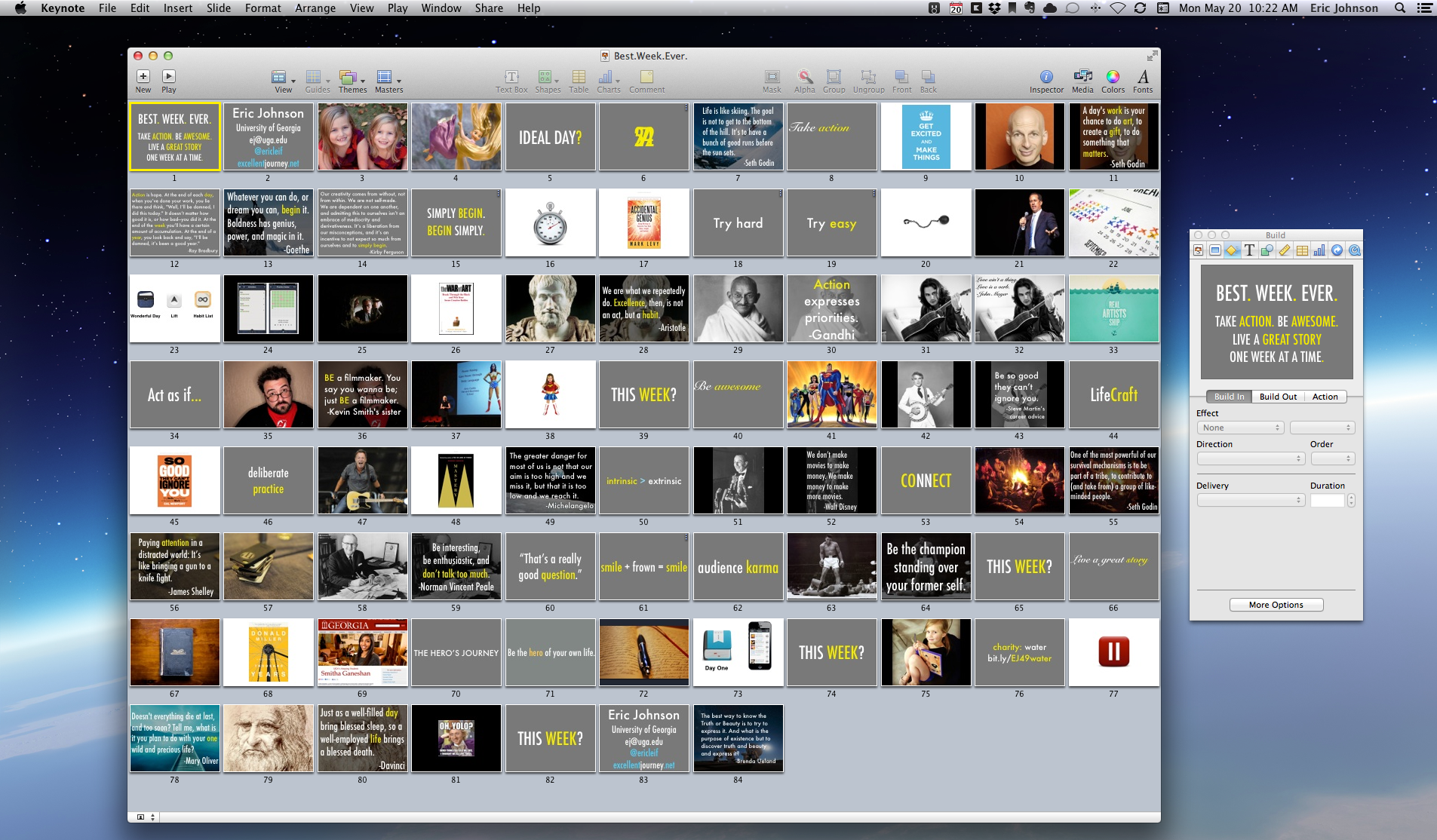
I came up with a title and short description months ago so it could be promoted in the conference program, and I immediately created a Keynote document that I’ve been dumping ideas into ever since. It’s a “kitchen sink” approach. Any thought or quote or image that seems remotely interesting and relevant gets dropped in over the course of several months. But only in the last couple of weeks have I begun putting it all together. I love Keynote. (For those who don’t know, Keynote is Apple’s version of slide software. It’s a beautiful, smart app that blows Powerpoint away.) I spend most of my time in Keynote in the “Light Table” view. It’s a great perspective for seeing connections between ideas and assessing the flow of your thoughts. Keynote is a powerful tool to plan projects in, even if you don’t need presentation slides. Here’s what my presentation looks like at the moment:

Best.Week.Ever. light table view

Since I’ve been crafting this talk over the last two weeks, I’ve been tweaking slides and adding images and rearranging the order of ideas. I’m no designer, but I care how each slide looks. I often get lost in small details of typography and which shade of yellow I prefer at the expense of the big picture of the key themes I’m supposed to be addressing. And I find myself getting infatuated with a slide or image that may not really belong. When that happens, I open up my writing app and just start writing. I simply write what I imagine I will say during my presentation. This helps sort out the flow and gets to the heart of what I’m trying to accomplish. I keep coming back to “Why?” And “What’s the point?” And “How do I hope my audience is different at the end of my talk?” Writing it out helps point me in the direction I need to go. I use iA Writer on my iPad mini for any long writing. I’m more focused when writing on the iPad than I am on my iMac. And iA Writer is a gorgeously designed, minimal app with very few features. It’s great for just writing, not for fiddling around with settings and formatting and such. It syncs your documents in iCloud or Dropbox, and there’s an equally beautiful Mac version of the app.

iA Writer on iPad mini

(I really like Apple’s wireless bluetooth keyboard, by the way. The feel of the keys is great, and the size is just right. I don’t write enough to need an iPad/keyboard combo case that’s with me all the time, so I just purchased Incase’s Origami keyboard case, which is made especially for the Apple keyboard. It’s perfect for my setup.)

Working on this presentation has reminded me how much I love creating and getting lost in a project I’m excited about. I skipped lunch last Friday because I was immersed in working on this. I never skip lunch. Lunch is my favorite meal of the day. That’s how satisfying I find this process. I find myself reviewing the slides on my iPad each night and tweaking details almost every time I open the presentation. Fortunately, iCloud has been rock solid at keeping everything synced nicely between my iPad and my Mac.

I’m still a long way from a finished presentation. I may scrap half of what I’ve already done before June 2 arrives. And once I begin rehearsing out loud, which is crucial, I will make more changes.

Okay, back to working on my work. Was this post just another bit of procrastination? Maybe. Now it’s time for lunch.

*I just looked at my presentation from last summer’s conference, where I was the closing speaker, and now those slides look ugly and half-done to me. I’m terrible. Why do they keep asking me to speak at this conference…?

Second circle: To be or not to be… fully present

Nick Morgan’s recent post introduced me to Patsy Rodenburg. She is one of the world’s most prominent voice teachers and a renowned expert on Shakespeare. Actors come to her for coaching on how best to use their voice in performance. And she has a great take on what it means to have “it“. Charisma. Presence.

This 10-minute video shows her explaining “second circle”:

This clip inspired me to purchase and begin reading her book, The Second Circle. I’ve only gotten a third of the way into it, but I’m hooked and know that she’s on target.

We all know people who seem to shine with presence, and it’s easy to think it’s some gift they have, that they won the charisma lottery. But I’m confident that everyone can flip a switch and become present, even charismatic, at will. I’m no master of this. I spend too much time in my head and not in the present moment. But, when I am intentional about connecting with the present moment, whether in conversation or giving a presentation or creating something, I feel so much more alive and dynamic. When you make that connection with an audience as a public speaker, you feel like a rock star. When you have that moment of genuine presence in a relationship, or even with a stranger, you feel like a real human being.

Think of those you consider to have a strong sense of presence. Don’t they seem to care more than the average person? They actually listen intently in conversation rather than simply waiting their turn to talk. In front of an audience they glow with expressiveness and confidence and energy. Charisma is caring deeply and having the courage to fully express yourself and genuinely connect in the present moment. It’s talking with someone rather than at them. It’s paying attention. It’s using the physical senses to connect with the here and now. It’s this paradox of being more powerful by being vulnerable.

Kids have this naturally. Watch young children engrossed in play. They are free and fearless and full of life. Somewhere along the way this gets stifled, and fear throttles our natural impulse.

I’ll report back after I finish reading Rodenburg’s book to see what she recommends for consistently getting into second circle. In the meantime, I’m going to be intentional about being present in conversations especially. I want to make a genuine attempt to understand before seeking to be understood. I will ask more questions. Make more eye contact. I will religiously put my phone away when I’m with humans, especially when I’m with my wife and kids. (What if your level of coolness is inversely proportional to how often your phone is visible in public? A staggering thought for most of us.) When standing in front of an audience, I will attempt to think through their point of view and make my remarks audience-centered. When asking “How are you?”, I’ll mean it and wait for a response. This is my aim, at least. An excellent journey of a life would be spent mostly in second circle, in the here and now.