Seek not that the things which happen should happen as you wish; but wish the things which happen to be as they are, and you will have a tranquil flow of life. –Epictetus
This is some serious mental jujitsu. There’s a fine line between passiveness and acceptance. One is weak. The other is strong.
Take action to make your plan happen, but accept whatever does happen as though it’s part of the plan.
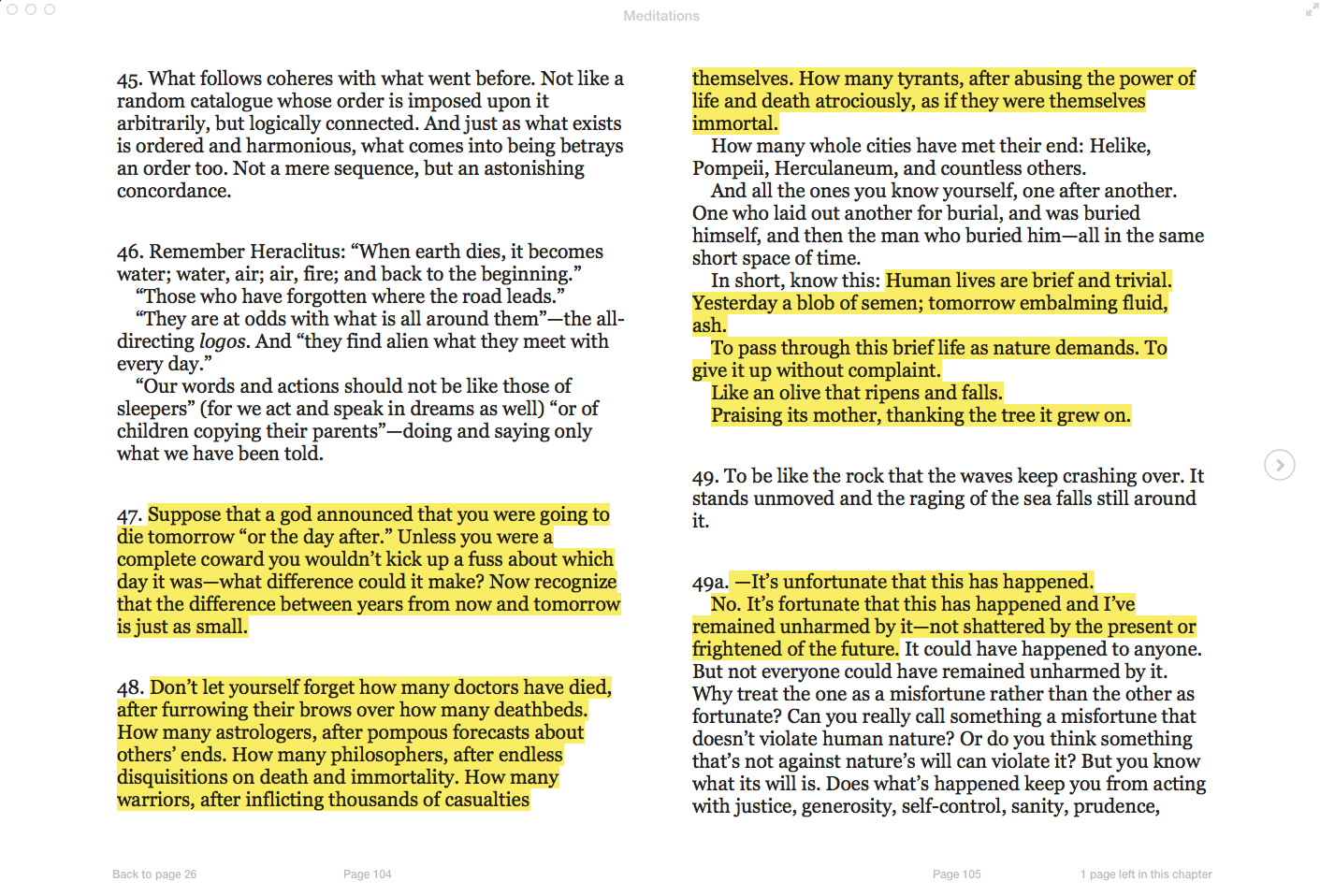
I’m rereading Marcus Aurelius’s Meditations. It’s the kind of book that you can open anywhere and find something worthwhile to ponder. My copy is filled with yellow highlights, and I marvel at his prolifically quote-worthy (and tweet-worthy) insights into the challenges of living an excellent human life.
What makes this book so remarkable, I think, is that he was not writing it for anyone but himself. He had no intent to publish what was the private diary of the most powerful man in the world. Instead of filling this journal, though, with the people and events of his life, which certainly would have been of great historical value, he instead wrote of his efforts to master his own mind and live in a virtuous, excellent way. The philosophical value more than makes up for what was lost to history.
Meditations is a sort of extended “note to self” wherein he is clearly talking only to Marcus Aurelius and chiding and encouraging and reminding himself of what should be his focus. There are sentence fragments galore. Some make no sense to me, and others are as starkly profound as anything I’ve read.
Uninhibited by what others might think, Aurelius was free to write with a remarkable rawness and candor that would be unlikely if he were writing for an audience.
This site is my attempt to somehow publicly share a sort of note-to-self journal. I keep a private journal (using Day One), and I find my writing there is not nearly as well thought out as what I post here. Being aware that someone else might read this (hello, lone reader) forces me to craft my thoughts with more care and intention.
Just as inviting people over forces you to clean up your apartment, writing something that other people will read forces you to think well. -Paul Graham
But I don’t want to come across as some pretentious expert with answers and solutions for all. I’m far from it. Yet I want the kind of candor and directness that Marcus has in writing to himself.
How to balance the authenticity a note-to-self approach with the benefits of writing for others? It’s a worthwhile challenge to attempt. Squelch the self-consciousness of being observed yet write with enough awareness of an audience to focus my thinking more sharply.
My imperative sentences are addressed to myself. “Do this…” “Think in this way…” Those are directed at me, and if a reader finds some value as well, excellent. But if I am the only person who derives any benefit from sharing my notes-to-self online, if this effort moves me just a little further along the path toward living a better life, that is excellent, too.
Byron Howard, one of our directors at Disney, told me that when he was learning to play the guitar, a teacher taught him the phrase, “If you think, you stink.” The idea resonated with him—and it informs his work as a director to this day. “The goal is to get so comfortable and relaxed with your instrument, or process, that you can just get Zen with it and let the music flow without thinking,” he told me. “I notice the same thing when I storyboard. I do my best work when I’m zipping through the scene, not overthinking, not worrying if every drawing is perfect, but just flowing with and connecting to the scene—sort of doing it by the seat of my pants.”
Too much thinking will mess things up. When I’m struggling or discouraged or anxious and uptight, it’s my mind that’s getting in the way. Instead of try hard, I should try easy, right? Or, just skip trying and simplydo.
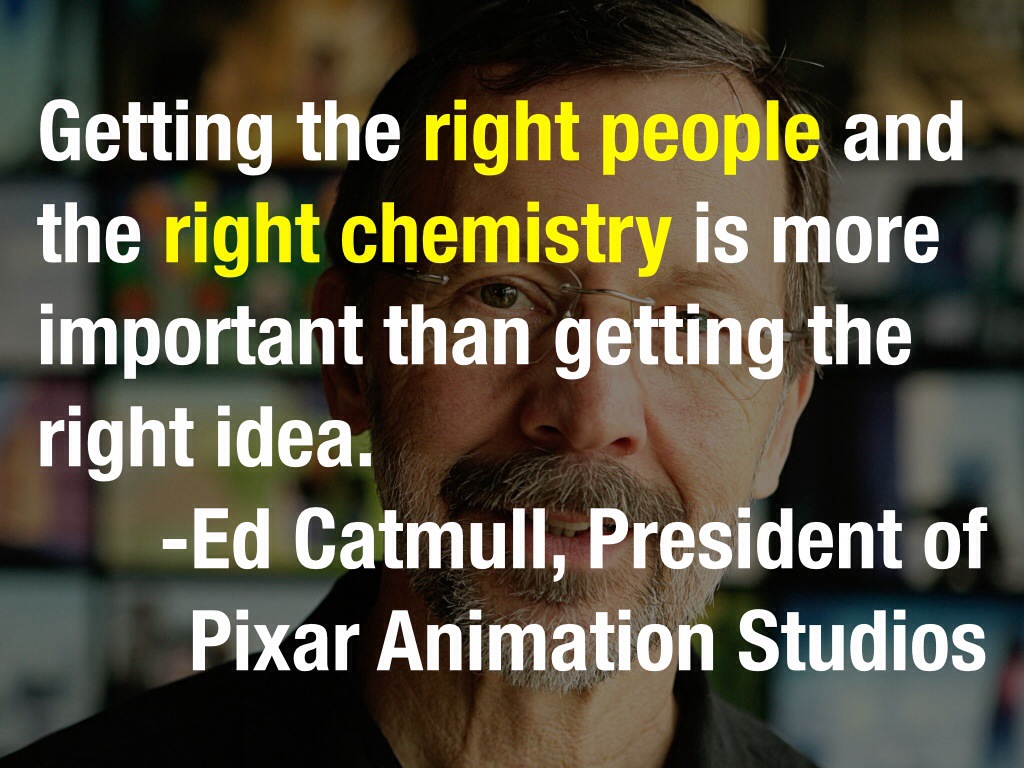
I have been reading Ed Catmull’s excellent book, Creativity, Inc. Catmull is one of Pixar’s founders and now leads both Pixar and Disney Animation. He knows plenty about running a successful organization, and his book is refreshingly unlike the typical business book. It’s humble and candid and authentic in ways most business insider books are not.
I will post later with more that I gleaned from Catmull’s compelling stories and heartfelt advice, but I completely connect with this insight about centering your priorities around people:
This is in sync with all I’ve experienced about strong organizations and great teams. Find people who fit the vision and the culture, and then tend the culture gently, get the heck out of the way, and allow your people the freedom to be awesome.
Tony Hsieh, Zappos CEO, is a visionary business leader and a crusader for the primacy of organizational culture. His excellent book, Delivering Happiness, tells the story of the creation of Zappos, a company with one of the most lauded customer service operations anywhere. Zappos has a reputation for being one of the happiest places to work, and Hsieh’s books goes into great detail about how they have cultivated the unique culture responsible for their public success and their rewarding work environment.
How would you describe the culture of your organization? Most organizations have some official mission statement posted on a corner of their web site and maybe even a statement of values, but the true culture of a place defies artificial attempts to mandate it from a PR document.
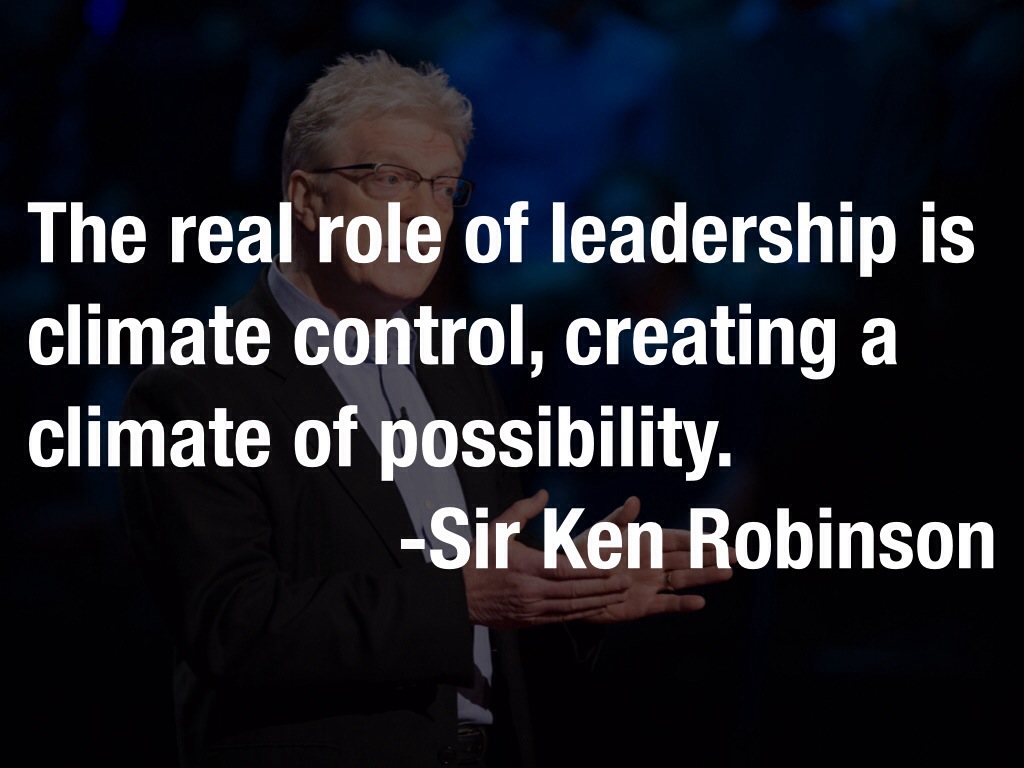
Effective leaders know that culture should be their primary focus. Create and nurture an environment that provides vision and frees each person to unleash their best work. Create a climate of possibility.
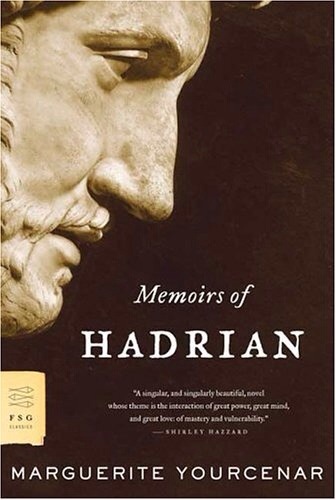
I’m reading Marguerite Yourcenar’s 1951 novel, Memoirs of Hadrian, about the Roman emperor and written as though it was his own journal as he is facing the end of his life. It’s addressed to the future emperor, Marcus Aurelius. I could only find a paperback copy but was eager to have it. A book like this dealing with Roman history and Stoicism and Marcus Aurelius is right in my wheelhouse. I, Claudius remains the most delightful novel I’ve read and helped spark my fascination with ancient Rome.
Memoirs of Hadrian is no I, Claudius, though. It’s not the exhilarating, page-turning romp through Roman scandal and political intrigue. Yourcenar’s book is a quiet, reflective review of a notable life as our protagonist is facing his final days.
I came across this remarkable passage yesterday. It’s Hadrian looking back on his years as a young army officer:
I determined to make the best of whatever situation I was in; during my years of dependence my subjection lost its portion of bitterness, and even ignominy, if I learned to accept it as a useful exercise. Whatever I had I chose to have, obliging myself only to possess it totally, and to taste the experience to the full. Thus the most dreary tasks were accomplished with ease as long as I was willing to give myself to them. Whenever an object repelled me, I made it a subject of study, ingeniously compelling myself to extract from it a motive for enjoyment. If faced with something unforeseen or near cause for despair, like an ambush or a storm at sea, after all measures for the safety of others had been taken, I strove to welcome this hazard, to rejoice in whatever it brought me of the new and unexpected, and thus without shock the ambush or the tempest was incorporated into my plans, or my thoughts. Even in the throes of my worst disaster, I have seen a moment when sheer exhaustion reduced some part of the horror of the experience, and when I made the defeat a thing of my own in being willing to accept it. … And it is in such a way, with a mixture of reserve and of daring, of submission and revolt carefully concerted, of extreme demand and prudent concession, that I have finally learned to accept myself. –Memoirs of Hadrian, pp. 44-45
This is life-changing insight explained with profound clarity. “Whatever I had I chose to have…” Consider some unpleasant circumstance or event, from something as trivial as having to wash dishes to something as potentially catastrophic as facing a tragic loss. If you welcomed this thing you have no control over and accepted it fully, embracing, even, something that seems unembraceable, imagine the transformation in your psychology. Accept what is and use it to learn and grow and find unforeseen opportunities. Fling yourself fully into even the worst circumstances that befall you. Don’t resist. Welcome whatever comes your way and grow your character and peace of mind in the process.
“Learn to ask of all actions, ‘Why are they doing that?’
Starting with your own.” -Marcus Aurelius, Meditations
Reading those lines this morning reminded me of some great Stephen Covey insights I wish I was more inclined to consistently apply in my life.
I’m paraphrasing, but Covey, author of The 7 Habits of Highly Effective People, suggested when you’re inclined to judge, stop yourself and attempt, instead, to try to understand.
“Why?” is the king of questions. And if you ask “I wonder why…?” on a regular basis, you will open yourself to possibilities and to compassion, for others and for yourself.
Asking “I wonder why that driver is driving so recklessly?” can transform you from an angry observer to a curious one. What if the driver was on the way to the hospital for an emergency? Unlikely? Sure. But just framing the question can give you pause and defuse an unhelpful emotion.
Got some bad habits or frustrating tendencies in your own life? Wonder why and you just might go a little easier on yourself while sparking the possibility for genuine understanding and possibly a breakthrough.
Instead of labeling or judging or reacting, use the gap between stimulus and response to try to understand.
Want to spark more meaningful conversations? Ask “Why?” often, not in a pestering way, but with the intent to truly understand the other.
Want a clear vision for your family or your organization or your work? Ask “Why?” and pursue the answers relentlessly.
Why not make “Why?” your go-to question, the spark for possibilities that otherwise would remain undiscovered.
This afternoon I made a trip to the backyard hammock. I had survived my daughter’s 7th birthday Frozen slumber party and was looking forward to a quiet day. I picked up my old Kindle e-reader, the one with no touch screen and no apps. I usually read on my iPad mini, but reading in a hammock outside is a Kindle occasion.
The book that happened to be at the top of the list when I powered the Kindle on was Steven Pressfield’s The War of Art. Such a great read. It’s the ultimate kick in the seat of the pants for anyone who wants to get something done but who keeps not doing the thing they want to do.
Pressfield is a novelist (his Gates of Fire is terrific), but The War of Art is non-fiction and non-B.S. It’s straight talk about the battle we all face when confronted by the desire to make something meaningful or to live a nobler life. He names the force that opposes our efforts the “Resistance”. From the opening pages:
“Most of us have two lives. The life we live, and the unlived life within us. Between the two stands Resistance.”
The greats are great because they mustered the will to overcome this Resistance. The greats didn’t wait on inspiration; they put their butts in their chairs and did work, whether they felt like it or not.
Instant gratification, comfort, pleasure, pain-avoidance of any sort are all forms of Resistance. Beating Resistance is a daily undertaking. It’s not a one and done kind of battle. Pressfield encourages us, though, to use Resistance to our advantage:
“Like a magnetized needle floating on a surface of oil, Resistance will unfailingly point to true North – meaning that calling or action it most wants to stop us from doing.
We can use this. We can use it as a compass. We can navigate by Resistance, letting it guide us to that calling or action that we must follow before all others.
Rule of thumb: The more important a call or action is to our soul’s evolution, the more Resistance we will feel toward pursuing it.”
So, search yourself and explore the grand plans of your imagination. The plans for the kind of person you would like to be and the dreams of the work you want to do. Find where there is the most Resistance, those things that seem to be too much of a stretch, where the fear of action is greatest. There’s your calling. Head in that direction.
This two-part video series was inspired by one of my favorite recent books, Mastery by Robert Greene.
It takes a long time and focused effort to become an “overnight” success. Imagine being a 20-year-old whose primary focus was to peak at 60? How would such a mindset change your decisions? It’s so natural to be in a hurry, to be ambitious for success right away. But consider focusing on the “long game”, the steady, patient pursuit of awesomeness over the long arc of a life worth talking about.
The impediment to action advances action. What stands in the way becomes the way. -Marcus Aurelius
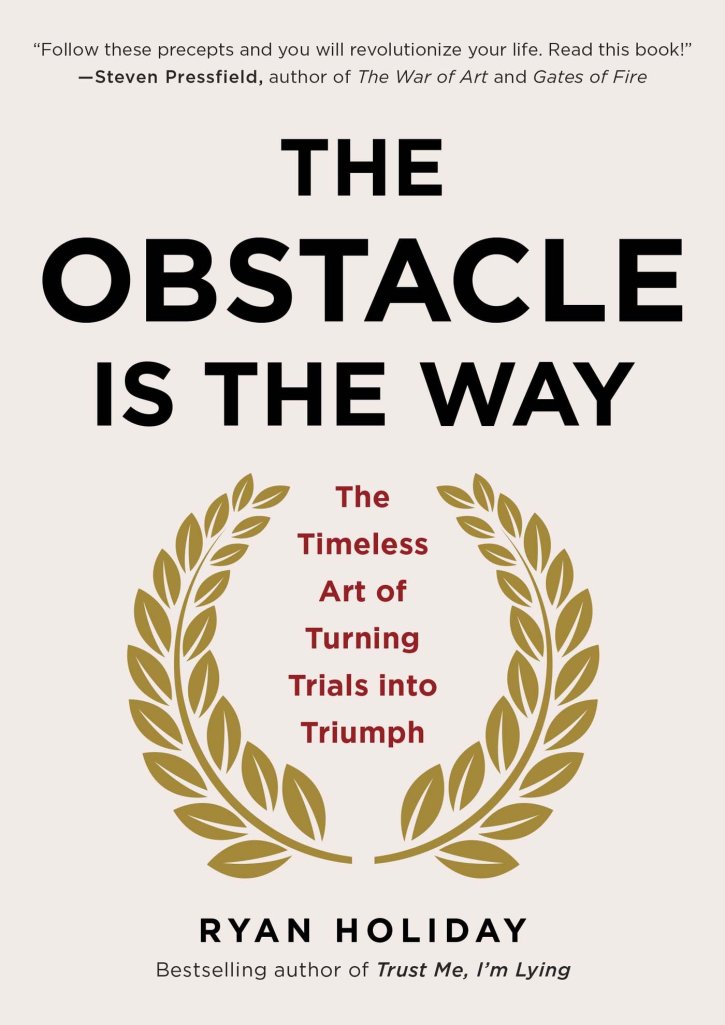
Ryan Holiday is an impressive young author. He’s in his mid-twenties and just published his third book, The Obstacle is the Way, which is a delightful, short, story-filled exploration of the value of embracing adversity. Ryan’s writing is influenced by the Stoics, and Marcus Aurelius’s Meditations is one of his favorite books also. (So, he must be cool, right?)
I’ve already given The Obstacle is the Way to a few young friends. It’s a quick read and filled with examples of great men and women who thrived in spite of, or, actually, because of the difficulties seemingly blocking their way.
Holiday, the author, has had an interesting career. He left college before graduating, but has continued his own education through some killer work experiences and a prolific consumption of books. My friend, Nick, recommended Holiday’s reading recommendation newsletter, and I’ve been impressed with the quality and quantity of his book suggestions.
This is a solid podcast interview with Ryan by Tim Ferriss. I listened to this while doing yard work recently and found Holiday to be just as engaging and thoughtful in conversation as he is in his writing. It’s a bit humbling to me that this guy who is almost half my age has accomplished so much and seems so wise already.
College students and others just getting started (and even old guys like me who are still trying to figure things out) will appreciate his take on building a meaningful and artful life.
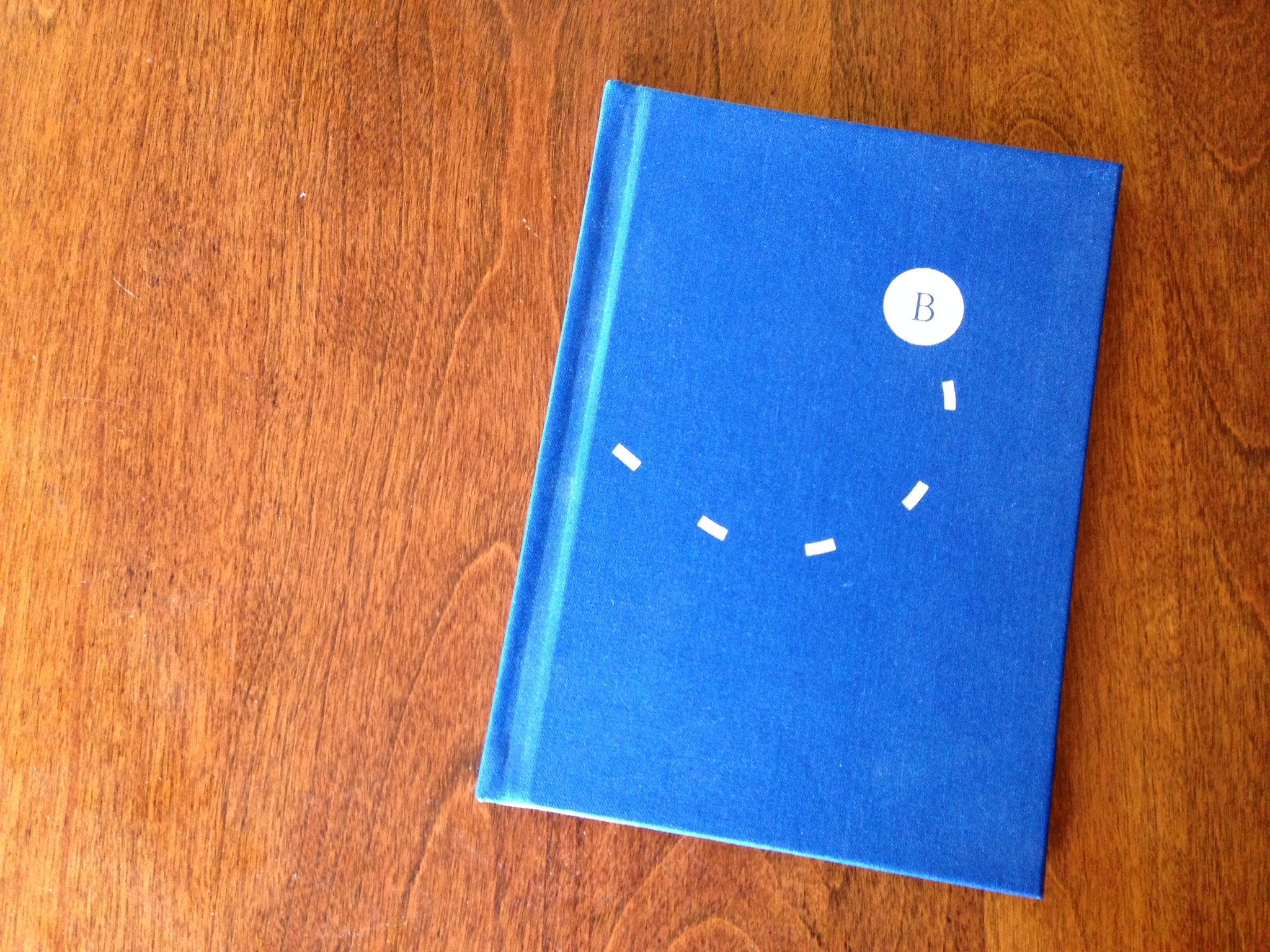
Need something thoughtful for a mother in your life for Mother’s Day this weekend? My daughters and I gave this lovely little book of Sarah Kay’s poem B to my wife a couple of years ago.
I think we ought to read only the kind of books that wound and stab us. If the book we are reading doesn’t wake us up with a blow on the head, what are we reading it for? …we need the books that affect us like a disaster, that grieve us deeply, like the death of someone we loved more than ourselves, like being banished into forests far from everyone, like a suicide. A book must be the axe for the frozen sea inside us. -Franz Kafka
Kafka is a bit extreme here (hyperbole suits him, of course), but I share his desire for books and for any art that pitches me out of my complacency, that disrupts my comfort of safe ideas and undisturbed feelings.
There’s a numbness to most of our daily existence. Well worn paths are trodden mindlessly. Wake up and go through the motions. Cling thoughtlessly to our tight little circle of opinions and beliefs.
There are landmark moments in my life, though, where an artist has shaken me and provoked a new way of seeing. It’s a surprisingly refreshing kind of pain.
I remember being twenty-something and crashing while riding a bicycle, landing hard on a gravel road and scraping my leg in the process. And it was euphoric. The pain startled me into a sudden awareness that I was indeed alive.
I need that kind of euphoric intellectual and emotional blow regularly. I should embrace the pursuit of ideas that stretch my mind and challenge me to reconsider comfortable assumptions. A truly great book can send me on a journey of discovery that changes everything.
I don’t mind some occasional mindless entertainment, but life is too short to not seek out regular doses of mental and emotional nourishment – provocative, mind altering, life altering works of art.
My friend Richard is a writer. We met for lunch a couple of months ago, and he told me he’s working on a novel. (So, yes, I have lunch with novelists.) We worked together on Capitol Hill many years ago, and now he’s retired from the political world and is focused on writing. He saw my post about books I’m reading and asked me why there are no novels on my to-read list.
I didn’t have a good answer. I’ve gone through phases where I read a lot of fiction and other times where I think I need to focus exclusively on non-fiction to get as much value as possible from my reading. But a great novel is more than a pleasant mental diversion. Fiction can awaken and enlighten in ways that non-fiction cannot. And a remarkable novel makes an indelible mark on my memory. There are passages from Tolstoy that evoke emotion twenty years after first reading them. (Read Tolstoy. His masterpieces may seem overwhelming, but they are simply long, not impenetrable. To the contrary, his writing is remarkable for its clarity and profound insight into the simplest of human experiences. He’s considered the greatest novelist ever for a reason.) The joyous experience of reading books like I, Claudius and The English Patient remain as vivid as recalling the greatest conversations I’ve ever had.
So, Richard’s question prompted me to add novels back into my regular reading routine, and it’s been a wonderful change. I try to read fiction at the end of the night. Novels are less likely to spark my mental to-do list or inspire brainstorming when I really need to go to sleep. I’m currently switching between two novels: The Signature of All Things by Elizabeth Gilbert and The Martian by Andy Weir. They are very different stories and provide a nice change of pace when I want to switch my attention, kind of like changing channels on TV for a different mood.
I’m more than three-quarters through each book, and I’m enjoying them both. I’ve also started Zorba the Greek and just purchased Memoirs of Hadrian. (I’m a sucker for Roman historical fiction, and this one gets such rave reviews.)
Getting lost in a great story is a singular pleasure. Being in a reading zone, where all else falls away, dispels distractions like few other activities. And in a distracted age such focused attention is precious therapy and a prod to more wholehearted living.
The delight and insight offered by a good story well told justify making the time for novels in your reading habit.
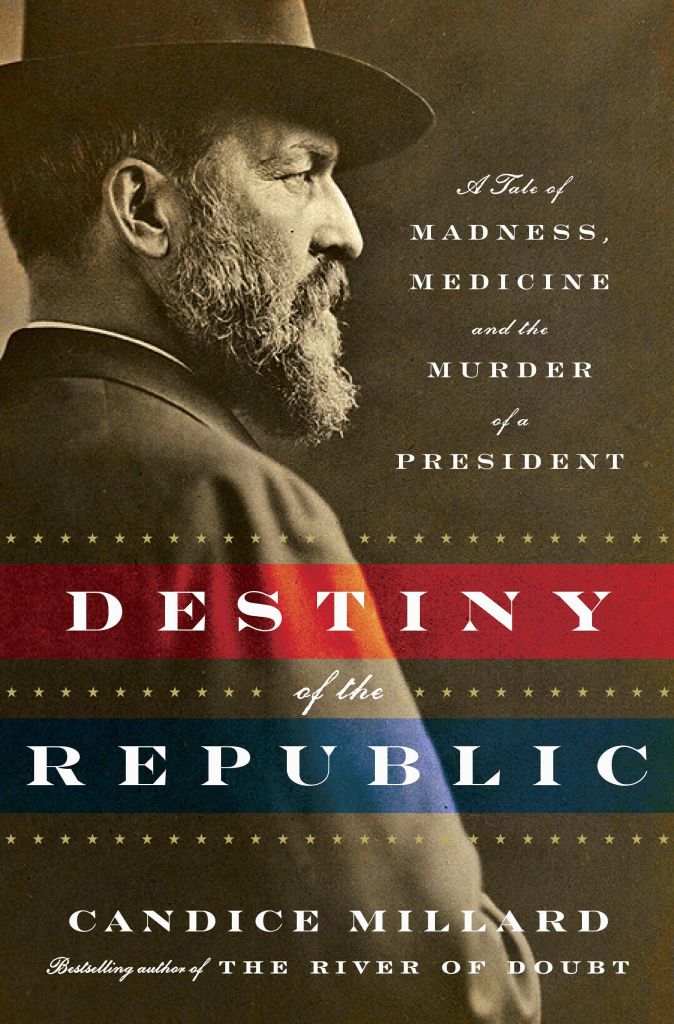
I recently read Destiny of the Republic by Candice Millard. It’s the story of the assassination of President Garfield in 1881, and it is beautifully written and heartbreaking.
Yes, a history book can be a page-turner. I previously knew very little about Garfield or late 19th-century American politics. And I wasn’t particularly compelled to know more until I saw this book recommended and read some terrific reviews. I’m willing to take a chance on a topic if I can expect remarkable writing from an author. I know a great writer can take a marginally interesting topic and make it fascinating, while a poor writer can ruin even the most promising material. (I’ve joked before that I would rather take an accounting class taught by a skilled and enthusiastic professor than sit through a sex ed class taught by someone who’s an uninspired and poor communicator. Same principle.)
Well, Millard’s writing delivered. She weaves story lines together masterfully. Politics, medicine, technology, and lunacy take their places in a narrative centered on the biography of a man who could have been a truly great president. But he’s no more than a footnote in history because of the delusions of one deranged man and the failings of late 19th-century medicine.
Garfield would easily have survived had medicine been about twenty years more advanced at the time. It wasn’t the assassin’s bullet that killed him. It was the infection caused by the ignorance of the doctors who treated him.
Garfield was a notable scholar and a leader of great character and immense talent. You can’t read this book and not have admiration for him. And that makes the story so much more wrenching, knowing what potential was lost and to such a combination of lunacy and medical incompetence.
This book is a great read for students of history and politics, of course, but also for those interested in medicine and technology. Alexander Graham Bell’s story is woven into Garfield’s as he rushes to perfect a device to help locate the bullet lodged inside the President. Bell at the time was weary of the acclaim and stress his invention of the telephone had brought him, and his quest to help save Garfield plunged him into work he thought would be of more lasting value than his most famous invention.
This book is a good story well told and is a reminder that non-fiction in the hands of an excellent writer can be just as compelling as a novel.
I’ve gone to iBooks as my primary reading app. Books just look better in iBooks compared to the Kindle app. iBooks allows for a natural ragged right margin, which is so much more appealing than the jarring full justification of Kindle titles. And I’m kind of digging the scrolling option that iBooks offers rather than standard page turns.
I received a generous iTunes gift card for Christmas from my in-laws. When my wife asked me what my favorite gift was, I said it was the iTunes card. It was a pleasure to ponder and explore book recommendations for a couple of weeks, and I was emboldened to be more adventurous with my acquisitions.
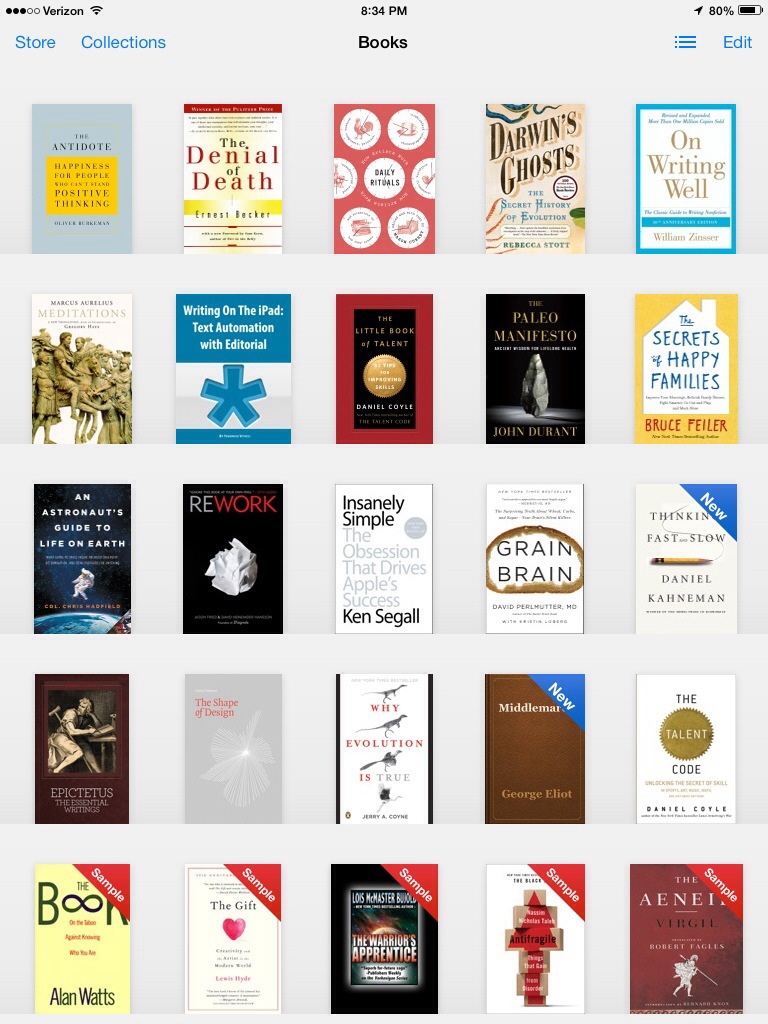
Below is a screenshot of the top of my bookshelf on my iPad. I’m especially enjoying Oliver Burkeman’s The Antidote, a wry look at the positive benefits of negative thinking. It’s a nice complement to my recent readings in the Stoic philosophers.
I recently finished Candice Millard’s excellent Destiny of the Republic, a page-turner of a history book. I’ll post some thoughts on it soon.
I tend to dip in and out of books until one grabs hold and compels me to commit to it. Burkeman’s book is pulling me in now. Looking forward to working my way through this stack.
“Human life.
Duration: momentary. Nature: changeable. Perception: dim. Condition of Body: decaying. Soul: spinning around. Fortune: unpredictable. Lasting Fame: uncertain. Sum Up: The body and its parts are a river, the soul a dream and mist, life is warfare and a journey far from home, lasting reputation is oblivion.
Then what can guide us?
Only philosophy.
Which means making sure that the power within stays safe and free from assault, superior to pleasure and pain, doing nothing randomly or dishonestly and with imposture, not dependent on anyone else’s doing something or not doing it. And making sure that it accepts what happens and what it is dealt as coming from the same place it came from. And above all, that it accepts death in a cheerful spirit, as nothing but the dissolution of the elements from which each living thing is composed. If it doesn’t hurt the individual elements to change continually into one another, why are people afraid of all of them changing and separating? It’s a natural thing. And nothing natural is evil.”
And this is from a Roman emperor, an actual, and rare, philosopher-king.
These gifts are awesome and can be given instantly online:
Born Standing Up by Steve Martin – $17.95. This audiobook is narrated by the author, making it even more awesome. Martin strums the banjo between chapters and you hear his story and his jokes in his own voice. Very nice way to spend four hours, especially if you’re traveling during the holidays.
Mastery by Robert Greene – $9.99. One of the three best books I read this year. Greene explores what sets the greatest masters in history apart. How did they become great, and what can we learn from them?
The Talent Code by Daniel Coyle – $13.99. This book completes the theme forwarded by the previous two. Coyle investigates talent hotbeds and what their formula is for producing the most skilled people in their fields. Neuroscience ends up offering the key to what it takes to be awesome at something.
Harry Potter HD bundle – $59.99. All eight Harry Potter movies in HD, downloadable in iTunes to play on your iPad or Mac or on Apple TV. That’s $7.50 per movie. Limited time on this discount.
If you’ve got time to ship something, here are some excellent gifts:
Apple TV – $99. My family’s entertainment centers around this tiny device. If you’ve got an iPad or iPhone or Mac, the AirPlay feature is like magic and makes the Apple TV more compelling than a Roku.
Bodum YoYo Personal Tea Set – $34.95. This is how I brew my tea each morning. It is beautifully designed and an elegant, simple way to enjoy a hot cup of tea.
Things that are beautifully and thoughtfully designed are delightful and offer too rare a pleasure in our culture. There is a grace in great things. The art of a skilled maker – an author or designer or creator of any sort – transfers emotion and gives a gift to the recipient beyond the monetary value of the thing itself. Enjoy finding ways to delight those you love this holiday season.
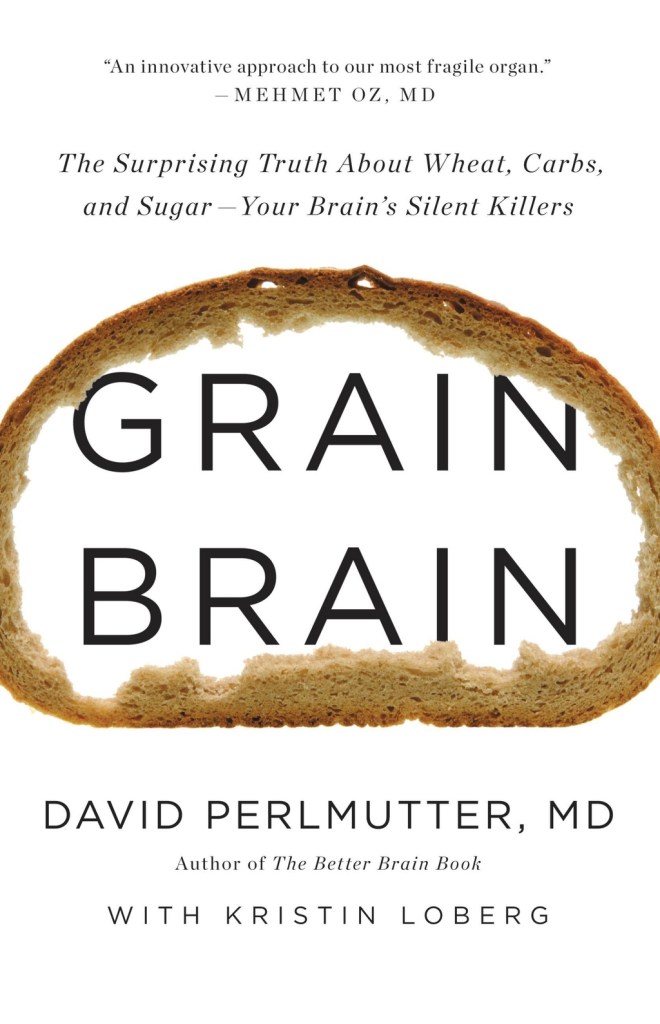
I just downloaded Grain Brain on iBooks today. It’s a potentially game changing book by a prominent board-certified neurologist, David Perlmutter, who also happens to be a Fellow of the American College of Nutrition.
The basic point of the book: carbohydrates are toxic for your brain. Seriously. Even so-called healthy whole grains and most fruit.
He’s even got traditionally conventional low-fat/whole grain-touting Dr. Oz turning around on this. Here’s Perlmutter on Oz’s show discussing how carbohydrate consumption may be a key culprit in the rise of Alzheimer’s.
Conventional wisdom has been stubborn, but I’m seeing more mainstream acceptance recently of the merits of a low-carb/high-fat diet. Usually, it’s related to fighting obesity and diabetes. This focus on brain health, though, is startling and may make for a double-whammy that begins to change our culture’s attachment to the old, failed emphasis on cutting fat and eating more whole grains.
I know just reading the first few pages of this book has me recommitting to a low-carb approach. Both my brain and my waistline will thank me.
There’s an interesting story in The Atlantic about the evolutionary advantages of story telling. Humans have been sharing stories for possibly a million years. Story tellers thrived and survived.
We long to be pulled along by a narrative. Even a poorly told story is more compelling than just disconnected facts. We are wired for story from generations of story tellers binding us together and guiding us as a culture.
And now stories are filling up even more of our attention each day. From The Atlantic article:
Thanks to Gutenberg and the inventions of film and television, we immerse ourselves in more narratives than our ancestors could have imagined, which means we’re cutting back, along the way, on real-life experience.
This means our choice of which stories to consume is more crucial than ever. They need to be as useful as lived experience, or more so, or we’re putting ourselves at a disadvantage.
Mediocrity abounds in popular culture. Seek out quality. Time-wasting entertainment is like junk food. Fill your time with real life and meaningful experiences. Make a great story of your own life. And when you do seek to get lost in someone else’s narrative, choose wisely. The classics are classics for a reason. They’ve stood the test of time and are probably worthy of your attention.
Seek out the greatest authors and filmmakers. And when you find an artist that connects with you, go feast on everything they’ve produced rather than sampling lightly and bouncing around to other creators. Do a deep dive into an artist’s work. If War and Peace grabs you, don’t stop there. Go read all of Tolstoy. Loved 2001? Make time to watch all of Kubrick’s films.
Our story is a million years in the making. Fill your life with stories worth your attention.






 Excellent Journey