Epictetus on choices and living artfully

FullSizeRender

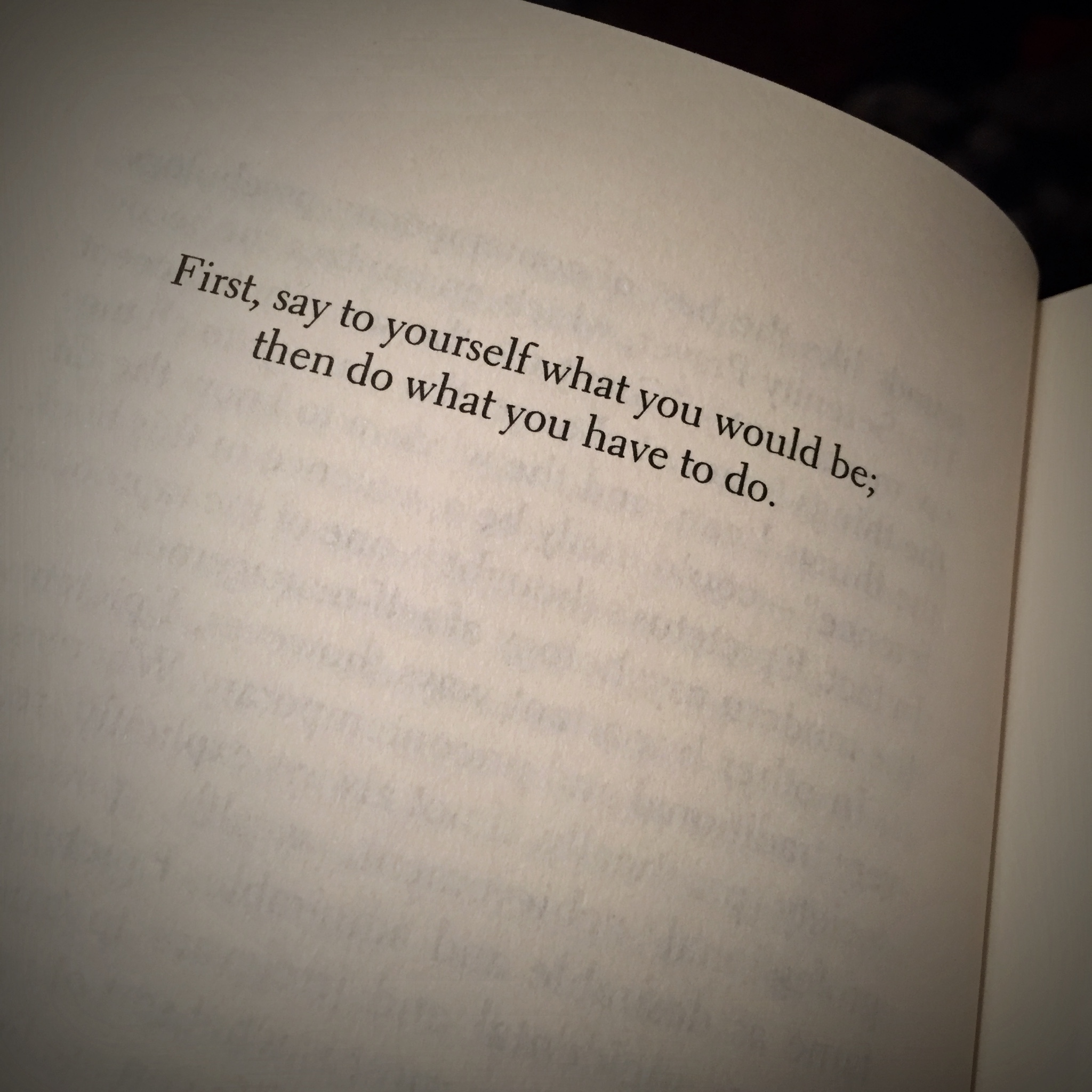
My wife put a lamp by the deeply cushioned chair in our bedroom last night to make a new reading spot in our house, and I gave it a go. I sat down to read from an actual book, made from paper. It was my hardcover copy of The Art of Living, Sharon Lebell’s collection of the best of the wisdom of the first and second century Stoic teacher Epictetus.

Epictetus had been a slave who earned his freedom through his excellence as a student and, eventually, a teacher of Stoic philosophy. Nothing he may have written survives, but his students collected and saved his teachings, which went on to influence everyone’s favorite philosopher king, Marcus Aurelius. (Marcus was an emperor, not a king, of course. Philosopher emperor was beyond even Plato’s imagination.)

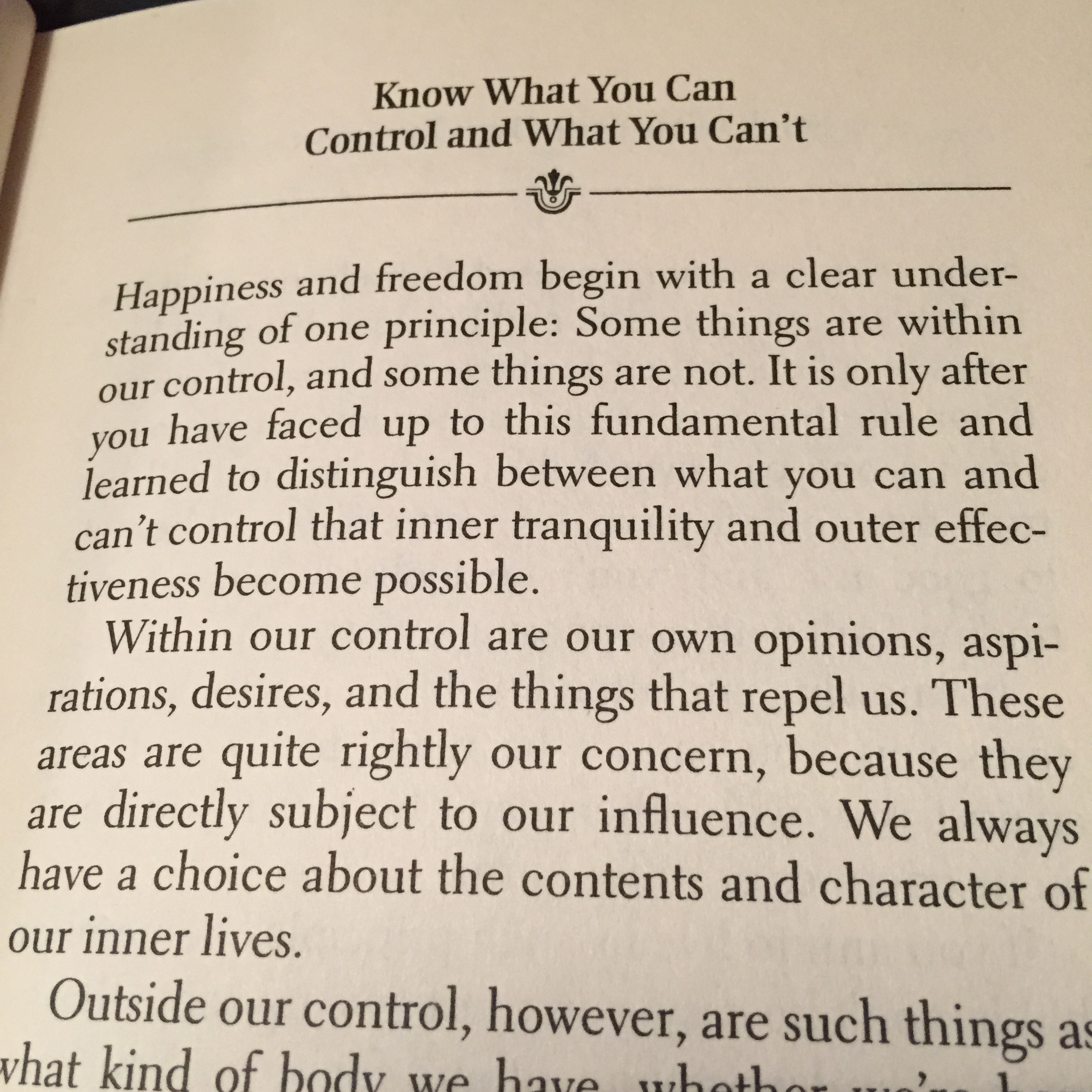
The single sentence on the opening page above is as good an exhortation as anyone could need. But it’s followed on the next page by this jewel of simple yet often neglected common sense:
IMG_5765


We always have a choice about the contents and character of our inner lives.

We don’t have much control over what happens around us and to us, but we do get to choose our response. Easy to understand. Hard, though, to own that choice standing in the often very small, poorly lit gap between stimulus and response.

I’ve got to at least be more aware that I am making these choices. I am responsible – able to choose my response – and not made to do or be anything not in my choosing. No one or no thing can make me angry, for example. I may choose to be angry in response, but it’s my choice, whether I own up to it or not.

I need these reminders regularly. Searching to share something insightful every day has been a great way to live a more adventurous inner life and to remind myself to do better, to grow and improve. These notes to self that I share publicly have become a daily discipline that I hope will keep me sharp and curious. I recommend this to anyone looking to make better sense of their own thinking and their place in the universe. Oh, that’s everyone. Of course, everyone should write.

We all are artists creating a unique life, a life that’s never been before and never will be again. Choose to craft yours as though you’re sculpting a masterpiece.

Life is asking us a question

From Ryan Holiday’s excellent book The Obstacle is the Way:

The great psychologist Viktor Frankl, survivor of three concentration camps, found presumptuousness in the age-old question: “What is the meaning of life?” As though it is someone else’s responsibility to tell you. Instead, he said, the world is asking you that question. And it’s your job to answer with your actions.
In every situation, life is asking us a question, and our actions are the answer. Our job is simply to answer well.

The infinity of past and future gapes before us

IMG_5648.JPG
Meditations 5.23-24:

23. Keep in mind how fast things pass by and are gone—those that are now, and those to come. Existence flows past us like a river: the “what” is in constant flux, the “why” has a thousand variations. Nothing is stable, not even what’s right here. The infinity of past and future gapes before us—a chasm whose depths we cannot see.
So it would take an idiot to feel self-importance or distress. Or any indignation, either. As if the things that irritate us lasted.
24. Remember:
Matter. How tiny your share of it.
Time. How brief and fleeting your allotment of it.
Fate. How small a role you play in it.

Accept whatever happens

Meditations 4.33:

Everything fades so quickly, turns into legend, and soon oblivion covers it.
And those are the ones who shone. The rest—“unknown, unasked-for” a minute after death. What is “eternal” fame? Emptiness.

Then what should we work for?

Only this: proper understanding; unselfish action; truthful speech. A resolve to accept whatever happens as necessary and familiar, flowing like water from that same source and spring.

What if you embraced whatever happens as if you chose it? Even – especially! – if it is something that seems like a setback.

You have so little control over almost everything external to you. But you always have control over how you respond. If you choose to be curious, intrigued, or fascinated instead of perturbed, discouraged, or angry, imagine how everything changes.

Sampling books

After just finishing a massive novel I find myself a bit lost, wondering what to invest my reading time in next.

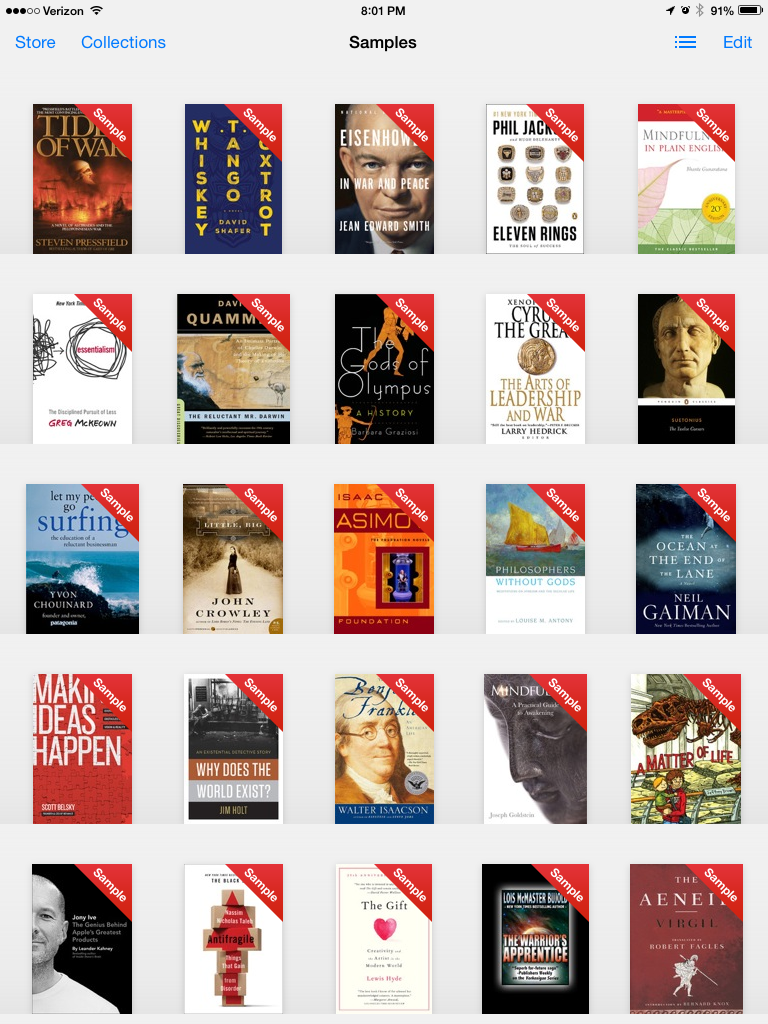
I’ve got a good collection of unread non-fiction in my iBooks library, but I can’t resist searching for new discoveries. I keep a separate collection of book samples I’ve downloaded. It’s a great way to remind myself of books to consider and try them out before purchasing.

I never feel guilty about spending on books, though. It’s a virtuous vice. Err on the side of overdoing it with books rather than scrimping on what is easily one of the most beneficial habits for living an excellent life.

Here’s my current collection of samples I’m exploring:

IMG_1201.PNG

When I get a little money I buy books; and if any is left I buy food and clothes. –Erasmus

Fantasy recommendation: Words of Radiance

I started reading a fantasy series this summer. I like to have a novel in my reading rotation along with whatever non-fiction I’m reading. It’s nice to end the night with fiction. It’s less likely to spark ideas that get my brain going when I’m trying to wind down.

Fantasy is not my usual genre, though. I read The Lord Of the Rings when I was younger and have enjoyed lighter fantasy like Neil Gaiman’s Stardust. But I’ve never gotten into the breadth of fantasy literature.

A friend recommended Brandon Sanderson’s The Way of Kings when I was looking for beach reads. I gave it a look and ended up enjoying it. It’s a massive first book in a projected ten book series. The author creates a richly intricate and original world and crafts a compelling narrative around three strong main characters.

I ended up downloading the second book, Words of Radiance, as soon as I had finished the first. It’s another 1,000+ page epic, and it’s a page-turner with as satisfying a payoff as any novel I’ve read. Now, a long wait until the third in the series is released.

I read these two books in awe of the author’s ability to hone the details of his story. His vision of the setting and the countless back stories is impressive. What a gift he has to make these stories come to life with such imagination and daring.

If you’re willing to invest some time in a long, long read and invest in a fascinating world of escape, this series will delight you.

IMG_1198.PNG

Five C’s of leadership

Kevin and Melissa, two of the university students I work with, are taking a leadership class and were assigned to ask questions about leadership. They both had this question for me: “What are the characteristics of an effective leader?”

“Effective” is subject to interpretation. Gengis Khan was effective… in conquering, destroying, and subjugating, but he was a heck of a leader, as were many violent tyrants throughout history.

For this purpose, however, let’s assume effective has a threshold of moral propiety that makes no room for obvious bad behavior or world domination.

Leadership is not a topic I’ve explored with much intention. I’ve always felt like I’ve known it when I’ve seen it, and, more commonly, been very aware where it’s lacking. As I pondered this question from my students, though, some key attributes came to mind. (And after I thought of the first couple, I couldn’t resist continuing with alliteration. Hence, five “C’s”.)

Here’s what I see or hope to see in the most honorable and effective leaders:

Clarity – Effective leaders have a clear vision of the big picture and can communicate with clarity the “why” of an organization or business or movement. “Why?” comes first, and if a leader hasn’t asked and can’t answer that question about the endeavor they’re hoping to lead, they still may be leading effectively but in a completely wrong direction.

Caring – A good leader cares deeply about the mission and the people involved and all the “how’s” and “what’s” necessary for excellence. The leader cares about even small details, about the process as much as (if not more than) the outcome. The intrinsic rewards of a job well done, of creating something of value and quality, outweigh any extrinsic rewards.

Competence – Mastery inspires confidence. We will follow someone who is clearly competent in their abilities, who knows their stuff. Teammates will rally around someone who is committed to excellence and demonstrates extraordinary competence, even if that person has not been entrusted with any official leadership role.

Character – The authentic person of integrity, who treats everyone with fairness and is impeccable with their actions, that person is a leader I want to follow. A leader of character will be wholly themselves regardless of the circumstances or the people around them. And trust is the most valuable asset an effective leader has to offer.

Compassion – A leader I admire is one who is kind and compassionate and who treats everyone with respect regardless of position or title. She is quick to forgive, eager to reconcile, and open to listening to and understanding even, or especially, divergent viewpoints.

My favorite description of a master leader comes from the Tao te Ching, one of the most profound books of wisdom:

When the Master governs, the people
are hardly aware that he exists.
Next best is a leader who is loved.
Next, one who is feared.
The worst is one who is despised.

If you don’t trust the people,
you make them untrustworthy.

The Master doesn’t talk, he acts.
When his work is done,
the people say, “Amazing:
we did it, all by ourselves!”

You don’t need to be offered a promotion or run for office to be a leader. Be the CEO of your cubicle or your desk. Lead yourself. Act like you are who you want to be and embody the attributes that lead to an excellent life well lived.

Mesmerized by routine

Mason Currey’s fascinating book, Daily Rituals, is filled with details of how prolifically creative people structure their days. Here’s the opening paragraph on novelist Haruki Murakami’s daily rituals:

When he is writing a novel, Murakami wakes at 4:00 A.M. and works for five to six hours straight. In the afternoons he runs or swims (or does both), runs errands, reads, and listens to music; bedtime is 9:00. “I keep to this routine every day without variation,” he told The Paris Review in 2004. “The repetition itself becomes the important thing; it’s a form of mesmerism. I mesmerize myself to reach a deeper state of mind.”

A repetitive daily routine seems monotonous, but consistently flipping the switch on a work mode will eventually let the muse know you are in it for the long haul. And the muse will be expected to show up, too. The sameness can lull your inner critic, that voice of caution that kills your creative fight. Mesmerized by routine, you can summon more consistently the creative force that may never otherwise appear randomly.

Microscopic truthfulness

IMG_1096.PNG

My favorite book is If You Want to Write by Brenda Ueland. I’ve written about this charming, effusively encouraging and insightful book before and was reminded recently of her championing what she called “microscopic truthfulness”.

Good writing or art or communication of any sort should be characterized by a detailed and exacting commitment to accuracy. Details matter. Our brains can absorb so much and have evolved to find patterns and grasp nuance. The effective artist will take advantage of the audience’s ability and eagerness to fully inhabit and imagine sensory and emotional details. We miss opportunities to deeply connect and make our message resonate if we don’t embrace the fine points, if we stick to mere generalizations.

Hemingway gave similar advice about observing intently and communicating in detail:

Find what gave you the emotion; what the action was that gave you the excitement. Then write it down making it clear so the reader will see it too and have the same feeling that you had.

Details matter and give meaning and energy and interest to what would otherwise be forgettable and lost in the wash of information that rolls over us every day.

Act as if you were absolutely perfect

All you get by waiting is more waiting. Absolute perfection is here and now, not in some future, near or far. The secret is in action – here and now. It is your behavior that binds you to yourself. Disregard whatever you think yourself to be and act as if you were absolutely perfect – whatever your idea of perfection may be. All you need is courage.
My grace is telling you now: look within. All you need you have. Use it. Behave as best you know, do what you think you should. Don’t be afraid of mistakes; you can always correct them, only intentions matter. The shape things take is not within your power; the motives of your actions are.
–Sri Nisargadatta Maharaj

I found this in the book 365 Nirvana: Here and Now, which is a profound collection of insight and wisdom I used to keep on my nightstand.

This thought seems stunning: “Absolute perfection is here and now… Act as if you were absolutely perfect.” Acting as if conjures almost magical powers. Action is the key.

Do something! Stop thinking and waiting and hoping and wondering. Have a picture in your mind of who you want to be? Even if you’re not sure or you’re afraid you’ll change your mind later, go ahead and start acting like you are that person you envision.

Wake up each day and intend to be the perfect version of the human you imagine yourself to be. You will screw up, likely before you leave your room. It doesn’t matter. Your intent is what counts. Keep coming back to the actions that you desire.

Don’t judge yourself by some distant goal. Just be perfect in this moment. Act like you are who you want to be.

Chris Hadfield: “Don’t let life randomly kick you into the adult you don’t want to become.”

Everyone’s favorite Canadian Astronaut, Chris Hadfield, has written a really good book, The Astronaut’s Guide to Life on Earth. He tells the improbable story of how a kid from Canada grew up dreaming of going to space and ended up as the most well known astronaut of his era. The book is filled with lessons he learned on his quest but that are relevant to those of us who will only be astronauts in our imagination. Hadfield has been a prominent and relatable voice for space exploration and science education. And he just seems like such a good guy.

ZenPencils created a great illustration of this response from Hadfield in a Reddit “Ask Me Anything”, which he did while orbiting the Earth in the International Space Station:

Decide in your heart of hearts what really excites and challenges you, and start moving your life in that direction. Every decision you make, from what you eat to what you do with your time tonight, turns you into who you are tomorrow, and the day after that. Look at who you want to be, and start sculpting yourself into that person. You may not get exactly where you thought you’d be, but you will be doing things that suit you in a profession you believe in. Don’t let life randomly kick you into the adult you don’t want to become. –Chris Hadfield

Act like you are who you want to be. Do the things that the ideal version of you would do. Live the life you have imagined.

“The future is a hoax”

From Alan Watts’s intriguing and challenging The Book On the Taboo Against Knowing Who You Are:

Unless one is able to live fully in the present, the future is a hoax. There is no point whatever in making plans for a future which you will never be able to enjoy. When your plans mature, you will still be living for some other future beyond. You will never, never be able to sit back with full contentment and say, “Now, I’ve arrived!”

Your life is now. The challenge is to live where your life is and not where you think or hope it’s going to be in the future.

Craft a routine for creative spontaneity

I’ve often taken pride in a seat-of-the-pants approach. With Indiana Jones as a model – “I’m making this up as I go!”winging it seemed a virtue.

With age, though, I’ve developed an appreciation for order and structure and routine. And I’m far from disciplined in actually applying order to my daily life.

We expect creativity to be mysterious and ecstatic, and we wait for it, hoping it will grab hold of us. We delay, waiting to be inspired.

But it’s been my experience that waiting for inspiration leads to a lot of doing nothing. What if it’s the other way around? What if routine and structure, showing up and taking action regardless of your emotional state, were what summoned the muse?

Here is William James as quoted in the excellent book, Daily Rituals, by Mason Curry:

“The more of the details of our daily life we can hand over to the effortless custody of automatism, the more our higher powers of mind will be set free for their own proper work. There is no more miserable human being than one in whom nothing is habitual but indecision, and for whom the lighting of every cigar, the drinking of every cup, the time of rising and going to bed every day, and the beginning of every bit of work, are subjects of express volitional deliberation.”

Interestingly, at the time James wrote this he was struggling with the misery of indecision he describes.

As a new school year is beginning, it’s a great time to craft a fresh, new routine for your days. Create a structure of when to arise and exercise and work and eat and read and play and when to turn the lights out. Stick to the schedule. Automate easy decisions, taking them out of your brain and opening space there for more challenging, creative endeavors.

Routine can spark spontaneity. Make a plan, show up consistently, and see if inspiration notices your pattern and begins showing up, too.

Keep it simple, make it clear

A story from Ken Segall’s book, Insanely Simple, about his experience as part of the advertising team working with Apple:

At one agency meeting with Steve Jobs, we were reviewing the content of a proposed iMac commercial when a debate arose about how much we should say in the commercial. The creative team was arguing that it would work best if the entire spot was devoted to describing the one key feature of this particular iMac. Steve, however, had it in his head that there were four or five really important things to say. It seemed to him that all of those copy points would fit comfortably in a thirty-second spot.
After debating the issue for a few minutes, it didn’t look like Steve was going to budge. That’s when a little voice started to make itself heard inside the head of Lee Clow, leader of the Chiat team. He decided this would be a good time to give Steve a live demonstration.
Lee tore five sheets of paper off of his notepad (yes, notepad—Lee was laptop-resistant at the time) and crumpled them into five balls. Once the crumpling was complete, he started his performance.
“Here, Steve, catch,” said Lee, as he tossed a single ball of paper across the table. Steve caught it, no problem, and tossed it back.
“That’s a good ad,” said Lee.
“Now catch this,” he said, as he threw all five paper balls in Steve’s direction. Steve didn’t catch a single one, and they bounced onto the table and floor.
“That’s a bad ad,” said Lee.
I hadn’t seen that one before, so I rather enjoyed it. And it was pretty convincing proof: The more things you ask people to focus on, the fewer they’ll remember. Lee’s argument was that if we want to give people a good reason to check out an iMac, we should pick the most compelling feature and present it in the most compelling way.

Keep it simple. I often struggle with a “kitchen sink” approach when I speak, wanting to throw in everything that might be useful. But what is most important and how can I make that stick? What do I need to cut so that I can give more attention to what matters most? Make it clear.

And consider how many people use Powerpoint and fill their slides with multiple points. Lots of points, no power. One point per slide is much more effective.

Kill the bullet points. Hone your idea to the essentials, and craft your message with simplicity and clarity.

Screen Shot 2014-07-29 at 11.24.36 AM


Daring in design, cautious in execution

Screen Shot 2014-07-24 at 3.29.04 PM

I’m reading Titan, Ron Chernow’s massive biography of John D. Rockefeller. Early in Rockefeller’s career, his approach to business is described as “daring in design, cautious in execution.”

That’s a good motto for undertaking any endeavor. Be bold with your vision. Go where no one has gone. Go bigger. Go better. Have the courage to be audacious with your plan.

Then pursue that vision with care and meticulous attention to detail. Be patient and plodding, even, as you painstakingly nurture and craft the small things that are necessary to make your big plan truly daring and worth talking about.

Apple works this way. Their vision is bold. They want to change the world with their products. But they are conservative with their execution, famous for patiently and secretly refining and iterating, unwilling to release anything that doesn’t meet their high standards, even if profit is assured.

The big picture is crucial, and having a daring goal can spark action and unleash possibilities previously unimagined. But it’s the execution – the follow-through and the commitment to the countless difficult decisions and unglamorous hours honing and reworking the details – that determines the destiny of the dream.

Dream your big dreams. Open to a blank page and put down those daring, scary ideas. Commit to the vision that most delights you, and then get busy doing the deep, detailed work necessary to make that dream fulfill its promise.

Write what you want to read

I’m reading The Way of Kings by Brandon Sanderson now. (Thanks to my friend, Jesse, for the recommendation.) It’s an epic fantasy novel (1,000 pages in this first of a planned ten book series) and not my usual reading fare. But I’m immersed in it and marveling at the compelling narrative and level of detail the author has created. Years ago, before the movies ever came out, I read Tolkien’s Lord of the Rings and felt a similar level of awe at the marvelous world an author can create.

Intrigued by this young author’s career, I found this interview with Sanderson and appreciated his approach:

I can only speak from my own experience, which may be abnormal, but I really feel that the times where I worried too much about the market were the times I wrote my worst fiction. And the times where I wrote: “this is what I want to read — this is what I’m passionate about,” I wrote my best fiction. And so that’s what I would advise.

That being said, I was very steeped in this genre. You can say what I wanted to read was very naturally an outgrowth of what a lot of what the fandom wanted to read because I was one of them. That’s why it worked for me. And I’m sure there are a number of people who are writing to their passion, and it just doesn’t end up catching on. I wrote 13 books before I got published, and at the end of the day I decided I would rather keep writing and never publish than give up writing or go do something else. And if I reached the end of my life and had 70 unpublished novels, I’d still consider myself a successful writer. That decision has driven me ever since and it’s worked out for me. -Brandon Sanderson

He’s writing what he wants to read and seems as if he would be content if he was never published.

That’s a good formula for work in general, not just writing. Make things that will delight you. Do your best, not for the chance for advancement or to impress bosses or to win some sales competition. Be awesome in all that you do whether anyone else notices or not. You will notice. And you will delight in the intrinsic rewards of work that shines regardless of any extrinsic rewards.

And that approach is more likely to produce quality work that does resonate and connect with others in a more meaningful way than trying to figure out what will sell.

Socrates: A Man for Our Times

20140714-125249-46369584.jpg

I just finished reading Paul Johnson’s Socrates: A Man for Our Times. It’s a quick read at 224 pages, maybe too quick. (By contrast, I’m currently reading Titan, the acclaimed biography of John D. Rockefeller. Titan weighs in at a massive 832 pages. No offense to John D., but Socrates easily is one of the most influential figures in all of human history. The page differential in these two books seems crazy.)

I was looking for a bit more depth and detail, but Johnson’s book is nice as an introduction to Socrates. He seems completely worthy of the acclaim he gets as the first and maybe the greatest of the world’s philosophers. His character was consistent with his philosophy, and he was greatly admired by seemingly all who knew him in his beloved Athens.

Socrates was not interested in philosophy as an academic pursuit but only in how it could be applied to daily life, to help people live better lives. He wouldn’t be likely to get a job in the philosophy departments at most colleges were he living today.

He fully and humbly embraced his own ignorance, and that makes him such an appealing character. He regularly claimed to know nothing and that he was just trying to find things out. From the book:

His one reiterated insistence was that he knew nothing. What he did feel he could do, and what was the essence of his ministry, was to help ordinary humans to think a little more clearly and coherently about what constituted good behavior, worthy of humanity at its best.

“He cannot teach Wisdom because he has none, and he cannot give birth to Wisdom any more than he can give birth to a child. But if someone else has Wisdom within him, or her, he can assist, by his questioning, and help them to give birth to the truth they carry within their minds and hearts.”

He seems to have felt he knew nothing about the things that really mattered. When his friend Chaerephon, while visiting the Oracle of Delphi, asked if any man was wiser than Socrates, the answer came: “There is none.” When told about this, Socrates was not flattered but puzzled. He eventually concluded that what the Oracle meant was that his wisdom consisted in knowing his own ignorance.

Considered to be one of the wisest men ever, Socrates thought of himself simply as someone who was only sure of how little he knew.

His approach epitomizes one of my favorite notions:

“He who thinks he knows, doesn’t know. But he who knows he doesn’t know, knows.”

Socrates regularly challenged others, by words and by his own example, to examine their lives, to not just go through the motions. It’s easy to default to navigating your life on auto-pilot, but you’ve got a fabulously interesting mind and the freedom to inquire and explore. What a missed opportunity if you don’t live with intention and seek to craft for yourself a virtuous and excellent life.

For Socrates, ideas existed to serve and illuminate people, not the other way around. Here was the big distinction between him and Plato. To Socrates, philosophy had no meaning or relevance unless it concerned itself with men and women. It is worth repeating, and emphasizing, Cicero’s summary of Socrates’ work: “He was the first to call philosophy down from the sky and establish her in the towns, and bring her into homes, and force her to investigate the life of men and women, ethical conduct, good and evil.”

For Socrates saw and practiced philosophy not as an academic but as a human activity. It was about real men and women facing actual ethical choices between right and wrong, good and evil. Hence a philosophical leader had to be more than a thinker, much more. He had to be a good man, for whom the quest for virtue was not an abstract idea but a practical business of daily living. He had to be brave in facing up to choices and living with their consequences. Philosophy, in the last resort, was a form of heroism, and those who practiced it had to possess the courage to sacrifice everything, including life itself, in pursuing excellence of mind. That is what Socrates himself did. And that is why we honor him and salute him as philosophy personified.

Examine your life. Embrace not-knowing. Be as excellent as you can be.

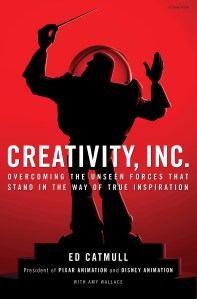
Creativity, Inc.

© Disney • Pixar

I recently finished reading Creativity, Inc. by Ed Catmull, the President of Pixar and Disney Animation. It’s really good. So many business books come across as superficial or self-serving PR pieces. But Catmull has created an enlightening, useful book filled with candid insights into the creative powerhouses he has helped to build.

Catmull tells the fascinating story of how Pixar came to be and then goes on to share how they have adapted in response to internal challenges to continue making remarkable movies. This is a particularly great read if you are responsible for leading other creative people or if you are part of a team of creatives. Catmull doesn’t sugarcoat Pixar’s success. He focuses repeatedly on failures and stresses that have forced the company to keep reinventing its processes.

This book is worthwhile for anyone who wants to understand what it takes to create and cultivate a great organizational culture.

If you’re part of an organization or a team or a family even, and you care about it being the best it can be, you must care about the group’s culture. If you’re not intentional about shaping and cultivating the culture, then brace yourself for the culture to be shaped randomly, and possibly destructively. Culture is everything for an organization.

It’s clear that Catmull and his partner John Lasseter (and the late Steve Jobs) were meticulous in crafting the culture of Pixar to bring out the best in the creative people on their team. And they’re still learning and failing and trying new approaches.

Here are some passages I highlighted as I read:

“Figuring out how to build a sustainable creative culture—one that didn’t just pay lip service to the importance of things like honesty, excellence, communication, originality, and self-assessment but really committed to them, no matter how uncomfortable that became—wasn’t a singular assignment. It was a day-in-day-out, full-time job. And one that I wanted to do.”

“My hope was to make this culture so vigorous that it would survive when Pixar’s founding members were long gone, enabling the company to continue producing original films that made money, yes, but also contributed positively to the world.”

“Getting the right people and the right chemistry is more important than getting the right idea.”

“Candor isn’t cruel. It does not destroy. On the contrary, any successful feedback system is built on empathy, on the idea that we are all in this together, that we understand your pain because we’ve experienced it ourselves.”

“You need storms. It’s like an ecology. To view lack of conflict as optimum is like saying a sunny day is optimum. A sunny day is when the sun wins out over the rain. There’s no conflict. You have a clear winner. But if every day is sunny and it doesn’t rain, things don’t grow. And if it’s sunny all the time—if, in fact, we don’t ever even have night—all kinds of things don’t happen and the planet dries up. The key is to view conflict as essential, because that’s how we know the best ideas will be tested and survive. You know, it can’t only be sunlight.”

“My rule of thumb is that any time we impose limits or procedures, we should ask how they will aid in enabling people to respond creatively. If the answer is that they won’t, then the proposals are ill suited to the task at hand.”

“Better to have train wrecks with miniature trains than with real ones.”

“Paying attention to the present moment without letting your thoughts and ideas about the past and the future get in the way is essential. Why? Because it makes room for the views of others. It allows us to begin to trust them—and, more important, to hear them. It makes us willing to experiment, and it makes it safe to try something that may fail. It encourages us to work on our awareness, trying to set up our own feedback loop in which paying attention improves our ability to pay attention. It requires us to understand that to advance creatively, we must let go of something. As the composer Philip Glass once said, ‘The real issue is not how do you find your voice, but … getting rid of the damn thing.'”

“My goal has never been to tell people how Pixar and Disney figured it all out but rather to show how we continue to figure it out, every hour of every day. How we persist. The future is not a destination—it is a direction. It is our job, then, to work each day to chart the right course and make corrections when, inevitably, we stray. I already can sense the next crisis coming around the corner. To keep a creative culture vibrant, we must not be afraid of constant uncertainty. We must accept it, just as we accept the weather. Uncertainty and change are life’s constants. And that’s the fun part.”

“Unleashing creativity requires that we loosen the controls, accept risk, trust our colleagues, work to clear the path for them, and pay attention to anything that creates fear. Doing all these things won’t necessarily make the job of managing a creative culture easier. But ease isn’t the goal; excellence is.”

What a refreshing book. Great stories. Candid insights. Humble confessions. Helpful advice from many of the key players at Pixar on how to work in a more effective and creative way. Pixar can seem to do no wrong. (Except for Cars 2. What happened there?) This book continues the string of excellent stories from what has become maybe our nation’s most iconic story teller.


June books

I finished a couple of books this week – Dying Every Day about Seneca and Nero and The Sisters Brothers, a striking novel about brothers who work as hired killers on a mission to track down their victim during the California gold rush.

Both are impressively written, and both are a bit disturbing and dark. Death around almost every page.

Nero was brutal, having his own mother and wife murdered among many other victims who fell out of his favor. The glory of Rome is hard to see under such a monster, and the Stoic sage, Seneca, was unable to do much as Nero’s chief adviser to moderate his worst instincts.

The characters in The Sisters Brothers had a gentler, occasionally comic approach to their killings. But, still, I’ve read enough for now about violence and despair.

I’m moving on to continue making a dent in the pile of books I purchased earlier in the month. Here’s my current reading list not including a novel I just downloaded, Beautiful Ruins, which is only $2 right now for the Kindle version.

20140628-180930-65370138.jpg