My wife’s company is sending us to Hawaii for a week as a reward for her great sales performance in the past year.
I’ve never been to Hawaii, but it’s a place that’s always been near the top of my dream destinations list.
To get myself in an island state of mind I started reading James Michener’s epic novel, Hawaii.
So good.
Michener reaches way back as he begins with the geological history of the place and the story of the volcanic eruptions that eventually launched the islands from deep within the Pacific. From there he gradually builds a narrative of the first people to find the islands, and it’s an incredible story of risk and courage and skill. I’m locked in to this great book and eager to immerse myself in all things Hawaii as we plan for our trip.
When I visited Italy years ago I re-read I, Claudius, the masterful novel set in first century Rome. Like pairing wine with a meal, it’s a delight to pair fiction with an upcoming journey. You see the place you’re visiting with an enhanced imagination, primed to absorb the experience more vividly.
I’m intent to savor this trip to Hawaii. This novel is helping me dial in the tone of the place ahead of my visit and will hopefully help me better appreciate what may be a once in a lifetime experience.
I have a stack (a virtual stack, that is) of unread books that I am genuinely interested in reading. I often go through long periods of dipping in and out of different books, making little progress on any one book. My potentially unlimited access to almost any book I want at any time is a bit overwhelming and regularly keeps me from actually reading a book all the way through.
However, Born To Run pulled me in and kept me intrigued all the way to the end and beyond. When I opened my iBooks app in the past week, I didn’t hesitate to open Born To Run, and only Born To Run. I didn’t stray or skim through another title in indecision. All Born To Run, all the time. It was a delight to read, and it was a delight to find a book that had the magnetism to hold my attention and push all other reading material behind it.
The author, Christopher McDougall, did a masterful job of weaving together a fascinating group of characters (real people that I found intriguing enough to google and explore further) into a narrative that was truly compelling. And I’m not even a runner.
But this book has sparked a new appreciation of distance runners and a curiosity about the science and engineering and anthropology behind truly great running form. I even, in preparation for an upcoming trip, bought a pair of the Luna Sandals whose design was inspired by the story in this book. And I have definitely never been a sandals guy. At all. (Though, the similarity of these particular sandals to what I think gladiator/Roman emperor sandals would have looked like makes them a bit easier to accept.)
A book that entertains with a page-turner of a story that also educates and challenges assumptions and has you trying a new approach to your basic daily habits (and buying sandals, of all things)… A fine accomplishment for an author.
I see that McDougall has a new book coming out this month with a similar vibe: Natural Born Heroes. Pre-ordered.
Tim Ferriss is featuring an audiobook version of Tim Kreider’s book, We Learn Nothing, on his podcast. He posted a sample of the audiobook with a free chapter, Lazy: A Manifesto.
The sample chapter is a terrific essay on the crazy obsession our culture has with being “busy”. When you ask someone how they’re doing, “Busy” is a common and depressingly acceptable, even admirable, response.
Go listen to that free chapter. It’s so good. And Kreider will have you questioning your own addiction to at least appearing to be busy.
From the book:
“Yes, I know we’re all very busy, but what, exactly, is getting done? Are all those people running late for meetings and yelling on their cellphones stopping the spread of malaria or developing feasible alternatives to fossil fuels or making anything beautiful?
This busyness serves as a kind of existential reassurance, a hedge against emptiness: obviously your life cannot possibly be silly or trivial or meaningless if you are *so busy*, completely booked, in demand every hour of the day. All this noise and rush and stress seem contrived to drown out or cover up some fear at the center of our lives.”
And this:
“Idleness is not just a vacation, an indulgence, or a vice: it is as indispensable to the brain as vitamin D is to the body, and deprived of it we suffer a mental affliction as disfiguring as rickets. The space and quiet that idleness provides is a necessary condition for standing back from life and seeing it whole, for making unexpected connections and waiting for the wild summer lightning strikes of inspiration—it is, paradoxically, necessary to getting any work done.”
There is not enough idleness in my life. And most of my busyness is probably not accomplishing much in the big scheme of a 13-billion-year-old universe.
“I can’t help but wonder whether all this histrionic exhaustion isn’t a way of covering up the fact that most of what we do doesn’t matter.” –Tim Kreider
Do less, better. That should be my mantra. What does matter? What will count for something worthwhile when I look back on it? What makes for a really good day? Focus on the quality of those things that will send me to bed each night with the satisfaction, not of having been busy, but of having spent my time wisely and joyfully.
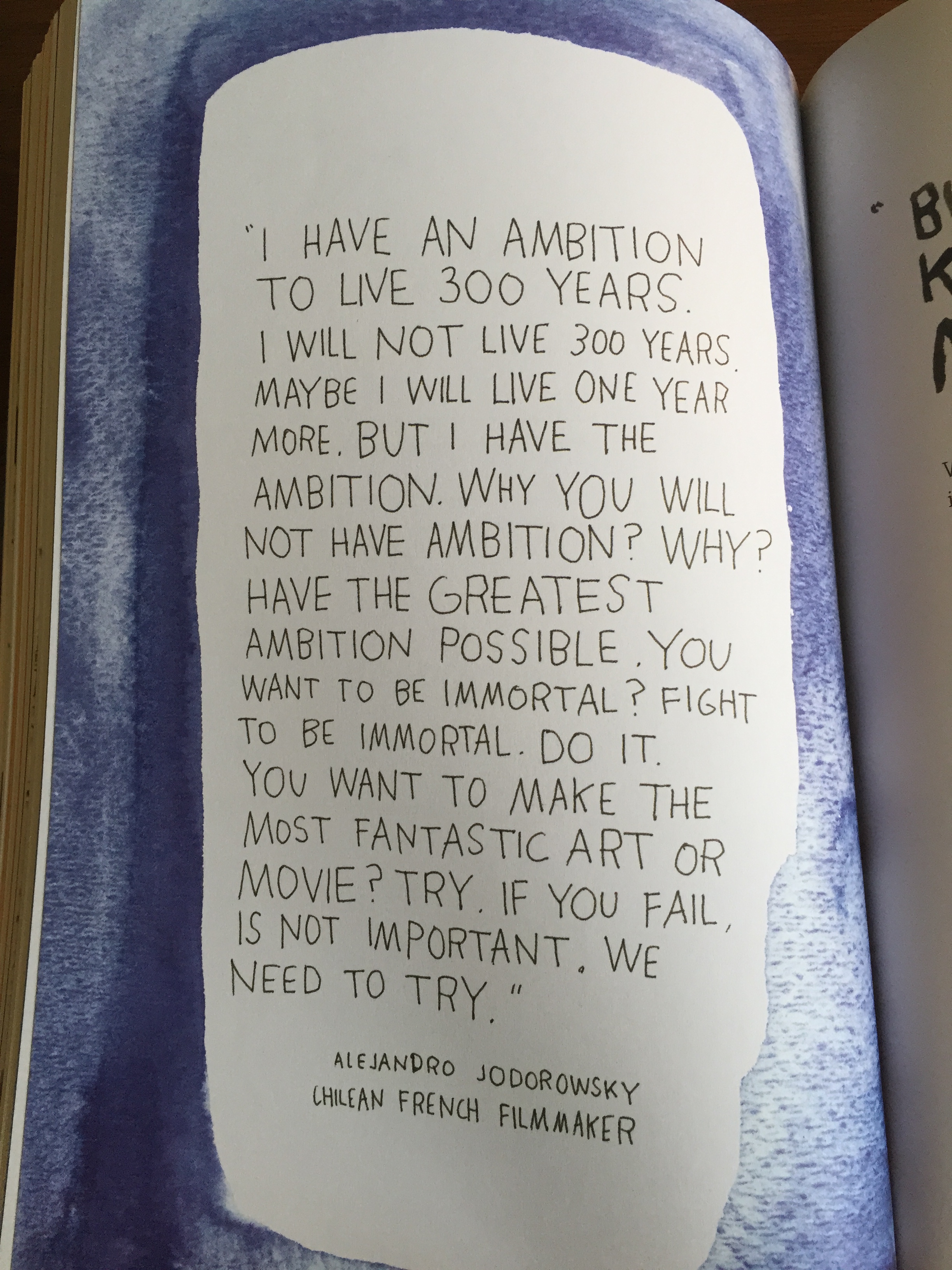
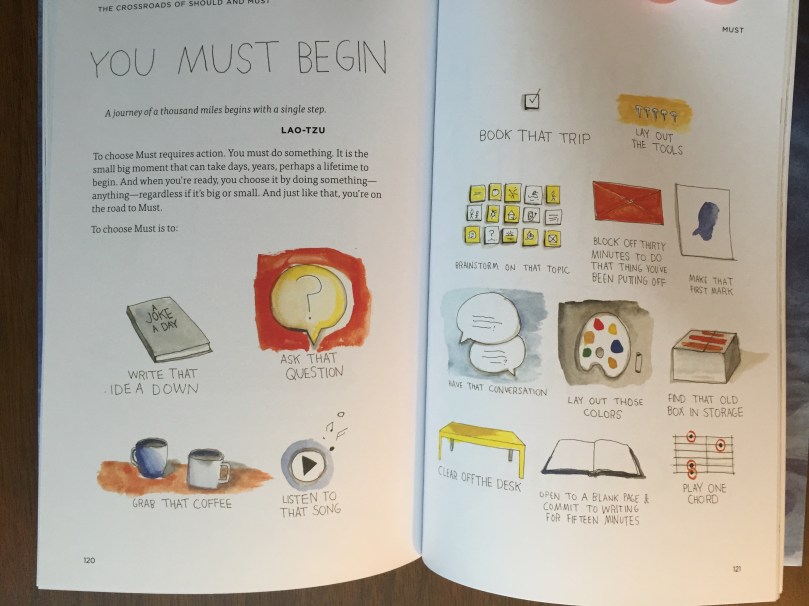
I received The Crossroads of Should and Must by Elle Luna today. I read the essay that ended up being the seed of the book earlier this week, and the book itself is a delight to hold and page through.
Books like this are why ebooks will not put an end to printed books. Beautifully crafted with striking colors throughout and hand-drawn illustrations, Luna’s book is a gift-worthy gem of a souvenir, a souvenir of ideas that will have more value because of the style that conveys the substance.
Books like this offer an experience, not just information. The art is in more than just the words. The visual hooks connect more intensely than words alone could.
When I think back on some of my favorite reading experiences, the form of the book often is a vivid part of the memory. Even books that have no art other than the cover make a memory through their heft and their physical design. Recalling the thick paperback copy of Anna Karenina I read in 1991, I can still picture the cover image, and I remember the general feel and thickness of the book and even the position (left page, upper half about a quarter of the way through) of one of my favorite passages.
Picking up a Dr. Seuss book with my kids rockets my memories back to seeing those same whimsical drawings as a kid myself.
Form matters. And you can make your ideas stick better and longer with art that resonates with the senses. Certainly visual appeal is important, but even the feel of the paper or the weight of the cover of a book can make a difference. It’s why Apple works so hard designing the boxes their devices are sold in.
I enjoy using slides when I present for this reason. Uncluttered, memorable images can make ideas pop and stick and can set an emotional tone for the delivery of a narrative.
I still mostly read ebooks. They’re convenient. It’s amazing to have a whole library a touch away no matter where I am. But beautiful books like Luna’s and Seth Godin’s most recent are reminders that a book as a work of art and as a tangible vehicle for compelling ideas has a bright future.
In this essay (and now in her book) Elle tells her story of finding her calling by resisting the path of Should and instead embracing the path of Must. Most of us are guided by what we think we should do while ignoring the call of our deepest desires and what we must do to be fully alive.
“What if who we are and what we do become one and the same? What if our work is so thoroughly autobiographical that we can’t parse the product from the person? What if our jobs are our careers and our callings?” –Elle Luna
I have struggled, though, with the notion that we have some innate passion we have to find and follow. Maybe it’s just semantics. What an authentic life needs is to be true to what you genuinely love and to make an art of it, to do it as well as you can.
Pick a path the excites you, that seems like fun, but that also will challenge you and will compel you to mastery. Course correct regularly. Change your mind. Try and fail, but stick with something long enough to know.
Elle Luna closes her essay with a strong call to choose Must over Should, to have the courage to live the life that is calling to you:
“If you believe that you have something special inside of you, and you feel it’s about time you gave it a shot, honor that calling in some small way — today.
If you feel a knot in your stomach because you can see the enormous distance between your dreams and your daily reality, do one thing to tighten your grip on what you want — today.
If you’ve been peering out over the edge of the cliff but can’t quite make the leap, dig a little deeper and find out what’s stopping you — today.
Because there is a recurring choice in life, and it occurs at the intersection of two roads. We arrive at this place again and again. And today, you get to choose.”
I am reading Christopher McDougall’s book, Born To Run, and it is fascinating. So much so that I’ve been Googling characters from the story and found the author’s web site and got lost in videos on his site today.
Again, I’m no runner, but the story McDougall tells is intriguing. It’s beyond just an exposition of running fundamentals. It gets to the heart of our potential as a species, physically and socially. What we were. What we’ve lost. And what still resides within and can be reawakened by getting in sync with our primal nature.
And the book is simply a good story, well told. And it will make you want to ditch your overly cushioned athletic shoes.
Here’s the book’s author giving a short talk about the key themes in his book:
“Take Antoninus as your model, always. His energy in doing what was rational … his steadiness in any situation … his sense of reverence … his calm expression … his gentleness … his modesty … his eagerness to grasp things. And how he never let things go before he was sure he had examined them thoroughly, understood them perfectly … the way he put up with unfair criticism, without returning it … how he couldn’t be hurried … how he wouldn’t listen to informers … how reliable he was as a judge of character, and of actions … not prone to backbiting, or cowardice, or jealousy, or empty rhetoric … content with the basics—in living quarters, bedding, clothes, food, servants … how hard he worked, how much he put up with … his ability to work straight through till dusk—because of his simple diet (he didn’t even need to relieve himself, except at set times) … his constancy and reliability as a friend … his tolerance of people who openly questioned his views and his delight at seeing his ideas improved on … his piety—without a trace of superstition …
So that when your time comes, your conscience will be as clear as his.”
Whether Antoninus (Marcus’s predecessor as emperor) was really this together or not, this description provides a great model of character for anyone to aspire to.
I just finished two Walt Disney biographies, and I’ve started the new Steve Jobs biography. Those two men, Disney and Jobs, compare and contrast very interestingly, and it’s particularly compelling to read their stories back-to-back.
I can’t seem to stick to just one book at a time, of course, and I started another book this weekend: Born To Run by Christopher McDougall. I had heard of the book a few years ago, though I’m not a runner and have no plan to become one. But it has gotten rave reviews both for the phenomenal story and provocative ideas as well as for the excellent writing. I just started reading it yesterday, and it’s already grabbed my attention and will be a nice change-up from the Steve Jobs book.
My consumption of fiction is down significantly from last year. I need some good novels to mix in with all this non-fiction.
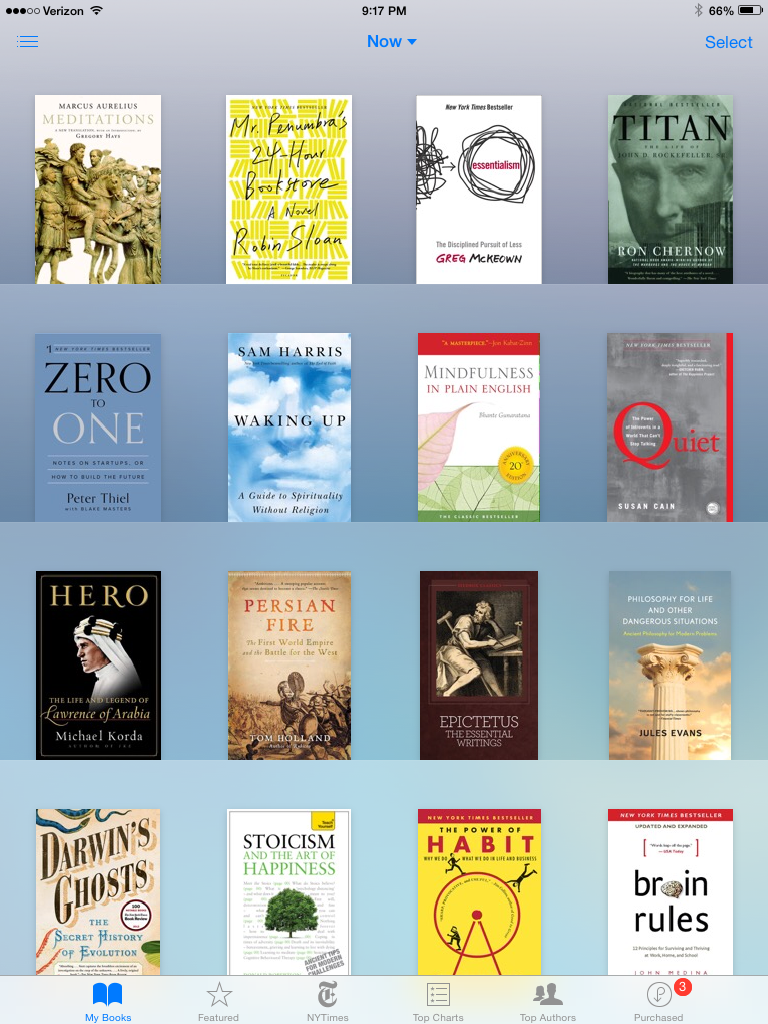
I continue to have plenty of unread books in my iBooks app. Some have been sampled. Others have been begun and put on hold. And a few are untouched. (I’m probably, though, on my fifth reading of Meditations.)
Just looking at this stack of books to read delights me. There’s such potential for new ideas and possibilities yet to be awakened and, certainly, the anticipated pleasure of the reading experience.
The unread book count doesn’t hold the cognitive burden of, say, your unread email count. It may be just the opposite kind of tension in the way that “Here it comes!” compares to “Here it comes.”
The new, much-hyped biography, Becoming Steve Jobs, was released yesterday, and my pre-ordered copy was on my porch when I got home last night. This is the rare book that I’m choosing to purchase as a physical book instead of an ebook. The advance praise was sufficient enough and the topic is one I find fascinating. I’m thinking it will be a keeper.
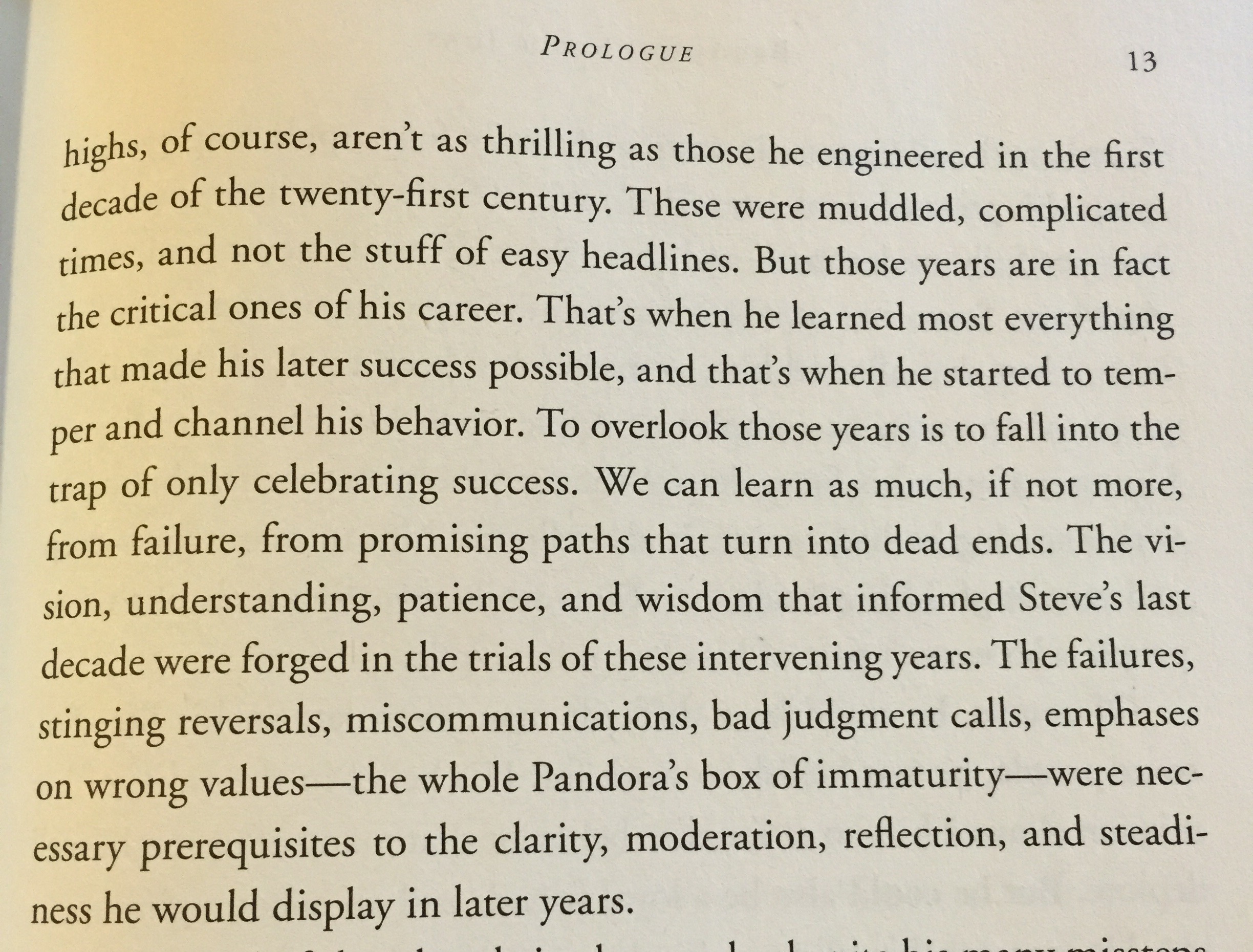
The book explores how someone who seemed so insensitive and reckless at the beginning of his career could end up as THE visionary business leader of our time. I just started reading it and came to this passage in the prologue:
“We can learn as much, if not more, from failure, from promising paths that turn into dead ends. The vision, understanding, patience, and wisdom that informed Steve’s last decade were forged in the trials of these intervening years.”
The greatness of the company that Steve Jobs fashioned in his last decade would not have been possible without the failures and shortcomings of his first couple of decades.
I’ve been fascinated recently by those who have turned adversity and failure to their advantage. We all seem to know that facing difficulties and enduring setbacks make us stronger and better. Yet we resist even the thought of coming up short or of taking on hardship.
Maybe we all should regularly and intentionally fling ourselves into the teeth of surefire heartbreak and dismal failure just so we can grow and learn faster.
The ceramics teacher announced on opening day that he was dividing the class into two groups. All those on the left side of the studio, he said, would be graded solely on the quantity of work they produced, all those on the right solely on its quality.
His procedure was simple: on the final day of class he would bring in his bathroom scales and weigh the work of the “quantity” group: fifty pound of pots rated an “A”, forty pounds a “B”, and so on. Those being graded on “quality”, however, needed to produce only one pot – albeit a perfect one – to get an “A”.
Well, came grading time and a curious fact emerged: the works of highest quality were all produced by the group being graded for quantity. It seems that while the “quantity” group was busily churning out piles of work – and learning from their mistakes – the “quality” group had sat theorizing about perfection, and in the end had little more to show for their efforts than grandiose theories and a pile of dead clay.
Brilliant. And I’ve been having this lesson delivered to me repeatedly over the past year. Quantity leads to quality. I don’t know if I’m learning it. I still get stuck overthinking, delaying, waiting for inspiration. When what I need to do is just show up. Do work. And keep showing up.
Attempt mediocrity, even. Dare to write one really awful sentence if you have to. It takes the pressure off. And mediocre might just lead to good, which every now and then might get me to awesome. But if I start by expecting to begin with awesome, I might just sit there instead, waiting for lightning to strike. Or, more likely, start scrolling Twitter and RSS feeds.
Quantity. Hammer away at the thing you want to get good at. Not to the point of grooving an easy path or just mailing it in. You need to challenge yourself routinely with hard things, by stretching your skills. But the more you do, the better you’ll be.
Don’t wait for the muse to show up. Your showing up is more likely to summon the muse than the other way around.
The ceramics class story, by the way, has been linked in several places (Cool Tools, Herbert Lui, and Coding Horror are three I found), and then I saw that book recommended today in a Chase Jarvis post, 6 Books Guaranteed to Make You More Creative. I have five of his recommended six books. The one I’m lacking: Art & Fear. The internet, great and powerful, clearly, is telling me to get that book.
After being intrigued by a Shawn Blanc post about it, Offscreen Magazine, Issue 10, arrived in my mailbox yesterday. It’s a delight, a touchable treasure of insights about and for people whose work revolves around the internet. The creator, Kai Branch, decided he wanted to do more than push pixels and digital wares that seemed to have no meaningful shelf life. He wanted to make something real, that you could hold and share tangibly and that might have some staying power. From Offscreen’s “About” page:
Originally a web designer by trade, Kai Brach launched the first issue of Offscreen in early 2012. Feeling disconnected by the fast pace and the ephemeral nature of digital, after ten years of freelance work Kai wanted to create something more tangible. With Offscreen Magazine, he combines both his love for technology and the web, and the unique experience of printed magazines.
In the span of three months, Kai “converted” from a UI designer to an editorial art director, not only publishing and editing Offscreen but also designing the magazine from the ground up. As such, Offscreen is still a one-man operation, and a proudly authentic indie magazine supported by amazing contributors and curious readers. Kai hopes to reinvigorate printed magazines as a choice of media that provides a welcome break from our always-on society.
I’m impressed by the content in this magazine. And that it’s a one-man operation makes it even more impressive. There are insights on seemingly every page. It’s stuffed with meaty interviews with interesting people and is scattered throughout with thoughtful touches like this:
A wise insight from Slack CEO Stewart Butterfield in the current issue of Offscreen Magazine
And it’s beautifully made and a pleasure to hold. Quality paper, crisp print. The size is just right, too. Clearly, a lot of thought and care has gone into making this magazine.
Those of us who share on the internet are regularly reminded how fleeting our creations are. Of course, there’s poetry in the impermanence. Online creations are like a mandala, a Buddhist sand painting that’s intentionally scattered after being painstakingly created as a reminder of the impermanence of all things.
But there’s a grace in great things, things you can hold and tuck under your arm and put on your shelf to enjoy again and again. A thoughtfully crafted thing has a beauty that endures and offers a distinctive pleasure that a flickering screen cannot adequately match.
What will my web site, for example, have to offer of value to anyone ten or twenty years from now? I suppose I could still be adding to it regularly. I envision making this as long-term a repository of my writing as is possible. And the intrinsic value of notching new posts every day has meaning for me whether anyone else reads or not.
But the web is like a river. You never surf the same web twice. It’s constantly changing. On the internet, everything flows and nothing abides for long. Such is life, of course.
Enjoying this magazine has sparked a bit of curiosity about making more permanent things. I don’t know if “Excellent Journey: The Book” is in my future, but it’s worthwhile to consider what I might create in a more fixed form. Seth Godin’s recent book along with this magazine are great examples reminding me of the value of the touchable and the beauty of old-fashioned words on paper.
The printed word will, I venture, have a much more enduring presence than, say, vinyl records, which seem more of a novelty for a narrow niche of aficionados. No technology is required to use a book. But, I think people eventually will treat paper books more like souvenirs of ideas and memories. Electronic reading will be fine for most occasions. Real books, though, will become more special, for selected experiences and more valued ideas, for gifts that endure, that touch and can be touched.
I enjoyed Walter Isaacson’s massive, authorized biography of Steve Jobs. It was a big bestseller when it was published in 2011 so soon after its iconic subject died. The book was filled with sensational stories highlighting Jobs’s infamous temperament, and it was a decent history of the early days of the technology revolution. (Though, the author didn’t always seem to get technology.)
But the book seemed like a missed opportunity. Isaacson was granted access to Jobs in a way no other writer had been, but the “why’s” weren’t explored nearly as well as I had hoped. For such a thick book, it was surprisingly thin on takeaways, other than knowing I didn’t want to be Steve Jobs or to work for anyone like him.
I was hoping to see more into the day-to-day life of one of the key business innovators of our time. How did he structure his day? How did he spend his time? Why did he think so differently? How did he grow from such an idiosyncratic and often childishly cruel young entrepreneur into arguably the most dynamic and successful CEO and technology visionary of our generation?
My favorite writer on all things related to Apple, John Gruber, just posted on Daring Fireball about a new biography coming out later this month: Becoming Steve Jobs by Brent Schlender and Rick Tetzeli. It looks like exactly what I was hoping for in a Steve Jobs biography. From the book’s description on Amazon.com:
Becoming Steve Jobs answers the central question about the life and career of the Apple cofounder and CEO: How did a young man so reckless and arrogant that he was exiled from the company he founded become the most effective visionary business leader of our time, ultimately transforming the daily life of billions of people?
The authors interviewed key people from Steve’s life, including his wife. Gruber read an advanced copy and raves about the quality of the book while calling it “an essential reference for decades to come”.
Pre-ordered. Hardcover. (That shows how high my expectations are. I’m thinking it’s a keeper, one my kids might want eventually.)
I’m reading a biography of Walt Disney. Interestingly, Walt’s father did not exactly encourage his dreams. The author describes a conversation between father and son when Walt was in his late teens and just getting started on his career:
“That evening after dinner, Walt’s father called him into the living room for a serious discussion. “Walter,” Elias said, “I have a job for you at the jelly factory. It pays twenty-five dollars a week.” “Dad,” Walt replied, “I don’t want to work at the jelly factory. I want to be an artist.” “You can’t make a living drawing pictures,” Elias said. “You need a real job.”
And that was just one small moment of a theme in their relationship, a pattern of Elias Disney trying to impose his version of reality on his son regardless of Walt’s interests and inclinations. Walt Disney’s father was stern, harsh even, with all of his children. His personality seems in many ways the opposite of the personality of Walt. Those who knew Walt universally acclaimed his personality as optimistic and kind and fun-loving, and it’s certainly possible that he crafted his persona, consciously or not, in opposition to his father’s.
But Disney, obviously, defied his father’s expectations for his career more than even he could possibly have imagined. Maybe his father’s opposition helped fuel Walt’s ambition. Maybe Walt was that much more persistent and committed because of the resistance he knew he would face from his father.
I don’t want to be that kind of father, though. I would like to think I will encourage the dreams of my children when they begin to wade through the dilemmas of building a career. My kids should get their obstacles elsewhere. Not from me.
Maybe, though, my fears will turn me into a wet-blanket of an old man who pushes my kids to the safe option rather than the one with the chance for awesome. We want security for our children. I know that is what motivates so much parental meddling and micromanagement of their adult children’s lives. Working with college students I see this frequently and posted this previously:
I heard a commencement speaker last year say that your parents do not want what is best for you. They want what is good for you. They want you to be safe, secure, successful, and have all your needs met. But what’s best for you might be risk and struggle and failure, key components on any path to mastery and awesomeness. Respect your parents, but lead your own life. And know that one day you might be that parent wanting what is just good for your child. And that’s okay. Parents are wired by evolution to protect their babies. Of course, the way you live your life will inform your children more than anything you say to them.
If, like Walt Disney, you face opposition to your path within your own family, you can be like Walt, and move yourself to action in spite of the resistance. Walt was not directly disrespectful to his father. He was just determined to go it alone if he had to, and he did. Turn your obstacles into fuel.
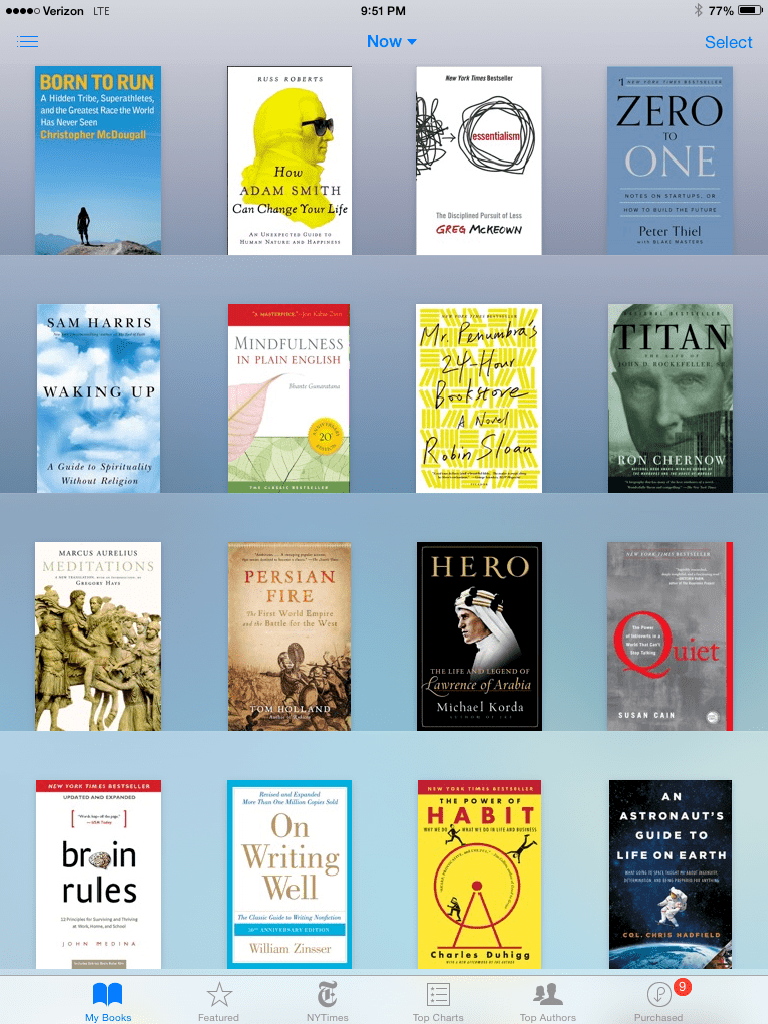
I added a couple of books this week to my stack to read:
How Adam Smith Can Change Your Life by Russ Roberts – An intriguing look at a little known book written in the 1700’s by the same man who wrote the famous economic treatise, The Wealth of Nations.
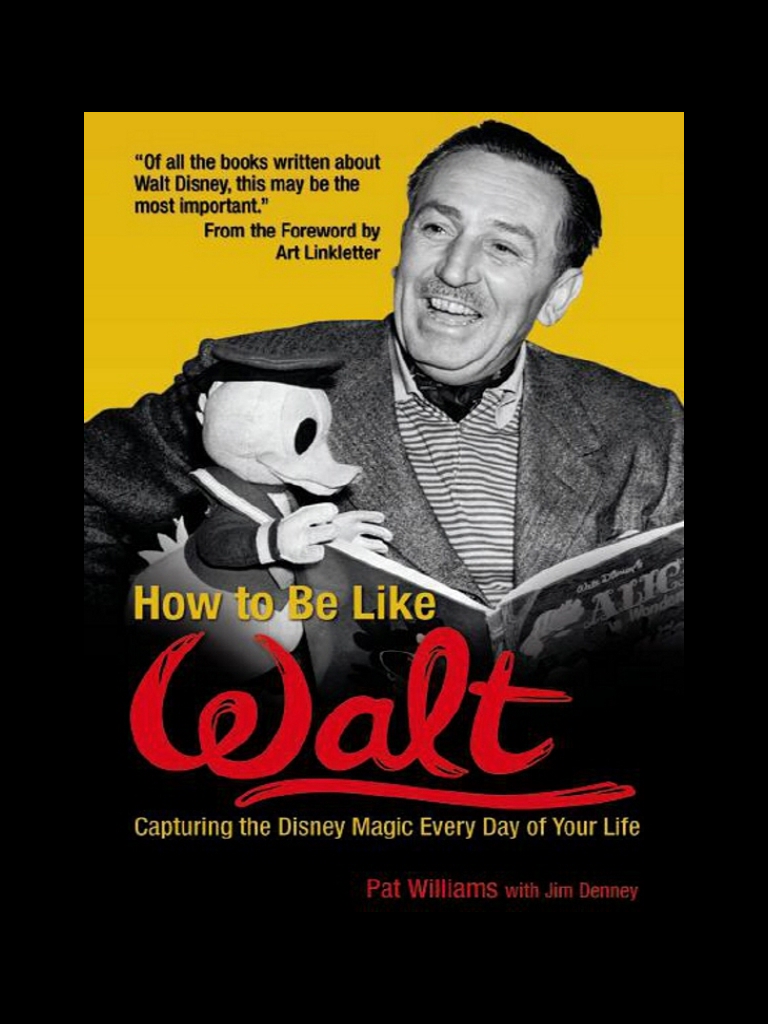
How to Be Like Walt by Pat Williams – A sort of applied biography of Walt Disney.
Donald Miller, in his new book, Scary Close, refers to a story I saw last year about a nurse who worked with patients as they approached death and the lessons she learned about their regrets:
“Remarkably, the most common regret of the dying was this: they wish they’d had the courage to live a life true to themselves and not the life others expected of them.”
You’ve got one shot at life. Don’t live on someone else’s terms. Their life is enough for them. Your life is your life. Live it as best you can.
“So remember this principle when something threatens to cause you pain: the thing itself was no misfortune at all; to endure it and prevail is great good fortune.”
Even the saddest, most emotionally painful turn of events can be considered good fortune if you use it to grow and get stronger and to live a more wholehearted life.
This is no easy lesson, and I keep forgetting to welcome the seemingly unwelcome, to embrace what I am inclined to resist.
What is, is. I can only control my response. I can take action toward a course I prefer, but much is out of my hands.
Accept what you can’t control. The world isn’t striving to make you feel good. Welcome to reality.
But why not use even “bad” fortune, especially bad fortune, to propel you a little further on your journey to becoming a more excellent version of yourself?
“Objective judgment, now, at this very moment.
Unselfish action, now, at this very moment.
Willing acceptance—now, at this very moment—of all external events.
That’s all you need.”
No matter what came before, who you’ve been, or what you’ve done, the present moment is pure possibility, untainted by what was or will be.
All you need is the courage to embrace this moment, see clearly, act boldly, and do what you think is best.
Each new moment is a blank page, a fresh start on being the human you aspire to be. Why not be awesome?
Adding to your library is no guilty pleasure. It’s your obligation as a human living in a vast and mysterious universe to feed your mind and spur on your curiosity and your yearning for wonder and delight. When in doubt, buy the book.
“When I have a little money, I buy books; and if I have any left, I buy food and clothes.” ―Desiderius Erasmus







 Excellent Journey