Act as if you were absolutely perfect

All you get by waiting is more waiting. Absolute perfection is here and now, not in some future, near or far. The secret is in action – here and now. It is your behavior that binds you to yourself. Disregard whatever you think yourself to be and act as if you were absolutely perfect – whatever your idea of perfection may be. All you need is courage.
My grace is telling you now: look within. All you need you have. Use it. Behave as best you know, do what you think you should. Don’t be afraid of mistakes; you can always correct them, only intentions matter. The shape things take is not within your power; the motives of your actions are.
–Sri Nisargadatta Maharaj

I found this in the book 365 Nirvana: Here and Now, which is a profound collection of insight and wisdom I used to keep on my nightstand.

This thought seems stunning: “Absolute perfection is here and now… Act as if you were absolutely perfect.” Acting as if conjures almost magical powers. Action is the key.

Do something! Stop thinking and waiting and hoping and wondering. Have a picture in your mind of who you want to be? Even if you’re not sure or you’re afraid you’ll change your mind later, go ahead and start acting like you are that person you envision.

Wake up each day and intend to be the perfect version of the human you imagine yourself to be. You will screw up, likely before you leave your room. It doesn’t matter. Your intent is what counts. Keep coming back to the actions that you desire.

Don’t judge yourself by some distant goal. Just be perfect in this moment. Act like you are who you want to be.

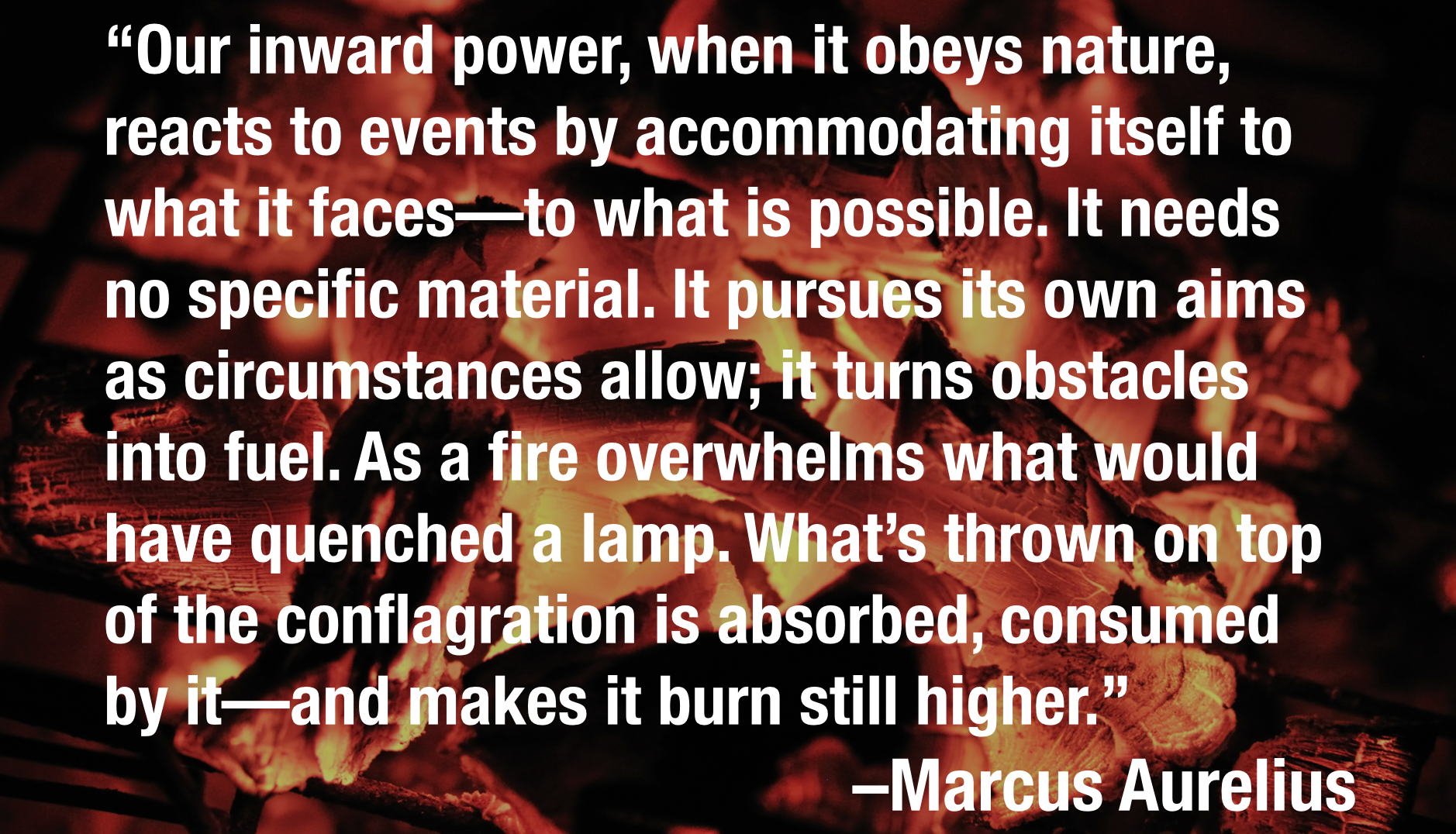
Turning obstacles into fuel

From Marcus Aurelius’s Meditations:

Screen Shot 2014-08-16 at 9.26.59 AM

“The obstacle is the way” is such encouragement when facing adversity. And when aren’t we? Your nature calls for you to embrace difficulty and failure, to turn “obstacles into fuel” to propel yourself further.

Things not going as planned? Unforeseen problems appearing? Failure seems certain? Excellent! Use those obstacles to grow stronger, to reorient, to see previously unimagined possibilities. Seek out a path you know will be difficult if you want to grow and improve and live a life that burns brightly, that shines with the fire of your resolve.


“The future is a hoax”

From Alan Watts’s intriguing and challenging The Book On the Taboo Against Knowing Who You Are:

Unless one is able to live fully in the present, the future is a hoax. There is no point whatever in making plans for a future which you will never be able to enjoy. When your plans mature, you will still be living for some other future beyond. You will never, never be able to sit back with full contentment and say, “Now, I’ve arrived!”

Your life is now. The challenge is to live where your life is and not where you think or hope it’s going to be in the future.

Paying for quality

20140805-091252-33172048.jpg

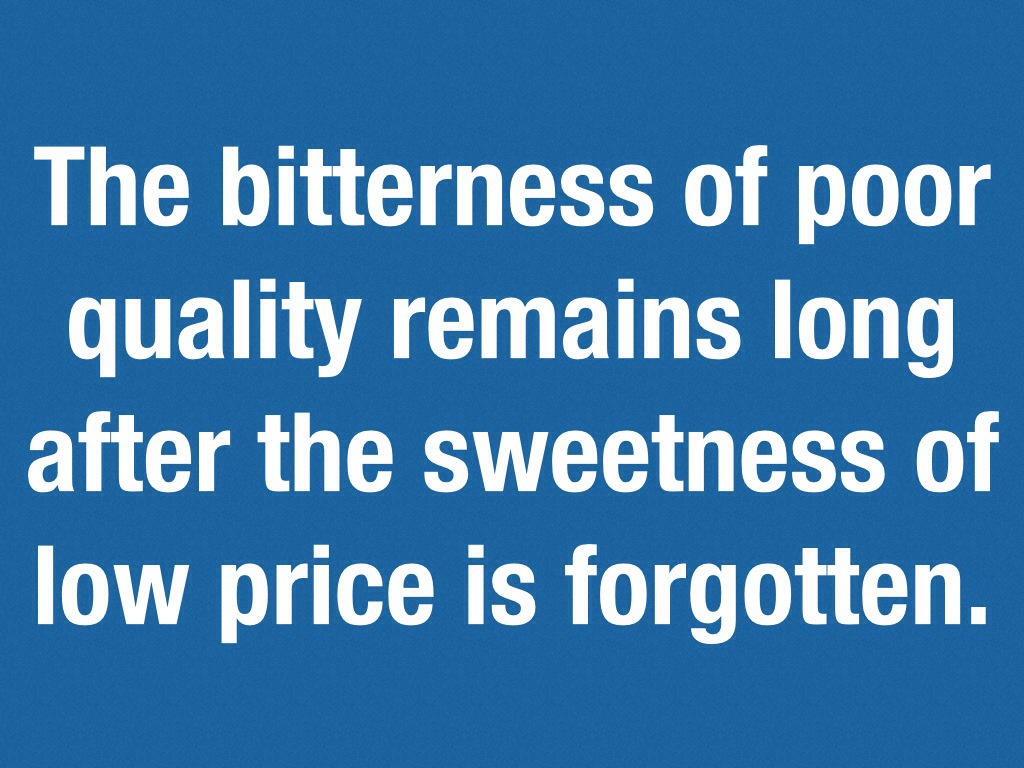
You pay for quality.

If it’s poor quality you’ve purchased, you pay again with annoyance or frustration and regret and possibly lost time and maybe repairing or replacing.

High quality purchases may typically only require the initial payment.

Things are ultimately just things. But great things can add value and beauty and more consistently satisfying moments than things that are merely cheap.

It’s much better to have fewer things that you find useful and beautiful than to have a lot of things that ultimately do not delight you past the purchase price.

Get away from it all

Nice Sunday morning thought from Marcus Aurelius’s Meditations:

People try to get away from it all—to the country, to the beach, to the mountains. You always wish that you could too. Which is idiotic: you can get away from it anytime you like.
By going within.
Nowhere you can go is more peaceful—more free of interruptions—than your own soul. Especially if you have other things to rely on. An instant’s recollection and there it is: complete tranquillity. And by tranquillity I mean a kind of harmony.

So keep this refuge in mind: the back roads of your self. Above all, no strain and no stress. Be straightforward. Look at things like a man, like a human being, like a citizen, like a mortal. And among the things you turn to, these two:
i. That things have no hold on the soul. They stand there unmoving, outside it. Disturbance comes only from within—from our own perceptions.
ii. That everything you see will soon alter and cease to exist. Think of how many changes you’ve already seen.
“The world is nothing but change. Our life is only perception.”

Head out on “the back roads of your self” when the world seems too distracting, too full. Unplug for a while and be intentional about finding a moment of tranquility. No vacation necessary.

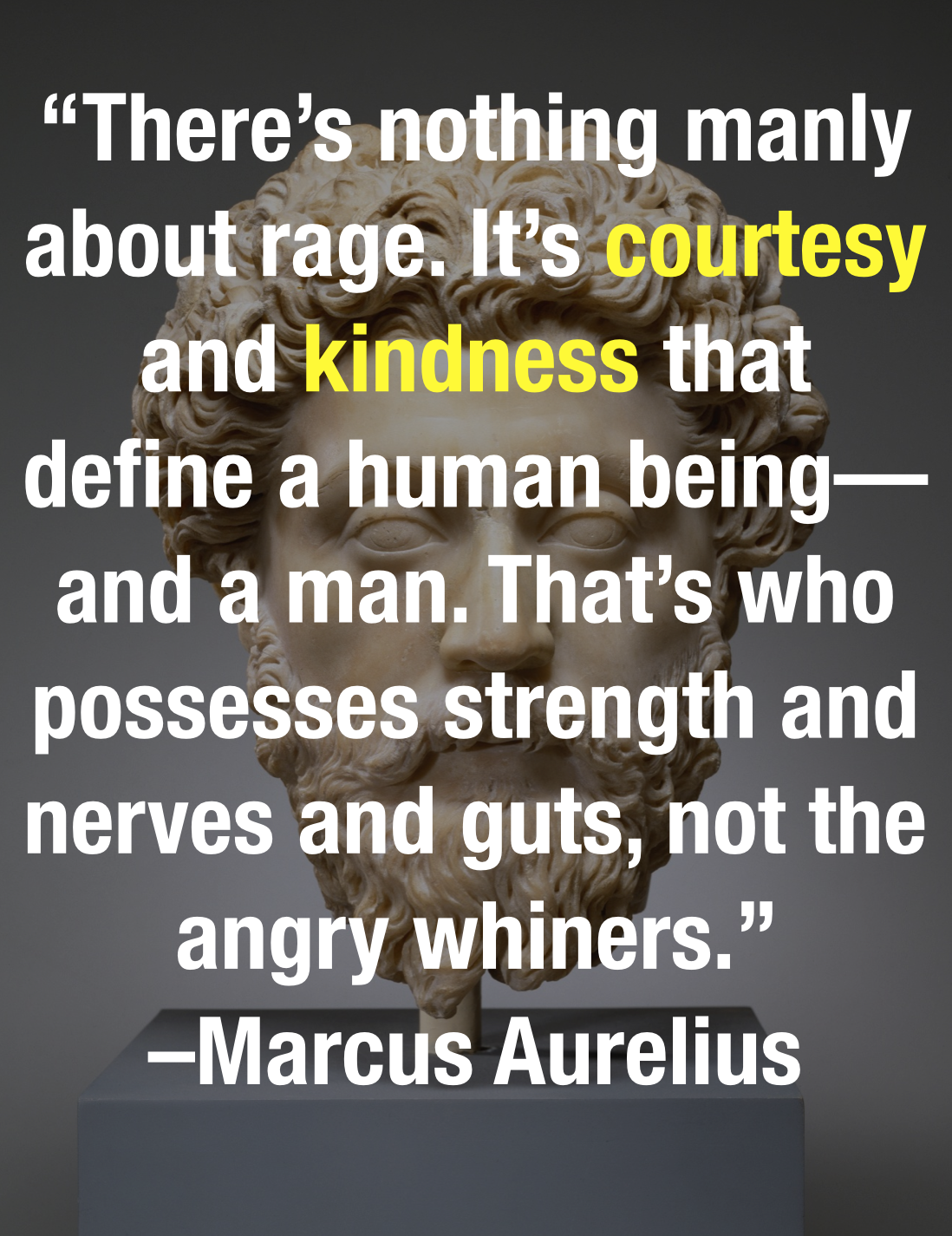
Courtesy and kindness

Screen Shot 2014-07-26 at 9.13.45 AM

Kindness is the king of virtues.

Rage can win headlines and whip a crowd into a frenzy. A stadium roars in approval when a coach goes on a rampage against an official. A politician’s poll numbers will rise if she goes off on a sanctimonious rant against an opponent in a debate. “Look how tough I am” is often the message. Ego is at stake.

Anger is loud. Kindness is quiet.

It’s easy to give in to anger. It’s a powerful emotion. That’s why defaulting to kindness and courtesy, especially when righteous anger seems justified, when someone has done you wrong, requires great strength and genuine courage. Whenever I have snapped at someone (which, truly, does not happen often), the regret is immediate and painful.

Next time I feel I’m losing my temper or itching to rant, I need to catch myself in the act and find the strength to observe the emotion rather than venting it.


Advice for getting started after college

My first job out of college was on Capitol Hill, working on the staff of a member of Congress. I lived alone on the Hill and walked to work every day. There was no internet in 1987, of course, and no cable TV then, surprisingly, on the Hill. I didn’t have much money and didn’t socialize much. Dinner was often finger food from whatever Congressional reception was on my boss’s schedule for the night. My family was far away. I had friends, but it was a very introspective, often delightfully solitary, relatively distraction-free time in my life.

My primary pastime when I wasn’t working was reading. I spent whatever I could on acquiring books, mostly biographies and history. As I was beginning my adult life with audacious dreams of greatness I wanted to be instructed by the examples of the lives of great men and women. I particularly remember reading Plutarch’s Lives and biographies of U.S. presidents. A fun Friday night for me was browsing the shelves of a bookstore.

It wasn’t exactly a monk-like existence, but I often wondered if I shouldn’t have been more social and had more fun. Looking back on it, though, I realize it was a great way to begin forming my identity and learning to think for myself and being intentional about who I wanted to be. I wasn’t molded by peers or social expectations or distracted by frivolities. That alone time was worthwhile. Much of who I am now and the way I think was formed in those years as a bachelor with books.

I was reminded of this time in my life by a post on Brain Pickings. The author Florence King gives her advice to young people on getting started in their adult lives, and it sounds a lot like what I did:

Put yourself on cruise control and go into limbo for a year. I’m not talking about a neo-grand tour; don’t bop around Europe, you’ll just get in trouble. Nor am I talking about what your parents’ generation called “dropping out.” I mean forget about success for a while, get yourself an ordinary job, an ordinary place to live, and live without worrying about what Americans call, in uppercase, the Future.

Go somewhere different, but stay away from big cities. If you’re from a place you call “godforsaken,” go to a small city in another part of the country…

Get a dead-end job — they’re plentiful now because nobody wants them. Tell your employer the truth: that you’ll be around only a year or so, but promise to work hard. Keep your promise. Little triumphs are the pennies of self-esteem. If you do well in such a job and make yourself indispensable to somebody, you will realize Robert E. Lee’s farewell words to his men after the surrender at Appomattox: “You will take with you the satisfaction that proceeds from a knowledge of duty faithfully performed.”

Live alone, even at a financial sacrifice. If you have a roommate, the whole college uproar will just start all over again…

Read, read, read. When you don’t have to worry about passing exams on them, subjects you studied in school suddenly become interesting…

What I am recommending is traditionally called “finding yourself.” The difference is, there is no bohemian excess here, none of the “experiencing everything” that comprises nostalgia de la boúe. It’s productive, constructive goofing-off.

This was close to my experience of being on my own for the first time. I was in a big city but was not particularly living a big city life. I was alone, far from family and old friends, and I used that time to read and think and start figuring out what was important to me. I didn’t have a “dead-end” job. It was intense, yet fun, and I learned what it meant to do good work and to be part of a team. But it didn’t end up being the field I would devote my career to.

I remember about that time discovering the work of Joseph Campbell, the great expert on mythology and comparative religion. His influence continues to resonate with me. He told of a similar period early in his career during the Great Depression when he couldn’t land an academic job. He ended up living in an isolated place for a few years, and all he did was read. Campbell credits that quiet time in his life for the success he ultimately found in his work life.

I know what it’s like to be 22 and eager to make your mark, to prove you’ve “arrived” and are bound for something big. Our connected and distracting world today only makes this impulse more irresistable and more burdensome. But understanding that it’s the long game that’s more meaningful is so reassuring. Attempt to peak at age 60 rather than, say, 27, and you’ll likely be more awesome at 27 than you would have been playing the short game, trying to succeed fast.

Take the time to ease your way into your adult life, to ponder and reflect and get to know who you are and who you want to be outside of the expectations of your family and the influence of your friends. There’s no hurry, people. The future is arriving fast enough.
Happiness, the pursuit

Screen Shot 2014-07-07 at 2.40.38 PM

After celebrating Independence Day here in the U.S.A. last week, we should remember the goal for those revolutionaries ultimately was a nation that would especially protect the rights to “life, liberty, and the pursuit of happiness“.

A government cannot grant you happiness. But it’s nice of ours to at least promise to get out of the way and not impede our pursuit of it.

How’s the pursuit going for you? Me? I think I probably have moments of happiness at a slightly above average rate. Happiness, though, is an elusive state. If you notice yourself feeling happy and try to dissect why, you lose the feeling. You can look back on truly happy moments after the fact, but it’s hard to catch happiness in the act. What if the act of pursuing actually prevents you from reaching the desired state?

Can you list distinct, indisputable happy moments in your life? This is a good exercise for your journal. What are the peak happy times from throughout your life, the big falling-in-love and birth-of-your-children moments, and the small, quiet sitting-on-a-covered-porch-during-a-gentle-rain moments?

It’s worthwhile to excavate those memories and try to understand why those moments stand out. You might discover some common elements to help set yourself up for even more happiness, to create the conditions most likely to spark more happy memories. Why not be happy on purpose?

This enlightening TED Talk from Matt Killingsworth highlights his research showing that people are happiest when they are lost in a moment, when their minds do NOT wander.

This seems true for many of my happiest moments. The chatty part of my brain, the happiness-killing part prone to near constant monologuing, disappears when I’m in a zone, whether that’s work or play or reading or watching a movie or riding a roller coaster. Happiness is absorption.

Jason Silva, in a recent interview on the Tim Ferriss Podcast, said that his aim is to build his life around flow states. Excellent idea.

How can I set myself up for more flow states, more moments getting lost in something that quiets that inner monologue, that stops my mind from wandering away from the present moment? What are the conditions that tend to lead to this kind of absorption?

Can I craft my day around creating flow states for work and for play? Set up my work area, tune out distractions, and just begin, whether I feel like it or not. Maybe by creating the climate for happy moments and engaging in activities that require complete absorption, happiness will pursue me rather than the other way around.

More happiness, less pursuit.


Memento mori

How amazing that you, yes you, are in the exact geographic center of the universe.

At least that’s what your brain sort of tells you. All of reality exists for you, spins in orbit around you.

That is what we all feel to some extent. Our perception of reality is self-centered, centered on the world as we experience it.

All humans have experienced life this way. We each are living in a bubble of our own creation and filtering life through this perspective of a me-centered universe. It’s easy to ignore that every human around you is experiencing reality separately, oblivious, somehow, to the fact that you are the actual center of the universe.

It’s worth attempting to regularly shift that perspective and see yourself as the short-lived speck of a being you are. Here for a moment, fleeting. Not here as the reason for all that is. But a part, an astoundingly conscious part, of all that is.

It was Romans who reminded the high and the mighty, “Memento mori.” Remember you are mortal.

Your death may not be the thought you are eager to reflect on regularly. Most of us can relate to this sentiment instead:

I don’t want to achieve immortality through my work; I want to achieve immortality through not dying. I don’t want to live on in the hearts of my countrymen; I want to live on in my apartment. ― Woody Allen

But we’re all goners, it’s just a matter of when and how. And reflecting on the brevity of your own life can unburden you from feeling the weight of the me-centric world you create for yourself. It can embolden you to make something of that ripple in the pond that is your existence, your time under the sun.

A hundred years from now, you may have left a legacy worth talking about still, but you won’t be around for the conversation. The universe will go on, spinning into infinity without you. What you’ve got right now, the experience of being alive in the universe, is precious and finite. Live now, and live well, while you can.

The only competition that matters

Screen Shot 2014-06-25 at 4.04.32 PM

How much better are you today than you were a year ago? Not better off. Better as a human, regardless of any change in circumstances beyond your control. I should be embarrassed to be virtually the same man I was even a few months ago. Principles should remain. Performance should improve.

Don’t look with envy at what others are doing. Don’t let the pace others set determine your pace. Don’t try to win some competition that doesn’t even exist. Live your life as excellently as you can.

As I said previously:

The only competition that matters is the one between who you want to become and who you are. Comparison with others will distract or discourage and put you off course. The you of one year from now should be able to kick the ass (in overall awesomeness and, maybe, physically as well) of the you from today.

“Wish the things which happen to be as they are”

Seek not that the things which happen should happen as you wish; but wish the things which happen to be as they are, and you will have a tranquil flow of life. –Epictetus

This is some serious mental jujitsu. There’s a fine line between passiveness and acceptance. One is weak. The other is strong.

Take action to make your plan happen, but accept whatever does happen as though it’s part of the plan.

Asking unanswerable questions

Ann Druyan, writer and executive producer of Cosmos: A Spacetime Odyssey, in a recent interview:

I have no problem asking the unanswerable questions, or in asking the as-yet-unanswerable questions. I have no problem with asking them, and I certainly have no issue with how we get through those dark nights of the soul by answering them. I would never presume to tell anyone how to answer them for themselves, not even my own children. I wouldn’t even think of it. I can only speak for myself when I say, “Yeah, asking questions – the more the better.” It’s just that if you come up with answers that make no adjustment to the scale of space and time that we find ourselves in, we see a failure of the imagination.

 
I happen to be surprisingly okay with uncertainty, but I’m not interested in intentionally rocking the world of someone who is not. All of our fellow humans are on their own, unique journey and traveling, presumably, as excellently as they think they can.

Keep asking questions and don’t settle for easy answers or answers that happen to work for someone else and have been handed to you in a tidy package. And have the courage to move on from the comfort of answers that were once cherished, or even sacred, but now don’t hold up to reason and have no compelling evidence to sustain them. The boat that got me across the river is no longer useful to me as I try to cross the mountain now in front of me. It’s okay to put the boat down and keep going.

Enthusiasm

Screen Shot 2014-06-16 at 4.34.29 PM

All the chasing we do after stuff and to please others and to build what we think is security for a comfortable life…

What if the greatest comfort, though, is the deep, satisfying happiness that comes from getting lost in something you love just for the thing itself? What generates genuine enthusiasm in you, not for any extrinsic rewards but for the simple joy of the pursuit, for the intrinsic rewards?

Enthusiasm in some people can seem trivial or insincere or even silly, especially when it comes across as contrived emotion worked up artificially on command like a salesman trying to make his quota or a manager in a dysfunctional bureaucracy trying vainly to rally her demoralized charges. But the real thing, genuine enthusiasm, delightful absorption, is an obvious marker that someone embarking on an excellent journey should heed. Go in that direction.

The imagined opinions of others

“It never ceases to amaze me: we all love ourselves more than other people, but care more about their opinion than our own. If a god appeared to us—or a wise human being, even—and prohibited us from concealing our thoughts or imagining anything without immediately shouting it out, we wouldn’t make it through a single day. That’s how much we value other people’s opinions—instead of our own.” -Marcus Aurelius, Meditations

We all are a bit crazy. Our minds are so occupied with what others may think of us, how something we do or how we look is being judged by other people. Of course, the reality is others aren’t thinking of us much at all. They are thinking of themselves and how they are being perceived by others. What a ridiculous cycle and what a waste of mental and emotional energy.

The freest people are those who have enough control of their own minds to either block out or be relatively unphased by the imagined opinions of others. Imagine what would be possible if we could free up all that space in our minds that is otherwise occupied by our concern for what other people think.

Resistance is futile: Hadrian and the profound power of acceptance

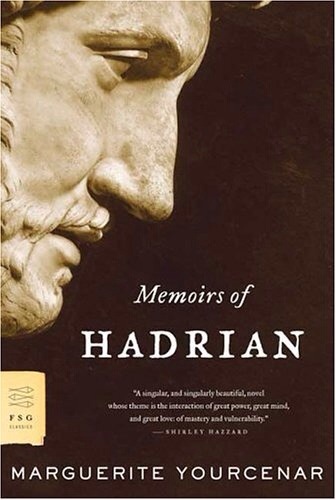
I’m reading Marguerite Yourcenar’s 1951 novel, Memoirs of Hadrian, about the Roman emperor and written as though it was his own journal as he is facing the end of his life. It’s addressed to the future emperor, Marcus Aurelius. I could only find a paperback copy but was eager to have it. A book like this dealing with Roman history and Stoicism and Marcus Aurelius is right in my wheelhouse. I, Claudius remains the most delightful novel I’ve read and helped spark my fascination with ancient Rome.

Memoirs of Hadrian is no I, Claudius, though. It’s not the exhilarating, page-turning romp through Roman scandal and political intrigue. Yourcenar’s book is a quiet, reflective review of a notable life as our protagonist is facing his final days.

I came across this remarkable passage yesterday. It’s Hadrian looking back on his years as a young army officer:

I determined to make the best of whatever situation I was in; during my years of dependence my subjection lost its portion of bitterness, and even ignominy, if I learned to accept it as a useful exercise. Whatever I had I chose to have, obliging myself only to possess it totally, and to taste the experience to the full. Thus the most dreary tasks were accomplished with ease as long as I was willing to give myself to them. Whenever an object repelled me, I made it a subject of study, ingeniously compelling myself to extract from it a motive for enjoyment. If faced with something unforeseen or near cause for despair, like an ambush or a storm at sea, after all measures for the safety of others had been taken, I strove to welcome this hazard, to rejoice in whatever it brought me of the new and unexpected, and thus without shock the ambush or the tempest was incorporated into my plans, or my thoughts. Even in the throes of my worst disaster, I have seen a moment when sheer exhaustion reduced some part of the horror of the experience, and when I made the defeat a thing of my own in being willing to accept it. … And it is in such a way, with a mixture of reserve and of daring, of submission and revolt carefully concerted, of extreme demand and prudent concession, that I have finally learned to accept myself. –Memoirs of Hadrian, pp. 44-45

This is life-changing insight explained with profound clarity. “Whatever I had I chose to have…” Consider some unpleasant circumstance or event, from something as trivial as having to wash dishes to something as potentially catastrophic as facing a tragic loss. If you welcomed this thing you have no control over and accepted it fully, embracing, even, something that seems unembraceable, imagine the transformation in your psychology. Accept what is and use it to learn and grow and find unforeseen opportunities. Fling yourself fully into even the worst circumstances that befall you. Don’t resist. Welcome whatever comes your way and grow your character and peace of mind in the process.


20140611-074226-27746993.jpg

Wonder why

“Learn to ask of all actions, ‘Why are they doing that?’
Starting with your own.” -Marcus Aurelius, Meditations

Reading those lines this morning reminded me of some great Stephen Covey insights I wish I was more inclined to consistently apply in my life.

I’m paraphrasing, but Covey, author of The 7 Habits of Highly Effective People, suggested when you’re inclined to judge, stop yourself and attempt, instead, to try to understand.

“Why?” is the king of questions. And if you ask “I wonder why…?” on a regular basis, you will open yourself to possibilities and to compassion, for others and for yourself.

Asking “I wonder why that driver is driving so recklessly?” can transform you from an angry observer to a curious one. What if the driver was on the way to the hospital for an emergency? Unlikely? Sure. But just framing the question can give you pause and defuse an unhelpful emotion.

Got some bad habits or frustrating tendencies in your own life? Wonder why and you just might go a little easier on yourself while sparking the possibility for genuine understanding and possibly a breakthrough.

Instead of labeling or judging or reacting, use the gap between stimulus and response to try to understand.

Want to spark more meaningful conversations? Ask “Why?” often, not in a pestering way, but with the intent to truly understand the other.

Want a clear vision for your family or your organization or your work? Ask “Why?” and pursue the answers relentlessly.

Why not make “Why?” your go-to question, the spark for possibilities that otherwise would remain undiscovered.

Screen Shot 2014-06-02 at 5.09.11 PM


Sunday morning Stoic

From Marcus Aurelius’s Meditations:

“External things are not the problem. It’s your assessment of them. Which you can erase right now.
If the problem is something in your own character, who’s stopping you from setting your mind straight?
And if it’s that you’re not doing something you think you should be, why not just do it?
—But there are insuperable obstacles.
Then it’s not a problem. The cause of your inaction lies outside you.
—But how can I go on living with that undone?
Then depart, with a good conscience, as if you’d done it, embracing the obstacles too.”

“Concentrate on what you have to do. Fix your eyes on it. Remind yourself that your task is to be a good human being; remind yourself what nature demands of people. Then do it, without hesitation, and speak the truth as you see it. But with kindness. With humility. Without hypocrisy.”

Sunday morning Stoic

Marcus Aurelius:

“If you do the job in a principled way, with diligence, energy and patience, if you keep yourself free of distractions, and keep the spirit inside you undamaged, as if you might have to give it back at any moment—
If you can embrace this without fear or expectation—can find fulfillment in what you’re doing now, as Nature intended, and in superhuman truthfulness (every word, every utterance)—then your life will be happy.”

It’s hard to open Meditations without finding something worth highlighting.

“Superhuman truthfulness”, now that’s a worthy aspiration.

“Don’t aim at success.”

Farnam Street has a post today that includes this paragraph from Victor Frankl’s classic book, Man’s Search For Meaning, which I recently mentioned:

Don’t aim at success — the more you aim at it and make it a target, the more you are going to miss it. For success, like happiness, cannot be pursued; it must ensue, and it only does so as the unintended side-effect of one’s dedication to a cause greater than oneself or as the by-product of one’s surrender to a person other than oneself. Happiness must happen, and the same holds for success: you have to let it happen by not caring about it. I want you to listen to what your conscience commands you to do and go on to carry it out to the best of your knowledge. Then you will live to see that in the long run—in the long run, I say!—success will follow you precisely because you had forgotten to think of it. -Victor Frankl

This is non-attachment. Do the thing for the thing itself, not for some desired outcome. Get lost in the path – the journey, the way – and the destination will meet you there.

Lay down your boat

Imagine a traveler on an epic journey, a quest. He’s making progress through tough terrain and comes to a wide, roiling river with no bridge in sight. But he discovers a small, abandoned row boat near the river bank. He takes the boat and uses it to get across the river. Once he reaches the other side he picks up the boat, lofts it overhead, and begins to carry the boat as he continues his quest on foot.

His journey would be easier and more reasonable if he put the boat down and left it behind. But the boat was valuable to him, precious even. It got him across what seemed to be an uncrossable river, and he wasn’t going to let go of such a useful tool, even though it was no longer serving its useful purpose. In fact, the boat was impeding the traveler’s quest now. Why not put it down and continue the journey unburdened?

A story like this is attributed to the Buddha. And it resonates with me. I’ve had boats – philosophies, habits, opinions, beliefs – that were useful in my life’s journey, that got me further along the path and helped me grow. And then I clung to them even though I had moved into territory where they weren’t needed any longer. I was convinced the boat was crucial because of the good it had done me. I feared letting go of the boat – the cherished idea or belief – would leave me lost and stall my journey.

But I’ve learned I can honor the role the boat played in my quest and still put it down and move on. And if I get to another roiling river on my journey, I’ll go get another boat or find a bridge or swim.

Attach yourself only to this step on the path, to this moment. Drop old boats and any other cherished but unnecessary burdens and lighten your load for a more excellent journey.