Courageous, not fearless

I recently heard someone say they wanted to be “fearless”. Then I heard it again the next night in a movie. A character was admired for being “fearless”.

Imagine never being afraid. Sounds like what Superman must feel like most of the time, minus those occasional encounters with Kryptonite. But, really, how little courage would it take to do awesome things if almost nothing could hurt you and your chances of success are literally sky high?

It’s normal to be afraid and experience fear regularly. I don’t know any sane person who is truly fearless. Being fearless is not the same as being courageous.

Fear is a friend, a friend who’s trying to keep us alive. Our ancestors are the ones who felt fear and responded to it. The long-ago humans who were without fear are the ones who don’t have descendants. Those humans were some creature’s lunch or ended up falling off the cliff our ancestors avoided.

The trick now is to understand our wiring, the inherited proclivities that enabled us to survive, and discern which fears are reasonable and helpful and which are keeping us from being awesome.

To be great at something and to have a remarkable life, you do need to be courageous, not fearless. Courage is not the absence of fear. It’s the willingness to take action in spite of the fear.

Some fears are there to keep you alive. Respect those fears and avoid doing stupid things. Other fears will keep you from coming alive. Consider the resistance you feel when you want to begin some great project or speak up for something meaningful or connect deeply with a fellow human being.

You know that voice that tells you to lie low, to keep your head down, don’t make waves, don’t risk failure? That’s the fear that should summon your courage.

The best way I know to respond to this kind of fear is action. Courage is like a muscle. It needs exercise to get stronger. Take on small moments of fear regularly. Even facing little awkward social fears, like smiling at a stranger or speaking up in a meeting, can strengthen your courage.

We have to be consistently courageous to overcome our predisposition for safety. I want to have courage. I have too often, though, skirted around hard things for fear of failure or embarrassment. I know my greatest obstacle to being the best I can be is the failure to confront caution — the spirit-suppressing, mediocrity-loving kind of caution — with courage.
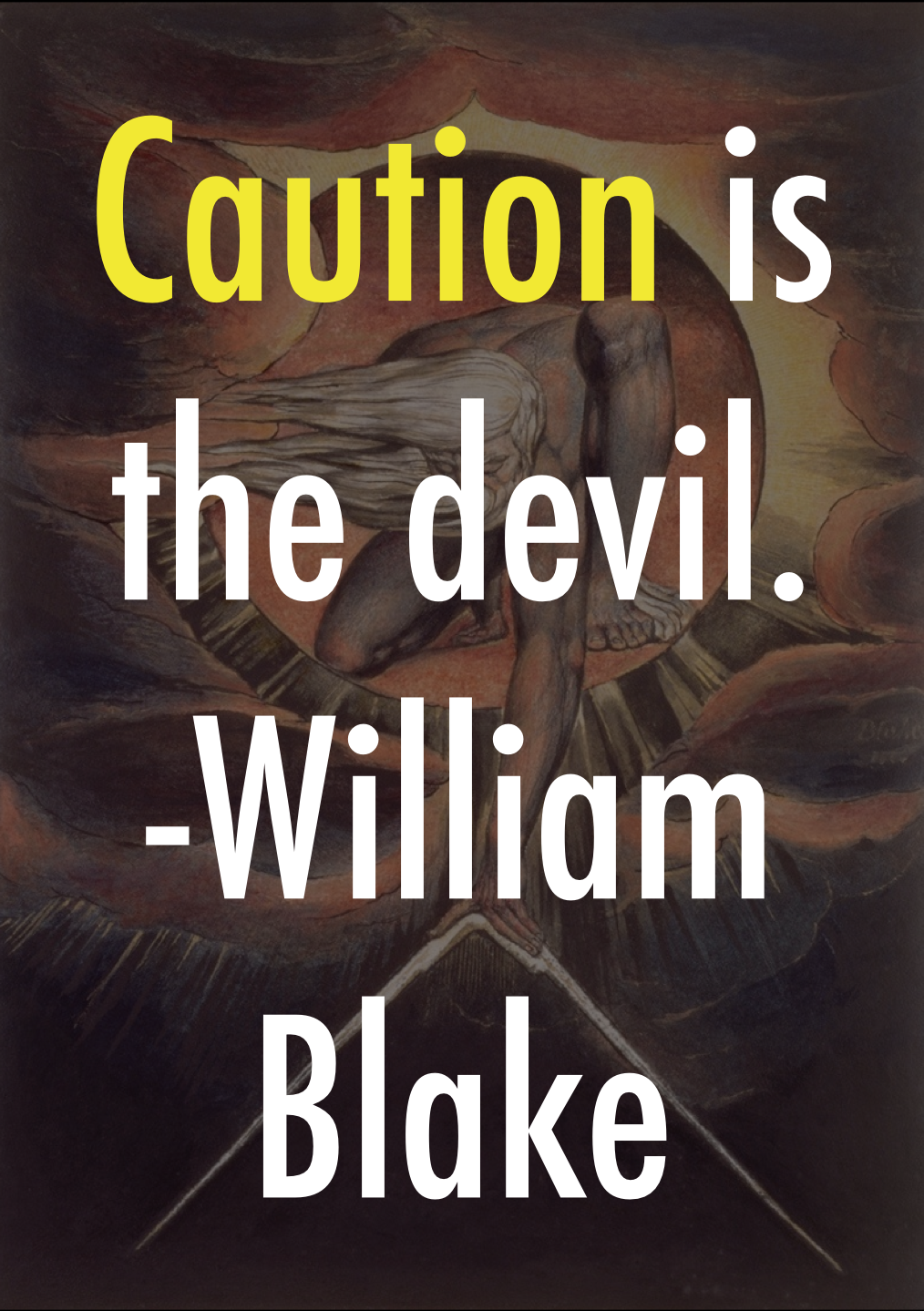
Screen Shot 2013-11-26 at 11.49.40 AM

The only competition that matters

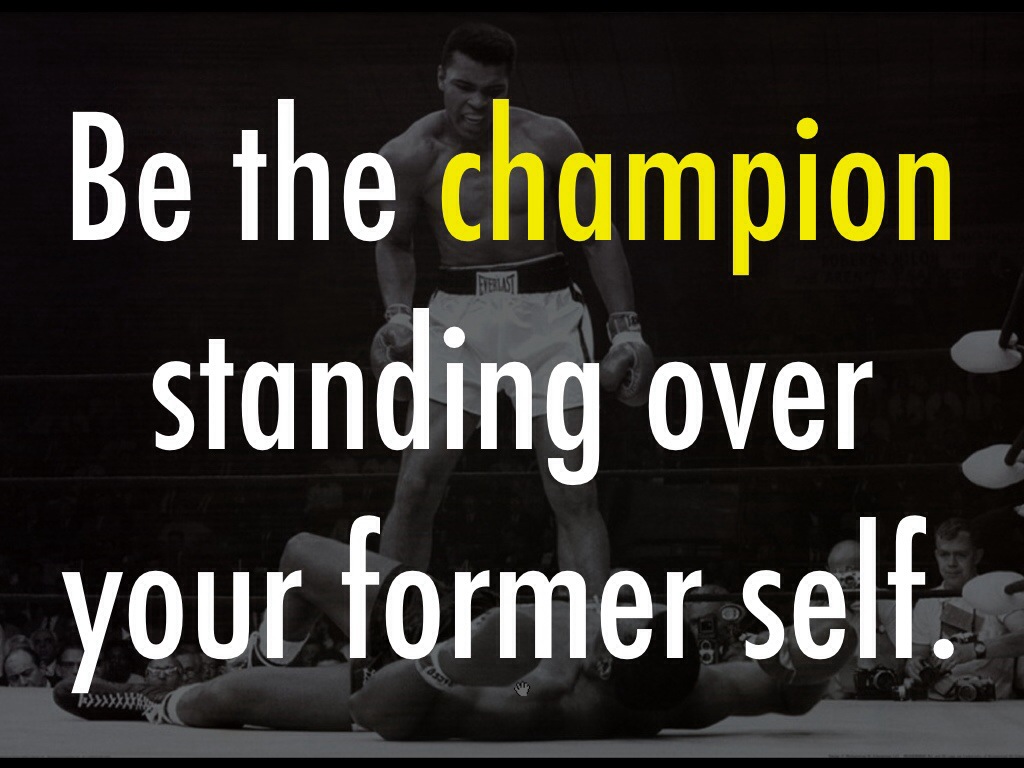
The only competition that matters is the one between who you want to become and who you are.

(Can I quote myself?)

Some weeks, I fall short of the week before. But just being aware is enough to make me want to do better the next week. No need to kick myself and make it worse. Just know that funks happen. And then they pass. And then take action to be more awesome next week.

20131005-094459.jpg

Our first responsibility

Maria Popova is prolific with her regular output of curated wisdom on brainpickings.org. I recently read an interview with her on The Great Discontent (another great site). She has an interesting story. Here’s a bit of wisdom from the interview:

I truly, truly believe that our first responsibility is to ourselves—to be true to our sense of right and wrong, our sense of purpose and meaning. That’s how we contribute to the world. Anyone who is able to do that for him or herself is already contributing a great deal of human potential into our collective, shared pool of humanity.

Don’t let other people’s ideas of success and good or meaningful work filter your perception of what you want to do. Listen to your heart and mind’s purpose; keep listening to that and even when the “shoulds” get really loud, try to stay in touch with what you hear within yourself. -Maria Popova

The opinions and expectations of others can be instructive as well as destructive. To be your best and do your best means first being true to your own vision of what that means for you.

Getting stronger

This is another great TED Talk*. Here, psychologist Kelly McGonigal shares research showing that facing stress head on rather than avoiding it or being crushed by it has beneficial effects:

Adversity and responding effectively to it generate growth. I’ve been learning that masters get great at something because they keep doing hard things, bumping up against their limits, and persevering to get better.

“No pain, no gain” is a real thing. But I’ve prided myself on avoiding stress when I can. This talk lets me know I should throw myself into the fray regularly and embrace difficulty and challenge more often.

Next time I get the panicky, tight feeling inside about a hard thing approaching, I should welcome it as an opportunity to get stronger.

*HT Getting Stronger blog

The greatness of kindness

From an interview with Stephen Fry where he discussed what he wished he had known at age 18:

“I suppose the thing I’d most would have like to have known or be reassured about is that in the world is what counts more than talent, what counts more than energy or concentration or commitment or anything else is kindness. And the more in the world you encounter kindness, and cheerfulness (which is kind of its amiable uncle or aunt), just the better the world always is – and all the big words: virtue, justice, truth, are dwarfed by the greatness of kindness.”

Kindness just keeps surfacing as a primary theme when pondering what makes for an excellent life. All the striving for achievement and wealth and happiness… Just being kind can change a moment, your day, your life and the lives of those you meet.

IMG_0149

Caring enough to be awesome

“But I do think that we sense when somebody has cared. And one thing that is incontrovertible is how much we’ve cared.” -Jony Ive, Apple’s design visionary on the Apple way.

It certainly seems that those people and organizations that really care are the ones worth talking about.

Most encounters are marked by the kind of caring that is just enough to not get someone in trouble or to avoid awkwardness. How remarkable when the level of caring is striking, when someone sweats the details and puts in extraordinary effort, even if there’s no obvious extrinsic reward.

Care more. Be more awesome.

Impermanence

Jason Silva’s latest short video, a bittersweet meditation on transience:

Everything changes. Motion is constant. You never step into the same river twice. This moment is gone already.

How do we live with impermanence? How do we make sense of knowing that we are unique, once in a universe creatures who will be gone soon? All that we love and hold dear will escape our grasp.

I was at my aunt’s funeral last week. Our family has lost her, but the universe keeps spinning. We have memories of happy times and moments shared, and we have the sadness that we will not look her in the eyes ever again. And all of us know that one day we will be the ones that our family and friends mourn.

What a world.

We are the only animals that live in the light of our own mortality. Yet we also are the only ones who can experience the awe of just being alive.

Do not go gentle into that good night. Rage, rage against the dying of the light. -Dylan Thomas

Sunday evening Epictetus

“Whoever then wishes to be free let him neither wish for anything nor avoid anything which depends on others” –Epictetus: The Essential Writings

The only sport I now follow with any real interest is college football. This reminder to put our happiness in our own hands is much needed as the season begins. Our happiness in the hands of 20-year-old football players is a silly thought.

Why waste any worry or frustration over things that we have no control over?

This week’s best of the web: Watterson’s wisdom and Zen Pencils

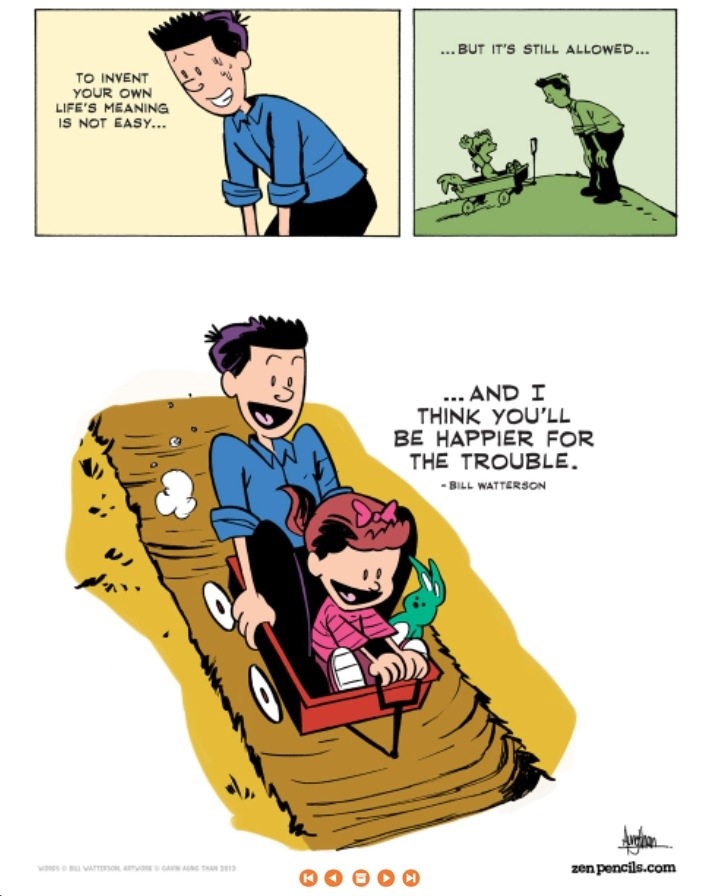
This Zen Pencils cartoon won the Internet this week.

It’s a lovely tribute to Bill Watterson, the amazing and enigmatic creator of Calvin and Hobbes, and it’s a profound exhortation to live an excellent, authentic life.

Click through, read, and enjoy. And then get lost in Zen Pencils. The creator, Gavin Aung Than, is doing beautiful work, mixing cartooning with life wisdom, and he is living the story he’s telling in this Watterson tribute. He abandoned the conventional career path and is making his own way. And using his talent to help awaken possibilities in others.

More about Watterson’s Kenyon College commencement speech, on which the Zen Pencils cartoon is based, is over on Brain Pickings. I love this part about playfulness and creativity:

It’s surprising how hard we’ll work when the work is done just for ourselves. And with all due respect to John Stuart Mill, maybe utilitarianism is overrated. If I’ve learned one thing from being a cartoonist, it’s how important playing is to creativity and happiness. My job is essentially to come up with 365 ideas a year.

If you ever want to find out just how uninteresting you really are, get a job where the quality and frequency of your thoughts determine your livelihood. I’ve found that the only way I can keep writing every day, year after year, is to let my mind wander into new territories. To do that, I’ve had to cultivate a kind of mental playfulness.

[…]

At school, new ideas are thrust at you every day. Out in the world, you’ll have to find the inner motivation to search for new ideas on your own. With any luck at all, you’ll never need to take an idea and squeeze a punchline out of it, but as bright, creative people, you’ll be called upon to generate ideas and solutions all your lives. Letting your mind play is the best way to solve problems.

[…]

A playful mind is inquisitive, and learning is fun. If you indulge your natural curiosity and retain a sense of fun in new experience, I think you’ll find it functions as a sort of shock absorber for the bumpy road ahead.

I’m inspired to go dig out my old Calvin and Hobbes collections and share with my daughters. And to play more.

20130831-101248.jpg

“Don’t aim at success.”

Farnam Street has a post today that includes this paragraph from Victor Frankl’s classic book, Man’s Search For Meaning, which I recently mentioned:

Don’t aim at success — the more you aim at it and make it a target, the more you are going to miss it. For success, like happiness, cannot be pursued; it must ensue, and it only does so as the unintended side-effect of one’s dedication to a cause greater than oneself or as the by-product of one’s surrender to a person other than oneself. Happiness must happen, and the same holds for success: you have to let it happen by not caring about it. I want you to listen to what your conscience commands you to do and go on to carry it out to the best of your knowledge. Then you will live to see that in the long run—in the long run, I say!—success will follow you precisely because you had forgotten to think of it. -Victor Frankl

This is non-attachment. Do the thing for the thing itself, not for some desired outcome. Get lost in the path – the journey, the way – and the destination will meet you there.

Show up and do something every day

Cal Newport, author of So Good They Can’t Ignore You, shared this story on his blog about a 15-year-old who followed an interest (not even a passion) with consistent, daily action and just a bit of audacity and had remarkable success.

You don’t have to be amazingly gifted to stand out, to make a difference. You will stand out just by showing up regularly and taking action. That’s exceptional and worth talking about because so few people actually do anything beyond talking.

Sunday morning Seneca: The fighter

From Seneca’s Letters from a Stoic:

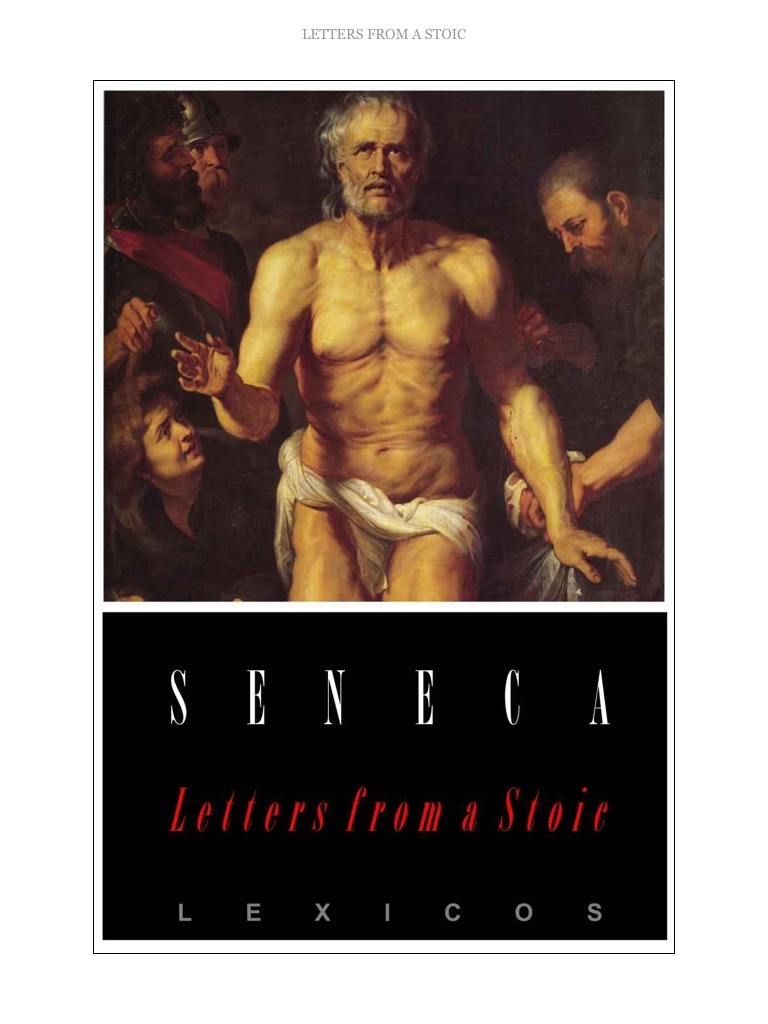
“… no prizefighter can go with high spirits into the strife if he has never been beaten black and blue; the only contestant who can confidently enter the lists is the man who has seen his own blood, who has felt his teeth rattle beneath his opponent’s fist, who has been tripped and felt the full force of his adversary’s charge, who has been downed in body but not in spirit, one who, as often as he falls, rises again with greater defiance than ever.”

20130825-074718.jpg

Talent and preparation

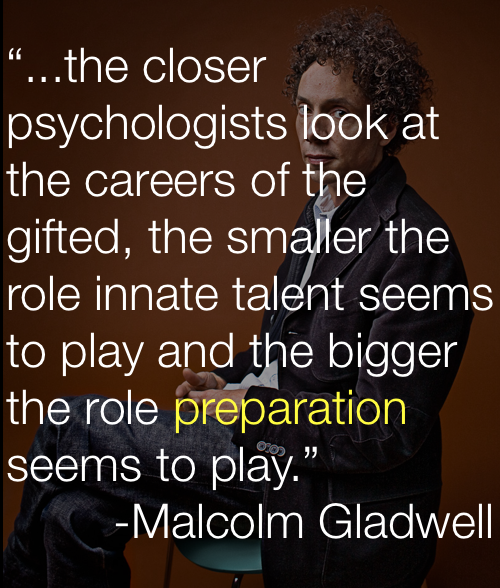
Farnam Street has a post today, Complexity and the Ten-Thousand-Hour-Rule, that explores the conversation about innate talent and preparation. Is it hard work that makes the difference, or is it something you’ve just got, something you’re born with that ultimately determines achievement?

We all have differing levels of innate ability, physically and mentally, and different temperaments. But focus and drive and grit count for more than can be easily measured. Imagine the countless would-be masters throughout history, people with the talent to be world class, who didn’t put in the effort, who didn’t persevere through difficulty and failure to become remarkable at something.

If you’ve got some talent, good for you. Now, figure out how to be awesome and get to work.

Screen Shot 2013-08-23 at 11.44.37 AM

Why before How

“Why?” is the children’s question that we too often grow out of asking. I suppose kids get shushed enough or stump their elders to frustration so often that it becomes uncomfortable to keep asking it.

But we ought to ask Why regularly. Ask our bosses our elders our leaders our peers and kindred spirits.

“Why exactly do we do this or do it this way…?”
“Can you remind me again what we’re hoping to accomplish?”
“Why do we exist as an organization?”
“Why, again, are we meeting? What’s the purpose, the desired outcome?”
“What are we about?”

If it’s asked with sincerity, snark-free, the Why question just might spark a fresh perspective that clarifies everything, that cuts through the clutter and distraction.

We tend to default to How before ever even asking Why.

Peter Drucker said: “Management is doing things right. Leadership is doing the right things.”

Answering How questions is crucial to “doing things right”, but it’s Why that will make sure you’re doing the “right things”.

A genuine answer to the Why might be painful, might make the effort moot. But it would be better to abandon and redirect toward a more meaningful Why, right?

Embrace the Why like a relentless 5-year-old with a curiosity problem. Figure out the Why then follow the How to previously unimagined possibilities.

Choosing your response

Men are disturbed not by things that happen, but by their opinion of the things that happen. -Epictetus

Between stimulus and response there is a gap. In that gap we can choose our response. This insight is from Victor Frankl’s profound little book, Man’s Search For Meaning. Frankl noticed a small number of fellow concentration camp prisoners who chose to be optimistic and encouraging in the midst of their horrifying reality. They had no control over their daily physical life, but these handful of prisoners he noticed exercised what Frankl called the “last of human freedoms”, the freedom to choose your attitude regardless of the circumstances. No one can deny you that final, ultimate freedom.

We can’t control the world and the actions of others. The weather, the traffic, the people we encounter – not in our control. We can control our own attitude and our own actions.

We all have regularly wasted too much emotion and mental energy fretting or stewing or worrying over things we can do absolutely nothing about.

What if, when I’m prone to respond with frustration or anger or anxiety, I simply chose to be curious instead.

“I wonder why that driver cut me off.”

“How interesting that it’s raining on the day of our picnic.”

“It’s fascinating that this person is angry with me. I wonder what’s at the root of their response.”

“Fascinating…” is a delightfully effective response when you’re otherwise inclined to react negatively.

We are not machines, right? No one or no thing can make you respond in a certain way. You’ve got a choice. It’s inaccurate to say “________ makes me mad.” You may choose to be mad because of ________, but it is your choice.

I know I’m choosing an unproductive response when I start feeling defensive. It’s a clear indicator I’m heading down a wrong path.

I heard someone say “Never take anything personally.” Nothing anyone does or says truly is about you, even if it seems so. Others’s actions are their own and are about them, not you.

This is not easy. We have to be mindful of how we are programmed and take control to reprogram our responses with that gap, that opportunity to choose, as the key to living a more wholehearted, mindful human life.

Fascinating.

frankl

The audacity of youth

Kottke (a must-follow blogger from way back when blogging was exotic) shared this post today about the age of key figures from the American Revolutionary War. Check out how old these stars of our early republic were on July 4, 1776:

Marquis de Lafayette, 18
James Monroe, 18
Gilbert Stuart, 20
Aaron Burr, 20
Alexander Hamilton, 21
Betsy Ross, 24
James Madison, 25

Incredible. I always thought of Jefferson as one of the younger founding fathers, but he was 33 at the time, an “old guy” compared to the youngsters listed above.

Yes, mastery is a product of time and deep practice. But, undoubtedly, the classical education of those in this class was much more intense than what we are accustomed to today. Certainly these people were more well versed in the classics and in philosophy and were more self-sufficient than a typical 20-year-old today. Some of these probably had put in a decade of study and life experience that would humble us now.

Yet, a 20-year-old certainly, even in that era, was not the equal of those a decade or two older in statecraft and leadership, right? Maybe those who were young were disproportionately represented in this revolutionary group because audacity and boldness and a bit of recklessness, hallmarks of youth, were just what was needed at that time in our history. Their youth probably made them more likely to be attracted to a high-risk endeavor, to a grand adventure. Older people are more risk averse. They typically have more to lose. What the younger ones lacked in experience and wisdom, they made up for, maybe, in audacity and useful foolhardiness.

Silicon Valley is filled with twenty-somethings who are drawn to a different kind of revolution. There’s a reason so many start-ups are led by people barely old enough to vote. It’s a great age to take some chances and try hard things without putting family and fortune in jeopardy. Some twenty-somethings can be afflicted with a presumptuous sense of entitlement, an impatience to wait and do the work and earn the dream over the long haul.

But points for boldness for young people. Think new thoughts. Do crazy big things that are likely to fail. Be a revolutionary while you’ve got the right stuff for it.

“Write as if you were dying.”

Brain Pickings is as prolifically wise and challenging and enlightening as any site on the internet. Hooray for it’s creator, Maria Popova! It’s worthwhile to subscribe to her free weekly email newsletter so you don’t miss out.

I found this post about Annie Dillard’s book, The Writing Life, in yesterday’s newsletter. I have the paperback version of the book, but I’ve never read it. I will remedy that now that I’ve read the book excerpts highlighted in the post.

This passage is a powerful reminder of why we create and how our mortality, and that of our audience, should inform our work:

“Write as if you were dying. At the same time, assume you write for an audience consisting solely of terminal patients. That is, after all, the case. What would you begin writing if you knew you would die soon? What could you say to a dying person that would not enrage by its triviality?

[…]

Why are we reading if not in hope that the writer will magnify and dramatize our days, will illuminate and inspire us with wisdom, courage, and the possibility of meaningfulness, and will press upon our minds the deepest mysteries, so we may feel again their majesty and power? What do we ever know that is higher than that power which, from time to time, seizes our lives, and reveals us startlingly to ourselves as creatures set down here bewildered? Why does death so catch us by surprise, and why love? We still and always want waking.” -Annie Dillard from The Writing Life

Wow.

Consider yourself and everyone else, for that matter, to be terminal. It is true. And living and thinking in the light of dying should add perspective and meaning that we would otherwise shut our eyes to.

I often imagine that my audience is just my two young daughters who will read this as adults, maybe after I’m gone. Thinking like that can’t help but shape my words and shame me away from pettiness and silliness.

We should not get lost in fretting over our mortality and miss out on actually living. But summoning the ultimate and embracing our impermanence are crucial to writing anything or making anything that lets us touch immortality.

anniedillard_thewritinglife

On belief

I came across this post today and found this insightful, provocative statement on belief:

“Believing something is not an accomplishment. I grew up thinking that beliefs are something to be proud of, but they’re really nothing but opinions one refuses to reconsider. Beliefs are easy. The stronger your beliefs are, the less open you are to growth and wisdom, because “strength of belief” is only the intensity with which you resist questioning yourself. As soon as you are proud of a belief, as soon as you think it adds something to who you are, then you’ve made it a part of your ego. Listen to any “die-hard” conservative or liberal talk about their deepest beliefs and you are listening to somebody who will never hear what you say on any matter that matters to them — unless you believe the same. It is gratifying to speak forcefully, it is gratifying to be agreed with, and this high is what the die-hards are chasing. Wherever there is a belief, there is a closed door. Take on the beliefs that stand up to your most honest, humble scrutiny, and never be afraid to lose them.” –David Cain

We all have believed things that turned out not to be true, from small inconsequential trivia to major life-shaping philosophies. Santa and fairies and such just don’t work as reasonable options for most adults.

There are 7 billion people on this planet. Consider all the conflicting beliefs that exist, all the misplaced certainty. All the meanness and pain and wasted opportunities spent on cherished beliefs.

I remember arguing passionately when I was in college for beliefs that I now no longer hold. As I’ve aged and grown in knowledge, and I may be an exception, believing has been less of a force in my life. I would rather know something than believe it. And that ends up leaving me with a lot more questions than answers. While I may no longer have the fixed stars I once used to navigate through life with, I’m okay with the mystery, with not knowing.

It is harder, though. Having your beliefs locked in is much easier. Less thinking required. And it’s kind of cozy and comfortable and safe. But, it’s also a lot less interesting, and, ultimately, it’s not real.

It’s okay, healthy and normal, exciting even, to question what simply has been handed to you as truth and move further into not-knowing. It takes courage to ask tough questions, but if a belief can’t withstand honest inquiry, it’s not worth holding on to.

Read good books. Get smarter.

I really enjoyed this recent post on the Farnam Street blog: The Buffett Formula – How To Get Smarter.

Warren Buffett and his partner, Charlie Munger, have done something right in their careers. They attribute much of their success and a lot of their time to one key activity: reading.

Warren Buffett says, “I just sit in my office and read all day.” What does that mean? He estimates that he spends 80% of his working day reading and thinking.

“You could hardly find a partnership in which two people settle on reading more hours of the day than in ours,” Charlie Munger commented.

When asked how to get smarter, Buffett once held up stacks of paper and said “read 500 pages like this every day. That’s how knowledge builds up, like compound interest.”

The reading they recommend is deep and challenging, not news and Twitter updates. I’ve got a stack of great books piled up in my iPad, but I need to be more intentional and structured about digging into and finishing them, not just grazing randomly through portions.

Reading good books throughout my life has affected my worldview and my character more than any other activity. As a new academic year begins this week, I’m going to put together my own personal syllabus for getting smarter and reading books that spark new possibilities.

20130806-225905.jpg