Memento mori

How amazing that you, yes you, are in the exact geographic center of the universe.

At least that’s what your brain sort of tells you. All of reality exists for you, spins in orbit around you.

That is what we all feel to some extent. Our perception of reality is self-centered, centered on the world as we experience it.

All humans have experienced life this way. We each are living in a bubble of our own creation and filtering life through this perspective of a me-centered universe. It’s easy to ignore that every human around you is experiencing reality separately, oblivious, somehow, to the fact that you are the actual center of the universe.

It’s worth attempting to regularly shift that perspective and see yourself as the short-lived speck of a being you are. Here for a moment, fleeting. Not here as the reason for all that is. But a part, an astoundingly conscious part, of all that is.

It was Romans who reminded the high and the mighty, “Memento mori.” Remember you are mortal.

Your death may not be the thought you are eager to reflect on regularly. Most of us can relate to this sentiment instead:

I don’t want to achieve immortality through my work; I want to achieve immortality through not dying. I don’t want to live on in the hearts of my countrymen; I want to live on in my apartment. ― Woody Allen

But we’re all goners, it’s just a matter of when and how. And reflecting on the brevity of your own life can unburden you from feeling the weight of the me-centric world you create for yourself. It can embolden you to make something of that ripple in the pond that is your existence, your time under the sun.

A hundred years from now, you may have left a legacy worth talking about still, but you won’t be around for the conversation. The universe will go on, spinning into infinity without you. What you’ve got right now, the experience of being alive in the universe, is precious and finite. Live now, and live well, while you can.
Mid-year crisis, anyone?

Screen Shot 2014-07-02 at 2.39.26 PM

So, it’s July. The halfway point of 2014 is here. (I say twenty-fourteen. You? I reverted to my twentieth century ways once we reached 2010, and now it seems cumbersome to hear people say two-thousand-whatever.)

My recent birthday reminded me I’m well past midlife (unless I end up a centenarian), and any funk I may happen to find myself in from here on out cannot be explained away as a midlife crisis.

But can you have a mid-year crisis? All those January hopes and dreams? Where do they stand now? Wilting in the summer heat? Evaporated by now?

I don’t look in the mirror on this July 2nd and see a man six months better than the man I was on January 1st. I’m not exactly a goal-setter, but I haven’t had any systems in place (remember, go for systems over goals) throughout the previous six months that have led to making this year my best ever.

I have upped my reading, and I’ve been consistently writing and posting recently. I have had quality time and fun adventures with my family, and my work life is rolling along just fine.

I know the long game should be my focus. Six months is just six months. I have no regrets. I’ve enjoyed a happy half-year.

I just know with a bit more intention and a more consistent commitment to worthwhile systems and habits, even small ones, I could be further along towards a more excellent life.

I am not facing a mid-year crisis or even a mid-year bad mood. But it is a great time to assess where I stand. What good have I done this year, and what good remains to be done in the half year ahead? Examine your life regularly. Face it squarely. Change what you can. Accept what you can’t. Spend your days wisely.

How we spend our days is, of course, how we spend our lives. -Annie Dillard

Shoreline of wonder

Screen Shot 2014-06-26 at 9.25.17 AM

Want a wonderful, wonder-filled life? Don’t stop learning. Keep searching. Keep growing. More knowledge will make you more uncertain and more humble. And more in awe of the mystery of being alive in the universe.

If you keep pushing out into the sea of mystery, expect discomfort and disillusion and maybe long periods of feeling lost. The alternative, though, is a safe, secure, and numb sleepwalk of a journey to nowhere.

The only competition that matters

Screen Shot 2014-06-25 at 4.04.32 PM

How much better are you today than you were a year ago? Not better off. Better as a human, regardless of any change in circumstances beyond your control. I should be embarrassed to be virtually the same man I was even a few months ago. Principles should remain. Performance should improve.

Don’t look with envy at what others are doing. Don’t let the pace others set determine your pace. Don’t try to win some competition that doesn’t even exist. Live your life as excellently as you can.

As I said previously:

The only competition that matters is the one between who you want to become and who you are. Comparison with others will distract or discourage and put you off course. The you of one year from now should be able to kick the ass (in overall awesomeness and, maybe, physically as well) of the you from today.

“Wish the things which happen to be as they are”

Seek not that the things which happen should happen as you wish; but wish the things which happen to be as they are, and you will have a tranquil flow of life. –Epictetus

This is some serious mental jujitsu. There’s a fine line between passiveness and acceptance. One is weak. The other is strong.

Take action to make your plan happen, but accept whatever does happen as though it’s part of the plan.

Note to self

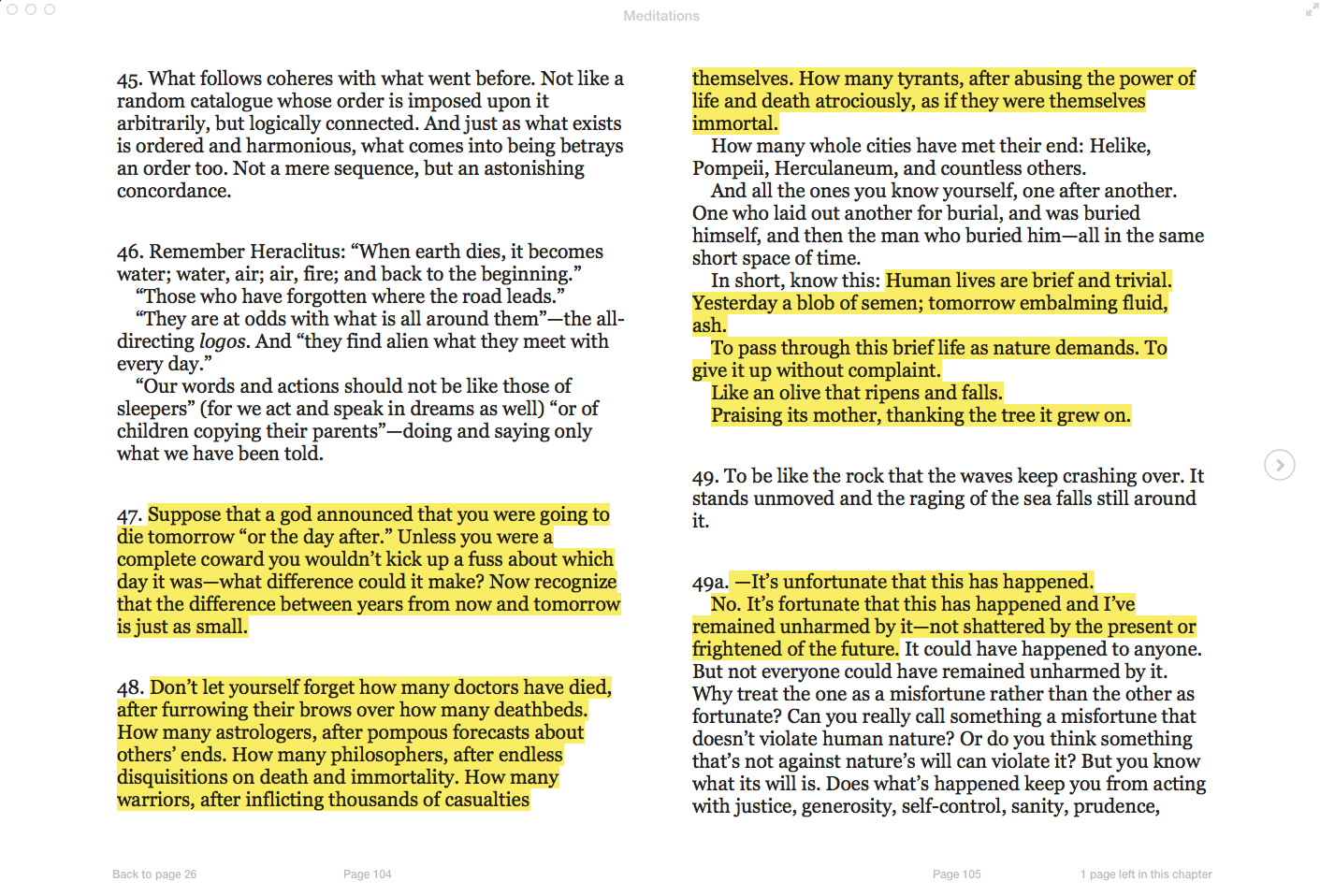
I’m rereading Marcus Aurelius’s Meditations. It’s the kind of book that you can open anywhere and find something worthwhile to ponder. My copy is filled with yellow highlights, and I marvel at his prolifically quote-worthy (and tweet-worthy) insights into the challenges of living an excellent human life.

What makes this book so remarkable, I think, is that he was not writing it for anyone but himself. He had no intent to publish what was the private diary of the most powerful man in the world. Instead of filling this journal, though, with the people and events of his life, which certainly would have been of great historical value, he instead wrote of his efforts to master his own mind and live in a virtuous, excellent way. The philosophical value more than makes up for what was lost to history.

Meditations is a sort of extended “note to self” wherein he is clearly talking only to Marcus Aurelius and chiding and encouraging and reminding himself of what should be his focus. There are sentence fragments galore. Some make no sense to me, and others are as starkly profound as anything I’ve read.

Uninhibited by what others might think, Aurelius was free to write with a remarkable rawness and candor that would be unlikely if he were writing for an audience.

This site is my attempt to somehow publicly share a sort of note-to-self journal. I keep a private journal (using Day One), and I find my writing there is not nearly as well thought out as what I post here. Being aware that someone else might read this (hello, lone reader) forces me to craft my thoughts with more care and intention.

Just as inviting people over forces you to clean up your apartment, writing something that other people will read forces you to think well. -Paul Graham

But I don’t want to come across as some pretentious expert with answers and solutions for all. I’m far from it. Yet I want the kind of candor and directness that Marcus has in writing to himself.

How to balance the authenticity a note-to-self approach with the benefits of writing for others? It’s a worthwhile challenge to attempt. Squelch the self-consciousness of being observed yet write with enough awareness of an audience to focus my thinking more sharply.

My imperative sentences are addressed to myself. “Do this…” “Think in this way…” Those are directed at me, and if a reader finds some value as well, excellent. But if I am the only person who derives any benefit from sharing my notes-to-self online, if this effort moves me just a little further along the path toward living a better life, that is excellent, too.

Screen Shot 2014-06-21 at 9.49.47 AM
screenshot from my copy of Meditations

“If you think, you stink.”

From Ed Catmull’s book Creativity, Inc.:

Byron Howard, one of our directors at Disney, told me that when he was learning to play the guitar, a teacher taught him the phrase, “If you think, you stink.” The idea resonated with him—and it informs his work as a director to this day. “The goal is to get so comfortable and relaxed with your instrument, or process, that you can just get Zen with it and let the music flow without thinking,” he told me. “I notice the same thing when I storyboard. I do my best work when I’m zipping through the scene, not overthinking, not worrying if every drawing is perfect, but just flowing with and connecting to the scene—sort of doing it by the seat of my pants.”

Too much thinking will mess things up. When I’m struggling or discouraged or anxious and uptight, it’s my mind that’s getting in the way. Instead of try hard, I should try easy, right? Or, just skip trying and simply do.

Enthusiasm

Screen Shot 2014-06-16 at 4.34.29 PM

All the chasing we do after stuff and to please others and to build what we think is security for a comfortable life…

What if the greatest comfort, though, is the deep, satisfying happiness that comes from getting lost in something you love just for the thing itself? What generates genuine enthusiasm in you, not for any extrinsic rewards but for the simple joy of the pursuit, for the intrinsic rewards?

Enthusiasm in some people can seem trivial or insincere or even silly, especially when it comes across as contrived emotion worked up artificially on command like a salesman trying to make his quota or a manager in a dysfunctional bureaucracy trying vainly to rally her demoralized charges. But the real thing, genuine enthusiasm, delightful absorption, is an obvious marker that someone embarking on an excellent journey should heed. Go in that direction.

The imagined opinions of others

“It never ceases to amaze me: we all love ourselves more than other people, but care more about their opinion than our own. If a god appeared to us—or a wise human being, even—and prohibited us from concealing our thoughts or imagining anything without immediately shouting it out, we wouldn’t make it through a single day. That’s how much we value other people’s opinions—instead of our own.” -Marcus Aurelius, Meditations

We all are a bit crazy. Our minds are so occupied with what others may think of us, how something we do or how we look is being judged by other people. Of course, the reality is others aren’t thinking of us much at all. They are thinking of themselves and how they are being perceived by others. What a ridiculous cycle and what a waste of mental and emotional energy.

The freest people are those who have enough control of their own minds to either block out or be relatively unphased by the imagined opinions of others. Imagine what would be possible if we could free up all that space in our minds that is otherwise occupied by our concern for what other people think.

Resistance is futile: Hadrian and the profound power of acceptance

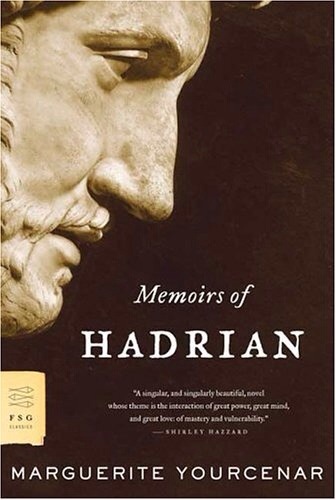
I’m reading Marguerite Yourcenar’s 1951 novel, Memoirs of Hadrian, about the Roman emperor and written as though it was his own journal as he is facing the end of his life. It’s addressed to the future emperor, Marcus Aurelius. I could only find a paperback copy but was eager to have it. A book like this dealing with Roman history and Stoicism and Marcus Aurelius is right in my wheelhouse. I, Claudius remains the most delightful novel I’ve read and helped spark my fascination with ancient Rome.

Memoirs of Hadrian is no I, Claudius, though. It’s not the exhilarating, page-turning romp through Roman scandal and political intrigue. Yourcenar’s book is a quiet, reflective review of a notable life as our protagonist is facing his final days.

I came across this remarkable passage yesterday. It’s Hadrian looking back on his years as a young army officer:

I determined to make the best of whatever situation I was in; during my years of dependence my subjection lost its portion of bitterness, and even ignominy, if I learned to accept it as a useful exercise. Whatever I had I chose to have, obliging myself only to possess it totally, and to taste the experience to the full. Thus the most dreary tasks were accomplished with ease as long as I was willing to give myself to them. Whenever an object repelled me, I made it a subject of study, ingeniously compelling myself to extract from it a motive for enjoyment. If faced with something unforeseen or near cause for despair, like an ambush or a storm at sea, after all measures for the safety of others had been taken, I strove to welcome this hazard, to rejoice in whatever it brought me of the new and unexpected, and thus without shock the ambush or the tempest was incorporated into my plans, or my thoughts. Even in the throes of my worst disaster, I have seen a moment when sheer exhaustion reduced some part of the horror of the experience, and when I made the defeat a thing of my own in being willing to accept it. … And it is in such a way, with a mixture of reserve and of daring, of submission and revolt carefully concerted, of extreme demand and prudent concession, that I have finally learned to accept myself. –Memoirs of Hadrian, pp. 44-45

This is life-changing insight explained with profound clarity. “Whatever I had I chose to have…” Consider some unpleasant circumstance or event, from something as trivial as having to wash dishes to something as potentially catastrophic as facing a tragic loss. If you welcomed this thing you have no control over and accepted it fully, embracing, even, something that seems unembraceable, imagine the transformation in your psychology. Accept what is and use it to learn and grow and find unforeseen opportunities. Fling yourself fully into even the worst circumstances that befall you. Don’t resist. Welcome whatever comes your way and grow your character and peace of mind in the process.


20140611-074226-27746993.jpg

Stoic Optimism: Ryan Holiday’s TEDx Talk

Following up on my post last week about Ryan Holiday’s wise little book, The Obstacle is the Way, here’s Holiday’s recent TEDx talk on Stoic Optimism:

There are some good stories in this talk. I loved the anecdote about Edison’s factory burning down and the inventor summoning the family to come because they would never likely see such a spectacle of a fire ever again. Find the good even in the really, really bad.

Some quotations from the talk:

Nothing either good or bad, but thinking makes it so. –Shakespeare


There is good in everything if only we look for it. –Laura Ingalls Wilder


Objective judgment, now at this very moment. Unselfish action, now at this very moment. Willing acceptance – now at this very moment – of all external events. That’s all you need. –Marcus Aurelius

Real freedom

The late David Foster Wallace on real freedom, overcoming our default settings and responding to life, or the “real world”, wholeheartedly and authentically:

The really important kind of freedom involves attention, and awareness, and discipline, and effort, and being able truly to care about other people and to sacrifice for them, over and over, in myriad petty little unsexy ways, every day. -David Foster Wallace

https://vimeo.com/75422173

Video by Max Temkin

Wonder why

“Learn to ask of all actions, ‘Why are they doing that?’
Starting with your own.” -Marcus Aurelius, Meditations

Reading those lines this morning reminded me of some great Stephen Covey insights I wish I was more inclined to consistently apply in my life.

I’m paraphrasing, but Covey, author of The 7 Habits of Highly Effective People, suggested when you’re inclined to judge, stop yourself and attempt, instead, to try to understand.

“Why?” is the king of questions. And if you ask “I wonder why…?” on a regular basis, you will open yourself to possibilities and to compassion, for others and for yourself.

Asking “I wonder why that driver is driving so recklessly?” can transform you from an angry observer to a curious one. What if the driver was on the way to the hospital for an emergency? Unlikely? Sure. But just framing the question can give you pause and defuse an unhelpful emotion.

Got some bad habits or frustrating tendencies in your own life? Wonder why and you just might go a little easier on yourself while sparking the possibility for genuine understanding and possibly a breakthrough.

Instead of labeling or judging or reacting, use the gap between stimulus and response to try to understand.

Want to spark more meaningful conversations? Ask “Why?” often, not in a pestering way, but with the intent to truly understand the other.

Want a clear vision for your family or your organization or your work? Ask “Why?” and pursue the answers relentlessly.

Why not make “Why?” your go-to question, the spark for possibilities that otherwise would remain undiscovered.

Screen Shot 2014-06-02 at 5.09.11 PM


Sunday morning Stoic

From Marcus Aurelius’s Meditations:

“External things are not the problem. It’s your assessment of them. Which you can erase right now.
If the problem is something in your own character, who’s stopping you from setting your mind straight?
And if it’s that you’re not doing something you think you should be, why not just do it?
—But there are insuperable obstacles.
Then it’s not a problem. The cause of your inaction lies outside you.
—But how can I go on living with that undone?
Then depart, with a good conscience, as if you’d done it, embracing the obstacles too.”

“Concentrate on what you have to do. Fix your eyes on it. Remind yourself that your task is to be a good human being; remind yourself what nature demands of people. Then do it, without hesitation, and speak the truth as you see it. But with kindness. With humility. Without hypocrisy.”

Awakening

20140401-221123.jpg

On a day of silly pranks, how blind were we to the magnificent mysteries all around us? The unfamiliar warmth of the spring sun and the shower of blossoms floating from the trees were enough to catch me by surprise. The seasonal awakening of nature can stir us from our winter lethargy. Let’s come alive with wonder and delight.

We are walking in a wonderland every day and yet tread ploddingly, numbly along.

“It’s about awakening the mind’s attention from the lethargy of custom and the film of familiarity and redirecting it instead to the wonders of existence.” -Jason Silva

This brief instant

More wisdom from the philosopher-king, Marcus Aurelius, in his Meditations:

“Forget everything else. Keep hold of this alone and remember it: Each of us lives only now, this brief instant. The rest has been lived already, or is impossible to see. The span we live is small—small as the corner of the earth in which we live it.”

Here and now. That’s all we have. But how often do we give our attention to the present moment?

Fascinating

On the original Star Trek television series, Spock would regularly respond to unpleasant or surprising circumstances with a one-word response: “Fascinating.”

Instead of judging or taking something personally or lashing out emotionally, he sought to understand.

What a healthy way to manage your responses. We all have the ability to choose our response in any circumstance. But I know I often default to an automatic, self-centered reaction instead, as if everything is all about me and as if I have no control over my feelings. And I feel like I’ve been more prone to emotional, knee-jerk reactions recently. I’m rapidly approaching 50. I should be getting wiser and more disciplined, right? (I should be fascinated rather than disturbed by that.)

Imagine, though, using the gap between stimulus and response to choose to be curious.

To ask, “I wonder why…?”, will completely reframe your response to something that otherwise might cause anger or frustration.

Next time I get cut off in traffic or receive bad news or deal with a difficult person, I’m going to give my inner Vulcan a try and get curious rather than getting mad.

“Men are disturbed not by the things that happen, but by their opinion of the things that happen.” -Epictetus

star-trek-spock-leonard-nimoy-desktop-wallpaper-other-626603849

Truthful AND helpful

If it is not truthful and not helpful, don’t say it.

If it is truthful and not helpful, don’t say it.

If it is helpful and not truthful, don’t say it.

If it is truthful and helpful, wait for the right time.

This is attributed to the Buddha. Whoever said it was wise.

I remember sharing this with a group of student leaders who were stuck working together for more than forty hours a week for two months in the summer. Tension and frustrations would mount occasionally, and it seemed noble to want to communicate forthrightly, honestly. But just telling it like it is was not always helpful.

I’ve seen too many people hurt by friends, coworkers, and family members simply “speaking the truth” or “telling you how I feel”.

The truth can hurt, and not always in a constructive way. If the truth is not also helpful, keep it to yourself. Making that judgment call can be tricky at times, but aiming for helpful should take priority over just speaking what you think is true.