How to find work you love

Some of my students and former students may have read my “Follow your passion” is not helpful advice post, and they’re saying to the screen: “But EJ [they call me EJ], what about Howard Thurman?”

I have shared this Howard Thurman quotation with thousands of college students over the past fifteen years:

“Don’t ask yourself what the world needs. Ask yourself what makes you come alive and then go do that. Because what the world needs is people who have come alive.”

I stand by this quote as great advice for a college student and anyone trying to pick a career path. Sounds a lot like the misguided follow your passion advice, I know. “Follow your passion” is just not helpful as a stand-alone, magic bullet for a happy career. While skills trump passion in your quest for satisfying work, you still need to choose a path that offers delight and interest, that makes you come alive. What kind of work would be a good enough fit for you to spend years getting good at it? That’s a much less overwhelming, paralyzing question than asking you to figure out your lifetime passion.

If you’re trying to just “follow your passion”, you’re likely to get stuck searching for that one elusive match. If, instead, you explore all the things that make you come alive, you will focus on a direction rather than a destination, on a set of skills that you can begin refining. Be intentional about asking what it is that you love to do, not for the extrinsic rewards, but for the joy of the thing itself.

“You must cultivate activities that you love. You must discover work that you do, not for its utility, but for itself. Think of something that you love to do for itself, whether it succeeds or not, whether you are praised for it or not, whether you are loved and rewarded for it or not, whether people know about it and are grateful to you for it or not. How many activities can you count in your life that you engage in simply because they delight you and grip your soul? Find them out. Cultivate them, for they are your passport to freedom and to love.” -Anthony DeMello

I challenge university students to leverage their time here to ask these kinds of questions. If they don’t ask the “what makes you come alive” question while they’re in college, when will they in the rest of their busy adult lives? In answering that question, look for patterns – skills that keep recurring, interests that intrigue more than most, problems that you enjoy solving.

Gretchen was a student orientation leader with wisdom beyond her years. When confronted with incoming freshmen in angst over choosing an academic major, she told them how she picked a major. She was undecided when she arrived as a freshman, so she read every course description in the college catalog. Each time she read a course description that seemed remotely appealing, that looked like a class that was interesting or fun, she circled the class. When she finished reading every course description and circling only those that grabbed her attention, she went back and counted which major had the most courses circled. And that became her major.

Brilliant, no? And so simple. She was figuring out what made her come alive. But then she got on that path and worked hard at getting good. She was good enough to go on to an Ivy League graduate program and great success in her career and family life.

The “don’t ask yourself what the world needs” quote is especially crucial for new students to hear. Many arrive on campus with their parents’ expectations setting their own. We get a lot of “pre-wealth” majors at freshman orientation. I had a student whose father required her to be pre-med. She didn’t like science so much, and when, after a rough freshman year in the classroom, she pleaded with him to let her change her major, he relented only if she would then choose business instead.

I heard a commencement speaker last year say that your parents do not want what is best for you. They want what is good for you. They want you to be safe, secure, successful, and have all your needs met. But what’s best for you might be risk and struggle and failure, key components on any path to mastery and awesomeness. Respect your parents, but lead your own life. And know that one day you might be that parent wanting what is just good for your child. And that’s okay. Parents are wired by evolution to protect their babies. Of course, the way you live your life will inform your children more than anything you say to them.

If you’re struggling with finding a career, use the “come alive” question to help you find a general direction, a path to follow. You don’t have to know the one thing you need to be doing, your life calling. You just need to know enough to start moving in a direction that works for you. You need a place or a profession that you don’t dislike and where you can start building skills and getting good enough to truly love what you do and come alive in the process.
Be like a “dog chasing a tennis ball”

This commencement address by Dropbox founder and CEO Drew Houston is terrific. He’s speaking at his alma mater, M.I.T., and he’s only been out of college since 2005. He tells the story of how he got started as an entrepreneur, and he offers some great wisdom about choosing work that challenges and delights you like a “dog chasing a tennis ball”:

When I think about it, the happiest and most successful people I know don’t just love what they do, they’re obsessed with solving an important problem, something that matters to them. They remind me of a dog chasing a tennis ball: their eyes go a little crazy, the leash snaps and they go bounding off, plowing through whatever gets in the way. I have some other friends who also work hard and get paid well in their jobs, but they complain as if they were shackled to a desk.

My dog, Mosley, certainly gets crazy eyes when I fling a ball across the yard. He could be waking from a nap, but if he sees me with a ball in hand, he comes to life in a flash. I feel that puppy-like excitement when I get caught up in creating something worthwhile or working on solving a problem and making a dent in the universe.

I love how Houston concludes, with the call to tell an interesting story with your life:

Every day we’re writing a few more words of a story. And when you die, it’s not like “here lies Drew, he came in 174th place.” So from then on, I stopped trying to make my life perfect, and instead tried to make it interesting. I wanted my story to be an adventure — and that’s made all the difference.

We’ve got a limited stay here on this planet. If we’re lucky, Houston points out, we might get as many as 30,000 days. Today is my 49th birthday. I’ve lived 17,885 days, and I’m delighted to have made it this far. But I’m on the back side of my days. I just want to make the ones that are left worth talking about.

20130608-170057.jpg

Smile

Three times each weekday I greet groups of campus visitors as they’re about to embark on our campus tour. I offer a brief overview and introduce the tour leaders.

Far too often, as I try to warm up the crowd, I’m greeted by a smattering of stone-faced expressions. These people are not waiting for a root canal or an IRS audit, where there may be less obvious reason to smile. They’re about to stroll through a lovely college campus with a couple of charming college students. Why the long faces, people? It’s my team’s aim, of course, to have them smiling by the time they leave.

But in pretty much every crowd there are smilers. Some are subtle with only a happy glint in their eyes. Others are nodding and grinning and practically glowing with positive energy. I love these people, those whose default expression is a smile. Just standing in the presence of smiling faces makes me happier and encourages me to be even a little more awesome myself.

Some children smile as many as 400 times a day. Many adults smile fewer than 10 times each day.

You want to be happy, right? No need to wait until you’ve reached some longed for accomplishment to be happy. Just act like you’re happy, and you likely will be. When you wake up, put a smile on your face. Make it a habit or ritual like brushing your teeth. When you greet people throughout your day, be intentional about smiling at them. Act like you’re happy to see them. Even if it’s just a nod and a quick smile. Fake it if you have to. Act like you are who you want to be. Use your body to inform your mind and your emotions.

There’s an old Peanuts cartoon where Charlie Brown is telling a friend that the worst thing you can do if you’re feeling depressed is hold your shoulders back and your head up and smile. Then you’ll start feeling better, and “that’s no good at all.”

Sages know this is true:

“Sometimes your joy is the source of your smile, but sometimes your smile can be the source of your joy.” Thich Nhat Hanh

Science backs this up:

“Even the simulation of an emotion tends to arouse it in our minds.” Charles Darwin

And smiling is contagious thanks to evolutionary wiring. Your smile can cause others to smile. What if one of your missions each day was to elicit as many smiles from others as possible? Make some mischief with your smile to subvert and co-opt the Charlie Browns of the world.

This is a delightful, short TED Talk from Ron Gutman about the power and surprising benefits of smiling:

There’s also this $2 e-book by Gutman that expands on his talk with plenty of support from researchers on how and why smiling is so powerful.

Good grief, Charlie Brown. Just smile.

Be awesome

I spoke to a group of college students yesterday. They are in training to run our university’s orientation program this summer. It’s a challenging job for these twelve students, who are stuck with each other in close quarters for sixty hours a week or more for two months. They will welcome thousands of new students, perform before large and small audiences multiple times each day, engage in countless conversations with nervous freshmen and anxious parents, and execute the logistics of a complex program that is crucial to our institution. I ran this program for thirteen years, so I greatly appreciate the challenge and the rewards of what these students are about to do.

At the end of my meeting with them yesterday, one of them asked me, “What’s your most important advice for us to keep in mind during our experience this summer?” I proceeded to offer some rambling discourse that I can’t exactly recall now. After I left, I realized what I should have told them: “Be awesome.”

This may sound trite and obvious and unhelpful. But it’s crucial to keep that intention, to be your best and do your best, at the center of your thoughts. If you’re constantly challenging yourself to be awesome, you will keep upping your game. You will get better. You will be discontent with cutting corners and doing “just enough to get by”. And this intent to be awesome applies to every area of your life – your work, your relationships, your health.

Awesome doesn’t phone it in. Awesome is awesome even when no one is watching. Awesome cares about the details.

When I drop my kids off at school each morning, my last words to them are, “Be awesome.” When I send off our student staff members to give a campus tour, I stand by the door to the bus and tell them, just before the door closes, “Be awesome.” When my wife leaves for work: “Be awesome.”

If you make this your mantra, if you wake up every day mindfully intent to be better on this day than the one before, you will put yourself on a path to excellence and deep satisfaction in all that you do. Before you go to sleep, assess the day. How did you do? How awesome were you? Note it in your journal to keep yourself accountable. If your actions didn’t meet your expectations, don’t beat yourself up. Being aware and caring are enough, and you get a fresh try the next morning.

I love this thought from Julien Smith:

I am a champion standing over my former self.

The only competition that matters is the one between who you want to become and who you are. Comparison with others will distract or discourage and put you off course. The you of one year from now should be able to kick the ass (in overall awesomeness and, maybe, physically as well) of the you from today.

Grow. Evolve. Rethink. Refine. Transcend your current limitations. One day at a time.

Be awesome.

IMG_0027

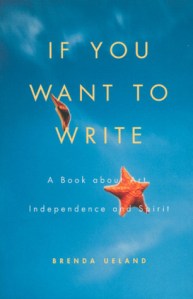
If You Want To Write

If You Want To Write by Brenda Ueland

I mentioned my favorite book, If You Want To Write, in a recent post. I discovered this little book back in the ’90s, and it remains one of the few books I’ve read more than once and recommended almost aggressively to others. The author, Brenda Ueland, was a writing instructor in the early 20th century. Reading this book is like sitting in her living room and having a pleasant conversation with a favorite aunt. She is kind and wise and funny, and her advice about writing is transferable to almost any endeavor. Really, the book could be titled, If You Want To Live A Happy Life.

Ueland’s book introduced me to the letters of Vincent van Gogh and the poetry of William Blake. Tolstoy is cited often as well. But it’s Ueland’s gentle, yet compelling, encouragement to take action, avoid being critical (of yourself and others), to be free, be bold, and be “microscopically truthful” with your work that stays with me. She says that everyone is an artist capable of creating something beautiful and meaningful. And we have the opportunity to help others express themselves. This quote from a van Gogh letter to his brother, Theo, has challenged me and informed my work ever since:

Many a man has a bonfire in his heart, and no one comes to warm himself at it. -Vincent van Gogh

How sad to imagine all the genius and insight and talent that has never been given a chance to grow and flourish in most people. Indeed, our culture is cruelly proficient at stamping out signs of originality and creative imaginings early in childhood even. It is a noble calling to be the one warming by the fire and fanning the flame that’s within someone who doesn’t think he’s got even a spark to share. If I produce nothing notable or lasting on my own but can help awaken possibility in others, that is a grand accomplishment.

If you ever need a dose of inspiration and a fresh perspective on what it means to be an artist, whether you want to write or perform or create a business or build a beautiful family, I highly recommend this sweet and powerful book.

Non-attachment for the win

Austin was a college freshman when he applied to work as one of the twelve orientation leaders who run our university’s summer orientation program that welcomes and transitions thousands of new students each summer. It’s a challenging, prestigious position, and there is always an impressive applicant pool, made up of the best and brightest leaders from a campus of more than 30,000 students.

Austin had a great interview during the first round, which was a group interview. He was thoughtful and enthusiastic and a strong communicator. We invited him back for the final round of interviews, which was an individual meeting with the program directors. He was even more impressive in his individual interview. We hired him. The next week we gathered the twelve newly selected student orientation leaders together for a first meeting to start planning their training and to meet each other.

After the meeting, Austin approached me privately and said he had a question for me. He looked a bit distressed. His question: “Why did you hire me?” That’s not the question I typically get the day someone begins a new position. I told him we hired him, of course, because he was a great fit for the job and would be terrific in the role.

He then related that, before he applied, his friends had told him that we do not hire freshmen for this particular job. Freshmen could apply, they said, but only to gain interview experience. He was stunned (and ended up being delighted) to actually be offered the position. Well, his friends were wrong. Freshmen were rarely selected because the competition was so strong, but they were just as eligible as any other student.

Austin walked into those interviews certain that getting the job was not even an option. He thought it was just practice. He was completely unattached to any outcome. And he was awesome.

Contrast that with a young woman, in the same selection process, who, when asked the very first question (which was a softball: “Tell us why you want this position”), immediately began crying. We scrounged up a box of tissue, and when she finally composed herself she said: “I’m sorry. I just want this… so… much.”

She was so attached to the outcome that she couldn’t even engage in a conversation. Austin was not attached at all and was able to focus completely on the moment and shine. For him, it was just a conversation, not a job interview.

There’s something powerful about this state of non-attachment. The great performers seem to have mastered the art of the present moment. Think of superstar athletes in clutch situations. The greatest ones aren’t weighed down by the stakes, the fear of failure or anticipation of the next day’s headlines.

There’s a classic story of football legend Joe Montana in the 49ers’ Super Bowl against the Bengals in 1989. Time was running out, and the 49ers were behind on the scoreboard. While his teammates are huddled on the field during a TV timeout, stressed about the challenge they were facing, Montana was unflappable, seemingly oblivious to the team’s dire straits. Just before the timeout ended, he pointed into the crowd and told one of his offensive linemen: “Hey, isn’t that the actor John Candy?” His teammate was incredulous that the quarterback was so relaxed in that high-stakes moment that he could point out celebrities in the stadium. When play resumed, Montana methodically moved the team down the field and into the end zone for the winning score with just 34 seconds left on the game clock.

The next time you’ve got an interview or a presentation or a first date, even, put your focus only on the moment at hand. In the interview and the date, make it your goal simply to have a great conversation, one where you listen intently and seek to understand before seeking to be understood. And then don’t be afraid to be interesting. And if you abandon any expectation of getting the job or a second date, you will be freed up to be your best and shine in the moment. Same with a presentation or any task you pursue, don’t attach to the outcome. Be awesome in the present moment and let the future unfold as it will. The more you practice getting yourself into that zone in low-stakes moments, the easier it will be when the stakes mount.

Best. Day. Ever?

Sunday is bittersweet for most of us. This day of rest that gradually and surely turns into a night of unease, or even dread, for too many. Today is an exception because tomorrow is a holiday, so this Sunday is sweeter than most.

My daughters love the movie Tangled. (Okay, I love the movie Tangled, too.) There’s a great scene where Rapunzel leaves the tower for the first time and is overwhelmed with how amazing it is to be free and doing things she’s never experienced before. As she’s swinging through the forest by her hair she exclaims, “Best. Day. Ever!”

My daughters now regularly use that phrase when things are going well. And, they say the opposite, “Worst. Day. Ever.”, almost as frequently. Often multiple times in the same day. We all know that feeling, right? Well, what makes for a great day? A great week? A great year? A great life? These are fundamental questions that don’t often get examined with any serious intent.

I often ask student applicants in our interview process to “describe their ideal day.” I’m confounded by how many struggle coming up with a response to this and how many just offer only a few superficial plans for an ideal day. “Sleep in…” is way too popular a response. Here’s a similar interview question we regularly ask: “When you get to the end of a particularly satisfying day, what was it about that day that made it so satisfying?”

Both are great questions to play with and see what you come up with. Explore the answers to these questions in your journal or in a conversation with friends. (The Day One app is a beautiful electronic journal that I use every day now. It’s like having your own private Twitter that only you can see. It’s iOS and Mac only, but there certainly are alternatives for you Android and PC people.) Then, be intentional about crafting days so they’re filled with those things that delight and satisfy you.

Clearly, some days are going to just be a struggle, so it’s not realistic to expect every day to top the one before. But it you put together enough great days, you’ll have a great week. String great weeks together, and you’re going to have a great year. Great years make for a great life.

Ebert on prayer

I believe prayer that makes requests is pointless. What will be, will be. But I value the kind of prayer when you stand at the edge of the sea, or beneath a tree, or smell a flower, or love someone, or do a good thing. Those prayers validate existence and snatch it away from meaningless […]

Your life is now

“We are very good at preparing to live, but not very good at living. We know how to sacrifice ten years for a diploma and we are willing to work very hard to get a job, a car, a house, and so on. But we have difficulty remembering that we are alive in the present moment, the only moment there is for us to be alive.” —Thich Nhat Hanh

I came across this quote in an excellent post by Jonathan Mead about preparing to live but never really living. Check out the video embedded in that post. It’s a fascinating interview with Ido Portal who looks like some kind of superhuman gymnast Zen ninja. Very cool.

As far back as my undergraduate days I’ve been talking about and pondering this dilemma of seeing everything in life as a means to an end but nothing as an end in itself. I remember giving a talk to a group during my senior year of college and saying something like, “You want to graduate so you can get a job so you can get a car so you can get a house so you can get a wife or husband… Then what? A bigger car? A bigger house? A bigger wife or husband…?!” I got a good laugh from that line, and still do, but it’s a legitimate quandary (except for the bigger spouse part).

We always seem to be getting ready for something out there in the future but never truly living in the present. But when you get to the future, it’s just the present, right? The peak moments in life are the ones where past and future fall away because you’re so aware of and alive in the present moment. Think back on the moments in your life when you felt most alive and see if that’s not true. That’s why thrill-seeking is a thing. It’s hard to worry about next week or feel regret for last week when you’re on a roller coaster or jumping out of an airplane. Or when you’re truly listening to someone you love or in a tickle fight with your kids or completely engrossed in work you love. Go read Thich Nhat Hanh’s classic little book, Peace Is Every Step. What an awake, aware life he must lead. Yes, the unexamined life is not worth living, but most of us most of the time are actually living a sort of unconscious life, hoping we’ll get there, someday.

So, how do you have more of those moments? This 2-minute video featuring an Alan Watts story beautifully exposes how our culture ingrains this future focus in us and leads to most of us never truly living. And he offers a nice metaphor for how to shift your perspective for a more excellent experience of life:

What human beings want

What human beings want, once they have enough food and shelter, is meaning. We want to matter. We want to engage with people who matter. We want to do something worth talking about. That’s our shortage. We don’t have a shortage of stuff; we have a shortage of caring. -Seth Godin True. This is from […]

Don’t pursue a role, LIVE that role.

I’ve willed almost all of the stuff I’ve done into existence, and if I can do that, ANYBODY can do that. So start your chatter: talk about what you’re going to do. Don’t pursue a role, LIVE that role. Like my sister told me, back when I confessed I wanted to be a filmmaker. “Then BE a filmmaker,” she said. “That’s what I’m saying: I wanna be.” And that’s when she gave me the million dollar advice: “No – BE a filmmaker. You say you wanna be; just BE a filmmaker. Think every thought AS a filmmaker. Don’t pine for it or pursue it; BE it. You ARE a filmmaker; you just haven’t made a film yet.
-Kevin Smith

I love this thought. Act like you are who you want to be, even if there’s nothing to show for it yet. Just start living the life you imagine and being the person you want to be.

It’s your life …

It’s your life — but only if you make it so. The standards by which you live must be your own standards, your own values, your own convictions in regard to what is right and wrong, what is true and false, what is important and what is trivial. When you adopt the standards and the values of someone else or a community or a pressure group, you surrender your own integrity. You become, to the extent of your surrender, less of a human being.
-Eleanor Roosevelt

via SwissMiss

Second circle: To be or not to be… fully present

Nick Morgan’s recent post introduced me to Patsy Rodenburg. She is one of the world’s most prominent voice teachers and a renowned expert on Shakespeare. Actors come to her for coaching on how best to use their voice in performance. And she has a great take on what it means to have “it“. Charisma. Presence.

This 10-minute video shows her explaining “second circle”:

This clip inspired me to purchase and begin reading her book, The Second Circle. I’ve only gotten a third of the way into it, but I’m hooked and know that she’s on target.

We all know people who seem to shine with presence, and it’s easy to think it’s some gift they have, that they won the charisma lottery. But I’m confident that everyone can flip a switch and become present, even charismatic, at will. I’m no master of this. I spend too much time in my head and not in the present moment. But, when I am intentional about connecting with the present moment, whether in conversation or giving a presentation or creating something, I feel so much more alive and dynamic. When you make that connection with an audience as a public speaker, you feel like a rock star. When you have that moment of genuine presence in a relationship, or even with a stranger, you feel like a real human being.

Think of those you consider to have a strong sense of presence. Don’t they seem to care more than the average person? They actually listen intently in conversation rather than simply waiting their turn to talk. In front of an audience they glow with expressiveness and confidence and energy. Charisma is caring deeply and having the courage to fully express yourself and genuinely connect in the present moment. It’s talking with someone rather than at them. It’s paying attention. It’s using the physical senses to connect with the here and now. It’s this paradox of being more powerful by being vulnerable.

Kids have this naturally. Watch young children engrossed in play. They are free and fearless and full of life. Somewhere along the way this gets stifled, and fear throttles our natural impulse.

I’ll report back after I finish reading Rodenburg’s book to see what she recommends for consistently getting into second circle. In the meantime, I’m going to be intentional about being present in conversations especially. I want to make a genuine attempt to understand before seeking to be understood. I will ask more questions. Make more eye contact. I will religiously put my phone away when I’m with humans, especially when I’m with my wife and kids. (What if your level of coolness is inversely proportional to how often your phone is visible in public? A staggering thought for most of us.) When standing in front of an audience, I will attempt to think through their point of view and make my remarks audience-centered. When asking “How are you?”, I’ll mean it and wait for a response. This is my aim, at least. An excellent journey of a life would be spent mostly in second circle, in the here and now.