Seek not that the things which happen should happen as you wish; but wish the things which happen to be as they are, and you will have a tranquil flow of life. –Epictetus
This is some serious mental jujitsu. There’s a fine line between passiveness and acceptance. One is weak. The other is strong.
Take action to make your plan happen, but accept whatever does happen as though it’s part of the plan.
Wanting to reform the world without discovering one’s true self is like trying to cover the world with leather to avoid the pain of walking on stones and thorns. It is much simpler to wear shoes. -Ramana Maharshi
A very Stoic-like thought from an Eastern sage. There is much overlap in the wisdom of the East and the insights of Stoicism.
It’s nice to want the world to be better and to work to fix its problems, but you’re only truly in control of your actions and your responses. Instead of complaining about external problems, make sure your internal armor, your “Inner Citadel” as the Stoics would say, is in place.
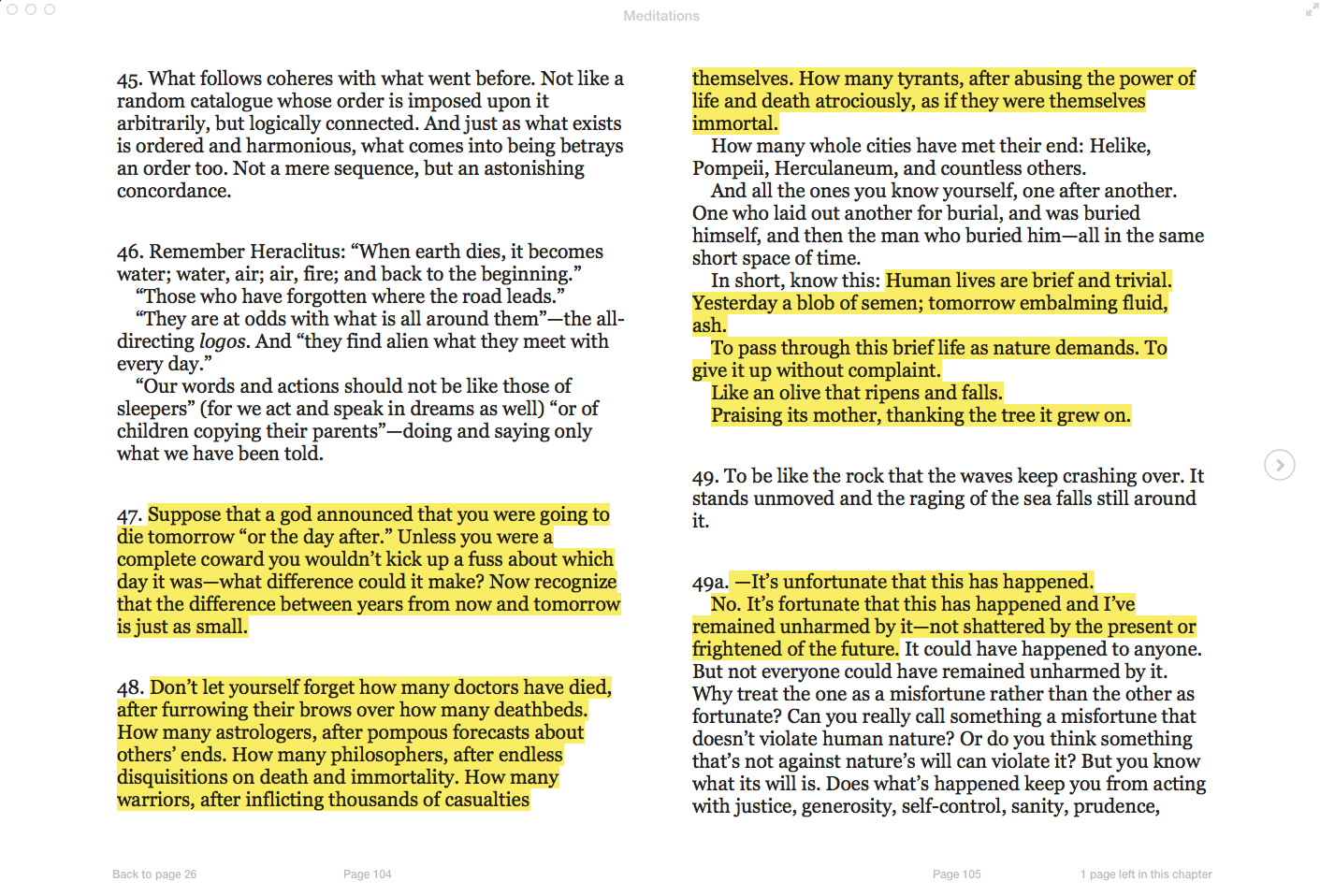
I’m rereading Marcus Aurelius’s Meditations. It’s the kind of book that you can open anywhere and find something worthwhile to ponder. My copy is filled with yellow highlights, and I marvel at his prolifically quote-worthy (and tweet-worthy) insights into the challenges of living an excellent human life.
What makes this book so remarkable, I think, is that he was not writing it for anyone but himself. He had no intent to publish what was the private diary of the most powerful man in the world. Instead of filling this journal, though, with the people and events of his life, which certainly would have been of great historical value, he instead wrote of his efforts to master his own mind and live in a virtuous, excellent way. The philosophical value more than makes up for what was lost to history.
Meditations is a sort of extended “note to self” wherein he is clearly talking only to Marcus Aurelius and chiding and encouraging and reminding himself of what should be his focus. There are sentence fragments galore. Some make no sense to me, and others are as starkly profound as anything I’ve read.
Uninhibited by what others might think, Aurelius was free to write with a remarkable rawness and candor that would be unlikely if he were writing for an audience.
This site is my attempt to somehow publicly share a sort of note-to-self journal. I keep a private journal (using Day One), and I find my writing there is not nearly as well thought out as what I post here. Being aware that someone else might read this (hello, lone reader) forces me to craft my thoughts with more care and intention.
Just as inviting people over forces you to clean up your apartment, writing something that other people will read forces you to think well. -Paul Graham
But I don’t want to come across as some pretentious expert with answers and solutions for all. I’m far from it. Yet I want the kind of candor and directness that Marcus has in writing to himself.
How to balance the authenticity a note-to-self approach with the benefits of writing for others? It’s a worthwhile challenge to attempt. Squelch the self-consciousness of being observed yet write with enough awareness of an audience to focus my thinking more sharply.
My imperative sentences are addressed to myself. “Do this…” “Think in this way…” Those are directed at me, and if a reader finds some value as well, excellent. But if I am the only person who derives any benefit from sharing my notes-to-self online, if this effort moves me just a little further along the path toward living a better life, that is excellent, too.
“It never ceases to amaze me: we all love ourselves more than other people, but care more about their opinion than our own. If a god appeared to us—or a wise human being, even—and prohibited us from concealing our thoughts or imagining anything without immediately shouting it out, we wouldn’t make it through a single day. That’s how much we value other people’s opinions—instead of our own.” -Marcus Aurelius, Meditations
We all are a bit crazy. Our minds are so occupied with what others may think of us, how something we do or how we look is being judged by other people. Of course, the reality is others aren’t thinking of us much at all. They are thinking of themselves and how they are being perceived by others. What a ridiculous cycle and what a waste of mental and emotional energy.
The freest people are those who have enough control of their own minds to either block out or be relatively unphased by the imagined opinions of others. Imagine what would be possible if we could free up all that space in our minds that is otherwise occupied by our concern for what other people think.
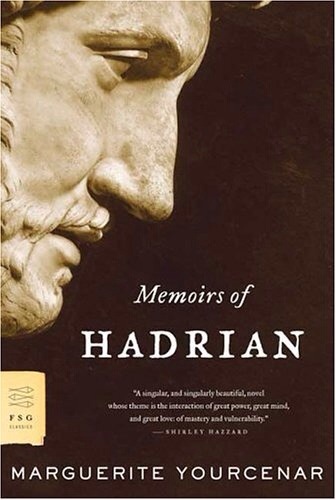
I’m reading Marguerite Yourcenar’s 1951 novel, Memoirs of Hadrian, about the Roman emperor and written as though it was his own journal as he is facing the end of his life. It’s addressed to the future emperor, Marcus Aurelius. I could only find a paperback copy but was eager to have it. A book like this dealing with Roman history and Stoicism and Marcus Aurelius is right in my wheelhouse. I, Claudius remains the most delightful novel I’ve read and helped spark my fascination with ancient Rome.
Memoirs of Hadrian is no I, Claudius, though. It’s not the exhilarating, page-turning romp through Roman scandal and political intrigue. Yourcenar’s book is a quiet, reflective review of a notable life as our protagonist is facing his final days.
I came across this remarkable passage yesterday. It’s Hadrian looking back on his years as a young army officer:
I determined to make the best of whatever situation I was in; during my years of dependence my subjection lost its portion of bitterness, and even ignominy, if I learned to accept it as a useful exercise. Whatever I had I chose to have, obliging myself only to possess it totally, and to taste the experience to the full. Thus the most dreary tasks were accomplished with ease as long as I was willing to give myself to them. Whenever an object repelled me, I made it a subject of study, ingeniously compelling myself to extract from it a motive for enjoyment. If faced with something unforeseen or near cause for despair, like an ambush or a storm at sea, after all measures for the safety of others had been taken, I strove to welcome this hazard, to rejoice in whatever it brought me of the new and unexpected, and thus without shock the ambush or the tempest was incorporated into my plans, or my thoughts. Even in the throes of my worst disaster, I have seen a moment when sheer exhaustion reduced some part of the horror of the experience, and when I made the defeat a thing of my own in being willing to accept it. … And it is in such a way, with a mixture of reserve and of daring, of submission and revolt carefully concerted, of extreme demand and prudent concession, that I have finally learned to accept myself. –Memoirs of Hadrian, pp. 44-45
This is life-changing insight explained with profound clarity. “Whatever I had I chose to have…” Consider some unpleasant circumstance or event, from something as trivial as having to wash dishes to something as potentially catastrophic as facing a tragic loss. If you welcomed this thing you have no control over and accepted it fully, embracing, even, something that seems unembraceable, imagine the transformation in your psychology. Accept what is and use it to learn and grow and find unforeseen opportunities. Fling yourself fully into even the worst circumstances that befall you. Don’t resist. Welcome whatever comes your way and grow your character and peace of mind in the process.
Following up on my post last week about Ryan Holiday’s wise little book, The Obstacle is the Way, here’s Holiday’s recent TEDx talk on Stoic Optimism:
There are some good stories in this talk. I loved the anecdote about Edison’s factory burning down and the inventor summoning the family to come because they would never likely see such a spectacle of a fire ever again. Find the good even in the really, really bad.
Some quotations from the talk:
Nothing either good or bad, but thinking makes it so. –Shakespeare
There is good in everything if only we look for it. –Laura Ingalls Wilder
Objective judgment, now at this very moment. Unselfish action, now at this very moment. Willing acceptance – now at this very moment – of all external events. That’s all you need. –Marcus Aurelius
The impediment to action advances action. What stands in the way becomes the way. -Marcus Aurelius
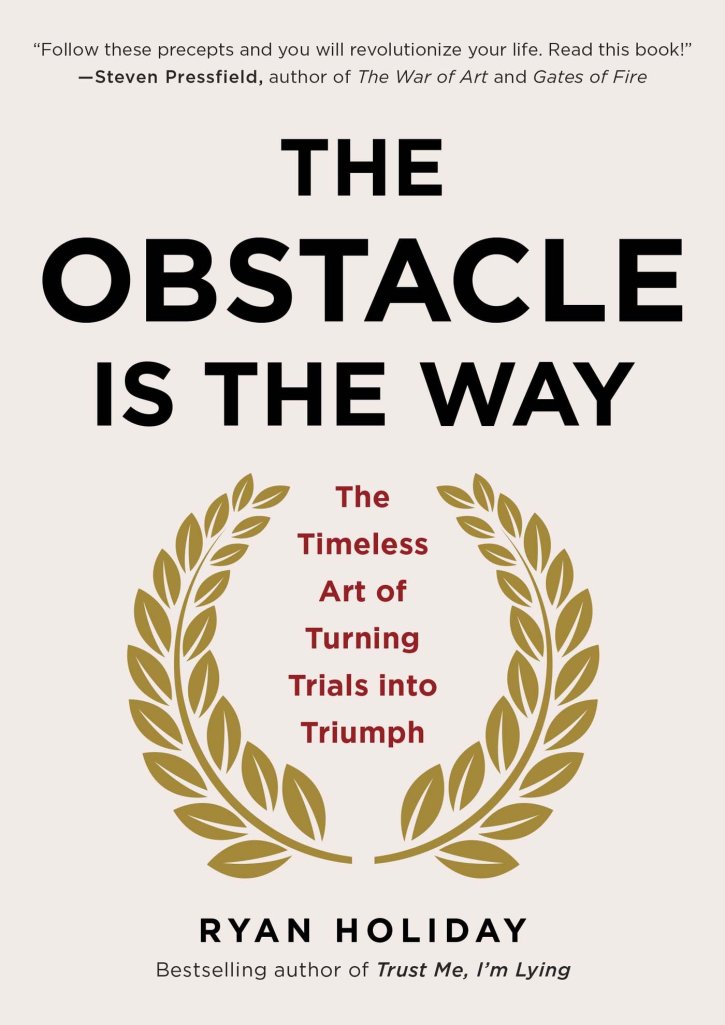
Ryan Holiday is an impressive young author. He’s in his mid-twenties and just published his third book, The Obstacle is the Way, which is a delightful, short, story-filled exploration of the value of embracing adversity. Ryan’s writing is influenced by the Stoics, and Marcus Aurelius’s Meditations is one of his favorite books also. (So, he must be cool, right?)
I’ve already given The Obstacle is the Way to a few young friends. It’s a quick read and filled with examples of great men and women who thrived in spite of, or, actually, because of the difficulties seemingly blocking their way.
Holiday, the author, has had an interesting career. He left college before graduating, but has continued his own education through some killer work experiences and a prolific consumption of books. My friend, Nick, recommended Holiday’s reading recommendation newsletter, and I’ve been impressed with the quality and quantity of his book suggestions.
This is a solid podcast interview with Ryan by Tim Ferriss. I listened to this while doing yard work recently and found Holiday to be just as engaging and thoughtful in conversation as he is in his writing. It’s a bit humbling to me that this guy who is almost half my age has accomplished so much and seems so wise already.
College students and others just getting started (and even old guys like me who are still trying to figure things out) will appreciate his take on building a meaningful and artful life.
“External things are not the problem. It’s your assessment of them. Which you can erase right now.
If the problem is something in your own character, who’s stopping you from setting your mind straight?
And if it’s that you’re not doing something you think you should be, why not just do it?
—But there are insuperable obstacles.
Then it’s not a problem. The cause of your inaction lies outside you.
—But how can I go on living with that undone?
Then depart, with a good conscience, as if you’d done it, embracing the obstacles too.”
“Concentrate on what you have to do. Fix your eyes on it. Remind yourself that your task is to be a good human being; remind yourself what nature demands of people. Then do it, without hesitation, and speak the truth as you see it. But with kindness. With humility. Without hypocrisy.”
I met with a group of university freshmen yesterday. They were part of a leadership program that required them to interview faculty and administrators to collect advice on how to have a great college experience.
One of the students asked which college activities I recommend. Several organizations came to mind, and I shared a list of the ones that seem to have strong reputations and offer worthwhile experiences.
But I cautioned them not to spend their college years trying to build a long and seemingly impressive resume. There’s some merit to trying a lot of activities early on. But the most remarkable students I’ve known were those who focused on depth over breadth, who invested deeply in a few activities they genuinely cared about
These college superstars invariably chose their pursuits, academic and extracurricular, for their intrinsic worth, not necessarily as a means to an end or for their potential to move them up the ladder of accomplishment. And their focus allowed them to shine in ways that those who spread themselves across more obligations did not.
Explore possibilities thoroughly and “try on” a variety of pursuits to see what might fit well. But commit to only those activities that resonate and are most worthy of your limited time. And then go be awesome there.
This is not just a strategy for college success. I need this in real world life. Do less, but do it better. I need to say “no” consistently to inessential opportunities and commitments, even noble ones, in order to give my best effort to the few, key priorities I’ve chosen to build my work and my life around.
“If you seek tranquillity, do less.” Or (more accurately) do what’s essential—what the logos of a social being requires, and in the requisite way. Which brings a double satisfaction: to do less, better.
Because most of what we say and do is not essential. If you can eliminate it, you’ll have more time, and more tranquillity. Ask yourself at every moment, “Is this necessary?”
But we need to eliminate unnecessary assumptions as well. To eliminate the unnecessary actions that follow” –Marcus Aurelius
More wisdom from the philosopher-king, Marcus Aurelius, in his Meditations:
“Forget everything else. Keep hold of this alone and remember it: Each of us lives only now, this brief instant. The rest has been lived already, or is impossible to see. The span we live is small—small as the corner of the earth in which we live it.”
Here and now. That’s all we have. But how often do we give our attention to the present moment?
I’ve gone to iBooks as my primary reading app. Books just look better in iBooks compared to the Kindle app. iBooks allows for a natural ragged right margin, which is so much more appealing than the jarring full justification of Kindle titles. And I’m kind of digging the scrolling option that iBooks offers rather than standard page turns.
I received a generous iTunes gift card for Christmas from my in-laws. When my wife asked me what my favorite gift was, I said it was the iTunes card. It was a pleasure to ponder and explore book recommendations for a couple of weeks, and I was emboldened to be more adventurous with my acquisitions.
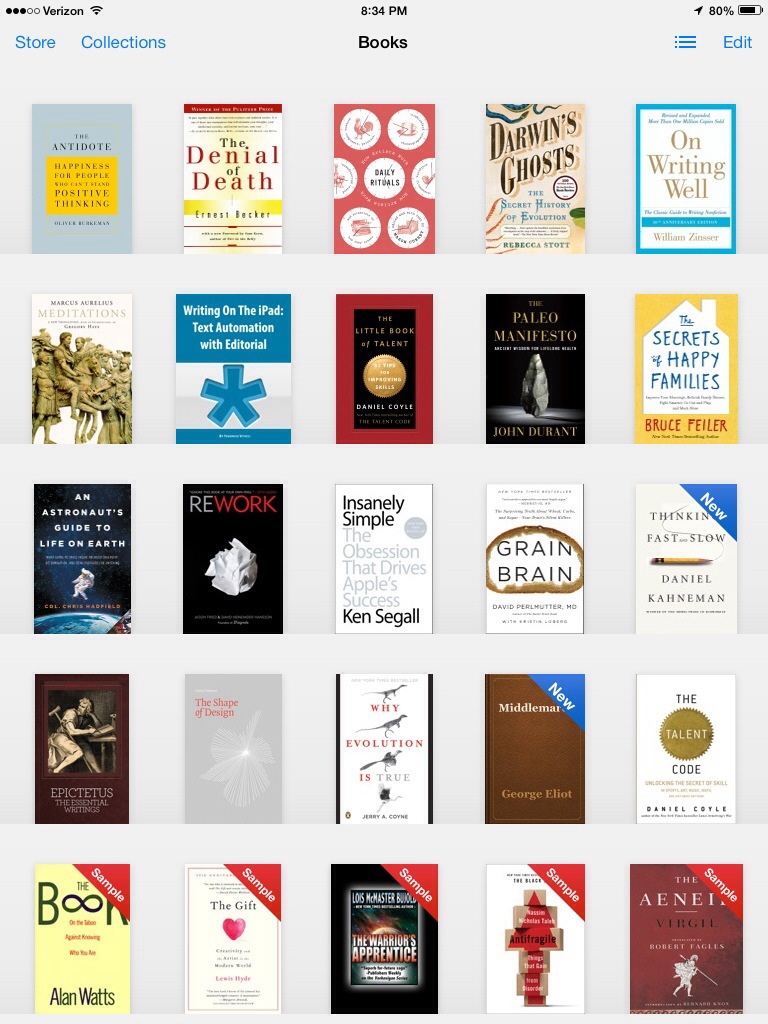
Below is a screenshot of the top of my bookshelf on my iPad. I’m especially enjoying Oliver Burkeman’s The Antidote, a wry look at the positive benefits of negative thinking. It’s a nice complement to my recent readings in the Stoic philosophers.
I recently finished Candice Millard’s excellent Destiny of the Republic, a page-turner of a history book. I’ll post some thoughts on it soon.
I tend to dip in and out of books until one grabs hold and compels me to commit to it. Burkeman’s book is pulling me in now. Looking forward to working my way through this stack.
“Human life.
Duration: momentary. Nature: changeable. Perception: dim. Condition of Body: decaying. Soul: spinning around. Fortune: unpredictable. Lasting Fame: uncertain. Sum Up: The body and its parts are a river, the soul a dream and mist, life is warfare and a journey far from home, lasting reputation is oblivion.
Then what can guide us?
Only philosophy.
Which means making sure that the power within stays safe and free from assault, superior to pleasure and pain, doing nothing randomly or dishonestly and with imposture, not dependent on anyone else’s doing something or not doing it. And making sure that it accepts what happens and what it is dealt as coming from the same place it came from. And above all, that it accepts death in a cheerful spirit, as nothing but the dissolution of the elements from which each living thing is composed. If it doesn’t hurt the individual elements to change continually into one another, why are people afraid of all of them changing and separating? It’s a natural thing. And nothing natural is evil.”
And this is from a Roman emperor, an actual, and rare, philosopher-king.

 Excellent Journey