Risking failure

“One of my role models is Bob Dylan. As I grew up, I learned the lyrics to all his songs and watched him never stand still. If you look at the artists, if they get really good, it always occurs to them at some point that they can do this one thing for the rest of their lives, and they can be really successful to the outside world but not really be successful to themselves. That’s the moment that an artist really decides who he or she is. If they keep on risking failure, they’re still artists. Dylan and Picasso were always risking failure. This Apple thing is that way for me. I don’t want to fail, of course. But even though I didn’t know how bad things really were, I still had a lot to think about before I said yes. I had to consider the implications for Pixar, for my family, for my reputation. I decided that I didn’t really care, because this is what I want to do. If I try my best and fail, well, I’ve tried my best.” -Steve Jobs in 1998 discussing his return to Apple

Never stand still. The greats keep pushing, experimenting, reaching further. And risking failure.

20130912-233934.jpg

Neil DeGrasse Tyson on what it takes to be a visionary

“If everyone had the luxury to pursue a life of exactly what they love, we would all be ranked as visionary and brilliant. … If you got to spend every day of your life doing what you love, you can’t help but be the best in the world at that. And you get to smile every day for doing so. And you’ll be working at it almost to the exclusion of personal hygiene, and your friends are knocking on your door, saying, ‘Don’t you need a vacation?!,’ and you don’t even know what the word ‘vacation’ means because what you’re doing is what you want to do and a vacation from that is anything but a vacation — that’s the state of mind of somebody who’s doing what others might call visionary and brilliant.” -Neil DeGrasse Tyson

via Brain Pickings

“Happiness is absorption.”

Another lovely video from Jason Silva, this one about creative absorption and flow:

Love the intro quotation:

“Happiness is absorption.” -T.E. Lawrence

Getting lost in a video game or a movie or a novel is delightful, but getting lost in creative imaginings and work that compels and pulls you along to the point where all else falls away, where time is compressed, that’s transcendent. And blissful.

It’s easy to assume you’ve got to wait for those moments of flow to somehow strike. But my experience is that you’ve got to do your part to meet flow along the path.

Just start, even if you’re not feeling it, especially if you’re not feeling it. Tackle the blank page with words, even awkward, awful ones.

Terrible is better than nothing, and opening the door of possibility just a bit can be enough to get something better flowing.

Fill your work with love

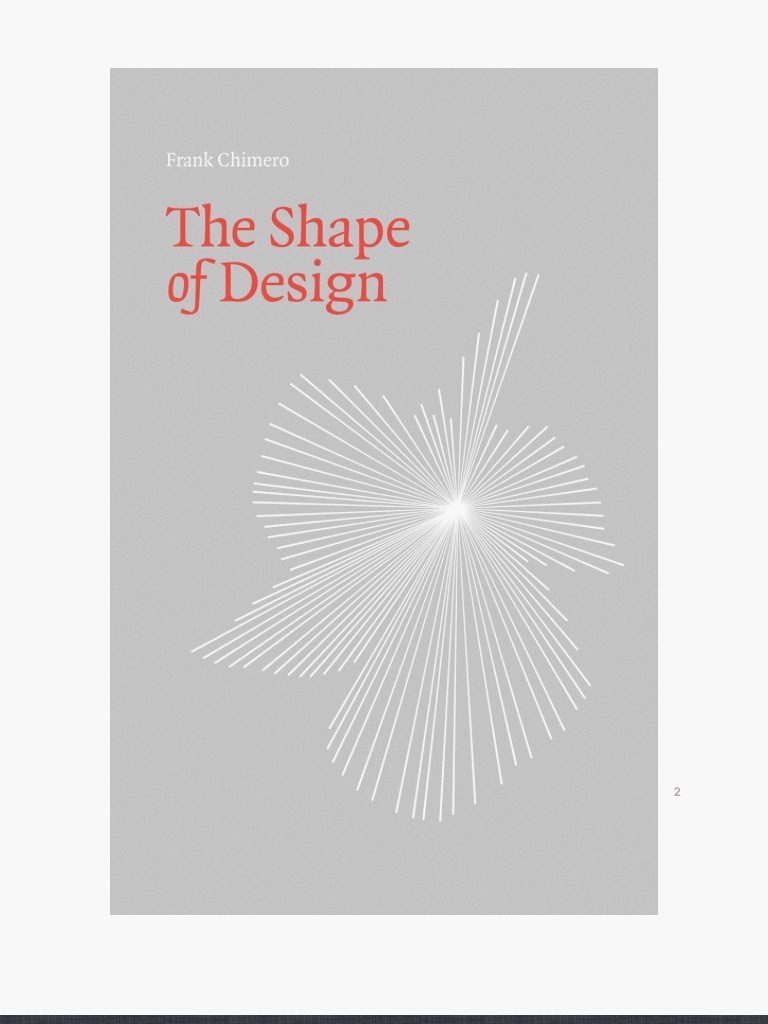
“Not enough love.” That was the response from Frank Chimero’s design professor after looking through some of his work.

“My work was flat, because it was missing the spark that comes from creating something you believe in for someone you care about. This is the source of the highest craft, because an affection for the audience produces the care necessary to make the work well.”

“The work has enough love when enthusiasm transfers from the maker to the audience and bonds them.”

This is from Chimero’s excellent book, The Shape of Design. The passage above reminds me of Tolstoy’s claim that “Art is infection.” An artist, a teacher, a maker of any sort, has an idea or feeling and wants to share it. It’s effective, it’s art, when the audience gets that very same feeling or sees that idea just as the maker did.

You’ve got to care enough about your work and those you serve – an audience, a customer, a student – that you fill your work with all the love you can, with care and attention to detail and enthusiasm.

When I write, I often imagine my audience to be my young daughters reading this many years from now, maybe even after I’m gone. Don’t you know that informs my efforts. When I lose sight of my ultimate audience, it’s easy to lapse into just going through the motions. Then flatness abounds.

What if we examined all our work in this light? What gift can we offer to our audiences? Our colleagues or customers? Our families? Are we putting enough love into our labors?

20130903-220319.jpg

Neil Gaiman’s main rule of writing

From Neil Gaiman’s 8 Rules of Writing:

“The main rule of writing is that if you do it with enough assurance and confidence, you’re allowed to do whatever you like. (That may be a rule for life as well as for writing. But it’s definitely true for writing.) So write your story as it needs to be written. Write it ­honestly, and tell it as best you can. I’m not sure that there are any other rules. Not ones that matter.” -Neil Gaiman

Sunday evening Epictetus

“Whoever then wishes to be free let him neither wish for anything nor avoid anything which depends on others” –Epictetus: The Essential Writings

The only sport I now follow with any real interest is college football. This reminder to put our happiness in our own hands is much needed as the season begins. Our happiness in the hands of 20-year-old football players is a silly thought.

Why waste any worry or frustration over things that we have no control over?

This week’s best of the web: Watterson’s wisdom and Zen Pencils

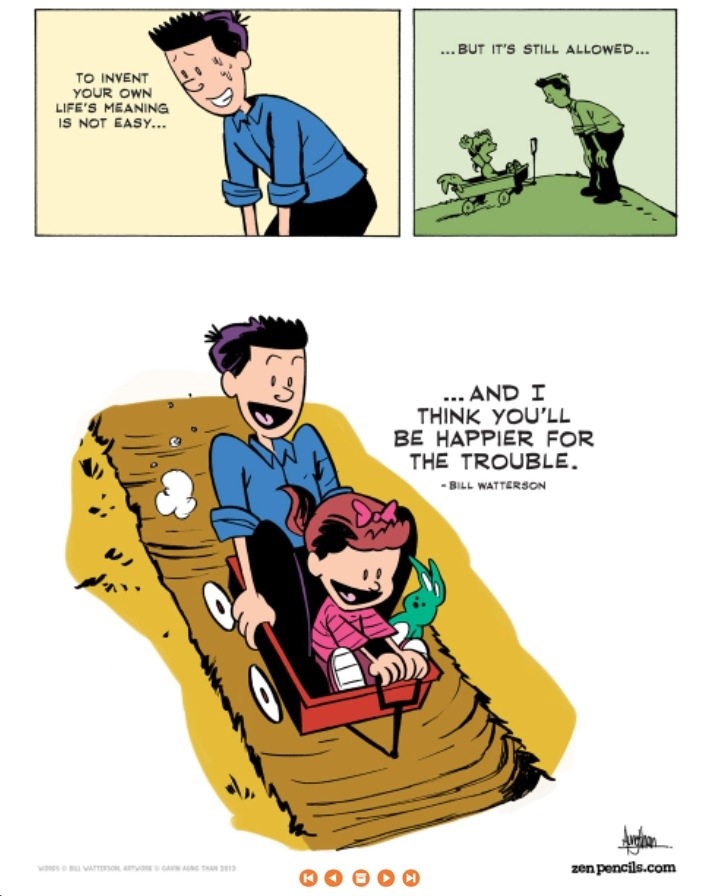
This Zen Pencils cartoon won the Internet this week.

It’s a lovely tribute to Bill Watterson, the amazing and enigmatic creator of Calvin and Hobbes, and it’s a profound exhortation to live an excellent, authentic life.

Click through, read, and enjoy. And then get lost in Zen Pencils. The creator, Gavin Aung Than, is doing beautiful work, mixing cartooning with life wisdom, and he is living the story he’s telling in this Watterson tribute. He abandoned the conventional career path and is making his own way. And using his talent to help awaken possibilities in others.

More about Watterson’s Kenyon College commencement speech, on which the Zen Pencils cartoon is based, is over on Brain Pickings. I love this part about playfulness and creativity:

It’s surprising how hard we’ll work when the work is done just for ourselves. And with all due respect to John Stuart Mill, maybe utilitarianism is overrated. If I’ve learned one thing from being a cartoonist, it’s how important playing is to creativity and happiness. My job is essentially to come up with 365 ideas a year.

If you ever want to find out just how uninteresting you really are, get a job where the quality and frequency of your thoughts determine your livelihood. I’ve found that the only way I can keep writing every day, year after year, is to let my mind wander into new territories. To do that, I’ve had to cultivate a kind of mental playfulness.

[…]

At school, new ideas are thrust at you every day. Out in the world, you’ll have to find the inner motivation to search for new ideas on your own. With any luck at all, you’ll never need to take an idea and squeeze a punchline out of it, but as bright, creative people, you’ll be called upon to generate ideas and solutions all your lives. Letting your mind play is the best way to solve problems.

[…]

A playful mind is inquisitive, and learning is fun. If you indulge your natural curiosity and retain a sense of fun in new experience, I think you’ll find it functions as a sort of shock absorber for the bumpy road ahead.

I’m inspired to go dig out my old Calvin and Hobbes collections and share with my daughters. And to play more.

20130831-101248.jpg

“Don’t aim at success.”

Farnam Street has a post today that includes this paragraph from Victor Frankl’s classic book, Man’s Search For Meaning, which I recently mentioned:

Don’t aim at success — the more you aim at it and make it a target, the more you are going to miss it. For success, like happiness, cannot be pursued; it must ensue, and it only does so as the unintended side-effect of one’s dedication to a cause greater than oneself or as the by-product of one’s surrender to a person other than oneself. Happiness must happen, and the same holds for success: you have to let it happen by not caring about it. I want you to listen to what your conscience commands you to do and go on to carry it out to the best of your knowledge. Then you will live to see that in the long run—in the long run, I say!—success will follow you precisely because you had forgotten to think of it. -Victor Frankl

This is non-attachment. Do the thing for the thing itself, not for some desired outcome. Get lost in the path – the journey, the way – and the destination will meet you there.

Sunday morning Seneca: The fighter

From Seneca’s Letters from a Stoic:

“… no prizefighter can go with high spirits into the strife if he has never been beaten black and blue; the only contestant who can confidently enter the lists is the man who has seen his own blood, who has felt his teeth rattle beneath his opponent’s fist, who has been tripped and felt the full force of his adversary’s charge, who has been downed in body but not in spirit, one who, as often as he falls, rises again with greater defiance than ever.”

20130825-074718.jpg

On belief

I came across this post today and found this insightful, provocative statement on belief:

“Believing something is not an accomplishment. I grew up thinking that beliefs are something to be proud of, but they’re really nothing but opinions one refuses to reconsider. Beliefs are easy. The stronger your beliefs are, the less open you are to growth and wisdom, because “strength of belief” is only the intensity with which you resist questioning yourself. As soon as you are proud of a belief, as soon as you think it adds something to who you are, then you’ve made it a part of your ego. Listen to any “die-hard” conservative or liberal talk about their deepest beliefs and you are listening to somebody who will never hear what you say on any matter that matters to them — unless you believe the same. It is gratifying to speak forcefully, it is gratifying to be agreed with, and this high is what the die-hards are chasing. Wherever there is a belief, there is a closed door. Take on the beliefs that stand up to your most honest, humble scrutiny, and never be afraid to lose them.” –David Cain

We all have believed things that turned out not to be true, from small inconsequential trivia to major life-shaping philosophies. Santa and fairies and such just don’t work as reasonable options for most adults.

There are 7 billion people on this planet. Consider all the conflicting beliefs that exist, all the misplaced certainty. All the meanness and pain and wasted opportunities spent on cherished beliefs.

I remember arguing passionately when I was in college for beliefs that I now no longer hold. As I’ve aged and grown in knowledge, and I may be an exception, believing has been less of a force in my life. I would rather know something than believe it. And that ends up leaving me with a lot more questions than answers. While I may no longer have the fixed stars I once used to navigate through life with, I’m okay with the mystery, with not knowing.

It is harder, though. Having your beliefs locked in is much easier. Less thinking required. And it’s kind of cozy and comfortable and safe. But, it’s also a lot less interesting, and, ultimately, it’s not real.

It’s okay, healthy and normal, exciting even, to question what simply has been handed to you as truth and move further into not-knowing. It takes courage to ask tough questions, but if a belief can’t withstand honest inquiry, it’s not worth holding on to.

Beginner’s mind

Today was “meet the teachers” day at my kids’ school. Tomorrow is the last day of summer break. Rather than being sad, my girls are excited. (For now…)

A new school year is a new beginning. New teachers. Different classmates. New possibilities. I remember the little thrill even of picking out school supplies.

“In the beginner’s mind there are many possibilities. In the expert’s mind there are few.” -Shunryu Suzuki

In the real world we lose a bit of that built-in reset each year that comes with the academic calendar. A regular reset, a return to a beginner mindset can rejuvenate and awaken.

It’s worth manufacturing an opportunity regularly to rethink your work and your personal or family life every three or four months, or at least a couple of times a year. A retreat, an event, a built in breather to assess and plan and dream. Discard old habits, try new ones, and imagine some “what ifs” that just might change everything.

A small daily task

Cal Newport has a post today about Woody Allen’s prolific productivity. The man is a movie making machine, having written and directed 44 movies in 44 years.

Allen works a few hours every day on what he considers his most worthwhile effort: writing. Like Jerry Seinfeld, he’s committed to sitting down day after day to make something. A little bit of quality effort done consistently over time can produce something of great value.

It can seem overwhelming to consider getting from where you are now – in a project or a dream or your life – to where you want to go. But if, instead, you just take a little bit of action, and do it every day, you might surprise yourself with what you can do or become. Do your work, the work you think is most valuable, and do it daily. It might sneak up on you, but awesome is usually not an overnight sensation.

20130804-220006.jpg

On kindness

I just read this lovely, short speech by author George Saunders. He’s addressing the Syracuse University class of 2013 and avoids the typical exhortations and conventional tips on how to be successful. Instead, he discusses his greatest regret: failures of kindness.

“What I regret most in my life are failures of kindness.

Those moments when another human being was there, in front of me, suffering, and I responded…sensibly. Reservedly. Mildly.

Or, to look at it from the other end of the telescope: Who, in your life, do you remember most fondly, with the most undeniable feelings of warmth?

Those who were kindest to you, I bet.

It’s a little facile, maybe, and certainly hard to implement, but I’d say, as a goal in life, you could do worse than: Try to be kinder.” -George Saunders

Go read the whole speech. It’s short, and it’s sweet in the noblest way. And it rings true with me. Moments of regret in my life are almost exclusively a failure to be courageous with kindness. A missed opportunity to encourage, to protect, to listen to someone in their moment of sadness or pain or embarrassment.

We focus too much on “success” and productivity and achievement, but a truly good life is marked by kindness, don’t you think?

After my mom passed away, there was a line of people waiting outside the funeral home for hours just to pay their respect. I was in awe. They didn’t stand in line, though, because of her success in business or leadership in the community or any major accomplishment. They were there because she was remarkably kind, and they had countless stories to tell about her compassion and big heart. I witnessed it all my life, of course.

I vividly remember tiny moments where she pursued opportunities to be kind. A little red-haired boy that she didn’t even know was in tears on a field after a children’s soccer match, and it was my mom who sought him out with a hug and an encouraging word. She would light up with a genuine smile when an acquaintance or stranger walked in to my parents’ photography studio. She listened wholeheartedly. The twinkle in her eyes let you know you were special, that you had her complete attention. People loved the way she made them feel.

She lived a truly great, and too short, life. Kindness may not make headlines, but it makes for a life with few regrets and a legacy marked by the abundant admiration and appreciation of those fortunate to have been warmed by its glow.

Be kind. Be intentional about it. Make it your craft, your calling, your legacy.

h/t Jesse Thorn, Put This On
Jason Silva: “We are the gods now”

I can’t get enough Jason Silva. He spoke last year at The Festival of Dangerous Ideas in Sydney. His talk is provocative, entertaining, and refreshingly optimistic about our future:

I appreciate his passion and rapid-fire incitement of excitement about the wonder of being alive.

It’s about awakening the mind’s attention from the lethargy of custom and the film of familiarity and redirecting it instead to the wonders of existence. -Jason Silva

Leo Buscaglia: Learn every day

The late, great Leo Buscaglia was a dynamic whirlwind of positive energy. He was a professor at USC and became famous on campus for teaching a non-credit class about love that would overflow the lecture hall with standing room only for the crowd of interested students. He wrote several books and took his wisdom and hugs on the road spreading the good news of love.

I had a few of his lectures on tape (cassette tapes, kids) and would listen on road trips. When he was a child, Leo and his family ate dinner together every night, and his dad would begin the nightly family dinner by asking everyone at the table what they had learned that day. And he expected everyone to have learned something. Leo said there were many days that, just before dinner time, he would rush to find an encyclopedia (that’s a tiny internet in a big stack of books, kids) and look up something new to learn just to make sure he wouldn’t come up empty when his dad asked that question at dinner.

I like that daily expectation, pressure even, to learn at least one thing each day. That’s what this blog is doing for me. I’m committed to writing daily, and there have been days when, just before bed time, I scramble to find something worth sharing. A quotation. A video. A book recommendation. A minor epiphany.

By committing to sharing regularly, I’m committing to learning regularly. Learn something every day. And share what you learn.

“Too often we underestimate the power of a touch, a smile, a kind word, a listening ear, an honest compliment, or the smallest act of caring, all of which have the potential to turn a life around.” -Leo Buscaglia

Here’s a brief bit of video from one of Buscaglia’s lectures, just to give you a sense of this guy’s energy:

Where the light is: John Mayer’s career wisdom

John Mayer is among my favorite performers. He broke onto the scene seeming like he might just be another pop sensation, but he has become quite the soulful virtuoso with thoughtful music that keeps evolving.

I’ve been wearing out his latest album, Born and Raised, which has a 70’s, Eagles kind of vibe to it. I appreciate that his music is not predictable and formulaic. And he does, too.

His fabulous live performance in Los Angeles in December 2007 was made into a concert film, Where The Light Is. The whole thing is available on YouTube now. He does three different performances during the concert. He opens with a solo acoustic set. Then he changes clothes and comes back to the stage with his blues band for a blues concert. Finally, he returns to the stage with his full touring band to wrap up the night.

He keeps stretching his musical chops, trying on different styles and formats. It would be easy for a guy who hit it big at such a young age to just stick with what brought him his success. He could phone it in for decades and play the same kind of stuff to big crowds of loyal fans. But, instead, he’s taking risks and going in directions that his fans may not want to follow.

He says this at the beginning of the “Where the light is” concert film:

“It’s only fun when you’re trying to get it in your grasp. It’s like, you know, once you catch it, throw it back in the water then catch it again. That’s really what I want to do my whole career.”

A good reminder for anyone who realizes it’s about the journey rather than the destination.

Education is not training

20130715-222848.jpg

Education is not training. A puppy can be trained, but not educated. True education grabs hold of you and sparks a powerful, consuming desire for lifelong learning stoked by curiosity and wonder.

“He who can no longer pause to wonder and stand rapt in awe, is as good as dead; his eyes are closed.” -Albert Einstein