The Obstacle is the Way

The impediment to action advances action. What stands in the way becomes the way. -Marcus Aurelius

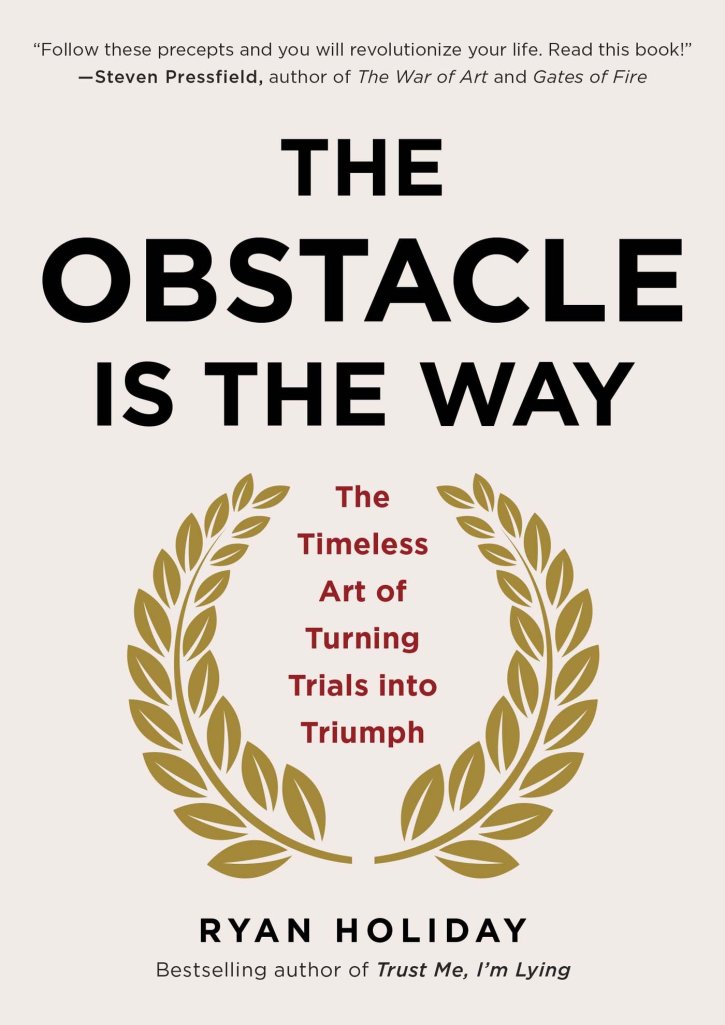
Ryan Holiday is an impressive young author. He’s in his mid-twenties and just published his third book, The Obstacle is the Way, which is a delightful, short, story-filled exploration of the value of embracing adversity. Ryan’s writing is influenced by the Stoics, and Marcus Aurelius’s Meditations is one of his favorite books also. (So, he must be cool, right?)

I’ve already given The Obstacle is the Way to a few young friends. It’s a quick read and filled with examples of great men and women who thrived in spite of, or, actually, because of the difficulties seemingly blocking their way.

Holiday, the author, has had an interesting career. He left college before graduating, but has continued his own education through some killer work experiences and a prolific consumption of books. My friend, Nick, recommended Holiday’s reading recommendation newsletter, and I’ve been impressed with the quality and quantity of his book suggestions.

This is a solid podcast interview with Ryan by Tim Ferriss. I listened to this while doing yard work recently and found Holiday to be just as engaging and thoughtful in conversation as he is in his writing. It’s a bit humbling to me that this guy who is almost half my age has accomplished so much and seems so wise already.

College students and others just getting started (and even old guys like me who are still trying to figure things out) will appreciate his take on building a meaningful and artful life.
obstacle

Sunday morning Stoic

From Marcus Aurelius’s Meditations:

“External things are not the problem. It’s your assessment of them. Which you can erase right now.
If the problem is something in your own character, who’s stopping you from setting your mind straight?
And if it’s that you’re not doing something you think you should be, why not just do it?
—But there are insuperable obstacles.
Then it’s not a problem. The cause of your inaction lies outside you.
—But how can I go on living with that undone?
Then depart, with a good conscience, as if you’d done it, embracing the obstacles too.”

“Concentrate on what you have to do. Fix your eyes on it. Remind yourself that your task is to be a good human being; remind yourself what nature demands of people. Then do it, without hesitation, and speak the truth as you see it. But with kindness. With humility. Without hypocrisy.”

Richard Sherman on craftsmanship: “meticulous attention to detail”

Kottke just shared this fascinating video of Seattle Seahawks star cornerback Richard Sherman talking about his craft. (Sherman is one of the more interesting personalities in the NFL. A Stanford grad with some serious smarts who is most well known now for his colorful comments. He talks, but he sure can back it up.)

I feel like I’m a decent athlete, but my tape study and my meticulous attention to detail are what make me a good ball player. -Richard Sherman

This video feature on Sherman is worth watching, even if you don’t have any interest in football. Sherman acknowledges he’s not the most athletically gifted at his position, but he’s considered maybe the best cornerback in the NFL. And it’s all because of how he prepares. He pursues his work with an obsessive attention to detail. Practice doesn’t necessarily make perfect, but thoughtful, strategic, relentless preparation can set you apart because so few, even the most gifted, pursue excellence with such focus.

Screen Shot 2014-05-09 at 4.07.54 PM

John Mayer on craftsmanship

I’ve written before about my appreciation of John Mayer’s artistry as a musician. I just saw this new documentary, Someday I’ll Fly, about his career and came away impressed. It’s a thorough review of how he got to mastery. Mayer narrates and offers several gems of insight throughout:

“I used to be at home in my bedroom and pretend that I was on stage, and now I’m on stage and I pretend that I’m home in my bedroom.”

“I want to bring my playing all the way up to the the top of ability…there are some nights my playing goes over my ability. I kind of hit that place where I’m unsure. But then I always find that I get a little further into the craft by doing that.”

“That craft responds to truth, and you’ve got to stay truthful. No matter how many records you’ve sold or performances you’ve played, you come home, the whirlwind stops and you go back to the craft.”

When he was a teenager Mayer was so obsessed with getting good at playing guitar that his mom had to give him a “guitar curfew”, a time he had to stop playing every night. John Mayer wasn’t born with a gift for guitar. He worked hard to become great.

It’s both comforting and convicting to know that our own levels of mastery are completely up to us. If we want to get really good at something, we only need to be willing to obsess enough to consistently devote quality time and smart effort.

via shawnblanc.net

“Talent is not stopping.”

This interview with Everything Is A Remix creator Kirby Ferguson is solid. Love his advice for those just getting started:

What would your advice be to the 20-year-old version of you, who’s just starting their career?

I wish I had Everything Is A Remix when I was younger. I wish I knew that you can just start copying other people’s stuff and fiddling with it, and putting stuff into it, and just sort of build from there. It’s okay to be primitive. That’s a perfectly fine way to start making things.

I wish the earlier me understood work and practice more. Just the repeated concerted effort to get better at things. I wish I didn’t have the notions of talent and genius I had back then. I thought, “Oh, these other people, they just have something that I don’t have.” When really, they are just people who work more.

I wish I understood work. Work is the key to anything you want to do. If you want to play the guitar—anybody can learn to play the fucking guitar—you can be good at it. Maybe you won’t get to be a genius but you could be good.

You can be good enough to write good songs or make a good film or whatever. There’s no such thing as not having enough talent to get to that level. I mean, persistence is talent, really. Just sticking with it. Talent is not stopping.

I keep coming across this simultaneously reassuring and frightening notion that genuine talent is not based on innate ability. We’ve got no excuse for not being great. It’s all about effort and persistence and thoughtful, incremental improvement. Sure, some people have genetic advantages, but the hard work and clear focus of someone of average ability can overtake the half-hearted efforts of a genius slacker.

Do the work. Be awesome.

On reading books that change you

I think we ought to read only the kind of books that wound and stab us. If the book we are reading doesn’t wake us up with a blow on the head, what are we reading it for? …we need the books that affect us like a disaster, that grieve us deeply, like the death of someone we loved more than ourselves, like being banished into forests far from everyone, like a suicide. A book must be the axe for the frozen sea inside us. -Franz Kafka

Kafka is a bit extreme here (hyperbole suits him, of course), but I share his desire for books and for any art that pitches me out of my complacency, that disrupts my comfort of safe ideas and undisturbed feelings.

There’s a numbness to most of our daily existence. Well worn paths are trodden mindlessly. Wake up and go through the motions. Cling thoughtlessly to our tight little circle of opinions and beliefs.

There are landmark moments in my life, though, where an artist has shaken me and provoked a new way of seeing. It’s a surprisingly refreshing kind of pain.

I remember being twenty-something and crashing while riding a bicycle, landing hard on a gravel road and scraping my leg in the process. And it was euphoric. The pain startled me into a sudden awareness that I was indeed alive.

I need that kind of euphoric intellectual and emotional blow regularly. I should embrace the pursuit of ideas that stretch my mind and challenge me to reconsider comfortable assumptions. A truly great book can send me on a journey of discovery that changes everything.

I don’t mind some occasional mindless entertainment, but life is too short to not seek out regular doses of mental and emotional nourishment – provocative, mind altering, life altering works of art.

Systems, not goals

This is from the cartoonist, Scott Adams, as quoted in The Farnam Street blog (Farnam Street is regularly excellent, by the way.):

“If you do something every day, it’s a system. If you’re waiting to achieve it someday in the future, it’s a goal.

[O]ne should have a system instead of a goal. The system-versus-goals model can be applied to most human endeavours. In the world of dieting, losing twenty pounds is a goal, but eating right is a system. In the exercise realm, running a marathon in under four hours is a goal, but exercising daily is a system. In business, making a million dollars is a goal, but being a serial entrepreneur is a system.

Goal-oriented people exist in a state of continuous pre-success failure at best, and permanent failure at worst if things never work out. Systems people succeed every time they apply their systems, in the sense that they did what they intended to do. The goals people are fighting the feeling of discouragement at each turn. The systems people are feeling good every time they apply their system. That’s a big difference in terms of maintaining your personal energy in the right direction …”

This is great insight. Instead of aiming for some goal out there, arbitrary as most goals are, aim instead to be the kind of person and do the kinds of things that someone who achieves those goals would be and do. And then don’t obsess on the goals. Just do the work and live the life. Act as if you are who you want to be.

A daily or weekly routine, a consistent application of even small habits, will transform our lives more effectively than striving for some overwhelmingly large goal.

20140421-204913.jpg

Do less, better

I met with a group of university freshmen yesterday. They were part of a leadership program that required them to interview faculty and administrators to collect advice on how to have a great college experience.

One of the students asked which college activities I recommend. Several organizations came to mind, and I shared a list of the ones that seem to have strong reputations and offer worthwhile experiences.

But I cautioned them not to spend their college years trying to build a long and seemingly impressive resume. There’s some merit to trying a lot of activities early on. But the most remarkable students I’ve known were those who focused on depth over breadth, who invested deeply in a few activities they genuinely cared about

These college superstars invariably chose their pursuits, academic and extracurricular, for their intrinsic worth, not necessarily as a means to an end or for their potential to move them up the ladder of accomplishment. And their focus allowed them to shine in ways that those who spread themselves across more obligations did not.

Explore possibilities thoroughly and “try on” a variety of pursuits to see what might fit well. But commit to only those activities that resonate and are most worthy of your limited time. And then go be awesome there.

This is not just a strategy for college success. I need this in real world life. Do less, but do it better. I need to say “no” consistently to inessential opportunities and commitments, even noble ones, in order to give my best effort to the few, key priorities I’ve chosen to build my work and my life around.

“If you seek tranquillity, do less.” Or (more accurately) do what’s essential—what the logos of a social being requires, and in the requisite way. Which brings a double satisfaction: to do less, better.
Because most of what we say and do is not essential. If you can eliminate it, you’ll have more time, and more tranquillity. Ask yourself at every moment, “Is this necessary?”
But we need to eliminate unnecessary assumptions as well. To eliminate the unnecessary actions that follow” –Marcus Aurelius

Awakening

20140401-221123.jpg

On a day of silly pranks, how blind were we to the magnificent mysteries all around us? The unfamiliar warmth of the spring sun and the shower of blossoms floating from the trees were enough to catch me by surprise. The seasonal awakening of nature can stir us from our winter lethargy. Let’s come alive with wonder and delight.

We are walking in a wonderland every day and yet tread ploddingly, numbly along.

“It’s about awakening the mind’s attention from the lethargy of custom and the film of familiarity and redirecting it instead to the wonders of existence.” -Jason Silva

Who are we?

Who are we, if not measured by our impact on others? That’s who we are! We’re not who we say we are, we’re not who we want to be — we are the sum of the influence and impact that we have, in our lives, on others. -Neil deGrasse Tyson speaking in tribute to the great Carl Sagan
via Brain Pickings

On a night when I sat with my 9-year-old to watch the new version of the Cosmos TV series, I was reminded just how overwhelmingly vast and dark and inexplicable our universe is. And how awesome it is to be alive and aware of how very little we know.

If we can shine a little light as we journey, light that just might illuminate the path of a fellow traveler, even for a mere moment, we have done something noble, something heroic.

Humans are so new to the universe and so alone as far as we can see. Our significance is not much in relation to the cosmos. But in relation to each other, we are all we have to share meaning and kindness and to make this journey worthwhile.

20140309-231621.jpg

This brief instant

More wisdom from the philosopher-king, Marcus Aurelius, in his Meditations:

“Forget everything else. Keep hold of this alone and remember it: Each of us lives only now, this brief instant. The rest has been lived already, or is impossible to see. The span we live is small—small as the corner of the earth in which we live it.”

Here and now. That’s all we have. But how often do we give our attention to the present moment?

Fascinating

On the original Star Trek television series, Spock would regularly respond to unpleasant or surprising circumstances with a one-word response: “Fascinating.”

Instead of judging or taking something personally or lashing out emotionally, he sought to understand.

What a healthy way to manage your responses. We all have the ability to choose our response in any circumstance. But I know I often default to an automatic, self-centered reaction instead, as if everything is all about me and as if I have no control over my feelings. And I feel like I’ve been more prone to emotional, knee-jerk reactions recently. I’m rapidly approaching 50. I should be getting wiser and more disciplined, right? (I should be fascinated rather than disturbed by that.)

Imagine, though, using the gap between stimulus and response to choose to be curious.

To ask, “I wonder why…?”, will completely reframe your response to something that otherwise might cause anger or frustration.

Next time I get cut off in traffic or receive bad news or deal with a difficult person, I’m going to give my inner Vulcan a try and get curious rather than getting mad.

“Men are disturbed not by the things that happen, but by their opinion of the things that happen.” -Epictetus

star-trek-spock-leonard-nimoy-desktop-wallpaper-other-626603849

Ken Robinson: Creating a climate of possibility

Sir Ken Robinson has the most viewed TED Talk ever, and his latest talk on education is a must-watch as well:

Notice his presentation style. He uses no slides, no video. He stands in one place and holds the audience’s attention with his wry humor and short stories and wise insight. His humor charms the audience throughout. The man has terrific stage presence without seeming to try hard. He’s just chatting, in a rather low-key manner, as though he’s talking to a small group of friends. He seems authentic and approachable, and, therefore, very persuasive.

His message, though, is dynamic and powerful. We must do better at educating children. We must free teachers to connect with kids where they are. We must honor and nurture creativity. We must create an expectation and an environment where these young humans can come alive, each in their own way.

Robinson’s final story about Death Valley provides a terrific metaphor and a strong finish for his talk. Flowers blooming in Death Valley proves that it’s not dead, just dormant. So, too, our failing students, or rather students being failed by our education system, have life in them and need only a change in climate and conditions to blossom as well.

The real role of leadership is climate control, creating a climate of possibility. -Sir Ken Robinson

Any great organization, whether a school or business or family, is great primarily because of its culture, its climate. If you’re in charge of something, if you’re a leader or want to be, the most important task is to create and nurture a culture that informs and empowers the people you serve.

And culture revolves around the “why” questions. Ask “why” before worrying about the “how’s”. “Why are we here?” “What’s our purpose?” “Why do we what we do?” Compelling answers to these questions can build and sustain a culture and create possibilities previously unimagined.

via PresentationZen.com

Truthful AND helpful

If it is not truthful and not helpful, don’t say it.

If it is truthful and not helpful, don’t say it.

If it is helpful and not truthful, don’t say it.

If it is truthful and helpful, wait for the right time.

This is attributed to the Buddha. Whoever said it was wise.

I remember sharing this with a group of student leaders who were stuck working together for more than forty hours a week for two months in the summer. Tension and frustrations would mount occasionally, and it seemed noble to want to communicate forthrightly, honestly. But just telling it like it is was not always helpful.

I’ve seen too many people hurt by friends, coworkers, and family members simply “speaking the truth” or “telling you how I feel”.

The truth can hurt, and not always in a constructive way. If the truth is not also helpful, keep it to yourself. Making that judgment call can be tricky at times, but aiming for helpful should take priority over just speaking what you think is true.

Courageous, not fearless

I recently heard someone say they wanted to be “fearless”. Then I heard it again the next night in a movie. A character was admired for being “fearless”.

Imagine never being afraid. Sounds like what Superman must feel like most of the time, minus those occasional encounters with Kryptonite. But, really, how little courage would it take to do awesome things if almost nothing could hurt you and your chances of success are literally sky high?

It’s normal to be afraid and experience fear regularly. I don’t know any sane person who is truly fearless. Being fearless is not the same as being courageous.

Fear is a friend, a friend who’s trying to keep us alive. Our ancestors are the ones who felt fear and responded to it. The long-ago humans who were without fear are the ones who don’t have descendants. Those humans were some creature’s lunch or ended up falling off the cliff our ancestors avoided.

The trick now is to understand our wiring, the inherited proclivities that enabled us to survive, and discern which fears are reasonable and helpful and which are keeping us from being awesome.

To be great at something and to have a remarkable life, you do need to be courageous, not fearless. Courage is not the absence of fear. It’s the willingness to take action in spite of the fear.

Some fears are there to keep you alive. Respect those fears and avoid doing stupid things. Other fears will keep you from coming alive. Consider the resistance you feel when you want to begin some great project or speak up for something meaningful or connect deeply with a fellow human being.

You know that voice that tells you to lie low, to keep your head down, don’t make waves, don’t risk failure? That’s the fear that should summon your courage.

The best way I know to respond to this kind of fear is action. Courage is like a muscle. It needs exercise to get stronger. Take on small moments of fear regularly. Even facing little awkward social fears, like smiling at a stranger or speaking up in a meeting, can strengthen your courage.

We have to be consistently courageous to overcome our predisposition for safety. I want to have courage. I have too often, though, skirted around hard things for fear of failure or embarrassment. I know my greatest obstacle to being the best I can be is the failure to confront caution — the spirit-suppressing, mediocrity-loving kind of caution — with courage.

Screen Shot 2013-11-26 at 11.49.40 AM

The only competition that matters

The only competition that matters is the one between who you want to become and who you are.

(Can I quote myself?)

Some weeks, I fall short of the week before. But just being aware is enough to make me want to do better the next week. No need to kick myself and make it worse. Just know that funks happen. And then they pass. And then take action to be more awesome next week.

20131005-094459.jpg

Inspiration is for amateurs

An Austin Kleon interview led me to this Brain Pickings post with this from painter Chuck Close:

“Inspiration is for amateurs — the rest of us just show up and get to work. And the belief that things will grow out of the activity itself and that you will — through work — bump into other possibilities and kick open other doors that you would never have dreamt of if you were just sitting around looking for a great ‘art idea.’ And the belief that process, in a sense, is liberating and that you don’t have to reinvent the wheel every day. Today, you know what you’ll do, you could be doing what you were doing yesterday, and tomorrow you are gonna do what you did today, and at least for a certain period of time you can just work. If you hang in there, you will get somewhere.” -Chuck Close

I’m still trying to learn this. Too often I’m waiting for the right mood, for an idea to grab me before getting busy making something.

I need to “just show up and get to work” every day and maybe working will lead to me grabbing an idea rather than the other way around. And if I do nothing but bad work, it’s better than no work. And bad work just might lead to something that’s kind of good. You can’t get to great without starting somewhere. Starting is the essential thing.

I keep coming back to Gretchen Rubin‘s starkly simple reminder from the potent little book on work habits, Manage Your Day-to-Day:

20131001-112815.jpg

The greatness of kindness

From an interview with Stephen Fry where he discussed what he wished he had known at age 18:

“I suppose the thing I’d most would have like to have known or be reassured about is that in the world is what counts more than talent, what counts more than energy or concentration or commitment or anything else is kindness. And the more in the world you encounter kindness, and cheerfulness (which is kind of its amiable uncle or aunt), just the better the world always is – and all the big words: virtue, justice, truth, are dwarfed by the greatness of kindness.”

Kindness just keeps surfacing as a primary theme when pondering what makes for an excellent life. All the striving for achievement and wealth and happiness… Just being kind can change a moment, your day, your life and the lives of those you meet.

IMG_0149