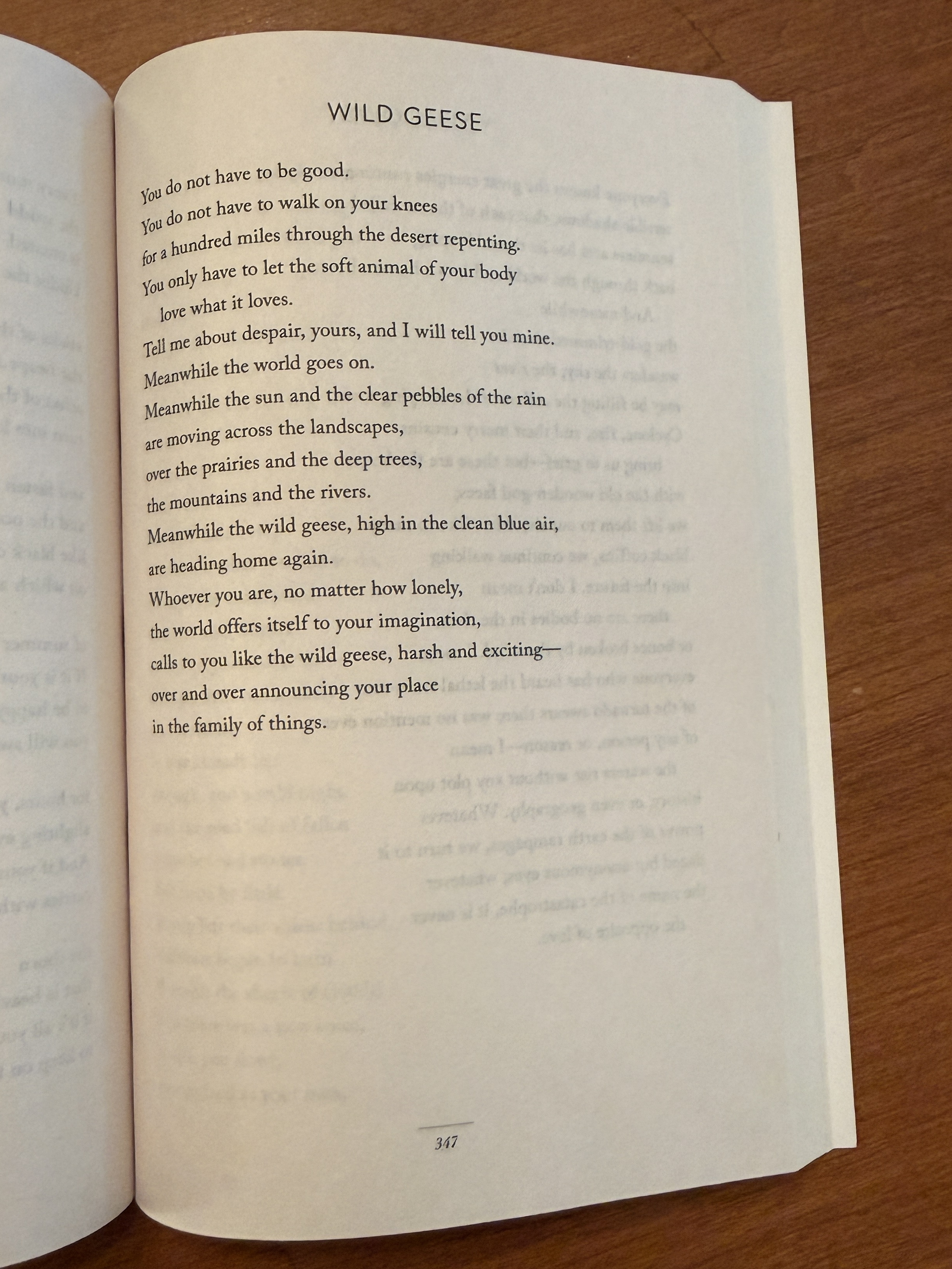
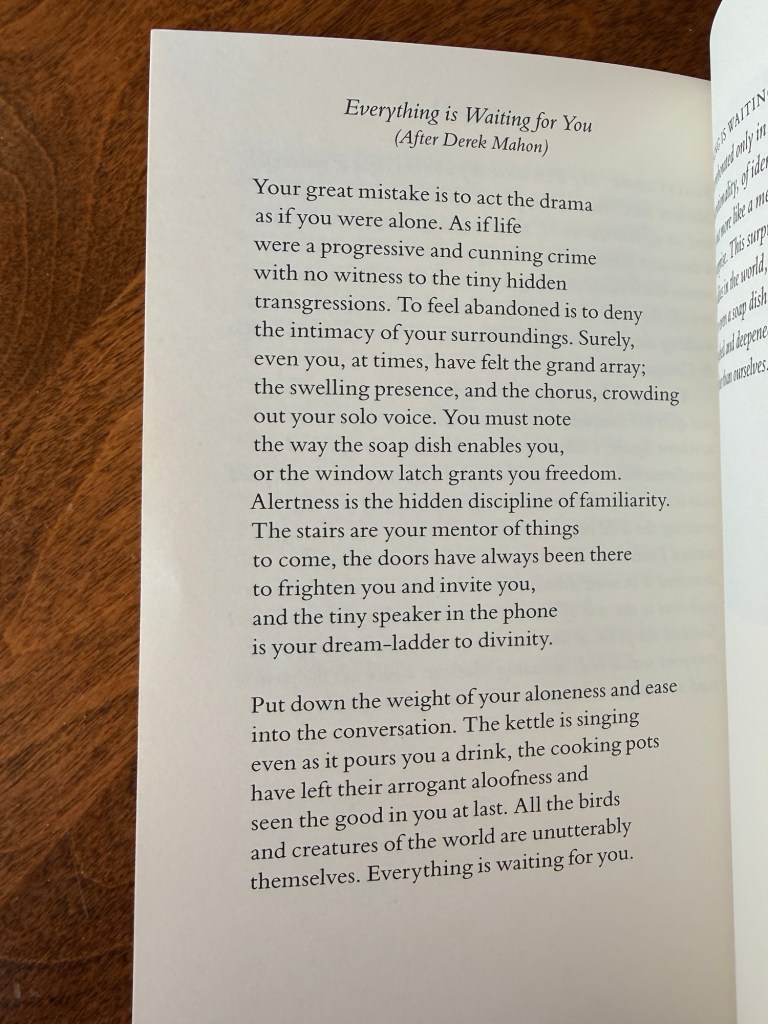
By heart: Everything is Waiting for You by David Whyte

From Essentials by David Whyte

David Whyte is who you would cast to play a poet in a movie. He has a wise sage aura and an amazingly resonant, warm, comforting voice. (Go listen to Rick Rubin’s conversation with him.)

And it was listening to multiple David Whyte interviews that inspired me to begin memorizing poetry. Poems flow out of him—his own and others.

So, for December, I’ll have David Whyte in my head, reminding me that I’m a part of something so much grander than my own little constricted perspective usually allows and that “Everything is waiting for you.”

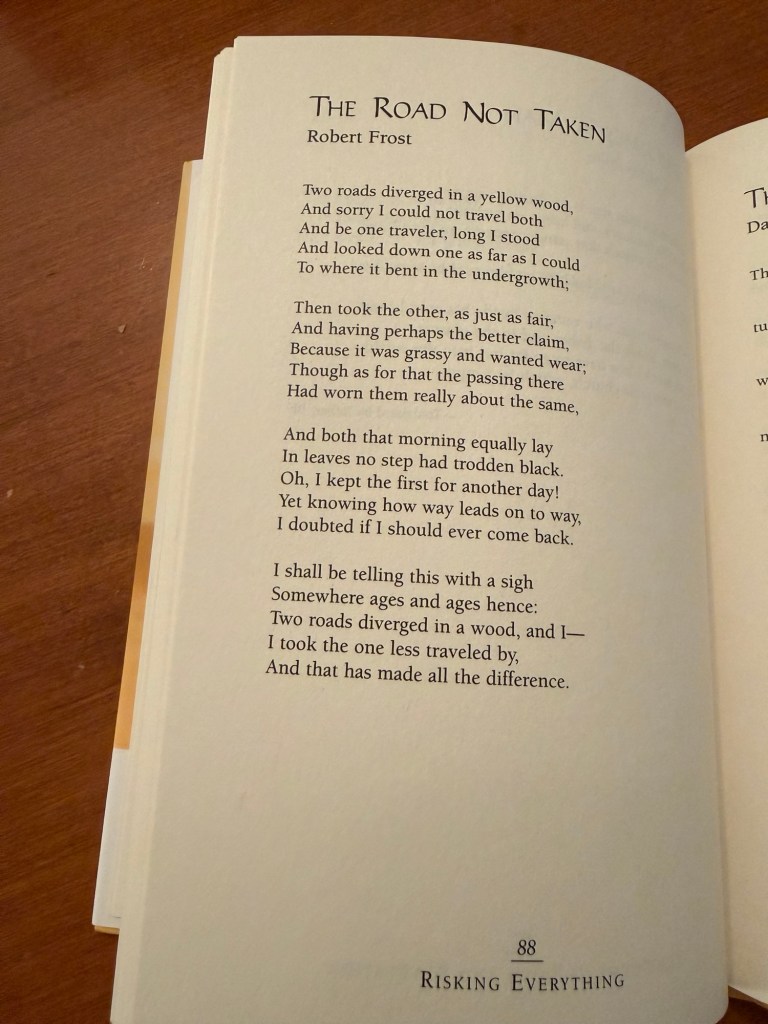
By heart: The Road Not Taken by Robert Frost

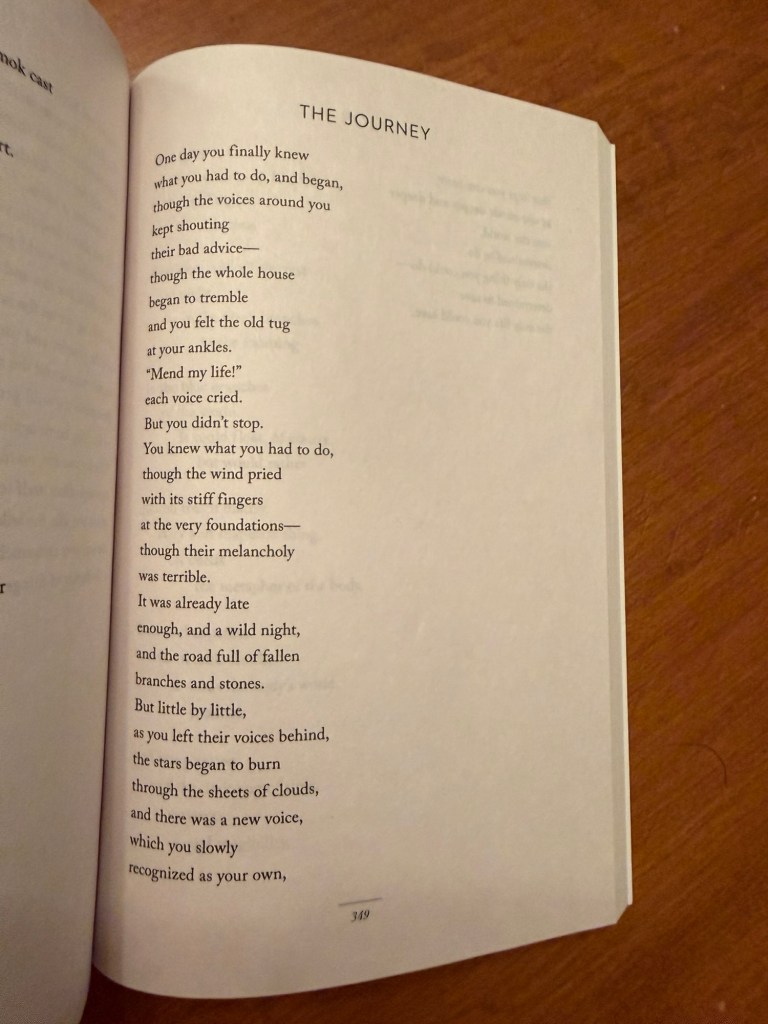
I’m memorizing one poem a month. I learned Mary Oliver’s The Journey last month. The first couple of days I worked on it I felt like I was never going to get it. Then I kept at it, and it just clicked. And I found myself saying it out loud to myself as I walked, as I drove, as I did errands and chores. It’s been a delight to have it just there, in my mind, ready to summon. I even recited it out loud at the end of a presentation I did for a group of college freshmen because it fit so well with what I was sharing with them.

So, this month I chose probably the most famous American poem, Robert Frost’s The Road Not Taken. There were actually a couple more Mary Oliver poems I was tempted to add to do a deep dive into her work, but I’m opting for Frost instead. It is a classic, and the rhyming structure is more traditional and hopefully easier to memorize than Oliver’s prose style. Choosing this one, though, is choosing, in opposition somewhat to the point of it, one of the most well traveled poems in the English language. But classics are classic for a reason, and it seems appropriate to add this one to the so far very little library of poetry in my mind.

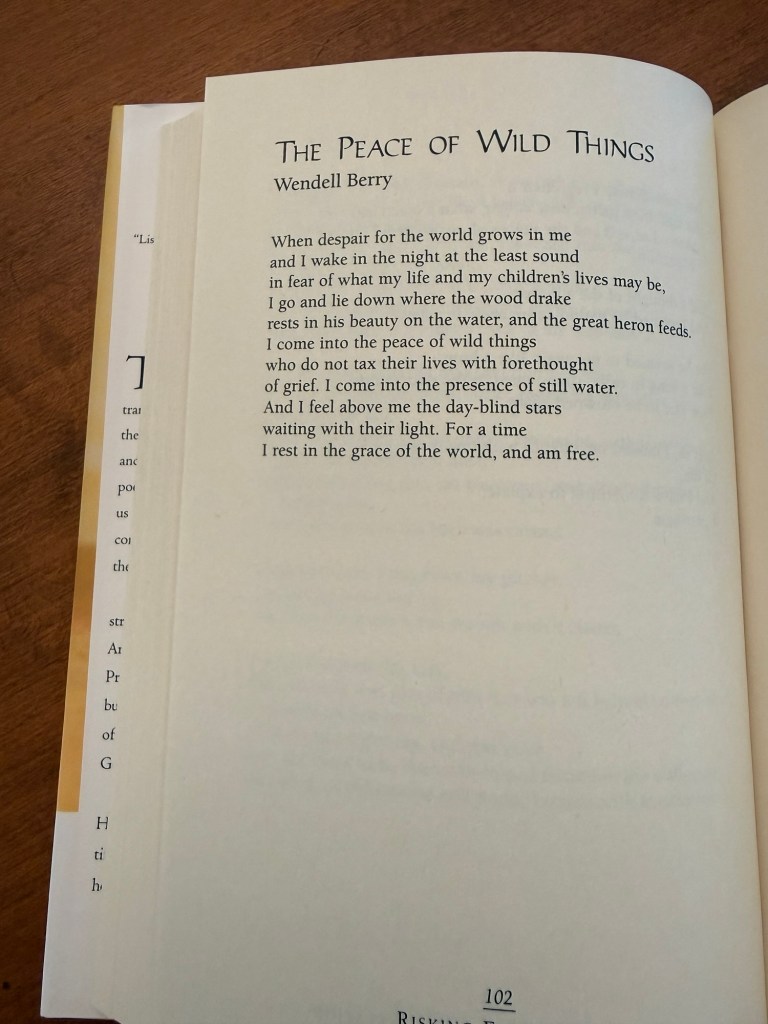
From Risking Everything: 110 Poems of Love and Revelation by Roger Housden

Fourth Quarter: Lock In, Finish Strong

The end is near. Three months are left in the year.

New Year’s resolutions are overrated. They’re so last year.

What if you had old year resolutions? What if you committed to finishing strong so that come December 31, you could feel a meaningful sense of accomplishment about the year that was before pivoting to the year ahead.

So, here’s your chance to use this final lap to sprint to the finish.

What would the December 31 version of you be appreciative that the October 1 you initiated?

What routines, habits, or systems can you lock in for this last quarter?

Me…? I want to be more disciplined with my health and fitness habits.

And I want to post here more regularly.

And I’ve always wanted to memorize some poetry. (I’m rereading Team of Rivals by Doris Kearns Goodwin right now, and I’m delighted and impressed by references to Lincoln reciting so many poems from memory. Greatest human ever. I’ve heard the poet David Whyte on some interviews recently. He rolls out poems, his own and others, from memory, and it seems like a bit of a superpower, as well as a nifty parlor trick and worthwhile self-therapy, to have a small library of poetry available in your mind.)

And I plan to get back to the reading routine that was so solid in the first half of the year.

What about you? What would make this final quarter of the year one worth remembering, worth telling a story about?

Begin now. Finish strong.

On bringing forth what is within you

I sometimes wake up thinking about this line:

“If you bring forth what is within you, what you bring forth will save you; if you do not bring forth what is within you, what you do not bring forth will destroy you.” –Gospel of Thomas

The Gospel of Thomas is, I suppose, the Pete Best of gospels, but this verse is fab on its own.

Maybe it’s when I’m going to sleep, actually, that this thought tugs at me most often. That moment when the distractions fade, when the screens are put away, the noise quietens, and there’s a gap of clarity. Did I just sleepwalk through another day? What is keeping me from giving my best, being my best, bringing forth whatever is real and true and somehow essential within me?

Destroy”, though? Maybe Thomas was being dramatic. Or just poetic enough to emphasize how high the stakes are for living your life timidly or lazily. (Or is laziness really just fear also?)

What is within me that I need to bring forth? It could be this—my attempts at figuring things out by trying to express them.

Or it could be the effort to more consistently make genuine connection with others, to truly see and hear the people around me, rather than slip sliding through human interactions as if we’re all just fine with the default thinness of most conversations.

Or maybe it’s just that I need to more regularly fully occupy my tiny portion of space and time in the universe—to be “bigger than my body gives me credit for”. To uncork the full measure of my life force. To be present. To be awake and aware. To shine.

I know that I sleep better when I’ve been more physically active during the day. My body was put to use, and rest comes easier and is more satisfying. We were made for movement, engineered for exertion. The full use of our physical powers brings a primally satisfying repose.

Similarly, my mind rests easier on days when I’ve employed it to some purpose and been creative and productive, or at least wrestling with some challenging ideas or bit of writing, and not just a passive consumer of glowing bits of transitory nothingness on some screen.

Or if I’ve had just one heartfelt conversation, even one moment of true rapport, the emotional momentum of it can carry me through the day and elevate every other interaction for hours.

“Caution is the devil” said William Blake. The devil is that force, that resistance, that’s keeping you from expressing or doing what only you can say or do.

It doesn’t matter whether there’s even someone to receive something from what you’ve got to give. Bring forth what is within without concern for some sort of “success”.

Your time is short and getting shorter by the day. If not now, when?

Wake up. Be who you are. Give your gift.

A chance to blaze in the sky

The Steve Jobs Archive last week released a book, Make Something Wonderful, that is a collection of the late Apple founder’s writings, speeches, and interviews. There’s a free e-book version, but the web version is especially engaging and beautifully designed.

It turns out Jobs had a habit of sending emails to himself to collect and iterate on his thoughts. The string of emails he sent to himself fleshing out his iconic 2005 Stanford commencement speech is remarkable. His first ideas for the speech were scattershot and mostly uninspiring bits of typical commencement address life advice. But the progression of ideas in his emails to himself starts sharpening over time into the three simple, poignant stories that ended up in the speech.

Seeing this inside peek into his process is a nice reminder to just get my ideas down, even if they’re not very good. Crappy first drafts are the norm—required even. Those first, possibly embarrassingly bad, ideas are the necessary foundation for the potentially good ideas that will never come without having laid out the bad ones first. Stick with it. Mull over it. Keep going. Keep tinkering and polishing.

The obvious delight Jobs had in making “something wonderful” shines throughout this collection of his words. I’m wired that way, too. When I am on a mission to make something wonderful myself, I can get lost in a thrilling sense of absorption. Well, the effort isn’t continually thrilling for me. Dead ends and clunkers and uncertainty often stymie me. But I have to resist letting the frustration of coming up short of my standards derail me. Keep at it, man. The real reward is the path and the process—the making of the thing even more than the thing itself. Hopefully, ultimately, I’ll also have the satisfaction of making something wonderful I’m delighted to give to the world.

There’s this lovely line in the introduction to Make Something Wonderful delivered by Jobs to a group of students:

“You appear, have a chance to blaze in the sky, then you disappear.”

I have appeared, through no effort of my own. Disappearing is inevitable. Taking the “chance to blaze in the sky”… that is the challenge.

Make something wonderful with your life while you can.

Making your kids proud

I often think about this tweet from Adam Grant:

“Too many people spend their lives being dutiful descendants instead of good ancestors. The responsibility of each generation is not to please their predecessors. It’s to improve things for their offspring. It’s more important to make your children proud than your parents proud.”

Having spent most of my career working with college students, I have too often seen young people overly concerned about what their parents want for their lives.

When in doubt, though, maybe default to choices that would make your kids, or future kids, proud. And that might simply be living a life that’s true to yourself, that’s on a track you truly want to be on, as an example for the generation following you.

When I was in elementary school, my dad quit his secure job to start his own business. After a few bumpy years of uncertainty and just barely getting by, he and my mom had their small business in a position to provide a rewarding, if not especially lucrative, career for them both. Years later he told me that his primary motivation in quitting his job and starting his business was to set an example for me and my sister, to show us we didn’t have to settle for a conventional career path, that we should feel free to pursue whatever dreams inspired us.

What is the story your grandchildren will be told about how you lived your life? Honor your parents. But live your life, not theirs.

“What would TSwift do?” and other questions for shaping my character

I was driving my 15-year-old to school a few days ago. She was having a particularly challenging week with final exams and a big project, and she was showing some signs of stress.

I asked her if she had ever seen those WWJD bracelets. “No.”

Did she know what WWJD stands for? “No.”

I explained that it means “What would Jesus do” and that people would wear them as a reminder of how they wanted to act throughout the day when facing challenges. While Jesus is certainly a good choice, I encouraged her to think of any role models in her life that she could be inspired by and keep them in mind to help her respond to hard things as she went through a tough day.

I explained that as a kid I was drawn to the biographies section of my school library. There were short biographies of a wide range of historical figures, and I couldn’t get enough of them. From MLK to Lincoln to George Washington Carver (the peanut guy) to Hannibal (the general with the elephants!), the heroes of those little books fueled my imagination and became role models. Biographies continued to be my primary reading material throughout my teenage and early adult years as I was trying to piece together how to be an adult.

I do think all those biographies wired in me some baseline standards as well as aspirational goals of how I want to think and act. While I don’t recall literally asking myself “What would Lincoln do?” (I’ve read a lot of Lincoln biographies), my subconscious mind is likely shaped by all those role models I’ve absorbed. Beyond reading, though, I know I’ve also soaked in character traits and mannerisms from, of course, my family and friends and coworkers and bosses and public figures and celebrities and even fictional characters. As a young man I aspired to become a kind of synthesis of Abraham Lincoln, David Letterman, Captain Picard, and Indiana Jones. I have come far short of that potentially epic hybrid of heroes.

I still often find myself automatically mimicking the way my dad stands or using one of my mom’s expressions or telling a funny line reflexively aiming for a hint of Obama’s wry humor. Even the way I over-enthusiastically greet someone appearing in my office door by saying their name with an exclamation point is a direct copy of one of my first coworkers from thirty-plus years ago. We are all products of our influences, and we can choose which influences we absorb by the books we read and the media we consume and the people we spend time with. You can be intentional about shaping your character by studying the kinds of characters you aspire to be like.

After monologuing a much shorter version of this line of thinking with my daughter on the way to school, she seemed to appreciate my point or was at least willing to humor me. Knowing she’s a Taylor Swift fan, I suggested that maybe her mantra for the tough day ahead could be: “What would Taylor do?” She pondered that for a moment, then came back with “How about WWRGD?”

WWRGD?

“What would Rory Gilmore do?” Ah, of course. Brilliant! Rory Gilmore of The Gilmore Girls TV show was an ace student who got into Yale, so, naturally, channeling Rory would be the move on exam day. She was quick to add that she would be thinking of high school Rory, not college Rory, who she thought made some poor decisions in that particular era of the show. This level of discernment was impressive and amusing and had me driving away from the school that morning feeling confident she would be just fine.

Lady Bird: Attention is love

This scene from the movie Lady Bird shows the main character, an angsty teenager eager to get out of high school and get out of town, being called on her supposed disdain for her hometown:

“You clearly love Sacramento.”

“I do?”

“You write about Sacramento so affectionately and with such care.”

“Well, I was just describing it.

“Well, it comes across as love.”

“Sure, I guess I pay attention.”

“Don’t you think maybe they are the same thing? Love and attention?”

I need to be intentional about giving my full attention to whom and what I love. Too often I have moved through days on a sort of autopilot, with my attention consumed by distractions and trivialities.

We are surrounded by wonders and trudge on by without notice. An occasional pause for reverent astonishment would be a potent tonic.

And maybe I should take note of what I truly pay attention to consistently and see if there are hidden objects of affection I’ve been oblivious to.

In an increasingly distracted world, paying attention is a powerful gift and the ultimate expression of love.

Conan O’Brien on the delight of eventually being forgotten

Conan O’Brien on being remembered, or not:

I had a great conversation with Albert Brooks once. When I met him for the first time, I was kind of stammering. I said, you make movies, they live on forever. I just do these late-night shows, they get lost, they’re never seen again and who cares? And he looked at me and he said, [Albert Brooks voice] “What are you talking about? None of it matters.” None of it matters? “No, that’s the secret. In 1940, people said Clark Gable is the face of the 20th Century. Who [expletive] thinks about Clark Gable? It doesn’t matter. You’ll be forgotten. I’ll be forgotten. We’ll all be forgotten.” It’s so funny because you’d think that would depress me. I was walking on air after that.

We all want to be something or do something that endures, that leaves a legacy, that outlives our life. But in the big scheme of things, we are a mere blip. We take up very little space, and our lives twinkle in and out of time in a flash. I am one in seven billion. I will be gone and forgotten soon. So will you.

So, the pressure is off. I don’t need to make a dent in the universe in an effort to be remembered. I should take my shot at making a dent, though, simply because it delights me to give it a go. I’m alive and living in a splendid mystery, so why not play the game I’ve been dropped into?

“You are someone amazing. You are nobody special. The challenge is to hold onto both of those truths at the same time.” –Allison Vesterfelt

Comfortably dumb

“It is a far cry from fleeing evil and pain to what the sages say, that among equally good actions the most desirable to do is the one in which there is most trouble.” –Montaigne

“There is most joy in virtue when it’s hardest won.” –Lucan

The hardest thing about doing hard things is in the imagining of how hard it will be before you actually do it. Having done a hard thing, though, is immensely satisfying.

This might be a guide for good decision-making. Considering two options, the one that seems hardest, that elicits more trepidation or resistance, might be the more interesting, more rewarding path.

At the end of a day that’s been especially satisfying for me, it’s usually because I’ve overcome some resistance to do something that required a bit of courage or summoned some effort.

Even barely fulfilling a fraction of my potential is going to mean choosing discomfort regularly. But I know the reward for consistently pivoting toward challenges and away from numbing comfort will be more satisfying than the mindless, empty pleasure of the path of least resistance.

“Hard choices, easy life. Easy choices, hard life.” –Jerzy Gregorak

Curious idiot

“The secret to being good at anything is to approach it like a curious idiot, rather than a know-it-all genius.” –Mike Monteiro

He who thinks he knows, doesn’t know. He who knows he doesn’t know, knows.

I need to regularly pause and remind myself just how little I know. When inclined to judge or label or assert my clever hot take, I need to stop myself and get curious instead.

When I’ve done a thing countless times and think I’ve got it down, I should check myself and try approaching it with a beginner’s mind.

“In the beginner’s mind there are many possibilities. In the expert’s mind there are few.” –Thich Nhat Hanh

“I don’t know” is a surprisingly strong mindset and, as an honest response to a question, a potential launching point to possibilities not yet imagined.

Curious idiot: My aspirational default mode.

Embrace the mess

“Almost everyone is screwed up, broken, clingy, scared, and yet designed for joy. Even (or especially) people who seem to have it more or less together are more like the rest of us than you would believe. I try not to compare my insides to their outsides, because this makes me much worse than I already am, and if I get to know them, they turn out to have plenty of irritability and shadow of their own. Besides, those few people who aren’t a mess are probably good for about twenty minutes of dinner conversation. This is good news, that almost everyone is petty, narcissistic, secretly insecure, and in it for themselves, because a few of the funny ones may actually long to be friends with you and me. They can be real with us, the greatest relief. As we develop love, appreciation, and forgiveness for others over time, we may accidentally develop those things toward ourselves, too.” –Anne Lamott


Everyone is completely winging it. I am. You are, too.

That’s either wonderfully reassuring or absolutely terrifying. Or both.

I have often felt I can’t let others know I don’t have things figured out. I don’t want to let anyone down who’s counting on me to be wise or strong. But allowing others to glimpse our own uncertainty and weakness is a gift that enriches both. Vulnerability leads to trust and authentic connection.

I need to embrace the mess and surf the chaos and give grace to everyone, because everyone is a mess just like me.

Back at it

There was a time when I posted something to this site every day. That daily challenge I set for myself added a little tension to each day, but it was also invigorating and rewarding. I would wake up each morning knowing I expected to capture an idea and put it out into the world. I would be on a daily hunt for a spark, for a thought worth exploring and worth sharing.

Some nights I would scramble before I went to bed to post a quote, a photo, a link, anything just to keep the streak going. And I had no shame in doing just barely enough to take credit for writing something every day. Just keep going. Just keep posting. Long streaks of forgettable or cringeworthy posts would be interrupted occasionally by something pretty good, something I was actually proud of. And I wouldn’t have gotten to the few good ones without all the mediocre attempts.

Committing to posting something daily put my antennae up throughout the day in a way that’s been missing since I’ve stopped writing regularly.

What can I ever write, though, that would be of lasting value? Who am I to write with any sense of authority? What do I know anyway? And who even cares? Eventually, those questions derailed me. It was just easier not to make the attempt.

Well, I do know that just the act of writing something down helps me to better understand myself. And writing, as frustratingly difficult as it is, can lead to rare, refreshing moments of clarity and the occasional deep satisfaction of crafting a phrase or illuminating a thought that delights me. Plus, there’s the double bonus of possibly writing something that might be meaningful to someone else, even if only by accident.

How can I know what I think until I see what I say?

The best way to understand something is to try to express it.

I know all this is true, but I have been resisting for years now the hard work and messy self-examination regular writing requires of me.

But I’m going to get back at it, even when—especially when—I just don’t feel like it. (Writing the first sentence is the hardest part. Once I put something down, no matter how embarrassingly bad it is, I tend to keep going. And it tends to get better.) I just know that being intentional about writing regularly has been good for my soul. “Not feeling like it” is a puny excuse that prevents an infinity of possible good things from ever happening.

I’m not promising daily posts. I’m not trying to start a new streak, knowing that the pressure of keeping a streak alive just adds to the resistance to even start. I’ll aim for dailyish.

It’s been too easy to default to consuming rather than creating. But I won’t look back some day and wish that I had scrolled Twitter more often or watched more YouTube videos. But I already regret not writing more. I regret not regularly attempting to make something meaningful or delightful, something that helps me make a little more sense of the world and might help someone else, too.

So, I’ll be back at it. Right here. Dailyish.

My John Lewis story

John Lewis made his mark by getting into what he called “good trouble”. He sat in the front row when told to go to the back. He kept going forward when told to stop. He defied authority when that authority defied the promise of justice and equal opportunity. His boldness and courage in the pursuit of a more just society helped move our nation forward.

I first saw him in person in a crowded Congressional committee hearing room in 1987. He had just been elected to his first term in Congress and was the talk of Capitol Hill for his stunning upset victory over Julian Bond in the Democratic primary. Everyone expected Bond to win that seat. He was handsome and charismatic and was anointed as a rising political superstar by the pundits. During that campaign Lewis was rightly lauded as a civil rights hero, but he was considered unpolished and not telegenic enough for the hip political crowd. But he won and started a career in Congress that would span more than three decades.

I was a new Congressional Legislative Assistant that winter, working on the staff of another Georgia Congressman, Buddy Darden. Buddy was a great boss and became a mentor for me. He had entrusted me with managing his assignments on the House Interior Committee. That morning when I first saw Mr. Lewis I was seated behind my boss in the staff section of the National Parks and Public Lands Subcommittee hearing room.

I thought I was something. I was 22-years-old and had a Congressional staff ID. I could come and go throughout the Capitol complex and enter committee hearings through the restricted entrance with the members of Congress.

I don’t remember what issue the committee was taking up, but the hearing that day must have been a big deal because the room was packed. There was standing room only, with people jammed all the way against the door at the back. Shortly after the hearing had begun, Mr. Vento from Minnesota, the subcommittee chairman, stopped the proceedings after noticing that Mr. Lewis, the newest member of the subcommittee, was standing in the very back of the room behind the crowd of lobbyists and reporters who couldn’t get a seat.

Seeming a bit flummoxed to see a subcommittee member quietly standing with the overflow crowd in his own hearing room, Mr. Vento called to Mr. Lewis to come through the crowd and take his seat on the dais with the subcommittee. The people standing in the back, realizing what was going on, parted to make way for him to come through to the front to join the hearing.

It was clear that Mr. Lewis did not want to impose or intrude, to push through to his rightful place. He was new enough to not know to use the “Members Only” entrance behind the committee table. His reluctance to exert his authority and his obvious lack of self-importance was a bracing and refreshing contrast to what I had already noticed in so many members of Congress in my short time on the Hill.

This man who had famously defied authority for the sake of those without power, was now the one with power. But here he was, the epitome of humility and gentleness in a place that seems to run on the fuel of ego.

That moment in the hearing room has remained with me. Over the next four years of my time working on Capitol Hill I got to see Mr. Lewis in action frequently. He eventually discovered the members entrance, but he never ceased to be kind and never acted like the big deal everyone knew him to be.

(I got to drive him to the airport once when my boss found out he was going to take the subway there one Saturday, and my boss offered that I could take him instead. Mr. Lewis didn’t want to impose on any of his staff on the weekend, but I was thrilled to have the honor to drive him.)

Since his death last week, I have seen many similar stories shared about Mr. Lewis. His strength of character, his courage, and his boldness in noble causes mark him as a true American hero and convict me and challenge me to be better and do more. But his gentle way and humble kindness made just as much of an impression on me.

I’ve found much value in having icons of greatness to guide my thinking and actions. Lincoln was my first childhood hero, and I have favored biography and history in my reading to cull what wisdom I could from lives of distinction. It’s good to have your own Mt. Rushmore of noble men and women carved into your consciousness, to remind you of the kind of character you want to possess. That moment in the hearing room with John Lewis continues to remind me of the humility that marks the bearing of those who are truly great.

I am thankful for the brief, ennobling encounters I had with Mr. Lewis and for the large difference his life has made on our nation and in the cause of human decency everywhere.

It’s your life

This:

“It’s your life — but only if you make it so. The standards by which you live must be your own standards, your own values, your own convictions in regard to what is right and wrong, what is true and false, what is important and what is trivial. When you adopt the standards and the values of someone else or a community or a pressure group, you surrender your own integrity. You become, to the extent of your surrender, less of a human being.” –Eleanor Roosevelt

And this:

“to be nobody but yourself — in a world which is doing its best, night and day, to make you like everybody else — means to fight the hardest battle which any human being can fight, and never stop fighting.” –e.e. cummings


Podcast SOS: Three sure things

I got a text today from a student on a road trip out west with some of his friends:

“EJ! Currently on a road trip across the US and wanted to know if you had any podcast suggestions while we are driving!”

I get this kind of request for podcast recommendations regularly.

I sent him these three podcast episodes:

Malcom Gladwell’s Revisionist History – The Big Man Can’t Shoot

The Art of Manliness – Becoming a Digital Minimalist

The Knowledge Project with Shane Parrish – The Angel Philosopher

Gladwell’s podcast is excellent throughout—provocative and compellingly counterintuitive. But that episode about free-throw shooting in basketball is the one that first got me hooked.

The Art of Manliness’s interview with the author Cal Newport is a solid introduction to his call for culling out the digital distractions currently overwhelming most of us.

And Shane Parrish’s interview with Naval Ravikant is full of nuggets of deep wisdom and practical life advice.

My podcast listening usually takes place while I’m driving or while walking my dog. I just don’t listen to the radio unless my kids take over in the car. Dad problems.

(Lately, though, podcasts have been shelved while I’ve listened to the audiobook versions of Robert Caro’s third and fourth volumes on LBJ: Master of the Senate and The Passage of Power. I’ve never read/listened to any book quite like these. This is the pinnacle of biography, at least from what I’ve read. The level of detail is extraordinary, but it’s not at the expense of truly riveting storytelling. Highly recommend.)

Raise the aspirations of others

Tyler Cowen is an economics professor and a prolific blogger at Marginal Revolution. He’s an A-list follow with multiple blog posts every day, and he’s a voracious reader who has pointed me to a lot of insightful articles and books.

I love this thought from Cowen: “At critical moments in time, you can raise the aspirations of other people significantly, especially when they are relatively young, simply by suggesting they do something better or more ambitious than what they might have in mind”

I have appreciated those who have seen more in me than I thought possible, who summoned something greater from me by their expectations.

And I have delighted in those moments when I have been able to awaken a new possibility in someone else. That’s a calling that keeps me going.

What if you looked for opportunities to heighten the trajectory of someone who would otherwise settle for a lower arc?

What if you regularly asked “What if…?”

There could be more people more fully fulfilling their potential with even a slight course correction thanks to your interest and curiosity and encouragement.

Awaken possibility.

A belief in the blood

“My great religion is a belief in the blood, the flesh, as being wiser than the intellect. We can go wrong in our minds. But what our blood feels and believes and says, is always true. The intellect is only a bit and a bridle. What do I care about knowledge? All I want is to answer to my blood, direct, without fribbling intervention of mind, or moral, or what not.” –D. H. Lawrence

This reminds me of Kubrick’s “The truth of a thing is the feel of it, not the think of it.”

“We can go wrong in our minds.”

Indeed. Just read the news.

Undoubtedly, our age is more disconnected than any before it from the physical—from blood and flesh and the feel of sunshine on skin and feet on actual ground. And face-to-face conversation. And taste and smell and the delicate sounds that get lost in the wash of noise emanating from ubiquitous devices.

There’s a knowing that comes from the body that our long-ago ancestors probably were in touch with in a way we never will be.

Not that I want to quit feeding my mind. But I know I need to more fully inhabit more often my flesh and blood.

And feel as well as think.

Lines of excellence

In a press conference just weeks before his death, President Kennedy was asked by a reporter if he liked his job. Kennedy’s response:

“Well, I find the work rewarding. Whether I am going to stay and what my intentions are and all the rest, it seems to me it is still a good many, many months away. But as far as the job of President goes, it is rewarding. And I have given before to this group the definition of happiness of the Greeks, and I will define it again: it is full use of your powers along lines of excellence. I find, therefore, the Presidency provides some happiness.”

The “full use of your powers along lines of excellence”.

Powers?

I’m late to the Marvel Cinematic Universe party, and the last few films have had me wondering who many of the superheroes are and what exactly are their powers.

Well, what exactly are your powers? I’m not completely sure what mine are.

Whatever they are, I know I’m not putting them to their “full use”.

Passive mode prevails over active mode way too often and the easy distractions of this age make it even harder to muster the will, to fully tap into my powers.

The looming regret just around the corner will be that of unfulfilled potential and unlived life. Powers wasted, left dormant and unsummoned.

Snap out of it, this half-slumber that most of us are muddling through. Fully use your gifts. Make them true gifts that offer value beyond yourself.

And be awesome in the process. Aim for excellence. Be discontent with just good enough.

Full use of your powers along lines of excellence.

“To be what we are, and to become what we are capable of becoming, is the only end of life.” –Robert Louis Stevenson